
Process Cartography A Graphical Approach to Process Definition



- Slides: 26
Process Cartography A Graphical Approach to Process Definition Presented by Rudy Gamberini Copyright 2009 by Process Performance LLC
Quiz CMM Capability Maturity Model PAL Process Asset Library BHB Big Honkin Binder Copyright 2009 by Process Performance LLC
What is Process Cartography? Process - a series of activities that produce a desired result or product Cartography - the art of map making Copyright 2009 by Process Performance LLC
Real Men Don’t Use Maps Initiating a process improvement program without having a clear understanding of your existing development process is like taking a car trip, to a new destination, without using a map to chart your course. You would eventually succeed but the efficiency of your trip would be questionable. Copyright 2009 by Process Performance LLC
Sure Signs You are Lost • Don’t know where to begin to initiate a process improvement program. • Everyone has a different opinion about what process is actually being followed. • Your auditors are given three different names for the same document. • You tried to collect process metrics but the data was garbage. Copyright 2009 by Process Performance LLC
Sure Signs You are Lost • New hires are trained in fifteen minutes, using your white-board with lots pretty color, interesting lines, boxes, arrows, and clouds. • Your development staff is never quite sure about anything. • Project repositories look more like a maze for information hiding than an organized library of project information. Copyright 2009 by Process Performance LLC
Key Features of Maps • Enable efficient navigation of new territory • Utilize minimal graphical symbols to get the information across • Learning curve measured in minutes • Convey a lot of information very efficiently Copyright 2009 by Process Performance LLC
Fundamentals of Maps • • • Area specific Utilize landmarks to support orientation Simple symbols, few symbols (legend) Unique graphics (distinguishable, colors) Form and function (map looks like the area it represents) Copyright 2009 by Process Performance LLC
Your Mission You have been dropped off in the woods with a compass, notebook, and a pencil. You must find your way out and be able to lead someone back to you original starting point. What would you do? Copyright 2009 by Process Performance LLC
Getting Started Identifying the Landmarks Map making begins by identifying the area being mapped and surveying it for identifiable landmarks. Area equates to Lifecycle Landmarks equates to Artifacts (AKA Work Products) Copyright 2009 by Process Performance LLC
Lifecycle Phases Copyright 2009 by Process Performance LLC
Phase-Artifact Table Copyright 2009 by Process Performance LLC
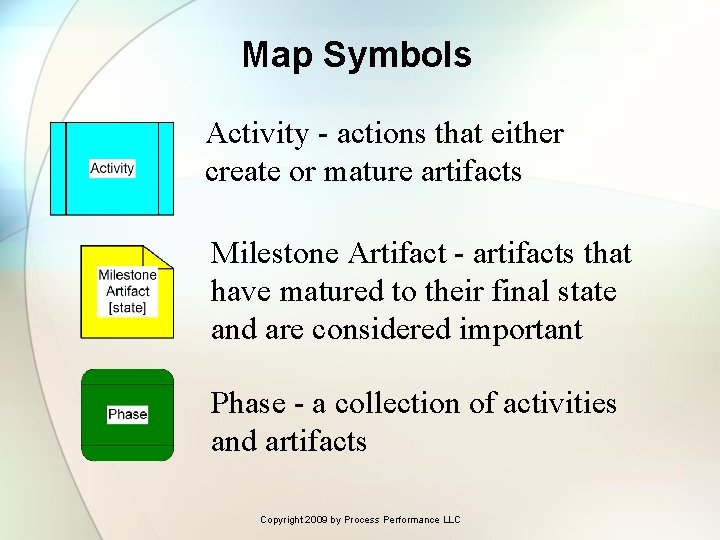
Map Symbols Activity - actions that either create or mature artifacts Milestone Artifact - artifacts that have matured to their final state and are considered important Phase - a collection of activities and artifacts Copyright 2009 by Process Performance LLC
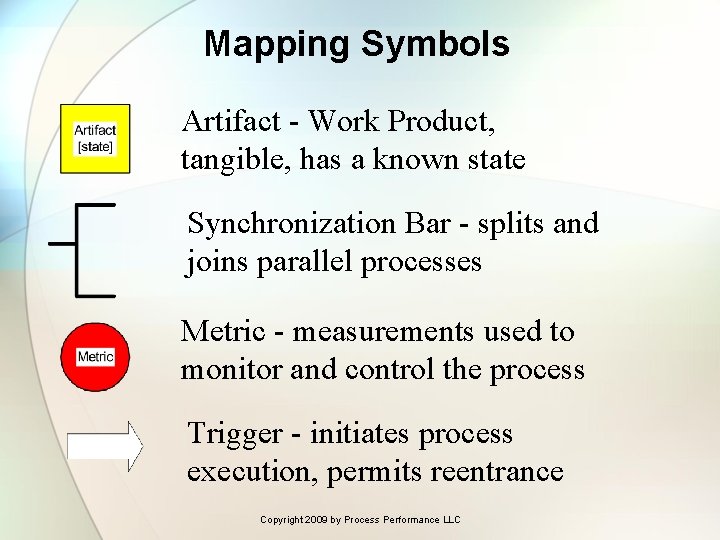
Mapping Symbols Artifact - Work Product, tangible, has a known state Synchronization Bar - splits and joins parallel processes Metric - measurements used to monitor and control the process Trigger - initiates process execution, permits reentrance Copyright 2009 by Process Performance LLC
Phase-Artifact Map Artifact Table Copyright 2009 by Process Performance LLC
Putting it all together Copyright 2009 by Process Performance LLC
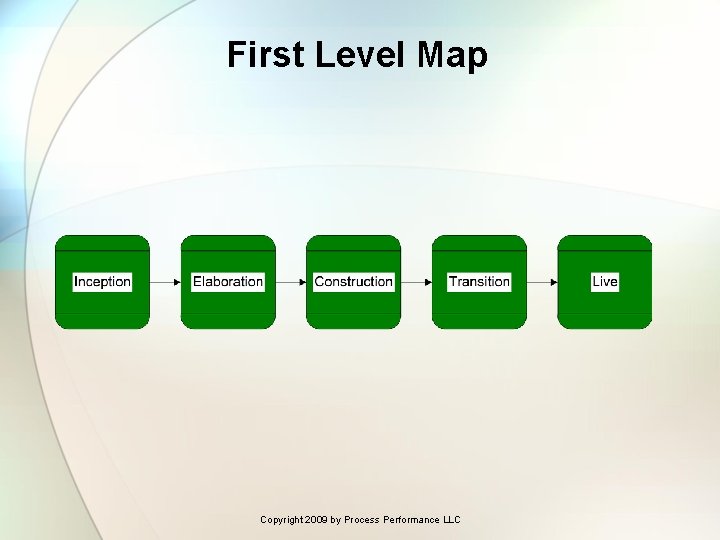
First Level Map Copyright 2009 by Process Performance LLC
Exit Criteria by Phase Copyright 2009 by Process Performance LLC
Map Expansion Copyright 2009 by Process Performance LLC
Process Pattern Copyright 2009 by Process Performance LLC
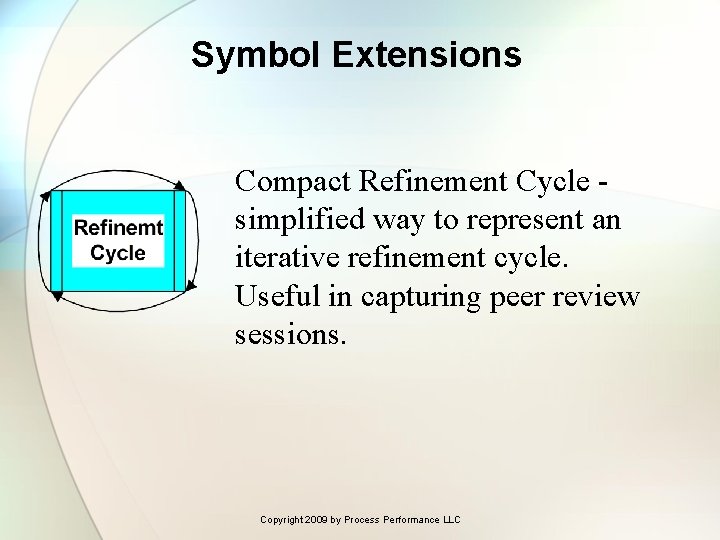
Symbol Extensions Compact Refinement Cycle simplified way to represent an iterative refinement cycle. Useful in capturing peer review sessions. Copyright 2009 by Process Performance LLC
Demo Copyright 2009 by Process Performance LLC
Key Learning Points • Maps are only valuable if they cover the area you desire to explore. • An organization’s development practices are unique and therefore require their own maps. • Using some else’s map is like navigating NY with a map of Chicago. Copyright 2009 by Process Performance LLC
Key Learning Points cont. • For maps to be useful the symbols must be few in number and visually unique. • Landmarks are the most important part of the map. • If your process map is getting too complex it is probably at too low a level of detail. Copyright 2009 by Process Performance LLC
Early Adopters • • Boeing Space Division Xerox Nokia US Army (CMM level 3) US Air Force Mountside Software (Netherlands) REUTERS (globally deployed) Copyright 2009 by Process Performance LLC
For Additional Information: rudy@processperformanceshop. c om Copyright 2009 by Process Performance LLC