
Process Capability Process capability For Variables The 6
Process Capability • Process capability – For Variables • The 6 versus specification limits – For attributes • Pareto chart • Cause and effect diagram 1
Process Capability • There is a difference between a process conforming to the specifications and a process performing within statistical limits • A process in statistical control will not necessarily meet specifications as established by the customer • The control limits on the charts represent what the process is capable of producing 2
Process Capability • Specifications are set by the customer. These are the “wishes. ” • Control limits are obtained by applying statistical rules on the data generated by the process. These are the “reality. ” • Process capability refers to the ability of a process to meet the specifications set by the customer or designer 3
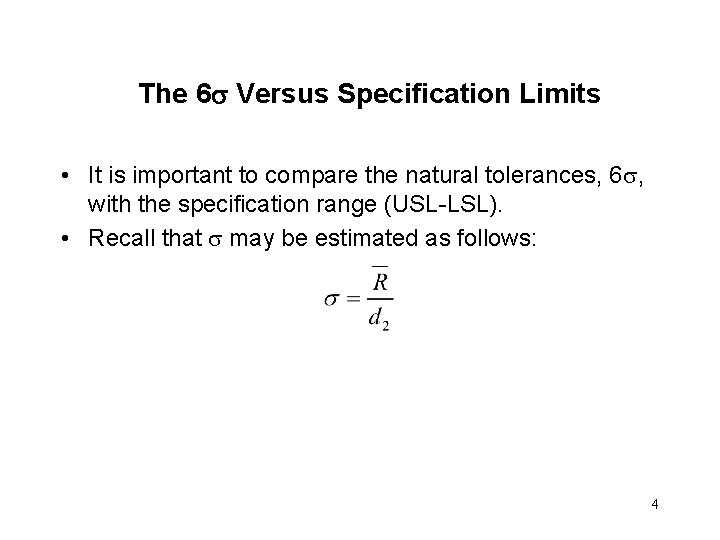
The 6 Versus Specification Limits • It is important to compare the natural tolerances, 6 , with the specification range (USL-LSL). • Recall that may be estimated as follows: 4
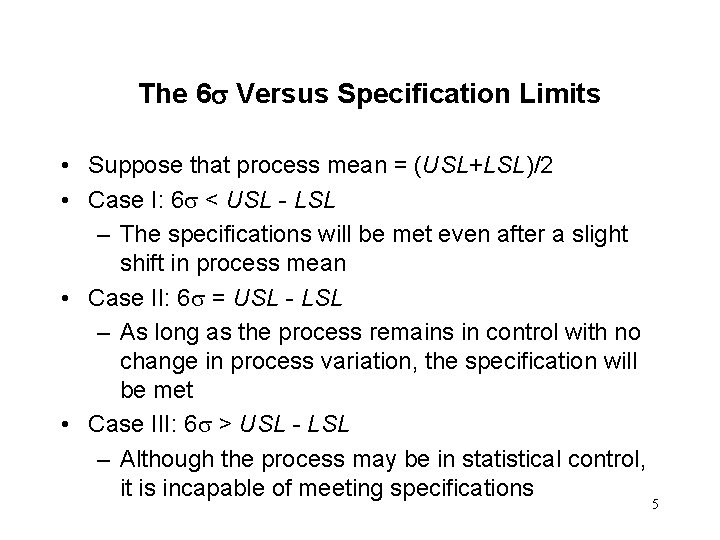
The 6 Versus Specification Limits • Suppose that process mean = (USL+LSL)/2 • Case I: 6 < USL - LSL – The specifications will be met even after a slight shift in process mean • Case II: 6 = USL - LSL – As long as the process remains in control with no change in process variation, the specification will be met • Case III: 6 > USL - LSL – Although the process may be in statistical control, it is incapable of meeting specifications 5
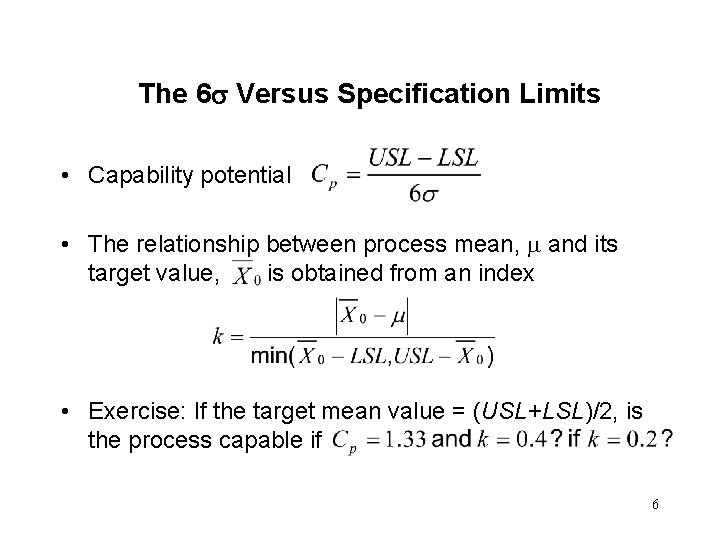
The 6 Versus Specification Limits • Capability potential • The relationship between process mean, and its target value, is obtained from an index • Exercise: If the target mean value = (USL+LSL)/2, is the process capable if 6
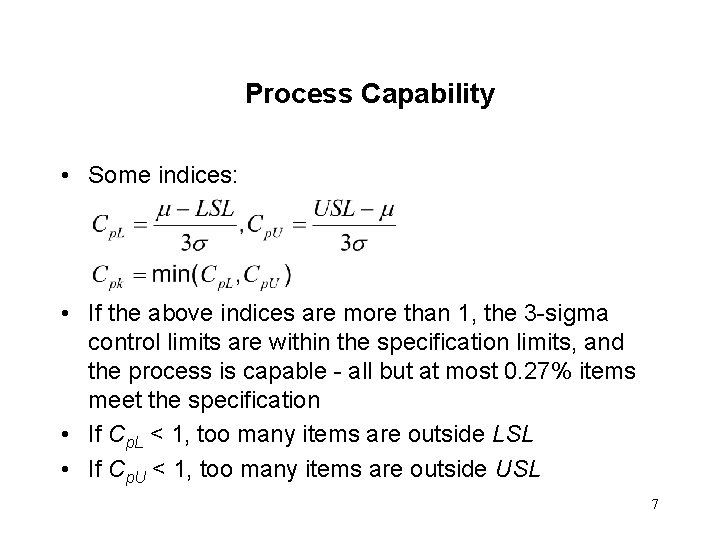
Process Capability • Some indices: • If the above indices are more than 1, the 3 -sigma control limits are within the specification limits, and the process is capable - all but at most 0. 27% items meet the specification • If Cp. L < 1, too many items are outside LSL • If Cp. U < 1, too many items are outside USL 7
The 6 Versus Specification Limits • Sometimes, only one of Cp. L and Cp. U may be relevant e. g. , testing for steel hardness • If the process is not capable, actions may be taken to adjust the – process mean – variation – specifications 8
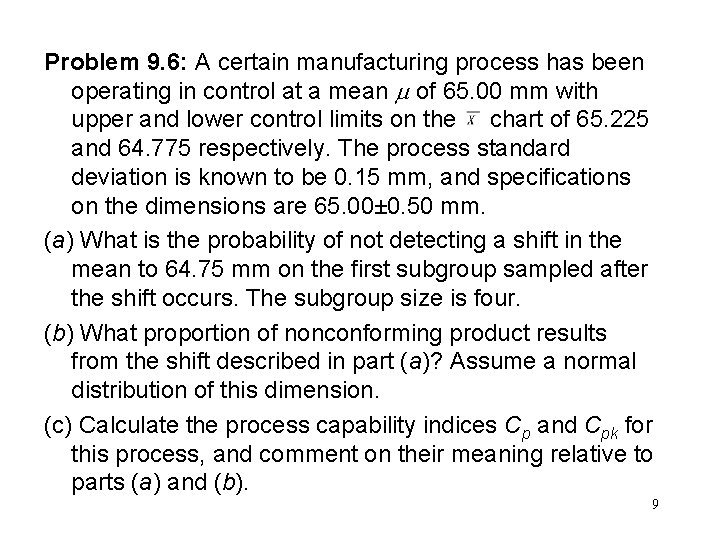
Problem 9. 6: A certain manufacturing process has been operating in control at a mean of 65. 00 mm with upper and lower control limits on the chart of 65. 225 and 64. 775 respectively. The process standard deviation is known to be 0. 15 mm, and specifications on the dimensions are 65. 00± 0. 50 mm. (a) What is the probability of not detecting a shift in the mean to 64. 75 mm on the first subgroup sampled after the shift occurs. The subgroup size is four. (b) What proportion of nonconforming product results from the shift described in part (a)? Assume a normal distribution of this dimension. (c) Calculate the process capability indices Cp and Cpk for this process, and comment on their meaning relative to parts (a) and (b). 9
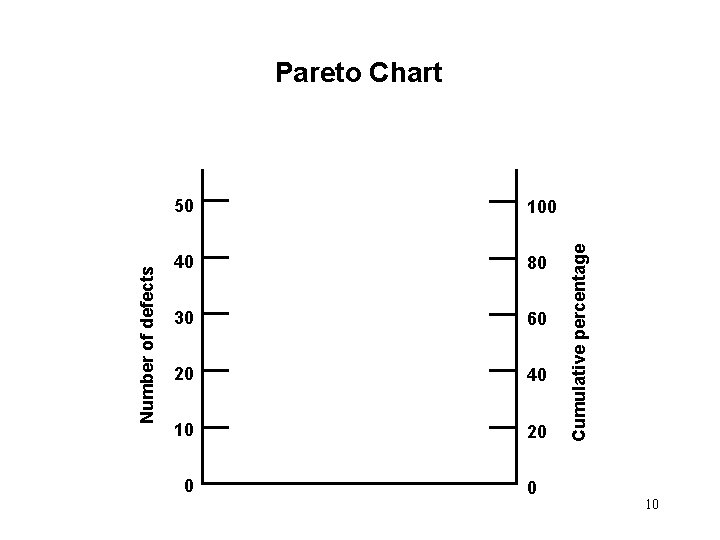
Number of defects 50 100 40 80 30 60 20 40 10 20 0 0 Cumulative percentage Pareto Chart 10
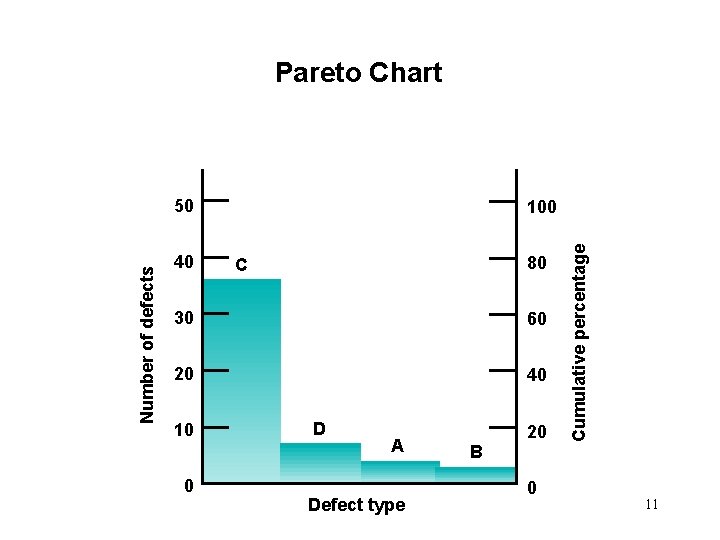
Pareto Chart 40 100 80 C 30 60 20 40 10 0 D A Defect type 20 B 0 Cumulative percentage Number of defects 50 11
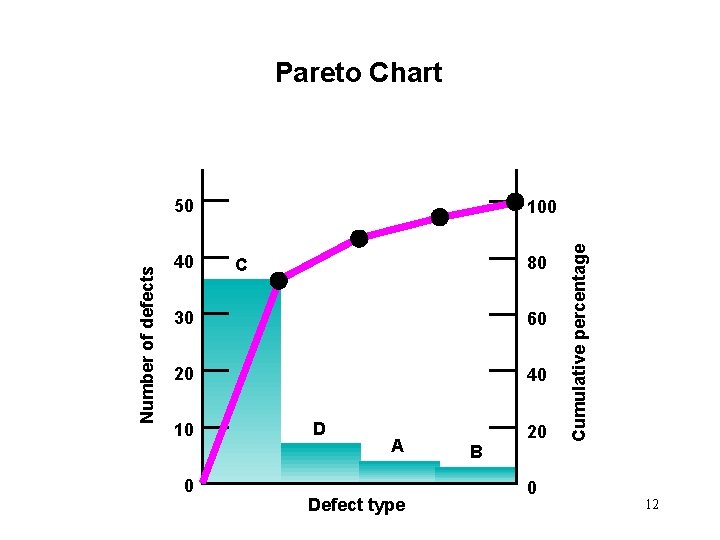
Pareto Chart 40 100 80 C 30 60 20 40 10 0 D A Defect type 20 B 0 Cumulative percentage Number of defects 50 12
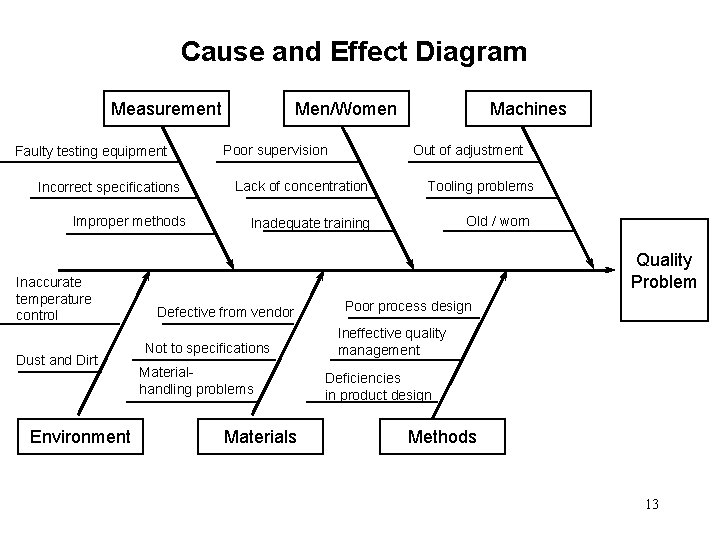
Cause and Effect Diagram Measurement Faulty testing equipment Incorrect specifications Improper methods Inaccurate temperature control Dust and Dirt Environment Men/Women Machines Out of adjustment Poor supervision Lack of concentration Tooling problems Old / worn Inadequate training Quality Problem Defective from vendor Not to specifications Materialhandling problems Materials Poor process design Ineffective quality management Deficiencies in product design Methods 13
Cause and Effect Diagram • Common categories of problems in manufacturing – 5 M’s and an E • Machines, methods, materials, men/women, measurement and environment • Common categories of problems in service – 3 P’s and an E • Procedures, policies, people and equipment 14
Reading and Exercises • Chapter 9: – pp. 324 -330 (Section 9. 2) – 9. 1, 9. 5 15
- Slides: 15