
Process Analysis HCS 150 Unit 4 1 This

- Slides: 37
Process Analysis HCS 150 Unit 4 -1 This work is licensed under a Creative Commons Attribution-Non. Commercial-Share. Alike 4. 0 International License. Based on a work at https: //www. healthit. gov/. This workforce product was funded by a grant awarded by the U. S. Department of Labor's Employment and Training Administration. The product was created by the grantee and does not necessarily reflect the official position of the U. S. Department of Labor. The Department of Labor makes no guarantees, warranties, or assurances of any kind, express or implied, with respect to such information, including any information on linked sites and including, but not limited to, accuracy 1 of the information or its completeness, timeliness, usefulness, adequacy, continued availability, or ownership.
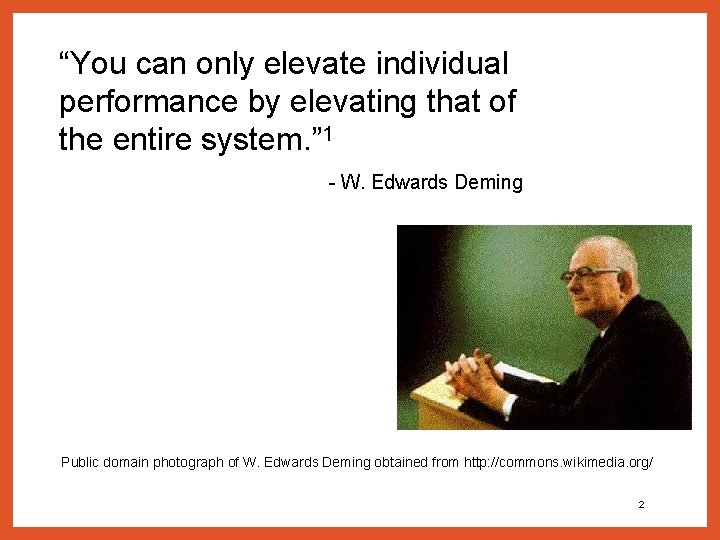
“You can only elevate individual performance by elevating that of the entire system. ” 1 - W. Edwards Deming Public domain photograph of W. Edwards Deming obtained from http: //commons. wikimedia. org/ 2
Definitions: • Process Analysis • Process Improvement 3
Process • Series of actions or operations conducing to an end • Continuous operation or treatment 4
Process Analysis • Understanding process elements and the relationships between them • As well as identification of opportunities for improvement 5
Process Improvement Making changes to a process to make it better in some way 6
Process Analysis Skills • At ease with data and data system concepts • At ease with clinical workflow concepts • Able to communicate such concepts • Able to identify problem areas 7
Framework for Process Analysis • Form an objective picture of the process, process variations and exceptions • Translate this information into a list of Electronic Medical Record functions needed at a clinic 8
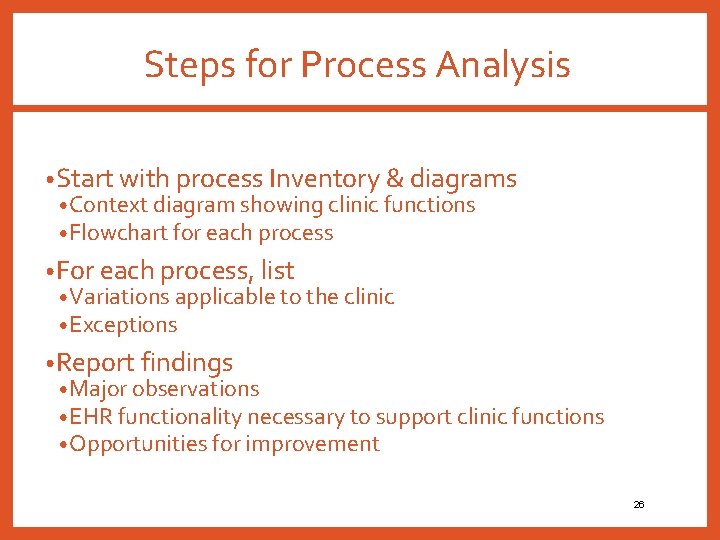
Steps for Process Analysis • Start with process inventory and diagrams • Context diagram showing clinic functions • Flowchart for each process • For each process, list • Variations applicable to the clinic • Exceptions • Report findings • Major observations • EHR functionality necessary to support clinic functions • Opportunities for improvement 9
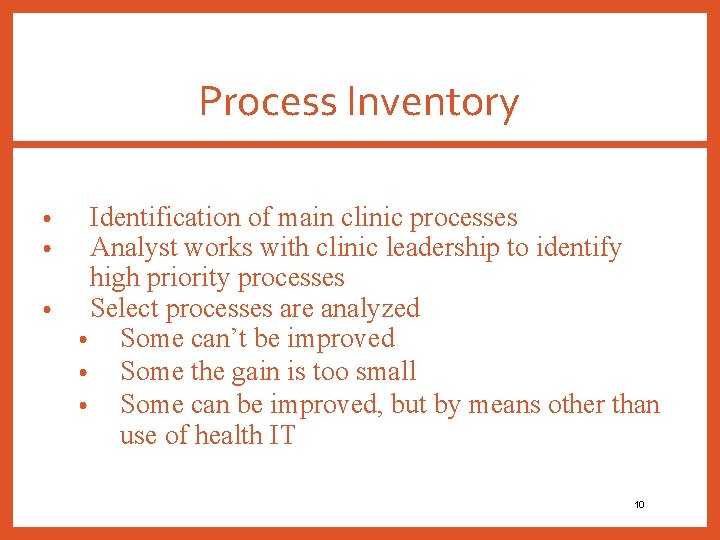
Process Inventory Identification of main clinic processes Analyst works with clinic leadership to identify high priority processes • Select processes are analyzed • Some can’t be improved • Some the gain is too small • Some can be improved, but by means other than use of health IT • • 10
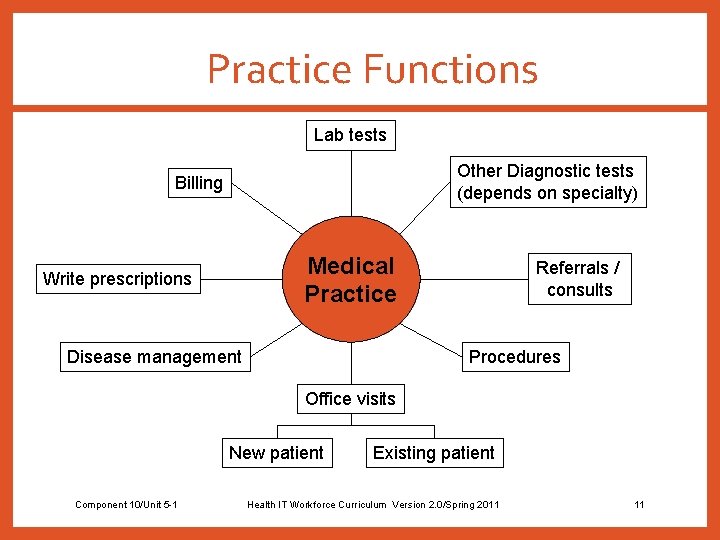
Practice Functions Lab tests Other Diagnostic tests (depends on specialty) Billing Medical Practice Write prescriptions Disease management Referrals / consults Procedures Office visits New patient Component 10/Unit 5 -1 Existing patient Health IT Workforce Curriculum Version 2. 0/Spring 2011 11
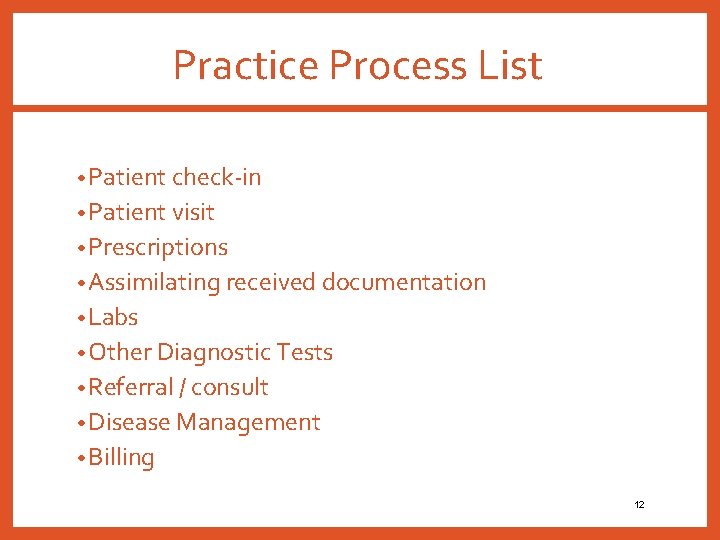
Practice Process List • Patient check-in • Patient visit • Prescriptions • Assimilating received documentation • Labs • Other Diagnostic Tests • Referral / consult • Disease Management • Billing 12
Process Inventory • List of the main processes used by a practice • Specifies common variations and exceptions 13
Process Variations and Exceptions Variations: processes used by the clinic Exceptions: errors or common odd things that occur during the process 14
Process Variations and Exceptions Variations: Processes used by the clinic Exceptions: Errors or common odd things that com up during the process. 15
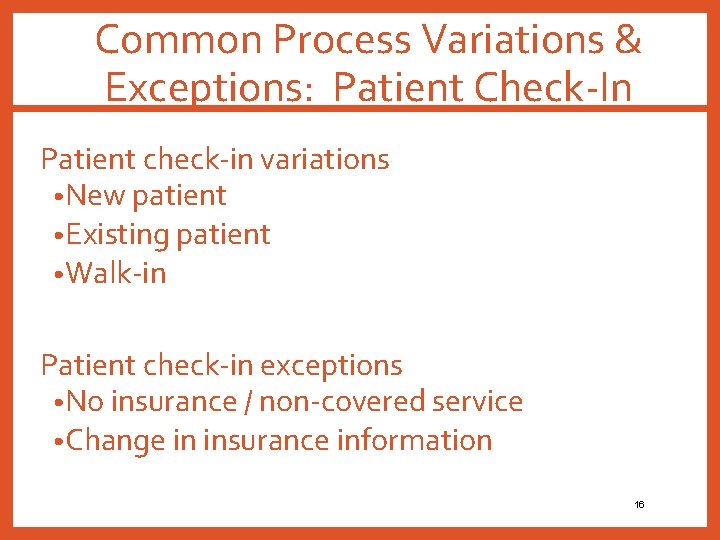
Common Process Variations & Exceptions: Patient Check-In Patient check-in variations • New patient • Existing patient • Walk-in Patient check-in exceptions • No insurance / non-covered service • Change in insurance information 16
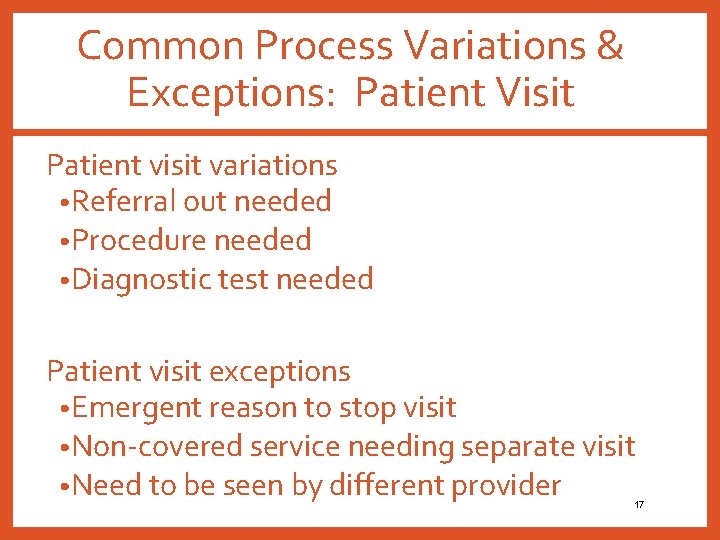
Common Process Variations & Exceptions: Patient Visit Patient visit variations • Referral out needed • Procedure needed • Diagnostic test needed Patient visit exceptions • Emergent reason to stop visit • Non-covered service needing separate visit • Need to be seen by different provider 17
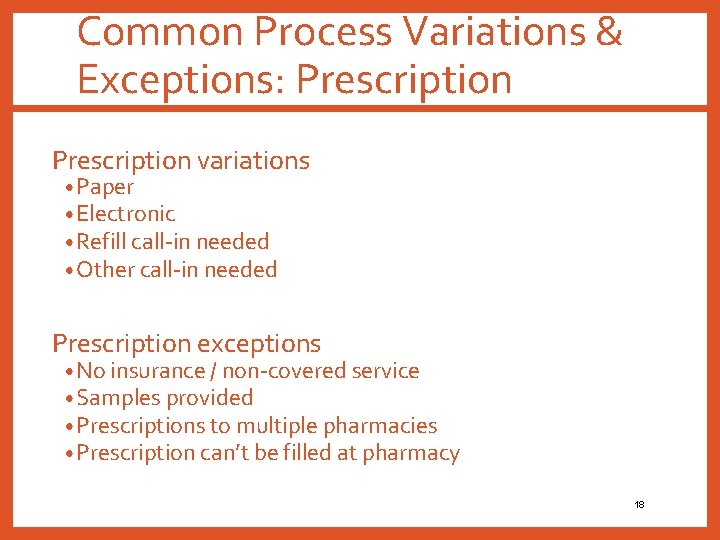
Common Process Variations & Exceptions: Prescription variations • Paper • Electronic • Refill call-in needed • Other call-in needed Prescription exceptions • No insurance / non-covered service • Samples provided • Prescriptions to multiple pharmacies • Prescription can’t be filled at pharmacy 18
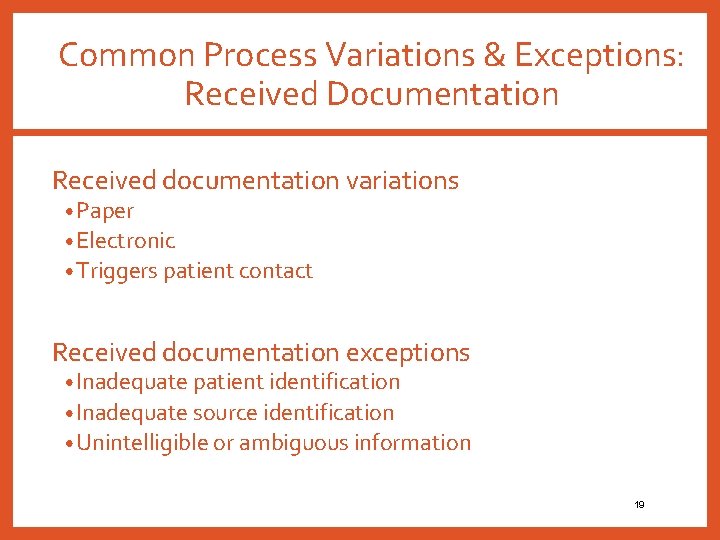
Common Process Variations & Exceptions: Received Documentation Received documentation variations • Paper • Electronic • Triggers patient contact Received documentation exceptions • Inadequate patient identification • Inadequate source identification • Unintelligible or ambiguous information 19
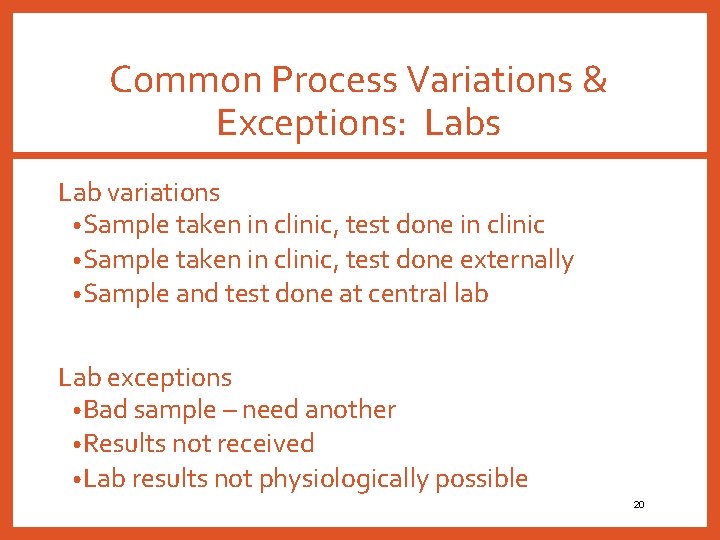
Common Process Variations & Exceptions: Labs Lab variations • Sample taken in clinic, test done in clinic • Sample taken in clinic, test done externally • Sample and test done at central lab Lab exceptions • Bad sample – need another • Results not received • Lab results not physiologically possible 20
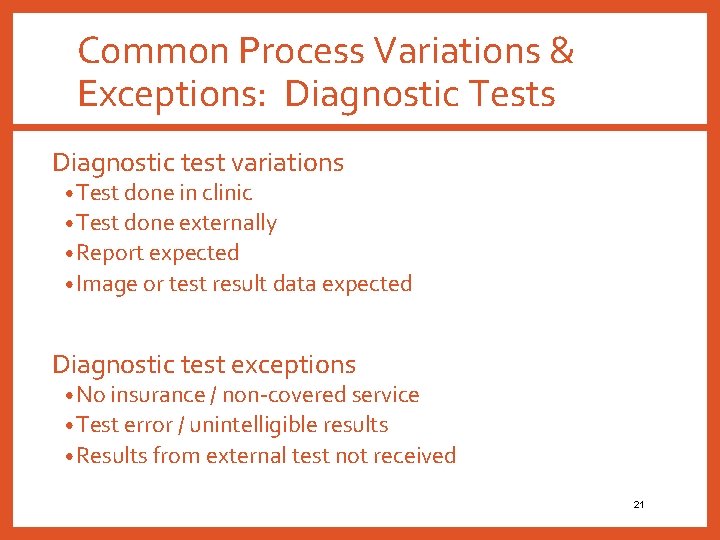
Common Process Variations & Exceptions: Diagnostic Tests Diagnostic test variations • Test done in clinic • Test done externally • Report expected • Image or test result data expected Diagnostic test exceptions • No insurance / non-covered service • Test error / unintelligible results • Results from external test not received 21
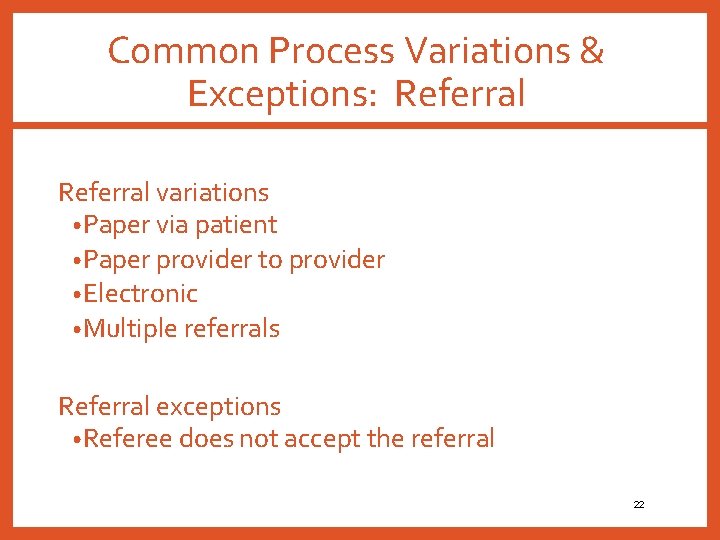
Common Process Variations & Exceptions: Referral variations • Paper via patient • Paper provider to provider • Electronic • Multiple referrals Referral exceptions • Referee does not accept the referral 22
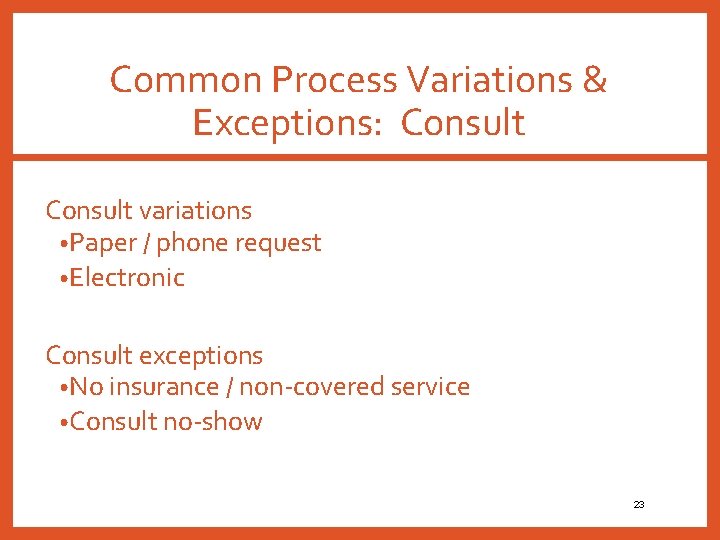
Common Process Variations & Exceptions: Consult variations • Paper / phone request • Electronic Consult exceptions • No insurance / non-covered service • Consult no-show 23
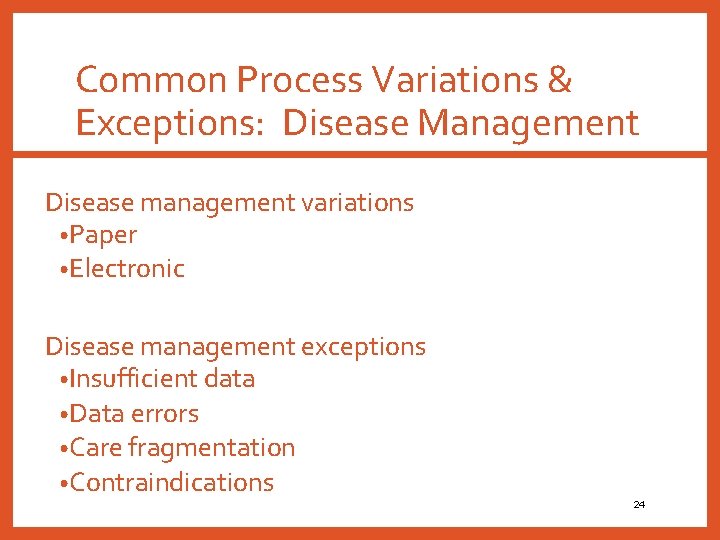
Common Process Variations & Exceptions: Disease Management Disease management variations • Paper • Electronic Disease management exceptions • Insufficient data • Data errors • Care fragmentation • Contraindications 24
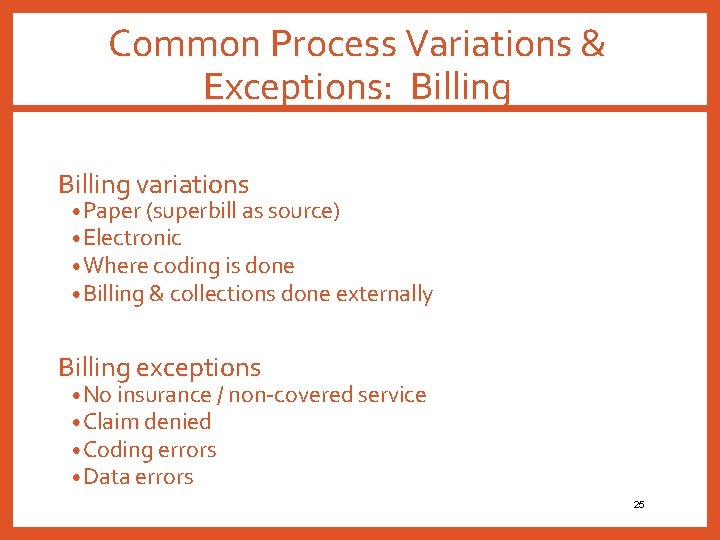
Common Process Variations & Exceptions: Billing variations • Paper (superbill as source) • Electronic • Where coding is done • Billing & collections done externally Billing exceptions • No insurance / non-covered service • Claim denied • Coding errors • Data errors 25
Steps for Process Analysis • Start with process Inventory & diagrams • Context diagram showing clinic functions • Flowchart for each process • For each process, list • Variations applicable to the clinic • Exceptions • Report findings • Major observations • EHR functionality necessary to support clinic functions • Opportunities for improvement 26
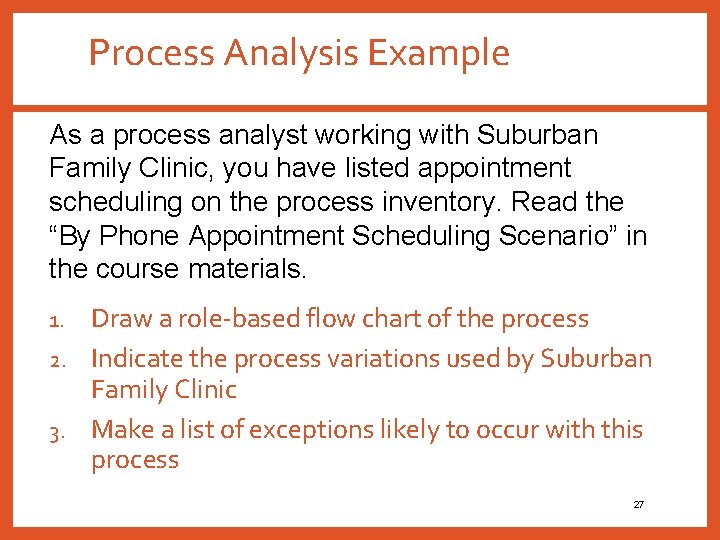
Process Analysis Example As a process analyst working with Suburban Family Clinic, you have listed appointment scheduling on the process inventory. Read the “By Phone Appointment Scheduling Scenario” in the course materials. Draw a role-based flow chart of the process 2. Indicate the process variations used by Suburban Family Clinic 3. Make a list of exceptions likely to occur with this process 1. 27
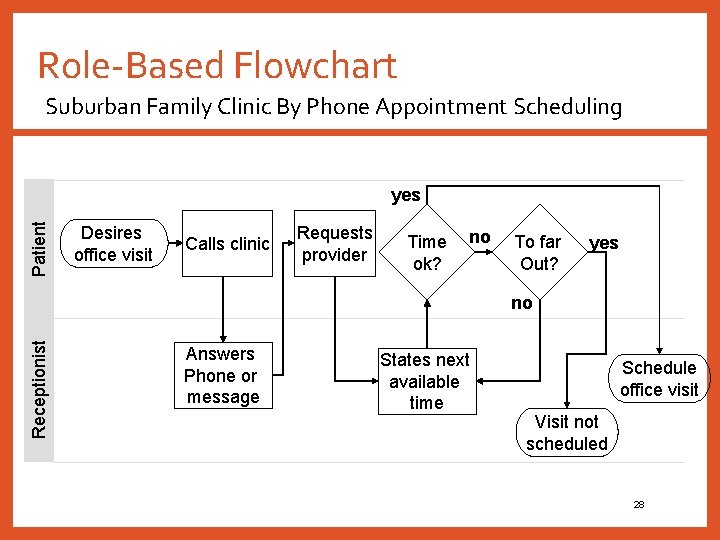
Role-Based Flowchart Suburban Family Clinic By Phone Appointment Scheduling Patient yes Desires office visit Calls clinic Requests provider Time ok? no To far Out? yes Receptionist no Answers Phone or message States next available time Schedule office visit Visit not scheduled 28
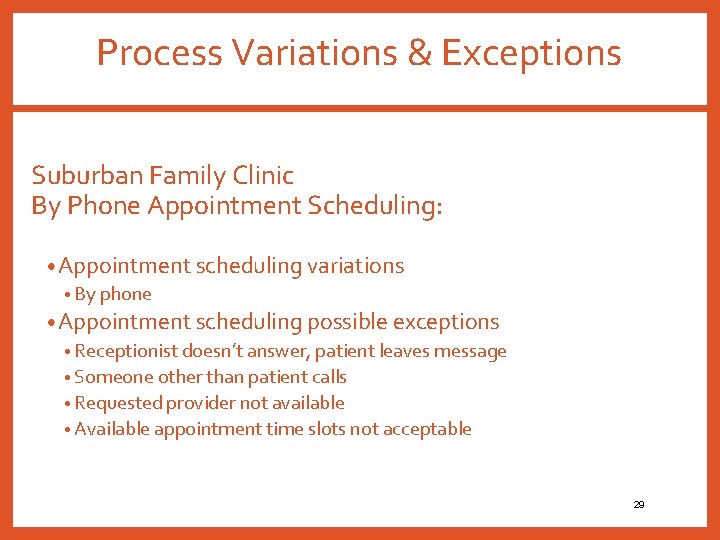
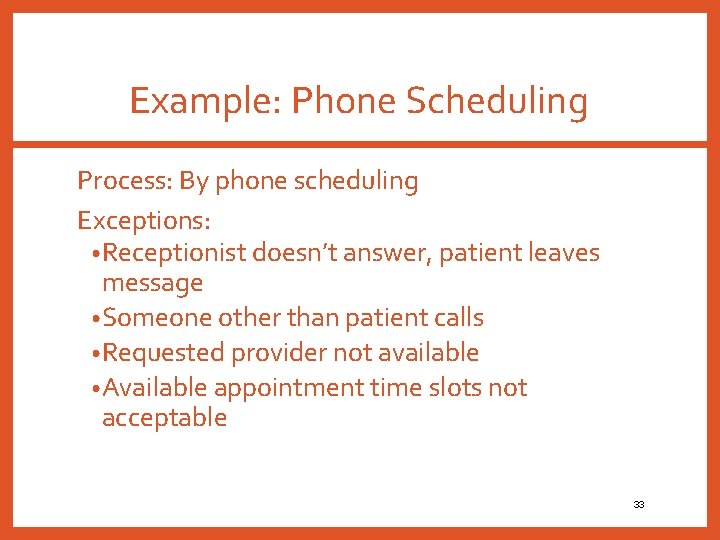
Process Variations & Exceptions Suburban Family Clinic By Phone Appointment Scheduling: • Appointment scheduling variations • By phone • Appointment scheduling possible exceptions • Receptionist doesn’t answer, patient leaves message • Someone other than patient calls • Requested provider not available • Available appointment time slots not acceptable 29
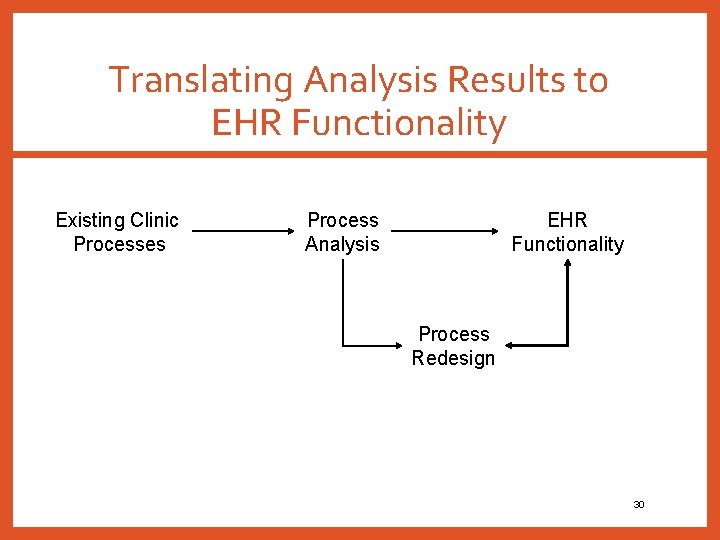
Translating Analysis Results to EHR Functionality Existing Clinic Processes Process Analysis EHR Functionality Process Redesign 30
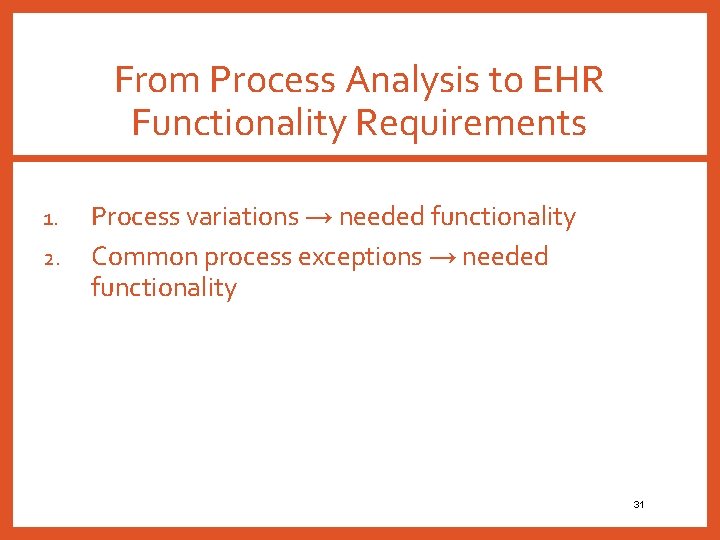
From Process Analysis to EHR Functionality Requirements 1. 2. Process variations → needed functionality Common process exceptions → needed functionality 31
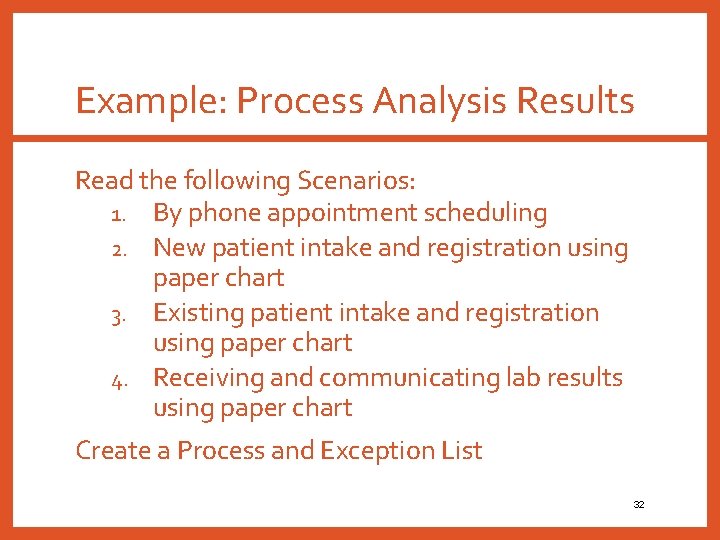
Example: Process Analysis Results Read the following Scenarios: 1. By phone appointment scheduling 2. New patient intake and registration using paper chart 3. Existing patient intake and registration using paper chart 4. Receiving and communicating lab results using paper chart Create a Process and Exception List 32
Example: Phone Scheduling Process: By phone scheduling Exceptions: • Receptionist doesn’t answer, patient leaves message • Someone other than patient calls • Requested provider not available • Available appointment time slots not acceptable 33
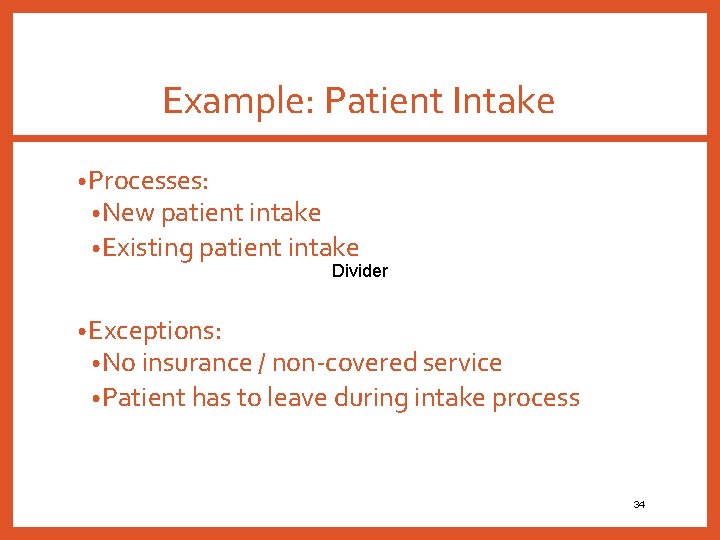
Example: Patient Intake • Processes: • New patient intake • Existing patient intake Divider • Exceptions: • No insurance / non-covered service • Patient has to leave during intake process 34
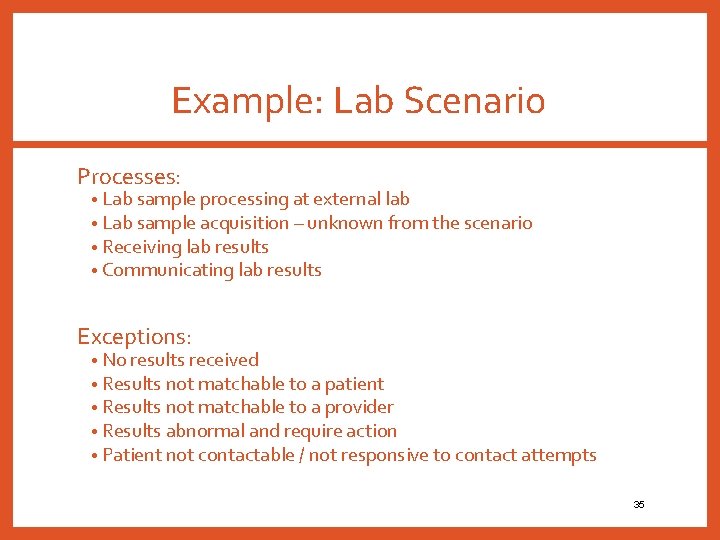
Example: Lab Scenario Processes: • Lab sample processing at external lab • Lab sample acquisition – unknown from the scenario • Receiving lab results • Communicating lab results Exceptions: • No results received • Results not matchable to a patient • Results not matchable to a provider • Results abnormal and require action • Patient not contactable / not responsive to contact attempts 35
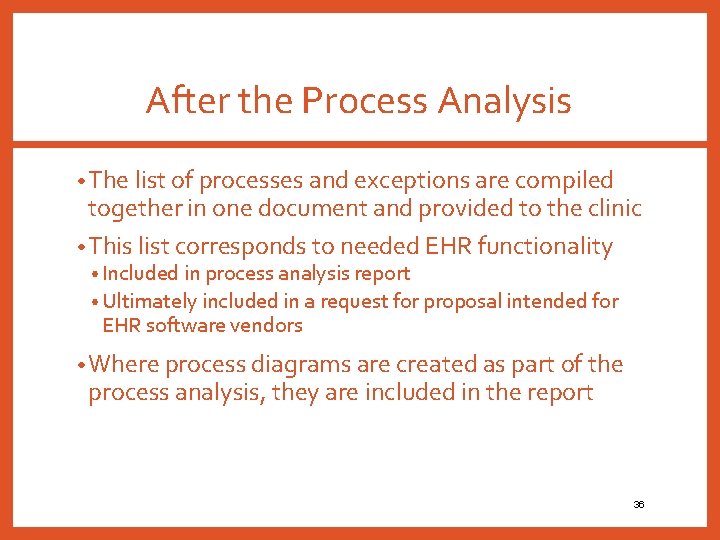
After the Process Analysis • The list of processes and exceptions are compiled together in one document and provided to the clinic • This list corresponds to needed EHR functionality • Included in process analysis report • Ultimately included in a request for proposal intended for EHR software vendors • Where process diagrams are created as part of the process analysis, they are included in the report 36
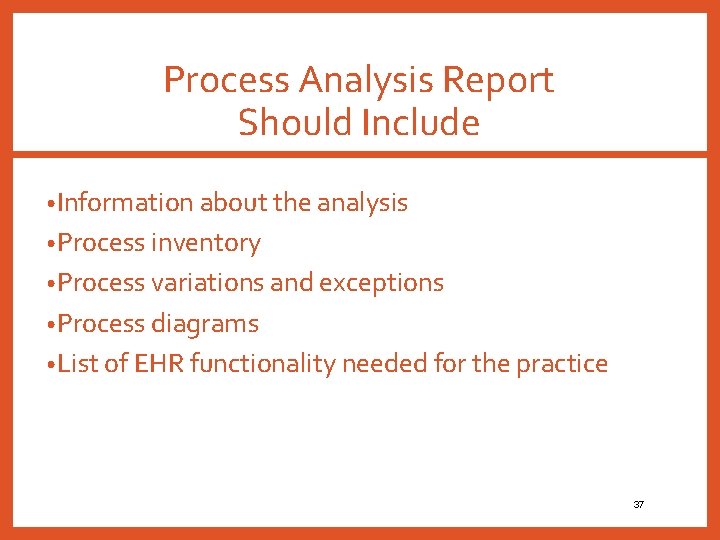
Process Analysis Report Should Include • Information about the analysis • Process inventory • Process variations and exceptions • Process diagrams • List of EHR functionality needed for the practice 37