
Process Analysis Chapter 4 Copyright 2013 Pearson Education

- Slides: 40
Process Analysis Chapter 4 Copyright © 2013 Pearson Education, Inc. publishing as Prentice Hall 04 - 0
What is Process Analysis? Process Analysis The set of tools used to identify opportunities for improvement, document current processes, evaluate processes to find performance gaps, redesign processes, and implement desired changes. Copyright © 2013 Pearson Education, Inc. publishing as Prentice Hall 04 -02
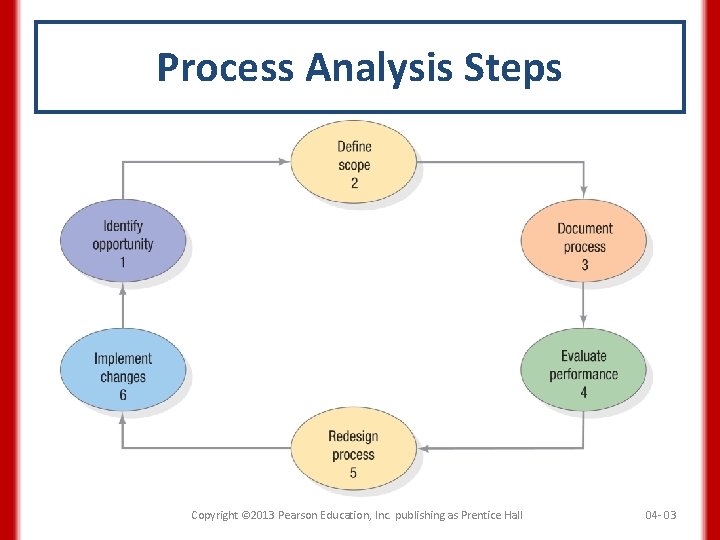
Process Analysis Steps Copyright © 2013 Pearson Education, Inc. publishing as Prentice Hall 04 - 03
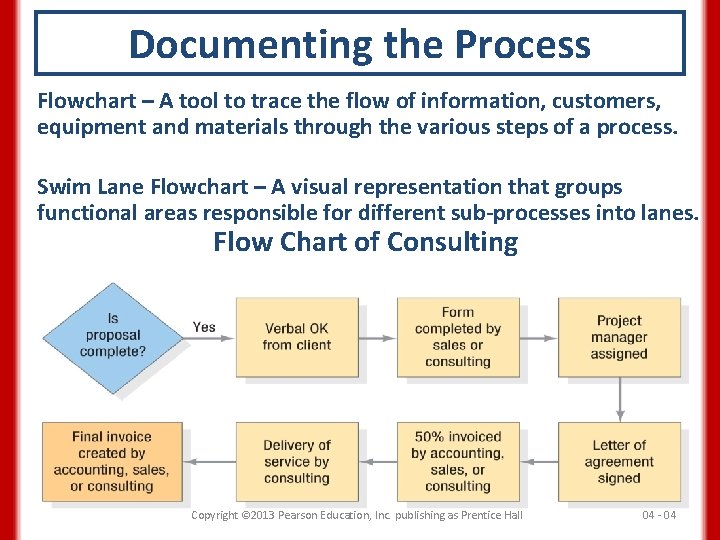
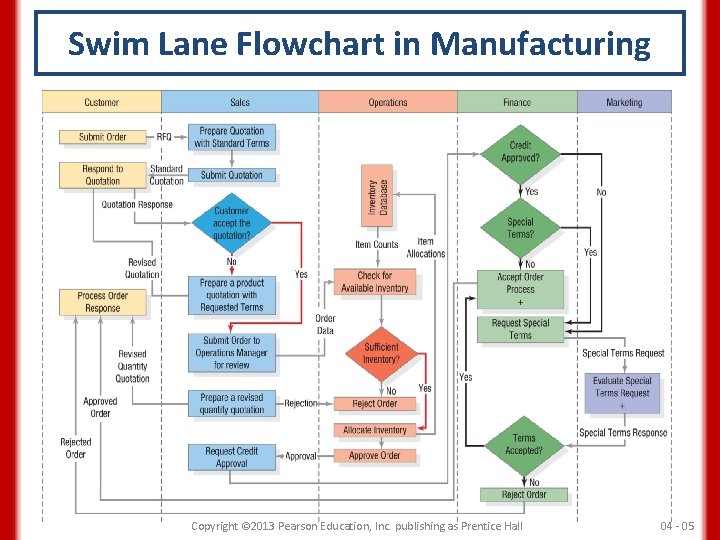
Documenting the Process Flowchart – A tool to trace the flow of information, customers, equipment and materials through the various steps of a process. Swim Lane Flowchart – A visual representation that groups functional areas responsible for different sub-processes into lanes. Flow Chart of Consulting Copyright © 2013 Pearson Education, Inc. publishing as Prentice Hall 04 - 04
Swim Lane Flowchart in Manufacturing Swim Lane Flowchart – A visual representation that groups functional areas responsible for different sub-processes into lanes. Copyright © 2013 Pearson Education, Inc. publishing as Prentice Hall 04 - 05
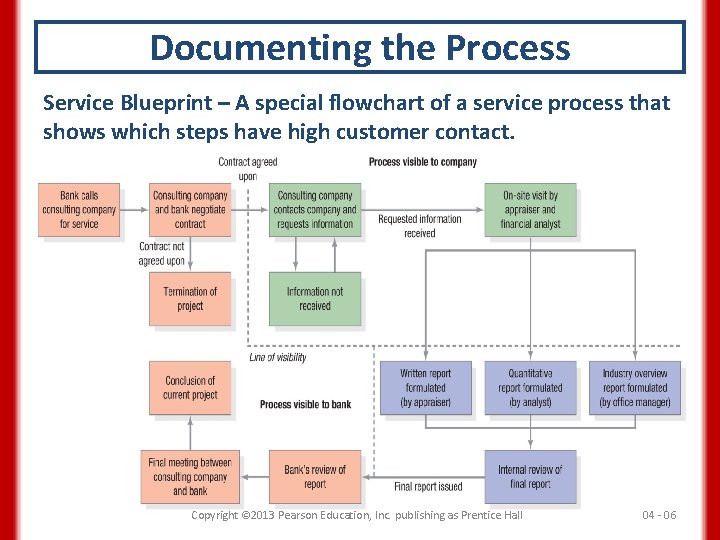
Documenting the Process Service Blueprint – A special flowchart of a service process that shows which steps have high customer contact. Copyright © 2013 Pearson Education, Inc. publishing as Prentice Hall 04 - 06
Documenting the Process • Work Measurement Techniques – Time Study – Elemental Standard Data approach – Predetermined Data Approach – Work Sampling Method – Learning Curve Analysis – Process Charts Copyright © 2013 Pearson Education, Inc. publishing as Prentice Hall 04 - 07
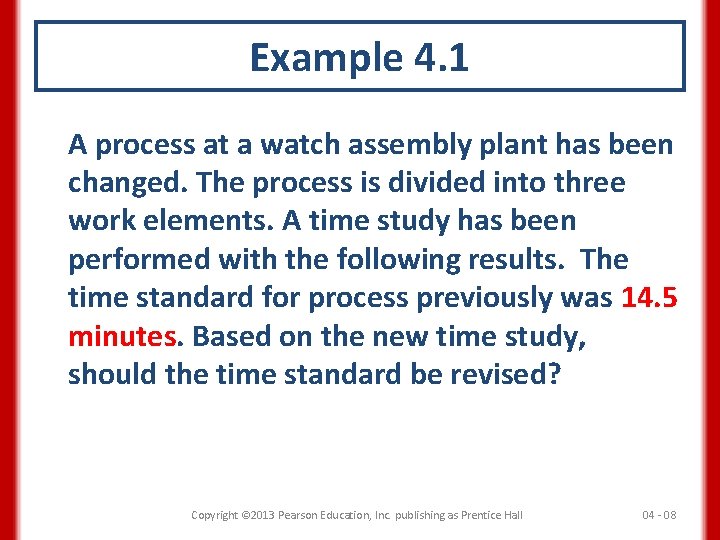
Example 4. 1 A process at a watch assembly plant has been changed. The process is divided into three work elements. A time study has been performed with the following results. The time standard for process previously was 14. 5 minutes. Based on the new time study, should the time standard be revised? Copyright © 2013 Pearson Education, Inc. publishing as Prentice Hall 04 - 08
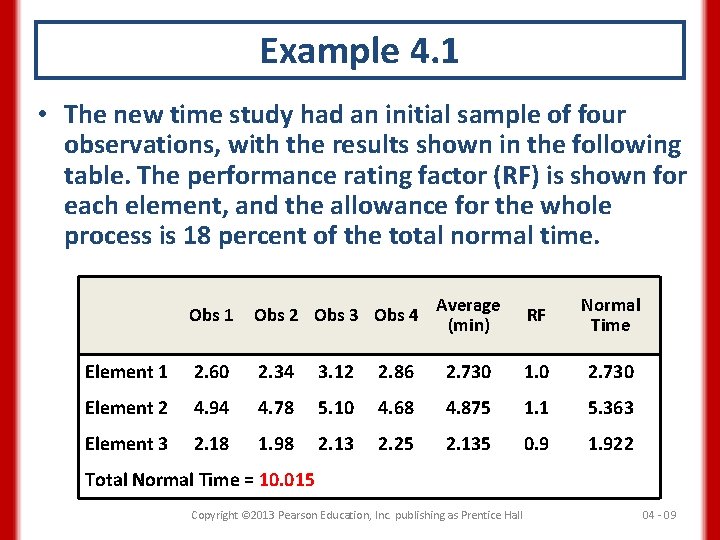
Example 4. 1 • The new time study had an initial sample of four observations, with the results shown in the following table. The performance rating factor (RF) is shown for each element, and the allowance for the whole process is 18 percent of the total normal time. Average (min) RF Normal Time 2. 86 2. 730 1. 0 2. 730 5. 10 4. 68 4. 875 1. 1 5. 363 2. 13 2. 25 2. 135 0. 9 1. 922 Obs 1 Obs 2 Obs 3 Obs 4 Element 1 2. 60 2. 34 3. 12 Element 2 4. 94 4. 78 Element 3 2. 18 1. 98 Total Normal Time = 10. 015 Copyright © 2013 Pearson Education, Inc. publishing as Prentice Hall 04 - 09
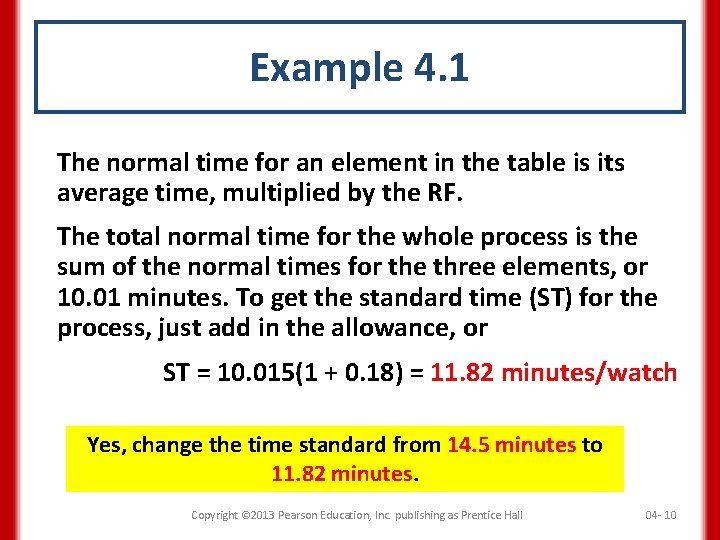
Example 4. 1 The normal time for an element in the table is its average time, multiplied by the RF. The total normal time for the whole process is the sum of the normal times for the three elements, or 10. 01 minutes. To get the standard time (ST) for the process, just add in the allowance, or ST = 10. 015(1 + 0. 18) = 11. 82 minutes/watch Yes, change the time standard from 14. 5 minutes to 11. 82 minutes. Copyright © 2013 Pearson Education, Inc. publishing as Prentice Hall 04 - 10
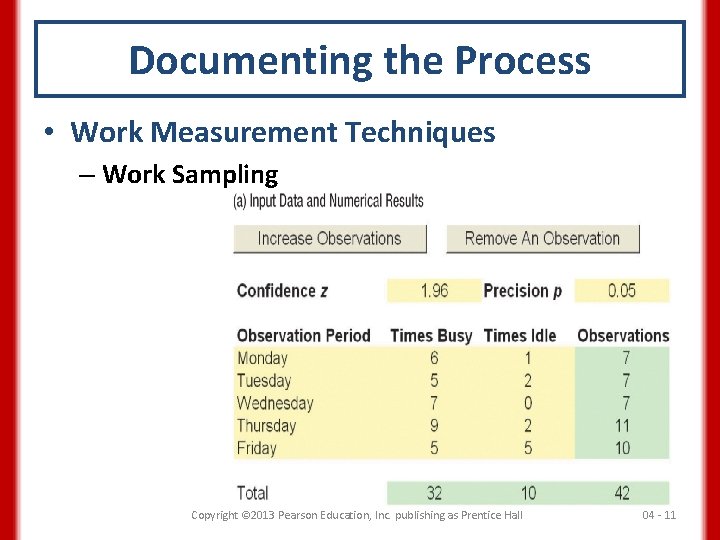
Documenting the Process • Work Measurement Techniques – Work Sampling Copyright © 2013 Pearson Education, Inc. publishing as Prentice Hall 04 - 11
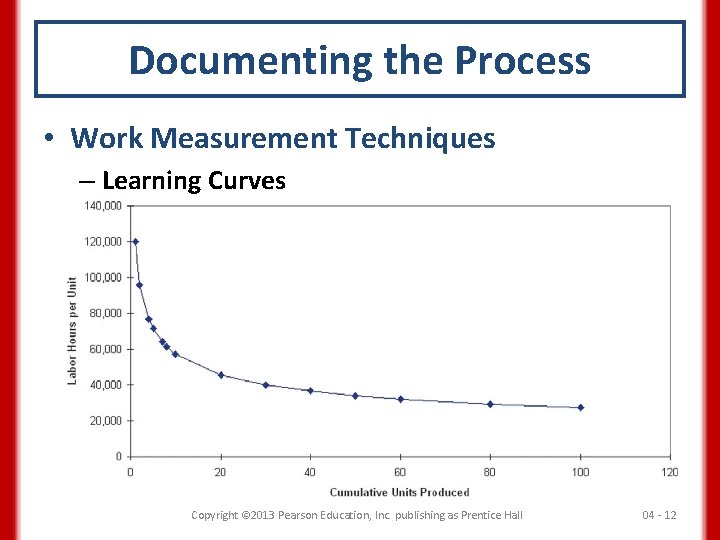
Documenting the Process • Work Measurement Techniques – Learning Curves Copyright © 2013 Pearson Education, Inc. publishing as Prentice Hall 04 - 12
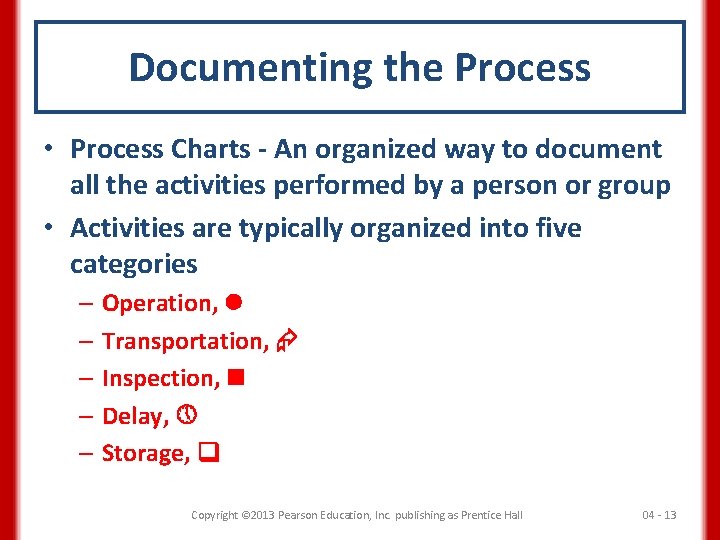
Documenting the Process • Process Charts - An organized way to document all the activities performed by a person or group • Activities are typically organized into five categories – Operation, – Transportation, – Inspection, – Delay, – Storage, Copyright © 2013 Pearson Education, Inc. publishing as Prentice Hall 04 - 13
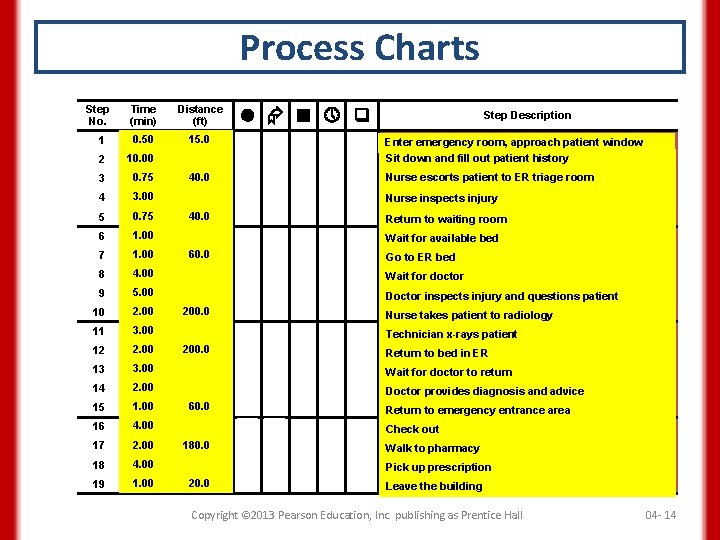
Process Charts Step No. Time (min) Distance (ft) 1 0. 50 15. 0 2 10. 00 3 0. 75 4 3. 00 5 0. 75 6 1. 00 7 1. 00 8 4. 00 9 5. 00 10 2. 00 11 3. 00 12 2. 00 13 3. 00 14 2. 00 15 1. 00 16 4. 00 17 2. 00 18 4. 00 19 1. 00 X Enter emergency room, approach patient window Sit down and fill out patient history X Nurse escorts patient to ER triage room X 40. 0 Nurse inspects injury X Return to waiting room X 60. 0 X X Nurse takes patient to radiology X Technician x-rays patient X Return to bed in ER X X 60. 0 X Return to emergency entrance area Check out X X 20. 0 Wait for doctor to return Doctor provides diagnosis and advice X 180. 0 Wait for doctor Doctor inspects injury and questions patient X 200. 0 Wait for available bed Go to ER bed X 200. 0 Step Description Walk to pharmacy Pick up prescription X Leave the building Copyright © 2013 Pearson Education, Inc. publishing as Prentice Hall 04 - 14
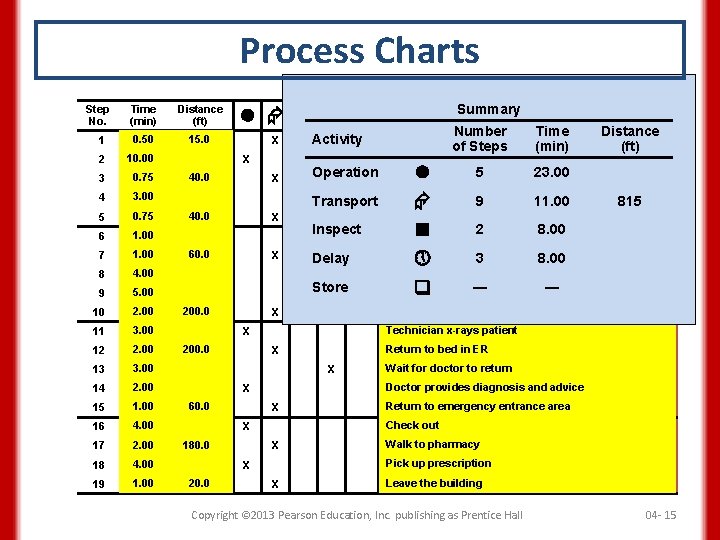
Process Charts Step No. Time (min) Distance (ft) 1 0. 50 15. 0 2 10. 00 3 0. 75 4 3. 00 5 0. 75 6 1. 00 7 1. 00 8 4. 00 9 5. 00 10 2. 00 11 3. 00 12 2. 00 13 3. 00 14 2. 00 15 1. 00 16 4. 00 17 2. 00 18 4. 00 19 1. 00 Activity X X 40. 0 Operation X X 40. 0 X 60. 0 X Transport Inspect X Delay X X 200. 0 Store 200. 0 Distance (ft) Sit down and fill out patient history Nurse inspects injury 9 11. 00 815 Return to waiting room 8. 00 available 2 bed Wait for Go to ER bed 3 8. 00 Wait for doctor ― and questions ― inspects injury Doctor patient 5 to ER triage 23. 00 room Nurse escorts patient Return to bed in ER X Wait for doctor to return Doctor provides diagnosis and advice X X Return to emergency entrance area Check out X 180. 0 Time (min) Technician x-rays patient X 60. 0 Number of Steps Enter emergency room, approach patient window Nurse takes patient to radiology X X X Walk to pharmacy Pick up prescription X 20. 0 Summary Step Description X Leave the building Copyright © 2013 Pearson Education, Inc. publishing as Prentice Hall 04 - 15
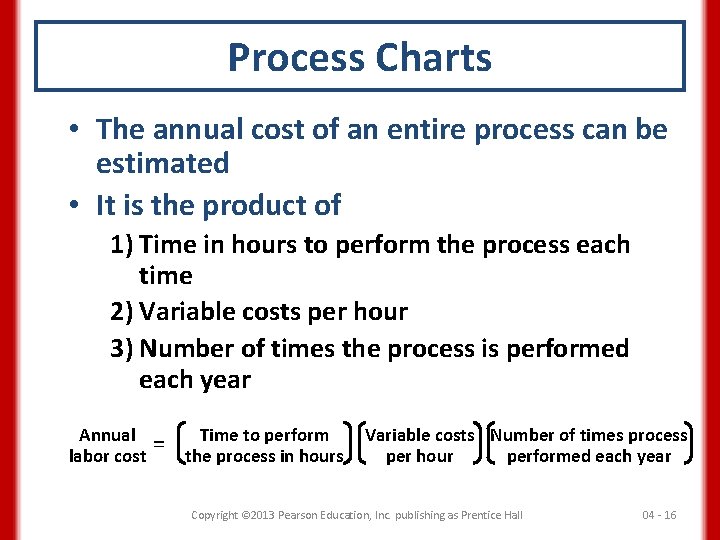
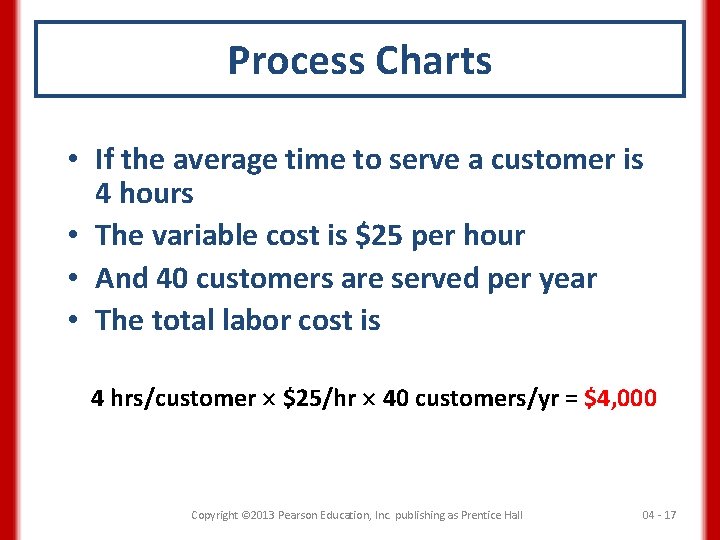
Process Charts • The annual cost of an entire process can be estimated • It is the product of 1) Time in hours to perform the process each time 2) Variable costs per hour 3) Number of times the process is performed each year Annual labor cost = Time to perform the process in hours Variable costs Number of times process per hour performed each year Copyright © 2013 Pearson Education, Inc. publishing as Prentice Hall 04 - 16
Process Charts • If the average time to serve a customer is 4 hours • The variable cost is $25 per hour • And 40 customers are served per year • The total labor cost is 4 hrs/customer $25/hr 40 customers/yr = $4, 000 Copyright © 2013 Pearson Education, Inc. publishing as Prentice Hall 04 - 17
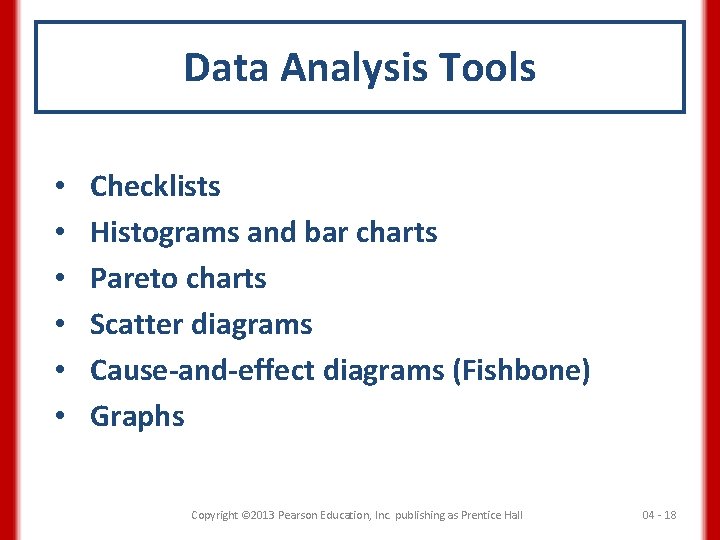
Data Analysis Tools • • • Checklists Histograms and bar charts Pareto charts Scatter diagrams Cause-and-effect diagrams (Fishbone) Graphs Copyright © 2013 Pearson Education, Inc. publishing as Prentice Hall 04 - 18
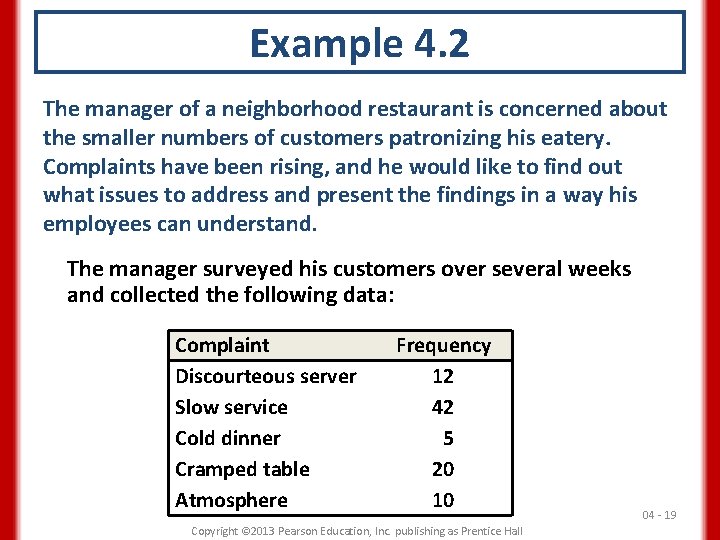
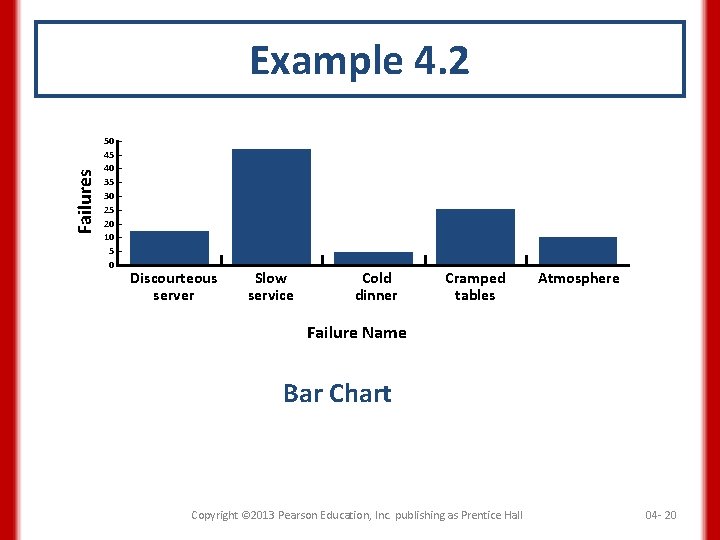
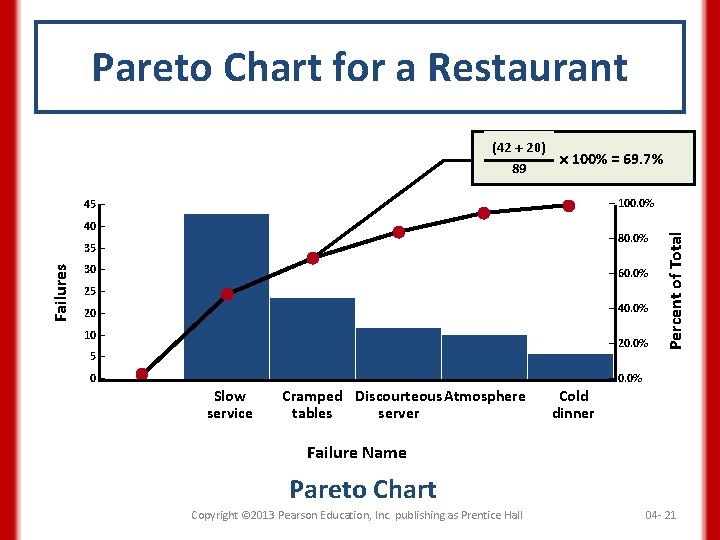
Example 4. 2 The manager of a neighborhood restaurant is concerned about the smaller numbers of customers patronizing his eatery. Complaints have been rising, and he would like to find out what issues to address and present the findings in a way his employees can understand. The manager surveyed his customers over several weeks and collected the following data: Complaint Discourteous server Slow service Cold dinner Cramped table Atmosphere Frequency 12 42 5 20 10 Copyright © 2013 Pearson Education, Inc. publishing as Prentice Hall 04 - 19
Failures Example 4. 2 50 – 45 – 40 – 35 – 30 – 25 – 20 – 10 – 5– 0– Discourteous server Slow service Cold dinner Cramped tables Atmosphere Failure Name Bar Chart Copyright © 2013 Pearson Education, Inc. publishing as Prentice Hall 04 - 20
Pareto Chart for a Restaurant (42 + 20) 100% = 69. 7% 89 40 – – 80. 0% Failures 35 – 30 – – 60. 0% 25 – – 40. 0% 20 – 10 – – 20. 0% 5– 0– Percent of Total – 100. 0% 45 – – 0. 0% Slow service Cramped Discourteous Atmosphere tables server Cold dinner Failure Name Pareto Chart Copyright © 2013 Pearson Education, Inc. publishing as Prentice Hall 04 - 21
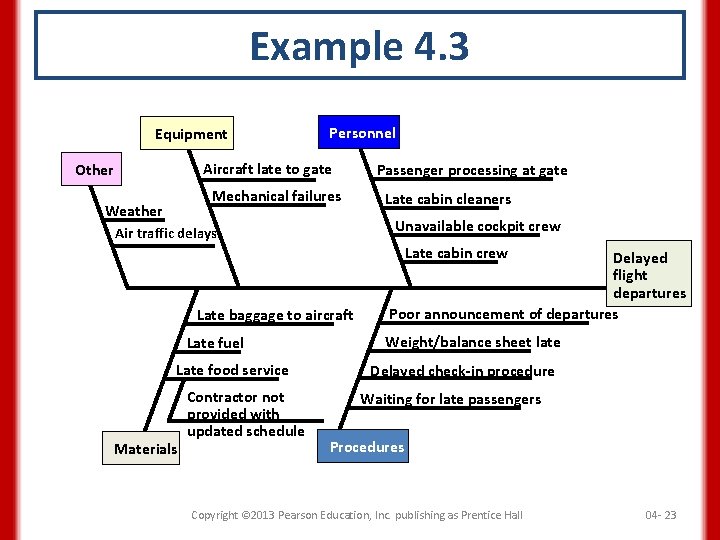
Example 4. 3 The operations manager for Checker Board Airlines at Port Columbus International Airport noticed an increase in the number of delayed flight departures. Draw a Fishbone Diagram to determine the root cause of the problem of Delayed Flight Departures. Copyright © 2013 Pearson Education, Inc. publishing as Prentice Hall 04 - 22
Example 4. 3 Equipment Personnel Aircraft late to gate Other Mechanical failures Weather Passenger processing at gate Late cabin cleaners Unavailable cockpit crew Air traffic delays Late cabin crew Late baggage to aircraft Late fuel Late food service Materials Contractor not provided with updated schedule Delayed flight departures Poor announcement of departures Weight/balance sheet late Delayed check-in procedure Waiting for late passengers Procedures Copyright © 2013 Pearson Education, Inc. publishing as Prentice Hall 04 - 23
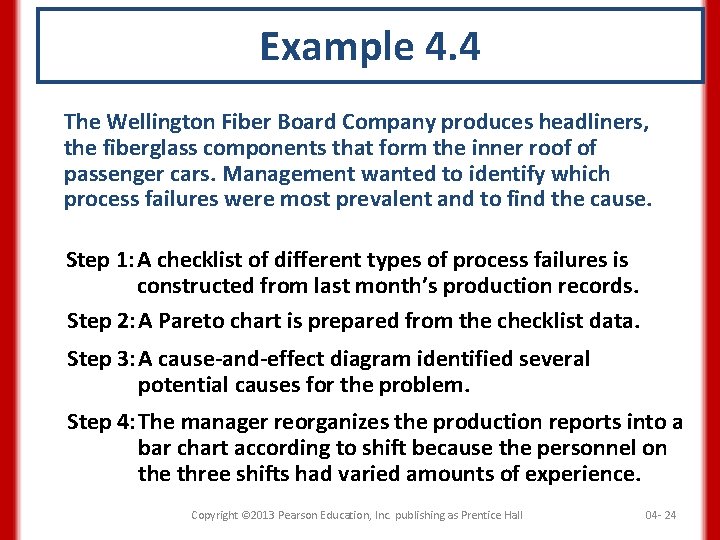
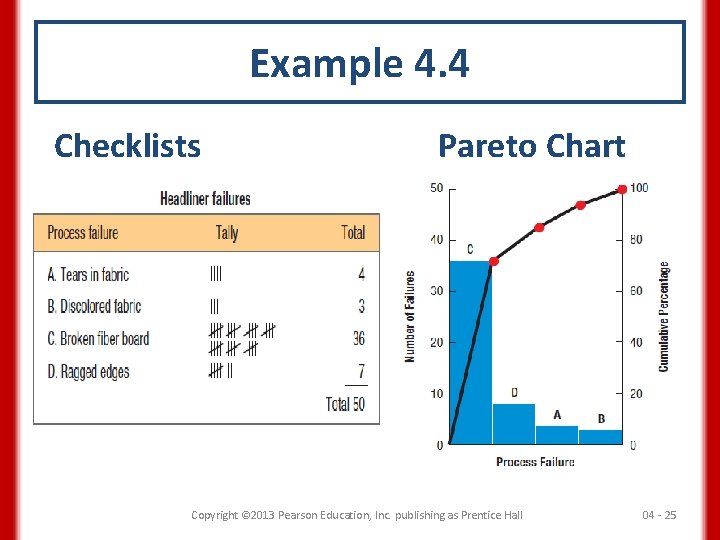
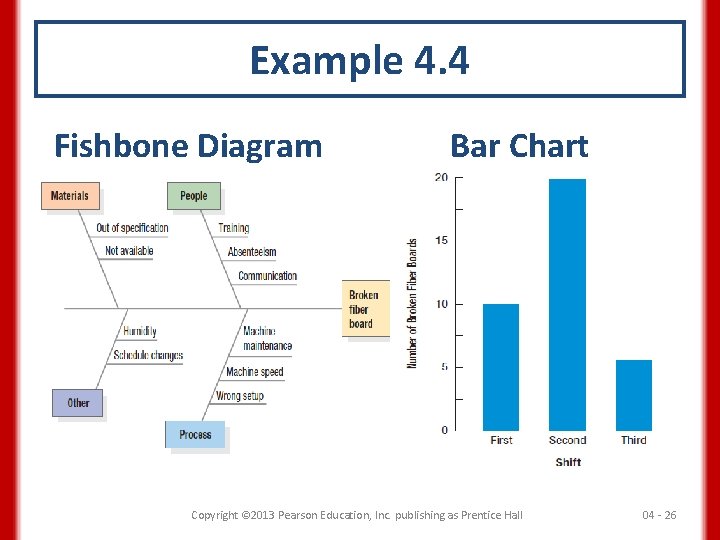
Example 4. 4 The Wellington Fiber Board Company produces headliners, the fiberglass components that form the inner roof of passenger cars. Management wanted to identify which process failures were most prevalent and to find the cause. Step 1: A checklist of different types of process failures is constructed from last month’s production records. Step 2: A Pareto chart is prepared from the checklist data. Step 3: A cause-and-effect diagram identified several potential causes for the problem. Step 4: The manager reorganizes the production reports into a bar chart according to shift because the personnel on the three shifts had varied amounts of experience. Copyright © 2013 Pearson Education, Inc. publishing as Prentice Hall 04 - 24
Example 4. 4 Checklists Pareto Chart Bar Chart Copyright © 2013 Pearson Education, Inc. publishing as Prentice Hall 04 - 25
Example 4. 4 Fishbone Diagram Bar Chart Copyright © 2013 Pearson Education, Inc. publishing as Prentice Hall 04 - 26
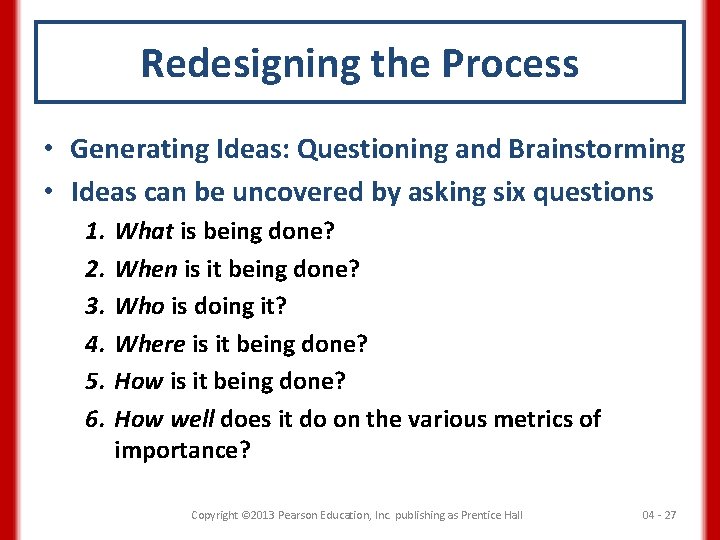
Redesigning the Process • Generating Ideas: Questioning and Brainstorming • Ideas can be uncovered by asking six questions 1. 2. 3. 4. 5. 6. What is being done? When is it being done? Who is doing it? Where is it being done? How well does it do on the various metrics of importance? Copyright © 2013 Pearson Education, Inc. publishing as Prentice Hall 04 - 27
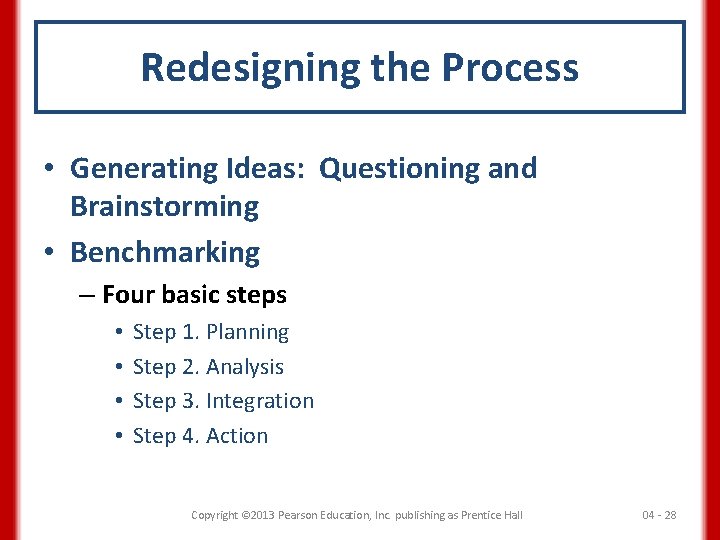
Redesigning the Process • Generating Ideas: Questioning and Brainstorming • Benchmarking – Four basic steps • • Step 1. Planning Step 2. Analysis Step 3. Integration Step 4. Action Copyright © 2013 Pearson Education, Inc. publishing as Prentice Hall 04 - 28
Managing and Implementing Processes • Seven common mistakes 1. Not connecting with strategic issues 2. Not involving the right people in the right way 3. Not giving the design teams and process analysts a clear charter and then holding them accountable 4. Not being satisfied unless fundamental “reengineering” changes are made 5. Not considering the impact on people 6. Not giving attention to implementation 7. Not creating an infrastructure for continuous process improvement Copyright © 2013 Pearson Education, Inc. publishing as Prentice Hall 04 - 29
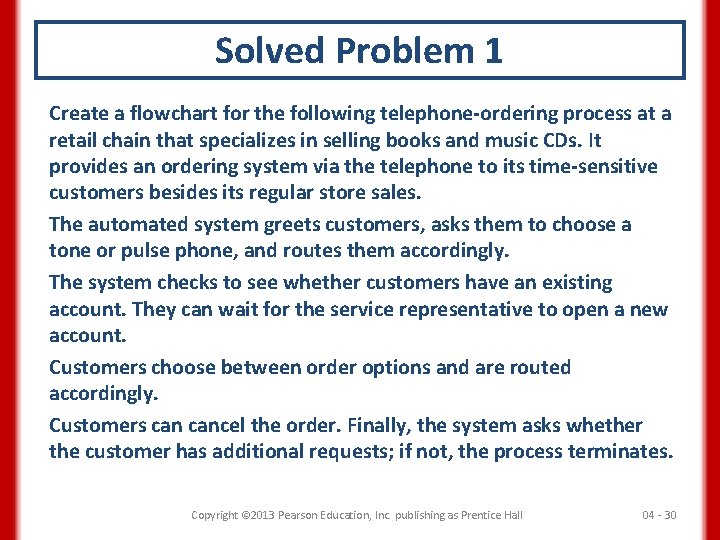
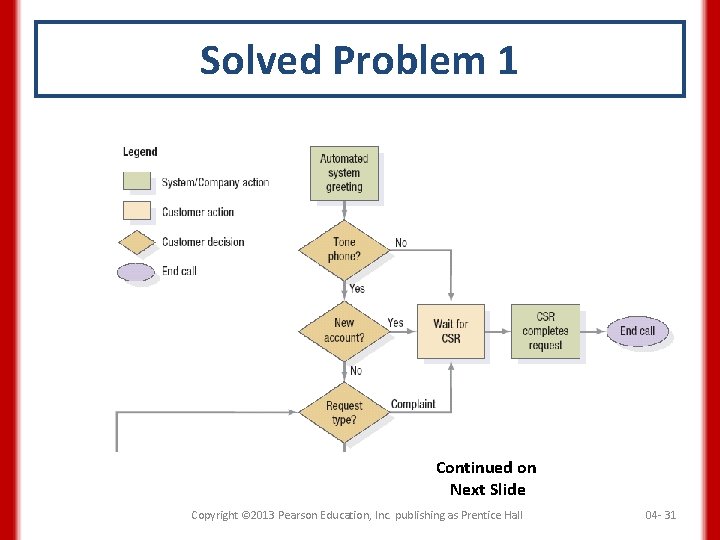
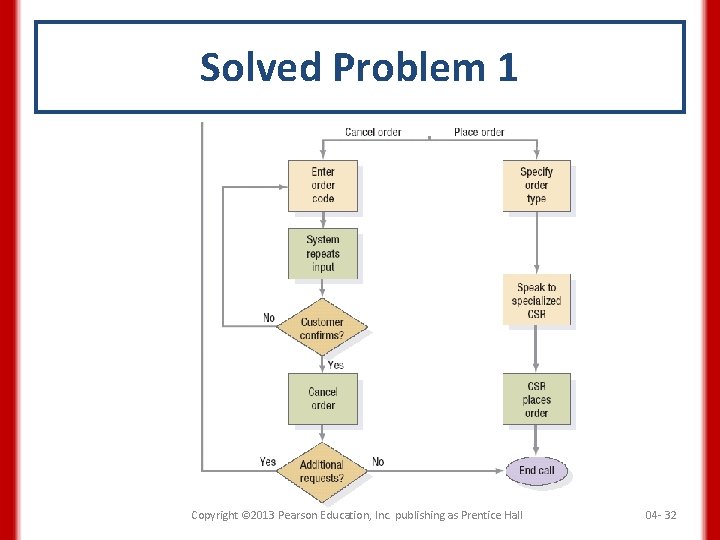
Solved Problem 1 Create a flowchart for the following telephone-ordering process at a retail chain that specializes in selling books and music CDs. It provides an ordering system via the telephone to its time-sensitive customers besides its regular store sales. The automated system greets customers, asks them to choose a tone or pulse phone, and routes them accordingly. The system checks to see whether customers have an existing account. They can wait for the service representative to open a new account. Customers choose between order options and are routed accordingly. Customers cancel the order. Finally, the system asks whether the customer has additional requests; if not, the process terminates. Copyright © 2013 Pearson Education, Inc. publishing as Prentice Hall 04 - 30
Solved Problem 1 Continued on Next Slide Copyright © 2013 Pearson Education, Inc. publishing as Prentice Hall 04 - 31
Solved Problem 1 Copyright © 2013 Pearson Education, Inc. publishing as Prentice Hall 04 - 32
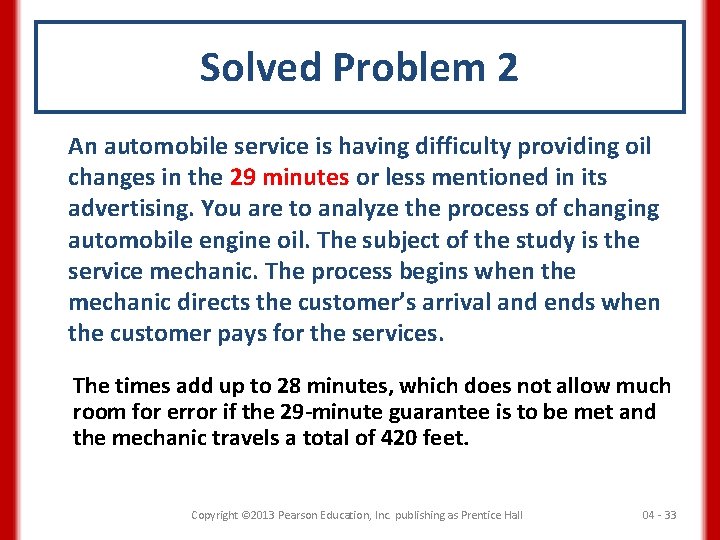
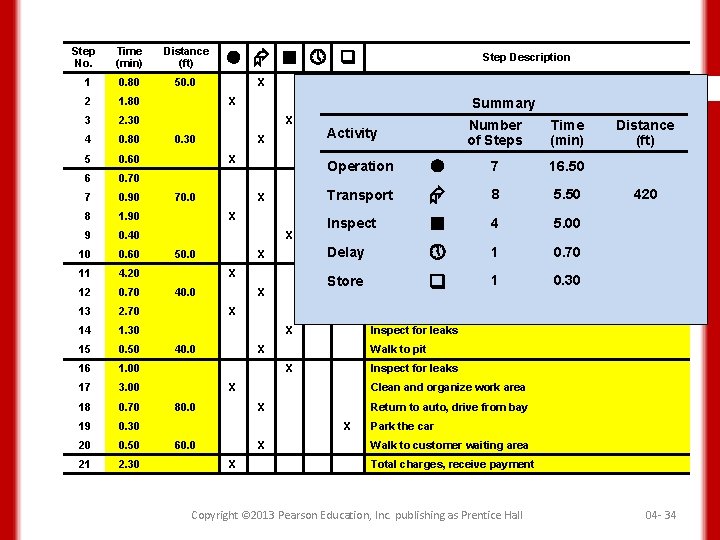
Solved Problem 2 An automobile service is having difficulty providing oil changes in the 29 minutes or less mentioned in its advertising. You are to analyze the process of changing automobile engine oil. The subject of the study is the service mechanic. The process begins when the mechanic directs the customer’s arrival and ends when the customer pays for the services. The times add up to 28 minutes, which does not allow much room for error if the 29 -minute guarantee is to be met and the mechanic travels a total of 420 feet. Copyright © 2013 Pearson Education, Inc. publishing as Prentice Hall 04 - 33
Step No. Time (min) Distance (ft) 1 0. 80 50. 0 2 1. 80 3 2. 30 4 0. 80 5 0. 60 6 0. 70 7 0. 90 8 1. 90 9 0. 40 10 0. 60 11 4. 20 12 0. 70 13 2. 70 14 1. 30 15 0. 50 16 1. 00 17 3. 00 18 0. 70 19 0. 30 20 0. 50 21 2. 30 X Direct customer into service bay Record name and desired service Summary X X 0. 30 Open hood, verify engine type, inspect hoses, check fluids Number Time Distance Activity. Walk to customer in waiting area of Steps (min) (ft) X X Recommend additional services X 70. 0 X X X 50. 0 X X 40. 0 X 7 16. 50 8 5. 50 Transport Walk to storeroom Look up filter number(s) 4 5. 00 Inspect Check filter number(s) 0. 70 Delay Carry filter(s) to service 1 pit Perform under-car services 1 0. 30 Store Climb from pit, walk to automobile Operation Wait for customer decision X Inspect for leaks X Walk to pit X Inspect for leaks X 80. 0 Clean and organize work area X Return to auto, drive from bay X 60. 0 X X 420 Fill engine with oil, start engine X 40. 0 Step Description Park the car Walk to customer waiting area Total charges, receive payment Copyright © 2013 Pearson Education, Inc. publishing as Prentice Hall 04 - 34
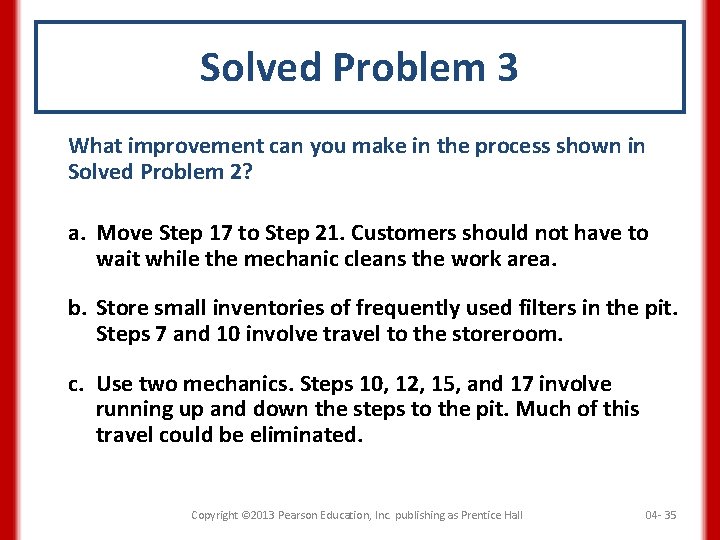
Solved Problem 3 What improvement can you make in the process shown in Solved Problem 2? a. Move Step 17 to Step 21. Customers should not have to wait while the mechanic cleans the work area. b. Store small inventories of frequently used filters in the pit. Steps 7 and 10 involve travel to the storeroom. c. Use two mechanics. Steps 10, 12, 15, and 17 involve running up and down the steps to the pit. Much of this travel could be eliminated. Copyright © 2013 Pearson Education, Inc. publishing as Prentice Hall 04 - 35
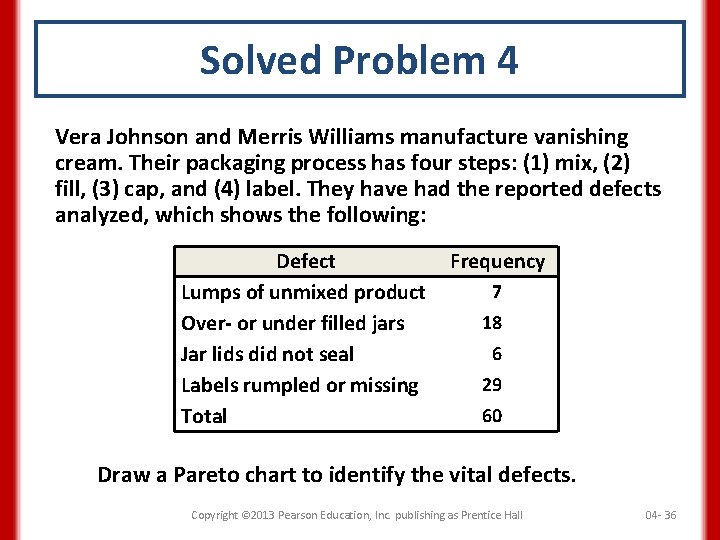
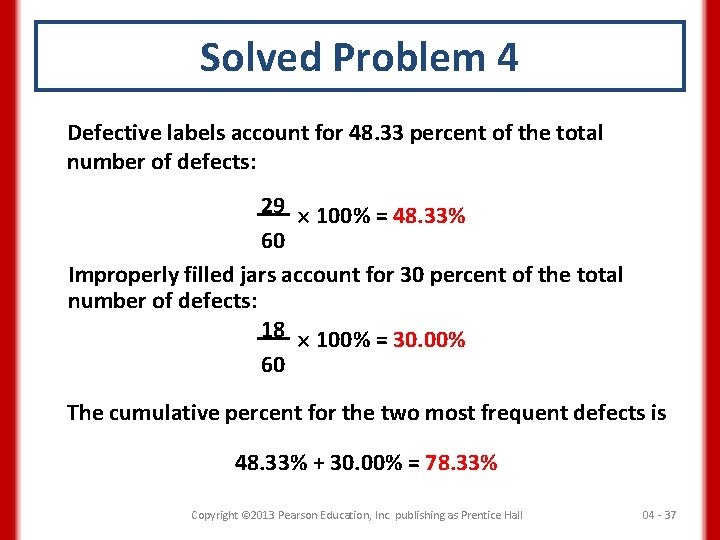
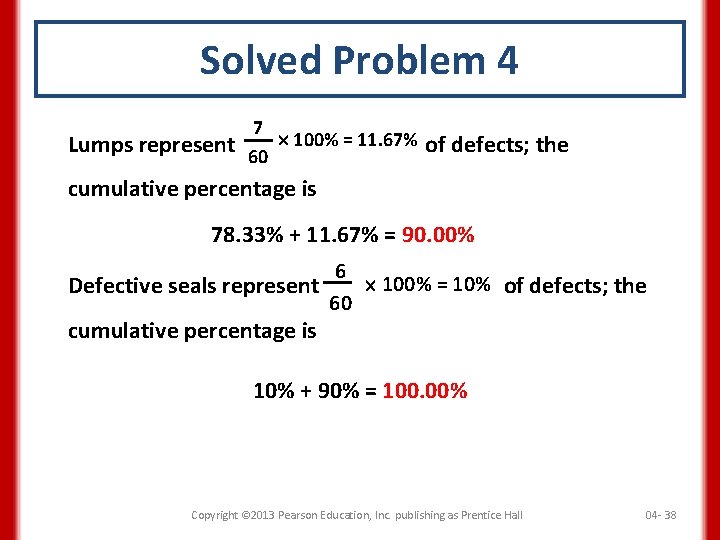
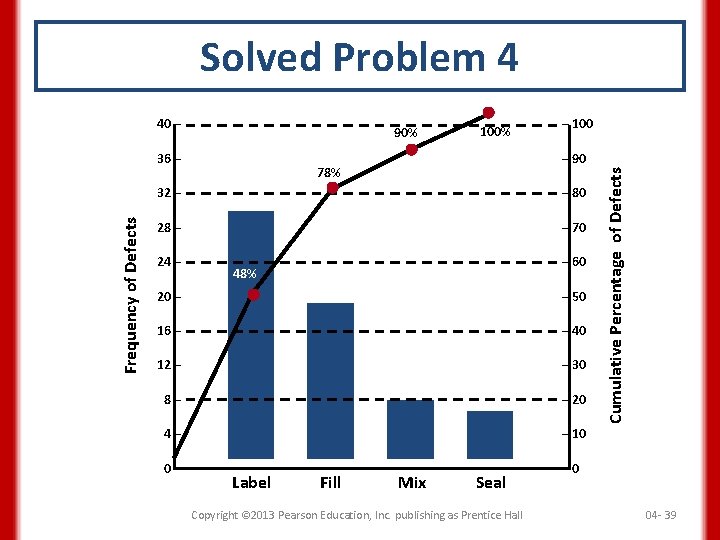
Solved Problem 4 Vera Johnson and Merris Williams manufacture vanishing cream. Their packaging process has four steps: (1) mix, (2) fill, (3) cap, and (4) label. They have had the reported defects analyzed, which shows the following: Defect Lumps of unmixed product Over- or under filled jars Jar lids did not seal Labels rumpled or missing Total Frequency 7 18 6 29 60 Draw a Pareto chart to identify the vital defects. Copyright © 2013 Pearson Education, Inc. publishing as Prentice Hall 04 - 36
Solved Problem 4 Defective labels account for 48. 33 percent of the total number of defects: 29 100% = 48. 33% 60 Improperly filled jars account for 30 percent of the total number of defects: 18 100% = 30. 00% 60 The cumulative percent for the two most frequent defects is 48. 33% + 30. 00% = 78. 33% Copyright © 2013 Pearson Education, Inc. publishing as Prentice Hall 04 - 37
Solved Problem 4 Lumps represent 7 100% = 11. 67% 60 of defects; the cumulative percentage is 78. 33% + 11. 67% = 90. 00% 6 100% = 10% of defects; the Defective seals represent 60 cumulative percentage is 10% + 90% = 100. 00% Copyright © 2013 Pearson Education, Inc. publishing as Prentice Hall 04 - 38
Solved Problem 4 90% Frequency of Defects 36 – 100% – 100 – 90 78% 32 – – 80 28 – – 70 24 – – 60 48% 20 – – 50 16 – – 40 12 – – 30 8– – 20 4– – 10 0– Label Fill Mix Seal Copyright © 2013 Pearson Education, Inc. publishing as Prentice Hall Cumulative Percentage of Defects 40 – – 0 04 - 39
All rights reserved. No part of this publication may be reproduced, stored in a retrieval system, or transmitted, in any form or by any means, electronic, mechanical, photocopying, recording, or otherwise, without the prior written permission of the publisher. Printed in the United States of America. Copyright © 2013 Pearson Education, Inc. publishing as Prentice Hall 04 - 40