
Procedures and Documentation for Availing Export Incentives Procedures


- Slides: 14
Procedures and Documentation for Availing Export Incentives
Procedures and Documentation for Availing Export Incentives • Exports are given priority in India and enjoy lot of incentives. However, the major problem lies in the process of realizing them. Unfortunately, exporters have to approach multiple organizations for seeking sanction. • Each organization prescribes its own exclusive method of documentation as well as procedure form the stage of submission of claim till sanction. • The documentation and procedures are diverse with each incentive provided. This is not the end of their problems
• Incentives are available at post-shipment stage but they are connected with the documents generated at the time of shipment. • If exporter does not pay adequate care and attention at the time and stage of export shipment in providing complete and adequate information in the documents in a proper way, their claims for export incentives are adversely affected. • It is essential to the exporters to plan carefully in respect of incentives, even at the time of shipment, though their benefits are available only after completion of the shipment.
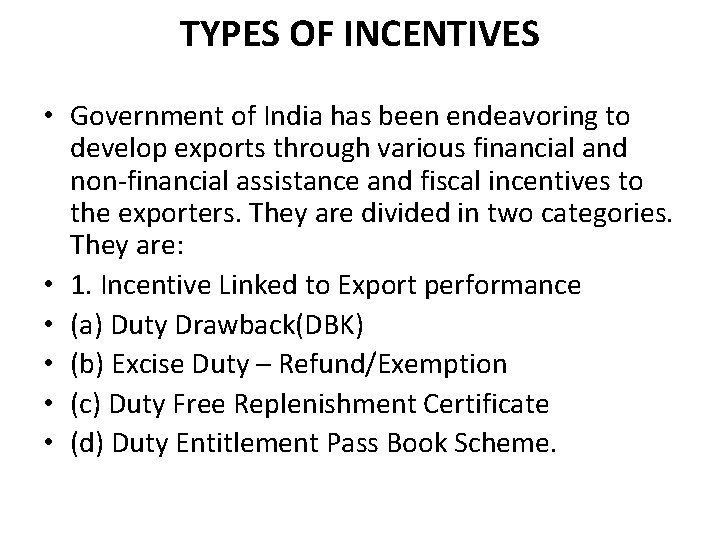
• In the absence of adequate planning, it will upset their fund flow and equally the total realization may not be remunerative for effecting exports. • Exporters have to draw a suitable plan of action for claiming incentives in a timely manner to avoid delays and cuts in realization. • Exporters have to understand the different procedural formalities, connected with multiple and diverse agencies. This would ensure proper compliance for availing of full benefit of incentives. • In this area, Government has to rationalize the incentives by opening a single window approach for sanction of multiple claims.
TYPES OF INCENTIVES • Government of India has been endeavoring to develop exports through various financial and non-financial assistance and fiscal incentives to the exporters. They are divided in two categories. They are: • 1. Incentive Linked to Export performance • (a) Duty Drawback(DBK) • (b) Excise Duty – Refund/Exemption • (c) Duty Free Replenishment Certificate • (d) Duty Entitlement Pass Book Scheme.
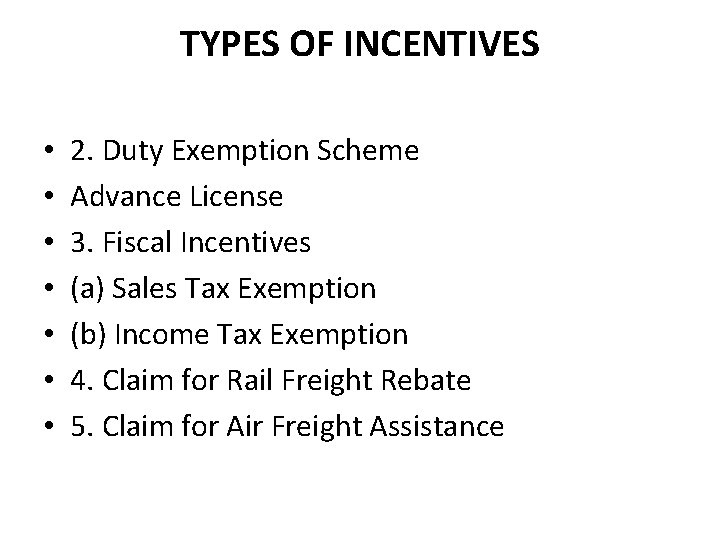
TYPES OF INCENTIVES • • 2. Duty Exemption Scheme Advance License 3. Fiscal Incentives (a) Sales Tax Exemption (b) Income Tax Exemption 4. Claim for Rail Freight Rebate 5. Claim for Air Freight Assistance
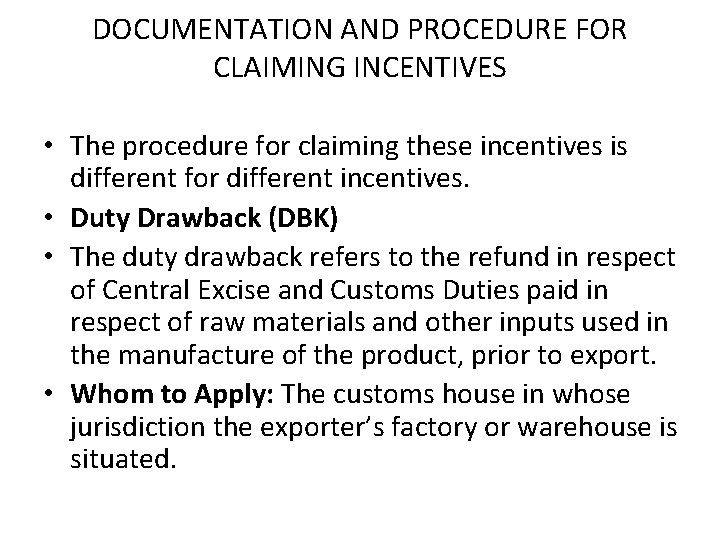
DOCUMENTATION AND PROCEDURE FOR CLAIMING INCENTIVES • The procedure for claiming these incentives is different for different incentives. • Duty Drawback (DBK) • The duty drawback refers to the refund in respect of Central Excise and Customs Duties paid in respect of raw materials and other inputs used in the manufacture of the product, prior to export. • Whom to Apply: The customs house in whose jurisdiction the exporter’s factory or warehouse is situated.
• When to Apply: An exporters is entitled to claim the duty drawback as soon as the export of goods is completed. Delivery of goods at the port of destination is not essential. Export’ for the purpose of claiming duty drawback is evidenced by “Let Export Order”. Claim application is to be submitted with in a period of three months from the date of “Let Export Order”, issued by the Customs Officer. The exporter can seek extension of period for submission of claim. The Assistant Commissioner can grant extension for a period of three months, if he is satisfied that the exporter is prevented from submitting the application.
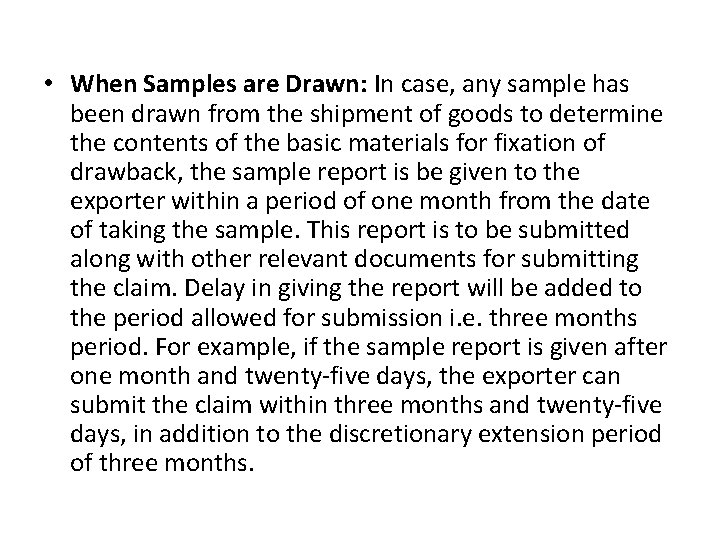
• When Samples are Drawn: In case, any sample has been drawn from the shipment of goods to determine the contents of the basic materials for fixation of drawback, the sample report is be given to the exporter within a period of one month from the date of taking the sample. This report is to be submitted along with other relevant documents for submitting the claim. Delay in giving the report will be added to the period allowed for submission i. e. three months period. For example, if the sample report is given after one month and twenty-five days, the exporter can submit the claim within three months and twenty-five days, in addition to the discretionary extension period of three months.
• Drawback Rates: The Government of India announces the rates of duty drawback every year on 31 st May, product wise in the drawback schedule. Generally, the rates are expressed as a percentage of the FOB value of the goods exported. All such rates are called All Industry Rates. The rates are made effective from 1 st June of every year. In case, duty drawback rate is not announced for a particular product, the manufacturer/exporter is known as Brand Rate. In case, the rate of duty drawback is less than 80% of the duties paid, the exporter can submit an application for suitable upward revision. This is known as Special Brand Rate. The application is to be submitted to Directorate of Duty Drawback Ministry of Finance.
• When Duty Drawback not Admissible: Duty drawback is admissible for the export of all the notified products. However, in the following cases, it is not admissible: • (a) No excise/customs duty is paid for the manufacture of export product • (b) Amount of drawback is less than 1% of the FOB value of the goods. However, if the amount of drawback is more than Rs. 500, it can be claimed • (c) If the export proceeds are not realized within six months • (d) If the amount of foreign exchange spent on the inputs used for the export is more than the foreign exchange value of the exports. In other words, value addition is negative • (e) Cenvat Credit is availed of
• How to File Claim: The procedure for claiming duty drawback depends upon whether the processing of shipping documents has been computerized or not. The exporter is not required to file any separate application for claiming duty drawback, if the processing of documents has been computerized at the jurisdiction customs station. Where processing has not been computerized, separate application is to be submitted for claiming duty drawback. Triplicate copy of the shipping bill becomes the application only after the Export General Manifest is filed.
• Documents to be submitted: The following documents are to be submitted to the Directorate of Duty Drawback: • (a) Triplicate copy of the Shipping Bill • (b) Copy of bank attested invoice • (c) Copy of Packing List • (d) Copy of Bill of Lading/ Airway Bill • (e) Copy of ARE-1 form, where applicable • (f) Insurance Certificate, where necessary • (g) Copy of the Test Report, where required • (h) Copy of communication regarding Special Brand Rate fixation • (i) Copy of the export contract or letter of credit as the case may be • (j) Pre-receipt for drawback claim
• How Claim Amount is paid: The Customs House that has the jurisdiction over the port or airport through which exports are affected makes the payment. • How Delay in Payment of Claim is avoided: when the claim application along with complete set of documents is submitted, an acknowledgement in the prescribed form is issued to the exporter within 15 days from the date of filing the claim. The duty drawback is to be paid to the exporter within a period of two months from the date of acknowledgment. In case of delay, interest @15% per annum is paid for the period of default. Due to compulsory interest provision, normally, claims are settled in time.