
PROCEDURE DEVELOPMENT OF FLIP STATION FOR POSITING DISC
- Slides: 1
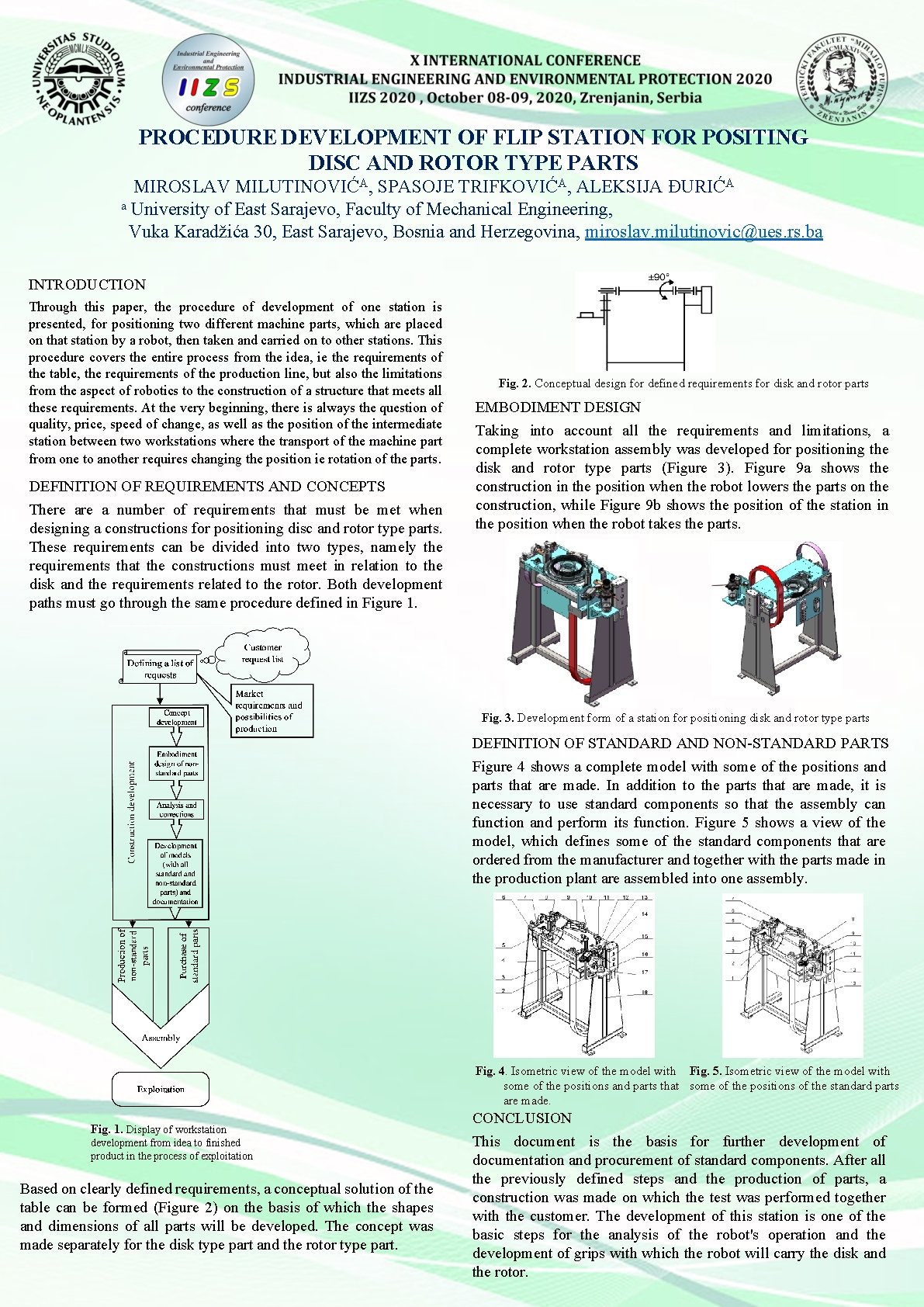
PROCEDURE DEVELOPMENT OF FLIP STATION FOR POSITING DISC AND ROTOR TYPE PARTS MIROSLAV MILUTINOVIĆA, SPASOJE TRIFKOVIĆA, ALEKSIJA ĐURIĆA a University of East Sarajevo, Faculty of Mechanical Engineering, Vuka Karadžića 30, East Sarajevo, Bosnia and Herzegovina, miroslav. milutinovic@ues. rs. ba INTRODUCTION Through this paper, the procedure of development of one station is presented, for positioning two different machine parts, which are placed on that station by a robot, then taken and carried on to other stations. This procedure covers the entire process from the idea, ie the requirements of the table, the requirements of the production line, but also the limitations from the aspect of robotics to the construction of a structure that meets all these requirements. At the very beginning, there is always the question of quality, price, speed of change, as well as the position of the intermediate station between two workstations where the transport of the machine part from one to another requires changing the position ie rotation of the parts. DEFINITION OF REQUIREMENTS AND CONCEPTS There a number of requirements that must be met when designing a constructions for positioning disc and rotor type parts. These requirements can be divided into two types, namely the requirements that the constructions must meet in relation to the disk and the requirements related to the rotor. Both development paths must go through the same procedure defined in Figure 1. Fig. 2. Conceptual design for defined requirements for disk and rotor parts EMBODIMENT DESIGN Taking into account all the requirements and limitations, a complete workstation assembly was developed for positioning the disk and rotor type parts (Figure 3). Figure 9 a shows the construction in the position when the robot lowers the parts on the construction, while Figure 9 b shows the position of the station in the position when the robot takes the parts. Fig. 3. Development form of a station for positioning disk and rotor type parts DEFINITION OF STANDARD AND NON-STANDARD PARTS Figure 4 shows a complete model with some of the positions and parts that are made. In addition to the parts that are made, it is necessary to use standard components so that the assembly can function and perform its function. Figure 5 shows a view of the model, which defines some of the standard components that are ordered from the manufacturer and together with the parts made in the production plant are assembled into one assembly. Fig. 4. Isometric view of the model with Fig. 5. Isometric view of the model with some of the positions and parts that some of the positions of the standard parts are made. Fig. 1. Display of workstation development from idea to finished product in the process of exploitation Based on clearly defined requirements, a conceptual solution of the table can be formed (Figure 2) on the basis of which the shapes and dimensions of all parts will be developed. The concept was made separately for the disk type part and the rotor type part. CONCLUSION This document is the basis for further development of documentation and procurement of standard components. After all the previously defined steps and the production of parts, a construction was made on which the test was performed together with the customer. The development of this station is one of the basic steps for the analysis of the robot's operation and the development of grips with which the robot will carry the disk and the rotor.