
Problems with Internal Validity Identifying Confounds Definition Internal
Problems with Internal Validity Identifying Confounds
Definition • Internal Validity: - Exclusivity in Conclusion - Power to define causal relationships - Independent Variable sole cause of change in Dependent Variable Exp: “The therapy treatment significantly reduced attention deficit symptoms in a sample of children”
Confounds • Limit Internal Validity • Reduce power of exclusivity • Reduce the credibility of any causal conclusion • Introduce alternative explanations for the change in the dependent variable • Alternative factors affecting subjects and the dependent variable • Can be uncontrolled factors or unknown factors • Goal: Anticipate potential confounds and eliminate their influence in the experiment
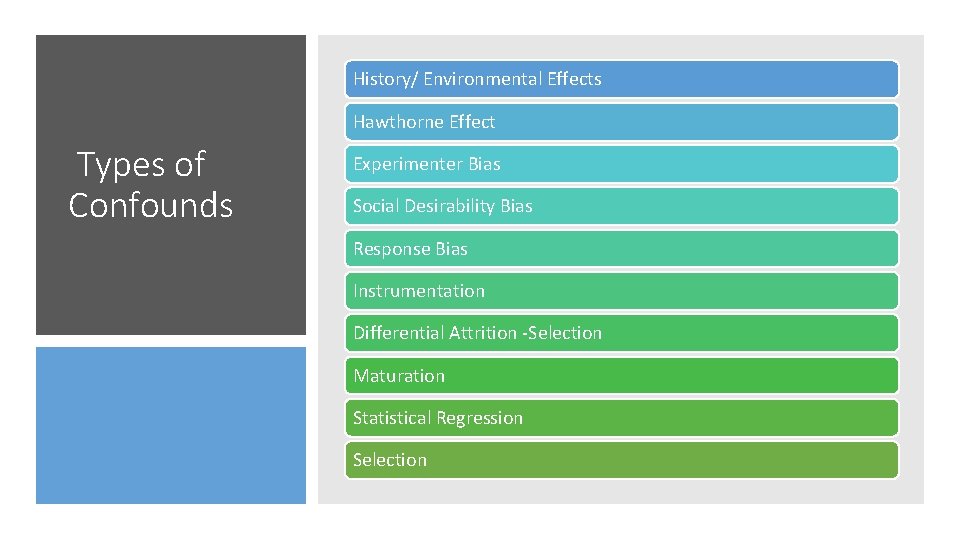
History/ Environmental Effects Hawthorne Effect Types of Confounds Experimenter Bias Social Desirability Bias Response Bias Instrumentation Differential Attrition -Selection Maturation Statistical Regression Selection
History Effect • Within-Subjects Design: • Pre-Post Test Design: • IV: Study Skills Training DV: Score on Test • Design: Pretest (measure on test) – Study Skills Training (IV) – Post-test (measure on test) • Confound: Subjects sent home after study skills training and many received individual after school tutoring • Question: What other factors might the subjects be exposed to that can affect their performance on the test?
• Between-Subject Design • Treatment vs No Treatment Control History Effect • IV: CBT Depr Treatment (tx or none) DV: Depr Tx • Confound: Control Group interacts with subjects in treatment group and learn of CBT training, leading to demoralization and distortive response on measure (contamination) • Question? What other kinds of factors can impact one group and not the other? And also effect the DV?
Hawthorne Effect Definition: Subjects are aware of being tested, measured, or observed which affects their response on the DV (measure). Within-Subjects: Pre-Post Design • Example: Workers in office setting were evaluated to assess whether reconfiguring work space to a more open model improved productivity. Measured pre-change and postchange of office space in levels of productivity. Subjects became aware of being monitored which increased their productivity by post test. • Question: Give an example of a Hawthorne effect if this was a between-subjects design study?
Experimenter Bias • Experimenter in aware of which group each subject is in and unwittingly influences the response in the condition. • Examples: • Experimenter is friendlier to the subjects in therapy tx group than subjects in the nontreatment control group. • Experimenter treats the one type treatment group differently from all the other treatment groups giving cues that they are receiving the “special” treatment • Within-Subjects Design: Experimenter approach/cues to subjects differ between conditions • Solution? “Blind Study”: Experimenter is unaware of which condition each Ss is in
Social Desirability Bias • Subjects are influenced by the need to create a positive impression • Examples: • Subjects may over-perform • Subjects may respond to questionnaire in an manner that depicts them positively • Subjects respond to measure in a manner they believe the experimenter desires • Solution? Both Experimenter and Social Desirability Bias can be reduced by having a “Double Blind” Study where neither the experimenter or subjects know which condition they are participating
Subjects answer questions randomly or check all same Invalidates the questionnaire/survey Response Bias Can bias and distort findings if not caught before conducting final statistical analysis Examples: Answering all ‘yes’, or randomly Answering all ‘a’ or ‘ 1’ on likert scale
Instrumentation • Errors in Measurement Taking • If different across groups – creates a confound, poor Internal validity • If equal error across group – creates increased “noise”, variance, therefore reduced Statistical Validity • Example: • Study on mindfulness training on reducing children’s aggressive behaviors; Raters were more accurate in their observations of student’s aggressive behavior in the tx condition but undercounted in the control condition. The difference of aggressive behavior observed between groups cannot be soley attributed to the difference in tx condition. • Solution: Standardize Training of Raters
Differential Attrition • Drop in subjects leading to different number of subjects across groups • Much more problematic with Within-Subjects Design • Selection Confound: Groups differ in characteristics that may affect DV(meas) Example: Pre-Post Study: Pretest – 100 subjects vs 20 subjects in Post-test Why? Subjects who leave may be very different from those who stay
Maturation • Subjects response to the Dep Variable changes due to changes in aspects of self (adaptation) • Example: • Evaluating effects of therapy in assisting foster children in group homes adjust to changes: pretest (adjustment measure) – therapy – posttest 6 months later (adjustment measure) • 1 year Longitudinal Study on effects of mindfulness training on reducing anxiety in post-surgery breast cancer patients
Statistical Regression • Change in scores on the DV due to “regression to the mean” phenomenon • Example: • Effects of support group in reducing grief symptoms • Subjects self-select into a self-help group (measurement taken) – 3 months later (measurement taken); High scores in grief likely to reduce due to statistical regression • Students struggling in math, selected into a study due to low math scores, post-tx will likely score higher due to statistical regression
• Differences in measure between groups due to differences in subject characteristics. Selection • Example: Non-random assignment of subjects: • Compare effect of marketing signs on costumers in a Starbucks on college campus vs no marketing signs at a coffee shop in a rural city • Compare the effect of psychoeducation on diabetes symptoms on patients from assisted living homes vs outpatient clinic control group
Group Work: Identifying Confounds • Researchers wanted to test the effects of a new performance anxiety treatment on athletes experiencing post performance anxiety. The independent variable Perf Anx Tx varied 3 ways (Tx, Coach Pep talk, visualization). Researcher recruited a college baseball team for the tx group, the volleyball team for the coach pep talk group, and the track team for the visualization. The dependent variable Perf Anx was measured by a clinical interview. There was a different clinician interviewing each of the teams. The researchers, clinicians, and subjects were aware of the condition assignments. Because of logistical complications, subjects in the visualization and tx groups were not post tested until 6 months after the administration of the conditions. • Identify as many confounds as possible and provide a solution for each.
- Slides: 16