
Problems of the Day Simplify each expression 1
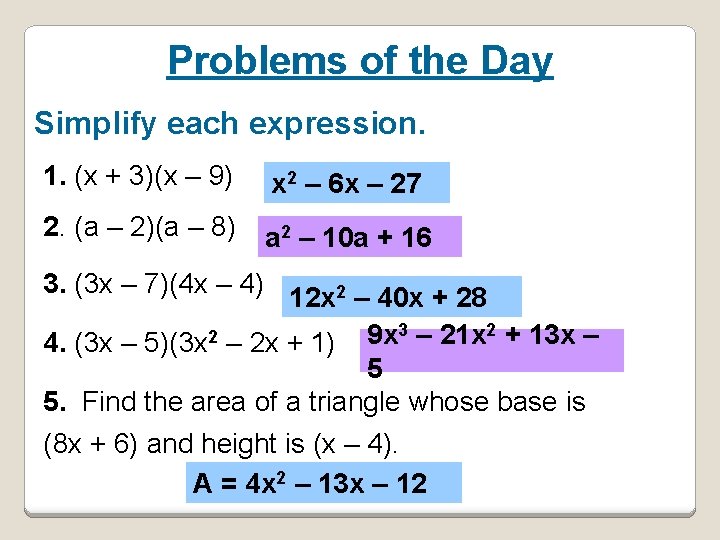
Problems of the Day Simplify each expression. 1. (x + 3)(x – 9) x 2 – 6 x – 27 2. (a – 2)(a – 8) a 2 – 10 a + 16 3. (3 x – 7)(4 x – 4) 12 x 2 – 40 x + 28 3 – 21 x 2 + 13 x – 2 9 x 4. (3 x – 5)(3 x – 2 x + 1) 5 5. Find the area of a triangle whose base is (8 x + 6) and height is (x – 4). A = 4 x 2 – 13 x – 12
Algebra 1 ~ Chapter 9. 1 “Factors and Greatest Common Factors”
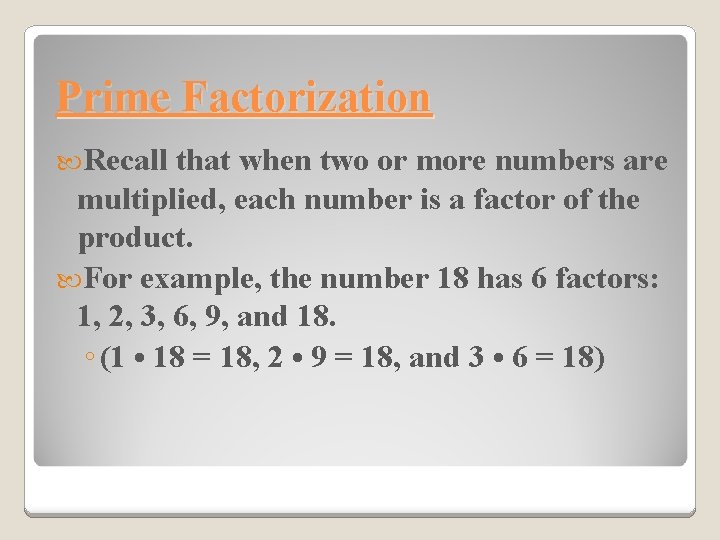
Prime Factorization Recall that when two or more numbers are multiplied, each number is a factor of the product. For example, the number 18 has 6 factors: 1, 2, 3, 6, 9, and 18. ◦ (1 • 18 = 18, 2 • 9 = 18, and 3 • 6 = 18)
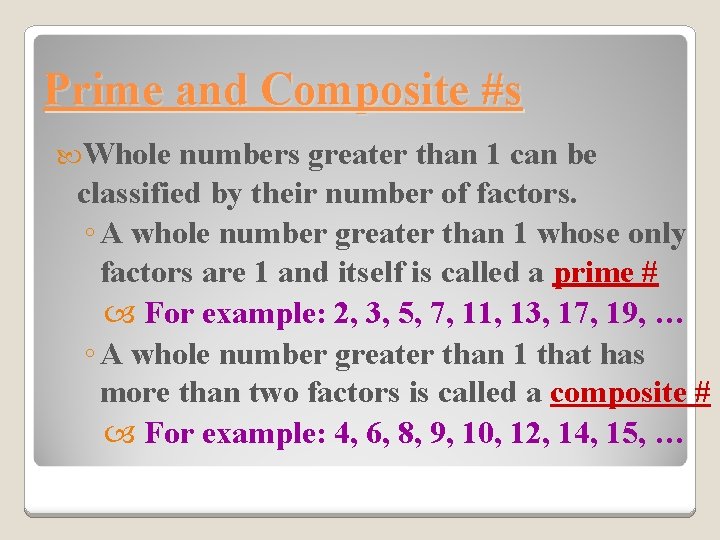
Prime and Composite #s Whole numbers greater than 1 can be classified by their number of factors. ◦ A whole number greater than 1 whose only factors are 1 and itself is called a prime # For example: 2, 3, 5, 7, 11, 13, 17, 19, … ◦ A whole number greater than 1 that has more than two factors is called a composite # For example: 4, 6, 8, 9, 10, 12, 14, 15, …
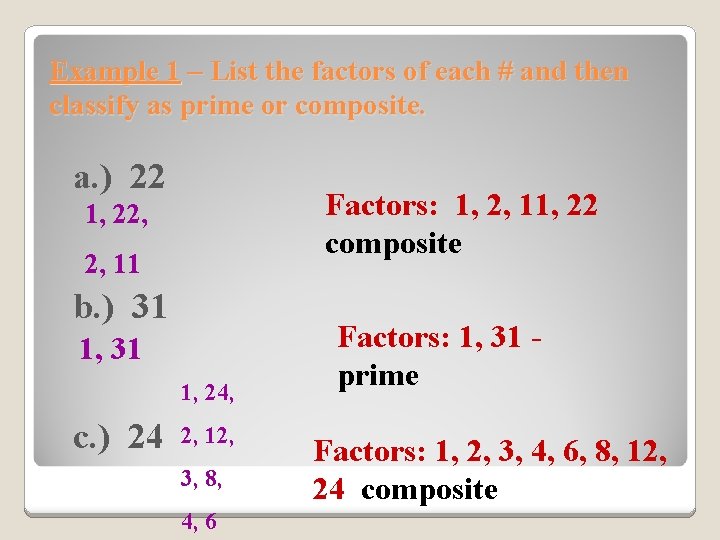
Example 1 – List the factors of each # and then classify as prime or composite. a. ) 22 Factors: 1, 2, 11, 22 composite 1, 22, 2, 11 b. ) 31 1, 24, c. ) 24 2, 12, 3, 8, 4, 6 Factors: 1, 31 prime Factors: 1, 2, 3, 4, 6, 8, 12, 24 composite
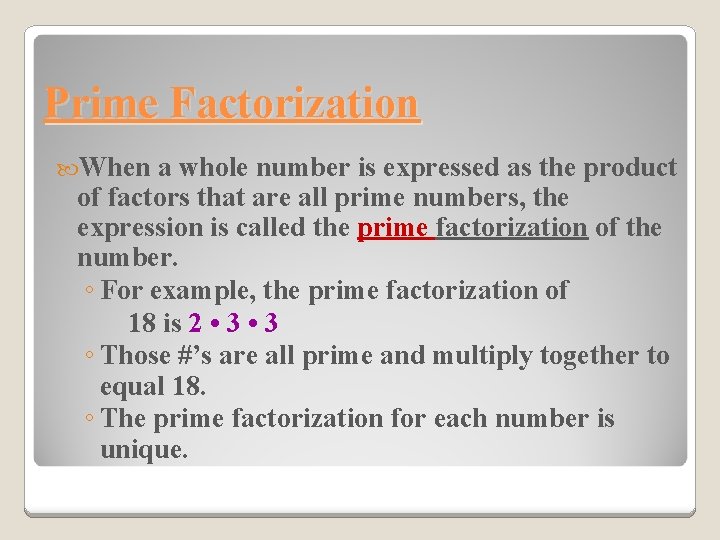
Prime Factorization When a whole number is expressed as the product of factors that are all prime numbers, the expression is called the prime factorization of the number. ◦ For example, the prime factorization of 18 is 2 • 3 ◦ Those #’s are all prime and multiply together to equal 18. ◦ The prime factorization for each number is unique.
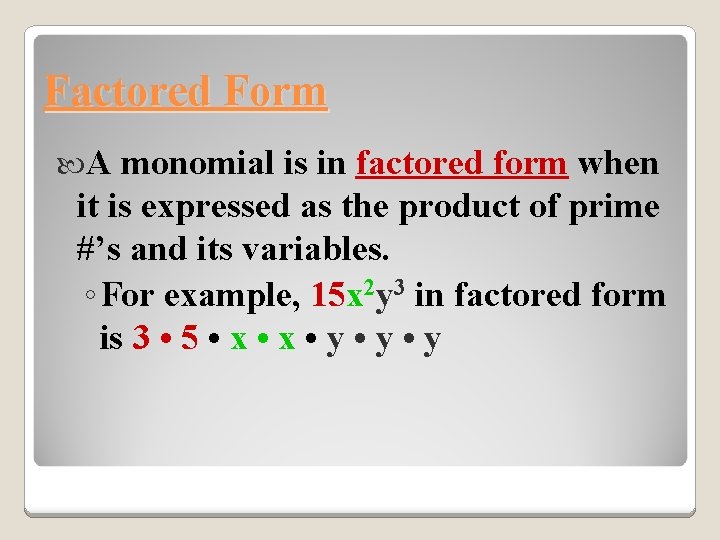
Factored Form A monomial is in factored form when it is expressed as the product of prime #’s and its variables. ◦ For example, 15 x 2 y 3 in factored form is 3 • 5 • x • y • y
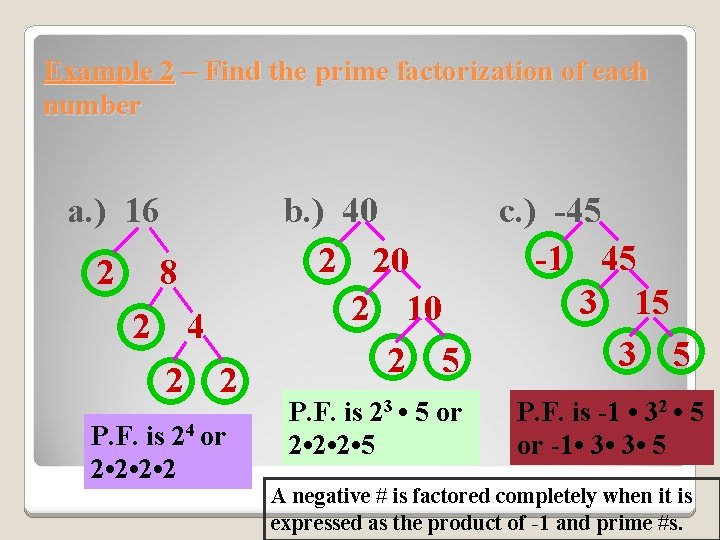
Example 2 – Find the prime factorization of each number a. ) 16 2 8 2 4 2 2 P. F. is 24 or 2 • 2 • 2 b. ) 40 2 20 2 10 2 5 P. F. is 23 • 5 or 2 • 2 • 5 c. ) -45 -1 45 3 15 3 5 P. F. is -1 • 32 • 5 or -1 • 3 • 5 A negative # is factored completely when it is expressed as the product of -1 and prime #s.
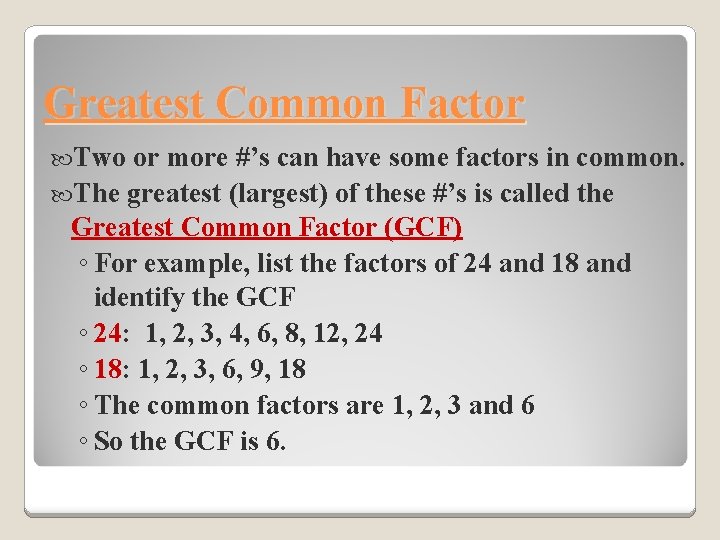
Greatest Common Factor Two or more #’s can have some factors in common. The greatest (largest) of these #’s is called the Greatest Common Factor (GCF) ◦ For example, list the factors of 24 and 18 and identify the GCF ◦ 24: 1, 2, 3, 4, 6, 8, 12, 24 ◦ 18: 1, 2, 3, 6, 9, 18 ◦ The common factors are 1, 2, 3 and 6 ◦ So the GCF is 6.
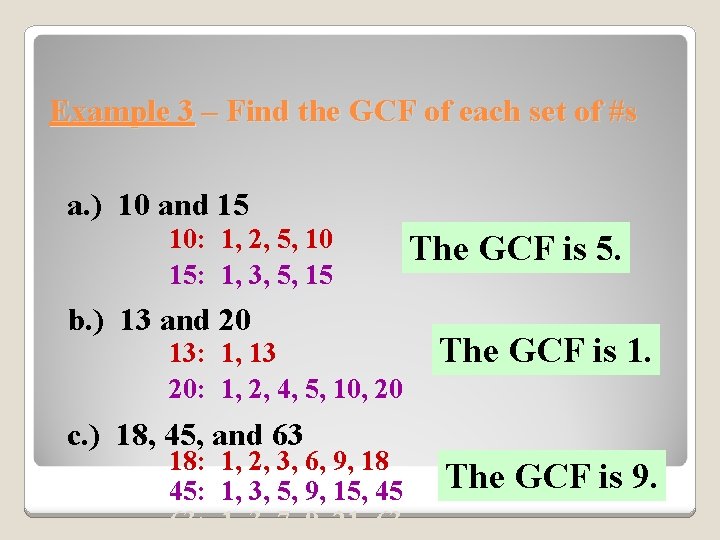
Example 3 – Find the GCF of each set of #s a. ) 10 and 15 10: 1, 2, 5, 10 15: 1, 3, 5, 15 b. ) 13 and 20 13: 1, 13 20: 1, 2, 4, 5, 10, 20 The GCF is 5. The GCF is 1. c. ) 18, 45, and 63 18: 1, 2, 3, 6, 9, 18 45: 1, 3, 5, 9, 15, 45 63: 1, 3, 7, 9, 21, 63 The GCF is 9.
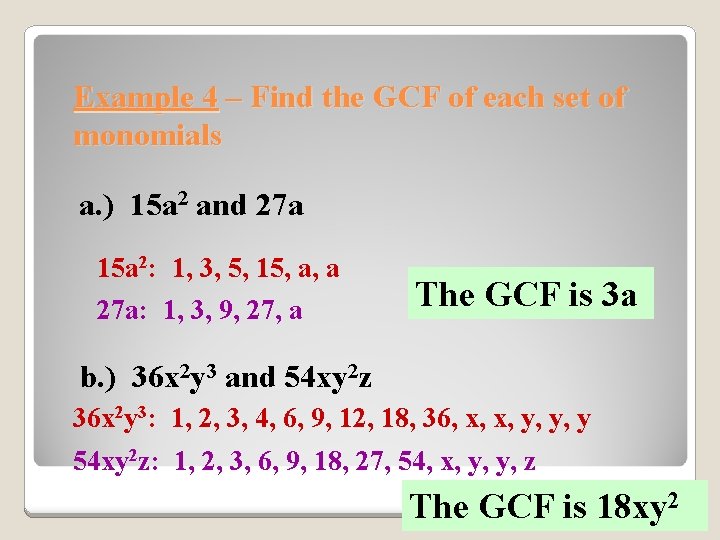
Example 4 – Find the GCF of each set of monomials a. ) 15 a 2 and 27 a 15 a 2: 1, 3, 5, 15, a, a 27 a: 1, 3, 9, 27, a The GCF is 3 a b. ) 36 x 2 y 3 and 54 xy 2 z 36 x 2 y 3: 1, 2, 3, 4, 6, 9, 12, 18, 36, x, x, y, y, y 54 xy 2 z: 1, 2, 3, 6, 9, 18, 27, 54, x, y, y, z The GCF is 18 xy 2
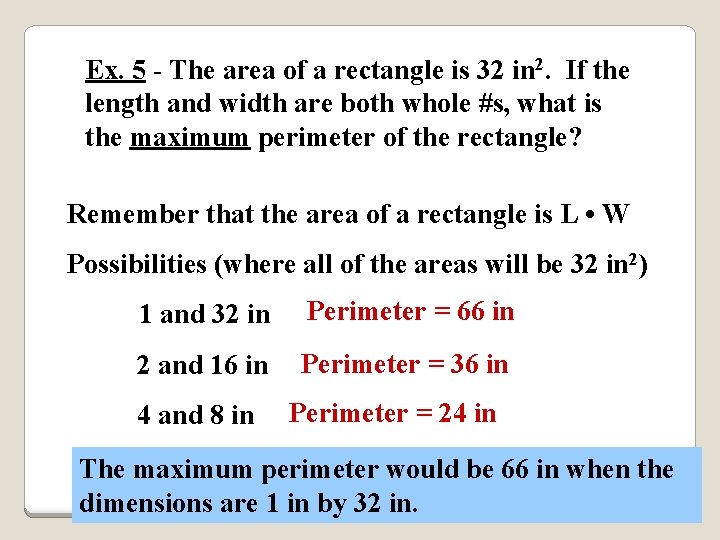
Ex. 5 - The area of a rectangle is 32 in 2. If the length and width are both whole #s, what is the maximum perimeter of the rectangle? Remember that the area of a rectangle is L • W Possibilities (where all of the areas will be 32 in 2) 1 and 32 in Perimeter = 66 in 2 and 16 in Perimeter = 36 in 4 and 8 in Perimeter = 24 in The maximum perimeter would be 66 in when the dimensions are 1 in by 32 in.
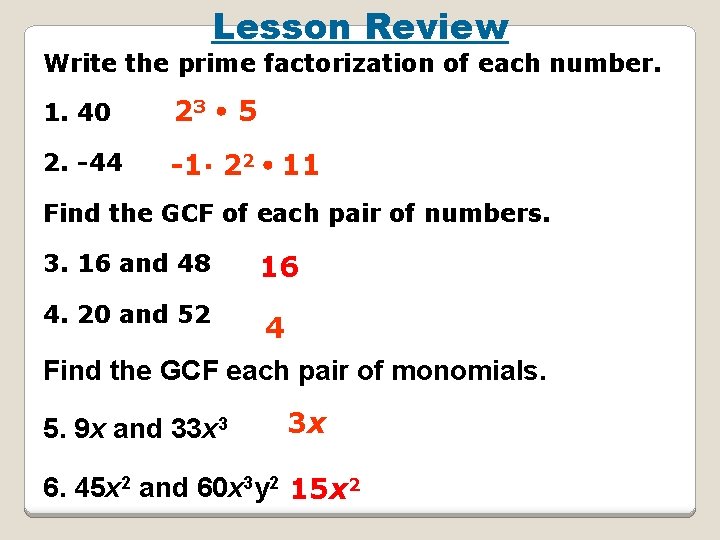
Lesson Review Write the prime factorization of each number. 1. 40 23 5 2. -44 -1· 22 11 Find the GCF of each pair of numbers. 3. 16 and 48 16 4. 20 and 52 4 Find the GCF each pair of monomials. 5. 9 x and 33 x 3 3 x 6. 45 x 2 and 60 x 3 y 2 15 x 2
Algebra 1 ~ Chapter 9. 2 day 1 Factoring out the GCF
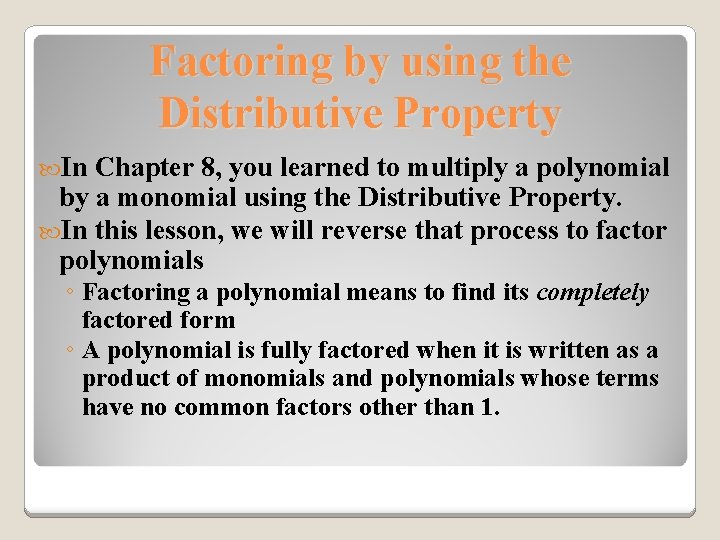
Factoring by using the Distributive Property In Chapter 8, you learned to multiply a polynomial by a monomial using the Distributive Property. In this lesson, we will reverse that process to factor polynomials ◦ Factoring a polynomial means to find its completely factored form ◦ A polynomial is fully factored when it is written as a product of monomials and polynomials whose terms have no common factors other than 1.
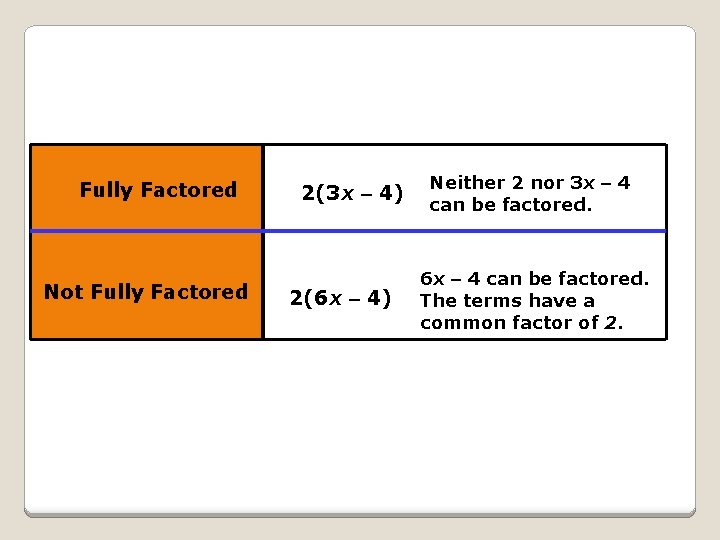
Fully Factored Not Fully Factored 2(3 x – 4) 2(6 x – 4) Neither 2 nor 3 x – 4 can be factored. 6 x – 4 can be factored. The terms have a common factor of 2.
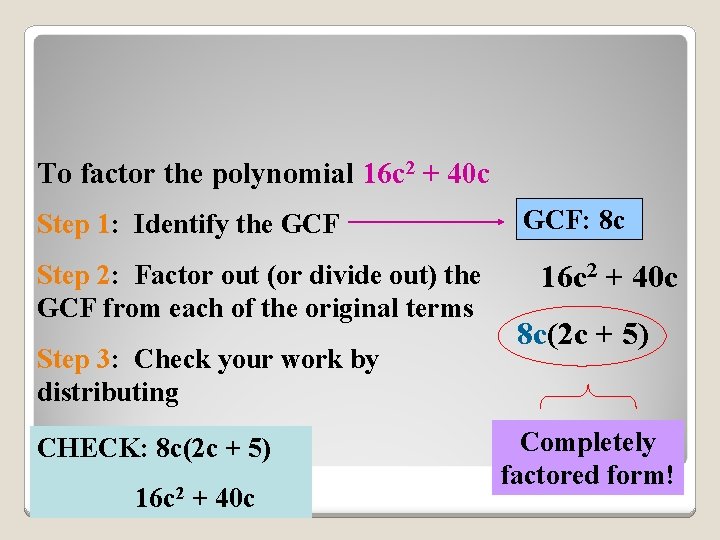
To factor the polynomial 16 c 2 + 40 c Step 1: Identify the GCF Step 2: Factor out (or divide out) the GCF from each of the original terms Step 3: Check your work by distributing CHECK: 8 c(2 c + 5) Example 16 c 2 + 40 c GCF: 8 c 16 c 2 + 40 c 8 c(2 c + 5) Completely factored form!
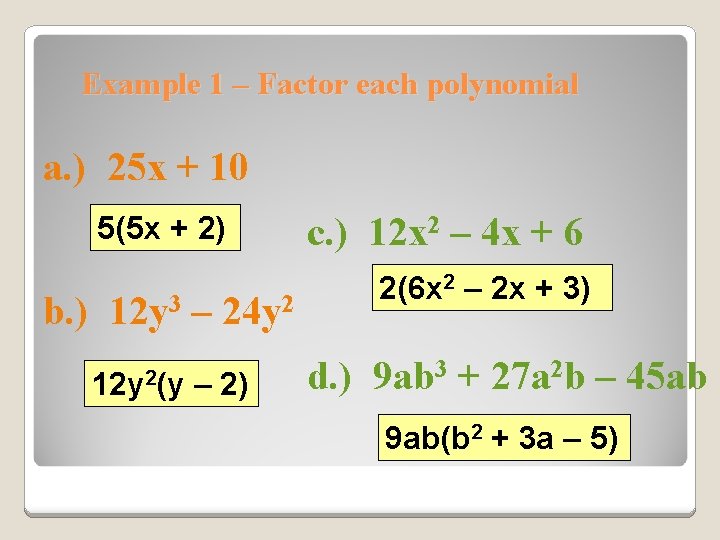
Example 1 – Factor each polynomial a. ) 25 x + 10 5(5 x + 2) b. ) 12 y 3 – 24 y 2 12 y 2(y – 2) c. ) 12 x 2 – 4 x + 6 2(6 x 2 – 2 x + 3) d. ) 9 ab 3 + 27 a 2 b – 45 ab 9 ab(b 2 + 3 a – 5)
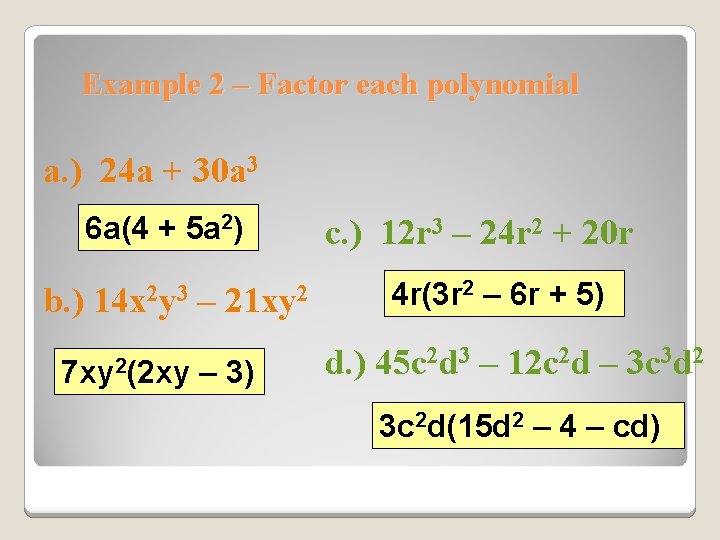
Example 2 – Factor each polynomial a. ) 24 a + 30 a 3 6 a(4 + 5 a 2) b. ) 14 x 2 y 3 7 xy 2(2 xy – 21 xy 2 – 3) c. ) 12 r 3 – 24 r 2 + 20 r 4 r(3 r 2 – 6 r + 5) d. ) 45 c 2 d 3 – 12 c 2 d – 3 c 3 d 2 3 c 2 d(15 d 2 – 4 – cd)
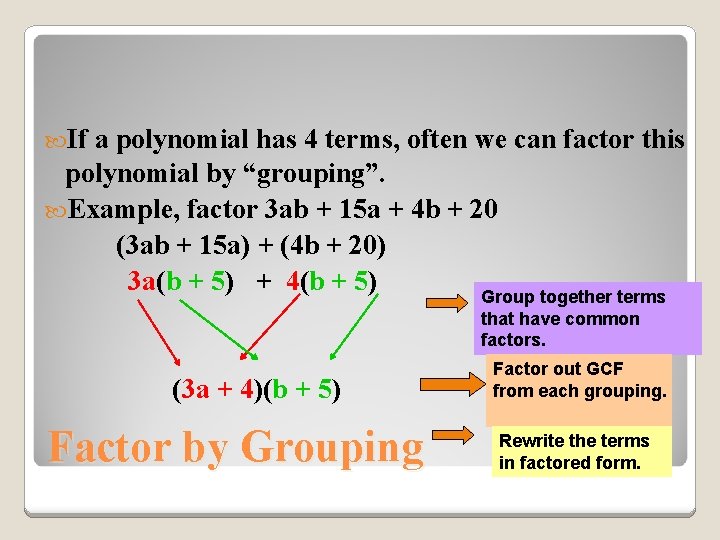
If a polynomial has 4 terms, often we can factor this polynomial by “grouping”. Example, factor 3 ab + 15 a + 4 b + 20 (3 ab + 15 a) + (4 b + 20) 3 a(b + 5) + 4(b + 5) Group together terms that have common factors. (3 a + 4)(b + 5) Factor by Grouping Factor out GCF from each grouping. Rewrite the terms in factored form.
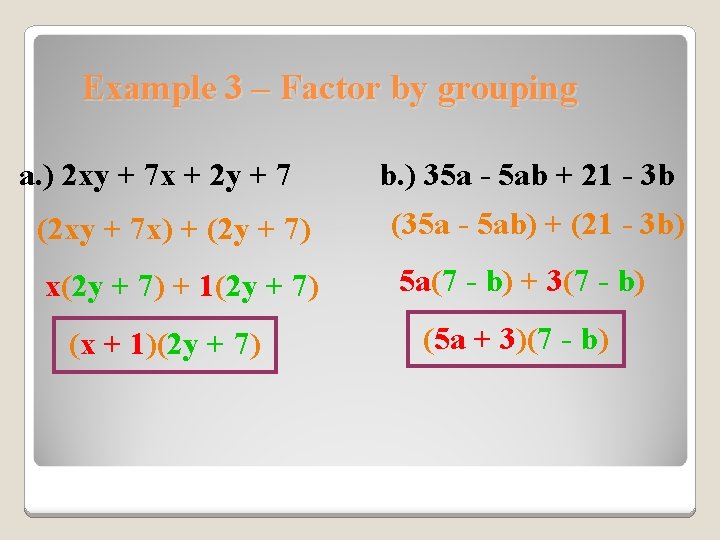
Example 3 – Factor by grouping a. ) 2 xy + 7 x + 2 y + 7 b. ) 35 a - 5 ab + 21 - 3 b (2 xy + 7 x) + (2 y + 7) (35 a - 5 ab) + (21 - 3 b) x(2 y + 7) + 1(2 y + 7) 5 a(7 - b) + 3(7 - b) (x + 1)(2 y + 7) (5 a + 3)(7 - b)
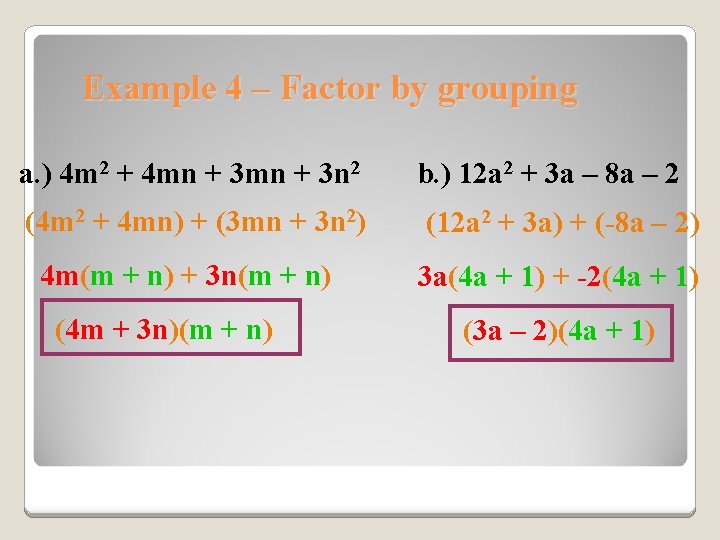
Example 4 – Factor by grouping a. ) 4 m 2 + 4 mn + 3 n 2 b. ) 12 a 2 + 3 a – 8 a – 2 (4 m 2 + 4 mn) + (3 mn + 3 n 2) (12 a 2 + 3 a) + (-8 a – 2) 4 m(m + n) + 3 n(m + n) (4 m + 3 n)(m + n) 3 a(4 a + 1) + -2(4 a + 1) (3 a – 2)(4 a + 1)

Assignment Skills Practice 9 -2 (#’s 1 -18) Practice 9 -2 (#1 -18) Quiz on Sections 9 -1 to 9 -2 on Friday, April 15 th!!!!!
- Slides: 23