
Problems of Crime Scene Management Legal Issues Are
Problems of Crime Scene Management
Legal Issues • • • Are we here legally? Can we search? Do we need a warrant? Where can we search? What can we take?
Michigan v. Tyler • January 21 st – Emergency circumstances – Criminal Investigation – Scene is left unprotected from 4 am until 8 am • February 16 – Re-entry by police – More photos and evidence collected
Mincey v. Arizona • Undercover officer shot and killed during raid • Homicide detectives make a four day warrantless search of the scene • Suspect is interrogated in the hospital • Asks for a lawyer but questioning continues • “murder scene exception” created by AZ. Supreme Ct. - unconstitutional
Mincey v. Arizona • Seriousness of the offense does not itself create exigent circumstances • All people were accounted for before the search began – no emergency existed • Does the person have an expectation of privacy in the location?
• Don’t assume this issue has been considered • Ask about it before you begin your scene work • Review the warrant before you begin • Copy of warrant and list of items collected left at scene
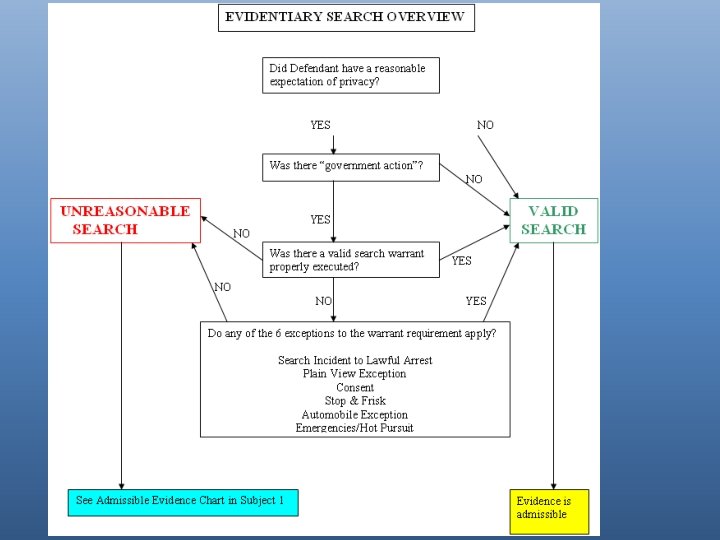
Warrantless Search • Incident to arrest – Chimel v. California – “within his immediate control” – Where he might gain a weapon or destructible device – Prevent the destruction of evidence – Either officer safety or evidentiary concerns must exist – but not both
Warrantless Search • Consent – Voluntary – not coerced – Scope of search can be limited – Written or verbal – Recorded if possible – Engage in conversation prior to obtaining consent – Can the person give consent? – Common areas – Withdrawal of consent
Warrantless Search • Consent – Motel employee – Parent consents to minor child – Minor child consent to parents – Spouse – Co-tenant
Warrantless Search • Plain view – Police must be lawfully present in a place from which the object can be plainly seen – Before an object can be seized the police must have probable cause that the object is subject to seizure under the law without further movement, manipulation or further intrusion on the persons expectation of privacy
Warrantless Search • Plain view categories of subjects that can be seized: – Property that constitutes evidence of the commission of a crime – Contraband, the fruits of a crime or things otherwise criminally possessed – Property designed or intended for use or which is or has been used as the means of committing a crime

Warrantless Search • Plain View – Police must have a lawful right of access to the object – Even if the officer can see the object from a place they are lawfully present, the officer cannot seize it unless there is a lawful right of access to the object itself – Taylor v. U. S. – police look through opening in garage and see cases containing illegal liquor. Cannot be seized because it is in a Constitutionally protected area – Does seeing it constitute probable cause?
Warrantless Search • Automobile Exception – Carroll Doctrine – LEO has probable cause that the vehicle contains items subject to seizure – Arizona v. Gant • Search of auto incident to arrest only if: • Arrestee is within reaching distance of the passenger compartment at the time arrested OR • It is reasonable to believe the vehicle contains evidence of the offense of the arrest – Inventory
Warrantless Search • Stop and Frisk – Terry v. Ohio • Reasonableness standard established • Outer clothing search for weapons
Warrantless Search • Exigent Circumstances/Fresh pursuit – Police can, without a warrant, seize evidence that can be easily moved, destroyed, or otherwise made to disappear before a warrant can be issued – Emergency aid – Threat of violence – Hot Pursuit – Risk of escape – Risk of loss of evidence
• If there is any doubt…. • GET A WARRANT!!!!!
3 Significant Problems • Duties of the first officer(s) to arrive at the scene • Exchange of information between investigators • Emphasis and recognition of physical evidence
Duties of first responders • Shut down the area and establish control – Use whatever is available – Needs to be done ASAP • Provide first aid – Police officer with victim/suspect to hospital – Statements taken – Physical evidence collection – chain of custody • Isolate witnesses/suspects – Separated – take their ID
Duties of first responders • Who is who – Victim? Witness? Suspect? – Who’s the best witness • Make arrest when appropriate – Don’t be premature in this – Miranda? • Prevent physical evidence from being destroyed – accidentally or on purpose
Duties of first responders • Info out to other units – May not need everyone at the scene – Descriptions, direction of travel, destination, items they may have on them • Listen carefully to what is being said – To you and to others they may be talking to – Watch carefully to see what is not being said – Body language • Do I need help with this? – Know when you are in over your head • This is the key to this job
Duties of first responders • Your investigation – Organization – Thoroughness – Caution • Somebody is going to have all the time in the world to critique your work • Most likely to lose evidence early in the investigation
Duties of first responders • First responding officers MUST be trained in recognizing evidence and scene preservation • Them recognizing the evidence is CRITICAL to the success of the investigation
L-O-L-O • • L – Lock O - On L - Lock O – Out • Develop a theory about what happened • Remain open to other possibilities • Support your theory with facts – statements and physical evidence • Reconstruct the scene to the extent possible
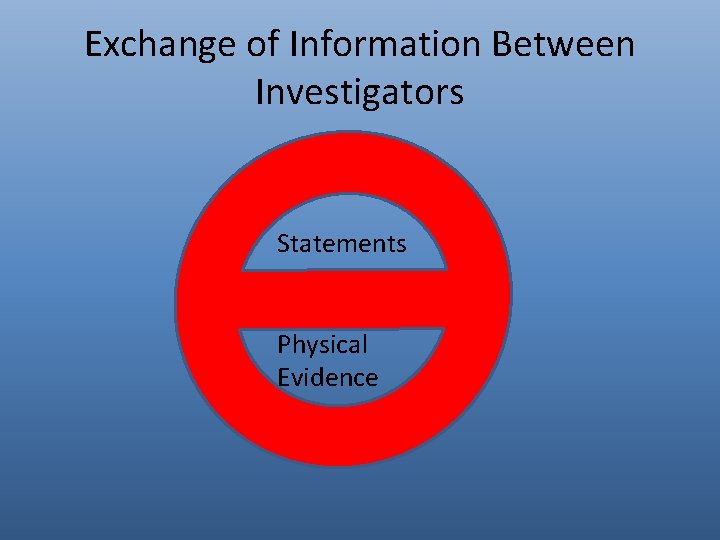
Exchange of Information Between Investigators Statements Physical Evidence
Exchange of Information Between Investigators • The physical evidence is also talking to you but it up to you to recognize it • Detectives and Evidence Techs need to constantly share information – During the investigation – scene liaison – As reports are received in follow up and trial prep • We limit ourselves if we are not doing this
Emphasis and Recognition of Physical Evidence • Many police departments do not emphasize physical evidence as much as they should • This includes what is possible from lab analysis • Crime scene personnel should be training first responders (Police/Fire/EMS) /Detectives /Prosecutors
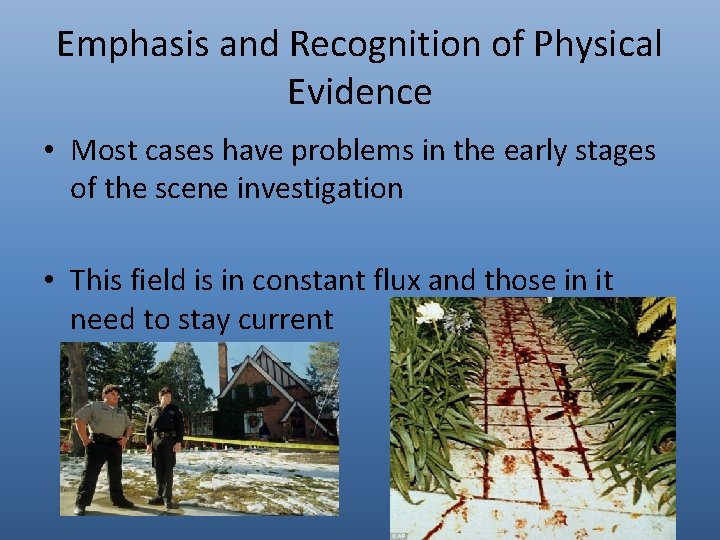
Emphasis and Recognition of Physical Evidence • Most cases have problems in the early stages of the scene investigation • This field is in constant flux and those in it need to stay current
Terminology • FORENSIC SCIENCE—The application of scientific or technical practices to the recognition, collection, analysis, and interpretation of evidence for criminal and civil law or regulatory issues
Terminology • Criminalistics – The scientific discipline directed to the recognition, identification, individualization and evaluation of physical evidence by application of the physical and natural sciences to law/science matters
Terminology • Evidence – That which is legally submitted to a competent tribunal as a means of ascertaining the truth of any alleged matter of fact under investigation before it – Physical evidence and testimonial evidence
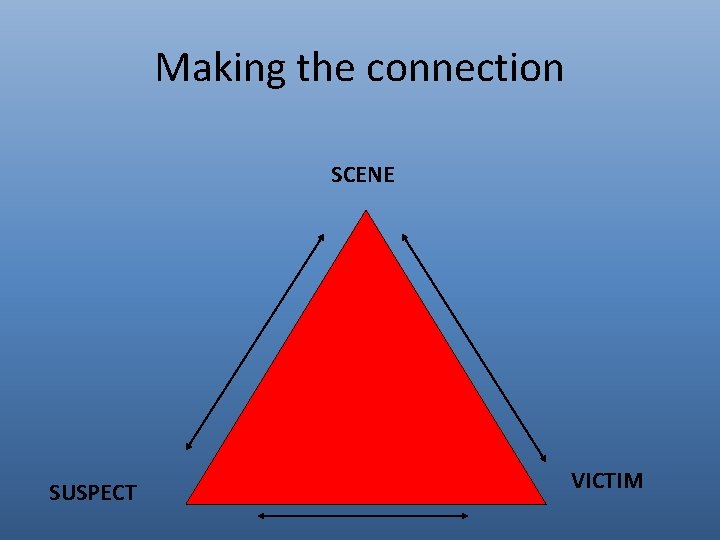
Making the connection SCENE SUSPECT VICTIM
Identification Terminology • Currently being revised for each forensic discipline (July 2016) • Latent Print Identification ONLY • 1. The examiner may state or imply that an identification is the determination that two friction ridge prints originated from the same source because there is sufficient quality and quantity of corresponding information such that the examiner would not expect to see that same arrangement of features repeated in another source. While an identification to the absolute exclusion of all others is not supported by research, studies have shown that as more reliable features are found in agreement, it becomes less likely to find that same arrangement of features in a print from another source.
Terminology • Class characteristic evidence – No matter how much the evidence is analyzed it can only be placed within a category or group and cannot be attributed to a single source • This determination may depend upon the quality of the evidence
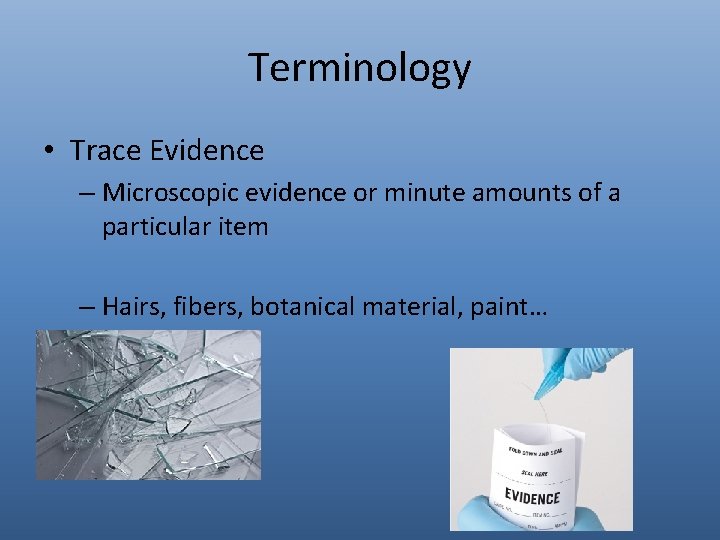
Terminology • Trace Evidence – Microscopic evidence or minute amounts of a particular item – Hairs, fibers, botanical material, paint…
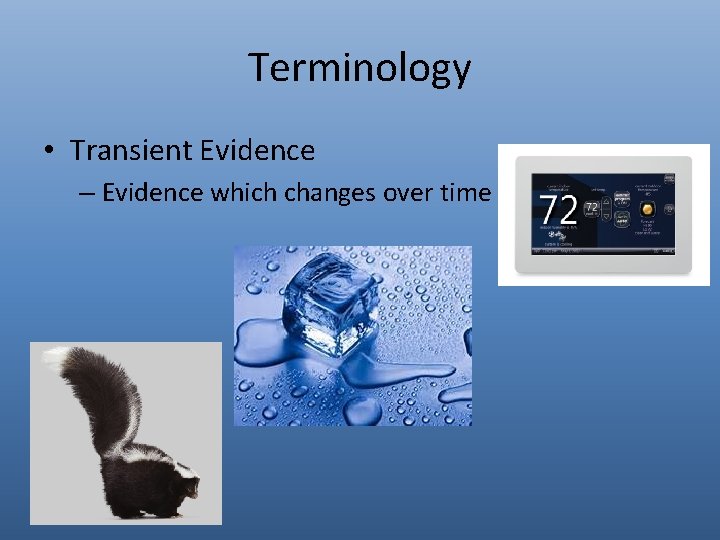
Terminology • Transient Evidence – Evidence which changes over time
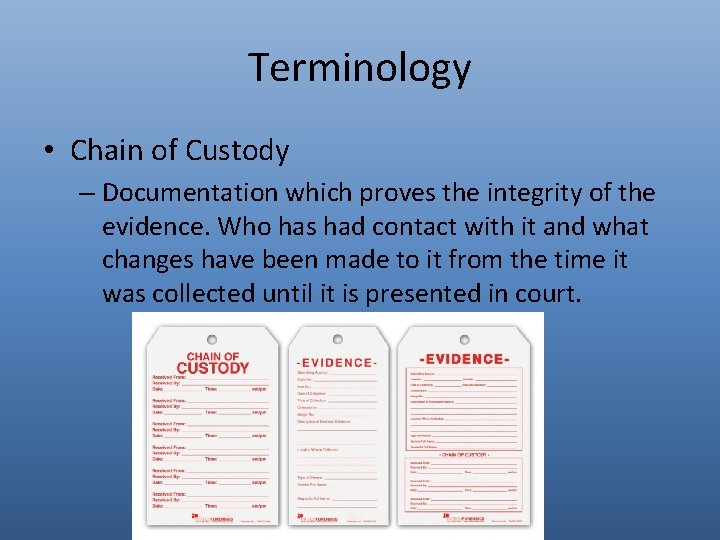
Terminology • Chain of Custody – Documentation which proves the integrity of the evidence. Who has had contact with it and what changes have been made to it from the time it was collected until it is presented in court.
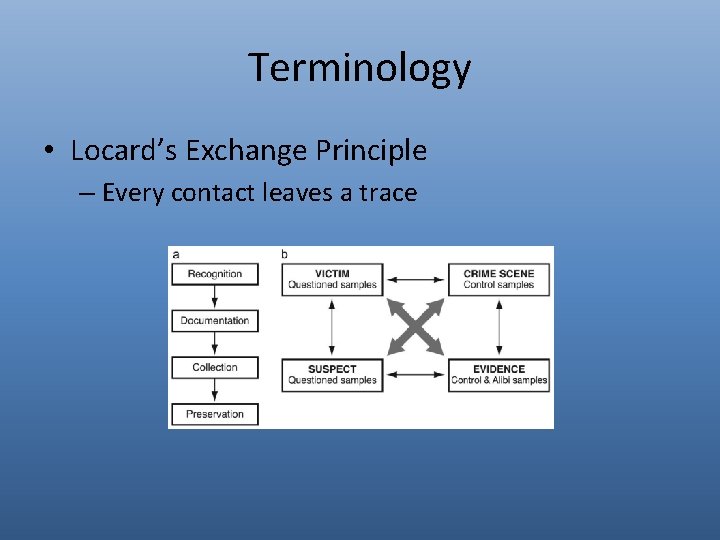
Terminology • Locard’s Exchange Principle – Every contact leaves a trace
Terminology • Crime Scene – That location where a violation of law has occurred – Primary scene v. satellite scene
Goals of Physical Evidence • R-I-P • Reconstruction • Identification • Probable Cause
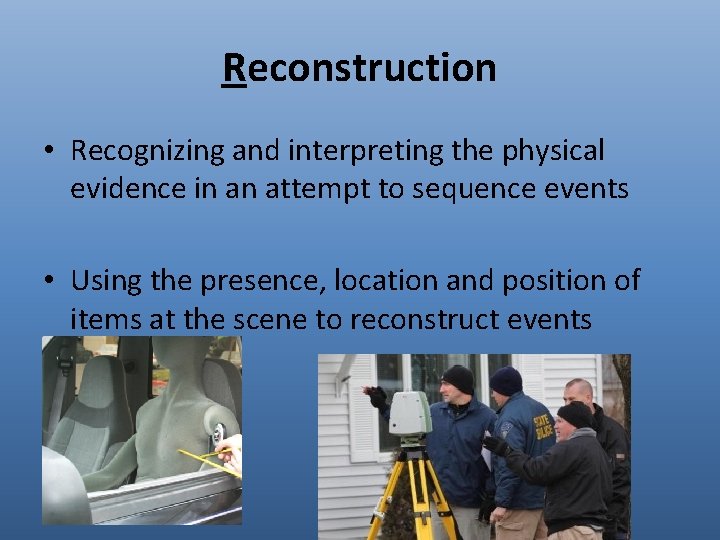
Reconstruction • Recognizing and interpreting the physical evidence in an attempt to sequence events • Using the presence, location and position of items at the scene to reconstruct events
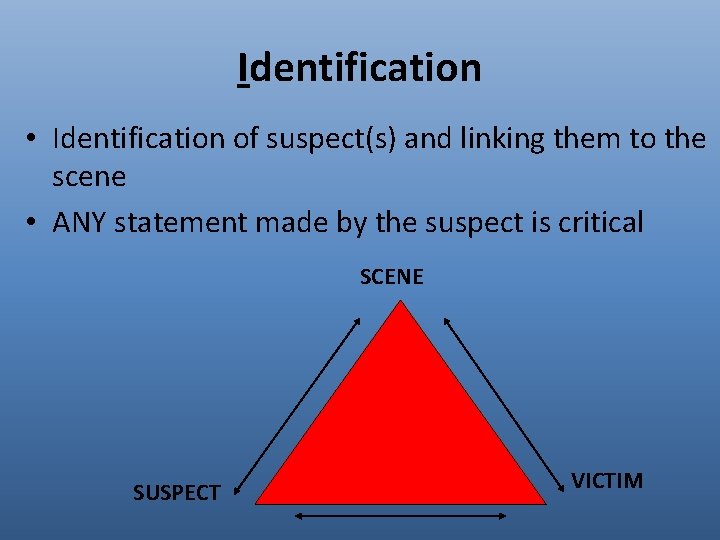
Identification • Identification of suspect(s) and linking them to the scene • ANY statement made by the suspect is critical SCENE SUSPECT VICTIM
Probable Cause • Using physical evidence to establish probable cause for arrest and/or search warrant • Scene information should be included in the affidavit for the search warrant
To achieve R-I-P • Recognize, collect, preserve and analyze the physical evidence • Document the scene and search thoroughly • Consider ALL the evidence – Exculpatory evidence must be included – Lock on/Lock out (LOLO)
Expert Testimony • The judge determines who will be allowed to testify as an expert • Judge will determine expertise by degrees, certification, experience, membership in organizations and previous expert testimony • Expert witness is allowed to give opinion testimony
Expert Testimony • Lay witness can only testify to what they have first hand knowledge of – what they have seen or heard • The weight given to the expert’s testimony by the judge or jury will depend upon the experts background, demeanor and ability to explain themselves
Expert Testimony • The opinion given by the expert can be ignored during deliberations • Preparation • Presentation • Know the case inside and out • Preview the courtroom
Crime Scene Reconstruction • One method is Event Analysis • Incident – based on events • Events – based on segments • Event segments – based on evidence • Sequence the events to the extent possible – based on recognition and interpretation of the evidence
The Process • Collect data • Establish event segments – Based on data/evidence/observations • Establish which event segments are related to each other • Sequence the related segments – Establish a flow for the event
• Consider ALL possible sequences • Sequence the individual events • Create a flow chart to lay out the sequence
Evidence Evaluation • What is it? • What function did it serve? • What does it tell us about timing and sequence? • How is each piece related to one another?
- Slides: 51