
Problems in Texas Between the years of 1845
Problems in Texas
Between the years of 1845 and 1861, Texas was beginning to slowly grow economically, politically, and socially. Most Texans made their living in agriculture and they voted Democrat. The population of Texas was focused primarily in central and southeast Texas and was a lot more diverse than other southern states. After the Mexican War, European and Mexican immigrants began settling Texas. After annexation though, American issues became Texas issues. sectionalism, states’ rights, and the act of secession by southern states will be causes for Texas to secede, join the Confederate States of America, and support the South in the Civil War.
• agriculture • abolitionist • popular sovereignty • federalism • ratify • secession convention • slavery • ordinance • sectionalism • states’ rights
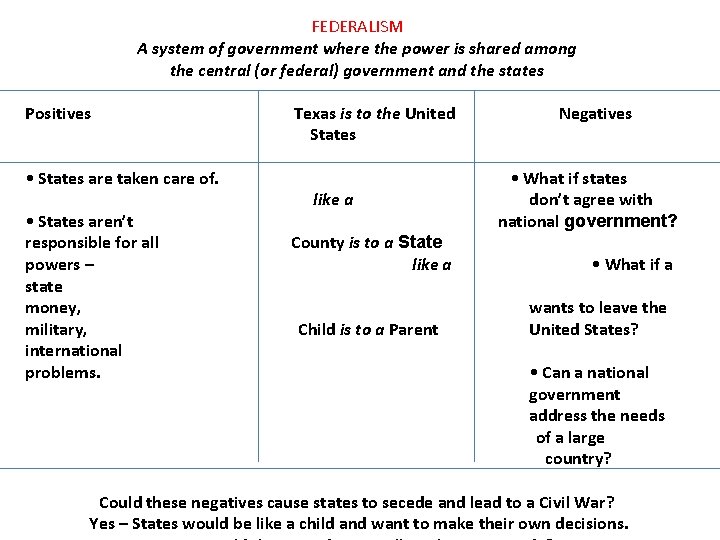
FEDERALISM A system of government where the power is shared among the central (or federal) government and the states Positives • States are taken care of. • States aren’t responsible for all powers – state money, military, international problems. Texas is to the United States like a County is to a State like a Child is to a Parent Negatives • What if states don’t agree with national government? • What if a wants to leave the United States? • Can a national government address the needs of a large country? Could these negatives cause states to secede and lead to a Civil War? Yes – States would be like a child and want to make their own decisions.
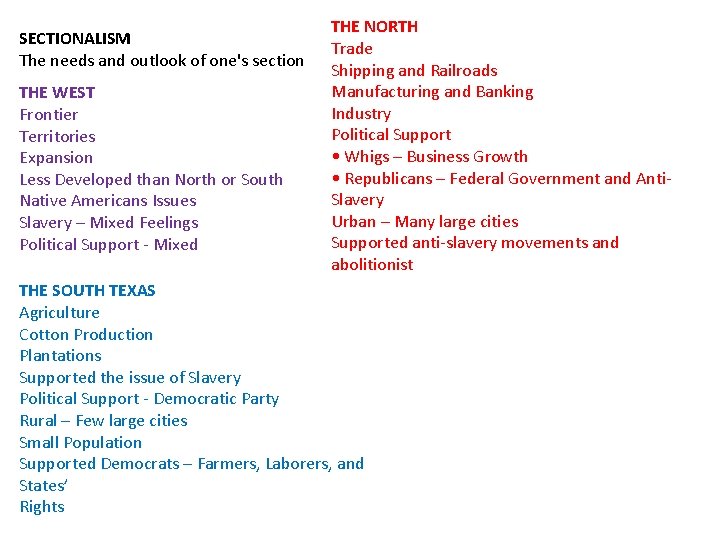
SECTIONALISM The needs and outlook of one's section THE WEST Frontier Territories Expansion Less Developed than North or South Native Americans Issues Slavery – Mixed Feelings Political Support - Mixed THE NORTH Trade Shipping and Railroads Manufacturing and Banking Industry Political Support • Whigs – Business Growth • Republicans – Federal Government and Anti. Slavery Urban – Many large cities Supported anti-slavery movements and abolitionist THE SOUTH TEXAS Agriculture Cotton Production Plantations Supported the issue of Slavery Political Support - Democratic Party Rural – Few large cities Small Population Supported Democrats – Farmers, Laborers, and States’ Rights
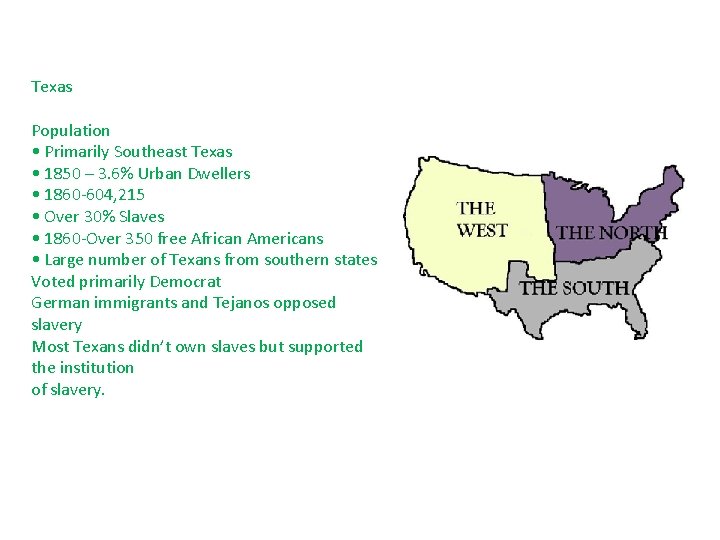
Texas Population • Primarily Southeast Texas • 1850 – 3. 6% Urban Dwellers • 1860 -604, 215 • Over 30% Slaves • 1860 -Over 350 free African Americans • Large number of Texans from southern states Voted primarily Democrat German immigrants and Tejanos opposed slavery Most Texans didn’t own slaves but supported the institution of slavery.
• How was the South different than the other parts of the United States prior to the Civil War? The South was different than other parts of the United States because it clearly supported slavery and in the North and West it was not supported or minimally supported.
• Describe three reasons Texas identified with the South because their economy was supported by agriculture, they voted for Democrats, they had a small population, and slavery was legal in Texas.
• Describe a reason for the involvement of Texas in the Civil War? A reason for the involvement of Texas in the Civil War was sectionalism which is meeting the needs and outlook of one's section Texas identified themselves with the South and the southern issues against the federal government.
STATES’ RIGHTS The belief that the federal government should not interfere with state constitutional powers When Texas was annexed (the process of adding) to the United States, it meant that national issues became Texas issues. Some of those issues were tariffs and distribution of public lands but the most crucial issue was states’ rights. States’ rights focused on who had the constitutional power to decide if slavery should be legal or not. Should that decision be made by individual states or the federal government? The Kansas-Nebraska Act would not answer this question but it would force Americans to take a side.
Kansas-Nebraska Act Senator Stephen Douglas a Democrat introduced a bill in January 1854 that would divide the western territories into the territories of Kansas and Nebraska. This bill stated that through popular sovereignty (a government in which the people rule; a system in which the residents vote to decide an issue) the settlers of these territories would decide if slavery would be legal or not. The problem with this bill was that under the terms of the Missouri Compromise of 1820, slavery could not exist in either one of these territories, but the bill pushed on through Congress. On May 30, 1854, the Kansas-Nebraska Act was passed and “Kansas Fever” swept the area. Settlers on both side of the issue flooded into Kansas hoping to determine the results. The election was won by the pro-slavery settlers. Those against slavery would not accept the decision and violence erupted. Kansas would earn the nickname “Bleeding Kansas” as the death toll rose. President Franklin Pierce who supported the pro-slavery settlers even sent federal troops to Kansas to try to stop the violence but it continued and American citizens began to clearly take sides. In the end, Kansas will be admitted as a free state just before the Civil War in January of 1861.
The Texas perspective… The Senator of Texas during this period of time was Sam Houston was a slave owner and defended the practice of slavery but he also supported preserving the Union. Houston voted against the Kansas-Nebraska Act and the result was that he was hated by many southerners. In 1855, the Texas legislature officially condemned Houston for his opposition to the Kansas-Nebraska Act and he was not chosen as a state senator again. So, in 1857 he decided to run for governor. He would lose that election to Thomas Runnels but in a rematch, Sam Houston would be elected governor in 1859. He warned Texans if Texas seceded from the Union, it would lead to Civil War, a northern victory, and an end to the southern way of life. Despite his efforts, Texas seceded from the Union. When Houston refused swear allegiance to the Confederacy, he resigned as governor and headed to his home in East Texas.
• Explain the issue of states’ rights. States’ Right is the belief that the federal government should not interfere with state constitutional powers.

Texas was affected by the issue of states’ rights because of slavery. The Kansas. Nebraska Act made Texans state their position on this issue. It would result in Sam Houston not being chosen again as senator. • How was Texas affected by the issue of states’ rights?
• Describe a reason for the involvement of Texas in the Civil War? A reason for the involvement of Texas in the Civil War is states’ rights. Texas thought that states should decide if slavery would be legal or not in their state because how they reacted to Sam Houston’s vote on the Kansas-Nebraska Act.
SECESSION CONVENTION In January 28, 1861, Texas delegates gathered in Austin to begin the secession convention led by Judge Oran M. Roberts. It was heated but the decision was made was that Texas would adopt the ordinance of secession (an official order to leave). Texans voted on this ordinance and approved it but not with an overwhelming majority. Ten Central Texas counties which were primarily German, some counties along the Red River and areas of East Texas voted against it. Texas became the seventh state to secede and join the Confederate states of America.
Secession Ordinance: To dissolve the union between the State of Texas and the other States, united under the compact styled "The Constitution of the United States of America. " Whereas, the Federal Government has failed to accomplish the purposes of the compact of union between these States, in giving protection either to the persons of our people upon an exposed frontier, or to the property of our citizens; and, whereas, the action of the Northern States of the Union is violative of the compact between the States and the guarantees of the Constitution; and whereas the recent developments in Federal affairs, make it evident that the power of the Federal Government is sought to be made a weapon with which to strike down the interests and prosperity of the people of Texas and her Sister slaveholding States, instead of permitting it to be, as was intended, our shield against outrage and aggression:
Section 1 We, the People of the State of Texas, by Delegates in Convention assembled, do declare and ordain, that the Ordinance adopted by our Convention of Delegates, on the Fourth day of July, A. D. 1845, and afterwards ratified by us, under which the Republic of Texas was admitted into Union with other States and became a party to the compact styled "The Constitution of the United States of America" be, and is hereby repealed annulled; That all the powers, which by said compact were delegated by Texas to the Federal Government, are revoked and resumed; That Texas is of right absolved from all restraints and obligations incurred by said compact, and is a separate Sovereign State, and that her citizens and people are absolved from allegiance to the United States, or the Government thereof.

Section 2 This ordinance shall be submitted to the people of Texas for ratification or rejection by the qualified voters thereof, on the 23 rd day of February 1861, and unless rejected by a majority of the votes cast, shall take effect and be in force on and after the 2 nd day of March, A. D. 1861. Provided, that in the Representative District of El Paso, said election may be held on the 19 th day of February, A. D. 1861.
• Name two reasons that Texas felt that they should secede from the Union because they were not receiving protection on the western frontier and the Texas. Mexico border by the federal government and the federal government was not supporting slavery in Texas and the other southern states.
• How would Texas determine whether they secede or not? Through popular sovereignty, Texas voters would decide to either ratify the secession ordinance or not.
• Describe a reason for the involvement of Texas in the Civil War? A reason for the involvement of Texas in the Civil War was the secession convention. At this convention, Texans decided that they would secede from the Union and join the Confederate states of America.

Describe the reasons for the involvement of Texas in the Civil War. What was the point of view of most Texans concerning seceding from the Union?
Where do these groups live in Texas? o Anglo – Southeast Texas o German- Central Texas o Tejano – South Texas o African Americans – East Texas
• What is their viewpoint on slavery in the new territories? o Anglo – for It (majority of people) o German – against It o Tejano – against It o African Americans – against It
• Why do they feel this way? o Anglo – brought slaves from U. S. and/or aspired to owning slaves; believed that slavery supported the economy of the South o German – did not own slaves in the home country o Tejano – did not own slaves in their home country o African Americans – if they owned a large plantation, they needed the help but slaves were African Americans and they could be mistook as a slave
• Did they have any influence in the Secession Convention? Why or why not? o Anglo – the majority of those at the Secession Convention were Anglos; they owned slaves or aspired to owning slaves, they could vote and were active in politics. o German- not that active in politics; many tried to maintain their own culture o Tejano – few to none in the political system o African Americans – few to none in the political system
- Slides: 27