
Problems in Marketing Analysis and Applications Second Edition
Problems in Marketing – Analysis and Applications Second Edition Luiz Moutinho and Charles S. Chien Made by Kate Li
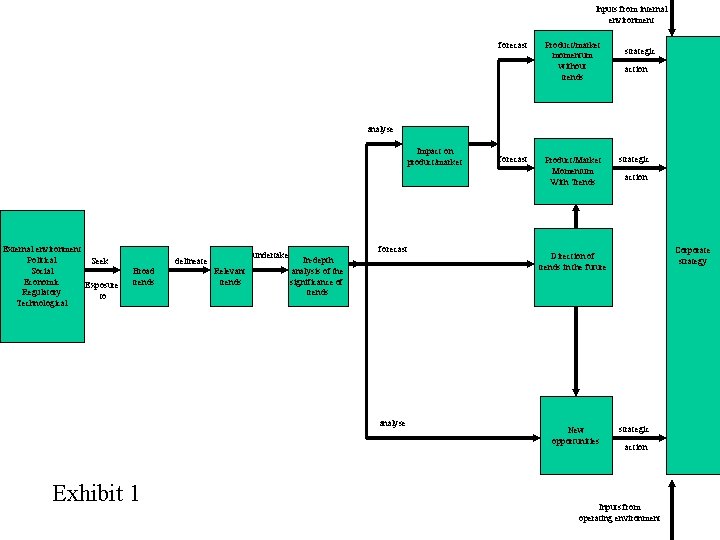
Inputs from internal environment forecast Product/market momentum without trends strategic action analyse Impact on product/market External environment Political Seek Social Economic Exposure Regulatory to Technological Broad trends delineate undertake Relevant trends forecast In-depth analysis of the significance of trends analyse Exhibit 1 forecast Product/Market Momentum With Trends strategic action Corporate strategy Direction of trends in the future New opportunities strategic action Inputs from operating environment
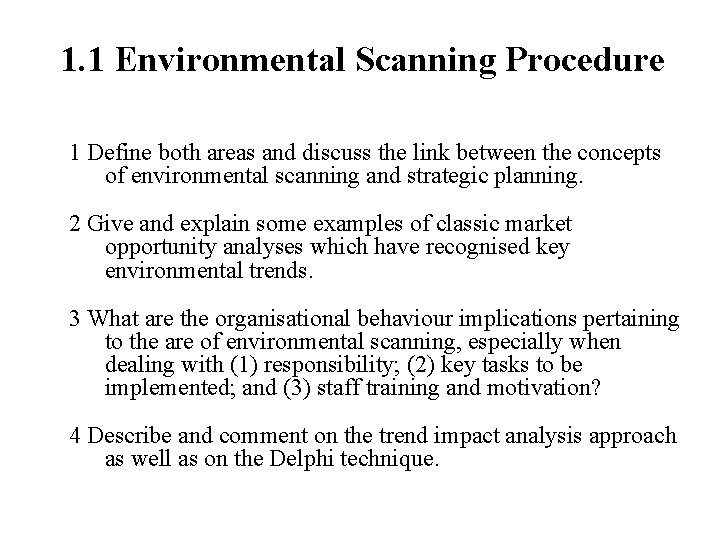
1. 1 Environmental Scanning Procedure 1 Define both areas and discuss the link between the concepts of environmental scanning and strategic planning. 2 Give and explain some examples of classic market opportunity analyses which have recognised key environmental trends. 3 What are the organisational behaviour implications pertaining to the are of environmental scanning, especially when dealing with (1) responsibility; (2) key tasks to be implemented; and (3) staff training and motivation? 4 Describe and comment on the trend impact analysis approach as well as on the Delphi technique.
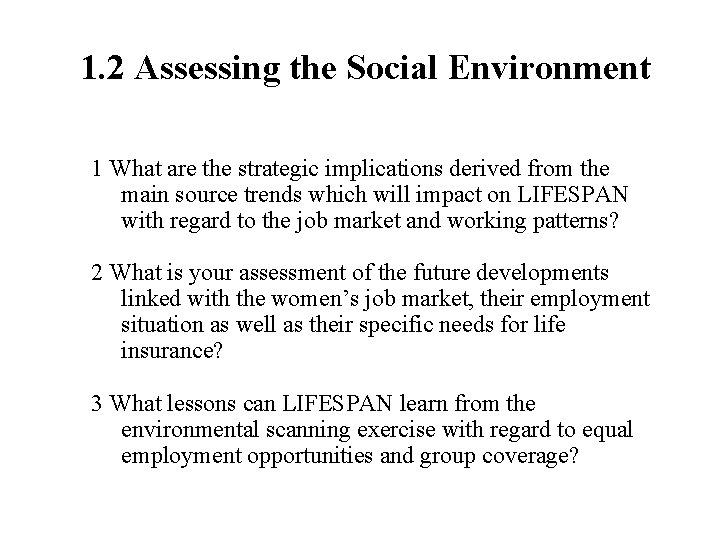
1. 2 Assessing the Social Environment 1 What are the strategic implications derived from the main source trends which will impact on LIFESPAN with regard to the job market and working patterns? 2 What is your assessment of the future developments linked with the women’s job market, their employment situation as well as their specific needs for life insurance? 3 What lessons can LIFESPAN learn from the environmental scanning exercise with regard to equal employment opportunities and group coverage?
1. 3 Scanning and Forecasting Methods 1 What are some of the key issues that you need to address in order to evaluate the reliability of regression forecasts? 2 Comment of the methodology behind these two judgmental forecasting methods: jury of executive opinion and Delphi. 3 Discuss the different kinds of consequences associated with overestimating and underestimating company sales.
1. 4 Data Mining 1 Explain some of the reasons behind the advent and availability of large databases to help companies/organisations increase their marketing effectiveness. 2 Discuss the role and managerial implications of some of the key data mining technologies. 3 Comment on the emergence of the position of a chief information officer (CIO) and its appearance on an organisational chart and its main functions.
2. 1 Emotions and Consumer Behaviour 1 Describe and provide your own examples of the functions of emotions. 2 Explain the antecedents and consequences of impulse buying, self-gift behaviours and recreational shopping. 3 How do you assess the effectiveness of JCB’s brand strategy in terms of emotions and consumer behaviour?
2. 2 Consideration Sets 1 Define consumer’s internal search and explain the process of its importance and role when dealing with ‘consideration sets’? 2 Analyse the difference between the concepts of ‘recognition’ and ‘recall’ when related to consideration sets. 3 How can COCOBIZ use an effective programme of sales promotion and packaging as a key inducer to gain prominence of the brand in consumers’ ‘consideration sets’?
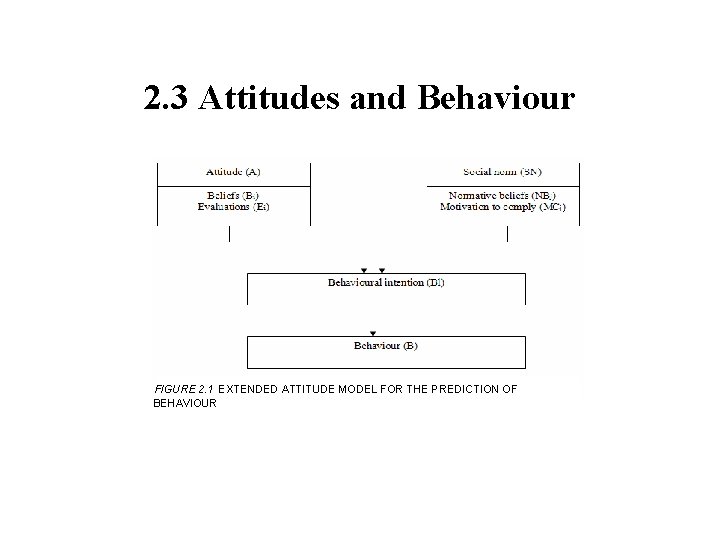
2. 3 Attitudes and Behaviour FIGURE 2. 1 EXTENDED ATTITUDE MODEL FOR THE PREDICTION OF BEHAVIOUR
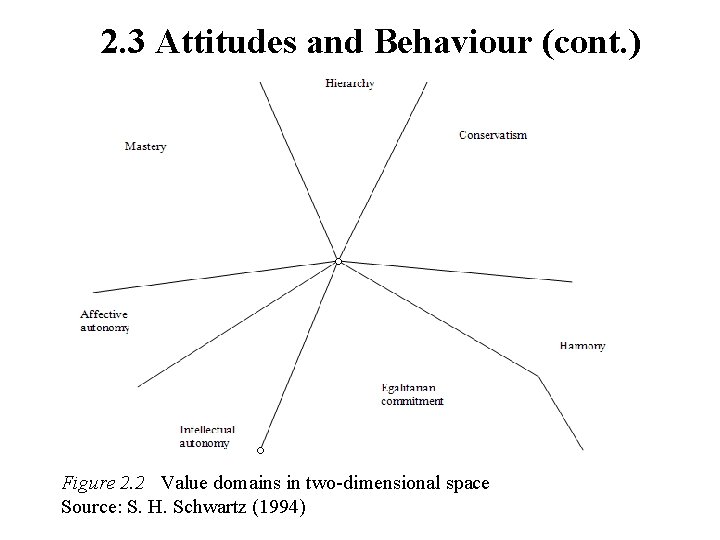
2. 3 Attitudes and Behaviour (cont. ) Figure 2. 2 Value domains in two-dimensional space Source: S. H. Schwartz (1994)
2. 3 Attitudes and Behaviour (cont. ) 1 In what way the measurement of attitude would be able to optimally predict behaviour? 2 How would you explain your buying behaviour on a particular purchasing experience by an extended attitude model? 3 Name and critically assess the seven value domains associated with the list of values (LOV) framework.
2. 4 Brand Loyalty 1 What are the two measures making up a brand’s sales? 2 What are the basic premises behind the Dirichlet model? 3 Comment on additional patterns in consumers’ buying behaviour which are also predicted by the Dirichlet theory. 4 By analysing the three tables of results, what conclusions can be drawn, for example, with regard to loyalty measures, impacts on large and small brands, patterns resulting from the predictive Dirichlet theory, as well as effect on market share.
3. 3 Computer-administered Survey • An alternative being considered by Jason is to place a questionnaire on the Internet itself. Jason took a course in Internet programming, and he can perform a survey on the Internet. What is your reaction to this data collection alternative? 1 Discuss some of the disadvantages related to the use of computer-assisted surveys. 2 What aspects of computer-administered surveys make them attractive to marketing researchers? 3 What are the advantages of person-administered surveys over computer-administered ones?
3. 6 Estimation of Market Potential 1 How would you determine the index number for each area? 2 Analyse and discuss some of the pitfalls and disadvantages associated with this particular forecasting method. 3 What kinds of data are available to be used as substitutes for industry sales data?
3. 7 Extrapolation 1 Comment of the fluctuation of values presented in the table related to Zamir Inc’s sales figures. 2 Is there a consistent trend? 3 Can moving-average methods be also used to track trends and seasonal patterns? 4 For the same 8 -period example depicting Zamir Inc’s sales, apply time series regression and calculate the forecast for periods 1 to 10.
4. 1 The Marketing Planning Process 1 Explain the components involved in the ‘strategy formulation’ stage (phase 3) of the marketing planning process. 2 What are some of the basic conditions that need to be met in order for the marketing planning process to be effective? 3 Discuss the relationship between customer power and the process of marketing planning.
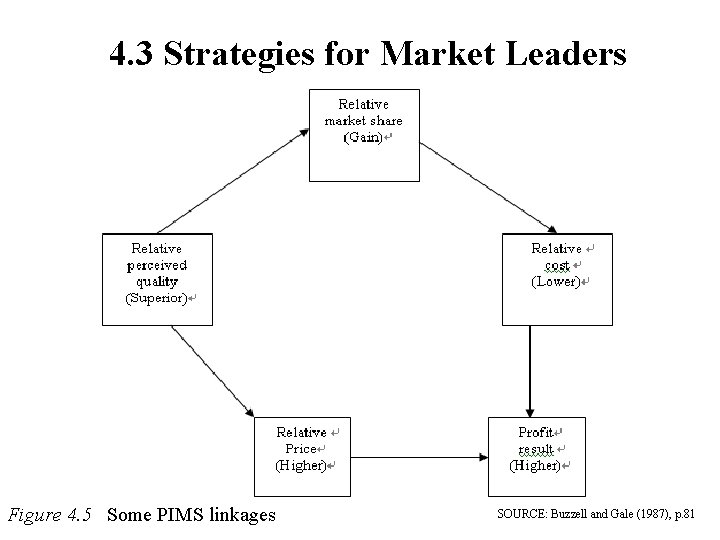
4. 3 Strategies for Market Leaders Figure 4. 5 Some PIMS linkages SOURCE: Buzzell and Gale (1987), p. 81
4. 3 Strategies for Market Leaders 1 Define and discuss a number of market leadership strategies linked with (i) the expansion of the overall market; (ii) guarding the existing market share; and (iii) the expansion of the current market share. 2 According to the PIMS programme, which are three most significant determinants of profitability? By examining these same key determinants, what strategic questions can be raised? 3 Discuss the rationale behind a V-shaped relationship between market share and profitability.
4. 6 Competitive Reaction Matrix and Measuring Market Power 1 How would you describe the different types of elasticity contained in the competitive reaction matrix? 2 What are the basic conditions for successful differentiation? 3 If a marketing manager has information about elasticity, how can he/she calculate the optimal price? 4 By way of illustration, if ε= -2. 1 and C = 105, calculate the optimum price as well as the optimal cost markup.
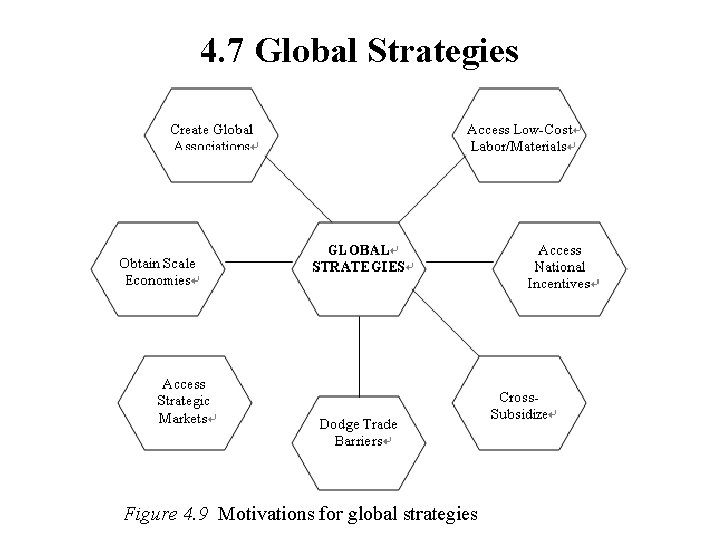
4. 7 Global Strategies Figure 4. 9 Motivations for global strategies
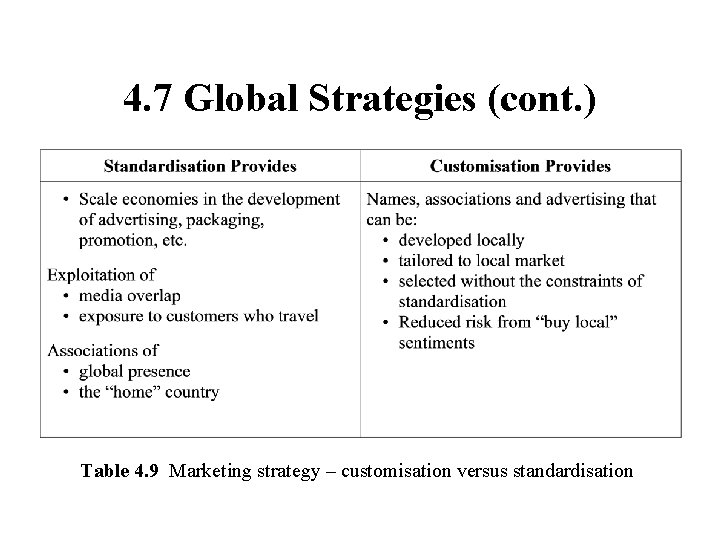
4. 7 Global Strategies (cont. ) Table 4. 9 Marketing strategy – customisation versus standardisation
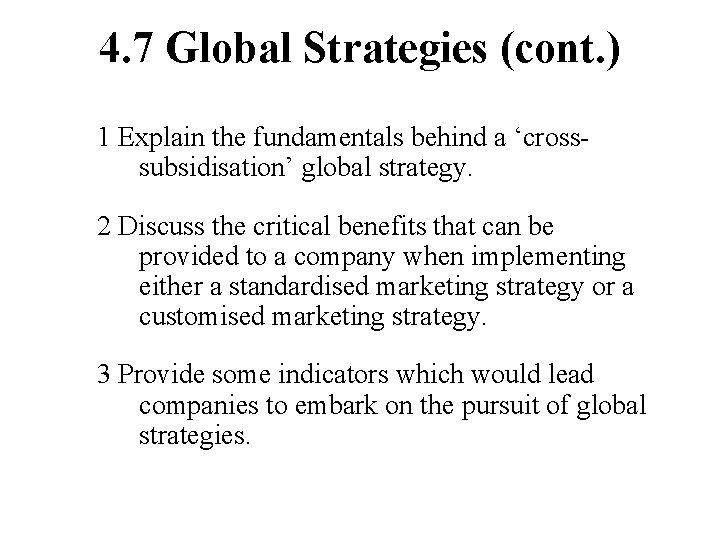
4. 7 Global Strategies (cont. ) 1 Explain the fundamentals behind a ‘crosssubsidisation’ global strategy. 2 Discuss the critical benefits that can be provided to a company when implementing either a standardised marketing strategy or a customised marketing strategy. 3 Provide some indicators which would lead companies to embark on the pursuit of global strategies.
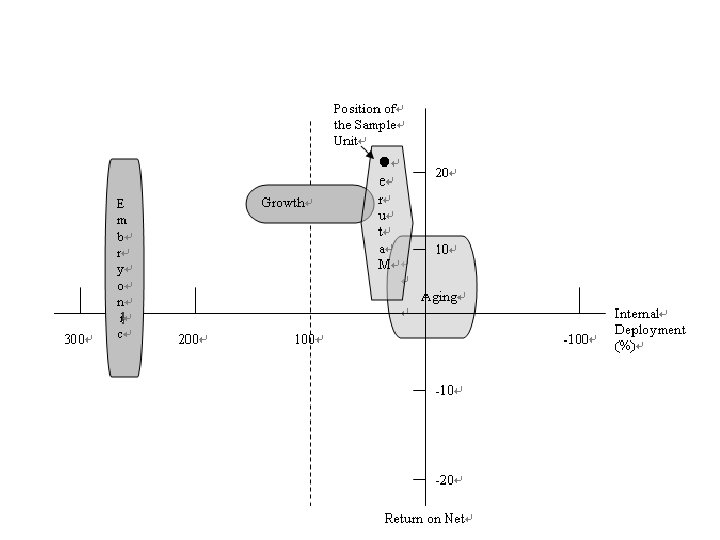
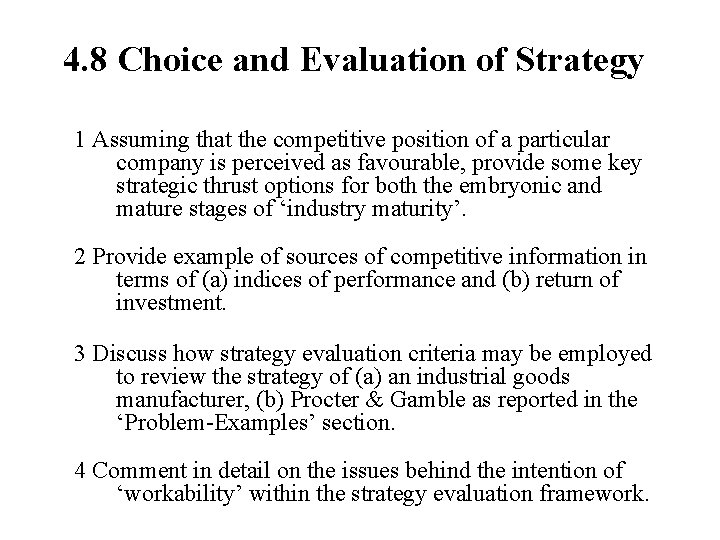
4. 8 Choice and Evaluation of Strategy 1 Assuming that the competitive position of a particular company is perceived as favourable, provide some key strategic thrust options for both the embryonic and mature stages of ‘industry maturity’. 2 Provide example of sources of competitive information in terms of (a) indices of performance and (b) return of investment. 3 Discuss how strategy evaluation criteria may be employed to review the strategy of (a) an industrial goods manufacturer, (b) Procter & Gamble as reported in the ‘Problem-Examples’ section. 4 Comment in detail on the issues behind the intention of ‘workability’ within the strategy evaluation framework.
5. 3 Product Replacement Strategies 1 Out of 9 product replacement strategies discussed, which do you feel applies more directly to the Volvo example? 2 What is the thinking behind the ‘facelift’ and ‘relaunch’ product replacement strategies? 3 Give examples of companies that have utilised a ‘no change’, an ‘intangible repositioning’ and a ‘re-merchandising’ product replacement strategies.
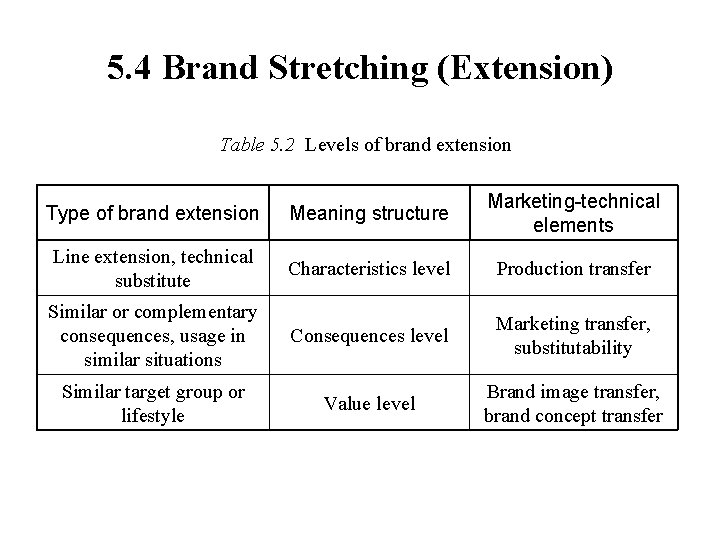
5. 4 Brand Stretching (Extension) Table 5. 2 Levels of brand extension Type of brand extension Meaning structure Marketing-technical elements Line extension, technical substitute Characteristics level Production transfer Similar or complementary consequences, usage in similar situations Consequences level Marketing transfer, substitutability Similar target group or lifestyle Value level Brand image transfer, brand concept transfer
5. 4 Brand Stretching (Extension) 1 Discuss how a brand extension can provide substantial support for an established brand name, as well as some examples of the negative impact of brand stretching. 2 Explain what is behind the meaning structure related to the levels of brand extension, namely, the characteristics and consequences levels, as well as lifestyle and values. 3 What are the basic conditions that a good brand extension must adhere to?
5. 5 Brand Equity 1 What is the meaning behind the value of a brand in terms of assets and liabilities? 2 Provide the definition of hard equity following a company’s financial perspective. 3 What is the P/E multiplier developed by the Interbrand Group? 4 Discuss and elaborate on (i) the notion that brand names can function as signals in the marketplace as well as (ii) the argument that hard equity can be defined as the utility intrinsic to a brand.
6. 1 Determining Price Levels 1 In the case example, if the manufacturer wishes to earn a mark-up (MU) of 20% on price, what would be the unit price that should be charged? 2 What would be the resulting price level if the company wanted to achieve a target return of 8% on investment. 3 Calculate the break-even price level at which total returns cover total costs. 4 Comment on the role of optimisation methods in the determination of price levels.
6. 2 Perceived Value Pricing 1 Comment on both the customer’s and the seller’s perspectives when dealing with the issue of perceived value pricing. 2 Discuss the elements of variability and continuity related to price perceptions in the mind of a potential buyer. 3 What should company W do about the pricing of its product if company Y charges £ 22?
6. 5 Price Dispersion in Online Markets 1 Define the concept of price dispersion. 2 What happens to price dispersion if the highest search cost increases and if the distribution of search costs across consumers becomes dispersed? 3 What is the equation which defines the quality-adjusted price? 4 Why is it that pure-play e-tailers may charge less than bricks-and-clicks e-tailers?
7. 1 Media Selection 1 The problem is this: For a maximum of £ 375, 000 for one month only, which vehicles should you choose from among the 4 choices that will attain the objective listed above? 2 Show your answers in the following spaces: (a) Names of vehicles chosen ………………. (b) Cost per thousand of the chosen group ………………. (c) Reach of the chosen group ……………… (d) Frequency ………… GRPs ……………. . . Show your calculations here for each of the answers listed above: Suppose that you had to compare your media package in Question 1, with the medial package of vehicles shown in the earlier example (vehicles B, C and D). Which package would you select and why?
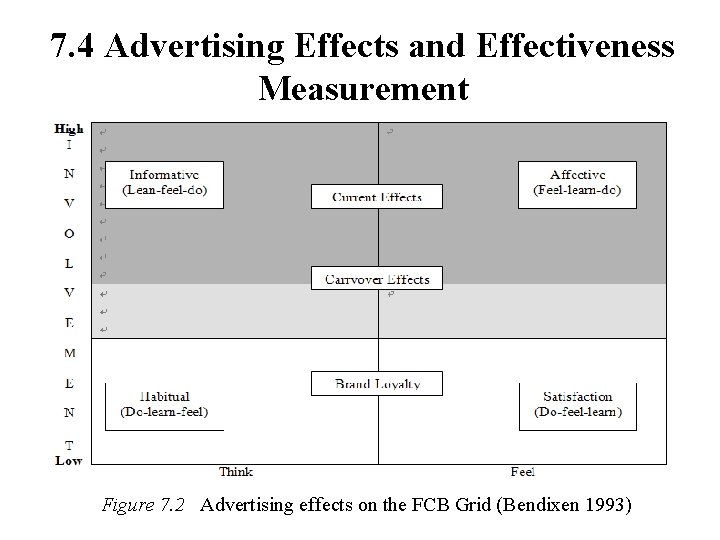
7. 4 Advertising Effects and Effectiveness Measurement Figure 7. 2 Advertising effects on the FCB Grid (Bendixen 1993)
7. 4 Advertising Effects and Effectiveness Measurement (cont. ) 1 Explain the rationale behind the Elaboration Likelihood (ELM) and the Advertising Response Model (ARM). 2 Discuss the concept of ‘competitive interference’. 3 Comment on the key managerial implications related to the study of advertising effects and its effectiveness measurement. 4 Based on Exhibit x which plots the profit levels associated with cases 1 and 2, make a critical analysis on these results.
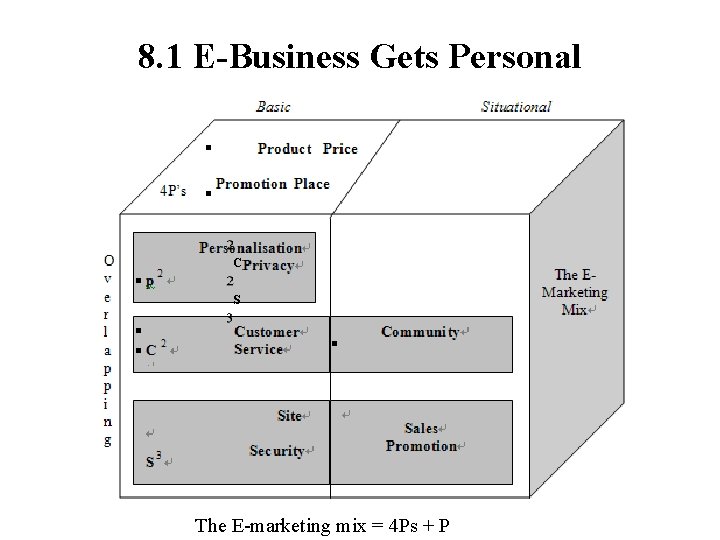
8. 1 E-Business Gets Personal C S The E-marketing mix = 4 Ps + P
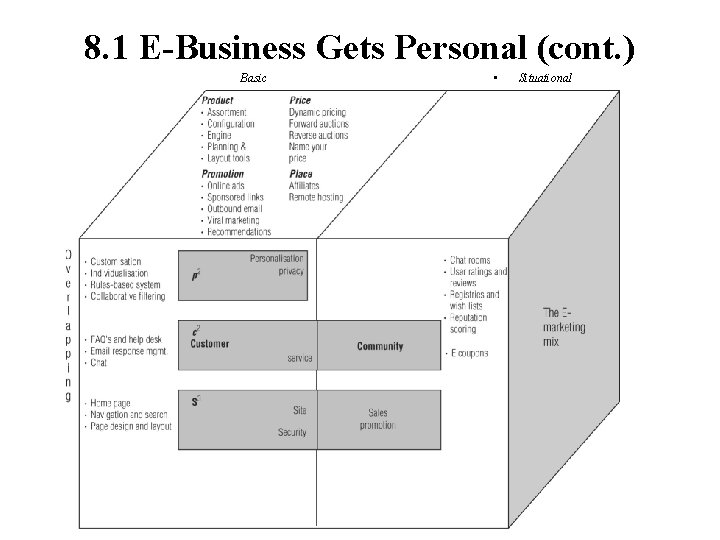
8. 1 E-Business Gets Personal (cont. ) Basic • Situational
8. 1 E-Business Gets Personal (cont. ) 1 Discuss the notion of a conceptual personalisation quotient (CPQ). 2 At the core of most personalisation programmes is an algorithm that attempts to predict which products, services, and messages a consumer will respond most favourably towards, still, why is prediction a poor instrument of analysis? 3 On the basis of the Kalyanam and Mc. Intyre's Framework depicting the e-marketing mix, classify and discuss the marketing tools related to personalisation. 4 Comment on the concept of ‘filtering’. 5 Refer to the Levi Strauss case study and critically assess the advantages and disadvantages of the recommendations tool used to encourage customers to repeat purchases.
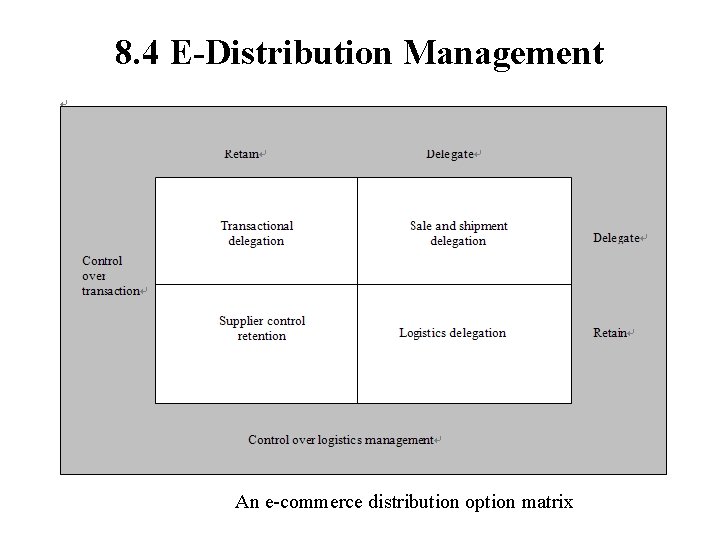
8. 4 E-Distribution Management An e-commerce distribution option matrix
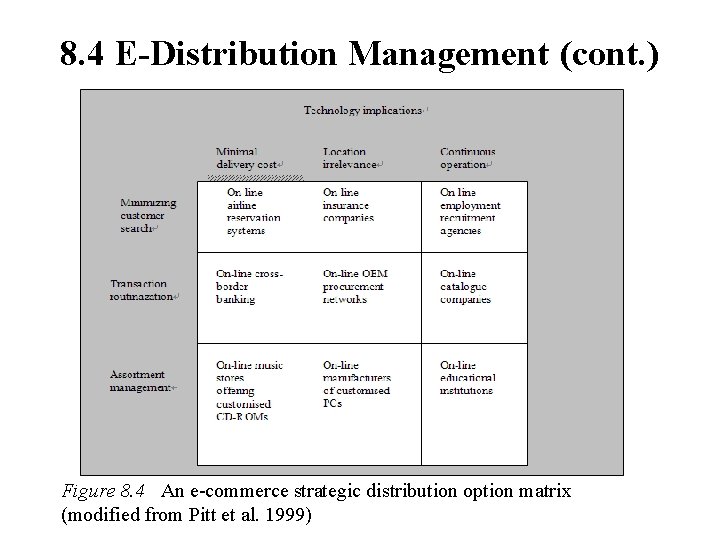
8. 4 E-Distribution Management (cont. ) Figure 8. 4 An e-commerce strategic distribution option matrix (modified from Pitt et al. 1999)
8. 4 E-Distribution Management (cont. ) 1 Comment and give examples of the advent of ‘hybrid marketing systems’. 2 Discuss one approach to determining an optimal strategy fro selecting an optimal e-commerce distribution channel. 3 Comment on the effectiveness of the ‘corner shop’, ‘the Delivery Dock’ and ‘Deliver –e Box’ approaches.
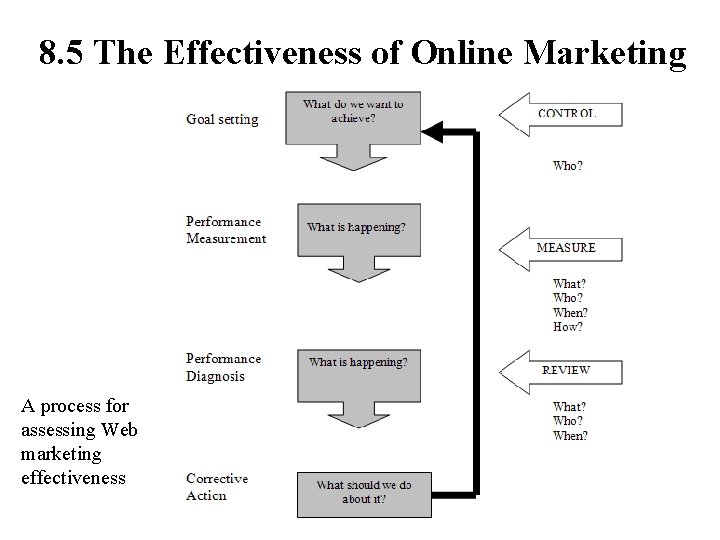
8. 5 The Effectiveness of Online Marketing A process for assessing Web marketing effectiveness
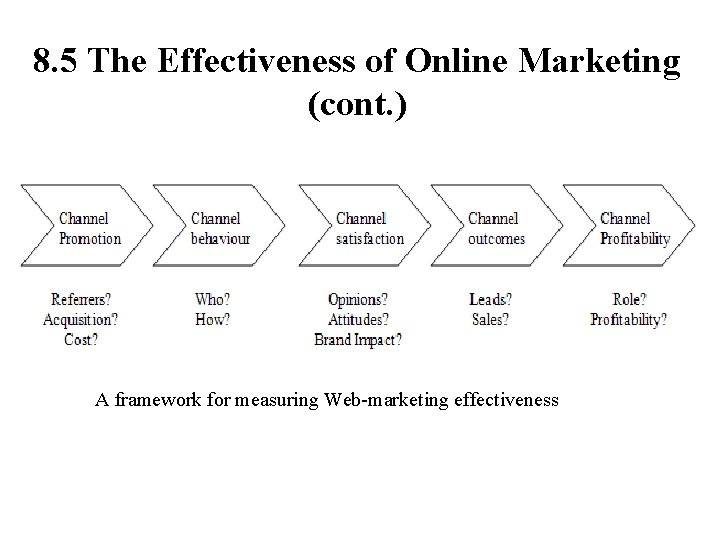
8. 5 The Effectiveness of Online Marketing (cont. ) A framework for measuring Web-marketing effectiveness
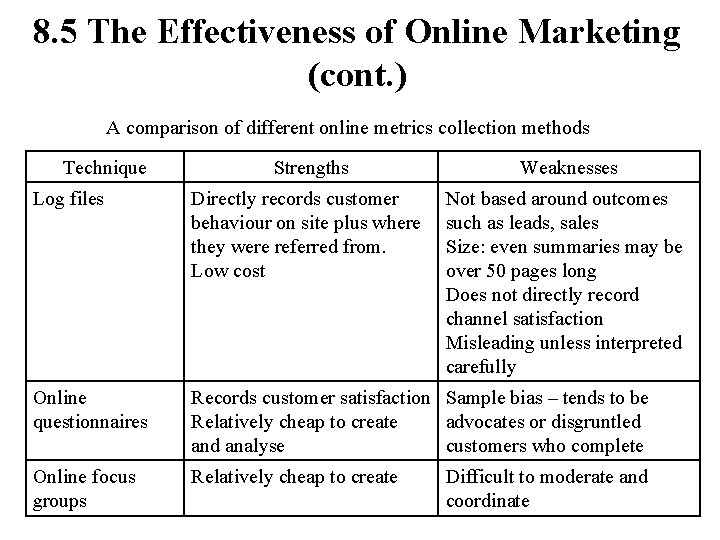
8. 5 The Effectiveness of Online Marketing (cont. ) A comparison of different online metrics collection methods Technique Strengths Weaknesses Log files Directly records customer behaviour on site plus where they were referred from. Low cost Not based around outcomes such as leads, sales Size: even summaries may be over 50 pages long Does not directly record channel satisfaction Misleading unless interpreted carefully Online questionnaires Records customer satisfaction Sample bias – tends to be Relatively cheap to create advocates or disgruntled analyse customers who complete Online focus groups Relatively cheap to create Difficult to moderate and coordinate
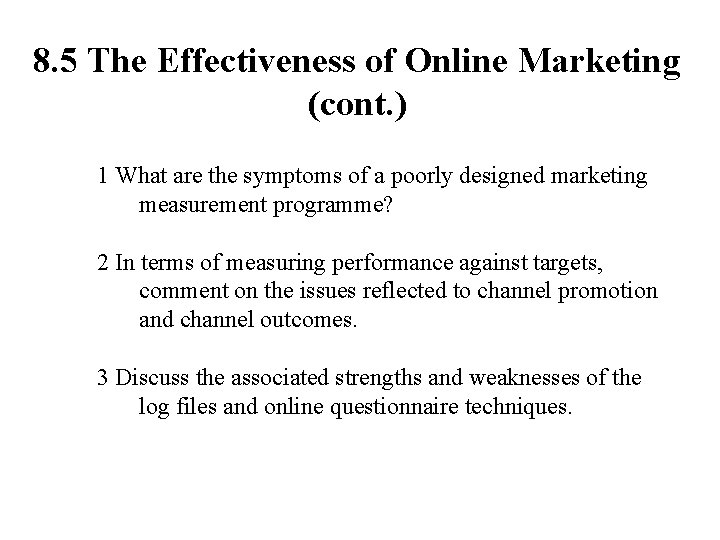
8. 5 The Effectiveness of Online Marketing (cont. ) 1 What are the symptoms of a poorly designed marketing measurement programme? 2 In terms of measuring performance against targets, comment on the issues reflected to channel promotion and channel outcomes. 3 Discuss the associated strengths and weaknesses of the log files and online questionnaire techniques.
9. 1 Marketing Objective and Structure for the Sales Force • A sales manager for a large consumer package goods firm argues that £ 350, 000 should be cut from the media advertising budget of the firm’s various products and used to hire five more company salespeople. Her rationale is that at today’s media prices five more salespeople can generate more sales volume than spending £ 350, 000 in advertising. 1 How would you evaluate this argument? Under which conditions might the sales manager be right? Under what conditions might she be wrong?
9. 1 Marketing Objective and Structure for the Sales Force (cont. ) • The 100 -member salesforce of the firm mentioned in question 1 calls on national, regional and local supermarket chains. They are responsible for gaining authorisation for purchases from the chain headquarters and winning shelf space in, and providing merchandising service to, individual stores in each chain. The company’s product line consists of 10 varieties of cookies, 7 kinds of crackers and 5 snack products. Suggest 2 ways in which such a salesforce might be organised. What are the benefits and limitations of each? 2 Which would you recommend and why? 3 Which type of sales job are the salespeople working for the company described in question 1 and 2 involved in? What objectives and activities are likely to be most important in such a job? What kind of skills and personal characteristics should the company look for when hiring new sales people?
9. 2 Sales Force Management 1 Outline the marketing and personal-selling problems facing Cove Inc. 2 What strategic and tactical recommendations would you make to Cove Inc’s managers? 3 With respect to sales management, how might the recruitment problem by approached?
9. 3 Development of a Sales Commission Plan 1 Discuss the advantages and limitation of the straight commission compensation method. 2 Analyse possible plan measurements associated with the following specific sales objectives: (1) increase sales/orders value; (2) increase market share; (3) increase profitability and (4) the introduction of a new product. 3 How can a sales manager determine the appropriate reward to risk ratio for commission earnings?
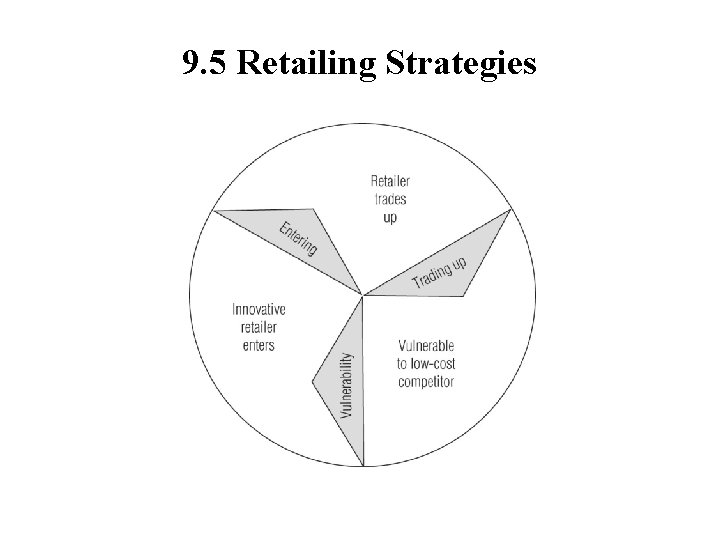
9. 5 Retailing Strategies
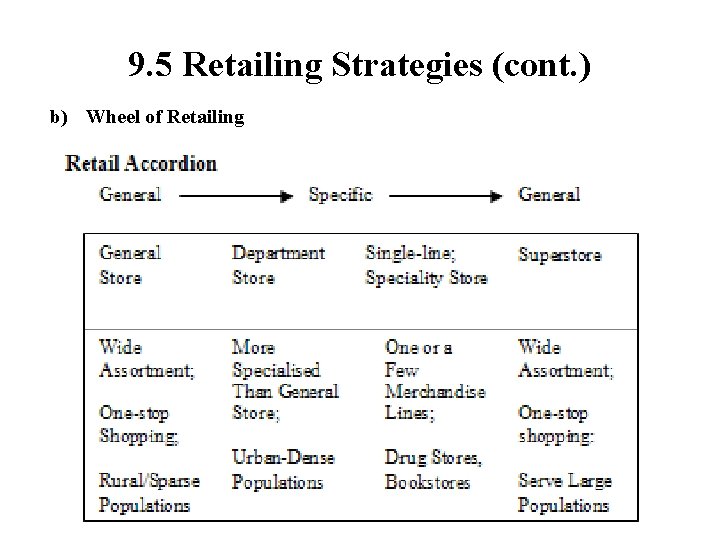
9. 5 Retailing Strategies (cont. ) b) Wheel of Retailing
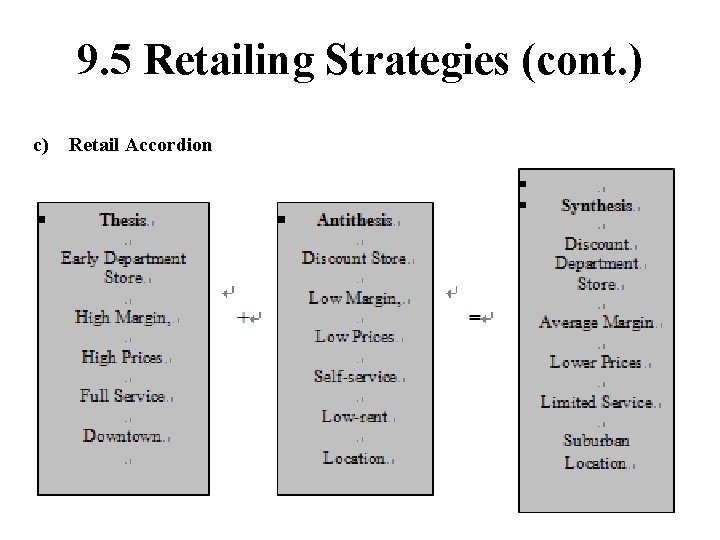
9. 5 Retailing Strategies (cont. ) c) Retail Accordion
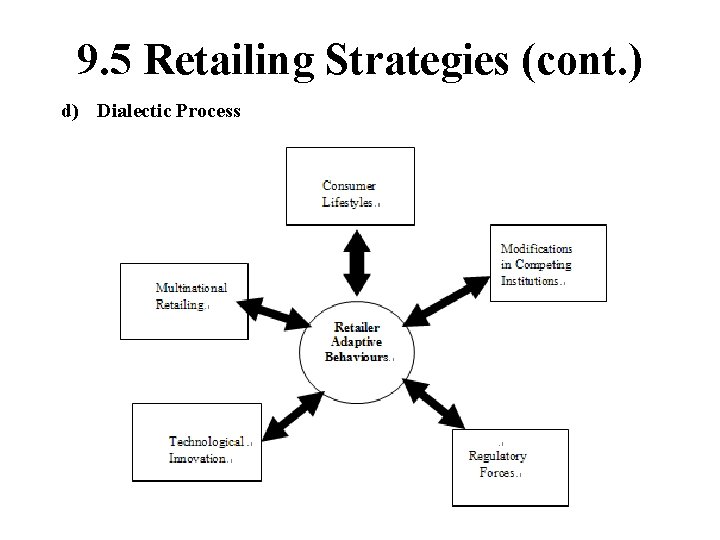
9. 5 Retailing Strategies (cont. ) d) Dialectic Process
9. 5 Retailing Strategies (cont. ) 1 Which of theories of structural change in retailing describes best the case discussed in the problem example above? 2 Taking into account the specific conditions of the competitive environment (e. g. saturation of markets, low growth rates, high competitive intensity, high business failure rates, the increased number of ‘multidimensional’ competitors) which of the models of structural change in retailing explains this scenario more accurately? 3 Comment on the retailing trend conceived with store formats and operations. 4 Discuss the impact of the new characteristics of the new consumer on the future of retailing.
9. 6 Merchandising Strategies 1 Comment on the concept of ‘grid pattern’. 2 What is the rationale behind the multisection of lifestyle displays? 3 What was the main driver associated with Selfridges’ repositioning strategy? Discuss some of the radical changes implemented by the company. 4 Analyse the key indicators used to measure effectiveness in the case of the Selfridges’ relaunch strategy.
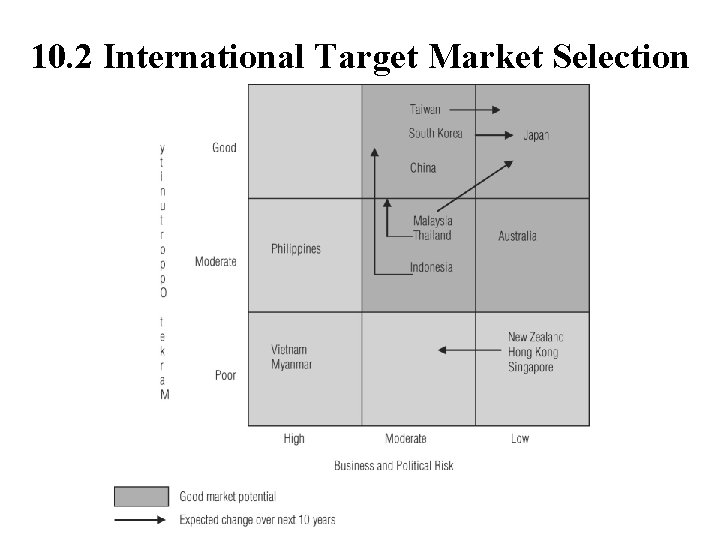
10. 2 International Target Market Selection
10. 2 International Target Market Selection (cont. ) 1 Select and discuss from of the critical stages included in a logical flow model of the entry decision process. 2 Compare the 4 initial pre-screening stages with the 5 stages associated with the case where a company possesses experience in existing markets and wishes to embark on an expansion strategy. 3 Explain the possible use of a cross-sectional regression model as in the case. When the analysis is deriving the weights for each of the country indicators.
10. 3 Screening and Concept Testing for New Global Products 1 Explain the concept behind the conjoint analysis technique. 2 Plugging in the market share and the cost estimates, calculate the profit potential of the various options. 3 Assess the overall strategic alternatives with regard to the Thai and Malaysian markets faced by SATEL.
10. 5 Organising for International Advertising 1 Discuss some of the conditions that might favour a decision towards decentralisation. 2 Describe the role played by subsidiary personnel when a company is pursuing a ‘compromise approach’. 3 Analyse some of the advantages and problems associated with cooperative local advertising.
10. 6 International Selling 1 Discuss some of the main trends associated with the role of language within international selling. 2 Critically comment on the ‘British Style’ of business behaviour with regard to non-verbal communication, meeting and greeting, as well as forms of address. 3 Comment on the concept of (i) ‘mindscape’ and (ii) on the ‘British style’ business behaviour applied to the bargaining style of negotiation. 4 Assess some of the key implications, related to the Bausch & Lomb example of selling in Japan.
11. 1 PBM - Process Based Marketing Management 1 What is the main goal of PBM? 2 What is the underlying reasoning behind the concept of process-based marketing management? 3 Name, and evaluate some of these critical ‘break-themould’ new management processes which would then be activated by new dedicated clusters of crossfunctional teams within organisations? 4 What is the link between process-based marketing management and the construct of customer satisfaction?
11. 2 The Study of Consumer Behaviour Trends and Econographics 1 Define the concept of econographics. 2 Discuss and elaborate your ideas with regard to trends in consumer behaviour when applied to the critical and emergent field of sustainable tourism. 3 What specific policies and strategies could be developed by key stakeholders and partners when confronting the impacts of tourism and its sustainability?
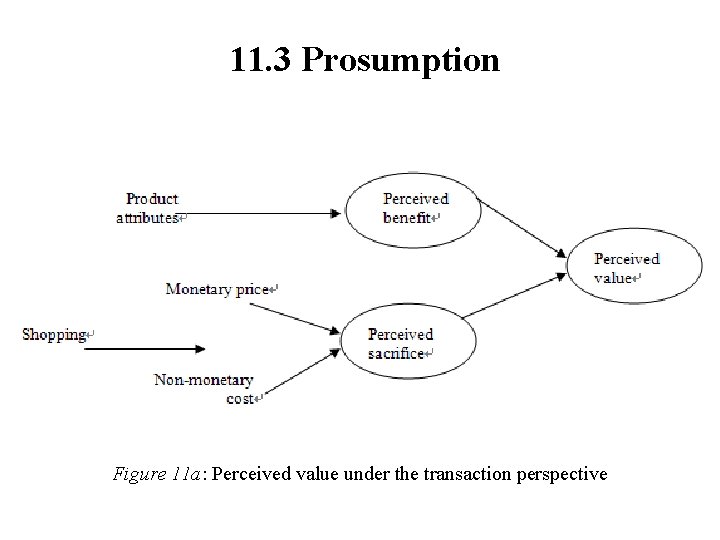
11. 3 Prosumption Figure 11 a: Perceived value under the transaction perspective
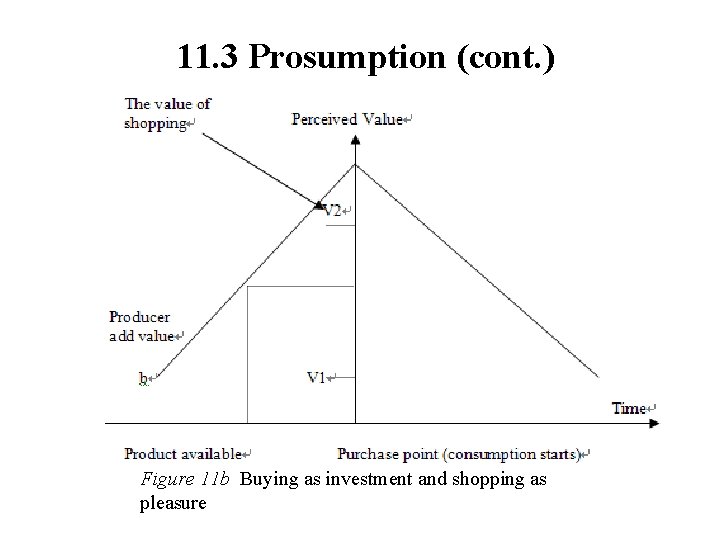
11. 3 Prosumption (cont. ) Figure 11 b Buying as investment and shopping as pleasure
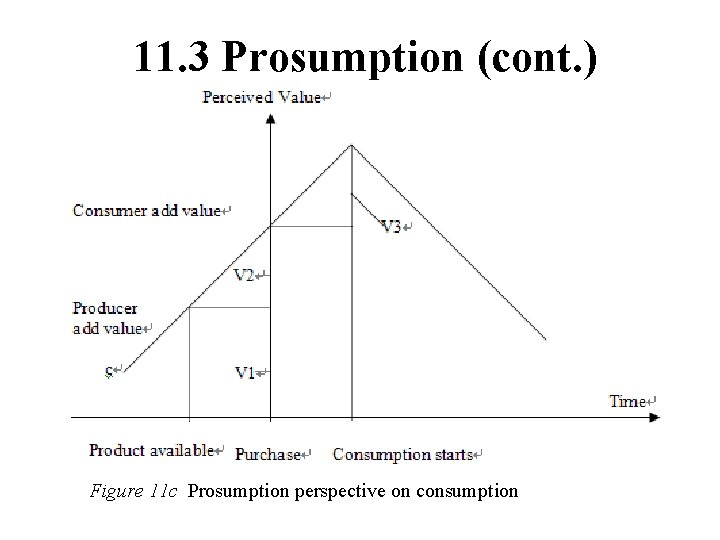
11. 3 Prosumption (cont. ) Figure 11 c Prosumption perspective on consumption
11. 3 Prosumption (cont. ) 1 What are the benefits and advantages of prosumption from the consumers’ point of view? 2 Discuss some of the main implications and challenges for marketing and consumer research derived from the trend towards prosumption. 3 What are the critical differences between the transaction, transaction and shopping-as-pleasure, and prosumption perspectives in terms of volitional control over outcome and conceptualisation of product?
11. 4 Elastic Brands 1 Why are ‘point-of-purchase’ (POP) programmes becoming more innovative and challenging? 2 Discuss the relationship between the need for a seamless integration and brand loyalty? 3 Comment on the concept of ‘retail theatre’.
11. 6 Trends in Integrated Marketing Communications (IMC) 1 Comment on the trend towards message maximisation modelling. 2 Discuss the types of marketing research studies which encapsulate the return to the utilisation of non-verbal response measures. 3 How can one interpret the trend towards ‘seamless integration’ of databases and evaluation systems?
- Slides: 67