
Problem Solving Using the Eight Tenets 1 High

Problem Solving Using the Eight Tenets 1 High School Technology Initiative © 2001
Introduction • The eight tenet method of problem solving lends itself well to mathematical solutions but can be expanded to other processes. • It uses a systematic approach to arrive at the solution of a problem. • This example revisits the problem solved in the video and examines the solution in greater depth. 2 High School Technology Initiative © 2001
The Eight Tenets of Problem Solving 1 Read and understand the problem statement. 2 Draw and label a picture that describes the problem statement. 3 Determine the known and unknown variables. 4 Examine the units and convert all units to those of the answer. 5 Determine the equations to be used. 6 Solve the equations. 7 Check the physical significance of the answer. 8 Report the answer with the correct units. 3 High School Technology Initiative © 2001

Tenet 1: Read and Understand the Problem Statement • The video question was : • How many ten millimeter square chips can fit on a circular wafer that has a diameter of eight inches? • This is a simple problem and you can think of the square chips as squares and the wafer as a circle. 4 High School Technology Initiative © 2001
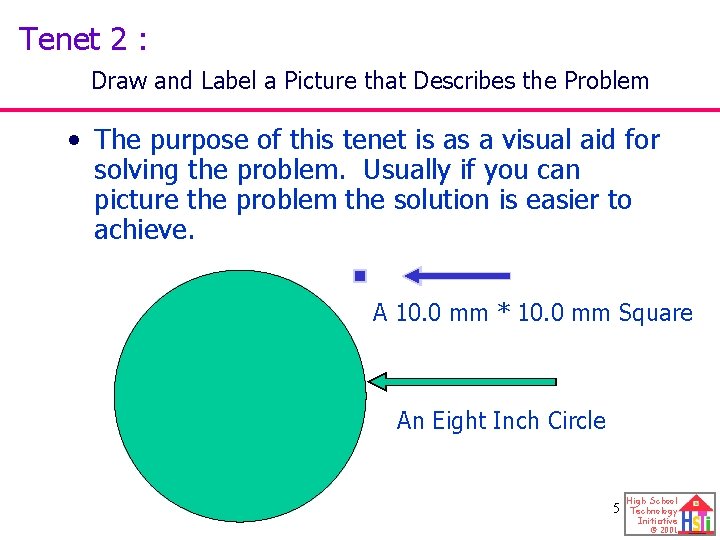
Tenet 2 : Draw and Label a Picture that Describes the Problem • The purpose of this tenet is as a visual aid for solving the problem. Usually if you can picture the problem the solution is easier to achieve. A 10. 0 mm * 10. 0 mm Square An Eight Inch Circle 5 High School Technology Initiative © 2001
Tenet 3 : Determine the Known and Unknown Variables Known Variables : • Diameter of Circle Unknown Variables : • Radius of the Circle – Dcir = 8. 00 inches • Area of the Circle • Length of a Side of a • Area of a Square • Number of Squares – Lside = 10. 0 mm. that fit inside the circle. 6 High School Technology Initiative © 2001
Tenet 4 : Examine the Units Used in the Problem • Converting all of the units to the answer’s units will save time in the end. • The units of the circle are inches. • The units of the sides of the square chip are given millimeters. • To solve this problem we need to convert the units of the problem to millimeters. 7 High School Technology Initiative © 2001
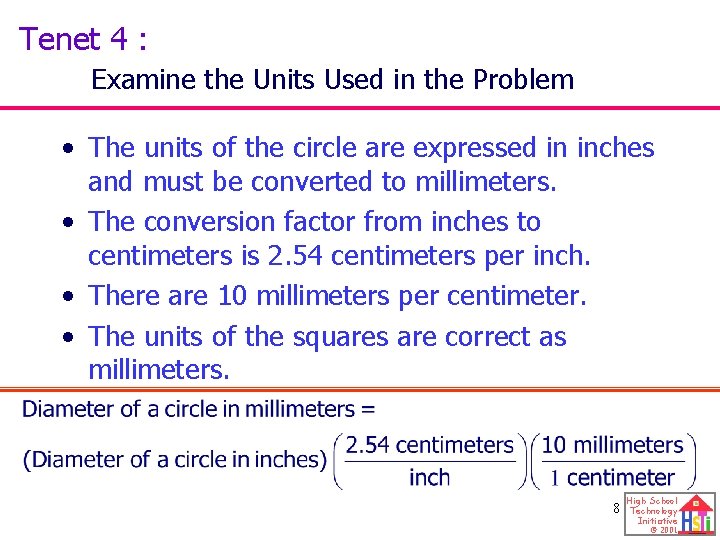
Tenet 4 : Examine the Units Used in the Problem • The units of the circle are expressed in inches and must be converted to millimeters. • The conversion factor from inches to centimeters is 2. 54 centimeters per inch. • There are 10 millimeters per centimeter. • The units of the squares are correct as millimeters. 8 High School Technology Initiative © 2001
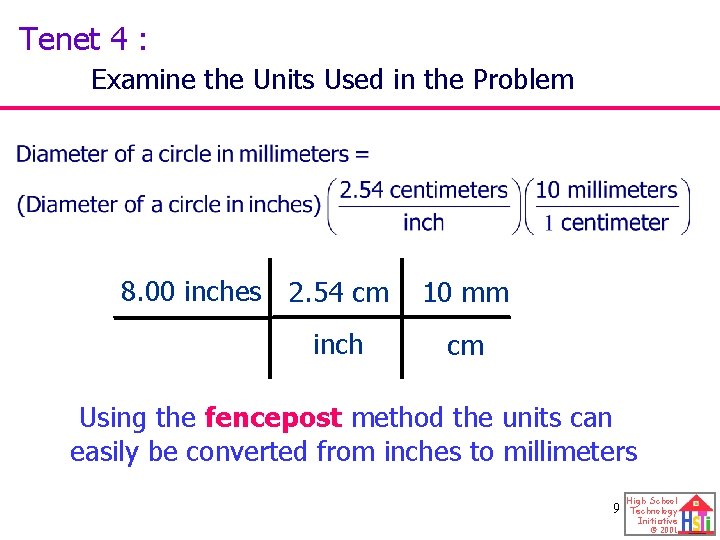
Tenet 4 : Examine the Units Used in the Problem 8. 00 inches 2. 54 cm inch 10 mm cm Using the fencepost method the units can easily be converted from inches to millimeters 9 High School Technology Initiative © 2001
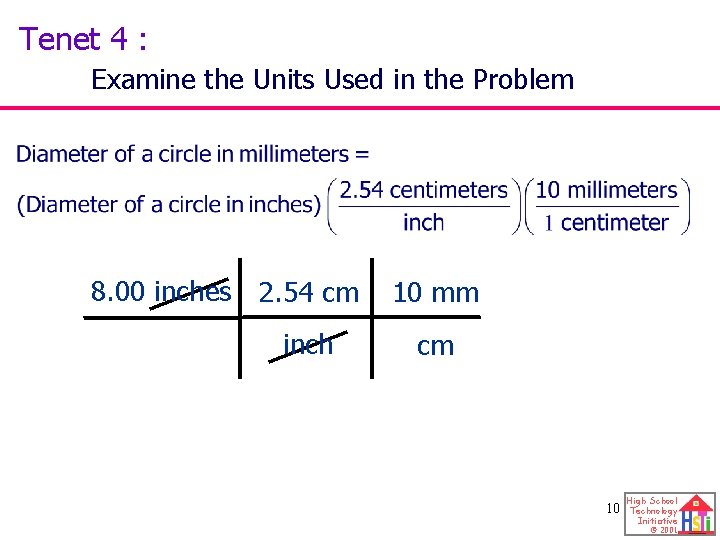
Tenet 4 : Examine the Units Used in the Problem 8. 00 inches 2. 54 cm inch 10 mm cm 10 High School Technology Initiative © 2001
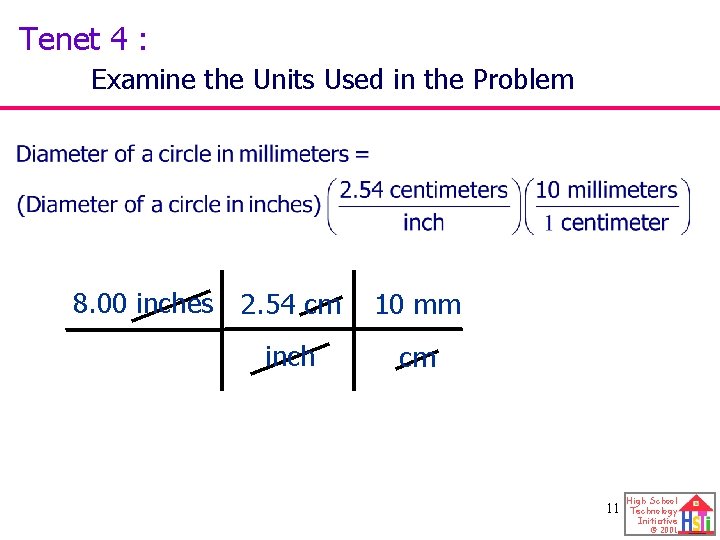
Tenet 4 : Examine the Units Used in the Problem 8. 00 inches 2. 54 cm inch 10 mm cm 11 High School Technology Initiative © 2001
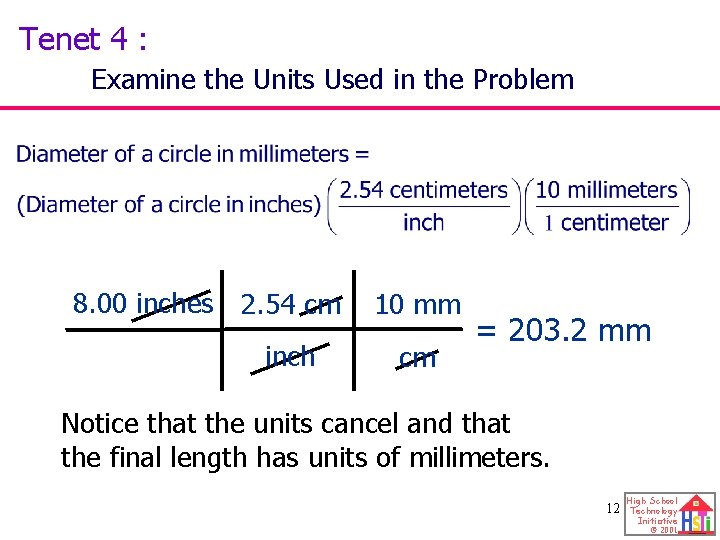
Tenet 4 : Examine the Units Used in the Problem 8. 00 inches 2. 54 cm inch 10 mm cm = 203. 2 mm Notice that the units cancel and that the final length has units of millimeters. 12 High School Technology Initiative © 2001
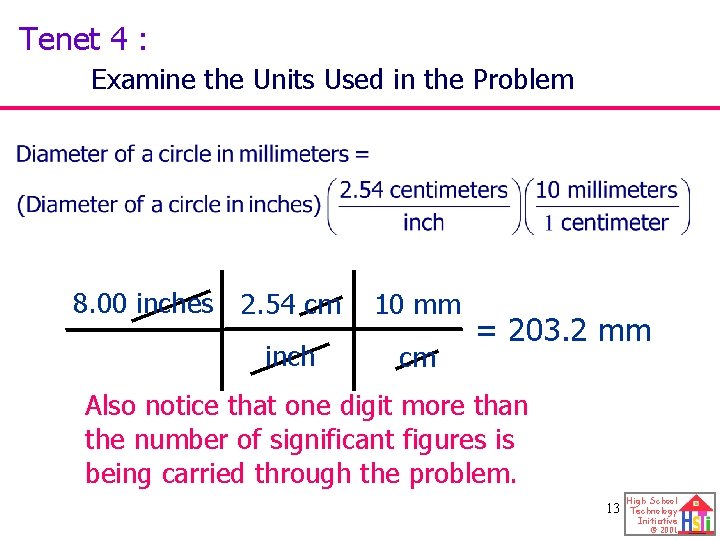
Tenet 4 : Examine the Units Used in the Problem 8. 00 inches 2. 54 cm inch 10 mm cm = 203. 2 mm Also notice that one digit more than the number of significant figures is being carried through the problem. 13 High School Technology Initiative © 2001
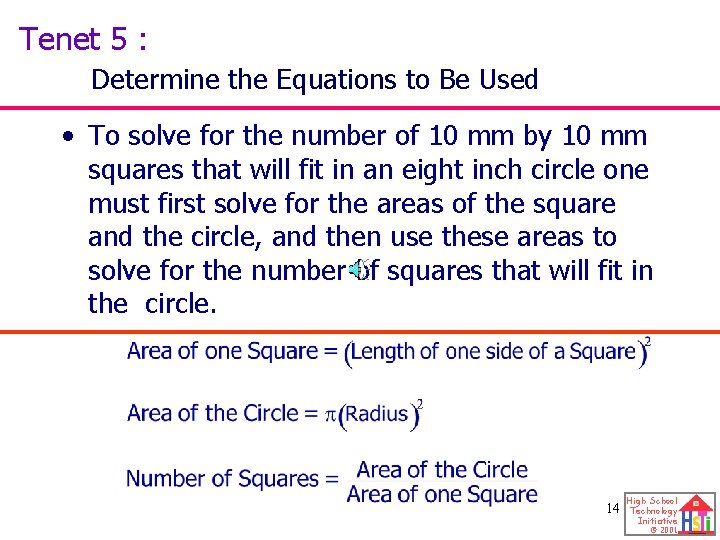
Tenet 5 : Determine the Equations to Be Used • To solve for the number of 10 mm by 10 mm squares that will fit in an eight inch circle one must first solve for the areas of the square and the circle, and then use these areas to solve for the number of squares that will fit in the circle. 14 High School Technology Initiative © 2001
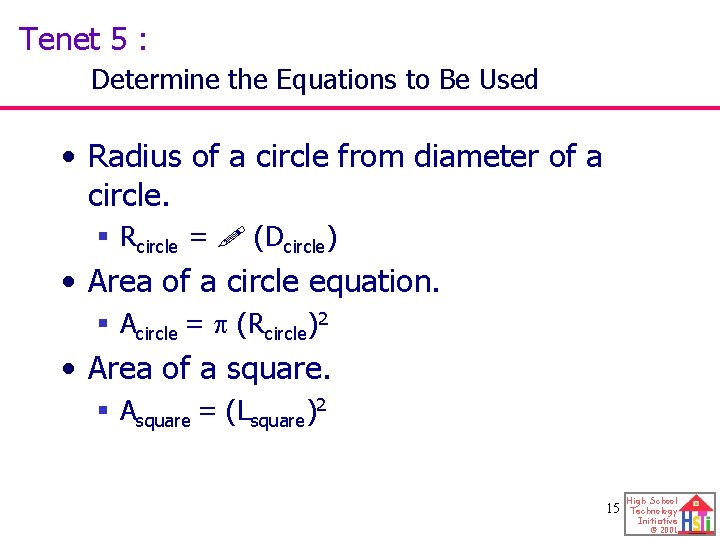
Tenet 5 : Determine the Equations to Be Used • Radius of a circle from diameter of a circle. § Rcircle = (Dcircle) • Area of a circle equation. § Acircle = (Rcircle)2 • Area of a square. § Asquare = (Lsquare)2 15 High School Technology Initiative © 2001
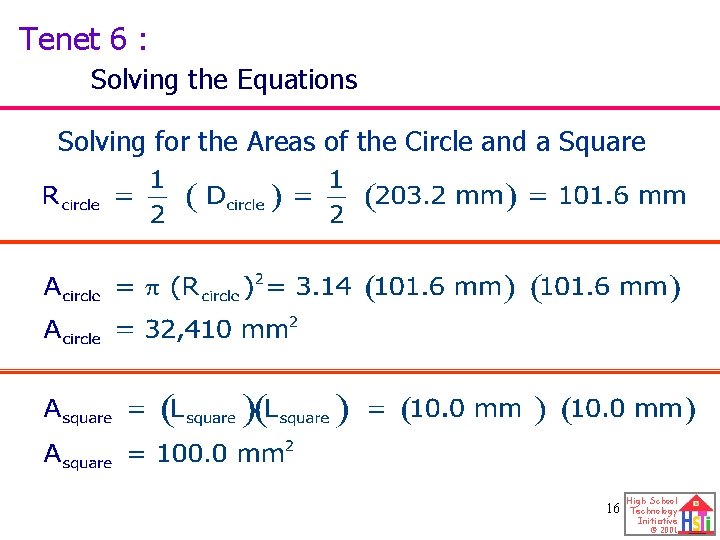
Tenet 6 : Solving the Equations Solving for the Areas of the Circle and a Square 16 High School Technology Initiative © 2001
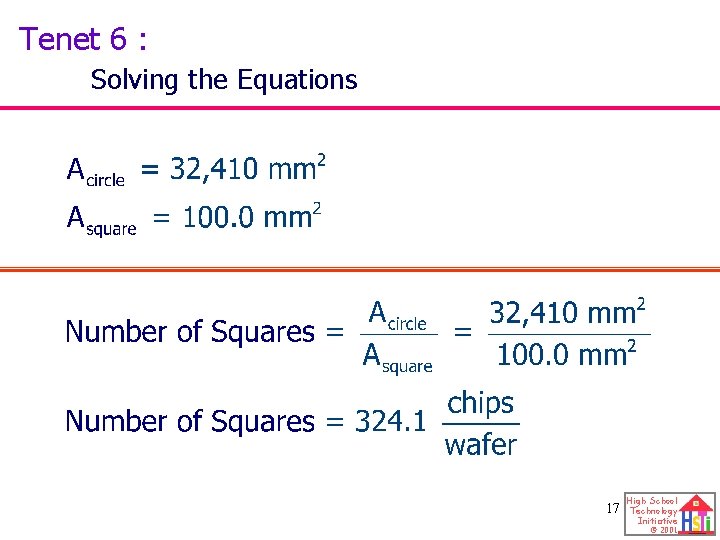
Tenet 6 : Solving the Equations 17 High School Technology Initiative © 2001
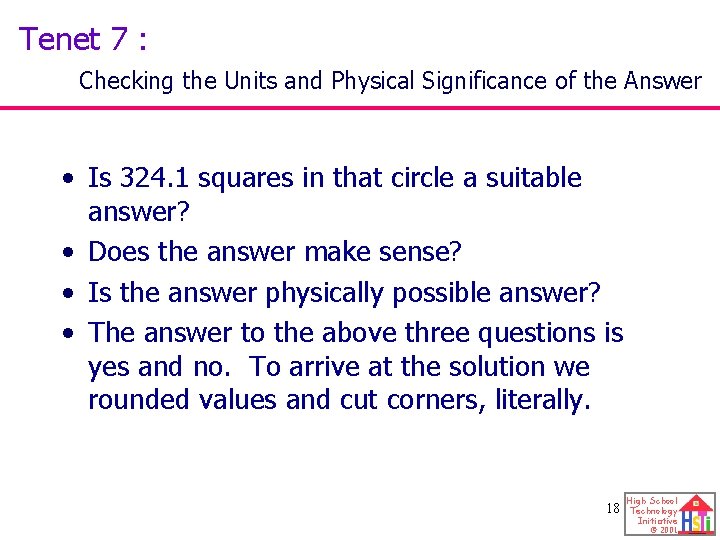
Tenet 7 : Checking the Units and Physical Significance of the Answer • Is 324. 1 squares in that circle a suitable answer? • Does the answer make sense? • Is the answer physically possible answer? • The answer to the above three questions is yes and no. To arrive at the solution we rounded values and cut corners, literally. 18 High School Technology Initiative © 2001
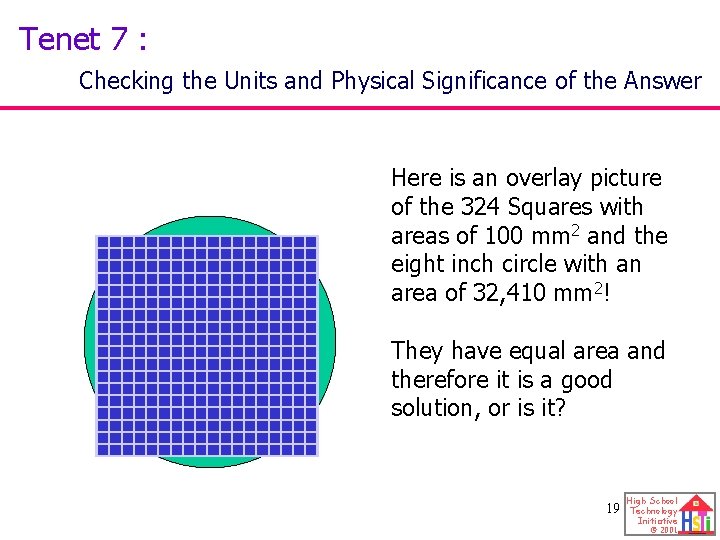
Tenet 7 : Checking the Units and Physical Significance of the Answer Here is an overlay picture of the 324 Squares with areas of 100 mm 2 and the eight inch circle with an area of 32, 410 mm 2! They have equal area and therefore it is a good solution, or is it? 19 High School Technology Initiative © 2001
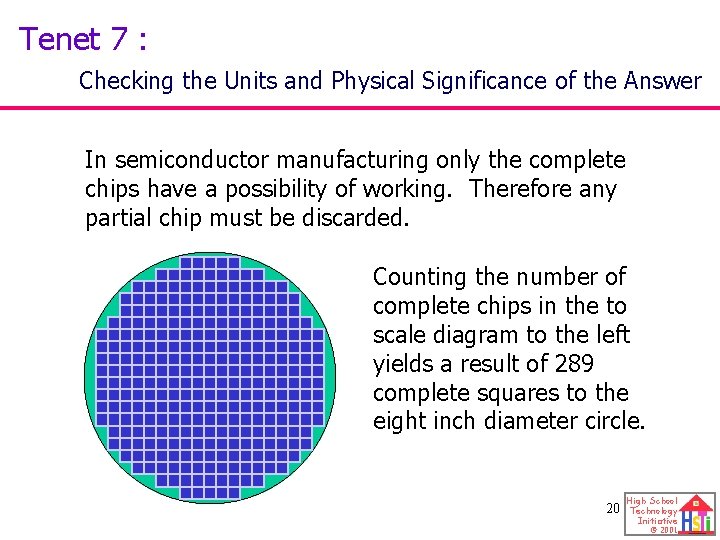
Tenet 7 : Checking the Units and Physical Significance of the Answer In semiconductor manufacturing only the complete chips have a possibility of working. Therefore any partial chip must be discarded. Counting the number of complete chips in the to scale diagram to the left yields a result of 289 complete squares to the eight inch diameter circle. 20 High School Technology Initiative © 2001
Tenet 8 : Reporting the Final Answer • The unit for the number of squares is mm 2 squares per 8. 00 inch diameter circle. • When the area of the 8. 00 inch diameter circle was matched with the area of the 100 mm 2 squares number of squares the result was 324. • The final value with units is less than 324 100 mm 2 squares per 8. 00 inch diameter circle. Notice that three significant figures are used for reporting the final answer! 21 High School Technology Initiative © 2001
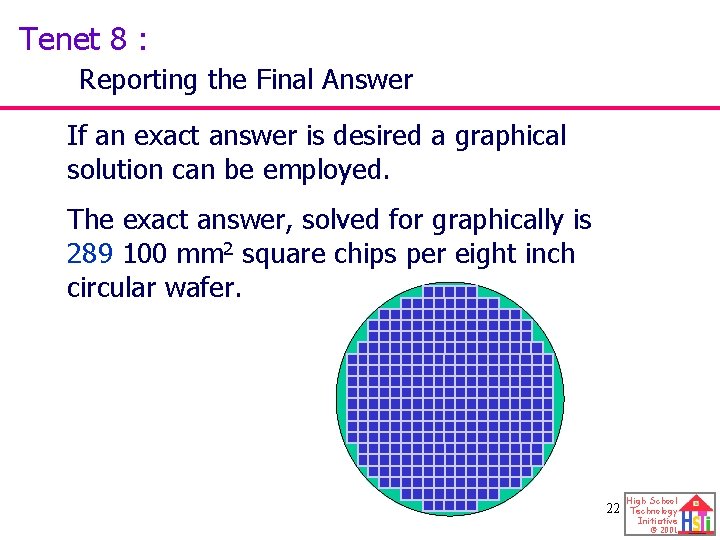
Tenet 8 : Reporting the Final Answer If an exact answer is desired a graphical solution can be employed. The exact answer, solved for graphically is 289 100 mm 2 square chips per eight inch circular wafer. 22 High School Technology Initiative © 2001
- Slides: 22