
Problem Solving Tools and methods for problems and
Problem Solving Tools and methods for problems and improvements 1
Problem Solving AGENDA • • Introduction Why do we need problem solving? Understanding problems Some tools and their uses Plan-Do-Check-Act Summary Questions 2
Introduction What is a problem? • A problem exists when there is a gap between what is and what must be, could be, or should be. ØIn today’s competitive environment, today’s “should be” might be tomorrow’s “must be” 3
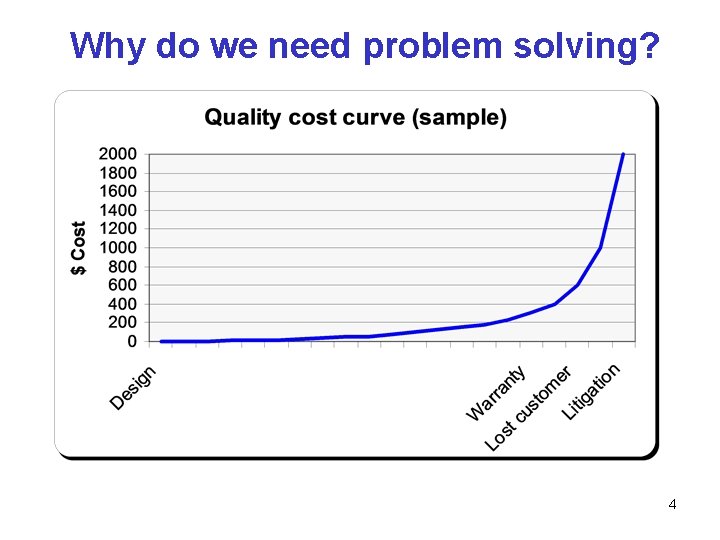
Why do we need problem solving? 4
Why do we need problem solving? Costs of quality - controllable Prevention cost • Quality planning (test, inspection, audits, process control) • Education and training • Performing capability analyses (Cpk) • Conducting design reviews Appraisal cost • Test and inspection • Supplier acceptance sampling • Auditing 5
Why do we need problem solving? Uncontrolled costs: poor quality Poor-quality costs: Internal error cost • In-process scrap and rework • Troubleshooting and repairing • Design changes • Additional mask moves to replace rejected lots External error cost • Warranties • Lost customer • Litigation 6
Understanding problems Types of problems § Production – defects and dropped lots § Maintenance – both equipment and facilities § Safety – risks, incidents and injuries § Environmental – risks and environmental incidents § Personal – what keeps us from getting what we want § Interpersonal – what keeps us from getting what we want from others 7
Tools and applications What’s the process? q Plan q Do q Check q Act 8
Tools and applications - Why use the process approach? A systematic approach can help with: • Fixing it the first time • Keeping the solution costs low • Sharing the lessons learned with others 9
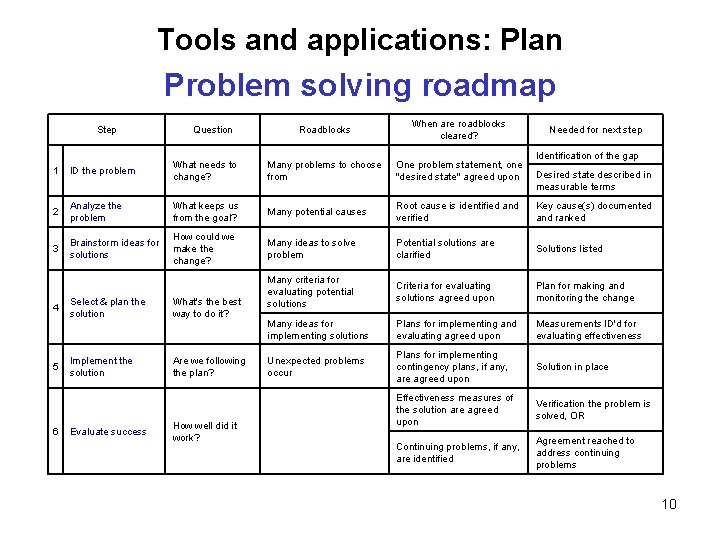
Tools and applications: Plan Problem solving roadmap Step Question Roadblocks When are roadblocks cleared? Many problems to choose from One problem statement, one "desired state" agreed upon Needed for next step Identification of the gap 1 ID the problem What needs to change? 2 Analyze the problem What keeps us from the goal? Many potential causes Root cause is identified and verified Key cause(s) documented and ranked 3 Brainstorm ideas for solutions How could we make the change? Many ideas to solve problem Potential solutions are clarified Solutions listed Many criteria for evaluating potential solutions Criteria for evaluating solutions agreed upon Plan for making and monitoring the change Many ideas for implementing solutions Plans for implementing and evaluating agreed upon Measurements ID'd for evaluating effectiveness Unexpected problems occur Plans for implementing contingency plans, if any, are agreed upon Solution in place Effectiveness measures of the solution are agreed upon Verification the problem is solved, OR Continuing problems, if any, are identified Agreement reached to address continuing problems 4 5 6 Select & plan the solution What's the best way to do it? Implement the solution Are we following the plan? Evaluate success How well did it work? Desired state described in measurable terms 10
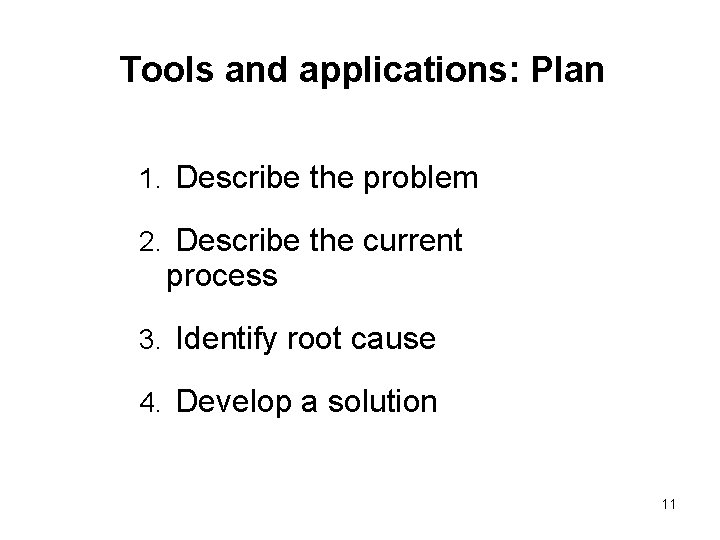
Tools and applications: Plan 1. Describe the problem 2. Describe the current process 3. Identify root cause 4. Develop a solution 11
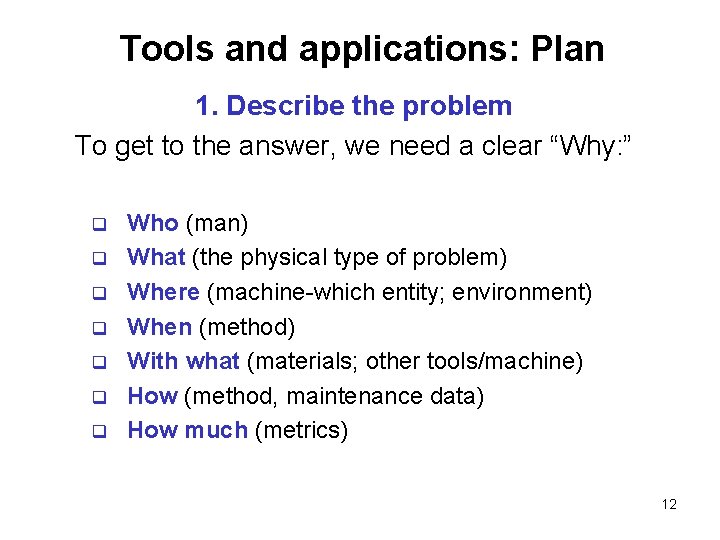
Tools and applications: Plan 1. Describe the problem To get to the answer, we need a clear “Why: ” q q q q Who (man) What (the physical type of problem) Where (machine-which entity; environment) When (method) With what (materials; other tools/machine) How (method, maintenance data) How much (metrics) 12
Tools and applications: Plan Write the problem statement The research-worthy problem statement should address all six questions: what, how, where, when, why, and who. ü Include your metrics to describe the problem. ü No theories or blame. 13
Tools and applications: Plan How do we know what the problem is? First, some definitions: Quantitative data ü Can be counted or measured. Qualitative data ü Descriptive, not easily counted. 14
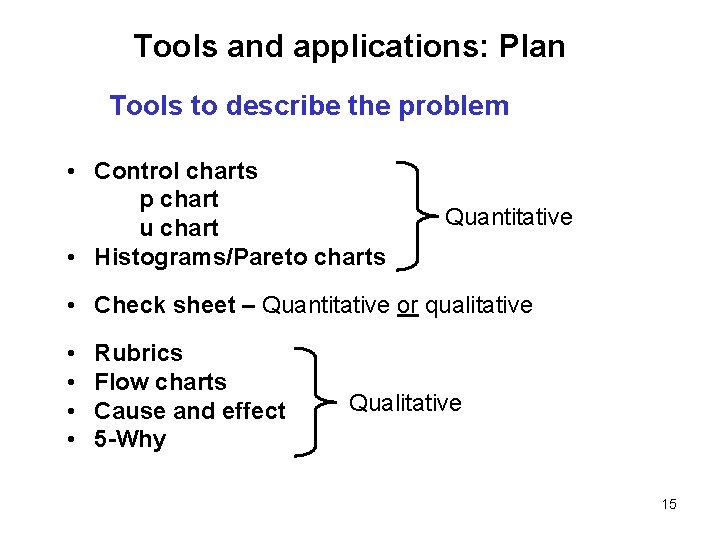
Tools and applications: Plan Tools to describe the problem • Control charts p chart u chart • Histograms/Pareto charts Quantitative • Check sheet – Quantitative or qualitative • • Rubrics Flow charts Cause and effect 5 -Why Qualitative 15
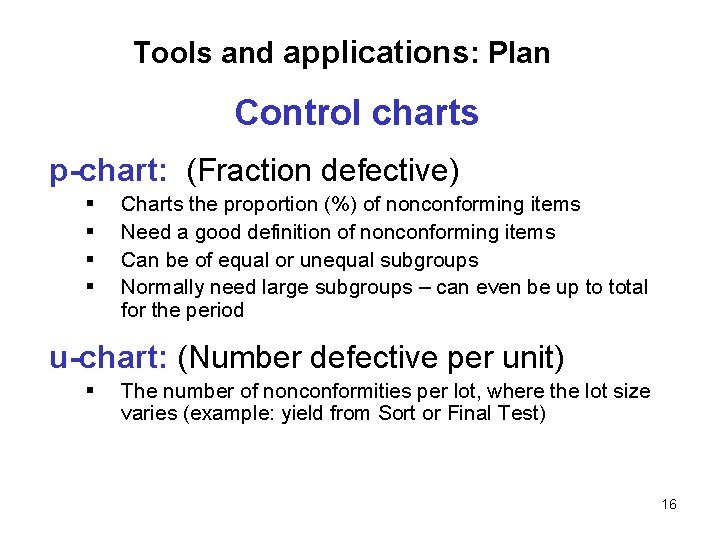
Tools and applications: Plan Control charts p-chart: (Fraction defective) § § Charts the proportion (%) of nonconforming items Need a good definition of nonconforming items Can be of equal or unequal subgroups Normally need large subgroups – can even be up to total for the period u-chart: (Number defective per unit) § The number of nonconformities per lot, where the lot size varies (example: yield from Sort or Final Test) 16
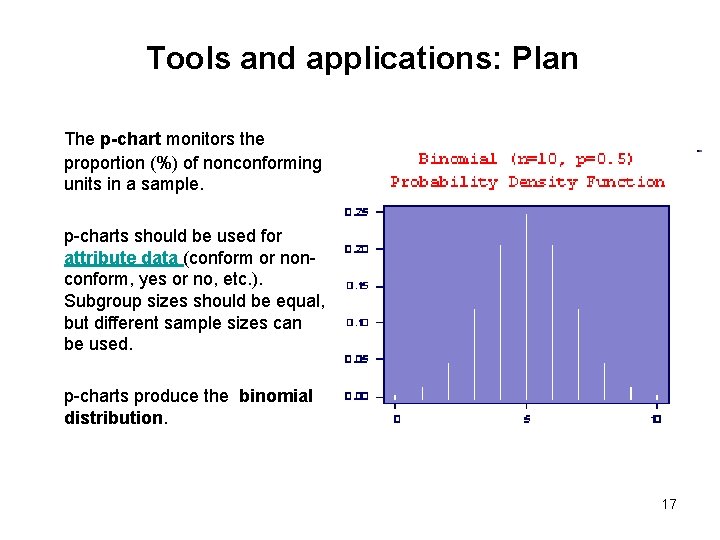
Tools and applications: Plan The p-chart monitors the proportion (%) of nonconforming units in a sample. p-charts should be used for attribute data (conform or nonconform, yes or no, etc. ). Subgroup sizes should be equal, but different sample sizes can be used. p-charts produce the binomial distribution. 17
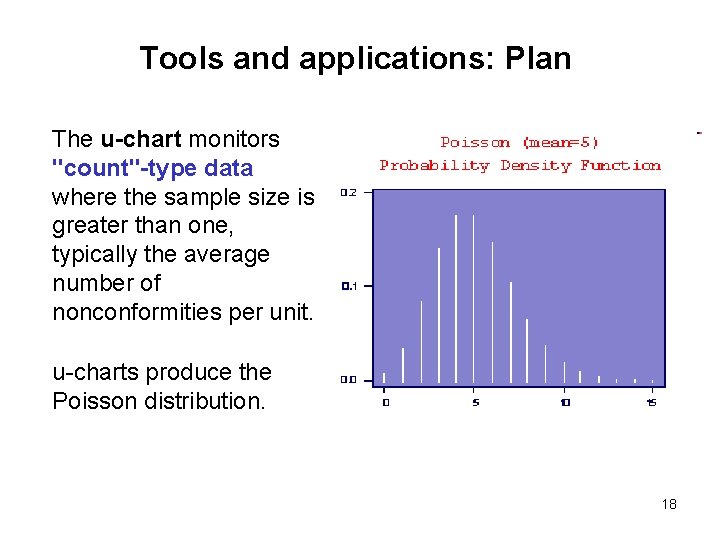
Tools and applications: Plan The u-chart monitors "count"-type data where the sample size is greater than one, typically the average number of nonconformities per unit. u-charts produce the Poisson distribution. 18
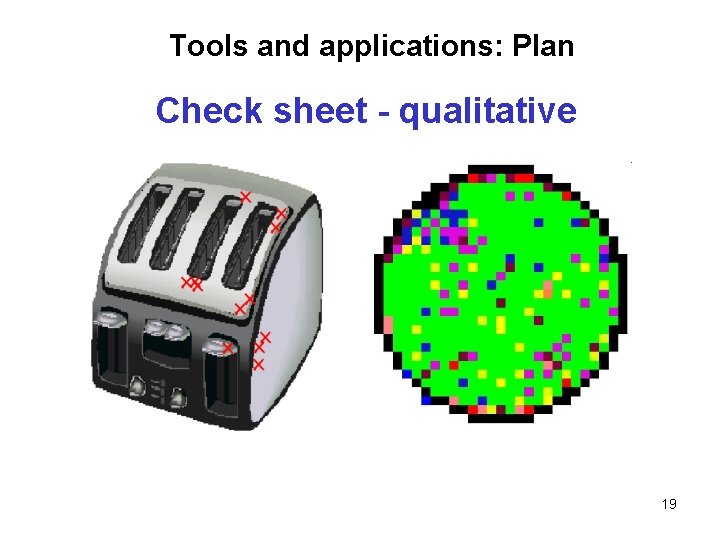
Tools and applications: Plan Check sheet - qualitative 19
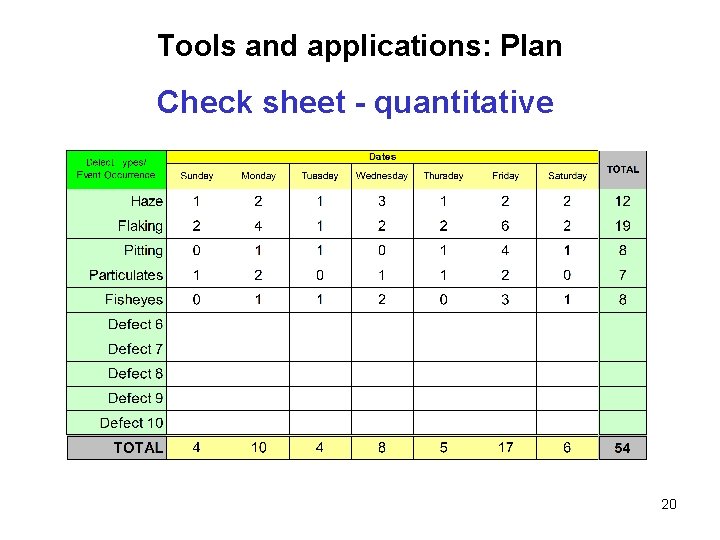
Tools and applications: Plan Check sheet - quantitative 20
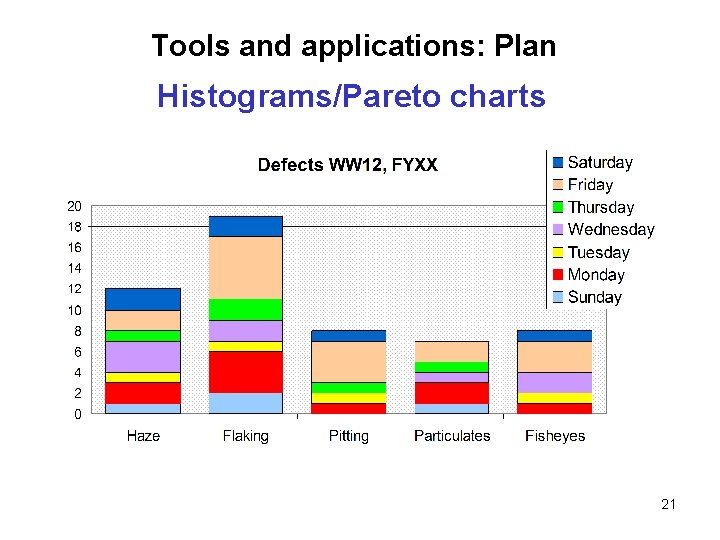
Tools and applications: Plan Histograms/Pareto charts 21
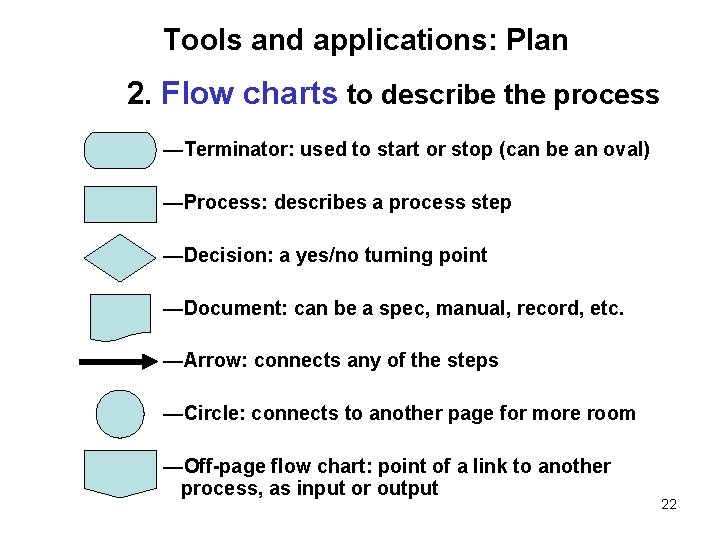
Tools and applications: Plan 2. Flow charts to describe the process —Terminator: used to start or stop (can be an oval) —Process: describes a process step —Decision: a yes/no turning point —Document: can be a spec, manual, record, etc. —Arrow: connects any of the steps —Circle: connects to another page for more room —Off-page flow chart: point of a link to another process, as input or output 22
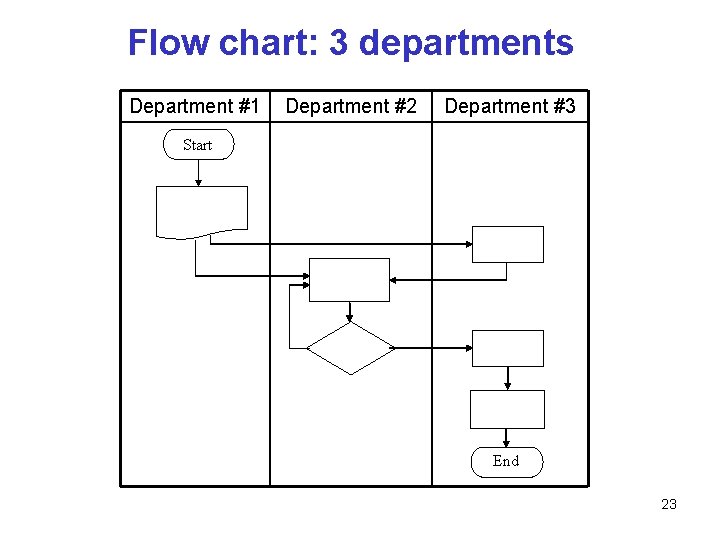
Flow chart: 3 departments Department #1 Department #2 Department #3 Start End 23
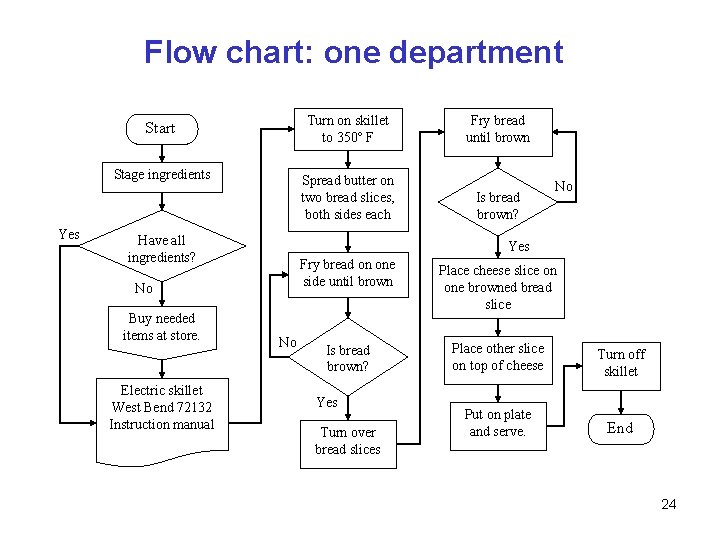
Flow chart: one department Yes Start Turn on skillet to 350º F Fry bread until brown Stage ingredients Spread butter on two bread slices, both sides each Is bread brown? Have all ingredients? Yes No Buy needed items at store. Electric skillet West Bend 72132 Instruction manual No No Fry bread on one side until brown Place cheese slice on one browned bread slice Is bread brown? Place other slice on top of cheese Turn off skillet Put on plate and serve. End Yes Turn over bread slices 24
Scripted flow chart ü More how-to process information is available for users. ü Can reference specs for critical information. ü Lists person responsible for each step. ü Can be made into a process spec. 25
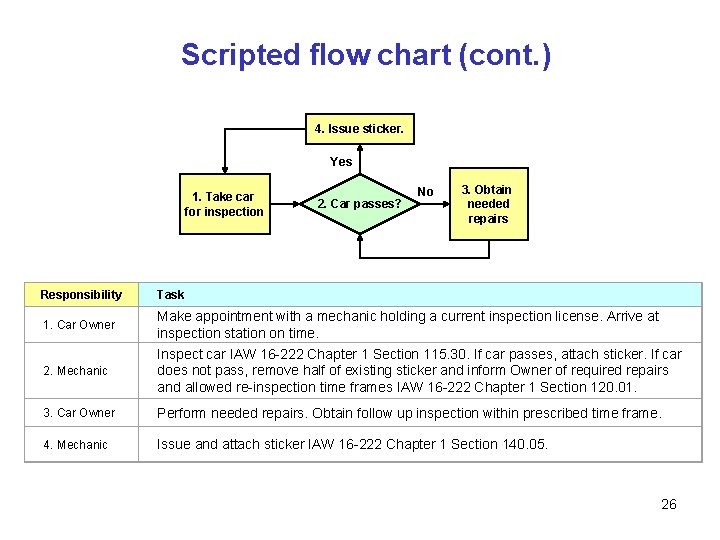
Scripted flow chart (cont. ) 4. Issue sticker. Yes 1. Take car for inspection Responsibility 1. Car Owner 2. Mechanic 2. Car passes? No 3. Obtain needed repairs Task Make appointment with a mechanic holding a current inspection license. Arrive at inspection station on time. Inspect car IAW 16 -222 Chapter 1 Section 115. 30. If car passes, attach sticker. If car does not pass, remove half of existing sticker and inform Owner of required repairs and allowed re-inspection time frames IAW 16 -222 Chapter 1 Section 120. 01. 3. Car Owner Perform needed repairs. Obtain follow up inspection within prescribed time frame. 4. Mechanic Issue and attach sticker IAW 16 -222 Chapter 1 Section 140. 05. 26
Tools and applications: Plan 3. What’s it all for? Finding the root cause Q: How do I know when I have arrived at root cause? A: If the root cause is removed, the problem disappears. 27
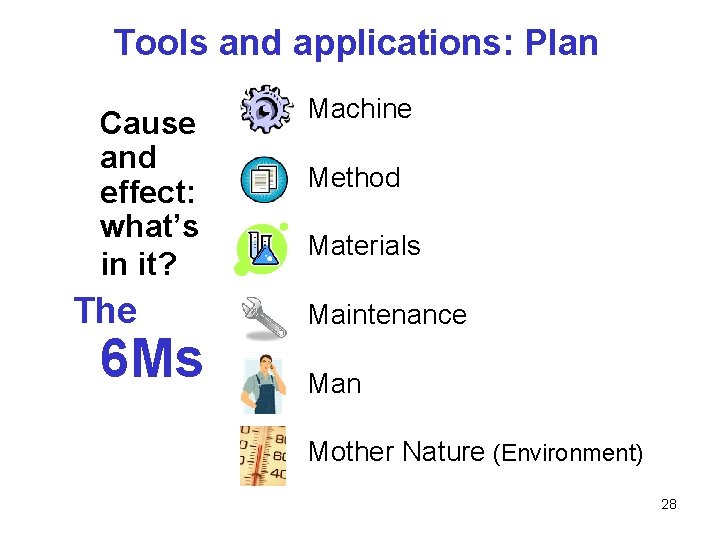
Tools and applications: Plan Cause and effect: what’s in it? The 6 Ms Machine Method Materials Maintenance Man Mother Nature (Environment) 28
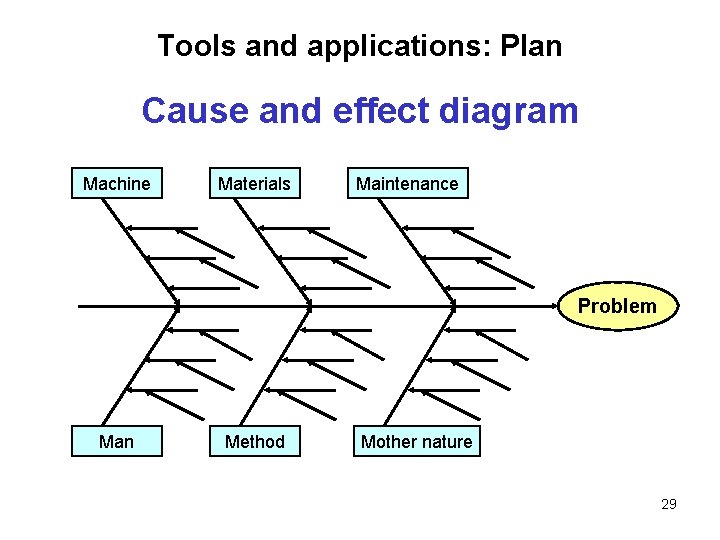
Tools and applications: Plan Cause and effect diagram Machine Materials Maintenance Problem Man Method Mother nature 29
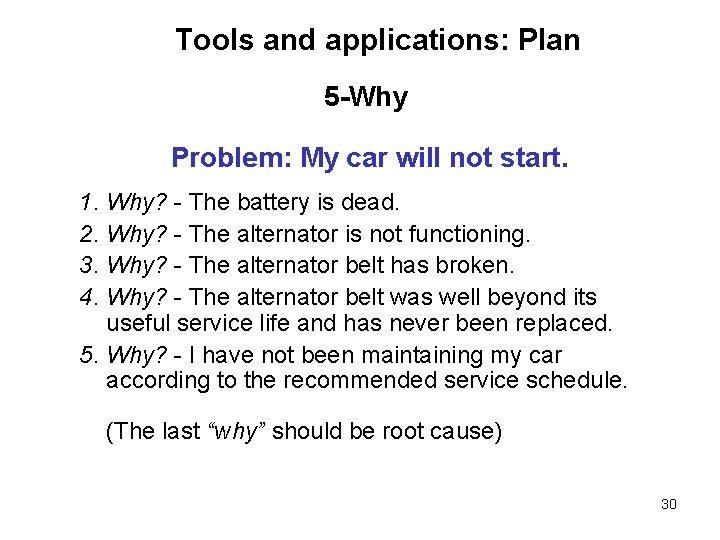
Tools and applications: Plan 5 -Why Problem: My car will not start. 1. Why? - The battery is dead. 2. Why? - The alternator is not functioning. 3. Why? - The alternator belt has broken. 4. Why? - The alternator belt was well beyond its useful service life and has never been replaced. 5. Why? - I have not been maintaining my car according to the recommended service schedule. (The last “why” should be root cause) 30
Tools and applications: Plan Finding the cause: Understanding human error Fundamental Attribution Error 31
Tools and applications: Plan Rubrics § Used to put a number value on descriptions. § Can “measure” performance in man, material, machines. § Can be customized. § The closest example is in employee performance evals. 32

Tools and applications: Plan Qualitative analysis using the rubric Stated Objective or Performance Criteria Beginning Score: 1 Developing Score: 2 Accomplished Score: 3 Excellence Score: 4 Description of performance characteristics: beginning performance level. Description of performance characteristics: development and movement toward mastery. Description of performance characteristics: highest performance. Definitions Result Scale 33
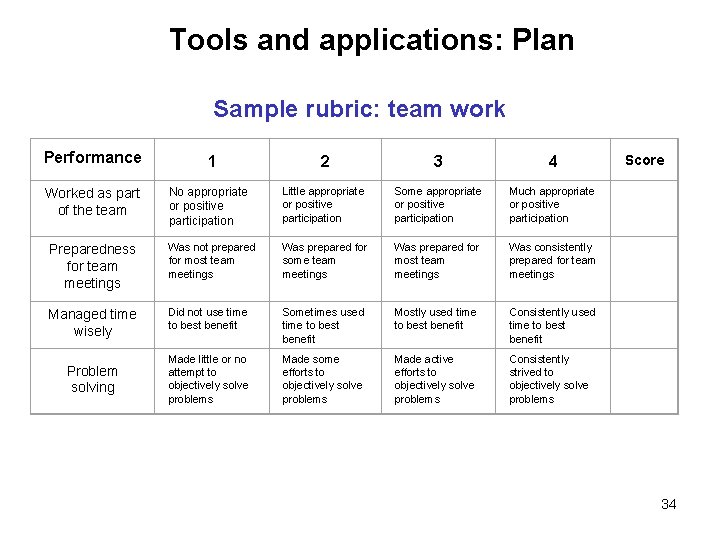
Tools and applications: Plan Sample rubric: team work Performance 2 3 4 No appropriate or positive participation Little appropriate or positive participation Some appropriate or positive participation Much appropriate or positive participation Preparedness for team meetings Was not prepared for most team meetings Was prepared for some team meetings Was prepared for most team meetings Was consistently prepared for team meetings Managed time wisely Did not use time to best benefit Sometimes used time to best benefit Mostly used time to best benefit Consistently used time to best benefit Problem solving Made little or no attempt to objectively solve problems Made some efforts to objectively solve problems Made active efforts to objectively solve problems Consistently strived to objectively solve problems Worked as part of the team 1 Score 34
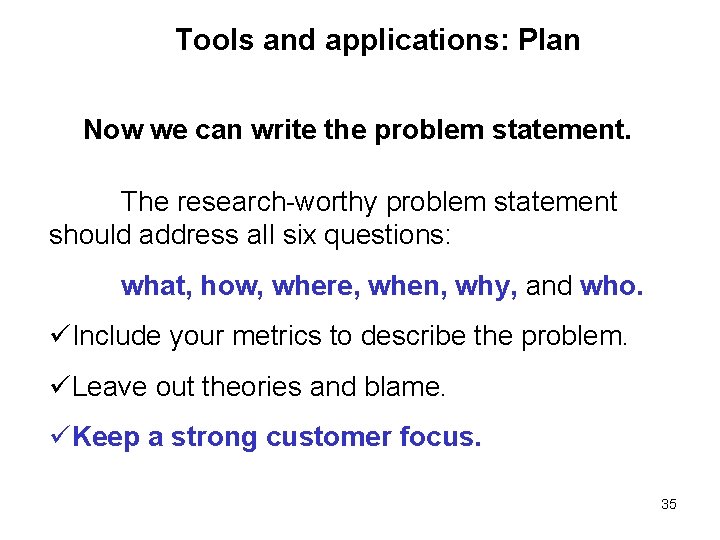
Tools and applications: Plan Now we can write the problem statement. The research-worthy problem statement should address all six questions: what, how, where, when, why, and who. üInclude your metrics to describe the problem. üLeave out theories and blame. üKeep a strong customer focus. 35
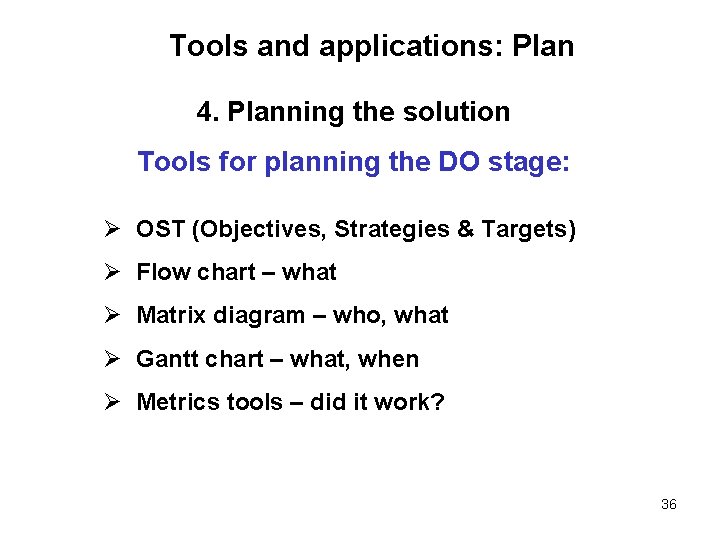
Tools and applications: Plan 4. Planning the solution Tools for planning the DO stage: Ø OST (Objectives, Strategies & Targets) Ø Flow chart – what Ø Matrix diagram – who, what Ø Gantt chart – what, when Ø Metrics tools – did it work? 36
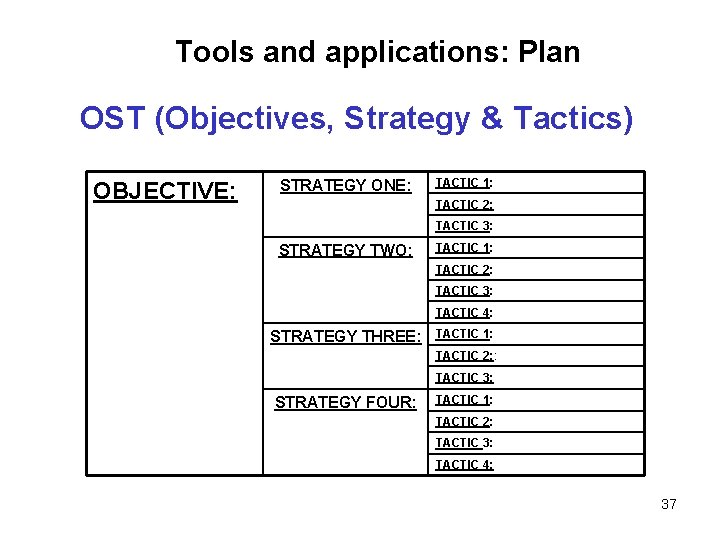
Tools and applications: Plan OST (Objectives, Strategy & Tactics) OBJECTIVE: STRATEGY ONE: TACTIC 1: TACTIC 2: TACTIC 3: STRATEGY TWO: TACTIC 1: TACTIC 2: TACTIC 3: TACTIC 4: STRATEGY THREE: TACTIC 1: TACTIC 2: : TACTIC 3: STRATEGY FOUR: TACTIC 1: TACTIC 2: TACTIC 3: TACTIC 4: 37
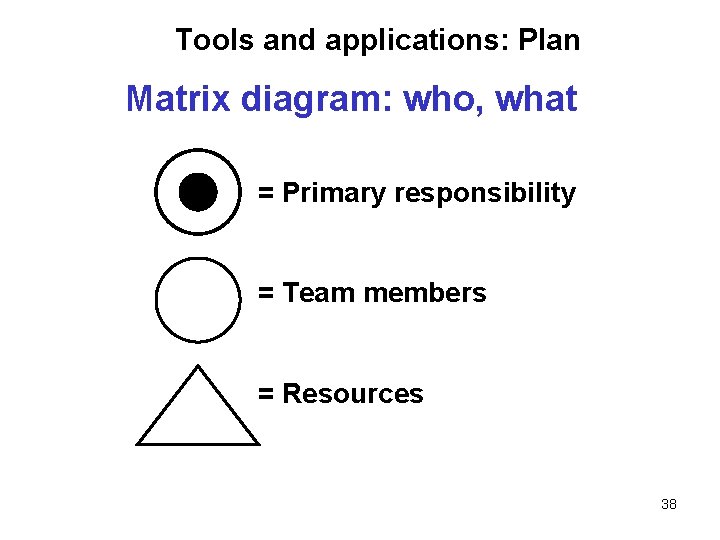
Tools and applications: Plan Matrix diagram: who, what = Primary responsibility = Team members = Resources 38
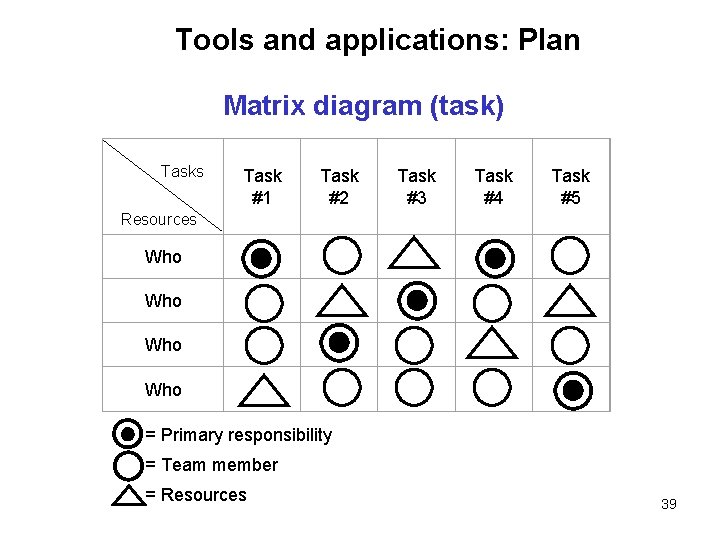
Tools and applications: Plan Matrix diagram (task) Tasks Task #1 Task #2 Task #3 Task #4 Task #5 Resources Who Who = Primary responsibility = Team member = Resources 39
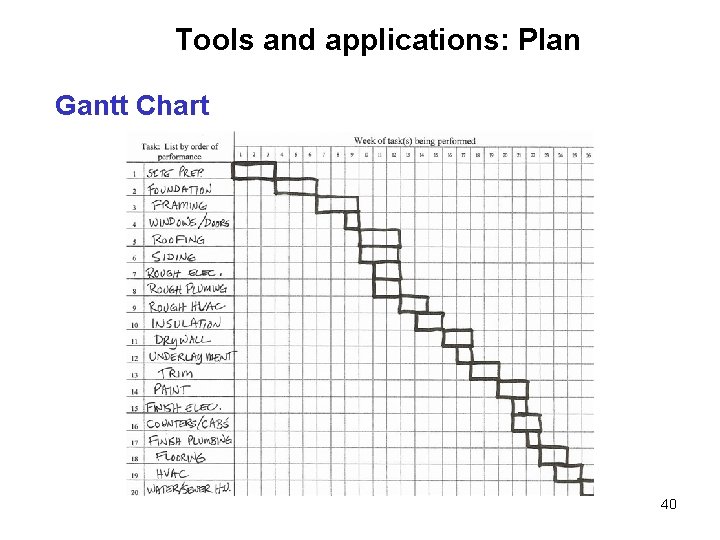
Tools and applications: Plan Gantt Chart 40
The DO stage What’s next in the process? þ Plan q Do: Implement the solution q Check q Act 41
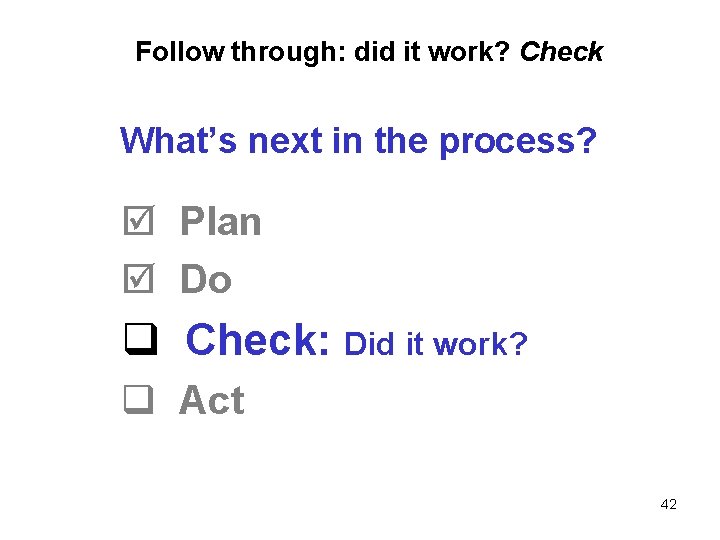
Follow through: did it work? Check What’s next in the process? þ Plan þ Do q Check: Did it work? q Act 42
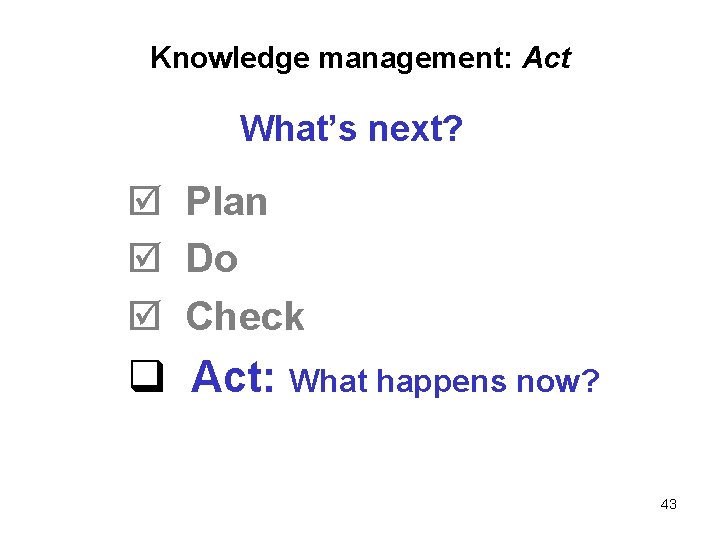
Knowledge management: Act What’s next? þ Plan þ Do þ Check q Act: What happens now? 43
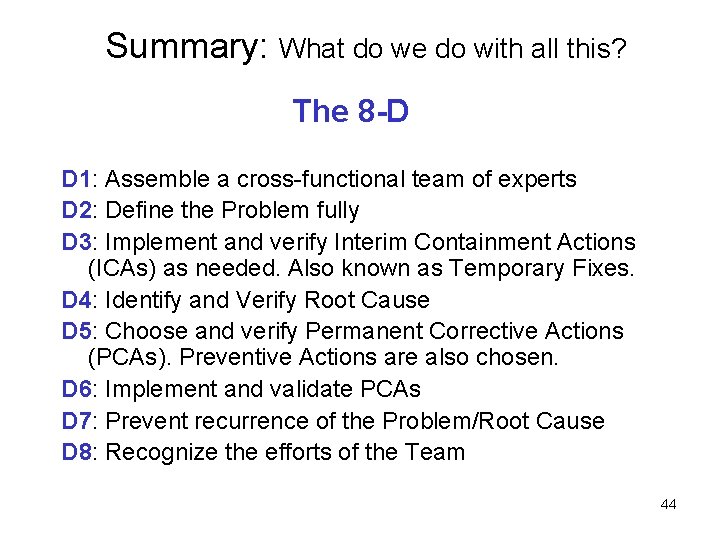
Summary: What do we do with all this? The 8 -D D 1: Assemble a cross-functional team of experts D 2: Define the Problem fully D 3: Implement and verify Interim Containment Actions (ICAs) as needed. Also known as Temporary Fixes. D 4: Identify and Verify Root Cause D 5: Choose and verify Permanent Corrective Actions (PCAs). Preventive Actions are also chosen. D 6: Implement and validate PCAs D 7: Prevent recurrence of the Problem/Root Cause D 8: Recognize the efforts of the Team 44
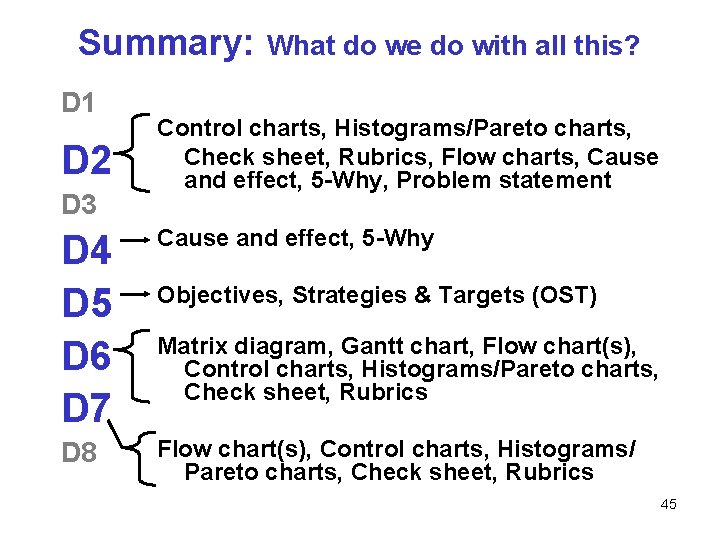
Summary: D 1 D 2 D 3 What do we do with all this? Control charts, Histograms/Pareto charts, Check sheet, Rubrics, Flow charts, Cause and effect, 5 -Why, Problem statement D 4 D 5 D 6 D 7 Cause and effect, 5 -Why D 8 Flow chart(s), Control charts, Histograms/ Pareto charts, Check sheet, Rubrics Objectives, Strategies & Targets (OST) Matrix diagram, Gantt chart, Flow chart(s), Control charts, Histograms/Pareto charts, Check sheet, Rubrics 45
Wrap up • Questions? • Comments? 46
Resources Memory Jogger II – Continuous Improvement Problem solving Memory Jogger (more advanced tools) 47
Presenter Contact Details Jennifer Kirley Productivity Engineer jkirley@kirleyworks. com 48
- Slides: 48