
Problem Solving Team XX XX PSY360 XX XX

Problem Solving Team XX: XX PSY/360 XX XX

Kimmi And Her Family • Kimmi is going back to school • Every family member has their own responsibilities and needs that have to be met and maintained while Kimmi attends school.

The Problem that Needs A Solution • Initial State Of The Problem • Could Become Overwhelmed • Could Neglect Some or All Responbilities

An Effective Schedule • Group decided it was effective to make a schedule based off past experiences • A schedule can help organize your time and show what you can and can not due.
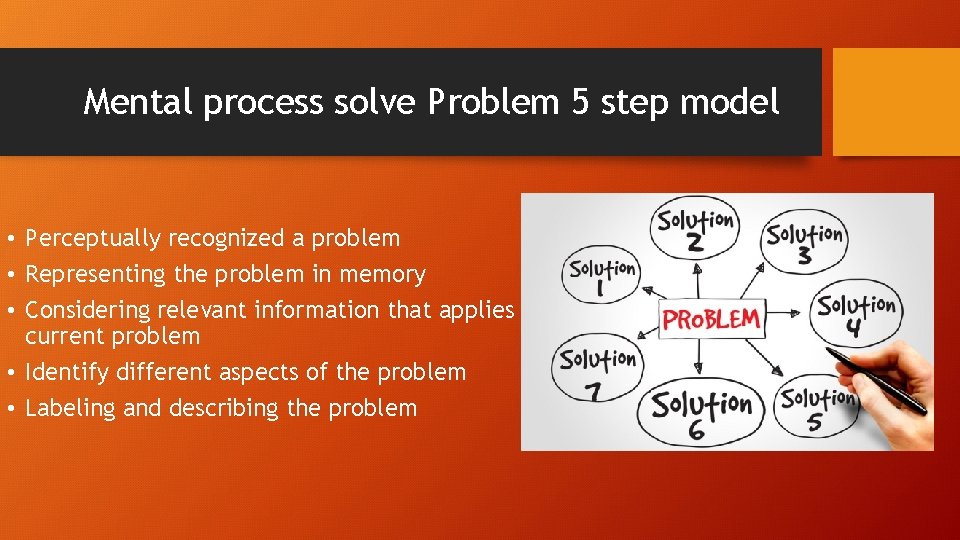
Mental process solve Problem 5 step model • Perceptually recognized a problem • Representing the problem in memory • Considering relevant information that applies to current problem • Identify different aspects of the problem • Labeling and describing the problem

Steps for Solution of the Problem • • • Identification of the problem Understanding the Problem Forming a strategy Organizing information Allocating Resources
Reasoning Processes and Strategies • We took our own situations into account and decided that the best way to figure out when was best for Kimmi to set aside time for school by utilizing a set schedule. We included the situations that may come up within her schedule and also took into account the time for groceries, meals, and various other daily tasks that a mother and wife must handle.
Problem Solving Strategies Utilized • We incorporated patterns of strategies of overcoming heuristic bias. We created a detailed schedule for the family including all of the schedules of the family. It was this way that we were able to ensure that each person was able to complete what needed to be completed as well as Kimmi having the capability of setting aside two hours for her studying each day. By Jenni Williams
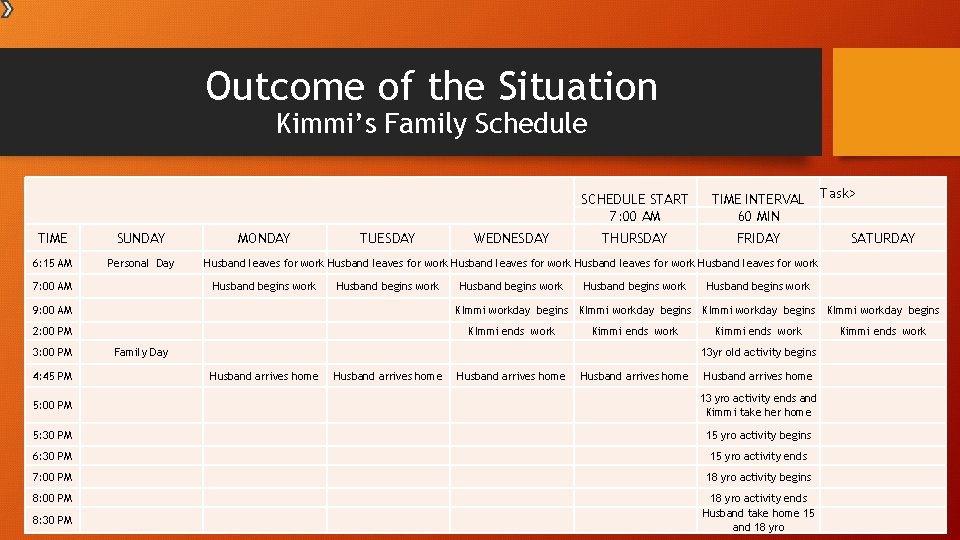
Outcome of the Situation Kimmi’s Family Schedule TIME SUNDAY 6: 15 AM Personal Day 7: 00 AM MONDAY TUESDAY Husband begins work THURSDAY FRIDAY Husband begins work KImmi ends work Kimmi ends work Family Day Kimmi ends work 13 yr old activity begins Husband arrives home Husband arrives home 5: 00 PM 13 yro activity ends and Kimmi take her home 5: 30 PM 15 yro activity begins 6: 30 PM 15 yro activity ends 7: 00 PM 18 yro activity begins 8: 00 PM 18 yro activity ends Husband take home 15 and 18 yro 8: 30 PM Task> SATURDAY Husband begins work KImmi workday begins 2: 00 PM 4: 45 PM TIME INTERVAL 60 MIN Husband leaves for work Husband leaves for work 9: 00 AM 3: 00 PM WEDNESDAY SCHEDULE START 7: 00 AM KImmi workday begins Kimmi ends work
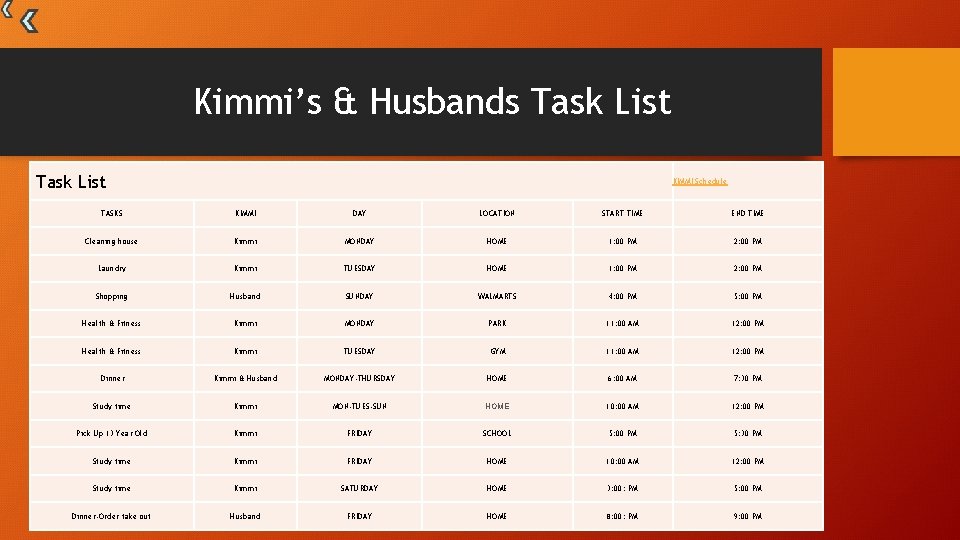
Kimmi’s & Husbands Task List KIMMI Schedule TASKS KIMMI DAY LOCATION START TIME END TIME Cleaning house Kimmi MONDAY HOME 1: 00 PM 2: 00 PM Laundry Kimmi TUESDAY HOME 1: 00 PM 2: 00 PM Shopping Husband SUNDAY WALMARTS 4: 00 PM 5: 00 PM Health & Fitness Kimmi MONDAY PARK 11: 00 AM 12: 00 PM Health & Fitness Kimmi TUESDAY GYM 11: 00 AM 12: 00 PM Dinner Kimmi & Husband MONDAY-THURSDAY HOME 6: 00 AM 7: 30 PM Study time Kimmi MON-TUES-SUN HOME 10: 00 AM 12: 00 PM Pick Up 13 Year Old Kimmi FRIDAY SCHOOL 5: 00 PM 5: 30 PM Study time Kimmi FRIDAY HOME 10: 00 AM 12: 00 PM Study time Kimmi SATURDAY HOME 3: 00: PM 5: 00 PM Dinner-Order take out Husband FRIDAY HOME 8: 00: PM 9: 00 PM
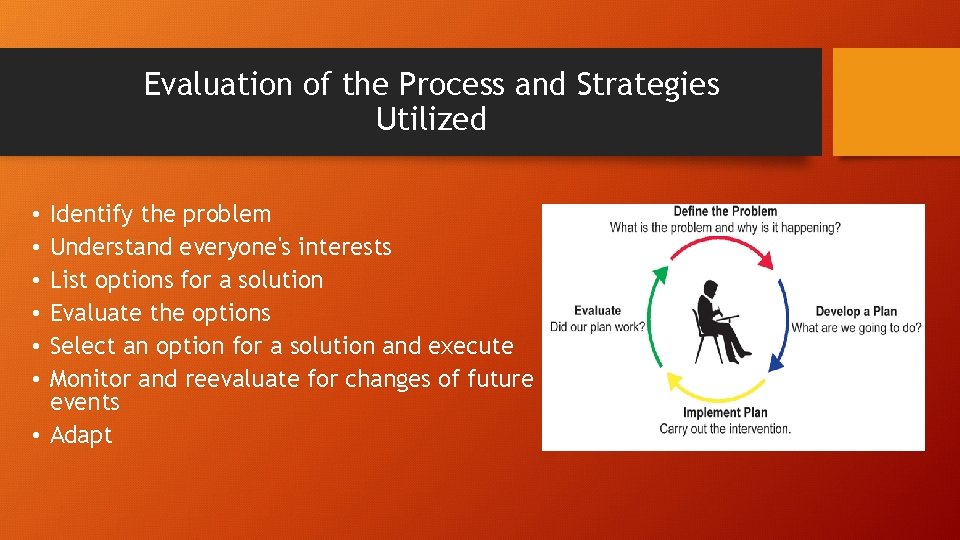
Evaluation of the Process and Strategies Utilized Identify the problem Understand everyone's interests List options for a solution Evaluate the options Select an option for a solution and execute Monitor and reevaluate for changes of future events • Adapt • • •
References • Cherry, K. (2018). Problem-Solving Strategies and Obstacles. Retrieved from https: //www. verywellmind. com/problemsolving-2795008 • Dostal, J. , (2015), Theory of problem solving, Procedia – Social and Behavioral Sciences, ISSN 1877 -0428. Vol. 174. DOI 10. 1016/j. sbspro. 2015. 01. 970 • Image retrieved from https: //www. google. com/search? q=problem+solving+at+work&rlz • Kern, Rebecca; 2010, https: //www. usnews. com/education/online-school). • Learn-Source; 2018, https: //learn-source. com/education/family_school • Mind Tools Content Team. (2018). Effective Scheduling: Planning to Make the Best Use of Your Time. Retrieved from https: //www. mindtools. com/pages/article/new. HTE_07. htm • Muir, T. , Beswick, K. , & Williamson, J. (2008). “I’m Not Very Good at Solving Problems”: An Exploration of Students’ Problem Solving Behaviours. Journal of Mathematical Behavior, 27(3), 228 -241. • Psychological Steps Involved in Problem Solving(2018). Retrieved from https: //www. psychestudy. com/cognitive/thinking/psychological-steps-problem-solving • Robinson-Riegler, B. & Robinson-Riegler, G. L. (2017). Cognitive psychology: Applying the science of the mind (4 th ed. ). Upper Saddle River, NJ: Pearson Education, Inc.
- Slides: 12