
PROBLEM SOLVING SOFTWARE DEVELOPMENT Lecturer AZRUL HAFIZ SOFTWARE

PROBLEM SOLVING & SOFTWARE DEVELOPMENT Lecturer: AZRUL HAFIZ
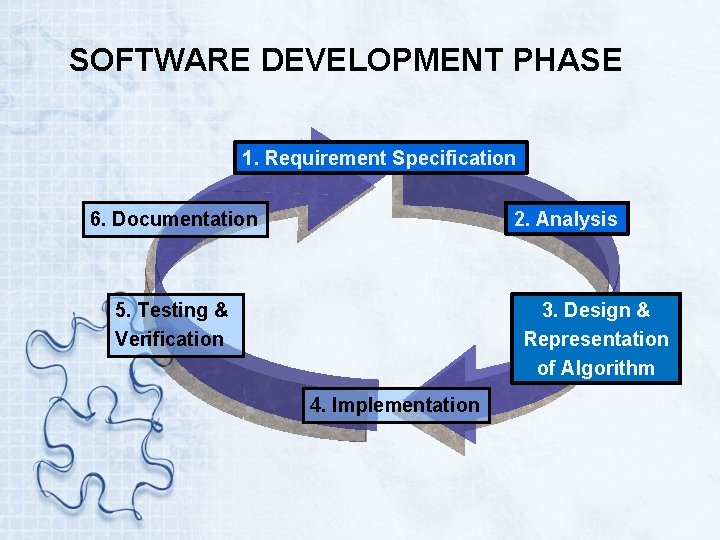
SOFTWARE DEVELOPMENT PHASE 1. Requirement Specification 6. Documentation 2. Analysis 5. Testing & Verification 3. Design & Representation of Algorithm 4. Implementation
Design and Representation of Algorithms • The project is broken down into smaller sections. • These too may be further broken down until there are units. • The method of programming each unit is then specified in great detail.
Design and Representation of Algorithms • The most suitable programming language for each unit is then chosen. • The complete specification is the final design. • The work of this stage is also performed by systems analysts
Design and Representation of Algorithms ALGORITHMS i. PSEUDOCODE ii. FLOWCHART
ALGORITHMS • A formal set of instruction that can be followed to perform a specific task. • An ordered set of unambiguous, executable steps defining a terminating process • Sequence of step – must have a well established structure in term of the order in which its step are executed
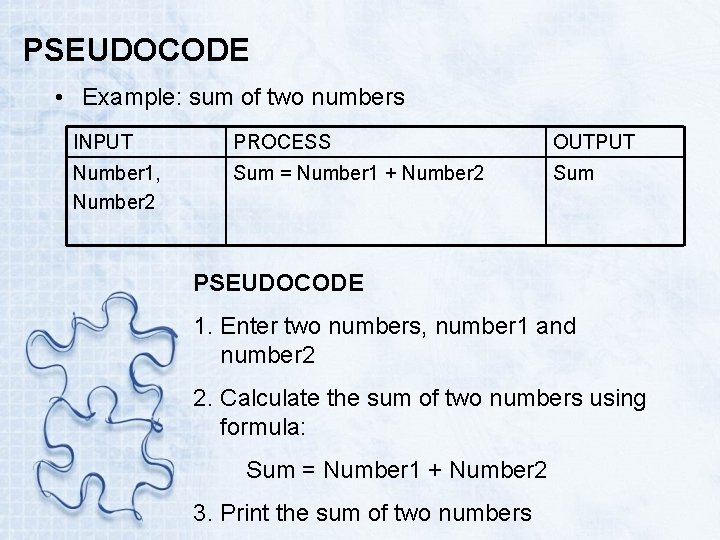
PSEUDOCODE • Example: sum of two numbers INPUT PROCESS OUTPUT Number 1, Number 2 Sum = Number 1 + Number 2 Sum PSEUDOCODE 1. Enter two numbers, number 1 and number 2 2. Calculate the sum of two numbers using formula: Sum = Number 1 + Number 2 3. Print the sum of two numbers
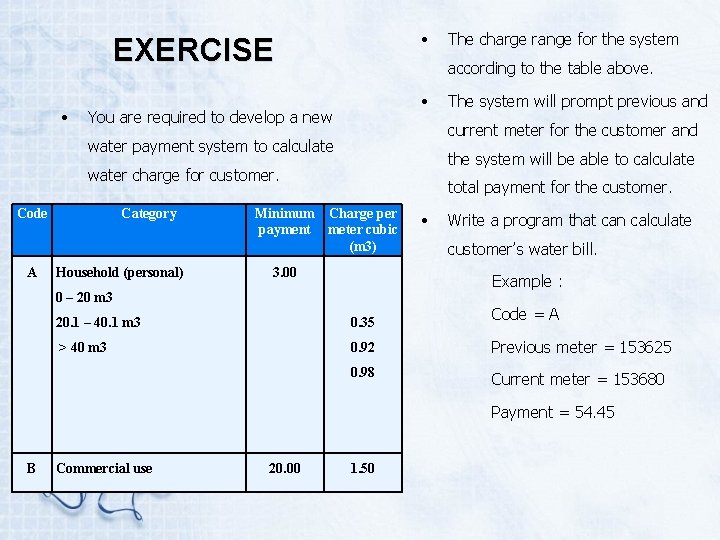
• EXERCISE • according to the table above. • You are required to develop a new the system will be able to calculate water charge for customer. A Category Household (personal) The system will prompt previous and current meter for the customer and water payment system to calculate Code The charge range for the system total payment for the customer. Minimum Charge per payment meter cubic (m 3) 3. 00 • Write a program that can calculate customer’s water bill. Example : 0 – 20 m 3 20. 1 – 40. 1 m 3 0. 35 Code = A > 40 m 3 0. 92 Previous meter = 153625 0. 98 Current meter = 153680 Payment = 54. 45 B Commercial use 20. 00 1. 50
- Slides: 8