
Problem Solving INST RUC Thes Place of Threedigit
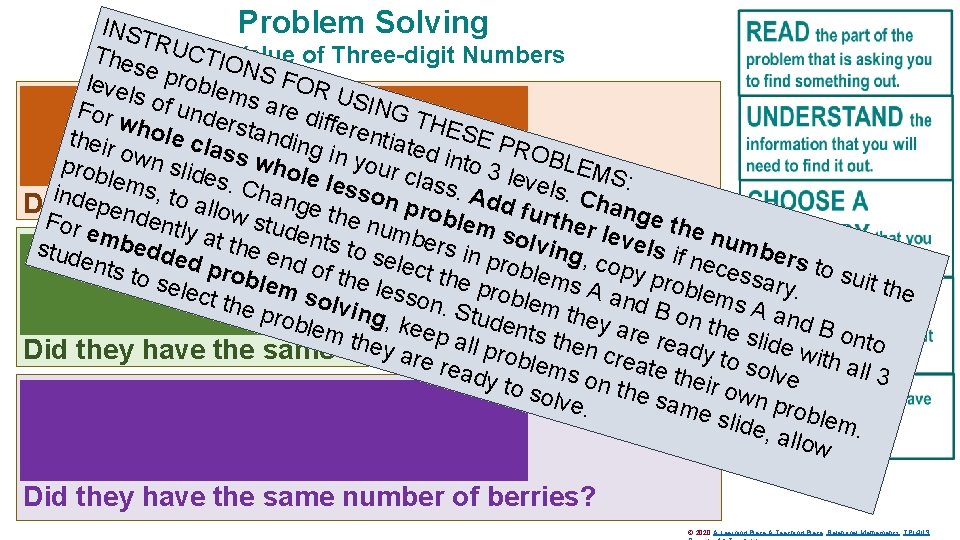
Problem Solving INST RUC Thes Place of Three-digit Numbers TIOValue N e pro S FO leve b lems R US l s o Fred. Fohad af packet aof 100 lollies. I r wh underst re differ NG THE ole 10 andi of e 10 SE P ntialollies. theirhad Lenny packets c n t l g ROB e a d ss w own i n your LEM to 3 prob s h l o i Gina had 100 individual lollies. d l c l S: es. C e les evel lems lass s. s inde hang , to a. Ch on p of. Ad d pendhave Did they same number lollies? ang e llthe robl furth ow s t h e For e er le e the n emb ntly at t tudents numbe em sol vels umb v r he eof 100 tomarbles. s stud hadedadpacket i n Fred in pr g, co ers if ne sele ed p nd o ents o to su c ct th py p b e r f l s o e t t o h s b m it the ary. e pro roble lem of e 10 s Lenny hadse 10 marbles. l e A lectpackets s s a blem ms A on. S nd B the p solvin they and tude on th g, ke roble marbles. Gina had 100 individual B on are r nts t e ep a m th s l hen ide w to eady ll pmarbles? ey a Did they have the same number of r c o ith a reate re re to so blem ll 3 ady l s v t h e o e n ir to so Fred had a packet of 100 berries. lve. the sam own pro e sli blem d e, al. Lenny had 10 packets of 10 berries. low Gina had 100 individual berries. Did they have the same number of berries? © 2020 A Learning Place A Teaching Place Relational Mathematics TPL 4 US
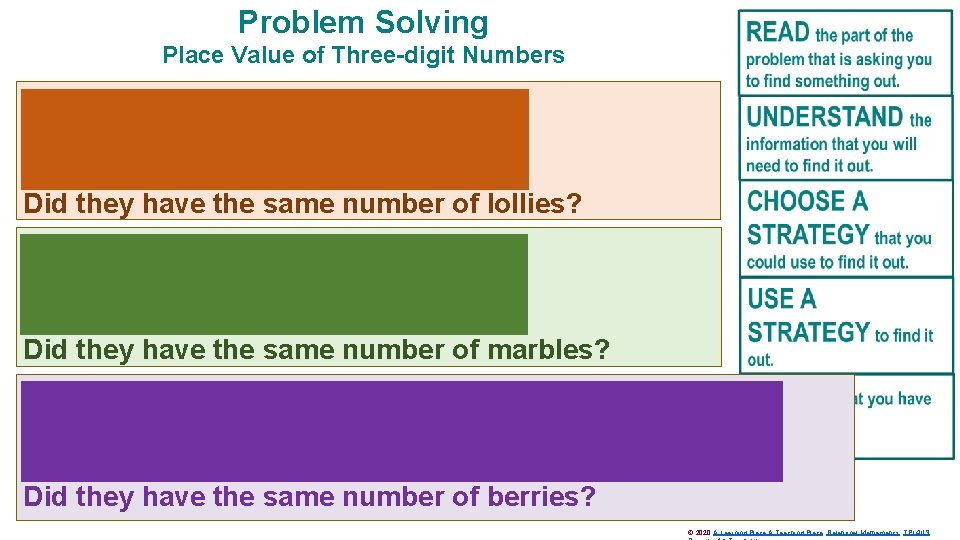
Problem Solving Place Value of Three-digit Numbers Fred had a packet of 100 lollies. Lenny had 10 packets of 10 lollies. Gina had 100 individual lollies. Did they have the same number of lollies? Fred had a packet of 100 marbles. Lenny had 10 packets of 10 marbles. Gina had 100 individual marbles. Did they have the same number of marbles? Fred had a packet of 100 berries, plus 10 more berries. Lenny had 10 packets of 10 berries, plus 10 more berries. Gina had 100 individual berries, plus 10 more berries Did they have the same number of berries? © 2020 A Learning Place A Teaching Place Relational Mathematics TPL 4 US
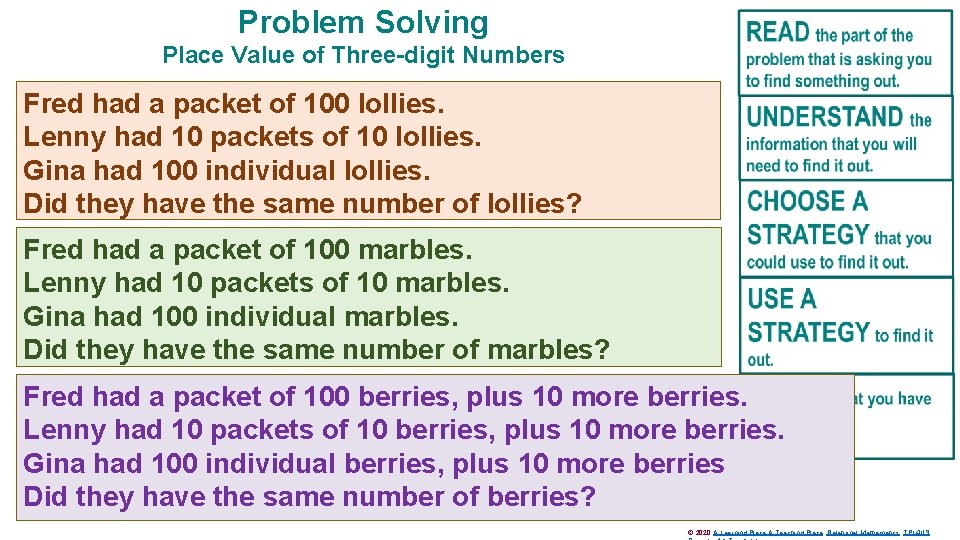
Problem Solving Place Value of Three-digit Numbers Fred had a packet of 100 lollies. Lenny had 10 packets of 10 lollies. Gina had 100 individual lollies. Did they have the same number of lollies? Fred had a packet of 100 marbles. Lenny had 10 packets of 10 marbles. Gina had 100 individual marbles. Did they have the same number of marbles? Fred had a packet of 100 berries, plus 10 more berries. Lenny had 10 packets of 10 berries, plus 10 more berries. Gina had 100 individual berries, plus 10 more berries Did they have the same number of berries? © 2020 A Learning Place A Teaching Place Relational Mathematics TPL 4 US
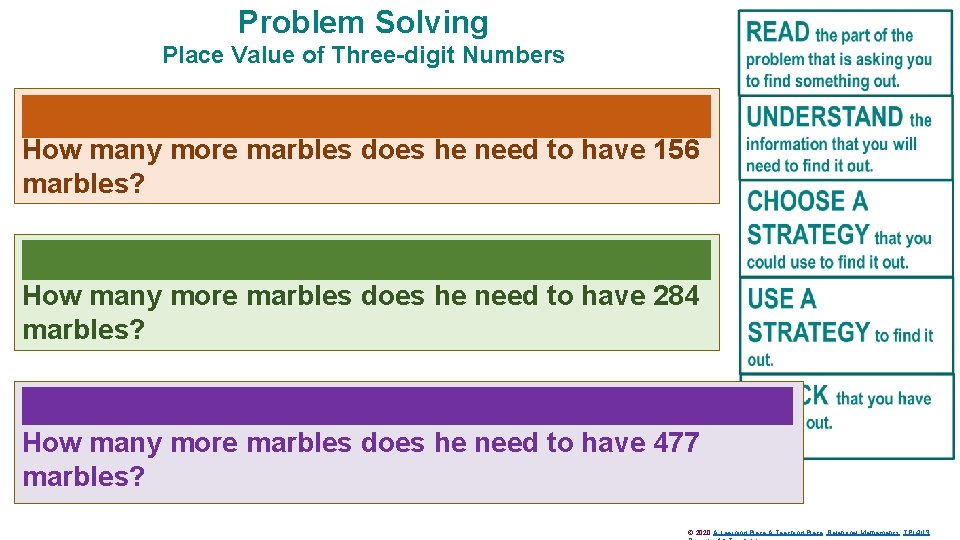
Problem Solving Place Value of Three-digit Numbers Jon collected 15 bags of 10 marbles. How many more marbles does he need to have 156 marbles? Jon collected 28 bags of 10 marbles. How many more marbles does he need to have 284 marbles? Jon collected 47 bags of 10 marbles and 2 extra marbles. How many more marbles does he need to have 477 marbles? © 2020 A Learning Place A Teaching Place Relational Mathematics TPL 4 US
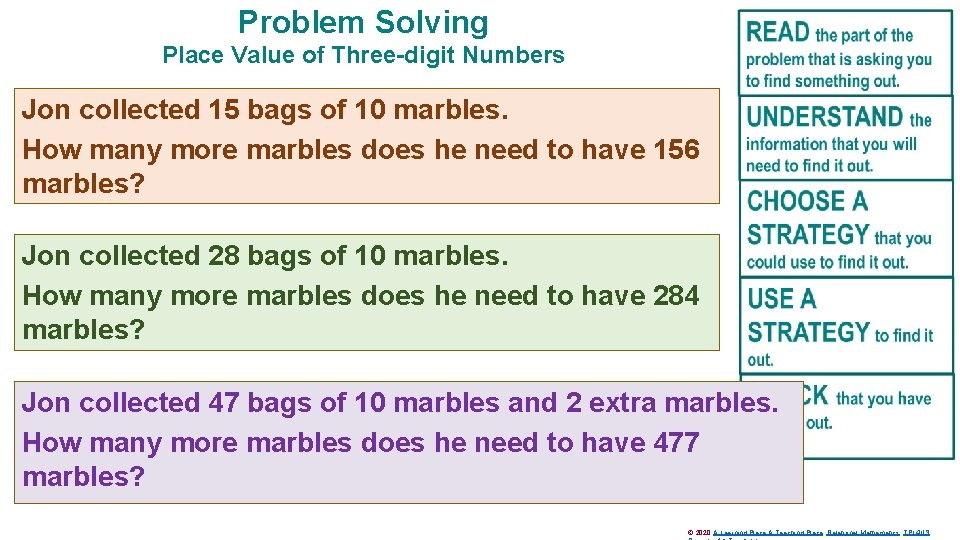
Problem Solving Place Value of Three-digit Numbers Jon collected 15 bags of 10 marbles. How many more marbles does he need to have 156 marbles? Jon collected 28 bags of 10 marbles. How many more marbles does he need to have 284 marbles? Jon collected 47 bags of 10 marbles and 2 extra marbles. How many more marbles does he need to have 477 marbles? © 2020 A Learning Place A Teaching Place Relational Mathematics TPL 4 US
Problem Solving Place Value of Three-digit Numbers Jan partitioned 324 blocks into parts. What might the parts look like? Jan partitioned 872 blocks into parts. What might the parts look like? Jan partitioned 796 blocks into 2 parts. One part was 106 more than the other part. What will the parts look like? © 2020 A Learning Place A Teaching Place Relational Mathematics TPL 4 US
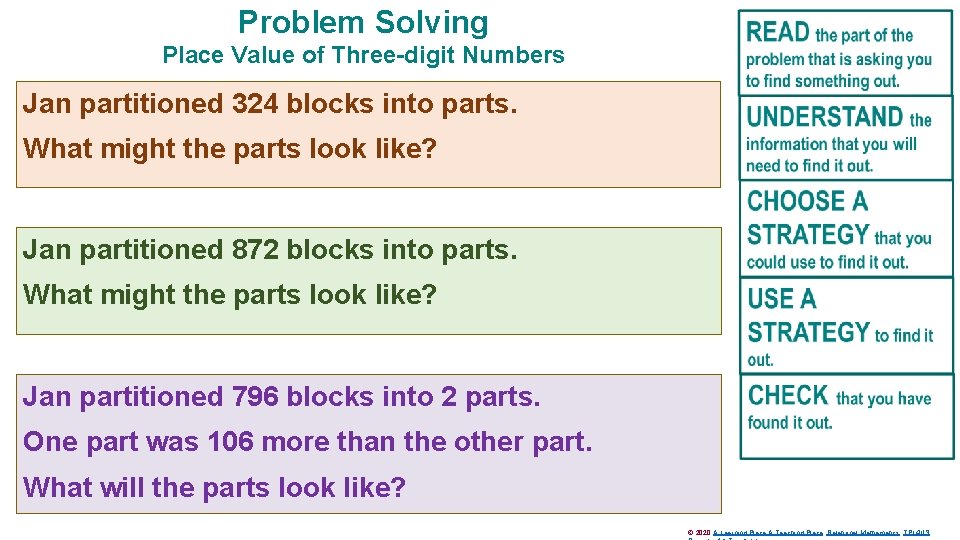
Problem Solving Place Value of Three-digit Numbers Jan partitioned 324 blocks into parts. What might the parts look like? Jan partitioned 872 blocks into parts. What might the parts look like? Jan partitioned 796 blocks into 2 parts. One part was 106 more than the other part. What will the parts look like? © 2020 A Learning Place A Teaching Place Relational Mathematics TPL 4 US

Problem Solving Place Value of Three-digit Numbers What number could be in the blank space on this number line? Marcus drew a number line with 687 in the centre. What number is at each end of the number line? © 2020 A Learning Place A Teaching Place Relational Mathematics TPL 4 US
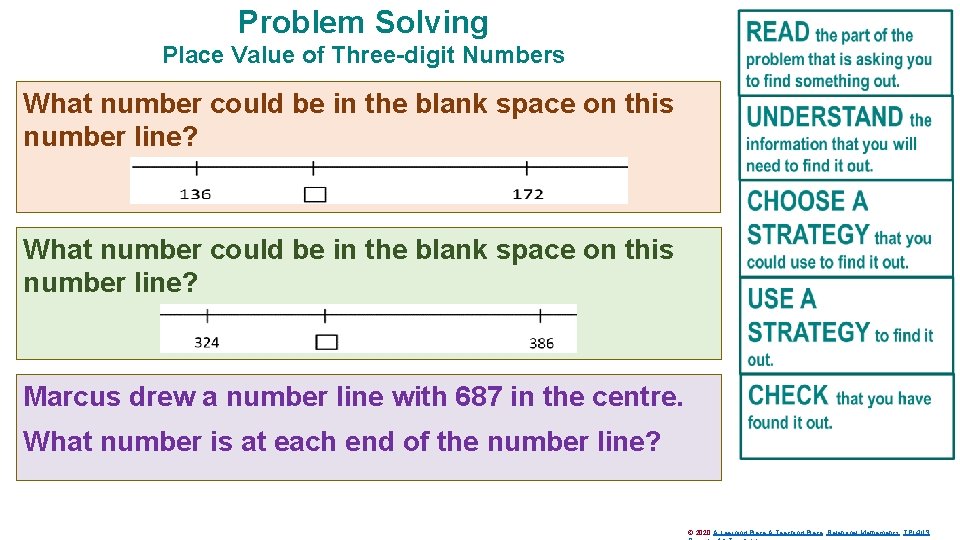
Problem Solving Place Value of Three-digit Numbers What number could be in the blank space on this number line? Marcus drew a number line with 687 in the centre. What number is at each end of the number line? © 2020 A Learning Place A Teaching Place Relational Mathematics TPL 4 US

Problem Solving Place Value of Three-digit Numbers A sugar cane train has 214 carriages. The train driver partitions the train into 2 parts. How many carriages could be in each part? A sugar cane train has 285 carriages. The train driver partitions the train into 2 parts. How many carriages could be in each part? A sugar cane train has 329 carriages. The train driver partitions the train into 2 parts, then partitions one of the parts into 3 parts. How many carriages could be in each part? © 2020 A Learning Place A Teaching Place Relational Mathematics TPL 4 US
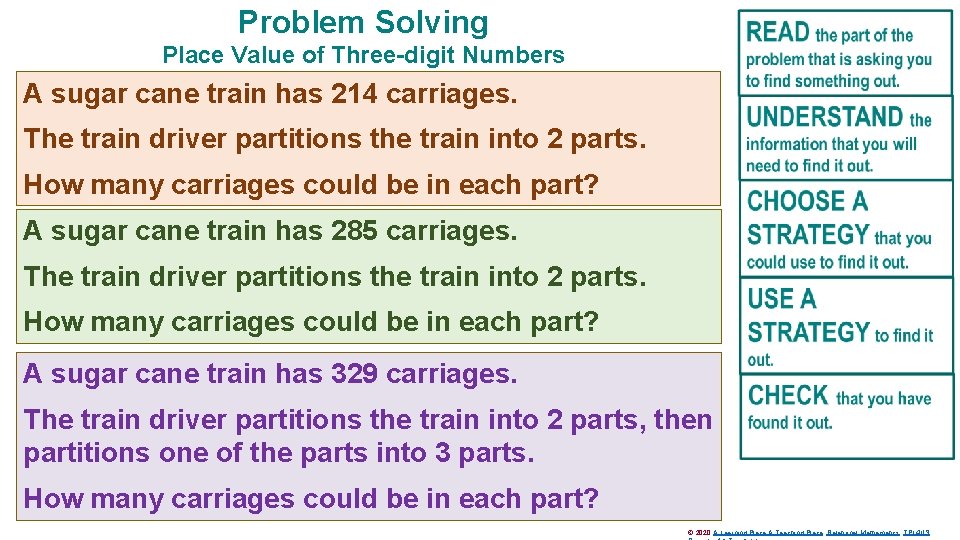
Problem Solving Place Value of Three-digit Numbers A sugar cane train has 214 carriages. The train driver partitions the train into 2 parts. How many carriages could be in each part? A sugar cane train has 285 carriages. The train driver partitions the train into 2 parts. How many carriages could be in each part? A sugar cane train has 329 carriages. The train driver partitions the train into 2 parts, then partitions one of the parts into 3 parts. How many carriages could be in each part? © 2020 A Learning Place A Teaching Place Relational Mathematics TPL 4 US
Problem Solving Place Value of Three-digit Numbers A sugar cane train has 214 carriages. The train driver partitions the train into 3 parts. How many carriages could be in each part? A sugar cane train has 285 carriages. The train driver partitions the train into 3 parts. How many carriages could be in each part? A sugar cane train has 329 carriages. The train driver partitions the train into 3 parts, then partitions one of the parts into 4 parts. How many carriages could be in each part? © 2020 A Learning Place A Teaching Place Relational Mathematics TPL 4 US
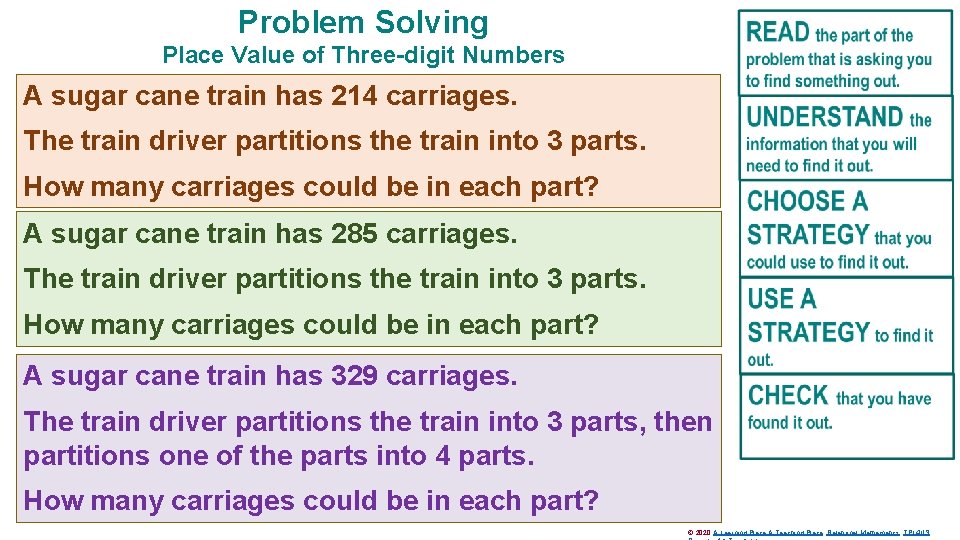
Problem Solving Place Value of Three-digit Numbers A sugar cane train has 214 carriages. The train driver partitions the train into 3 parts. How many carriages could be in each part? A sugar cane train has 285 carriages. The train driver partitions the train into 3 parts. How many carriages could be in each part? A sugar cane train has 329 carriages. The train driver partitions the train into 3 parts, then partitions one of the parts into 4 parts. How many carriages could be in each part? © 2020 A Learning Place A Teaching Place Relational Mathematics TPL 4 US
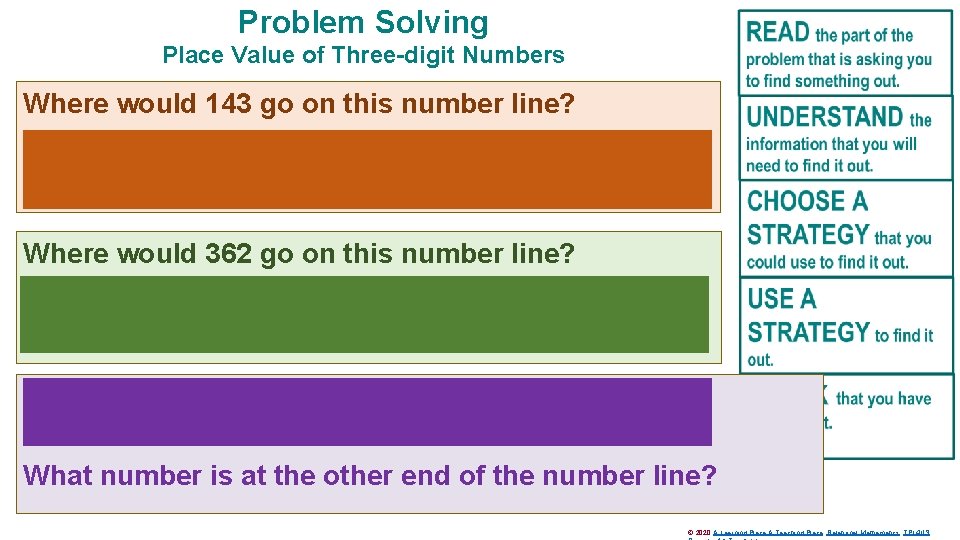
Problem Solving Place Value of Three-digit Numbers Where would 143 go on this number line? Where would 362 go on this number line? Marcus drew a number line with 687 at one end, and 387 in the centre. What number is at the other end of the number line? © 2020 A Learning Place A Teaching Place Relational Mathematics TPL 4 US
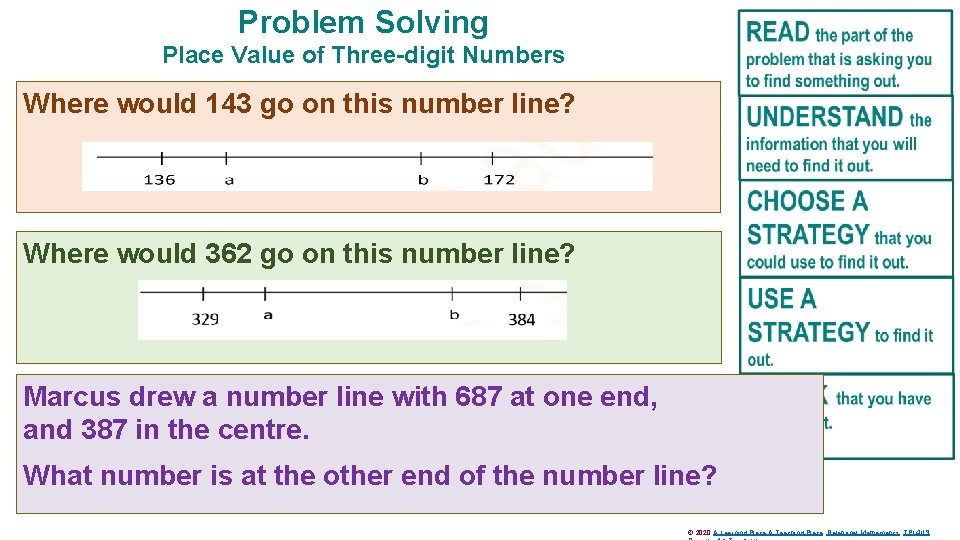
Problem Solving Place Value of Three-digit Numbers Where would 143 go on this number line? Where would 362 go on this number line? Marcus drew a number line with 687 at one end, and 387 in the centre. What number is at the other end of the number line? © 2020 A Learning Place A Teaching Place Relational Mathematics TPL 4 US

© 2020 A Learning Place A Teaching Place Relational Mathematics TPL 4 US Resourceful Teaching
© 2020 A Learning Place A Teaching Place Relational Mathematics TPL 4 US Resourceful Teaching

© 2020 A Learning Place A Teaching Place Relational Mathematics TPL 4 US Resourceful Teaching

© 2020 A Learning Place A Teaching Place Relational Mathematics TPL 4 US Resourceful Teaching
© 2020 A Learning Place A Teaching Place Relational Mathematics TPL 4 US Resourceful Teaching
- Slides: 20