
Problem Solving INST R C Volume Thes Ucapacity
Problem Solving INST R C Volume, Thes Ucapacity TION in cubic centimetres, millilitres, litres. e pro S FO leve b lems R US l s of un Annie are da cube ING where each dimension For constructed d THE ersta iffere who SE P ndilong. le cl ntiat was their 1 centimetre n g in ROB ed in ass own y who LEM to 3 our c prob is the s l i d l What volume of Annie’s cube? l S: e e evel lems lass s l. e C s s. C. Ad son inde hang , to a han d pend prob e the llow f u ge t r t For e l s h e n n t e he n u m t u r lev ly at denat cubemwhere emb constructed s Annie each dimension b o umb ers i l e s to the e v edd l stud i s n g , co n pro ers if ne sele e n e d d n to su c p t o c py p b wass 2 tocentimetres long. e r t f l s o e t t h h s b m it the a e e r sele l ct th em solv lesson. problem s A and oblems ry. e pro of in A an B on What is the volume Annie’s Scube? t t h g u e , d d. B y are blem keep ents th e s onto then lide they read all p with roble y to crea are r all 3 solv te 2 ms where eadyprism t Annie constructed a rectangular h e o e n the ir ow to so n sam lve. 1 dimensions were 1 centimetre long, and e sli problem de, a llow. dimension was 1 centimetre long. What is the volume of Annie’s rectangular prism? © 2020 A Learning Place A Teaching Place Relational Mathematics TPL 4 US
Problem Solving Volume, capacity in cubic centimetres, millilitres, litres. Annie constructed a cube where each dimension was 1 centimetre long. What is the volume of Annie’s cube? Annie constructed a cube where each dimension was 2 centimetres long. What is the volume of Annie’s cube? Annie constructed a rectangular prism where 2 dimensions were 1 centimetre long, and 1 dimension was 2 centimetres long. What is the volume of Annie’s rectangular prism? © 2020 A Learning Place A Teaching Place Relational Mathematics TPL 4 US
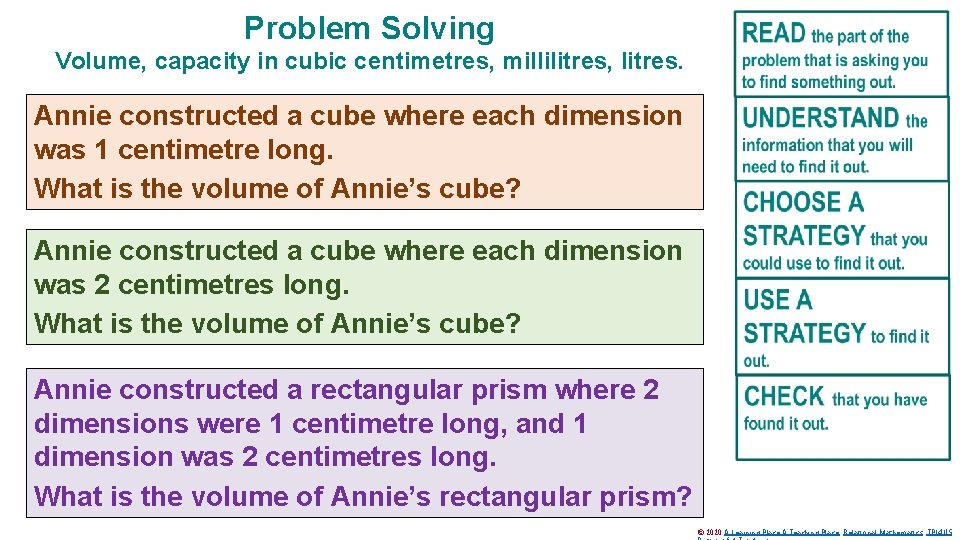
Problem Solving Volume, capacity in cubic centimetres, millilitres, litres. Annie constructed a cube where each dimension was 1 centimetre long. What is the volume of Annie’s cube? Annie constructed a cube where each dimension was 2 centimetres long. What is the volume of Annie’s cube? Annie constructed a rectangular prism where 2 dimensions were 1 centimetre long, and 1 dimension was 2 centimetres long. What is the volume of Annie’s rectangular prism? © 2020 A Learning Place A Teaching Place Relational Mathematics TPL 4 US
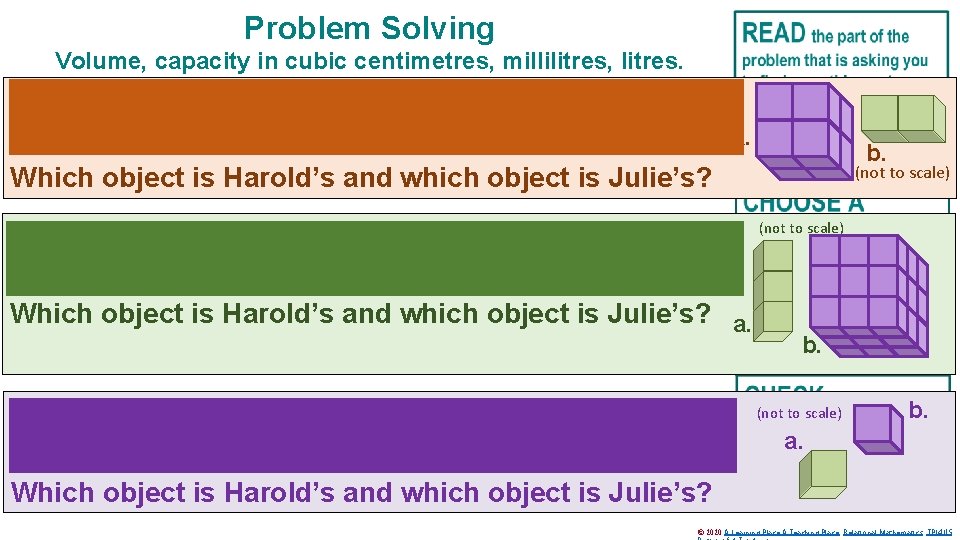
Problem Solving Volume, capacity in cubic centimetres, millilitres, litres. Harold drew an object with a volume of 2 cubic metres. a. Julie drew an object that is 2 metres cube/d. Which object is Harold’s and which object is Julie’s? b. (not to scale) Harold drew an object with a volume of 3 cubic metres. (not to scale) Julie drew an object that is 3 metres cube/d. Which object is Harold’s and which object is Julie’s? a. b. Harold drew an object with a volume of 1 cubic metre. Julie drew an object that is metre cube/d. Which object is Harold’s and which object is Julie’s? (not to scale) b. a. © 2020 A Learning Place A Teaching Place Relational Mathematics TPL 4 US
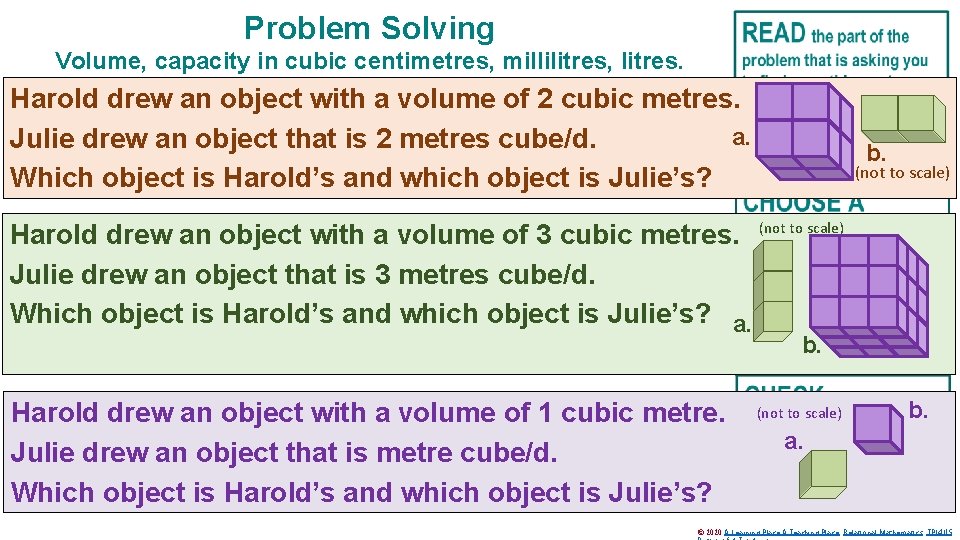
Problem Solving Volume, capacity in cubic centimetres, millilitres, litres. Harold drew an object with a volume of 2 cubic metres. a. Julie drew an object that is 2 metres cube/d. Which object is Harold’s and which object is Julie’s? b. (not to scale) Harold drew an object with a volume of 3 cubic metres. (not to scale) Julie drew an object that is 3 metres cube/d. Which object is Harold’s and which object is Julie’s? a. b. Harold drew an object with a volume of 1 cubic metre. Julie drew an object that is metre cube/d. Which object is Harold’s and which object is Julie’s? (not to scale) b. a. © 2020 A Learning Place A Teaching Place Relational Mathematics TPL 4 US
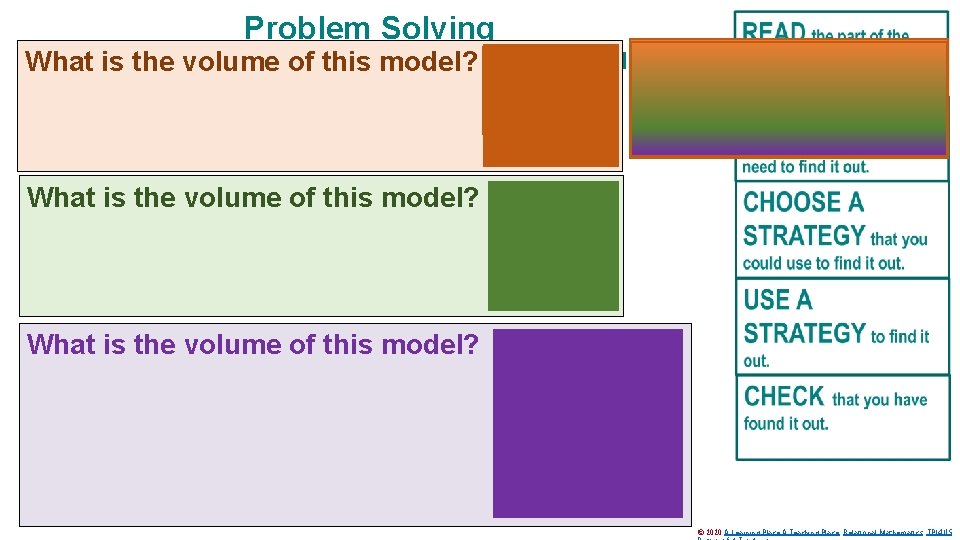
Problem Solving Volume, capacity in cubic centimetres, What is the volume of this model? millilitres, litres. 1 cubic centimetre What is the volume of this model? © 2020 A Learning Place A Teaching Place Relational Mathematics TPL 4 US
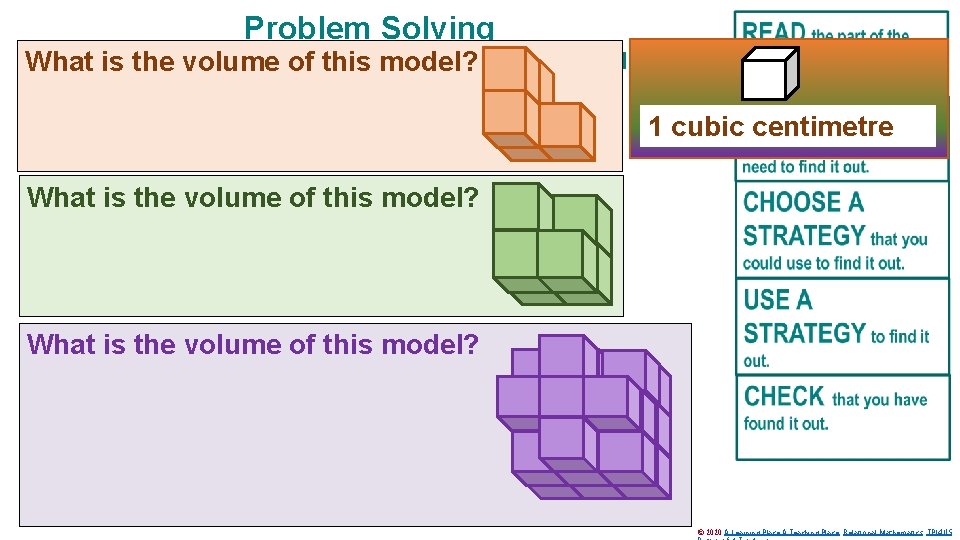
Problem Solving Volume, capacity in cubic centimetres, What is the volume of this model? millilitres, litres. 1 cubic centimetre What is the volume of this model? © 2020 A Learning Place A Teaching Place Relational Mathematics TPL 4 US
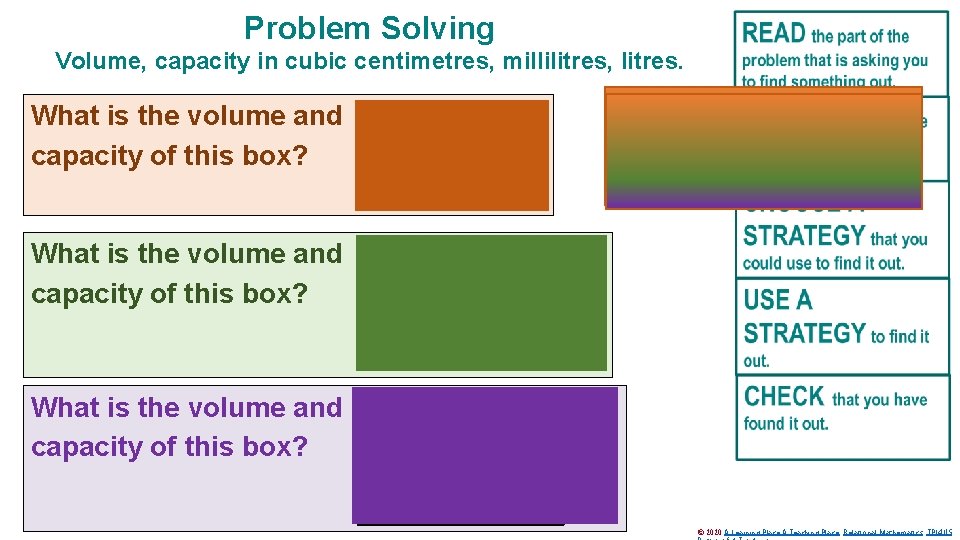
Problem Solving Volume, capacity in cubic centimetres, millilitres, litres. What is the volume and capacity of this box? 1 cubic centimetre What is the volume and capacity of this box? © 2020 A Learning Place A Teaching Place Relational Mathematics TPL 4 US
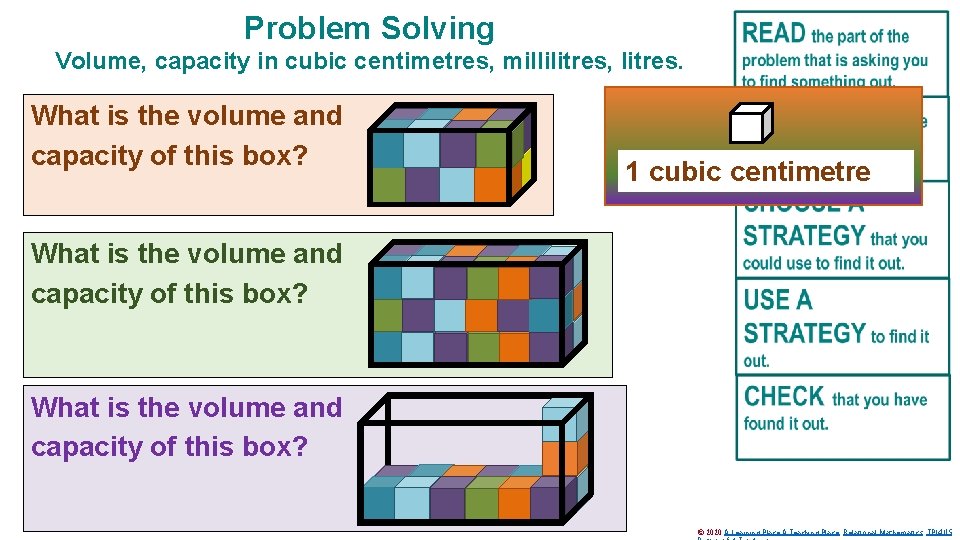
Problem Solving Volume, capacity in cubic centimetres, millilitres, litres. What is the volume and capacity of this box? 1 cubic centimetre What is the volume and capacity of this box? © 2020 A Learning Place A Teaching Place Relational Mathematics TPL 4 US
Problem Solving Volume, capacity in cubic centimetres, millilitres, litres. What is the volume and capacity of this box? 1 cubic centimetre What is the volume and capacity of this box? © 2020 A Learning Place A Teaching Place Relational Mathematics TPL 4 US
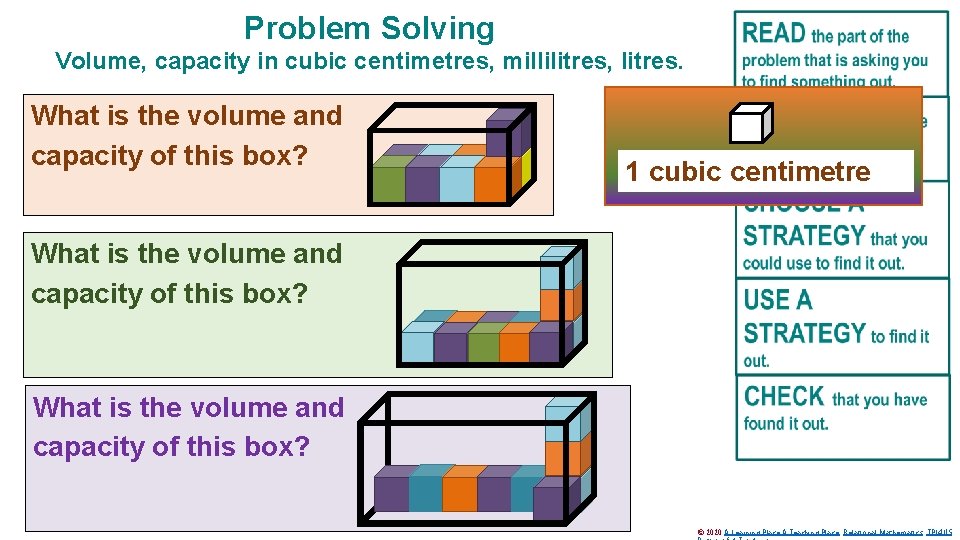
Problem Solving Volume, capacity in cubic centimetres, millilitres, litres. What is the volume and capacity of this box? 1 cubic centimetre What is the volume and capacity of this box? © 2020 A Learning Place A Teaching Place Relational Mathematics TPL 4 US
Problem Solving Volume, capacity in cubic centimetres, millilitres, litres. Annie filled a measuring jug with water to 1 litre. How many millilitres of water does Annie have? © 2020 A Learning Place A Teaching Place Relational Mathematics TPL 4 US
Problem Solving Volume, capacity in cubic centimetres, millilitres, litres. Annie filled a measuring jug with water to 1 litre. How many millilitres of water does Annie have? © 2020 A Learning Place A Teaching Place Relational Mathematics TPL 4 US
Problem Solving Volume, capacity in cubic centimetres, millilitres, litres. Jody filled a container to capacity with water. She poured the water into a measuring jug. What was the capacity of the container? 700 m. L 350 m. L Jody poured a litre of water in to litre jug. Jody poured some of the water to fill a container to capacity. The picture shows the volume of water that was left in the jug. What was the capacity of the container? 425 m. L © 2020 A Learning Place A Teaching Place Relational Mathematics TPL 4 US
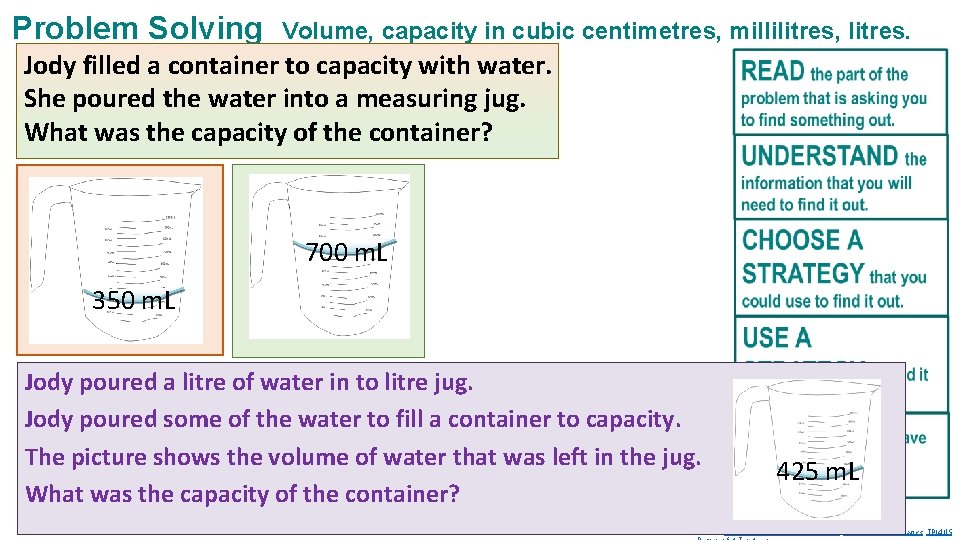
Problem Solving Volume, capacity in cubic centimetres, millilitres, litres. Jody filled a container to capacity with water. She poured the water into a measuring jug. What was the capacity of the container? 700 m. L 350 m. L Jody poured a litre of water in to litre jug. Jody poured some of the water to fill a container to capacity. The picture shows the volume of water that was left in the jug. What was the capacity of the container? 425 m. L © 2020 A Learning Place A Teaching Place Relational Mathematics TPL 4 US
Problem Solving Volume, capacity in cubic centimetres, a. millilitres, litres. Hannah made a model out of cubic centimetres. The model has a volume of 12 cubic centimetres. What could the model look like? Hannah made a model out of cubic centimetres. The model has a volume of 15 cubic centimetres. What could the model look like? b. c. d. Hannah made 2 models with the same volume. Which 2 models could she have made? © 2020 A Learning Place A Teaching Place Relational Mathematics TPL 4 US
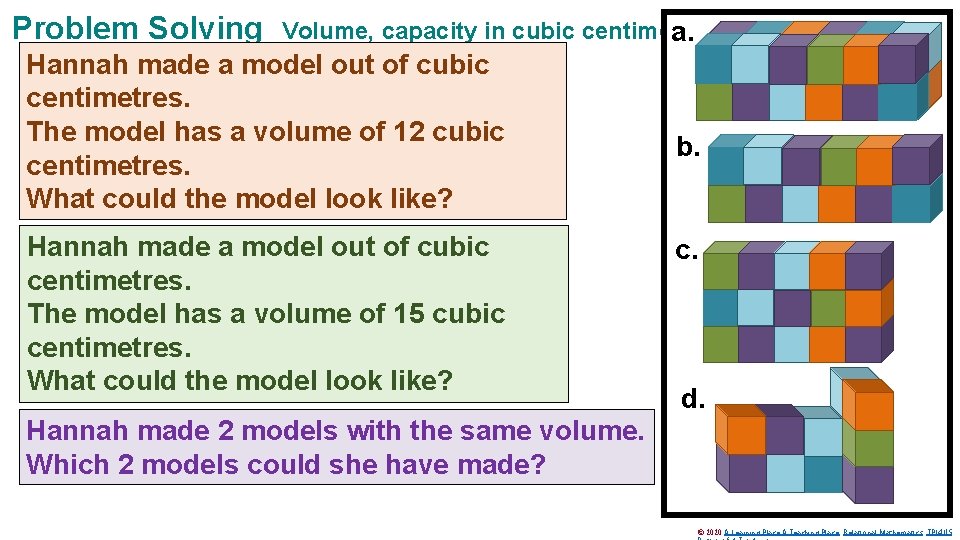
Problem Solving Volume, capacity in cubic centimetres, a. millilitres, litres. Hannah made a model out of cubic centimetres. The model has a volume of 12 cubic centimetres. What could the model look like? Hannah made a model out of cubic centimetres. The model has a volume of 15 cubic centimetres. What could the model look like? b. c. d. Hannah made 2 models with the same volume. Which 2 models could she have made? © 2020 A Learning Place A Teaching Place Relational Mathematics TPL 4 US
Problem Solving Volume, capacity in cubic centimetres, millilitres, litres. Hannah made a tall model and a short model out of cubic centimetres. Each model has the same volume, 6 cubic centimetres. Which 2 models did she make? Each model has the same volume, 12 cubic centimetres. Which 2 models did she make? The tall model’s volume was twice the volume of the short model. Which 2 models did she make? a. b. d. c. e. f. © 2020 A Learning Place A Teaching Place Relational Mathematics TPL 4 US
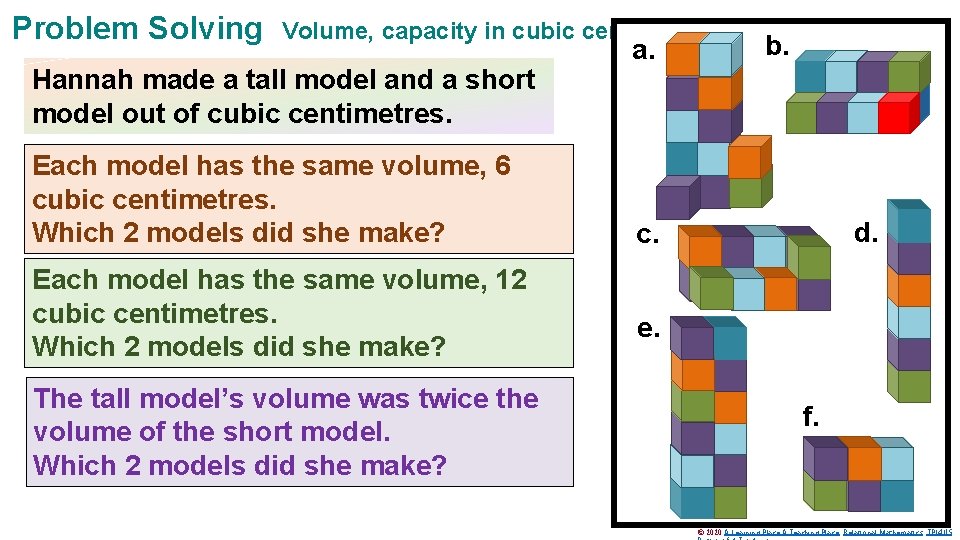
Problem Solving Volume, capacity in cubic centimetres, millilitres, litres. Hannah made a tall model and a short model out of cubic centimetres. Each model has the same volume, 6 cubic centimetres. Which 2 models did she make? Each model has the same volume, 12 cubic centimetres. Which 2 models did she make? The tall model’s volume was twice the volume of the short model. Which 2 models did she make? a. b. d. c. e. f. © 2020 A Learning Place A Teaching Place Relational Mathematics TPL 4 US
Problem Solving Volume, capacity in cubic centimetres, millilitres, litres. Billy packed some cubic centimetres into this carton. How many cubic centimetres did he pack into the carton? How many more cubic centimetres can fit in the carton? How many cubic centimetres can fit in the carton altogether? © 2020 A Learning Place A Teaching Place Relational Mathematics TPL 4 US
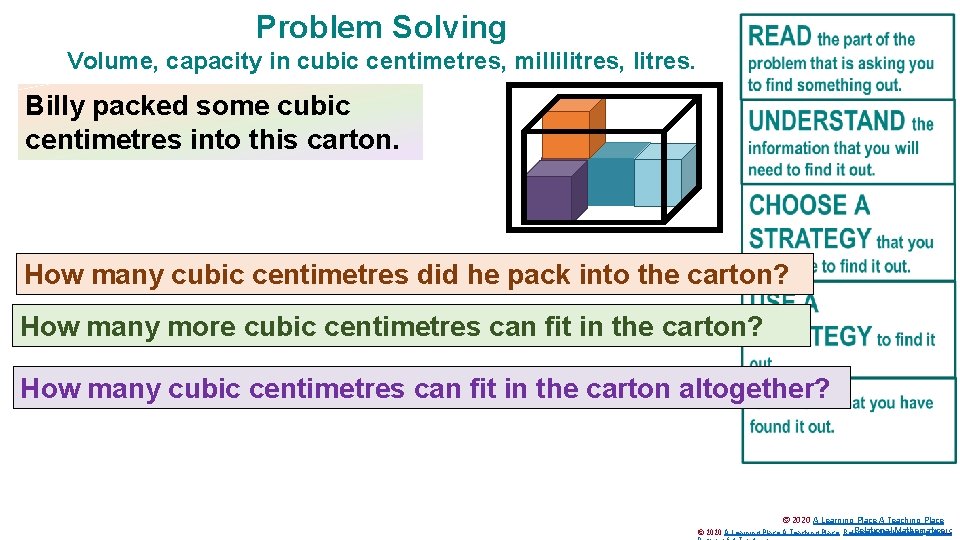
Problem Solving Volume, capacity in cubic centimetres, millilitres, litres. Billy packed some cubic centimetres into this carton. How many cubic centimetres did he pack into the carton? How many more cubic centimetres can fit in the carton? How many cubic centimetres can fit in the carton altogether? © 2020 A Learning Place A Teaching Place Relational Mathematics TPL 4 US
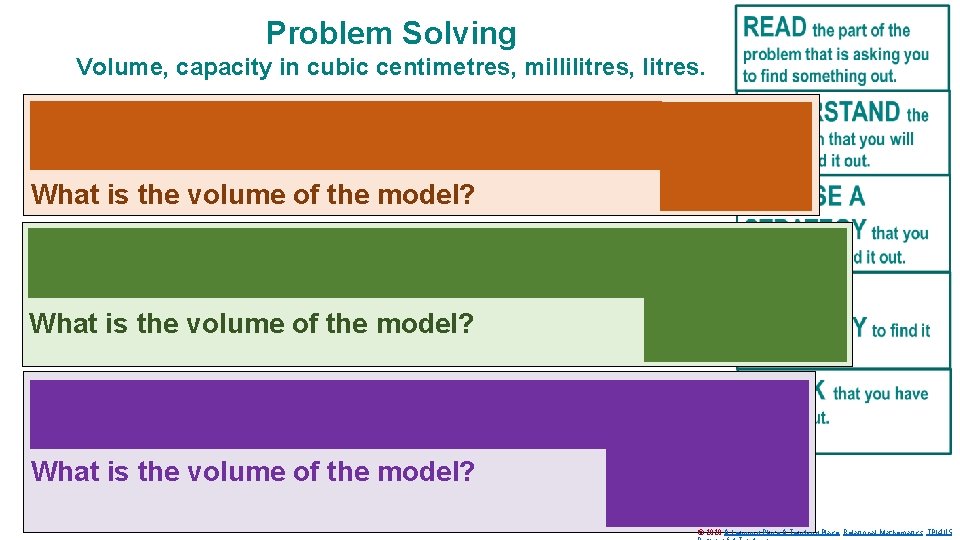
Problem Solving Volume, capacity in cubic centimetres, millilitres, litres. Mary made this model from cubic centimetres. The model has 6 faces. What is the volume of the model? Mary made this model from cubic centimetres. The model has 9 faces. What is the volume of the model? © 2020 A Learning Place A Teaching Place Relational Mathematics TPL 4 US
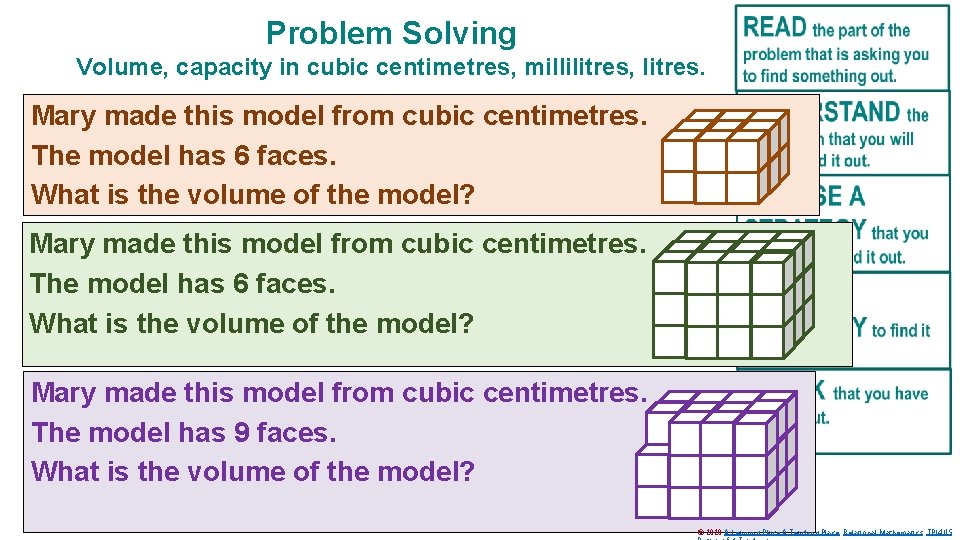
Problem Solving Volume, capacity in cubic centimetres, millilitres, litres. Mary made this model from cubic centimetres. The model has 6 faces. What is the volume of the model? Mary made this model from cubic centimetres. The model has 9 faces. What is the volume of the model? © 2020 A Learning Place A Teaching Place Relational Mathematics TPL 4 US
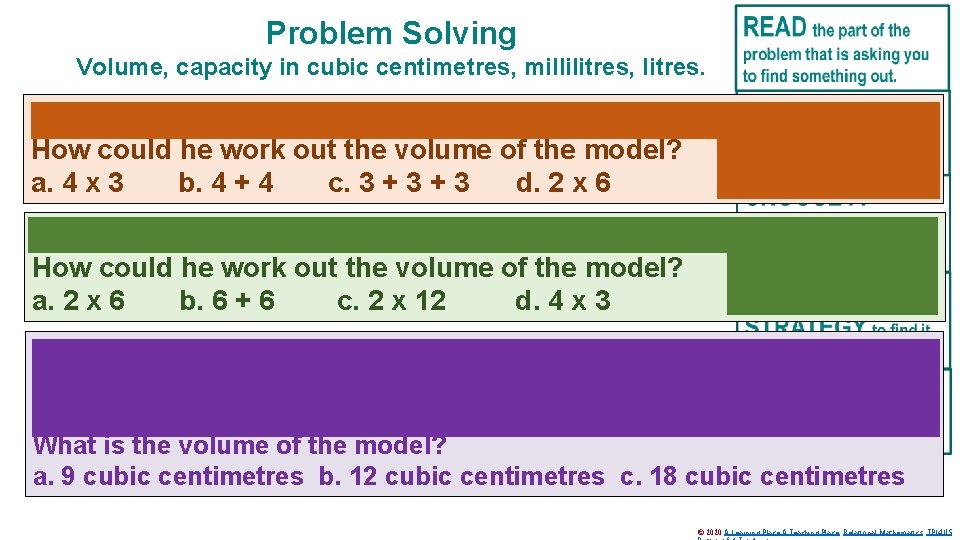
Problem Solving Volume, capacity in cubic centimetres, millilitres, litres. Tony constructed this model from cubic centimetres. How could he work out the volume of the model? a. 4 x 3 b. 4 + 4 c. 3 + 3 d. 2 x 6 Tony constructed this model from cubic centimetres. How could he work out the volume of the model? a. 2 x 6 b. 6 + 6 c. 2 x 12 d. 4 x 3 Tony constructed a model from cubic centimetres. There were 6 in the bottom layer. There were 3 layers. What is the volume of the model? a. 9 cubic centimetres b. 12 cubic centimetres c. 18 cubic centimetres © 2020 A Learning Place A Teaching Place Relational Mathematics TPL 4 US
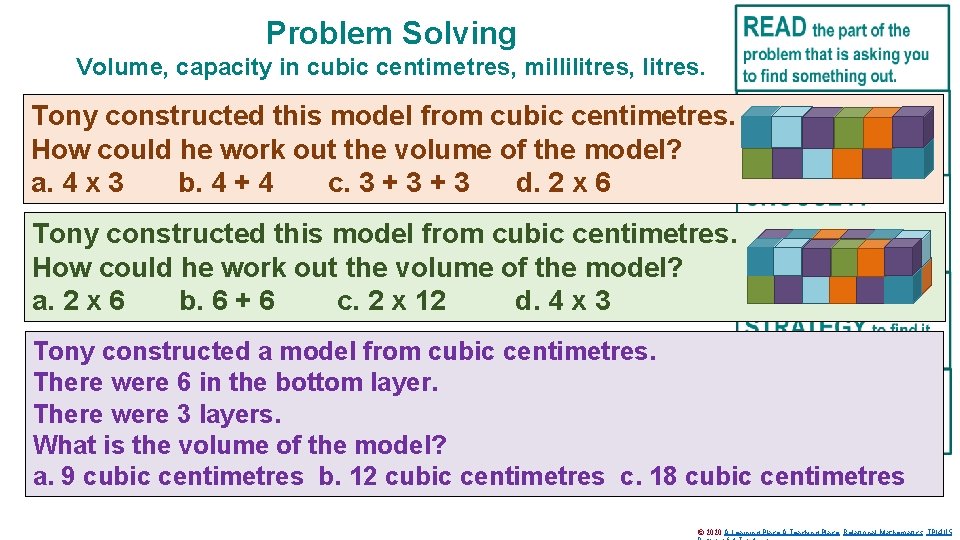
Problem Solving Volume, capacity in cubic centimetres, millilitres, litres. Tony constructed this model from cubic centimetres. How could he work out the volume of the model? a. 4 x 3 b. 4 + 4 c. 3 + 3 d. 2 x 6 Tony constructed this model from cubic centimetres. How could he work out the volume of the model? a. 2 x 6 b. 6 + 6 c. 2 x 12 d. 4 x 3 Tony constructed a model from cubic centimetres. There were 6 in the bottom layer. There were 3 layers. What is the volume of the model? a. 9 cubic centimetres b. 12 cubic centimetres c. 18 cubic centimetres © 2020 A Learning Place A Teaching Place Relational Mathematics TPL 4 US
Problem Solving Volume, capacity in cubic centimetres, millilitres, litres. Charlie constructed 3 models. a. b. cubic centimetre Which model has the smallest volume? Which model has the largest volume? What is the difference between the model with the largest volume and the model with the second largest volume? © 2020 A Learning Place A Teaching Place Relational Mathematics TPL 4 US
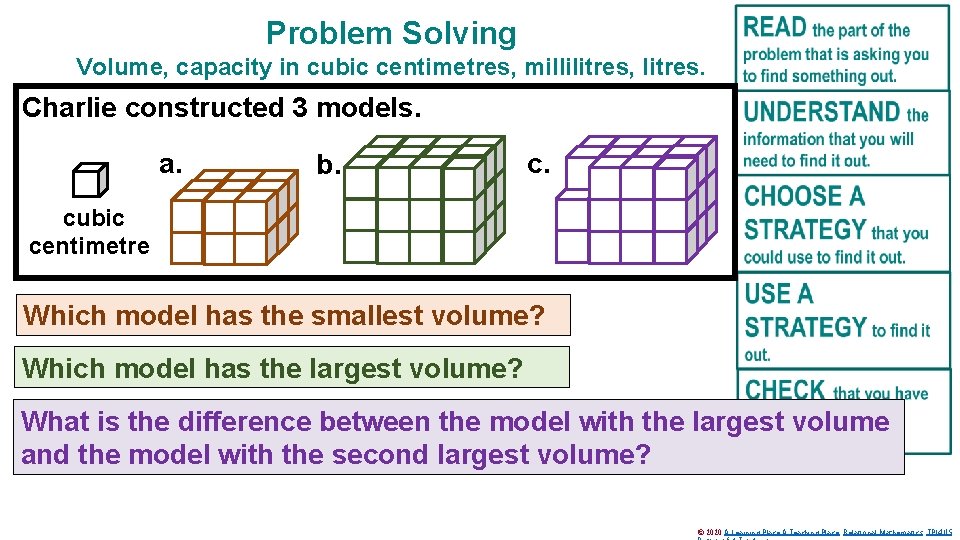
Problem Solving Volume, capacity in cubic centimetres, millilitres, litres. Charlie constructed 3 models. a. b. cubic centimetre Which model has the smallest volume? Which model has the largest volume? What is the difference between the model with the largest volume and the model with the second largest volume? © 2020 A Learning Place A Teaching Place Relational Mathematics TPL 4 US
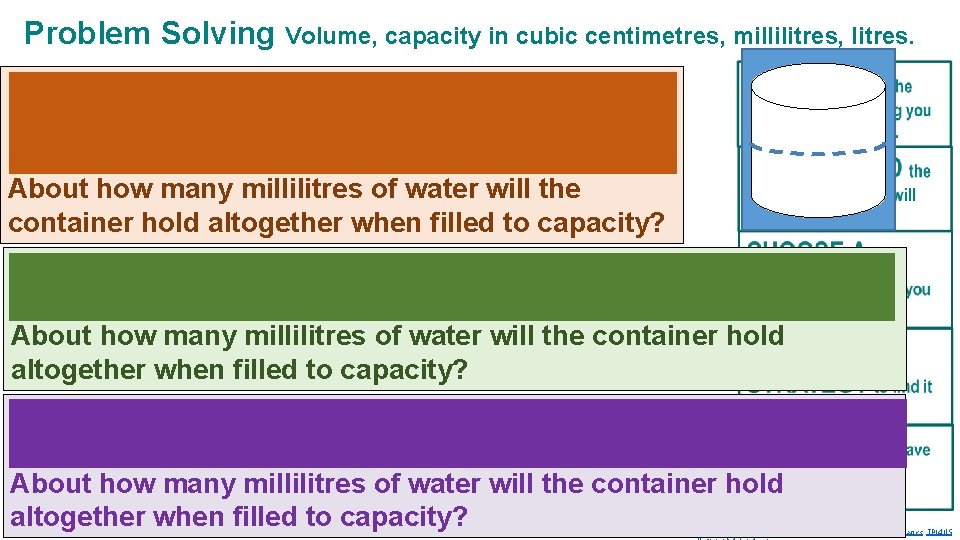
Problem Solving Volume, capacity in cubic centimetres, millilitres, litres. I poured 50 millilitres of water into a container. The dotted line shows how much water was then in the container. About how many millilitres of water will the container hold altogether when filled to capacity? I poured 150 millilitres of water into a container. The dotted line shows how much water was then in the container. About how many millilitres of water will the container hold altogether when filled to capacity? I poured 380 millilitres of water out of a container. The dotted line shows how much water was then in the container. About how many millilitres of water will the container hold altogether when filled to capacity? © 2020 A Learning Place A Teaching Place Relational Mathematics TPL 4 US
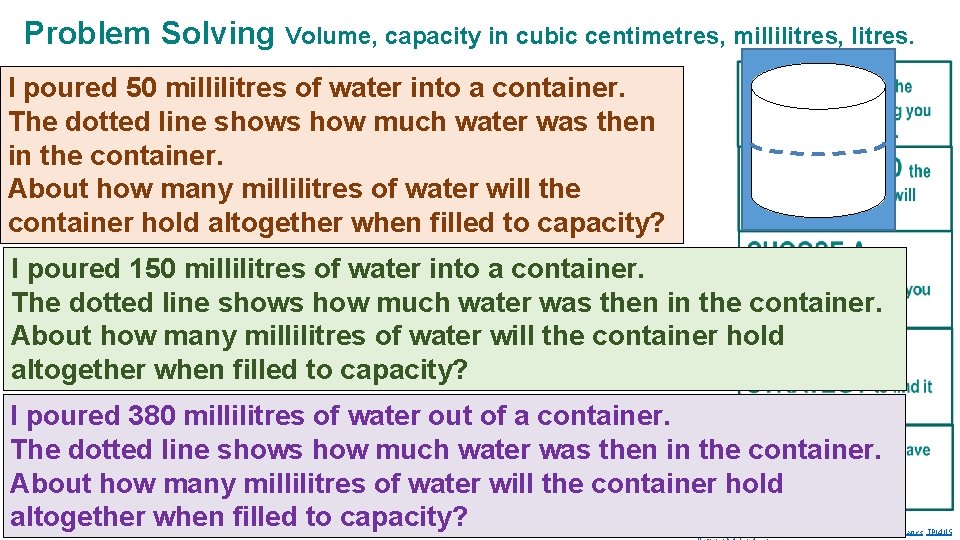
Problem Solving Volume, capacity in cubic centimetres, millilitres, litres. I poured 50 millilitres of water into a container. The dotted line shows how much water was then in the container. About how many millilitres of water will the container hold altogether when filled to capacity? I poured 150 millilitres of water into a container. The dotted line shows how much water was then in the container. About how many millilitres of water will the container hold altogether when filled to capacity? I poured 380 millilitres of water out of a container. The dotted line shows how much water was then in the container. About how many millilitres of water will the container hold altogether when filled to capacity? © 2020 A Learning Place A Teaching Place Relational Mathematics TPL 4 US
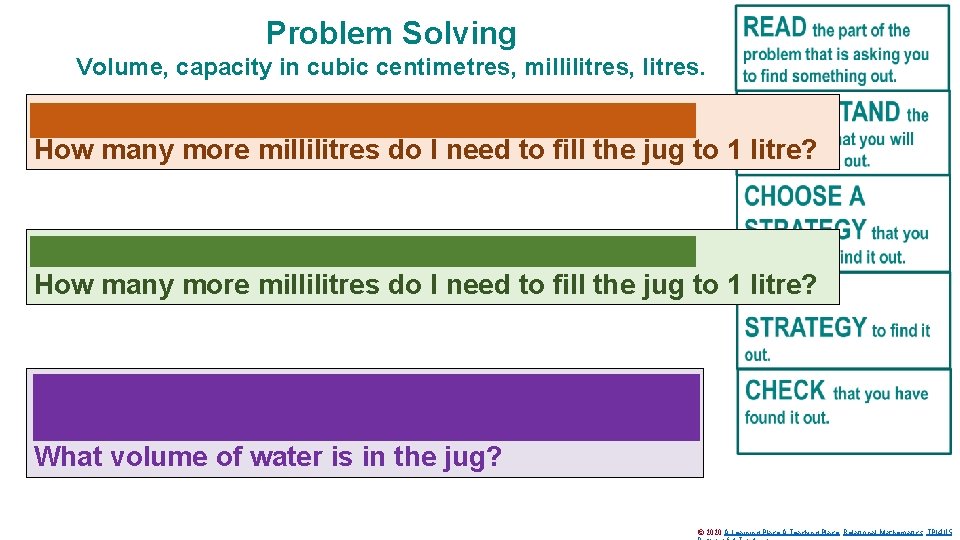
Problem Solving Volume, capacity in cubic centimetres, millilitres, litres. The jug is filled to 650 millilitres. How many more millilitres do I need to fill the jug to 1 litre? The jug is filled to 780 millilitres. How many more millilitres do I need to fill the jug to 1 litre? The jug has a volume of water in it. I need 327 more millilitres to fill the jug to 1 litre. What volume of water is in the jug? © 2020 A Learning Place A Teaching Place Relational Mathematics TPL 4 US
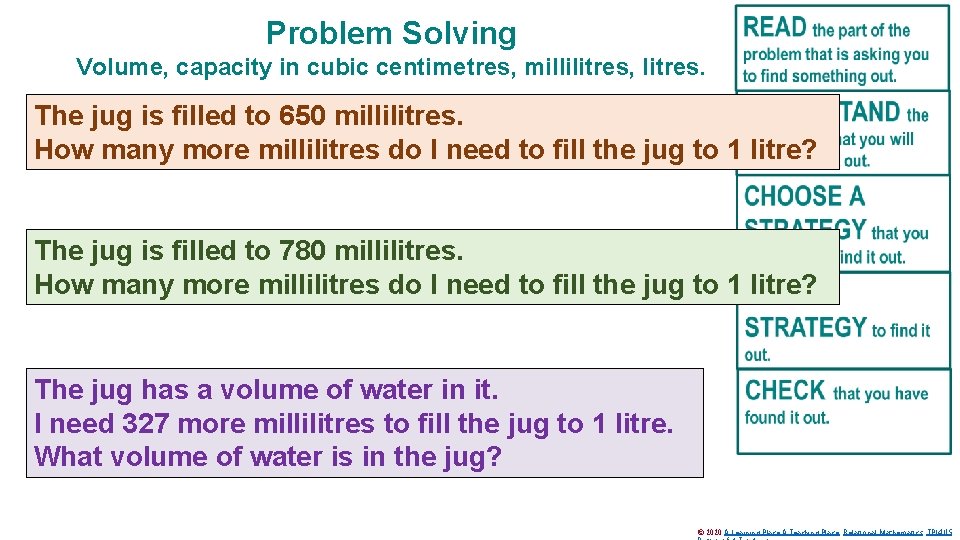
Problem Solving Volume, capacity in cubic centimetres, millilitres, litres. The jug is filled to 650 millilitres. How many more millilitres do I need to fill the jug to 1 litre? The jug is filled to 780 millilitres. How many more millilitres do I need to fill the jug to 1 litre? The jug has a volume of water in it. I need 327 more millilitres to fill the jug to 1 litre. What volume of water is in the jug? © 2020 A Learning Place A Teaching Place Relational Mathematics TPL 4 US
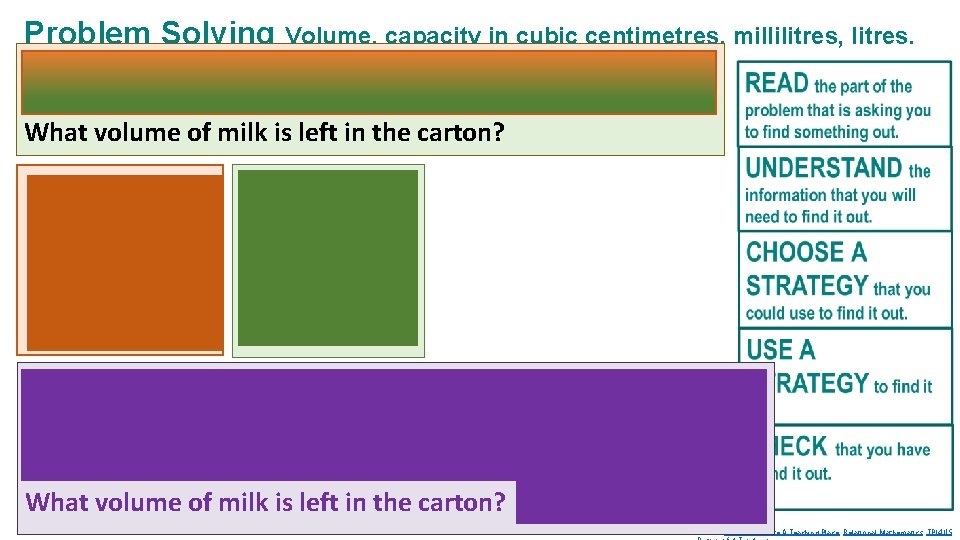
Problem Solving Volume, capacity in cubic centimetres, millilitres, litres. Jody had 1 litre of milk in a carton. She poured some milk into a measuring jug. What volume of milk is left in the carton? 700 m. L 350 m. L Jody had 1 litre of milk in a carton. She drank 250 millilitres of the milk. Then she poured some milk into a measuring jug. What volume of milk is left in the carton? 425 m. L © 2020 A Learning Place A Teaching Place Relational Mathematics TPL 4 US
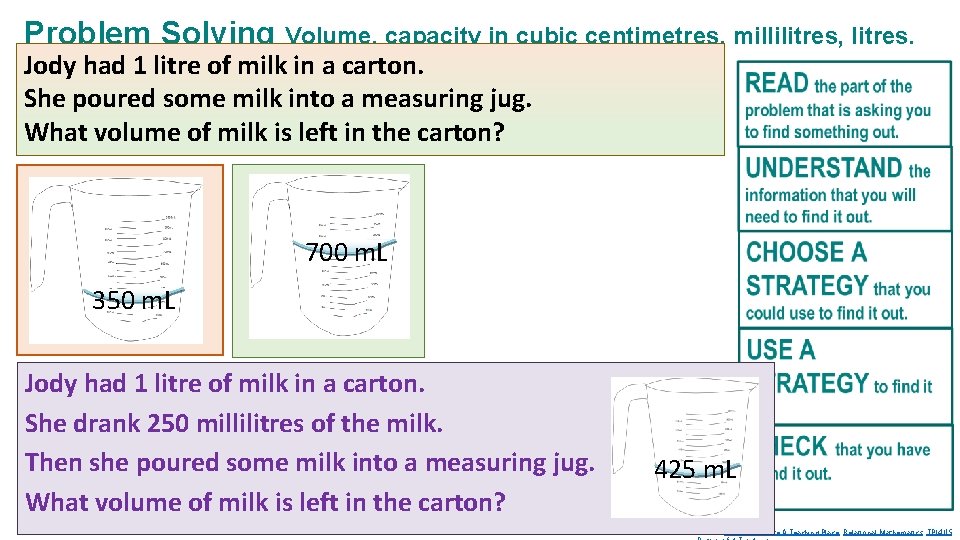
Problem Solving Volume, capacity in cubic centimetres, millilitres, litres. Jody had 1 litre of milk in a carton. She poured some milk into a measuring jug. What volume of milk is left in the carton? 700 m. L 350 m. L Jody had 1 litre of milk in a carton. She drank 250 millilitres of the milk. Then she poured some milk into a measuring jug. What volume of milk is left in the carton? 425 m. L © 2020 A Learning Place A Teaching Place Relational Mathematics TPL 4 US
Problem Solving Volume, capacity in cubic centimetres, millilitres, litres. Lucy poured 350 millilitres of milk into a jug from a full 1 litre carton. What volume of milk is left in the carton? Lucy poured 480 millilitres of milk into a jug from a full 1 litre carton. What volume of milk is left in the carton? Lucy drank 210 millilitres of milk from a full 1 litre carton. Then she poured a volume of milk into a jug. There was 345 millilitres of milk left in the jug. What volume of milk did she pour into the jug? © 2020 A Learning Place A Teaching Place Relational Mathematics TPL 4 US
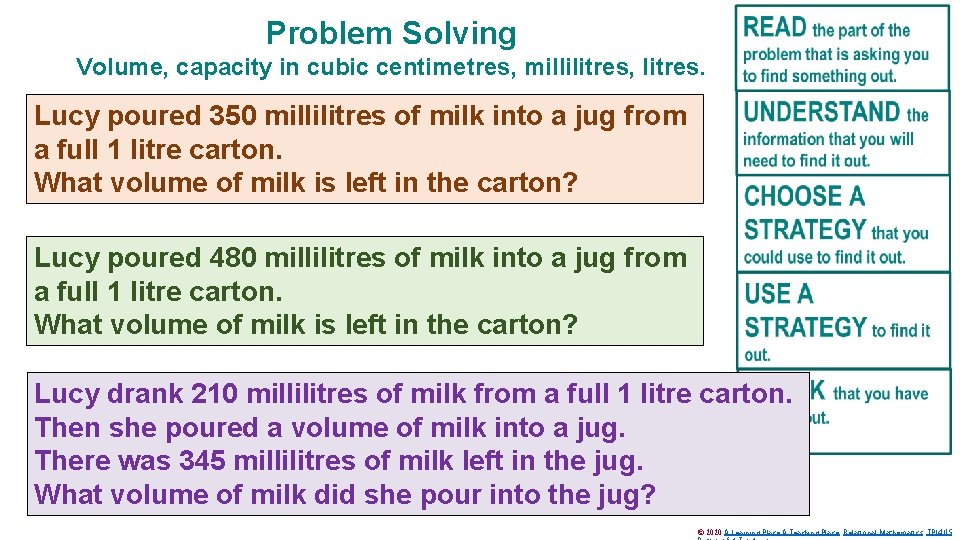
Problem Solving Volume, capacity in cubic centimetres, millilitres, litres. Lucy poured 350 millilitres of milk into a jug from a full 1 litre carton. What volume of milk is left in the carton? Lucy poured 480 millilitres of milk into a jug from a full 1 litre carton. What volume of milk is left in the carton? Lucy drank 210 millilitres of milk from a full 1 litre carton. Then she poured a volume of milk into a jug. There was 345 millilitres of milk left in the jug. What volume of milk did she pour into the jug? © 2020 A Learning Place A Teaching Place Relational Mathematics TPL 4 US
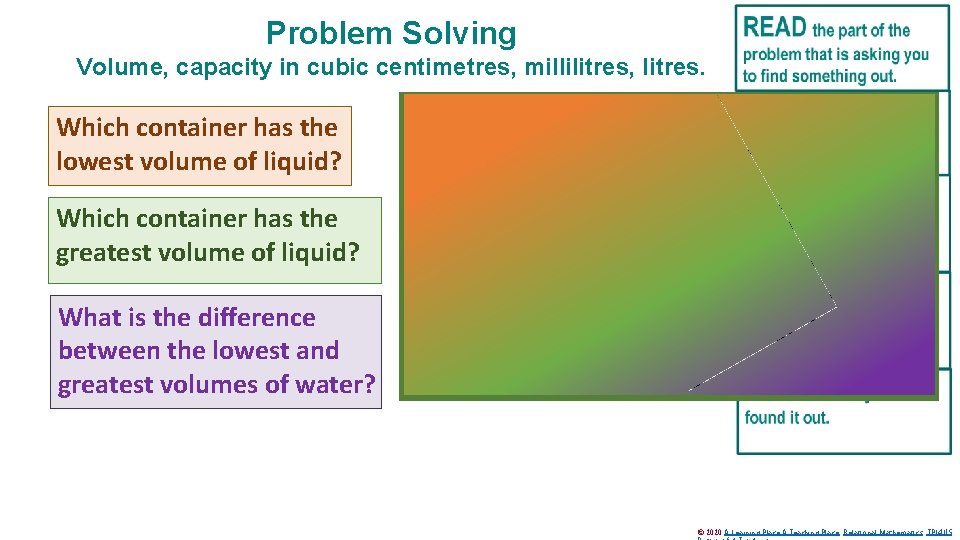
Problem Solving Volume, capacity in cubic centimetres, millilitres, litres. Which container has the lowest volume of liquid? a. b. c. Which container has the greatest volume of liquid? What is the difference between the lowest and greatest volumes of water? © 2020 A Learning Place A Teaching Place Relational Mathematics TPL 4 US
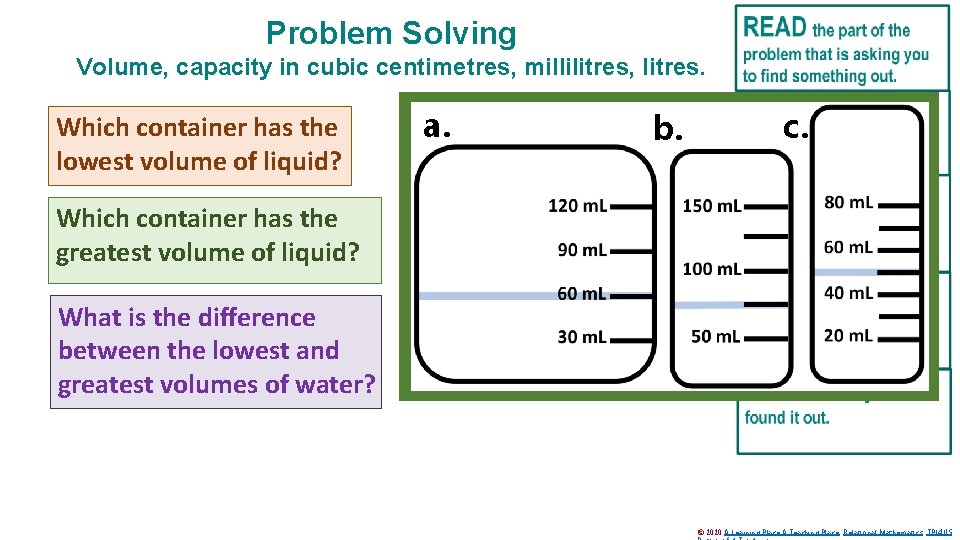
Problem Solving Volume, capacity in cubic centimetres, millilitres, litres. Which container has the lowest volume of liquid? a. b. c. Which container has the greatest volume of liquid? What is the difference between the lowest and greatest volumes of water? © 2020 A Learning Place A Teaching Place Relational Mathematics TPL 4 US
Problem Solving Volume, capacity in cubic centimetres, millilitres, litres. Sam poured water into 2 containers. He poured exactly 1 litre. How much water might he have poured into each container? Sam poured water into 2 containers. He poured exactly 1 litre. 1 container had a greater volume of water than the other container. How much water might he have poured into each container? Sam poured exactly 1 litre of water into 2 containers. 1 container had 3 times the volume of water of the other container. How much water might he have poured into each container? © 2020 A Learning Place A Teaching Place Relational Mathematics TPL 4 US
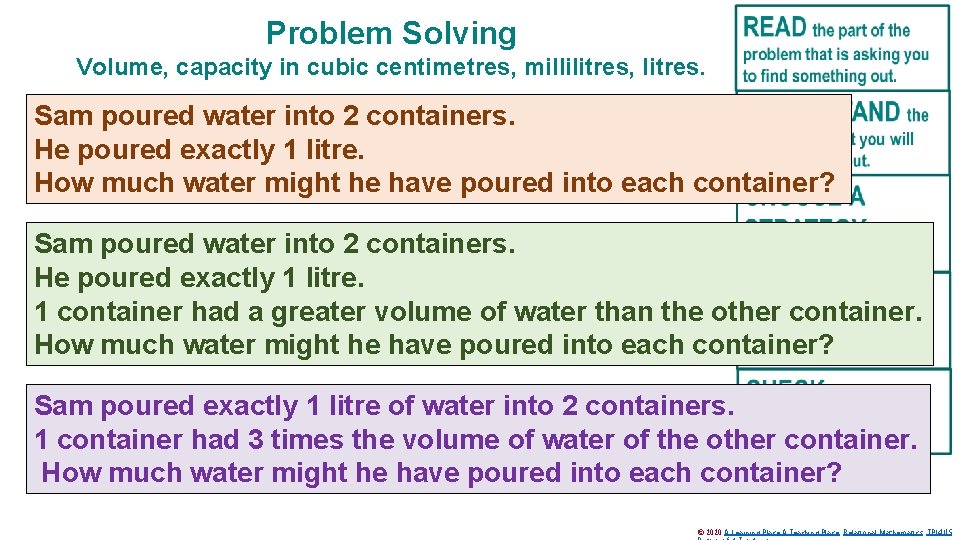
Problem Solving Volume, capacity in cubic centimetres, millilitres, litres. Sam poured water into 2 containers. He poured exactly 1 litre. How much water might he have poured into each container? Sam poured water into 2 containers. He poured exactly 1 litre. 1 container had a greater volume of water than the other container. How much water might he have poured into each container? Sam poured exactly 1 litre of water into 2 containers. 1 container had 3 times the volume of water of the other container. How much water might he have poured into each container? © 2020 A Learning Place A Teaching Place Relational Mathematics TPL 4 US
© 2020 A Learning Place A Teaching Place Relational Mathematics TPL 4 US Resourceful Teaching
© 2020 A Learning Place A Teaching Place Relational Mathematics TPL 4 US Resourceful Teaching
© 2020 A Learning Place A Teaching Place Relational Mathematics TPL 4 US Resourceful Teaching
© 2020 A Learning Place A Teaching Place Relational Mathematics TPL 4 US Resourceful Teaching
© 2020 A Learning Place A Teaching Place Relational Mathematics TPL 4 US Resourceful Teaching
- Slides: 44