
PROBLEM SOLVING FOR OPTIMIZATION Decisions Reality Max Profit
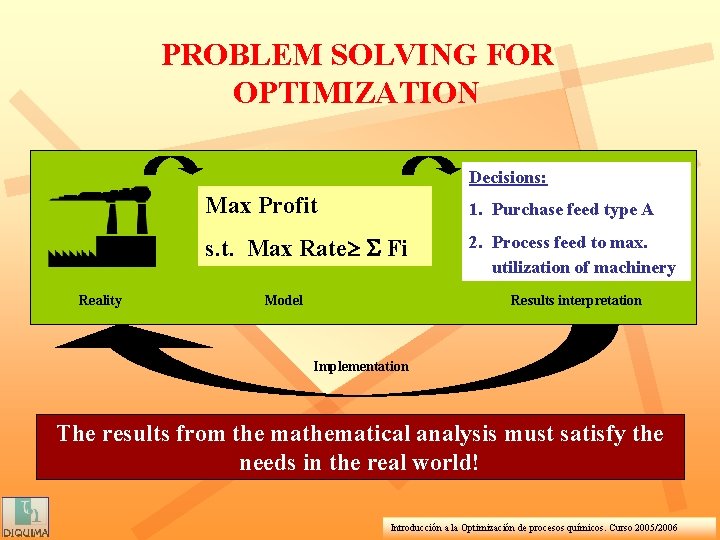
PROBLEM SOLVING FOR OPTIMIZATION Decisions: Reality Max Profit 1. Purchase feed type A s. t. Max Rate Fi 2. Process feed to max. utilization of machinery Model Results interpretation Implementation The results from the mathematical analysis must satisfy the needs in the real world! Introducción a la Optimización de procesos químicos. Curso 2005/2006
PROBLEM SOLVING FOR OPTIMIZATION Before we begin this process, we will be confident that • The problem involves optimization - Some degrees of freedom remain after safety, etc. • A model-based approach is appropriate - Not an empirical approach • The likely benefit is worth the effort - Answer is not obvious - Changes will likely yield substantial improvement Introducción a la Optimización de procesos químicos. Curso 2005/2006
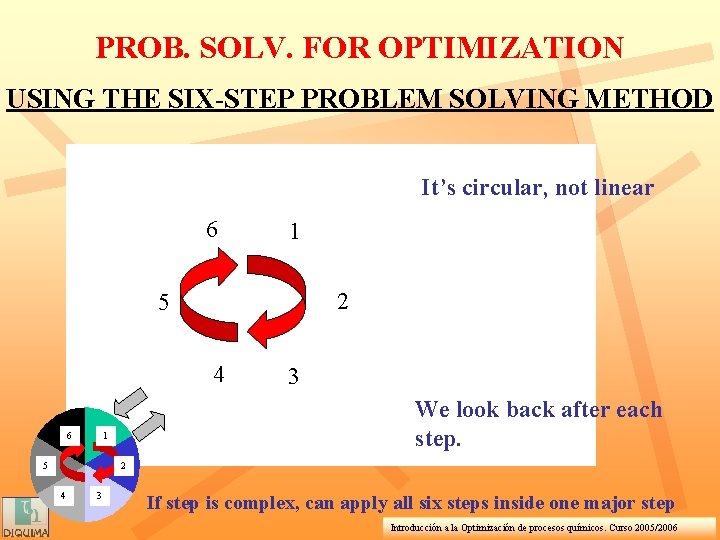
PROB. SOLV. FOR OPTIMIZATION USING THE SIX-STEP PROBLEM SOLVING METHOD It’s circular, not linear 6 1 2 5 4 6 We look back after each step. 1 5 3 2 4 3 If step is complex, can apply all six steps inside one major step Introducción a la Optimización de procesos químicos. Curso 2005/2006
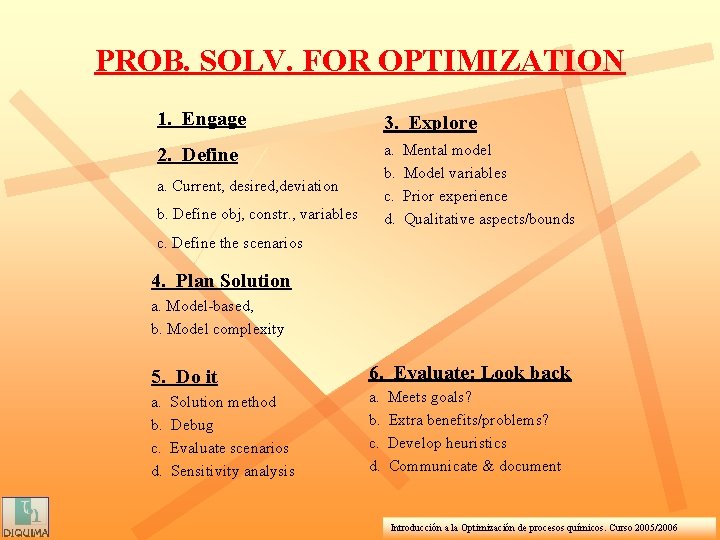
PROB. SOLV. FOR OPTIMIZATION 1. Engage 3. Explore 2. Define a. b. c. d. a. Current, desired, deviation b. Define obj, constr. , variables Mental model Model variables Prior experience Qualitative aspects/bounds c. Define the scenarios 4. Plan Solution a. Model-based, b. Model complexity 5. Do it 6. Evaluate: Look back a. b. c. d. Solution method Debug Evaluate scenarios Sensitivity analysis Meets goals? Extra benefits/problems? Develop heuristics Communicate & document Introducción a la Optimización de procesos químicos. Curso 2005/2006
PROB. SOLV. FOR OPTIMIZATION 1. ENGAGE - Be confident and calm a. Read and listen to information from all stakeholders b. Do not be concerned about proposing “silly” solutions Manage your time; Apply your problem-solving skills, I want to and I can! and Be confident! Introducción a la Optimización de procesos químicos. Curso 2005/2006
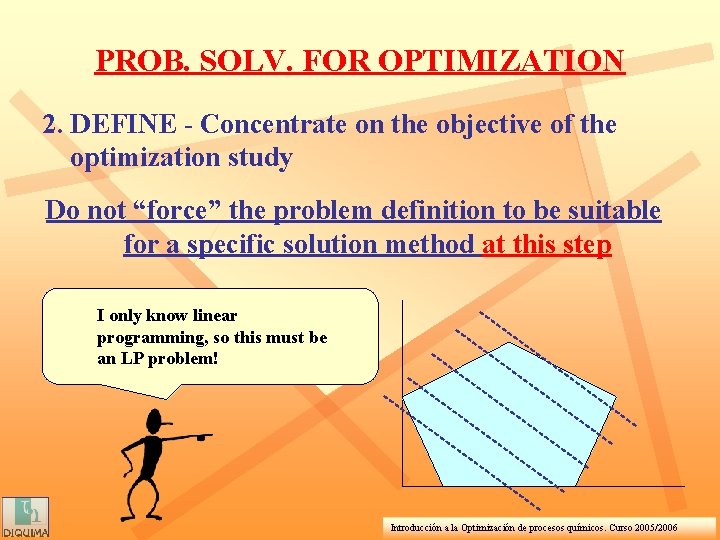
PROB. SOLV. FOR OPTIMIZATION 2. DEFINE - Concentrate on the objective of the optimization study Do not “force” the problem definition to be suitable for a specific solution method at this step I only know linear programming, so this must be an LP problem! Introducción a la Optimización de procesos químicos. Curso 2005/2006
PROB. SOLV. FOR OPTIMIZATION 2. DEFINE - Concentrate on the objective of the optimization study (cont’d) a. Sketch the problem and label variables Observe the real system, if possible b. Confirm/establish goals with priorities. We must understand all goals more important than the objective function so that we will satisfy these: for example, - Safety - Product quality Introducción a la Optimización de procesos químicos. Curso 2005/2006

PROB. SOLV. FOR OPTIMIZATION 2. DEFINE - Concentrate on the objective of the optimization study (cont’d) c. Specify the following aspects of the problem: - objective function - variables to be predicted - number of “degrees of freedom” for optimization - inequality constraints You should be able to state these is words and explain them, as well as specify mathematical relationships d. Look for/eliminate inconsistencies Introducción a la Optimización de procesos químicos. Curso 2005/2006
PROB. SOLV. FOR OPTIMIZATION 2. DEFINE - Concentrate on the objective of the optimization study (cont’d) e. Define range of conditions to be investigated: • • production rates, product qualities, feed materials, economics, likely model errors (parametric and structural), solution variables (e. g. , types of equipment, temperatures) steady-state or dynamic Introducción a la Optimización de procesos químicos. Curso 2005/2006
PROB. SOLV. FOR OPTIMIZATION 2. DEFINE - Concentrate on the objective of the optimization study (cont’d) f. Be sure that hard constraints are true. We can often violate “normal policies” or investment limits for a good reason. g. Define the desired solution in words h. Establish facts from opinions. Collect initial evidence. Introducción a la Optimización de procesos químicos. Curso 2005/2006
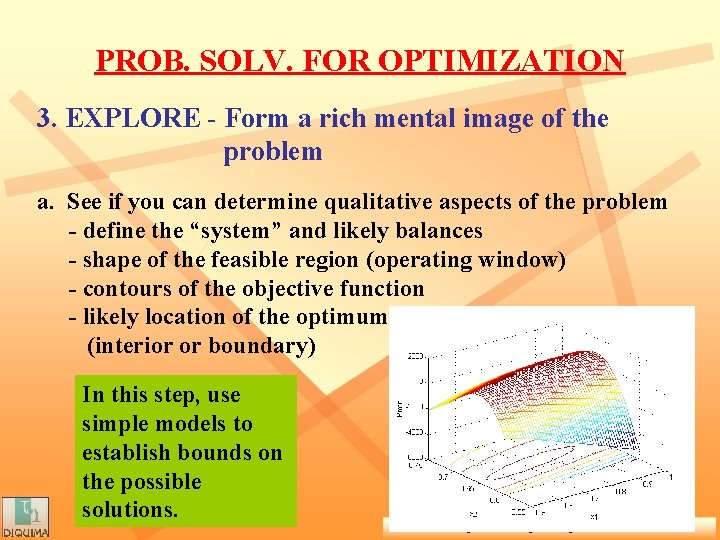
PROB. SOLV. FOR OPTIMIZATION 3. EXPLORE - Form a rich mental image of the problem a. See if you can determine qualitative aspects of the problem - define the “system” and likely balances - shape of the feasible region (operating window) - contours of the objective function - likely location of the optimum (interior or boundary) In this step, use simple models to establish bounds on the possible solutions. Introducción a la Optimización de procesos químicos. Curso 2005/2006
PROB. SOLV. FOR OPTIMIZATION 3. EXPLORE - Form a rich mental image of the problem (cont’d) b. Determine all of the variables needed to solve the optimization problem with sufficient accuracy, e. g. , - Intermediate variables (concentration along a PFR) - Feed properties (which concentrations, enthalpy, etc. ) - Environmental variables (cooling water) - physical properties (what accuracy? ) Why? This will help when we formulate a model. Introducción a la Optimización de procesos químicos. Curso 2005/2006
PROB. SOLV. FOR OPTIMIZATION 3. EXPLORE - Form a rich mental image of the problem (cont’d) c. Challenge the assumption that optimization is needed. Try your best to find the solution using simple principles and models. - Why can’t you solve the problem without the model? - What must the model tell you and with what accuracy? - Is there an obvious (sub-) optimal solution? - Can you determine the best values of a subset of the variables? d. Find relevant prior experience - Literature - Colleagues - Prior solutions Introducción a la Optimización de procesos químicos. Curso 2005/2006
PROB. SOLV. FOR OPTIMIZATION 4. PLAN - Formulate the optimization model Now, we make a major decision - the model formulation that determines the model accuracy! How accurate is good enough? We might have to • formulate and solve the model • perform a sensitivity analysis to determine whether the accuracy is good enough for the decisions • if accuracy not acceptable, iterate with other model Introducción a la Optimización de procesos químicos. Curso 2005/2006
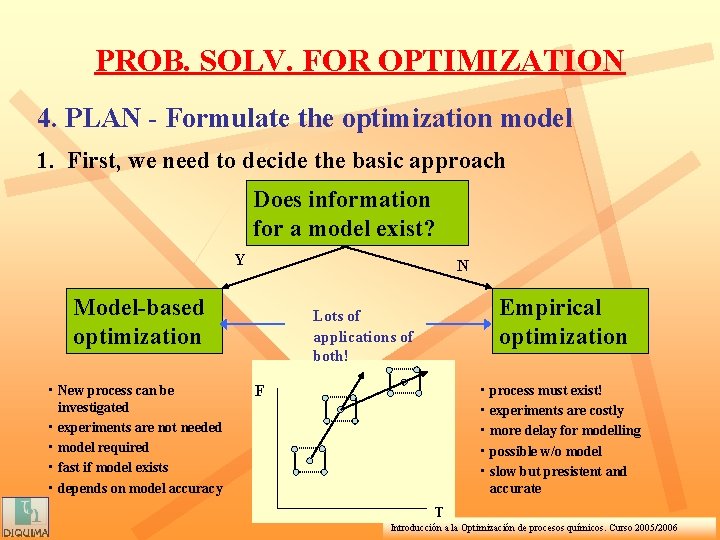
PROB. SOLV. FOR OPTIMIZATION 4. PLAN - Formulate the optimization model 1. First, we need to decide the basic approach Does information for a model exist? Y N Model-based optimization • New process can be investigated • experiments are not needed • model required • fast if model exists • depends on model accuracy Empirical optimization Lots of applications of both! F • process must exist! • experiments are costly • more delay for modelling • possible w/o model • slow but presistent and accurate T Introducción a la Optimización de procesos químicos. Curso 2005/2006
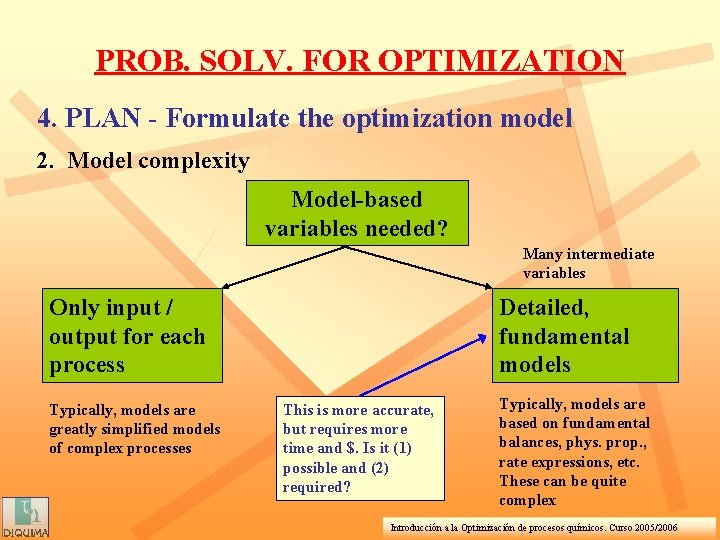
PROB. SOLV. FOR OPTIMIZATION 4. PLAN - Formulate the optimization model 2. Model complexity Model-based variables needed? Many intermediate variables Only input / output for each process Typically, models are greatly simplified models of complex processes Detailed, fundamental models This is more accurate, but requires more time and $. Is it (1) possible and (2) required? Typically, models are based on fundamental balances, phys. prop. , rate expressions, etc. These can be quite complex Introducción a la Optimización de procesos químicos. Curso 2005/2006
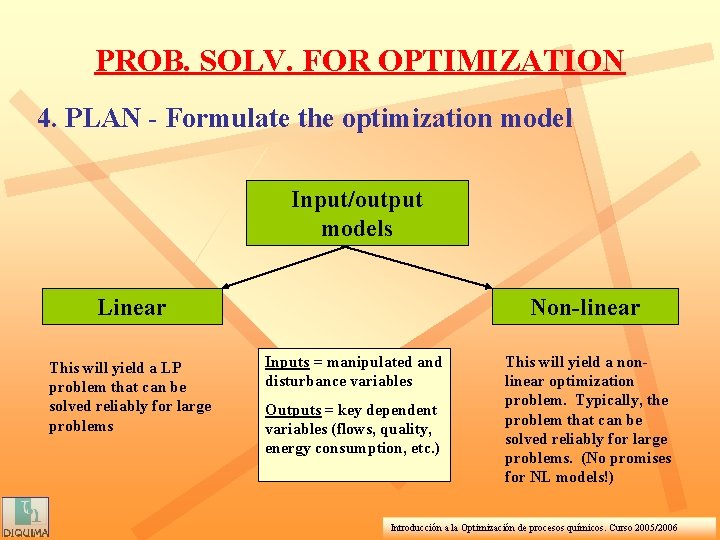
PROB. SOLV. FOR OPTIMIZATION 4. PLAN - Formulate the optimization model Input/output models Linear This will yield a LP problem that can be solved reliably for large problems Non-linear Inputs = manipulated and disturbance variables Outputs = key dependent variables (flows, quality, energy consumption, etc. ) This will yield a nonlinear optimization problem. Typically, the problem that can be solved reliably for large problems. (No promises for NL models!) Introducción a la Optimización de procesos químicos. Curso 2005/2006
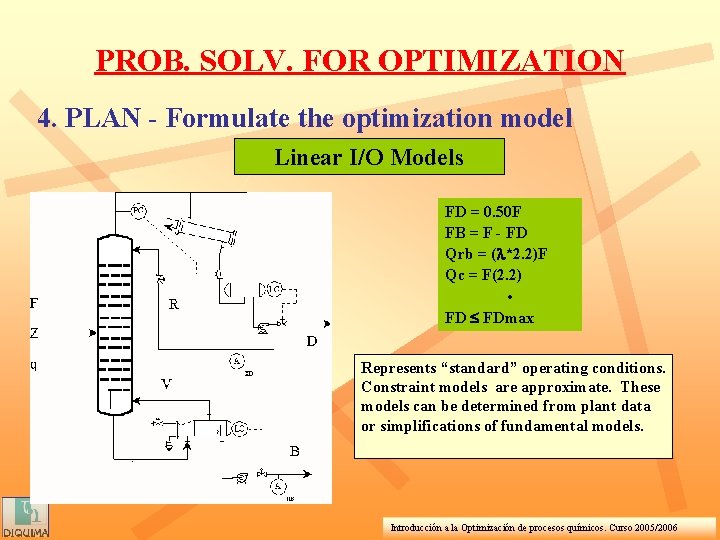
PROB. SOLV. FOR OPTIMIZATION 4. PLAN - Formulate the optimization model Linear I/O Models FD = 0. 50 F FB = F - FD Qrb = ( *2. 2)F Qc = F(2. 2) • FD FDmax Represents “standard” operating conditions. Constraint models are approximate. These models can be determined from plant data or simplifications of fundamental models. Introducción a la Optimización de procesos químicos. Curso 2005/2006
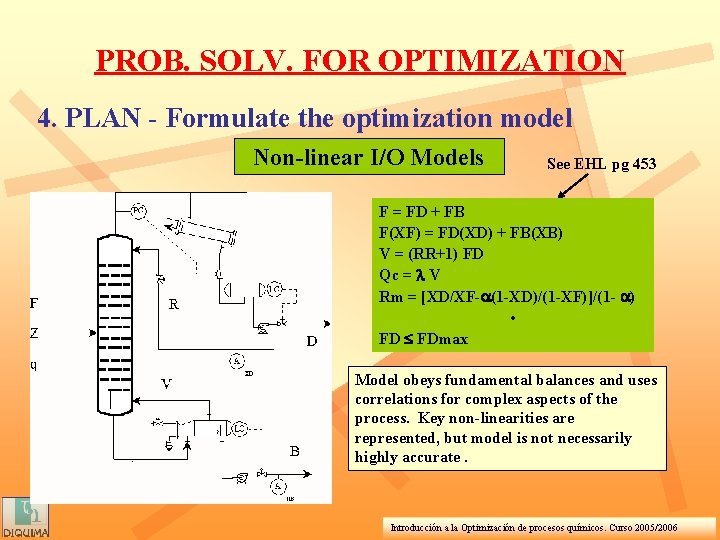
PROB. SOLV. FOR OPTIMIZATION 4. PLAN - Formulate the optimization model Non-linear I/O Models See EHL pg 453 F = FD + FB F(XF) = FD(XD) + FB(XB) V = (RR+1) FD Qc = V Rm = [XD/XF- (1 -XD)/(1 -XF)]/(1 - ) • FD FDmax Model obeys fundamental balances and uses correlations for complex aspects of the process. Key non-linearities are represented, but model is not necessarily highly accurate. Introducción a la Optimización de procesos químicos. Curso 2005/2006
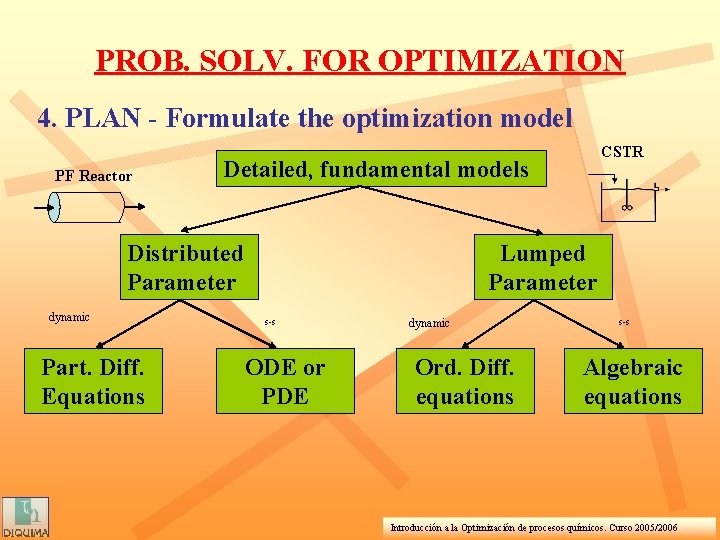
PROB. SOLV. FOR OPTIMIZATION 4. PLAN - Formulate the optimization model PF Reactor Detailed, fundamental models Distributed Parameter dynamic Part. Diff. Equations CSTR Lumped Parameter s-s ODE or PDE dynamic Ord. Diff. equations s-s Algebraic equations Introducción a la Optimización de procesos químicos. Curso 2005/2006
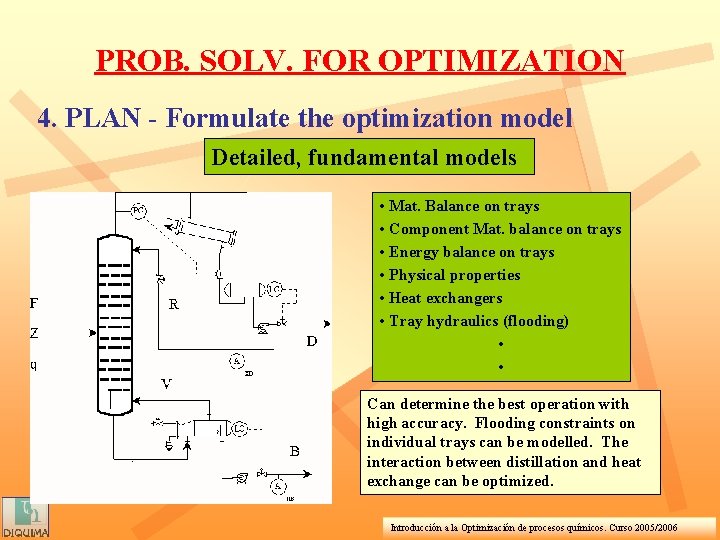
PROB. SOLV. FOR OPTIMIZATION 4. PLAN - Formulate the optimization model Detailed, fundamental models • Mat. Balance on trays • Component Mat. balance on trays • Energy balance on trays • Physical properties • Heat exchangers • Tray hydraulics (flooding) • • Can determine the best operation with high accuracy. Flooding constraints on individual trays can be modelled. The interaction between distillation and heat exchange can be optimized. Introducción a la Optimización de procesos químicos. Curso 2005/2006
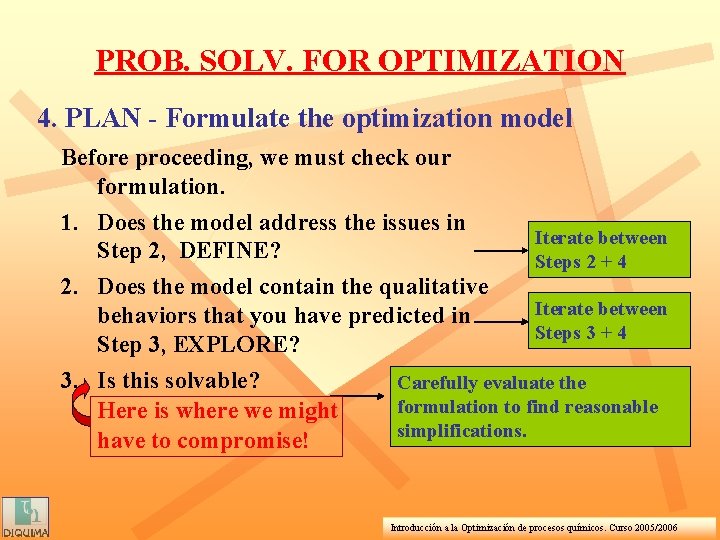
PROB. SOLV. FOR OPTIMIZATION 4. PLAN - Formulate the optimization model Before proceeding, we must check our formulation. 1. Does the model address the issues in Iterate between Step 2, DEFINE? Steps 2 + 4 2. Does the model contain the qualitative Iterate between behaviors that you have predicted in Steps 3 + 4 Step 3, EXPLORE? 3. Is this solvable? Carefully evaluate the formulation to find reasonable Here is where we might simplifications. have to compromise! Introducción a la Optimización de procesos químicos. Curso 2005/2006
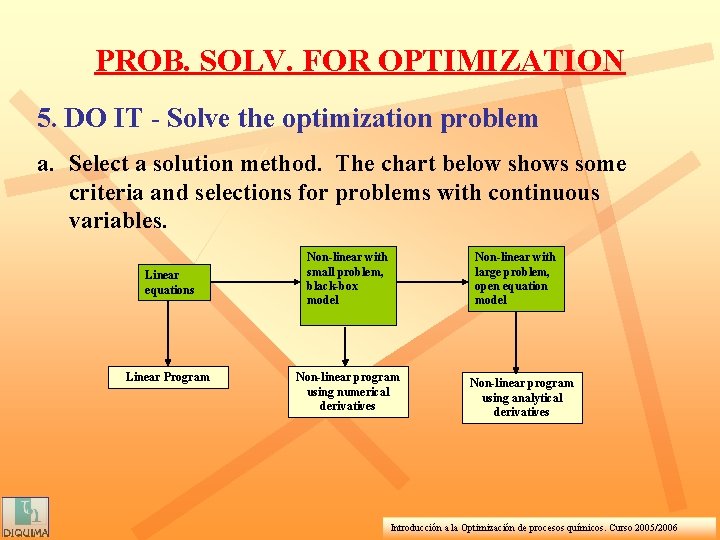
PROB. SOLV. FOR OPTIMIZATION 5. DO IT - Solve the optimization problem a. Select a solution method. The chart below shows some criteria and selections for problems with continuous variables. Linear equations Linear Program Non-linear with small problem, black-box model Non-linear with large problem, open equation model Non-linear program using numerical derivatives Non-linear program using analytical derivatives Introducción a la Optimización de procesos químicos. Curso 2005/2006
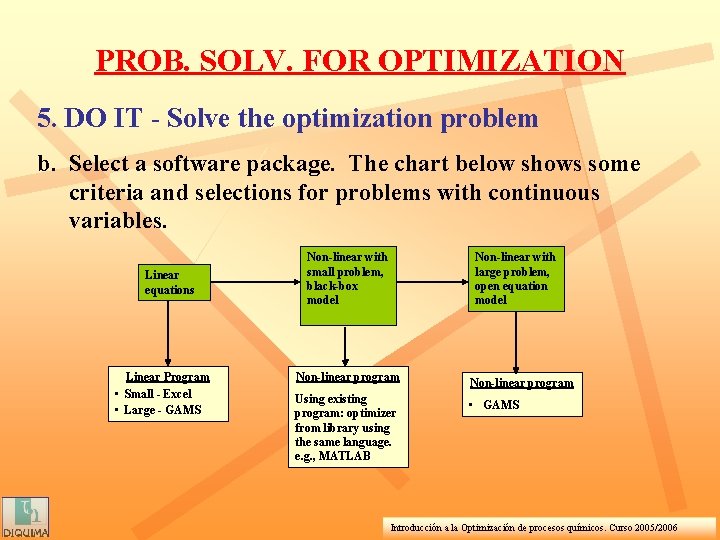
PROB. SOLV. FOR OPTIMIZATION 5. DO IT - Solve the optimization problem b. Select a software package. The chart below shows some criteria and selections for problems with continuous variables. Linear equations Linear Program • Small - Excel • Large - GAMS Non-linear with small problem, black-box model Non-linear with large problem, open equation model Non-linear program Using existing program: optimizer from library using the same language. e. g. , MATLAB • GAMS Introducción a la Optimización de procesos químicos. Curso 2005/2006
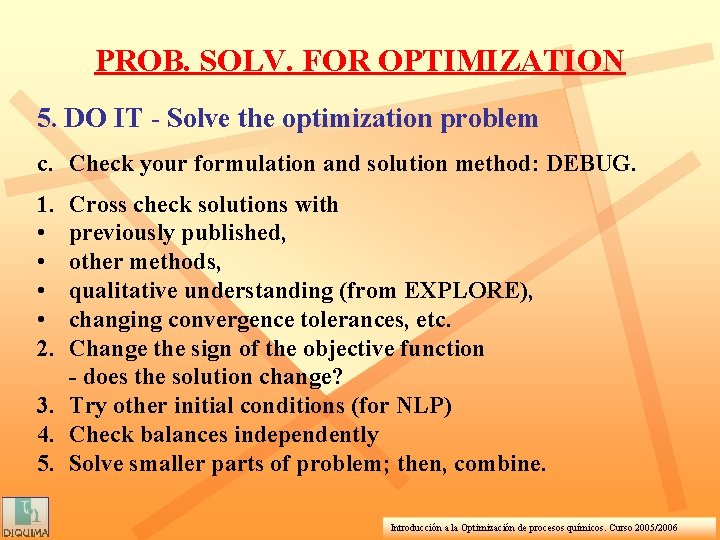
PROB. SOLV. FOR OPTIMIZATION 5. DO IT - Solve the optimization problem c. Check your formulation and solution method: DEBUG. 1. • • 2. Cross check solutions with previously published, other methods, qualitative understanding (from EXPLORE), changing convergence tolerances, etc. Change the sign of the objective function - does the solution change? 3. Try other initial conditions (for NLP) 4. Check balances independently 5. Solve smaller parts of problem; then, combine. Introducción a la Optimización de procesos químicos. Curso 2005/2006
PROB. SOLV. FOR OPTIMIZATION 5. DO IT - Solve the optimization problem d. Solve all scenarios specified in Step 2, DEFINE 1. Check solver diagnostics for lack of convergence, alternative solutions - anything not indicating unique optimum. 2. Collect results in side-by-side tables, so that you can see how variables and constraint activities change in scenarios. 3. Provide an explanation for every scenario - NEVER report the numbers alone! 4. Summarize the conclusions and likely benefits, if any, for implementing results Introducción a la Optimización de procesos químicos. Curso 2005/2006
PROB. SOLV. FOR OPTIMIZATION 5. DO IT - Solve the optimization problem e. Build confidence in your results - concentrate on the decision variables 1. Assumptions - Does the solution obey all key assumptions, or have variables moved “too far”? 2. Sensitivity - Evaluate the sensitivity of the decisions and objective to changes in key parameters that are uncertain. 3. Relative importance - Evaluate the importance of each decision variable. Could you gain the benefits with a subset of opt. variables? Introducción a la Optimización de procesos químicos. Curso 2005/2006
PROB. SOLV. FOR OPTIMIZATION 5. DO IT - Solve the optimization problem f. If you have the opportunity, implement the results 1. Potential Problem Analysis - Evaluate how these decisions influence other issues, including safety. How can problems be eliminated or mitigated? 2. Schedule - Develop a sequence for implementation. 3. Maintenance - Establish how the decisions will be maintained; in a plant, is control required? 4. Monitoring - Closely monitor the behavior to ensure that it follows the predictions of the analysis. Introducción a la Optimización de procesos químicos. Curso 2005/2006
PROB. SOLV. FOR OPTIMIZATION 6. EVALUATE - Look back and learn a. Have you solved the problem? 1. Done? - Was the model and optimization approach appropriate? If not, must iterate with a different approach. - If the limit was accuracy, try more accurate model - If the limit was computing, try simpler model 2. Simple solution? - Now that you have optimization results, can you find a heuristic that would give similar results in the future without (or with limited) mathematical analysis? Introducción a la Optimización de procesos químicos. Curso 2005/2006
PROB. SOLV. FOR OPTIMIZATION 6. EVALUATE - Look back and learn b. Check results of this problem 1. Consistency - Is the implementation consistent with all prior parts of the PS method? 2. Objective - Has the goal been achieved? If not, what factors have limited us? How can we improve further? 3. Engineering - What uncertainty in model structure or values has limited the achievements? 4. Unexpected factors - Have you encountered unexpected safety, legal, ethical issues? Introducción a la Optimización de procesos químicos. Curso 2005/2006
PROB. SOLV. FOR OPTIMIZATION 6. EVALUATE - Look back and learn c. Guidelines (experience factors) for the future 1. Problem Insights - What have you learned about this problem that could be used in the future? - Model accuracy - Parameter uncertainty - Variables changed - Useful objective function 2. General Insights - What can be used in many problems? - Performance of optimization method - Performance of software - Sensitivity analysis Introducción a la Optimización de procesos químicos. Curso 2005/2006
PROB. SOLV. FOR OPTIMIZATION 6. EVALUATE - Look back and learn d. Spreading the word 1. Engineering - How can you teach others about the use of optimization through this example? 2. Maintenance - How can we monitor, evaluate, decide when to optimize again? - Personnel training - Additional sensors - real-time calculations 3. Communication - How will you communicate these complex calculations to the people running the plant? What about management? Introducción a la Optimización de procesos químicos. Curso 2005/2006
- Slides: 32