
Problem Solving and Data Analysis Lessons 1 3
Problem Solving and Data Analysis Lessons 1 – 3 Ratio and Proportion Percents Measurement, Unit Rate, and Density Non-linear Behavior and Scatterplots
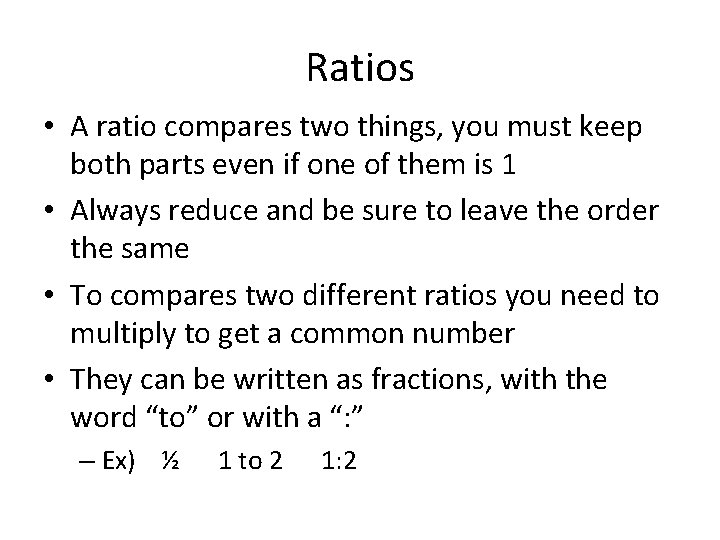
Ratios • A ratio compares two things, you must keep both parts even if one of them is 1 • Always reduce and be sure to leave the order the same • To compares two different ratios you need to multiply to get a common number • They can be written as fractions, with the word “to” or with a “: ” – Ex) ½ 1 to 2 1: 2
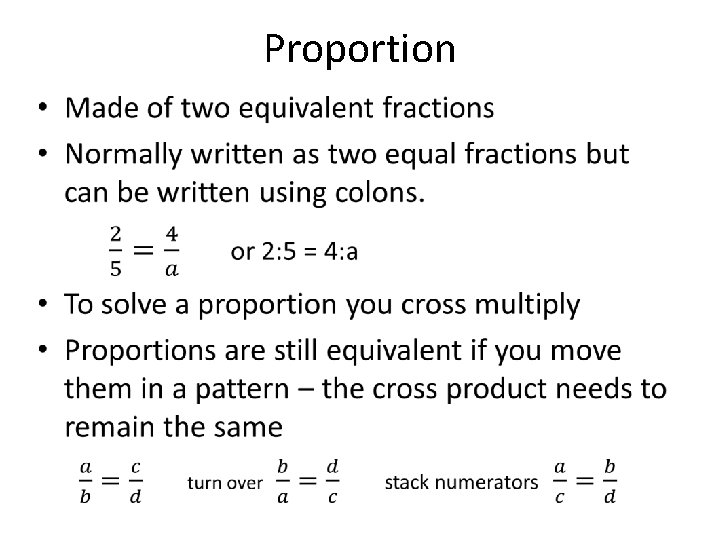
Proportion •

Percents •
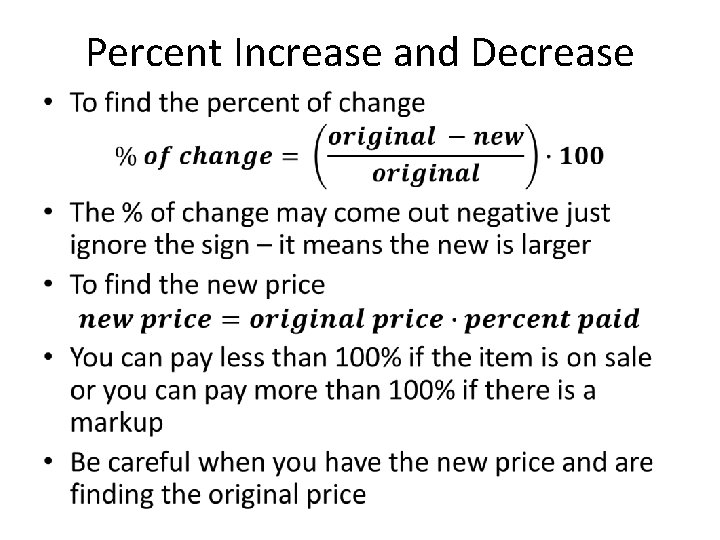
Percent Increase and Decrease •
Interest Formula • • • Interest = Principle ∙ Rate ∙ Time I = Prt Principle is your starting amount Rate must be in decimal form Time must be in years (not months)
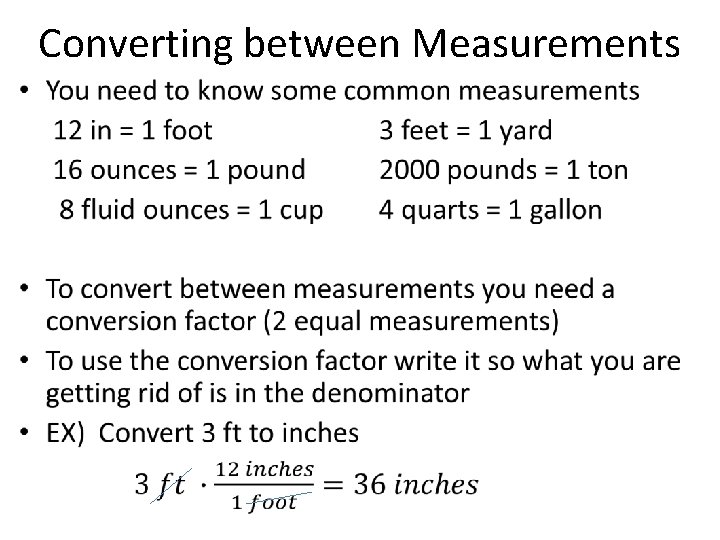
Converting between Measurements •
Scale Drawings • A scale model reflects the real object or surface, but all the real-life dimensions have been reduced or enlarged by the same scale factor • The scale factor is the ratio of any two corresponding lengths between the model and the real object or surface Scale drawing measure Ratio = Actual measure • Set up a proportion with the measurement you have and the scale factor. • Solve the proportion by cross-multiplying and dividing
Unit Rate • A Unit Rate is the ratio of two measurements in which the second measurement is 1 • Examples include – Cost per unit weight, such as dollars per 1 ounce – Distance per unit time, such as kilometers per 1 hour – Job done per unit time, such as fences painted per 1 hr – Population density, number of residents per single unit of defined area • To find a unit rate divide by the “per” quantity – Ex) Tom is paid $60 for 4 hours of work 60/4 = 15 – Therefore his unit rate is $15 per 1 hour
Density • Density is the ratio of mass per unit volume. • Scientists usually measure mass in grams (g) and the volume in 1 cm 3, which is equivalent to 1 m. L – Ex) Rock with mass of 60 grams takes up a volume of 30 cm 3 60/30 = 2 Therefore the density is 2 grams per cm 3 • To solve problems about density set up proportions and solve by cross-multiplying and dividing
Non-linear Behavior in Scatterplots • Scatterplots can look linear, quadratic or exponential • The correlation (relationship) between variables can be positive or negative – weak or strong • If a scatterplot is linear then the change over time is constant – the change is the slope and slope stays constant • If a scatterplot is exponential then the change over time increases or decreases
- Slides: 11