
Problem Solving A Six Thinking Hats Exercise Six
Problem Solving A Six Thinking Hats Exercise
Six Thinking Hats ● “Six thinking hats is a tool that can help us look at problems from different perspectives one at a time to avoid confusion from too many angles crowding your thinking. ” Source: Edward de Bono ● Focus - Everyone explores the situation from each perspective or hat at the same time. The sequence of hats can change - but everyone must change direction at the same time ● Each hat represents a different perspective ● Provides a common language and process
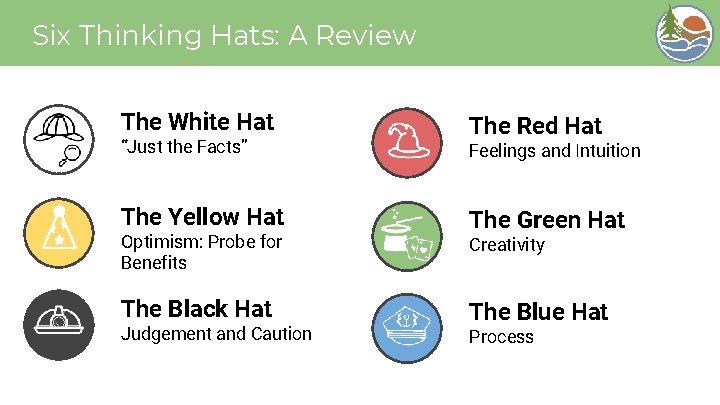
Six Thinking Hats: A Review The White Hat “Just the Facts” The Yellow Hat Optimism: Probe for Benefits The Black Hat Judgement and Caution The Red Hat Feelings and Intuition The Green Hat Creativity The Blue Hat Process
Six Thinking Hats Depending on your problem, hats can be used in many sequences and not all hats are necessary. Examples: ● Initial ideas - Blue, White, Green, Blue ● Quick feedback - Blue, Black, Green, Blue ● Solving problems - Blue, White, Green, Red, Yellow, Black, Green, Blue ● Identifying solutions - Blue, White, Green, Blue
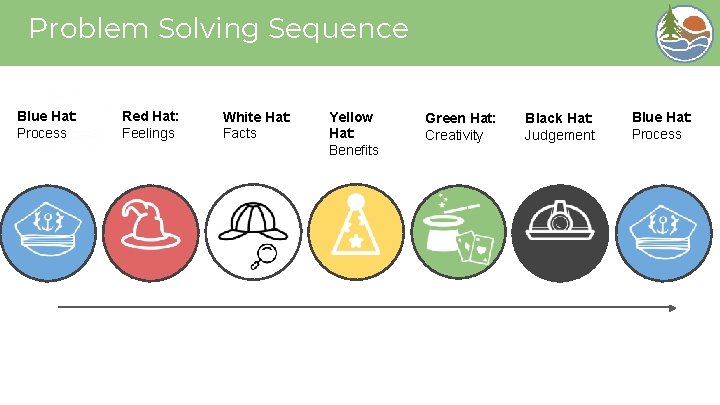
Problem Solving Sequence Blue Hat: Process Red Hat: Feelings White Hat: Facts Yellow Hat: Benefits Green Hat: Creativity Black Hat: Judgement Blue Hat: Process
Tools Needed ● Materials Needed ○ Use Sharpie Markers (Easier to Read) ○ 3” x 3” Post-It Notes ○ Easel Pad (large 24”x 30” Post-it Notes)
Preparation ● Prior to meeting, identify an issue or problem to solve with the group ● For each hat that you are using prepare individual easel pads with a hat & category name at the top. For example: Red (Emotions), White (Facts), Yellow (Benefits), Green (Creativity), Black (Judgement) ● Hang easel pad papers on wall in your order of operation ● White hat - may take the longest. Send questions to team before meeting allowing team members to come prepared with needed data
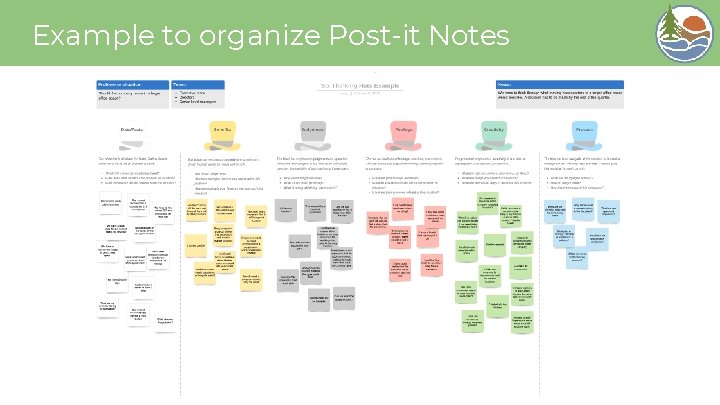
Example to organize Post-it Notes
Directions For each hat (1 at a time): 1. Two (2) minutes of individual brainstorming (more ideas the better) 2. Team focuses on answering one hat at a time 3. Write one (1) idea per Post-It note - be specific 4. For example: “More phone training”, instead of “training” 5. Use only 6 -7 words per Post-It note
Directions After 2 minutes: Each team member presents their Post-It Notes - 5 minutes for entire team 1. Team member puts Post-it Note on the Easel Paper for current hat 2. Group similar ideas together in each hat 3. Continue in this fashion until you move through all of the hats
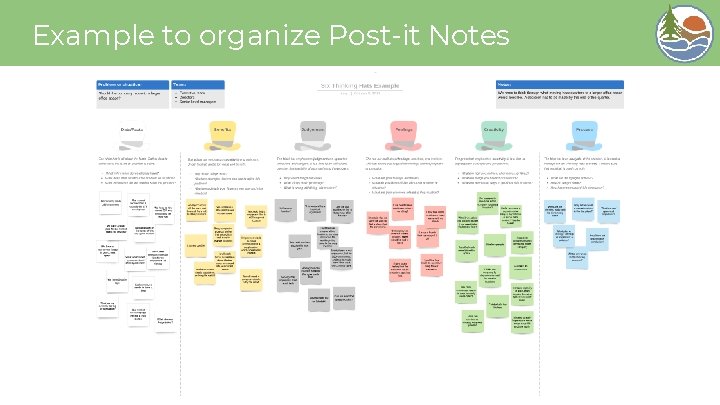
Example to organize Post-it Notes
● Manage the process ● Make sure the hats are followed Why are we here? Agenda Blue Hat: Process Why are we talking about it? What is the goal or intent of the meeting?
Feelings Red Hat: Feelings and Intuition ● Emotions are identified without explanation or justification ● Say things that they don’t have to validate ● Express true feelings ● What do I like about the it? ● What don’t I like about it? How do you feel about the current situation, issue, or problem?
Nothing But the Facts White Hat: Just the Facts ● What has led up to this? ● What is the current information about the issue or problem? ● What are the facts / figures? ● What information do we still need? Try to answer all the above questions.
What are the Benefits? Optimism: Probe for Benefits ● Explore the positives and probe for value and benefits ● Opposite of the black hat ● Look for positives Q 1: What is the best case scenario?
Creativity Green Hat: Find Potential Solutions ● How can we improve the current situation/ problem? ● Focus on creativity, possibilities, alternatives and new ideas. The more the better! ● Generate more ideas ● Provoke new ideas What are new creative ideas or alternatives to solve the issue or problem?
What are the Benefits? Optimism: Probe for Benefits ● Explore the positives and probe for value and benefits ● Identify the top solutions ● Cloud group / dot vote Q 1: What are the top solutions?
Caution! Black Hat: Judgement and Caution ● What are the risks, potential problems, obstacles, downsides and weaknesses. ● Why might it not work? Is it safe? ● What could be changed? ● Can we afford it? ● Will clients like this? What are the risks or potential problems with each of the top solutions?
Creativity Green Hat: Find Potential Solutions ● How can we improve the current situation/ problem? ● Focus on creativity, possibilities, alternatives and new ideas. The more the better! How can we solve our challenges that were identified in the black hat?
Conclusion Blue Hat: Process ● What have we achieved? ● What are the next steps or action items? ● Do we need to meet again?
- Slides: 20