
Problem Scoping in Design Some Research Results Dr
Problem Scoping in Design: Some Research Results Dr. Cynthia J. Atman, Dr. Ken Yasuhara, Deborah Kilgore Dr. Center for Engineering Learning and Teaching College of Engineering, University of Washington Acknowledgements: This work has been supported by grants from the National Science Foundation RED-9358516, DGE-9714459, EEC-9872498, REC-012554, ESI-0227558, SBE 0354453, the Boeing Company. 1
Complete the following task Over the summer, the Midwest experienced massive flooding of the Mississippi River. What factors would you take into account in designing a retaining wall system for the Mississippi? n n n n 1 2 3 4 5 6 7 ……. 2
Draw a line under the last factor you listed and work with a team to continue Over the summer, the Midwest experienced massive flooding of the Mississippi River. factors would you take into account in designing a retaining wall system for the. Whatlist Mississippi? n n n 1 2 3 4 5 6 7 _____________________ 8 9 ……. . 3
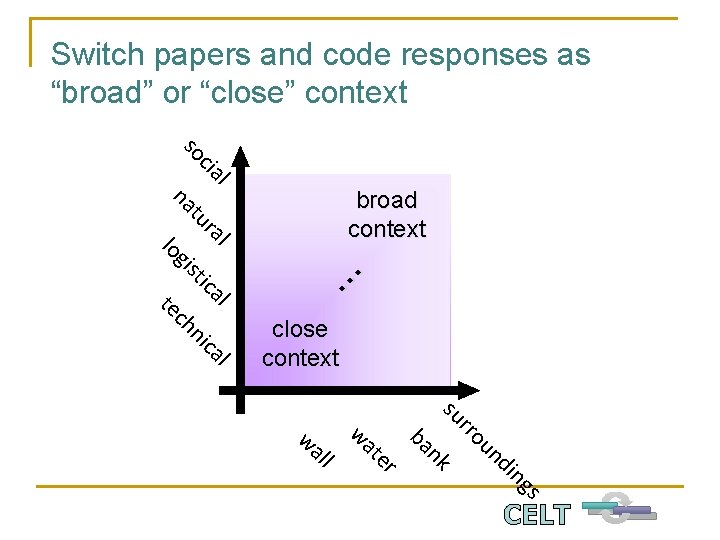
Switch papers and code responses as “broad” or “close” context . . . l l a a ca cia ur tic ni so at gis ch n lo te broad context close context gs n di un rro su er nk ba at w l al w
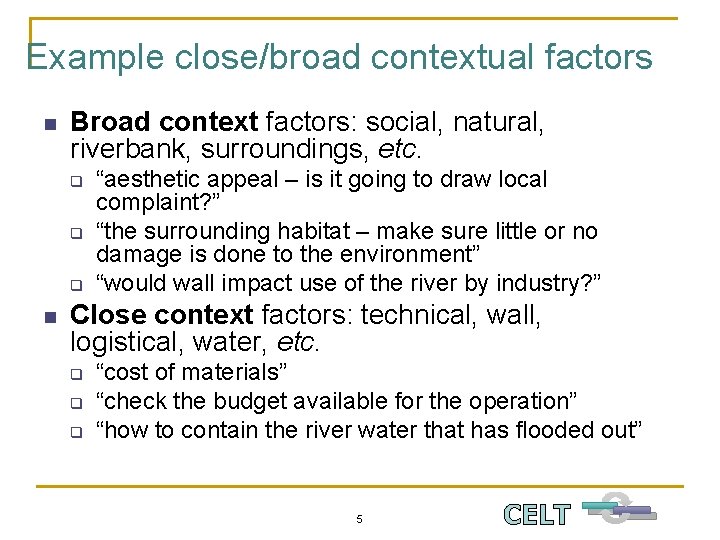
Example close/broad contextual factors n Broad context factors: social, natural, riverbank, surroundings, etc. q q q n “aesthetic appeal – is it going to draw local complaint? ” “the surrounding habitat – make sure little or no damage is done to the environment” “would wall impact use of the river by industry? ” Close context factors: technical, wall, logistical, water, etc. q q q “cost of materials” “check the budget available for the operation” “how to contain the river water that has flooded out” 5
What observations do you have? n n About the task About the types of factors listed q q n By you By others About doing the task as an individual or as a group 6
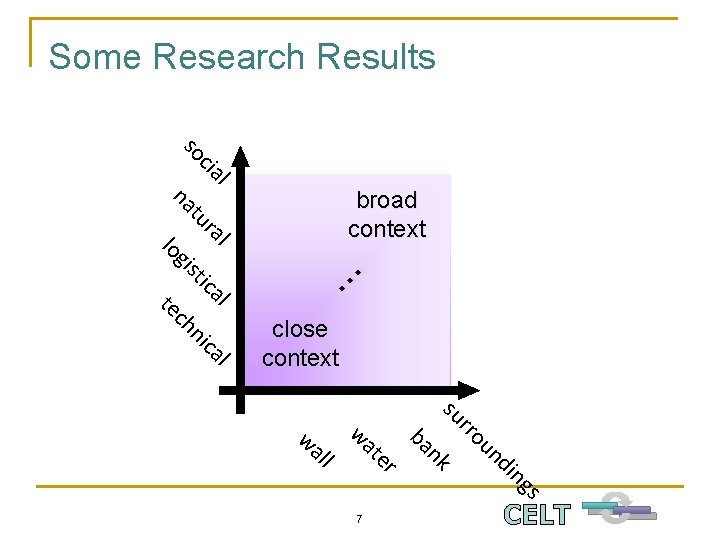
broad context close context l l a a ca cia ur tic ni so at gis ch n lo te . . . Some Research Results gs n di un rro su er nk ba at w l al w 7
Academic Pathways Study (APS) Sheppard (Lead), Atman, Fleming, Miller, Smith, Stevens, Streveler n n Large-scale, multi-method study of undergraduate engineering students Three cohorts of students from very different institutions q q q n n Longitudinal cohort Broader core sample Broader national sample One cohort of early career engineers Research on the engineering learning experience from the student perspective 8
Longitudinal cohort: Research methods n n n Surveys Structured interviews Ethnographic interviews and observations Engineering design tasks Supplementary data q q Academic transcripts Exit interviews 9
Longitudinal cohort: Sample n n 40 students from each of four institutions Institutions q q Technical Public Institution Large Public University Urban Private University Suburban Private University
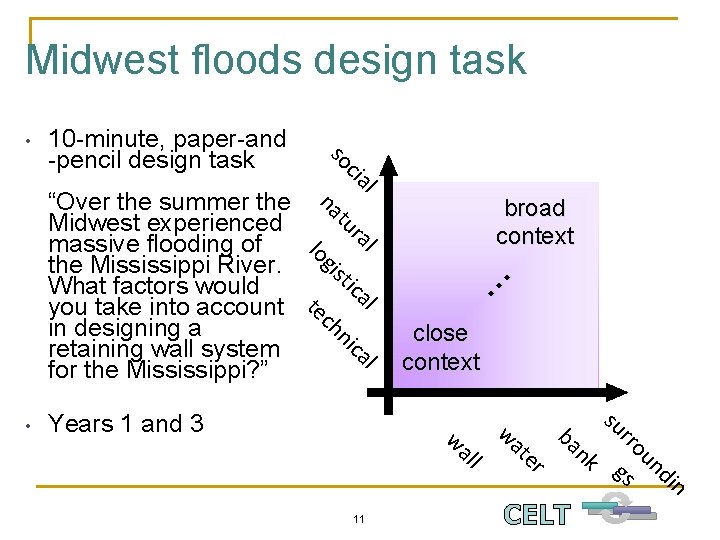
Midwest floods design task l al r tu l ca ni ch te al tic gis lo close context er 11 at l al w w Years 1 and 3 n di un rro s su g nk ba • broad context na “Over the summer the Midwest experienced massive flooding of the Mississippi River. What factors would you take into account in designing a retaining wall system for the Mississippi? ” cia so 10 -minute, paper-and -pencil design task . . . •

More factors in Year 3 N = 69 (longitudinal sample) p < 0. 001 (total factors) 12
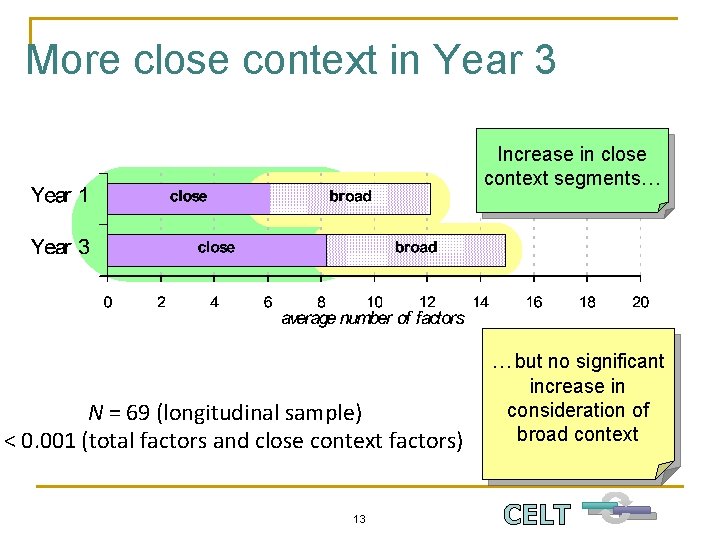
More close context in Year 3 Increase in close context segments… …but no significant N = 69 (longitudinal sample) < 0. 001 (total factors and close context factors) 13 increase in consideration of broad context
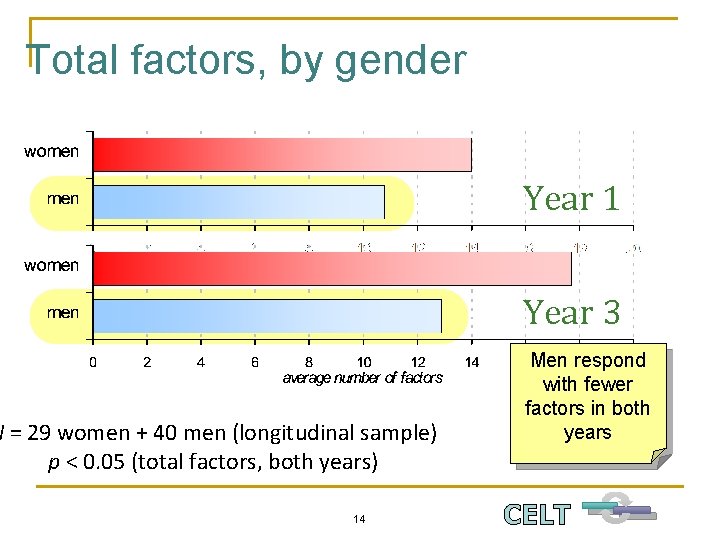
Total factors, by gender Year 1 Year 3 N = 29 women + 40 men (longitudinal sample) p < 0. 05 (total factors, both years) 14 Men respond with fewer factors in both years
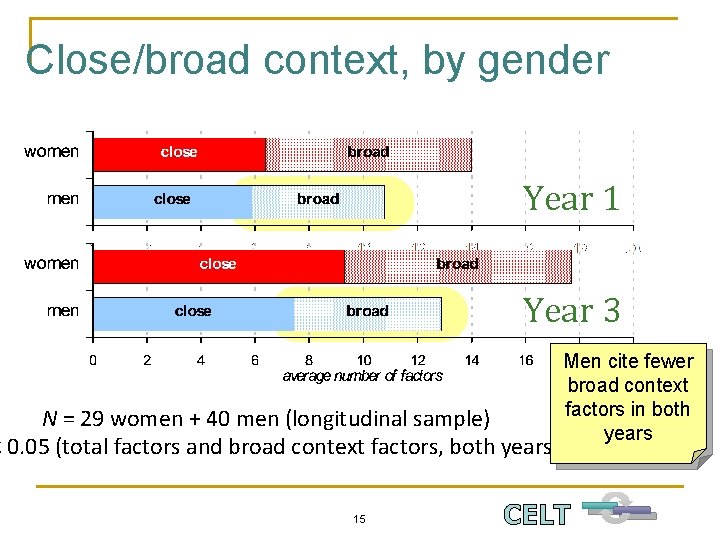
Close/broad context, by gender Year 1 Year 3 N = 29 women + 40 men (longitudinal sample) < 0. 05 (total factors and broad context factors, both years) 15 Men cite fewer broad context factors in both years
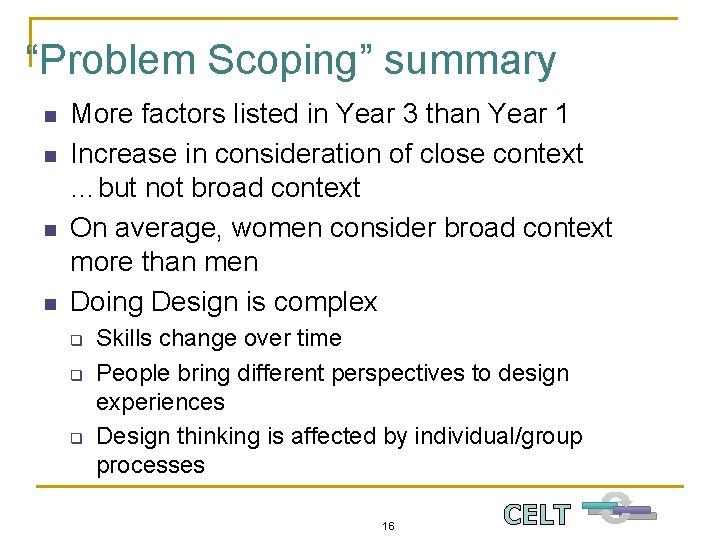
“Problem Scoping” summary n n More factors listed in Year 3 than Year 1 Increase in consideration of close context …but not broad context On average, women consider broad context more than men Doing Design is complex q q q Skills change over time People bring different perspectives to design experiences Design thinking is affected by individual/group processes 16
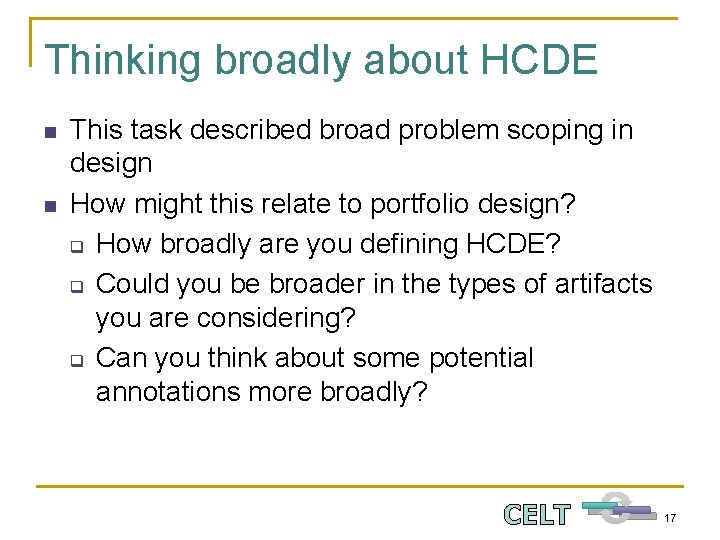
Thinking broadly about HCDE n n This task described broad problem scoping in design How might this relate to portfolio design? q How broadly are you defining HCDE? q Could you be broader in the types of artifacts you are considering? q Can you think about some potential annotations more broadly? 17
- Slides: 17