
Problem of the month Building a safe staircase
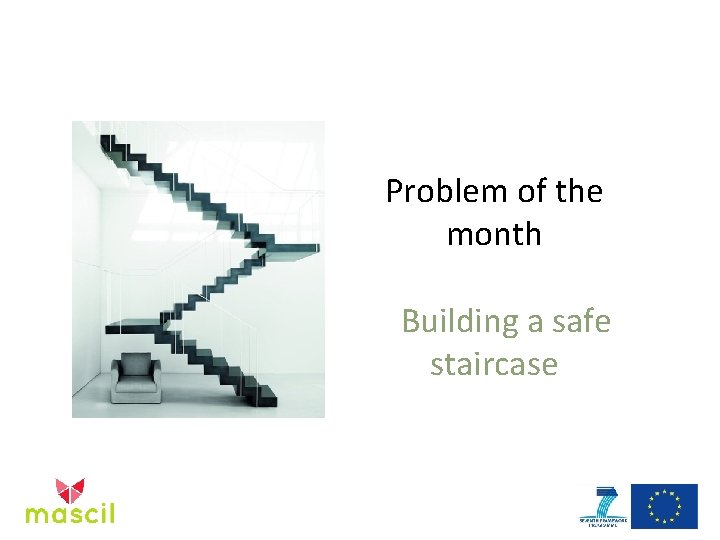
Problem of the month Building a safe staircase
Overview Aims: Ø To develop staircase designs to accepted workplace standards; Ø To critically compare designs and decisions with alternative approaches. We will: • Develop two staircase designs in small groups; • Explain and compare designs; • Explore alternative statements of requirements for staircases used in the workplace.
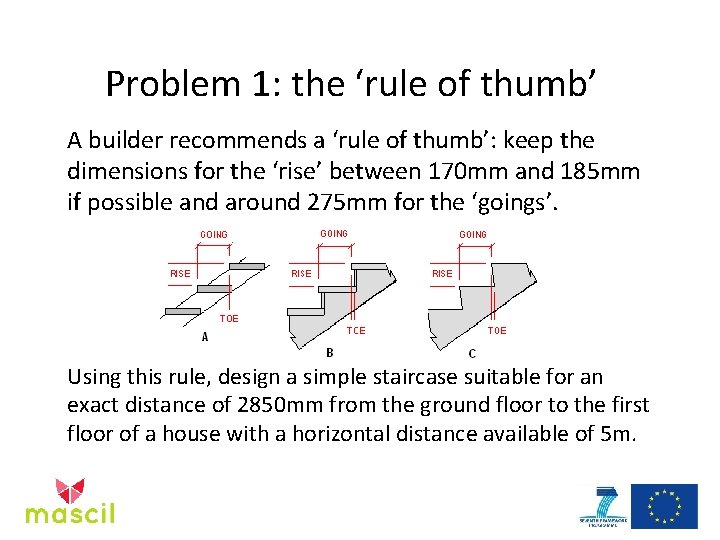
Problem 1: the ‘rule of thumb’ A builder recommends a ‘rule of thumb’: keep the dimensions for the ‘rise’ between 170 mm and 185 mm if possible and around 275 mm for the ‘goings’. Using this rule, design a simple staircase suitable for an exact distance of 2850 mm from the ground floor to the first floor of a house with a horizontal distance available of 5 m.
Problem 1: design decisions In your design you might consider: • How many goings and rises would you use? • What dimensions of goings and rises would you use and why? • What assumptions do you make? • What other factors might you need to consider in a real staircase design?

Problem 2: using landings When designing a staircase for a space where one continuous flight of stairs cannot be fitted you will have to consider how to place landings at the turns or design an alternative arrangement. The minimum landing space recommended is normally a square with sides equal in length to the width of the staircase.
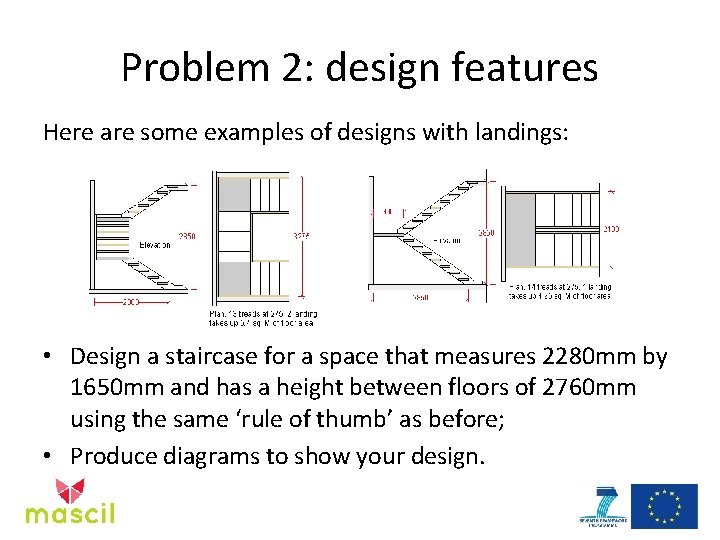
Problem 2: design features Here are some examples of designs with landings: • Design a staircase for a space that measures 2280 mm by 1650 mm and has a height between floors of 2760 mm using the same ‘rule of thumb’ as before; • Produce diagrams to show your design.
Problem 3 (extension) An alternative way of working is to use the actual building regulations rather than the ‘rule of thumb’ derived from them. In building regulations in the UK, for example, there are three key controls stated in the guidance. • Any rise between 155 mm and 220 mm can be used with any going 245 mm to 260 mm or any rise between 165 mm and 200 mm can be used with any going between 223 mm and 300 mm; • The maximum pitch of the staircase (vertical measurement divided by horizontal) must be 42 o; • 2 R + G must lie between 550 mm and 700 mm, where R is the dimension of the rise G of the going.
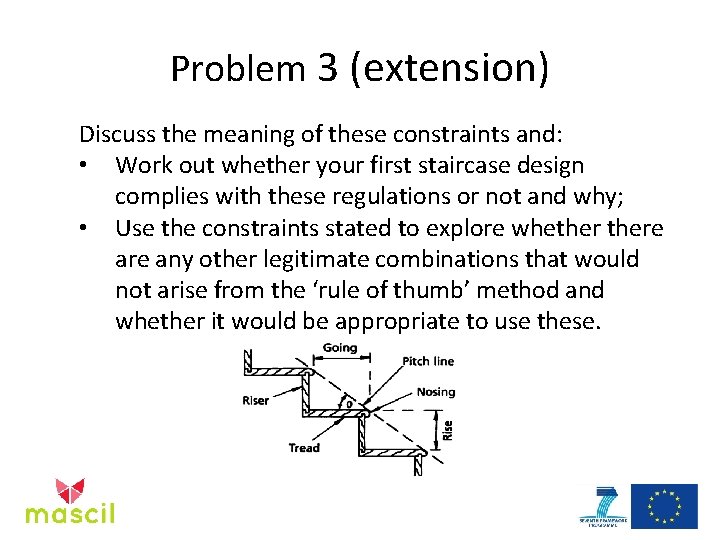
Problem 3 (extension) Discuss the meaning of these constraints and: • Work out whether your first staircase design complies with these regulations or not and why; • Use the constraints stated to explore whethere any other legitimate combinations that would not arise from the ‘rule of thumb’ method and whether it would be appropriate to use these.
Final questions Discuss the conclusions you have reached about different combinations of measurements: • Why or why not would you use these? • What are the relative merits of the ‘rule of thumb’ and the more detailed regulations?
- Slides: 9