
Problem INS Solving Multiplying and dividing by 10
Problem INS Solving Multiplying and dividing by 10, 1000 TRU What. Thnumber ese CTIONS pfrom roble FOR leve is missing ms a ls of USIN re di unde G TH r wh value this. Foplace f f r eren ESE ole c standi their t i a PRO ng in ted i lass chart? own BLE nto 3 your w prob s h l MS: o i le le clas l e lems des. C v els. s. A sson inde hang , to a pend prob dd fur Chang e the llow e th ther For e l s e n n t u m t u l d e nu y emb m l e s e a b n o v t e t l e s the e mbe ving rs in edd ls if stud t o s e rs to , n e nece prob entsnumber d pr c d l What e o o c p t the f the y pro lems suit ssar oble to se the p l y b m so esso A lect. r l o e is missing from a b m nd B lem the p s. Aa n. S lving t t h o uden nd B ey a n the , kee this place value roblem re re ts th onto p all slide they e a n cre prob dy to with are r chart? l a e all 3 s t ms o eady e the olve n the ir ow to so n pro s lve. ame blem slide. , allo w Henry drew a multiplicative place value chart. What number was he dividing by to get the value of the column 2 to the right? © 2020 A Learning Place A Teaching Place Relational Mathematics TPL 4 US
Problem Solving Multiplying and dividing by 10, 1000 What number is missing from this place value chart? Henry drew a multiplicative place value chart. What number was he dividing by to get the value of the column 2 to the right? © 2020 A Learning Place A Teaching Place Relational Mathematics TPL 4 US
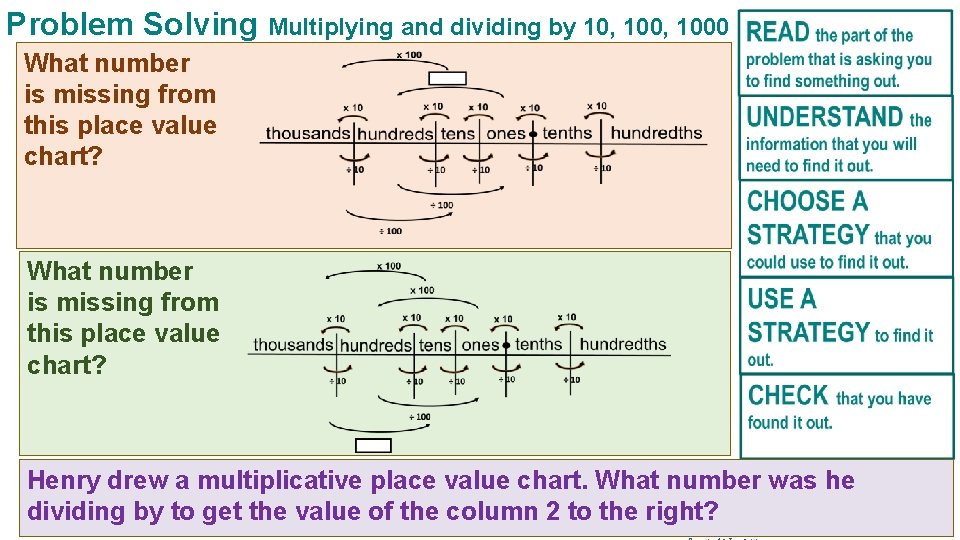
Problem Solving Multiplying and dividing by 10, 1000 What number is missing from this place value chart? Henry drew a multiplicative place value chart. What number was he dividing by to get the value of the column 2 to the right? © 2020 A Learning Place A Teaching Place Relational Mathematics TPL 4 US
Problem Solving Multiplying and dividing by 10, 1000 What number is missing from this place value chart? Henry drew a multiplicative place value chart. What number was he multiplying by to get the value of the column 3 to the left? © 2020 A Learning Place A Teaching Place Relational Mathematics TPL 4 US
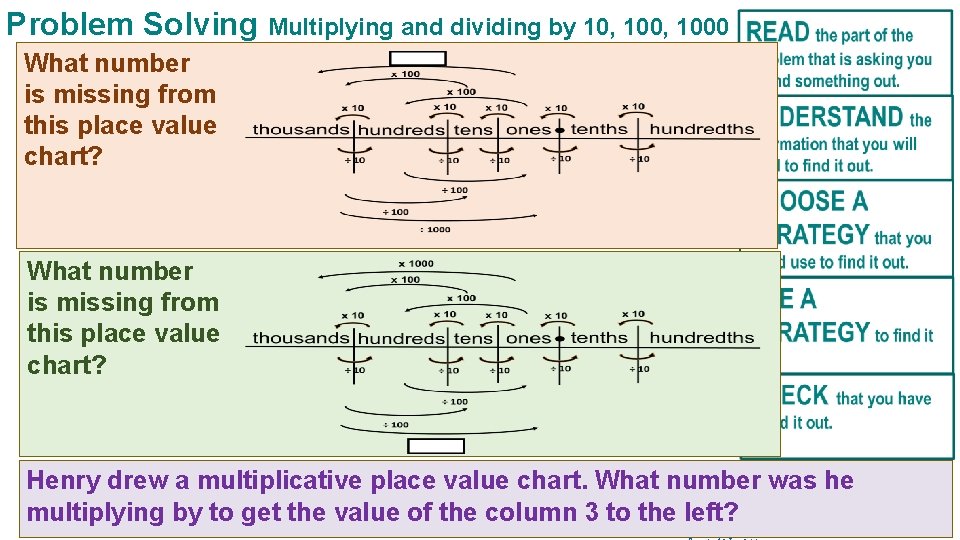
Problem Solving Multiplying and dividing by 10, 1000 What number is missing from this place value chart? Henry drew a multiplicative place value chart. What number was he multiplying by to get the value of the column 3 to the left? © 2020 A Learning Place A Teaching Place Relational Mathematics TPL 4 US
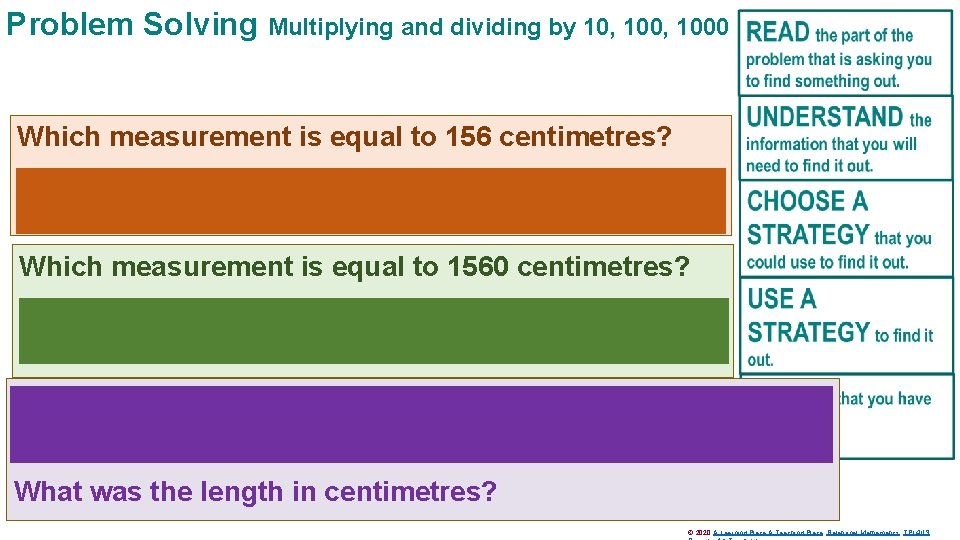
Problem Solving Multiplying and dividing by 10, 1000 Which measurement is equal to 156 centimetres? (a) 0. 156 metres (c) 15. 6 metres (b) 1. 56 metres (d) 156 metres Which measurement is equal to 1560 centimetres? (a) 0. 156 metres (c) 15. 6 metres (b) 1. 56 metres (d) 156 metres Mary measured a length of wood as a number of centimetres. She measured the same length of wood as 42. 65 metres. What was the length in centimetres? © 2020 A Learning Place A Teaching Place Relational Mathematics TPL 4 US
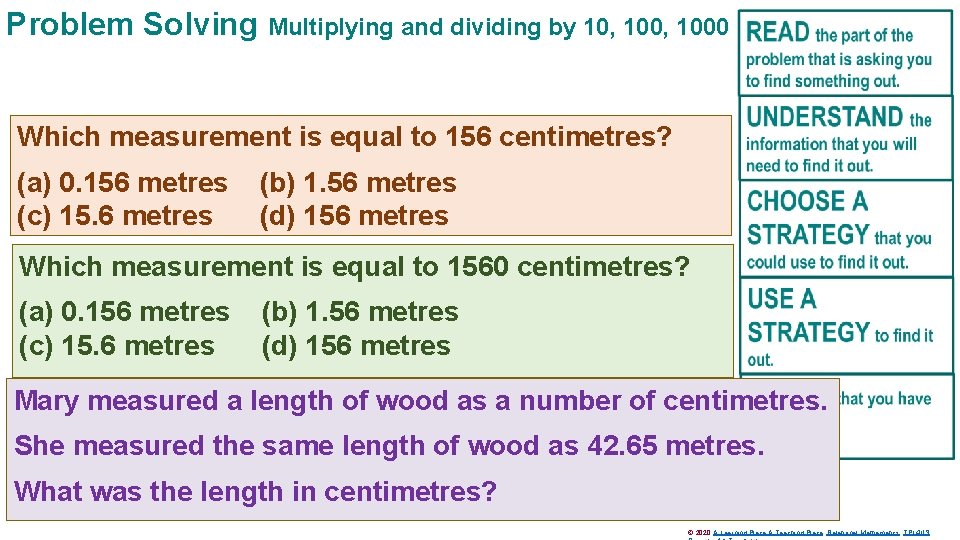
Problem Solving Multiplying and dividing by 10, 1000 Which measurement is equal to 156 centimetres? (a) 0. 156 metres (c) 15. 6 metres (b) 1. 56 metres (d) 156 metres Which measurement is equal to 1560 centimetres? (a) 0. 156 metres (c) 15. 6 metres (b) 1. 56 metres (d) 156 metres Mary measured a length of wood as a number of centimetres. She measured the same length of wood as 42. 65 metres. What was the length in centimetres? © 2020 A Learning Place A Teaching Place Relational Mathematics TPL 4 US
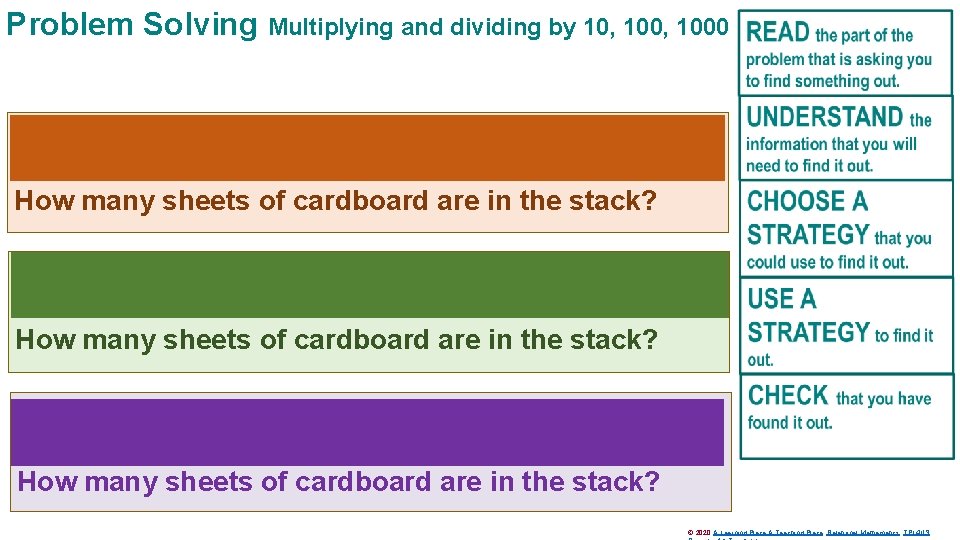
Problem Solving Multiplying and dividing by 10, 1000 A stack of cardboard sheets is 3 centimetres thick. Each sheet of cardboard is 0. 03 centimetres thick. How many sheets of cardboard are in the stack? A stack of cardboard sheets is 4 centimetres thick. Each sheet of cardboard is 0. 04 centimetres thick. How many sheets of cardboard are in the stack? A stack of cardboard sheets is 53 centimetre thick. Each sheet of cardboard is 0. 53 centimetres thick. How many sheets of cardboard are in the stack? © 2020 A Learning Place A Teaching Place Relational Mathematics TPL 4 US
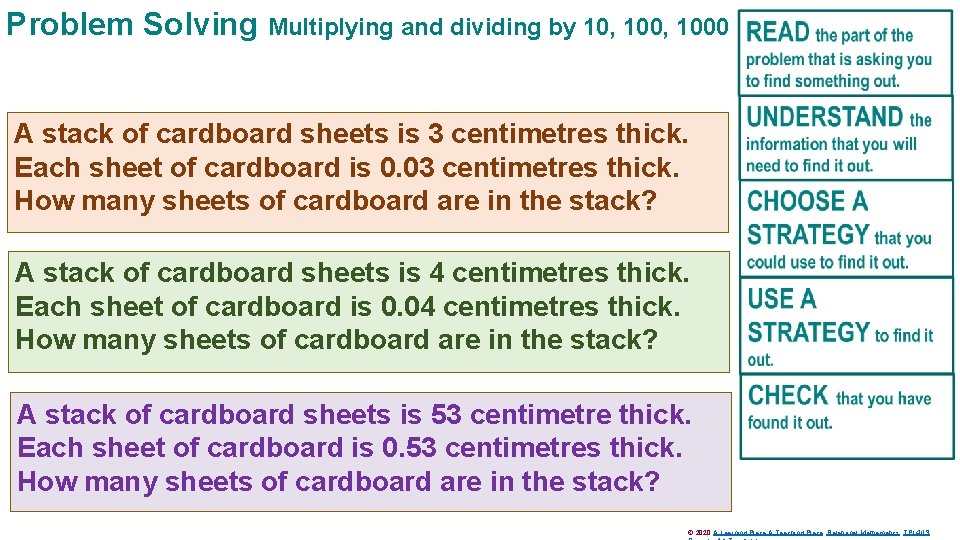
Problem Solving Multiplying and dividing by 10, 1000 A stack of cardboard sheets is 3 centimetres thick. Each sheet of cardboard is 0. 03 centimetres thick. How many sheets of cardboard are in the stack? A stack of cardboard sheets is 4 centimetres thick. Each sheet of cardboard is 0. 04 centimetres thick. How many sheets of cardboard are in the stack? A stack of cardboard sheets is 53 centimetre thick. Each sheet of cardboard is 0. 53 centimetres thick. How many sheets of cardboard are in the stack? © 2020 A Learning Place A Teaching Place Relational Mathematics TPL 4 US
Problem Solving Multiplying and dividing by 10, 1000 What is 6. 62 x 10? a) 6. 62 b) 66. 2 c) 662 d) 6620 What is 6. 62 x 100? a) 6. 62 b) 66. 2 c) 662 d) 6620 Max multiplied a number 100 and the product was 254. What number did Max multiply by 100? © 2020 A Learning Place A Teaching Place Relational Mathematics TPL 4 US
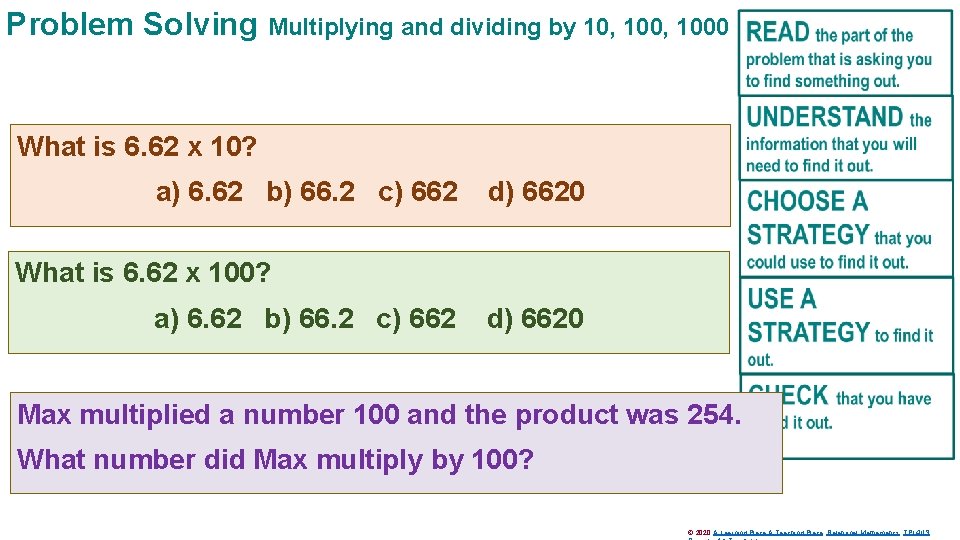
Problem Solving Multiplying and dividing by 10, 1000 What is 6. 62 x 10? a) 6. 62 b) 66. 2 c) 662 d) 6620 What is 6. 62 x 100? a) 6. 62 b) 66. 2 c) 662 d) 6620 Max multiplied a number 100 and the product was 254. What number did Max multiply by 100? © 2020 A Learning Place A Teaching Place Relational Mathematics TPL 4 US
Problem Solving Multiplying and dividing by 10, 1000 What is 5240 ÷ 10? a) 524 b) 52. 4 c) 5. 24 d) 0. 524 What is 5240 ÷ 100? a) 524 b) 52. 4 c) 5. 24 d) 0. 524 Max divided a number 100 and the quotient was 0. 25. What number did Max divide by 100? © 2020 A Learning Place A Teaching Place Relational Mathematics TPL 4 US
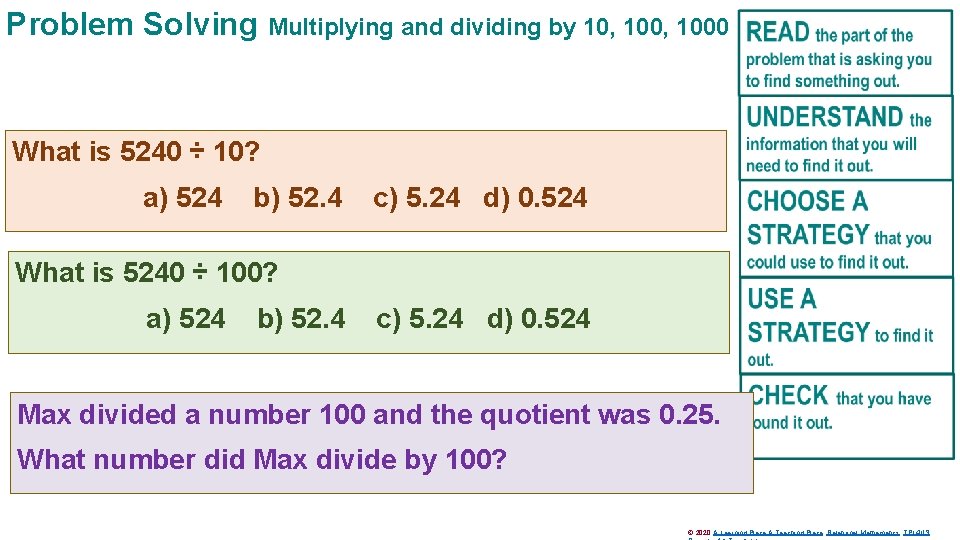
Problem Solving Multiplying and dividing by 10, 1000 What is 5240 ÷ 10? a) 524 b) 52. 4 c) 5. 24 d) 0. 524 What is 5240 ÷ 100? a) 524 b) 52. 4 c) 5. 24 d) 0. 524 Max divided a number 100 and the quotient was 0. 25. What number did Max divide by 100? © 2020 A Learning Place A Teaching Place Relational Mathematics TPL 4 US
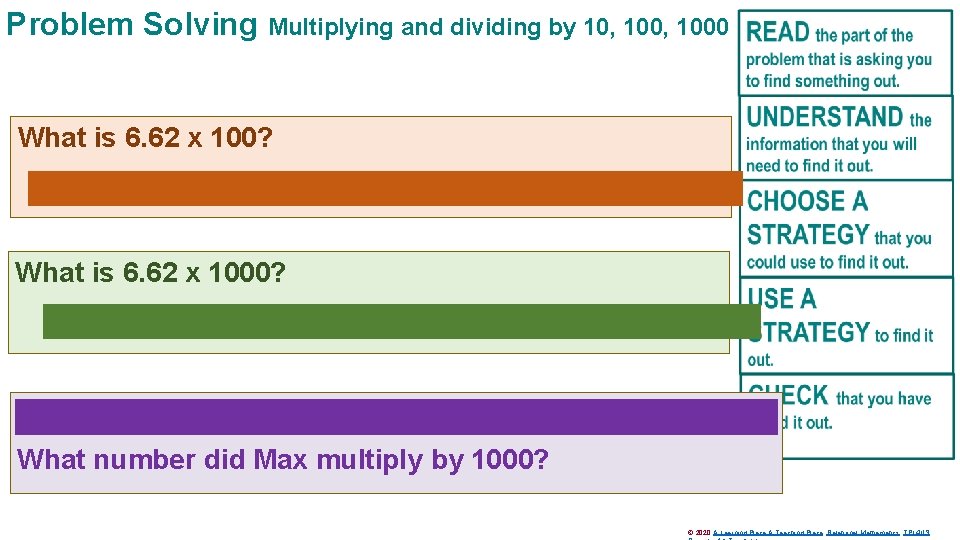
Problem Solving Multiplying and dividing by 10, 1000 What is 6. 62 x 100? a) 6. 62 b) 66. 2 c) 662 d) 6620 What is 6. 62 x 1000? a) 6. 62 b) 66. 2 c) 662 d) 6620 Max multiplied a number 1000 and the product was 250. What number did Max multiply by 1000? © 2020 A Learning Place A Teaching Place Relational Mathematics TPL 4 US
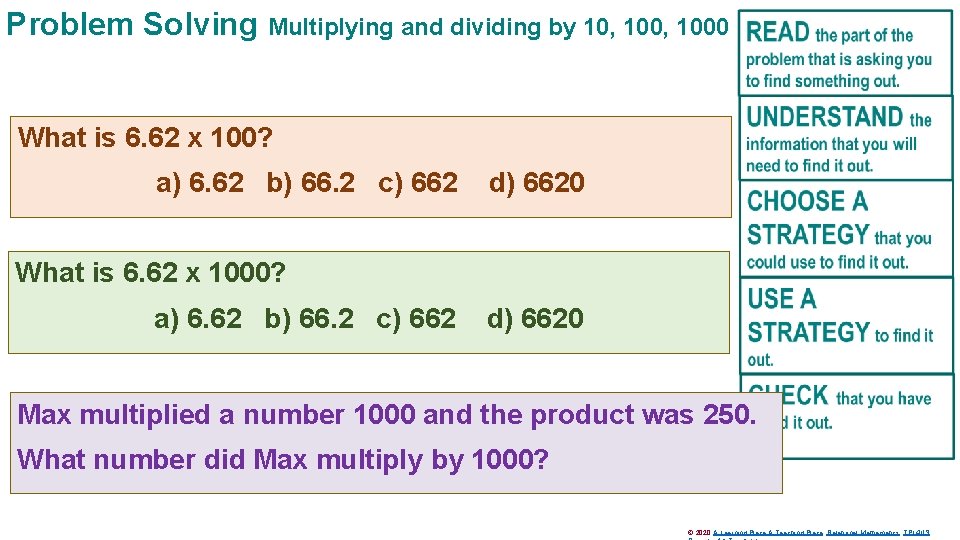
Problem Solving Multiplying and dividing by 10, 1000 What is 6. 62 x 100? a) 6. 62 b) 66. 2 c) 662 d) 6620 What is 6. 62 x 1000? a) 6. 62 b) 66. 2 c) 662 d) 6620 Max multiplied a number 1000 and the product was 250. What number did Max multiply by 1000? © 2020 A Learning Place A Teaching Place Relational Mathematics TPL 4 US
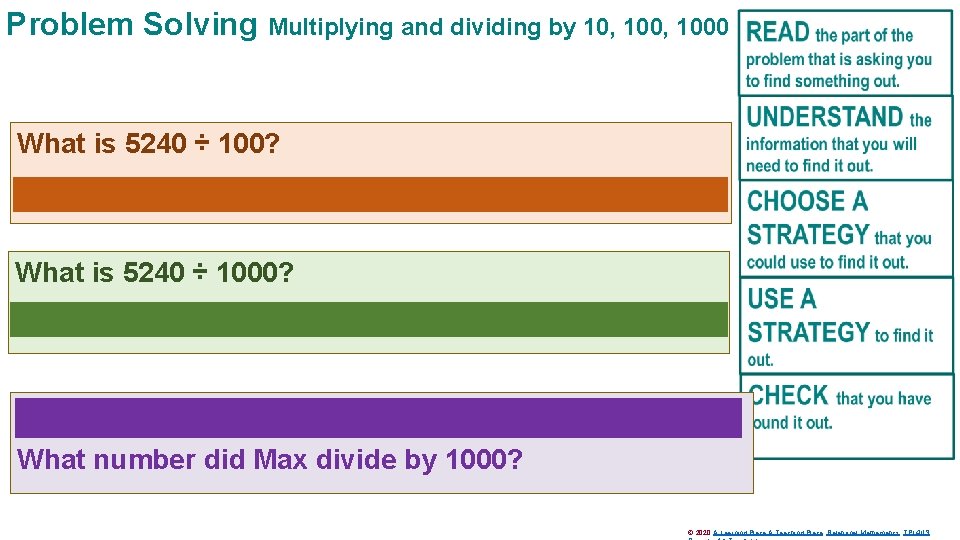
Problem Solving Multiplying and dividing by 10, 1000 What is 5240 ÷ 100? a) 524 b) 52. 4 c) 5. 24 d) 0. 524 What is 5240 ÷ 1000? a) 524 b) 52. 4 c) 5. 24 d) 0. 524 Max divided a number 1000 and the quotient was 0. 36. What number did Max divide by 1000? © 2020 A Learning Place A Teaching Place Relational Mathematics TPL 4 US
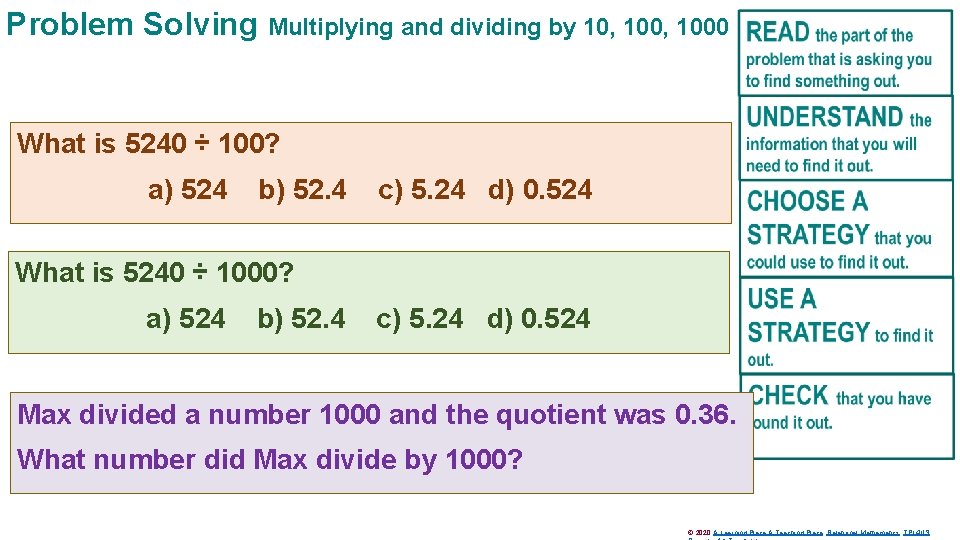
Problem Solving Multiplying and dividing by 10, 1000 What is 5240 ÷ 100? a) 524 b) 52. 4 c) 5. 24 d) 0. 524 What is 5240 ÷ 1000? a) 524 b) 52. 4 c) 5. 24 d) 0. 524 Max divided a number 1000 and the quotient was 0. 36. What number did Max divide by 1000? © 2020 A Learning Place A Teaching Place Relational Mathematics TPL 4 US
Problem Solving Multiplying and dividing by 10, 1000 A number multiplied by 100 equals 56. What is the number? A number multiplied by 1000 equals 560. What is the number? Jason thought of a number. He multiplied it by 10, then divided it by 100. The answer was 5. 6 What was the number Jason thought of? © 2020 A Learning Place A Teaching Place Relational Mathematics TPL 4 US
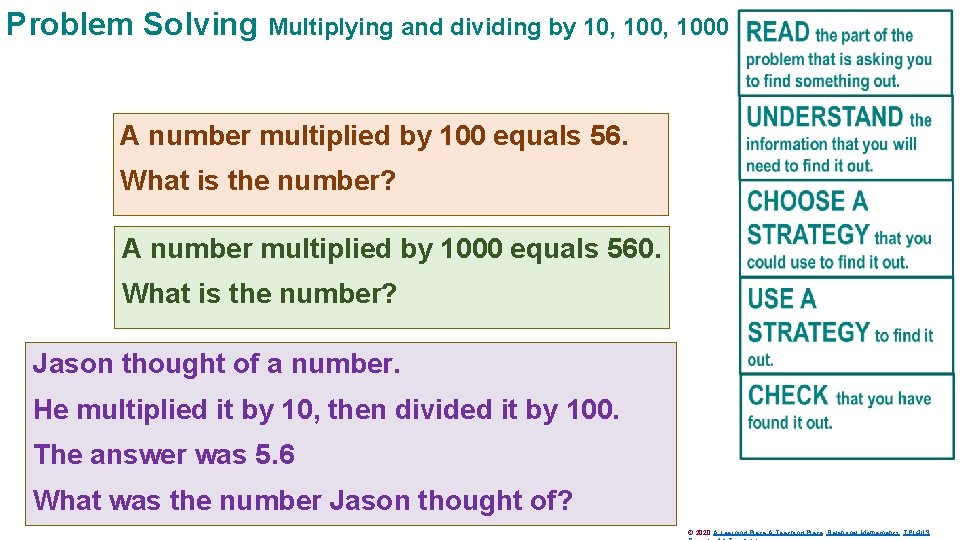
Problem Solving Multiplying and dividing by 10, 1000 A number multiplied by 100 equals 56. What is the number? A number multiplied by 1000 equals 560. What is the number? Jason thought of a number. He multiplied it by 10, then divided it by 100. The answer was 5. 6 What was the number Jason thought of? © 2020 A Learning Place A Teaching Place Relational Mathematics TPL 4 US
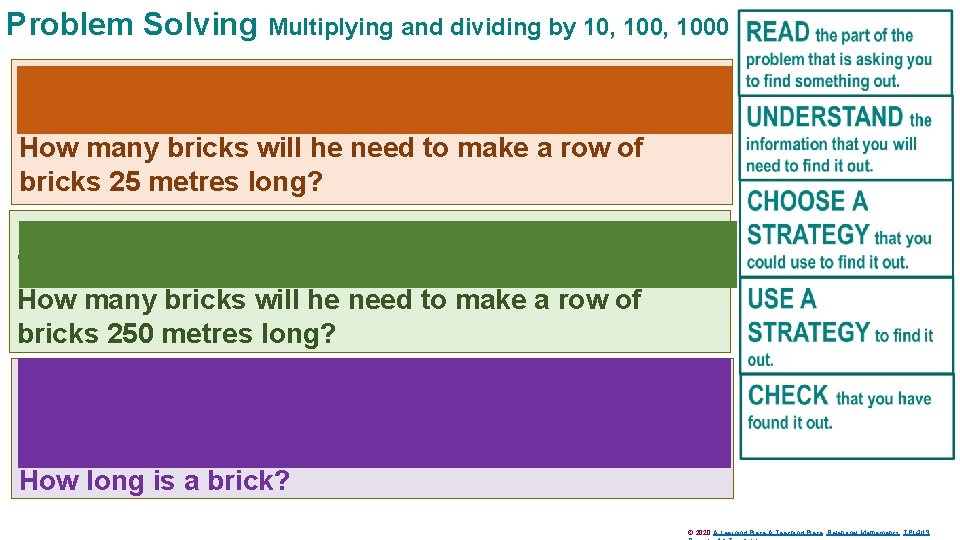
Problem Solving Multiplying and dividing by 10, 1000 Dan is building a brick wall. The length of a brick is 0. 25 metres. How many bricks will he need to make a row of bricks 25 metres long? Dan is building a brick wall. The length of a brick is 0. 25 metres. How many bricks will he need to make a row of bricks 250 metres long? Dan is building a brick wall. The wall is 32 metres long. He will need 100 bricks. How long is a brick? © 2020 A Learning Place A Teaching Place Relational Mathematics TPL 4 US
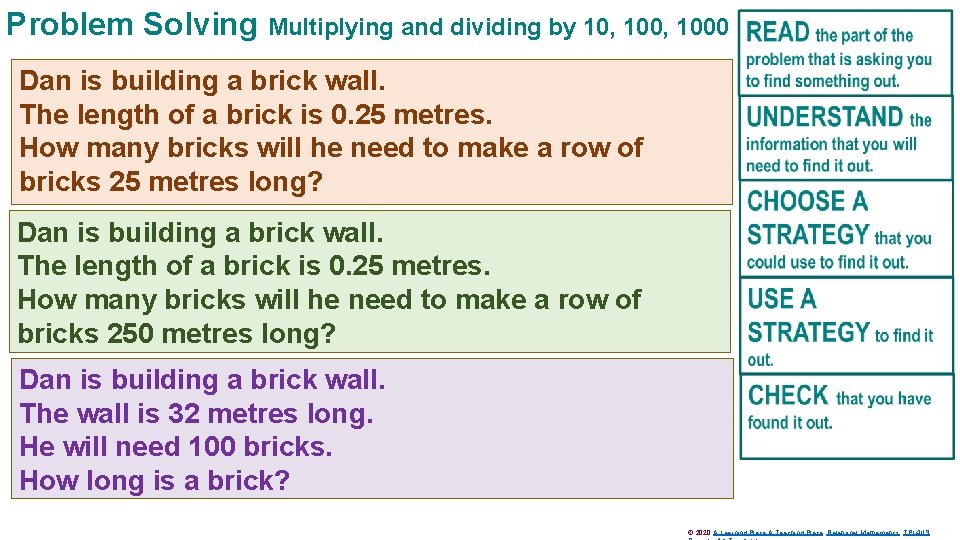
Problem Solving Multiplying and dividing by 10, 1000 Dan is building a brick wall. The length of a brick is 0. 25 metres. How many bricks will he need to make a row of bricks 25 metres long? Dan is building a brick wall. The length of a brick is 0. 25 metres. How many bricks will he need to make a row of bricks 250 metres long? Dan is building a brick wall. The wall is 32 metres long. He will need 100 bricks. How long is a brick? © 2020 A Learning Place A Teaching Place Relational Mathematics TPL 4 US
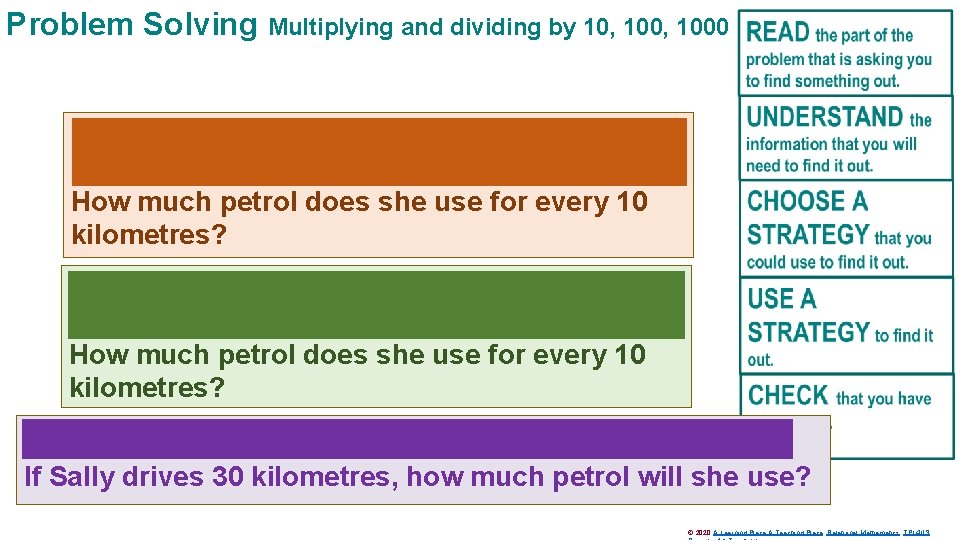
Problem Solving Multiplying and dividing by 10, 1000 Sally used 4. 9 litres of petrol for every 100 kilometres she drove. How much petrol does she use for every 10 kilometres? Sally used 6. 4 litres of petrol for every 100 kilometres she drove. How much petrol does she use for every 10 kilometres? Sally drove 300 kilometres and used 24. 6 litres of petrol. If Sally drives 30 kilometres, how much petrol will she use? © 2020 A Learning Place A Teaching Place Relational Mathematics TPL 4 US
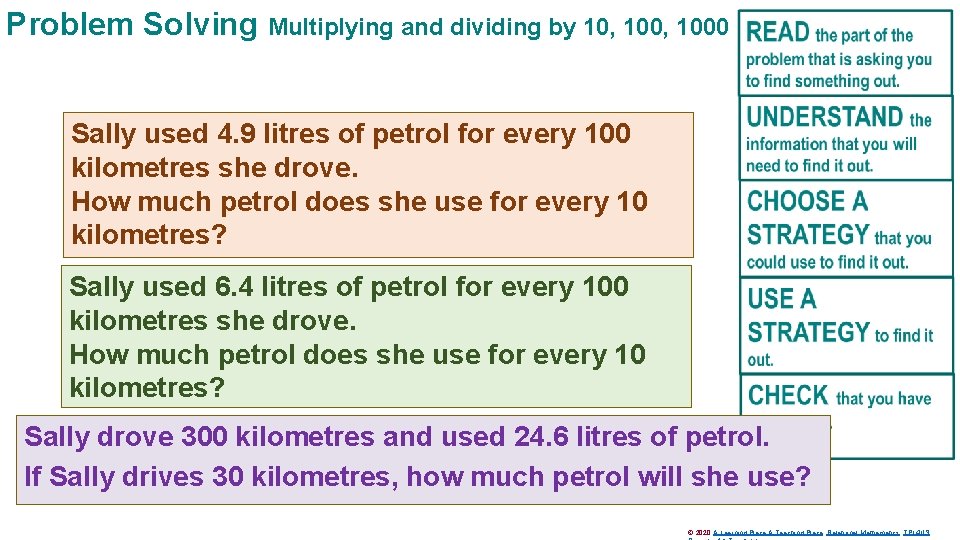
Problem Solving Multiplying and dividing by 10, 1000 Sally used 4. 9 litres of petrol for every 100 kilometres she drove. How much petrol does she use for every 10 kilometres? Sally used 6. 4 litres of petrol for every 100 kilometres she drove. How much petrol does she use for every 10 kilometres? Sally drove 300 kilometres and used 24. 6 litres of petrol. If Sally drives 30 kilometres, how much petrol will she use? © 2020 A Learning Place A Teaching Place Relational Mathematics TPL 4 US
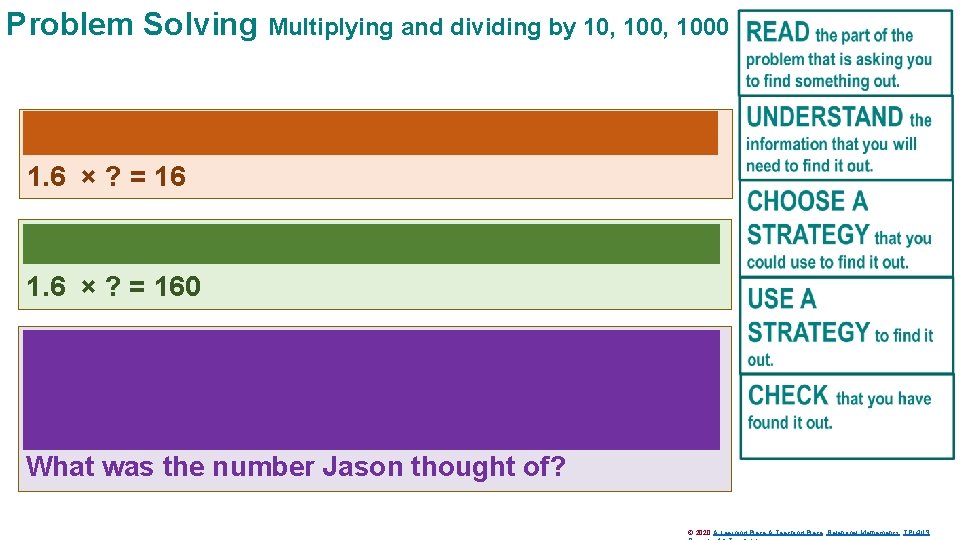
Problem Solving Multiplying and dividing by 10, 1000 What number makes this number sentence correct? 1. 6 × ? = 160 Jason thought of a number. He multiplied it by 1000, then divided it by 100. The answer was 5. 6 What was the number Jason thought of? © 2020 A Learning Place A Teaching Place Relational Mathematics TPL 4 US
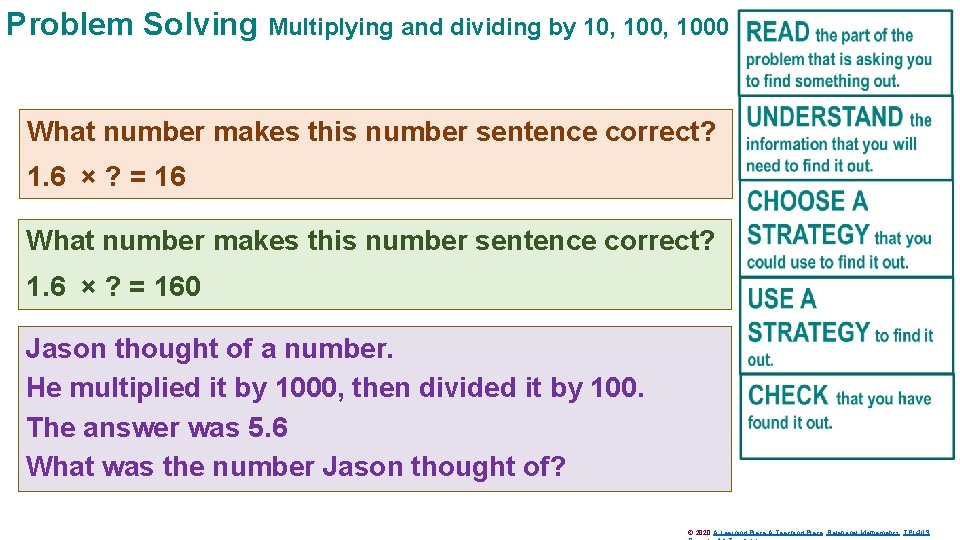
Problem Solving Multiplying and dividing by 10, 1000 What number makes this number sentence correct? 1. 6 × ? = 160 Jason thought of a number. He multiplied it by 1000, then divided it by 100. The answer was 5. 6 What was the number Jason thought of? © 2020 A Learning Place A Teaching Place Relational Mathematics TPL 4 US
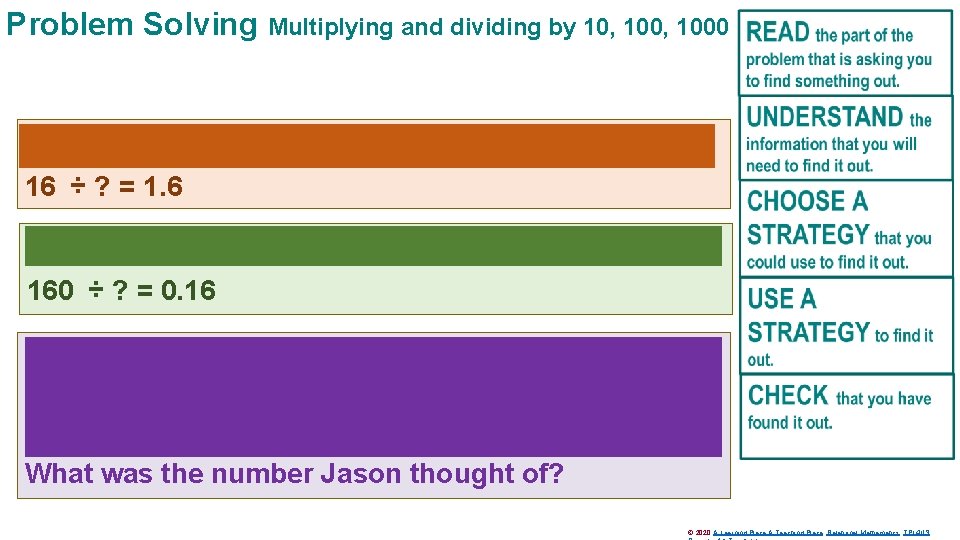
Problem Solving Multiplying and dividing by 10, 1000 What number makes this number sentence correct? 16 ÷ ? = 1. 6 What number makes this number sentence correct? 160 ÷ ? = 0. 16 Jason thought of a number. He divided it by 1000, then multiplied it by 100. The answer was 5. 6 What was the number Jason thought of? © 2020 A Learning Place A Teaching Place Relational Mathematics TPL 4 US
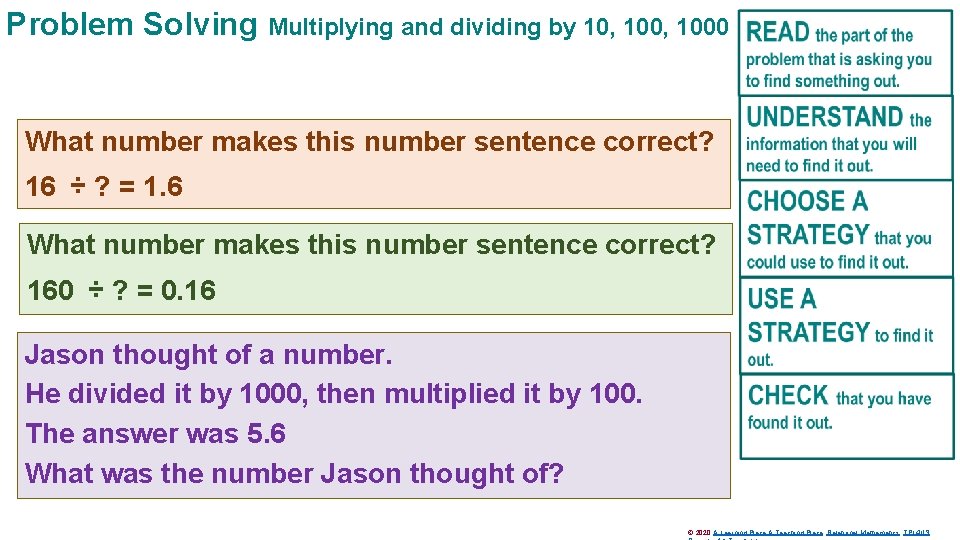
Problem Solving Multiplying and dividing by 10, 1000 What number makes this number sentence correct? 16 ÷ ? = 1. 6 What number makes this number sentence correct? 160 ÷ ? = 0. 16 Jason thought of a number. He divided it by 1000, then multiplied it by 100. The answer was 5. 6 What was the number Jason thought of? © 2020 A Learning Place A Teaching Place Relational Mathematics TPL 4 US
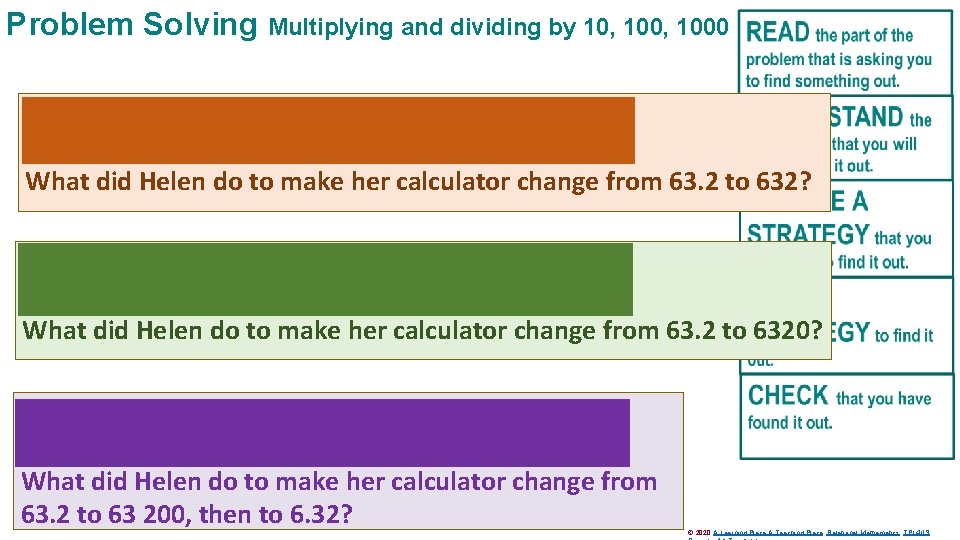
Problem Solving Multiplying and dividing by 10, 1000 Helen’s calculator showed 63. 2. Then it showed 632. What did Helen do to make her calculator change from 63. 2 to 632? Helen’s calculator showed 63. 2. Then it showed 6320. What did Helen do to make her calculator change from 63. 2 to 6320? Helen’s calculator showed 63. 2. Then it showed 63 200. then it showed 6. 32 What did Helen do to make her calculator change from 63. 2 to 63 200, then to 6. 32? © 2020 A Learning Place A Teaching Place Relational Mathematics TPL 4 US
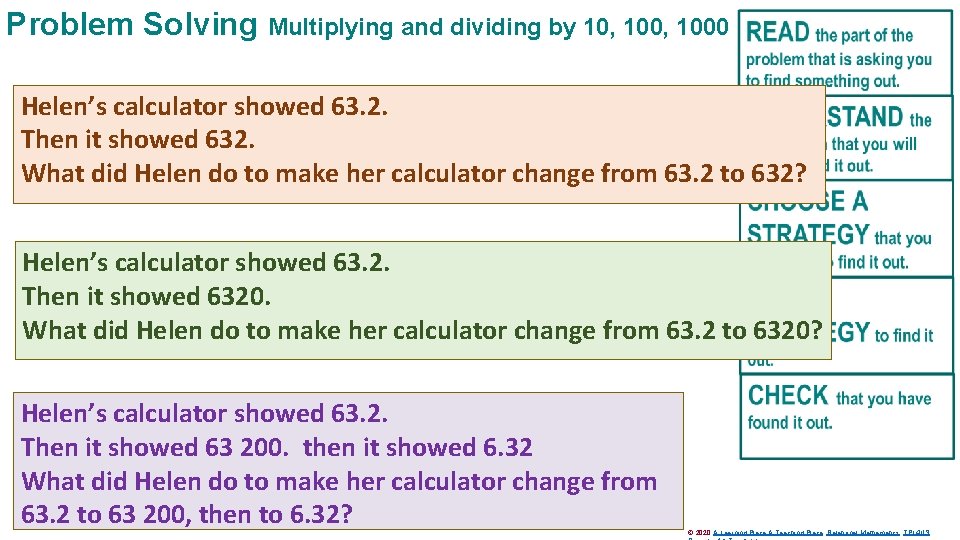
Problem Solving Multiplying and dividing by 10, 1000 Helen’s calculator showed 63. 2. Then it showed 632. What did Helen do to make her calculator change from 63. 2 to 632? Helen’s calculator showed 63. 2. Then it showed 6320. What did Helen do to make her calculator change from 63. 2 to 6320? Helen’s calculator showed 63. 2. Then it showed 63 200. then it showed 6. 32 What did Helen do to make her calculator change from 63. 2 to 63 200, then to 6. 32? © 2020 A Learning Place A Teaching Place Relational Mathematics TPL 4 US
© 2020 A Learning Place A Teaching Place Relational Mathematics TPL 4 US Resourceful Teaching
© 2020 A Learning Place A Teaching Place Relational Mathematics TPL 4 US Resourceful Teaching
© 2020 A Learning Place A Teaching Place Relational Mathematics TPL 4 US Resourceful Teaching
© 2020 A Learning Place A Teaching Place Relational Mathematics TPL 4 US Resourceful Teaching
© 2020 A Learning Place A Teaching Place Relational Mathematics TPL 4 US Resourceful Teaching
- Slides: 34