
PROBLEM FORMULATION Defining a Researchable Problem Research Methods
PROBLEM FORMULATION Defining a Researchable Problem Research Methods College of Public and Community Service University of Massachusetts at Boston © 2011 William Holmes 1
PROBLEM FORMULATION: SOURCES OF IDEAS Ø News Stories Ø Personal Experiences Ø Review of Research • Electronic Databases • Library Indexes • Web pages • Internet Libraries – NCJRS, NLM… Ø Authorities • Opinion Leaders • Funding Sources 2
PROBLEM FORMULATION: FOCUSING (DEFINING) THE PROBLEM • Ways of Defining Problem – Formal (nominal), defining with words – Example (epistemic), defining by example – Procedural (operational), defining a method to recognize examples 3
SOURCES OF DEFINITIONS: 1 • Articles in Professional Journals • Electronic Abstracts and Indexes • Web Searches • Books, Monographs, Government Reports 4
SOURCES OF DEFINITIONS: 2 • • • Professional Standards Legislation Regulations Journalistic Sources Advocacy Groups 5
WHAT MAKES A GOOD RESEARCH QUESTION? 1 • • Focused Empirical Clear Based on prior research or theory 6
WHAT MAKES A GOOD RESEARCH QUESTION? 2 • Important to answer • Does not use “should” • Has intuitive appeal 7
PROBLEM FORMULATION: TYPES OF RESEARCH QUESTIONS • • • Exploratory Descriptive Explanatory Predictive Evaluative 8
EXPLORATORY QUESTIONS • • Clarifying Questions Clarifying Populations Clarifying Ideas Open-ended 9
DESCRIPTIVE QUESTIONS • Obtaining specific facts • Obtaining facts to describe issue • Summarizing population characteristics • Examining non-causal relationships 10
EXPLANATORY QUESTIONS: 1 • Examines causal relationships • Tests causal hypotheses • Explains relationships • Builds theories 11
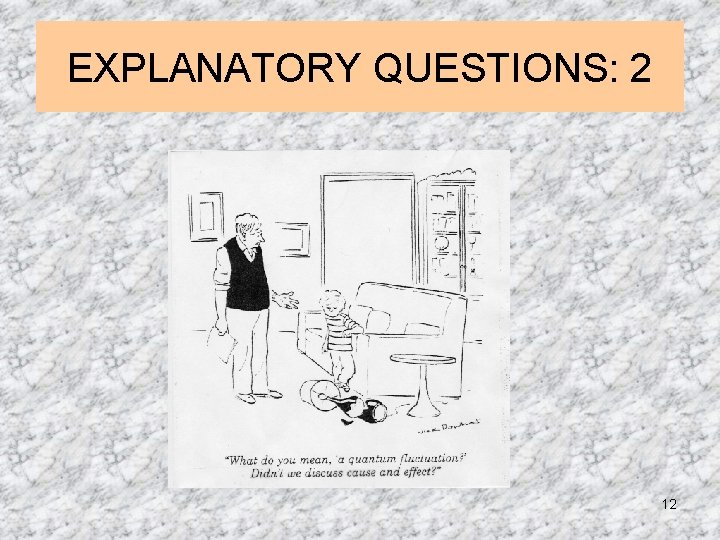
EXPLANATORY QUESTIONS: 2 12
PREDICTION • Predicts events • Predicts characteristics • Uses Theory and Description • Develops predictive equations 13
MIXED QUESTIONS • Triangulation • Multi-measures • Multi-methods 14
- Slides: 14