
Problem Definition and the Research Process Chapter Two
Problem Definition and the Research Process Chapter Two Copyright © 2006 John Wiley & Sons, Inc.
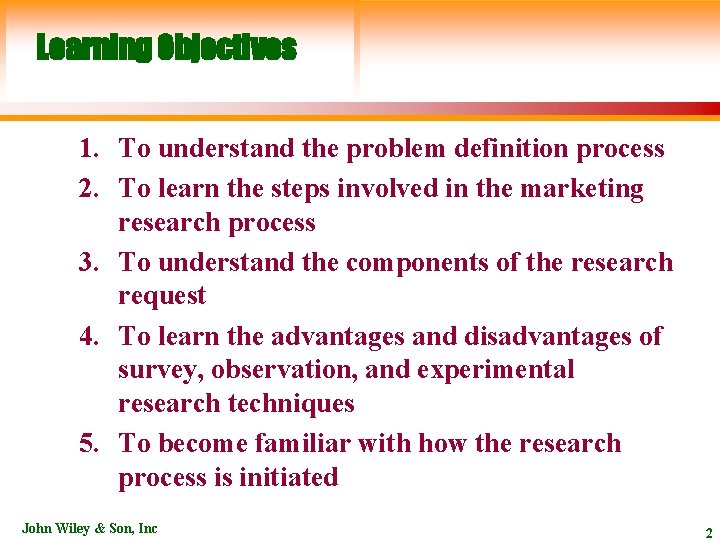
Learning Objectives 1. To understand the problem definition process 2. To learn the steps involved in the marketing research process 3. To understand the components of the research request 4. To learn the advantages and disadvantages of survey, observation, and experimental research techniques 5. To become familiar with how the research process is initiated John Wiley & Son, Inc 2

Exhibit 2. 1 Problem Definition Process Recognize the problem or opportunity Found why the information is being sought: Understand the decision-making environment Use the symptoms to help clarify the problem Translate the management problem into a marketing research problem Determine whether the information already exists Determine whether the question really can be answered State the research objectives John Wiley & Son, Inc 3
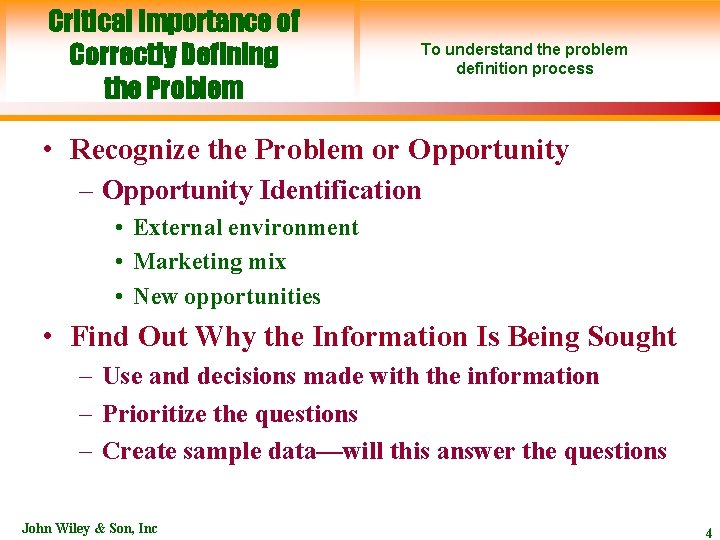
Critical Importance of Correctly Defining the Problem To understand the problem definition process • Recognize the Problem or Opportunity – Opportunity Identification • External environment • Marketing mix • New opportunities • Find Out Why the Information Is Being Sought – Use and decisions made with the information – Prioritize the questions – Create sample data—will this answer the questions John Wiley & Son, Inc 4
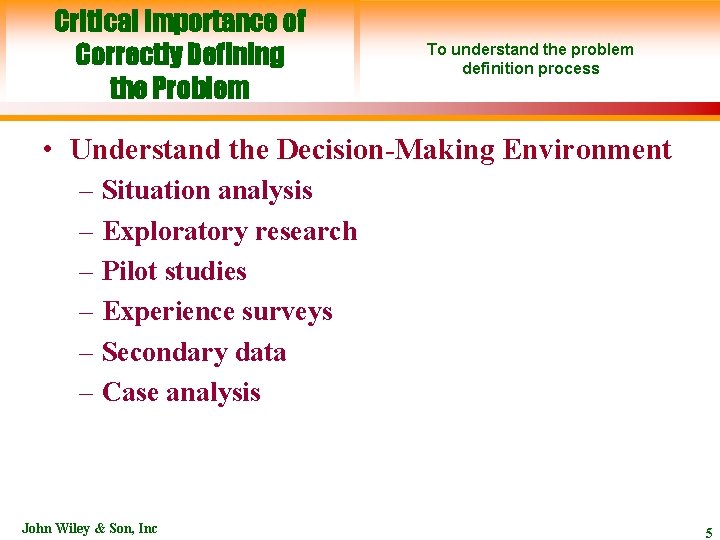
Critical Importance of Correctly Defining the Problem To understand the problem definition process • Understand the Decision-Making Environment – Situation analysis – Exploratory research – Pilot studies – Experience surveys – Secondary data – Case analysis John Wiley & Son, Inc 5
Critical Importance of Correctly Defining the Problem To understand the problem definition process • Use the Symptoms to Clarify the Problem – Symptom • Iceberg principle – “What caused this to occur? ” • Translate the Management Problem Into a Marketing Research Problem – Marketing research problem – Marketing research objective – Management decision problem John Wiley & Son, Inc 6
Critical Importance of Correctly Defining the Problem To understand the problem definition process • Determine Whether the Information Already Exist – Can save time and money • Determine Whether the Question Can Be Answered – Identify the following: • You know the information exists or can be obtained • Based on similar prior experience the information can be gathered • Trying this is new and there is a risk of drawing a blank John Wiley & Son, Inc 7
Critical Importance of Correctly Defining the Problem To learn the steps involved in the marketing research process • State the Research Objectives • Stated in terms of precise information necessary to address the problem/opportunity • Road map – Avoid the Nice-to-Know Syndrome – Management Decisions and Research Objectives • Would be a restatement, in research terms, of what management needs to know to make a decision John Wiley & Son, Inc 8
Critical Importance of Correctly Defining the Problem To understand the problem definition process – Research objectives as Hypotheses • Hypothesis—statement about a relationship between or or more variables that can be tested with empirical data • Should contain clear implications for testing stated relationships • Development of the research hypothesis sets the stage for creating the research design John Wiley & Son, Inc 9
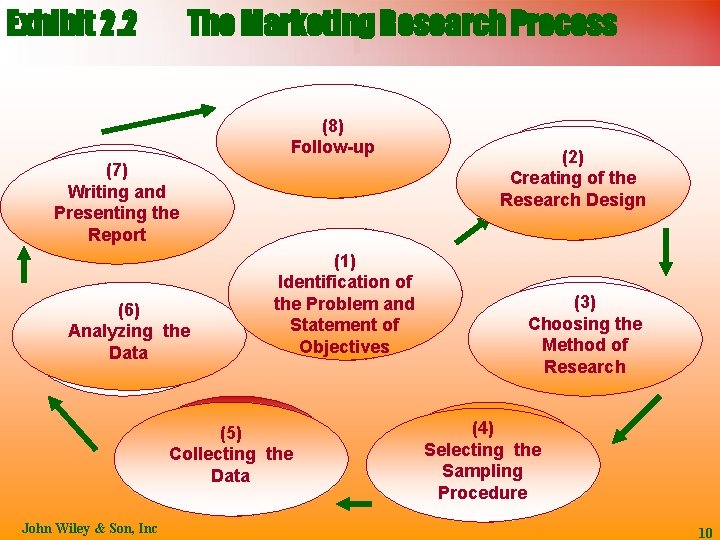
Exhibit 2. 2 The Marketing Research Process (8) Follow-up (7) Writing and Presenting the Report (6) Analyzing the Data (1) Identification of the Problem and Statement of Objectives (5) Collecting the Data John Wiley & Son, Inc (2) Creating of the Research Design (3) Choosing the Method of Research (4) Selecting the Sampling Procedure 10
The Marketing Research Process To learn the steps involved in the marketing research process. • Creating the Research Design – Research design • The plan to be followed to answer the research objectives or hypothesis – Descriptive studies • Who, what, when, where, and how • Variable- a symbol or concept that can assume any one of a set of values • Can shed light on associations or relationships John Wiley & Son, Inc 11
The Marketing Research Process To learn the steps involved in the marketing research process. – Causal Studies • Investigate whether one variable causes or determines the value of another – Dependent variable—to be predicted or explained – Independent variable—the variable that affects or causes the dependent variable—can be manipulated, changed or altered – Temporal sequence—effect follows closely the hypothesized cause—an appropriate causal order of events – Concomitant variation—the degree to which a presumed cause and a presumed effect occur together or vary together John Wiley & Son, Inc 12
The Marketing Research Process To learn the advantages and disadvantages of survey, observation, and experimental research • Choosing a Basic Method of Research – Survey: an interviewer and questionnaire – Observation: to monitor respondents’ actions without direct interaction – Experiments: to measure causality • Selecting a Sampling Procedure – Probability sample – Nonprobability sample John Wiley & Son, Inc 13
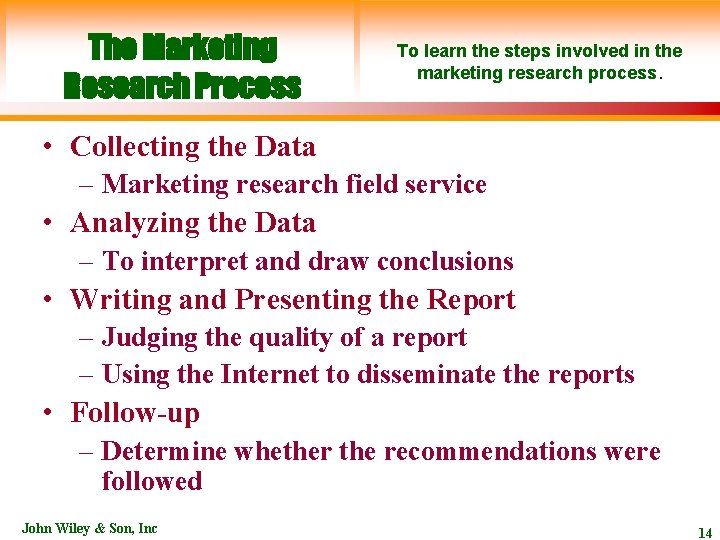
The Marketing Research Process To learn the steps involved in the marketing research process. • Collecting the Data – Marketing research field service • Analyzing the Data – To interpret and draw conclusions • Writing and Presenting the Report – Judging the quality of a report – Using the Internet to disseminate the reports • Follow-up – Determine whether the recommendations were followed John Wiley & Son, Inc 14
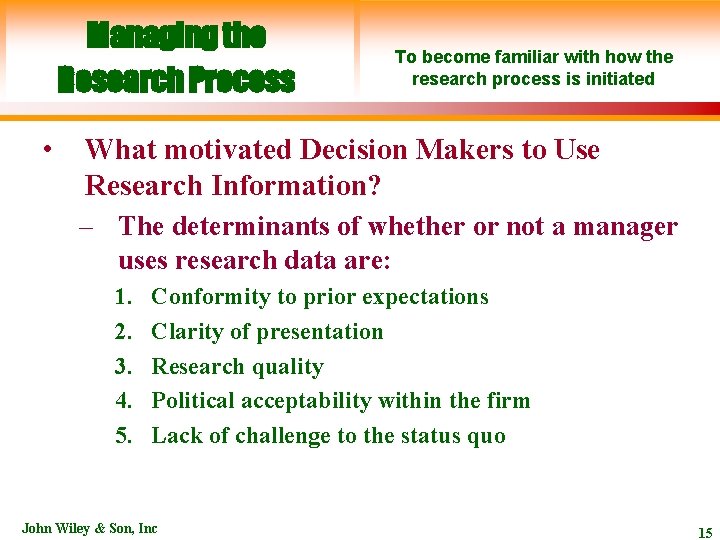
Managing the Research Process • To become familiar with how the research process is initiated What motivated Decision Makers to Use Research Information? – The determinants of whether or not a manager uses research data are: 1. 2. 3. 4. 5. Conformity to prior expectations Clarity of presentation Research quality Political acceptability within the firm Lack of challenge to the status quo John Wiley & Son, Inc 15
SUMMARY – Critical Importance of Correctly Defining the Problem – Marketing Research Process – Managing the Research Process John Wiley & Son, Inc 16
The End Copyright © 2006 John Wiley & Sons, Inc. John Wiley & Son, Inc 17
- Slides: 17