
PROBLEM BEHAVIORS WHY THEY EXIST HOW TO TREAT
PROBLEM BEHAVIORS: WHY THEY EXIST & HOW TO TREAT THEM KCART Conference October 14, 2010 Presented By: Jennifer Potterfield M. A. , BCBA Kansas City Behavior Analysts www. kcbehavioranalysts. com
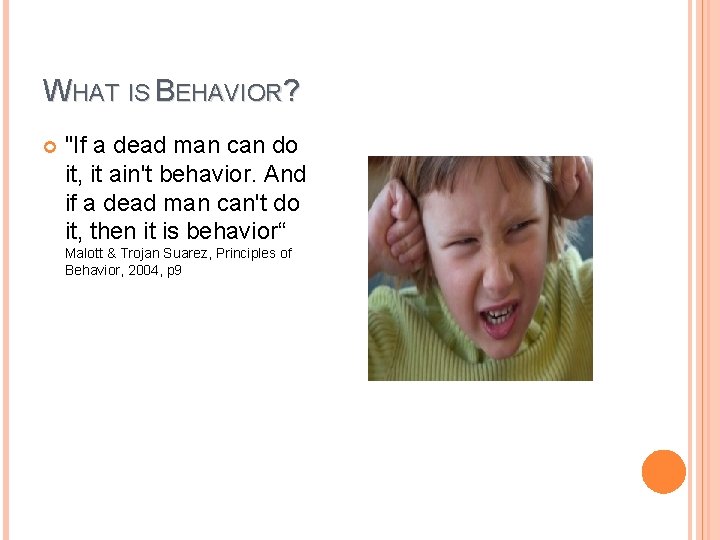
WHAT IS BEHAVIOR? "If a dead man can do it, it ain't behavior. And if a dead man can't do it, then it is behavior“ Malott & Trojan Suarez, Principles of Behavior, 2004, p 9
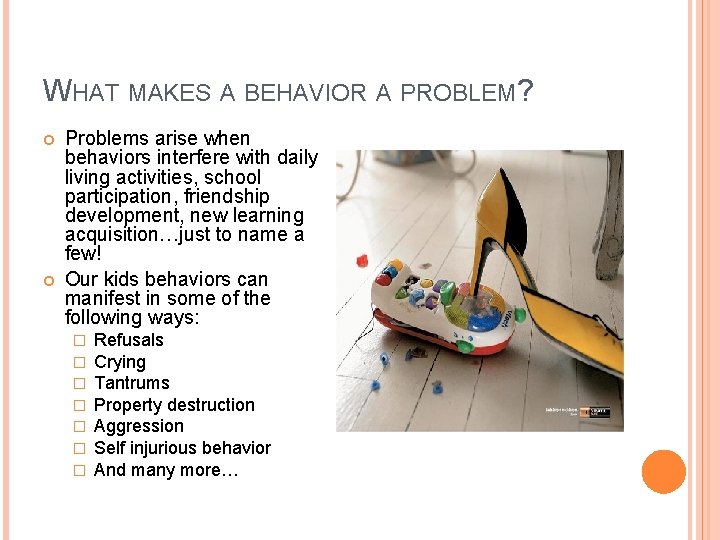
WHAT MAKES A BEHAVIOR A PROBLEM? Problems arise when behaviors interfere with daily living activities, school participation, friendship development, new learning acquisition…just to name a few! Our kids behaviors can manifest in some of the following ways: � � � � Refusals Crying Tantrums Property destruction Aggression Self injurious behavior And many more…
SO WE KNOW THERE’S A PROBLEM…WHAT NOW? There a couple of different tools that can help us identify the function or the “why” to a behavior. � Functional Behavior Assessment Includes direct & indirect methods including: observation, review of all relevant data collection, interviews and questionnaires Mandated by IDEA � Functional Analysis Developed by Dr. Brian Iwata, this procedure manipulates variables under various conditions and allows or sets the stage for the behavior to occur repeatedly under various conditions and contingencies. Because of the variable manipulation within function, a Functional Analysis yields a much higher % of accuracy in determining the function of a behavior over the FBA, but may pose some risk to the student. Only a trained professional should conduct a FA, after FBA results have failed to yield a consistent function.
SO WHAT IS A FUNCTIONAL BEHAVIOR ASSESSMENT? It is a comprehensive and individualized strategy to identify the purpose or function of a problem behavior. From this information, it is then possible to develop an effective plan to implement to modify the variables contributing to the problem behavior.
AND…WHAT’S A FUNCTION? To understand what a function of a child’s behavior is, we must reflect on our own. When we make effort to resolve conflicts, show anxiety, gain access to peer groups, maintain relationships, escape embarrassment and make others happy, these are all “normal” behaviors. But, we must recognize sometimes where we or others have sought these outcomes by inappropriate means. The core of FBA is changing the focus from the behavior, to the function he is trying to attain by engaging in that behavior. All behavior serves a purpose! There are 4 possible functions or “whys” to any behavior. When looking at the functions, certain behaviors may have only 1 function, or can be tricky and a single behavior can have a variety of different functions that will be set off under different circumstances.
THE 4 FUNCTIONS Access to Attention � Child Access to Escape � “time to clean up” and child runs away Access to Self Stimulation � Child screams when laying in bed to go to sleep flaps his hands Access to a Tangible � Child hits his teacher because he wants the toy she has
OBSTACLES TO FBA…FREQUENTLY NOTED Definition of behavior(s) is too vague. Data collection is inconsistent during observation phase and/or intervention phase. Data is not interpreted correctly. Intervention does not align with the function of behavior. Inconsistently in plan implementation. Lack of monitoring and analysis of intervention plan data. Failure to adjust the intervention plan over time. Lack of training by those who implement the intervention plan.
WITH THAT IN MIND, LET’S GET STARTED Define the problem behavior Layout the plan to collect data Compare and analyze the data Formulate a hypothesis Develop and implement a behavior plan Monitor the results
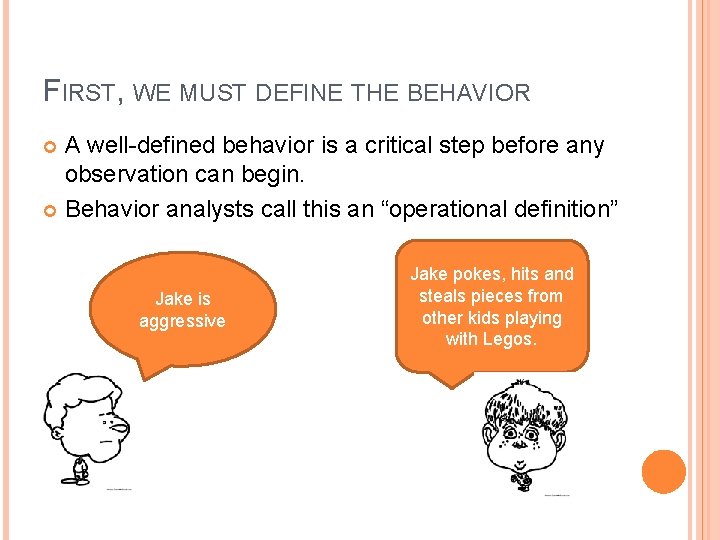
FIRST, WE MUST DEFINE THE BEHAVIOR A well-defined behavior is a critical step before any observation can begin. Behavior analysts call this an “operational definition” Jake is aggressive Jake pokes, hits and steals pieces from other kids playing with Legos.
OPERATIONAL DEFINITIONS… Must be observable & measurable in terms of the behavior you see. �Easily observed �Countable �Clear beginning & end
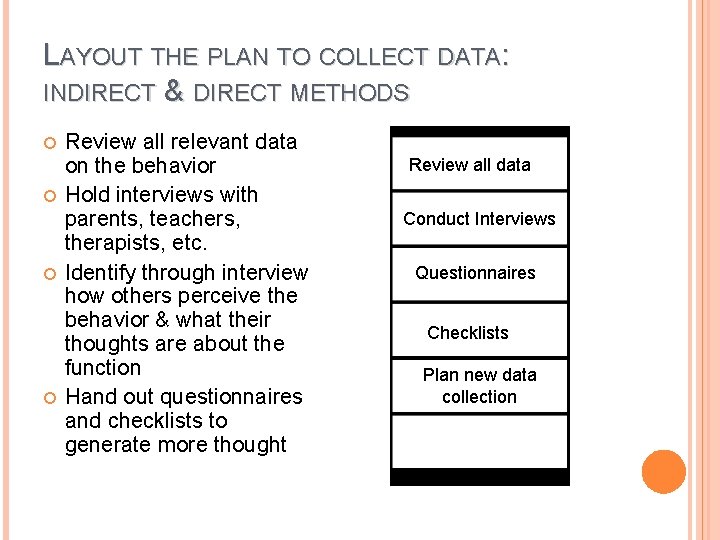
LAYOUT THE PLAN TO COLLECT DATA: INDIRECT & DIRECT METHODS Review all relevant data on the behavior Hold interviews with parents, teachers, therapists, etc. Identify through interview how others perceive the behavior & what their thoughts are about the function Hand out questionnaires and checklists to generate more thought Review all data Conduct Interviews Questionnaires Checklists Plan new data collection
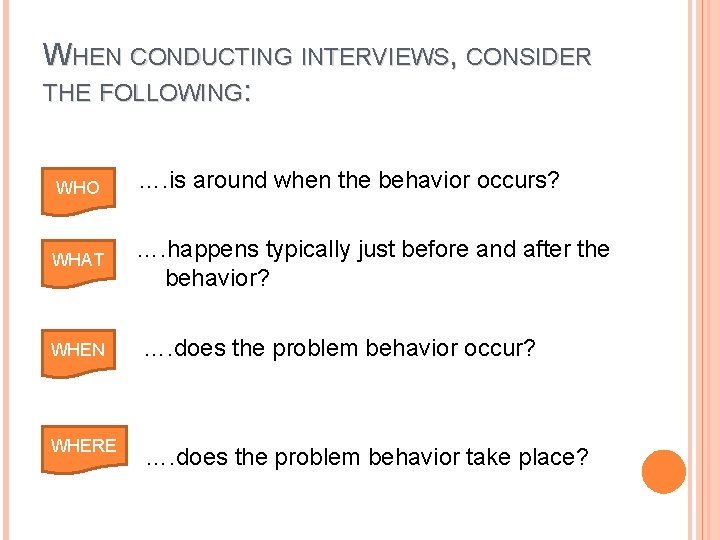
WHEN CONDUCTING INTERVIEWS, CONSIDER THE FOLLOWING: WHO WHAT b …. is around when the behavior occurs? …. happens typically just before and after the behavior? WHEN …. does the problem behavior occur? WHERE …. does the problem behavior take place?
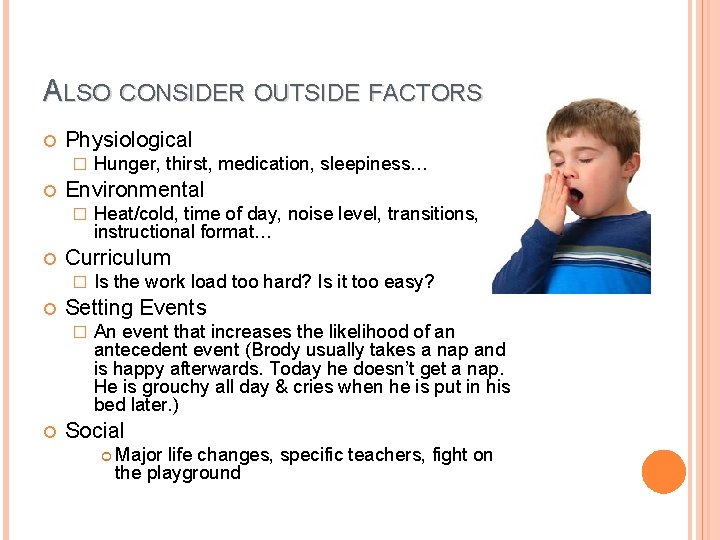
ALSO CONSIDER OUTSIDE FACTORS Physiological � Environmental � Is the work load too hard? Is it too easy? Setting Events � Heat/cold, time of day, noise level, transitions, instructional format… Curriculum � Hunger, thirst, medication, sleepiness… An event that increases the likelihood of an antecedent event (Brody usually takes a nap and is happy afterwards. Today he doesn’t get a nap. He is grouchy all day & cries when he is put in his bed later. ) Social Major life changes, specific teachers, fight on the playground
USE MULTIPLE SOURCES This is particularly important when a behavior is perceived to have more than one function, or has been difficult to identify. Remember, data is your friend!
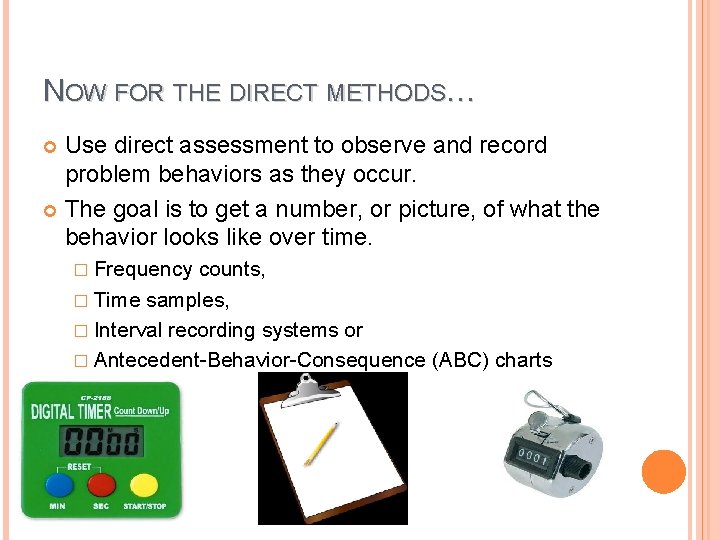
NOW FOR THE DIRECT METHODS… Use direct assessment to observe and record problem behaviors as they occur. The goal is to get a number, or picture, of what the behavior looks like over time. � Frequency counts, � Time samples, � Interval recording systems or � Antecedent-Behavior-Consequence (ABC) charts
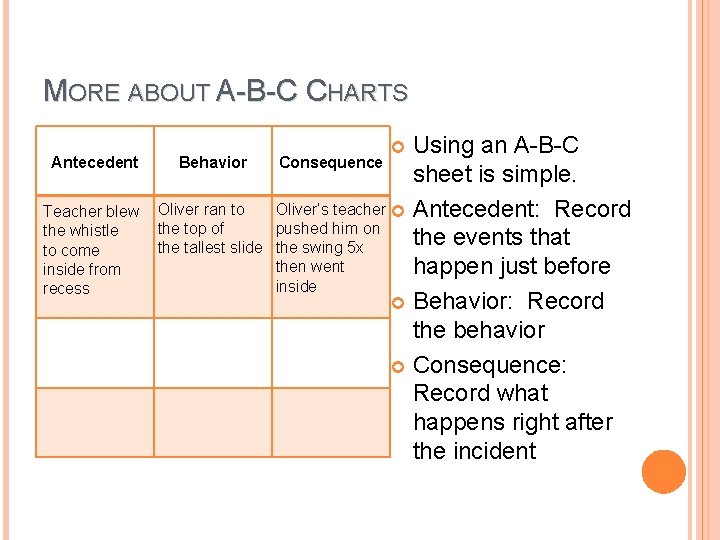
MORE ABOUT A-B-C CHARTS Antecedent Behavior Teacher blew the whistle to come inside from recess Oliver ran to the top of the tallest slide Using an A-B-C Consequence sheet is simple. Oliver’s teacher Antecedent: Record pushed him on the events that the swing 5 x then went happen just before inside Behavior: Record the behavior Consequence: Record what happens right after the incident
LAST THOUGHTS ABOUT A-B-C DATA Remember, it’s not what you perceive, think, or your interpretation about what’s going on, it’s what was actually observed. Typically observation of A-B-C data can take anywhere from 2 -5 days, depending on how much information can be collected. It stops when a trend can be found in the data. It’s important to collect enough information to get a good picture of day to day events and the associated behaviors.
NOW WHAT TO DO WITH ALL THIS DATA!? This is the fun part! In order to interpret the big picture from all of this data, it’s important to make sense of all of this data. Sort all of the data into manageable and meaningful parts. Setting events, antecedents, target behaviors and consequences A simpler way could be to break it into the Wh categories: who, what, when and where
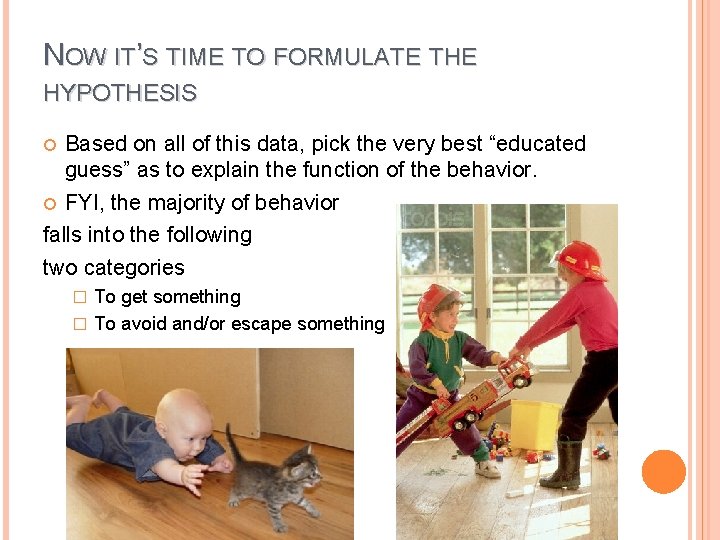
NOW IT’S TIME TO FORMULATE THE HYPOTHESIS Based on all of this data, pick the very best “educated guess” as to explain the function of the behavior. FYI, the majority of behavior falls into the following two categories To get something � To avoid and/or escape something �
FROM HYPOTHESIS TO BEHAVIOR PLAN Once you have determined a function, only then can you write a behavior plan. This is the single most important thing I want you to remember from today. The plan has to match the function. The function has to match the plan!
NOW LET’S WORK ON THEBIP After an adequate amount of data has been collected to find a trend and identify the likely function of the behavior, we must develop a behavior plan. To be able to fully comprehend the motivation behind a problem behavior, it’s important to consider behavior may be linked to performance deficits or skill deficits, or both. Proactive strategies teach new ways to behave. Intervention plans that contain components and strategies to emphasize skills needed in order to behave, or plans that provide motivation to comply will be more effective than any plan that simply serves to control the behavior. The plan should include: Strategies to teach new and appropriate replacement behaviors & skills, proactively � Program modifications � What to do when the behavior does occur � Interventions based on control alone have many down sides. � � They often fail to generalize Often they suppress the behavior, resulting in other, sometimes more inappropriate behaviors.
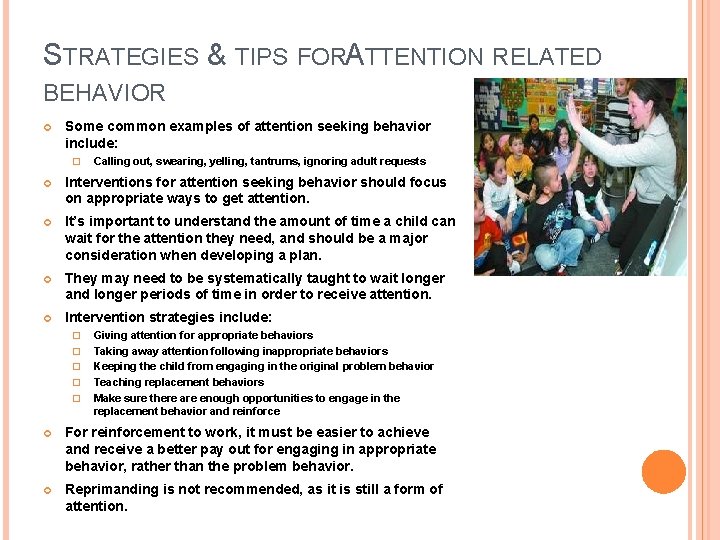
STRATEGIES & TIPS FORATTENTION RELATED BEHAVIOR Some common examples of attention seeking behavior include: � Calling out, swearing, yelling, tantrums, ignoring adult requests Interventions for attention seeking behavior should focus on appropriate ways to get attention. It’s important to understand the amount of time a child can wait for the attention they need, and should be a major consideration when developing a plan. They may need to be systematically taught to wait longer and longer periods of time in order to receive attention. Intervention strategies include: � � � Giving attention for appropriate behaviors Taking away attention following inappropriate behaviors Keeping the child from engaging in the original problem behavior Teaching replacement behaviors Make sure there are enough opportunities to engage in the replacement behavior and reinforce For reinforcement to work, it must be easier to achieve and receive a better pay out for engaging in appropriate behavior, rather than the problem behavior. Reprimanding is not recommended, as it is still a form of attention.
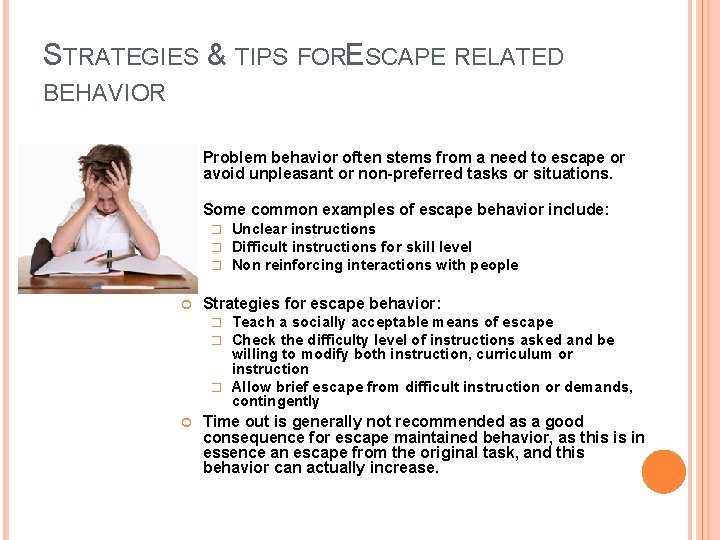
STRATEGIES & TIPS FORESCAPE RELATED BEHAVIOR Problem behavior often stems from a need to escape or avoid unpleasant or non-preferred tasks or situations. Some common examples of escape behavior include: � � � Unclear instructions Difficult instructions for skill level Non reinforcing interactions with people Strategies for escape behavior: Teach a socially acceptable means of escape Check the difficulty level of instructions asked and be willing to modify both instruction, curriculum or instruction � Allow brief escape from difficult instruction or demands, contingently � � Time out is generally not recommended as a good consequence for escape maintained behavior, as this is in essence an escape from the original task, and this behavior can actually increase.
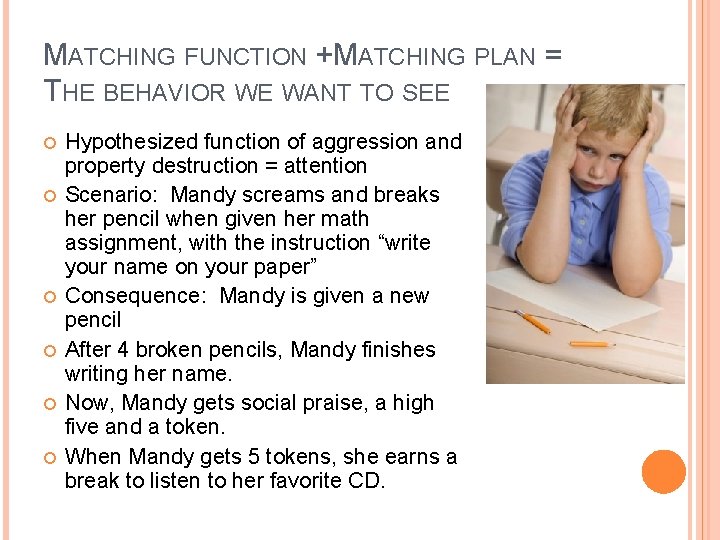
MATCHING FUNCTION +MATCHING PLAN = THE BEHAVIOR WE WANT TO SEE Hypothesized function of aggression and property destruction = attention Scenario: Mandy screams and breaks her pencil when given her math assignment, with the instruction “write your name on your paper” Consequence: Mandy is given a new pencil After 4 broken pencils, Mandy finishes writing her name. Now, Mandy gets social praise, a high five and a token. When Mandy gets 5 tokens, she earns a break to listen to her favorite CD.
LET’S TAKE A LOOK AT WHAT HAPPENS WHEN THE PLANS DON’T MATCH… Hypothesized function of aggression and property destruction = attention Scenario: Mandy screams and breaks her pencil when given her math assignment Consequence: Mandy is taken into time out (removal from receiving attention) En route, she hits, kicks & screams more. Mandy gets quiet & the teacher opens the door to let her out, she screams again, the door is shut. The teacher says she can’t come out until she is calm After a while, Mandy hears its time for lunch, she gets quiet and goes to lunch, then to recess. When she gets back from recess, the math assignment is given to her again and the cycle continues. Actual function = ? ? ?
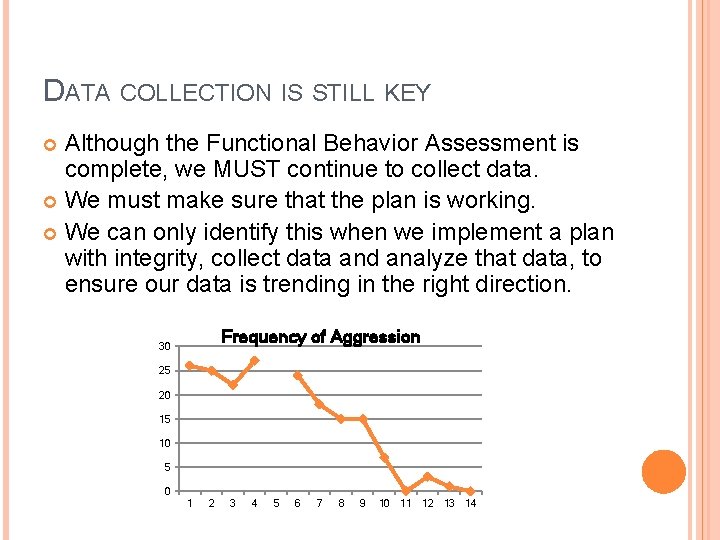
DATA COLLECTION IS STILL KEY Although the Functional Behavior Assessment is complete, we MUST continue to collect data. We must make sure that the plan is working. We can only identify this when we implement a plan with integrity, collect data and analyze that data, to ensure our data is trending in the right direction. Frequency of Aggression 30 25 20 15 10 5 0 1 2 3 4 5 6 7 8 9 10 11 12 13 14
NOW WE ARE READY TO LEARN! It is so important that behavior first be under control and before you can really open up to new learning.
REMEMBER… If the plan and function don’t match, you might as well go home.
- Slides: 29