
Problem Based Projects PBPs Making Them Relevant for

Problem Based Projects (PBPs)- Making Them Relevant for e. Learning Kuldeep Nagi Fulbright Fellow & Lecturer-ICT College of Internet Distance Education (CIDE) Assumption University, Bangkok, Thailand 1
About Me n n - Born in India, US citizen - Lived in Seattle, WA, USA - +25 Years - Fulbright Fellowship Award – 2006 to work at Assumption University 2

- About CIDE @ Assumption University C A M P U S P I C T U R E S 3
n. Agenda – - About CIDE- Assumption University - About Me 1. Introduction- What are PBPs? F 2 F & VLEs Issues 2. Problem Based Projects (PBPs) 3. e. Repository for Projects- Making it Available Conclusion Q& A 4
1. Introduction n. There is much evidence in Thai universities to characterize online learning as having come of age. It is a well known fact that in last five years using online technology is more of an expectation than a novelty for today’s university students in Thailand. n. In other word, there is abundant evidence that the Internet has become an integral part of Thai university education in terms of accessing learning resources, communicating with faculty or classmates, and its overall usage [1, 2]. 5
1. Introduction n. Realistic projects have proven popular and very effective component of on-campus courses taught Face-to-Face (F 2 F) in various graduate level programs offered in American and European universities. n. Big name companies like SUN (Stanford University Network) and got started as a part of the Master degree project at Stanford University. Similarly, host of other technologies were invented in MIT, Carnegie-Mellon and other major universities in U. S. A. 6
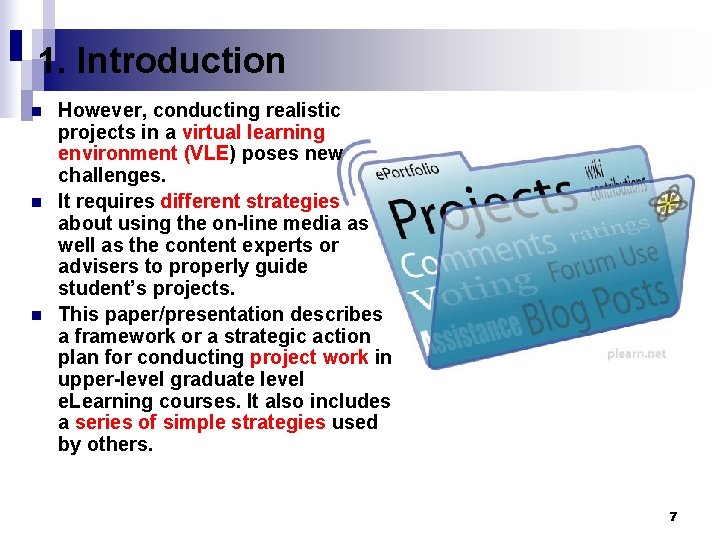
1. Introduction n However, conducting realistic projects in a virtual learning environment (VLE) poses new challenges. It requires different strategies about using the on-line media as well as the content experts or advisers to properly guide student’s projects. This paper/presentation describes a framework or a strategic action plan for conducting project work in upper-level graduate level e. Learning courses. It also includes a series of simple strategies used by others. 7
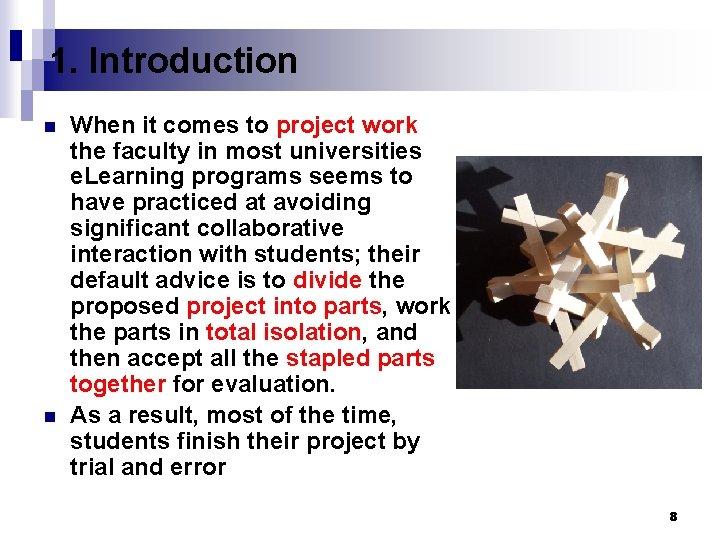
1. Introduction n n When it comes to project work the faculty in most universities e. Learning programs seems to have practiced at avoiding significant collaborative interaction with students; their default advice is to divide the proposed project into parts, work the parts in total isolation, and then accept all the stapled parts together for evaluation. As a result, most of the time, students finish their project by trial and error 8
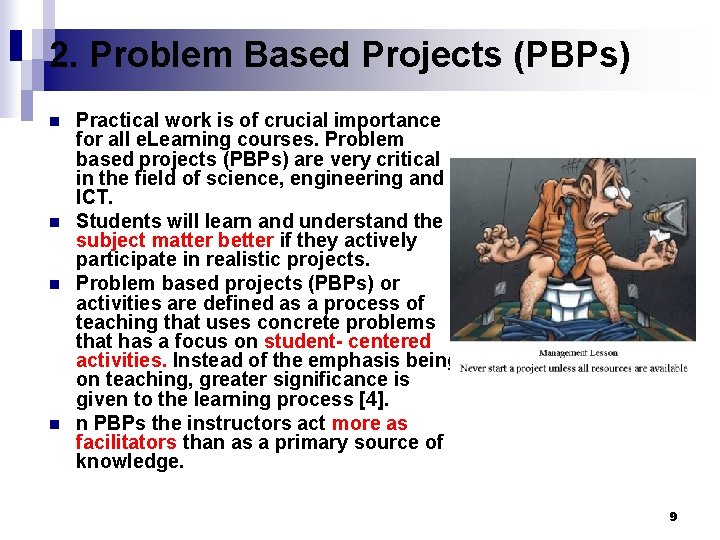
2. Problem Based Projects (PBPs) n n Practical work is of crucial importance for all e. Learning courses. Problem based projects (PBPs) are very critical in the field of science, engineering and ICT. Students will learn and understand the subject matter better if they actively participate in realistic projects. Problem based projects (PBPs) or activities are defined as a process of teaching that uses concrete problems that has a focus on student- centered activities. Instead of the emphasis being on teaching, greater significance is given to the learning process [4]. n PBPs the instructors act more as facilitators than as a primary source of knowledge. 9
2. Problem Based Projects (PBPs) Proposed 4 -D Framework n. Bringing this back to my own experience in M. S. in ICT courses at CIDE, Assumption University, I try to devise scaffolding of ideas to help students to look for problems or issues in their own work environment that they could examine as a part of their project. n. For me, any project is about problem solving. Bigger the problem, bigger will be the effort in each phase of the 4 -D process. 10
2. Problem Based Projects (PBPs) n n As a piece of guidance or a strategy the writer suggests a simple model for success of PBP in e. Learning courses. The proposed model for a realistic and relevant PBP work is expressed as a 4 -D model involving 4 clear-cut stages. Define, Decide, Develop and Deliver a solution or an enhancement in a currently available product or a service. Students select the projects, clarify and Define, Decide, Design and Deliver the projects. Examples of successful application of PBPs in ICT can be found in [5] - [7]. 11
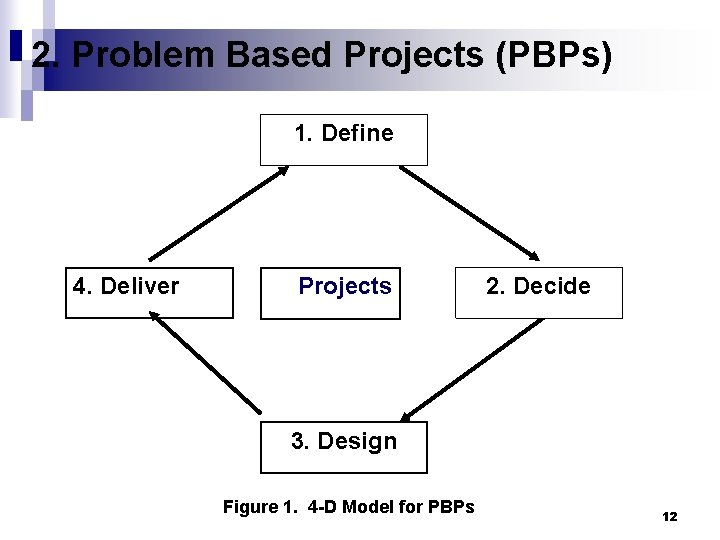
2. Problem Based Projects (PBPs) 1. Define 4. Deliver Projects 2. Decide 3. Design Figure 1. 4 -D Model for PBPs 12
2. Problem Based Projects (PBPs) n. Reflective thinking is the process of being aware of one’s own thinking and learning processes [8]. Constructivist learning theorists believe that it is important to encourage reflexivity, helping learners think about how they approach problems and how they look for and find solutions. n. Explicit tasks and activities encourage students to decide on their design process and promote their reflective thinking to deliver the project in a timely fashion. n. Please Refer to Figure 2. Advisers Guide for PBPs 13
3. e. Repository for Projects- Making it Available n n For most of the last century the universities around the world survived as silos of knowledge and academic practices with very little connection to the real world. In some cases they have become like museums hosting relics of the past. In extreme cases, they just survive on the glory of past and of those who died thinking in these silos. But now the old silos consisting of shifting sand concrete are crumbling. 14
3. e. Repository for Projects- Making it Available n According to two researchers Brill and Park (2008) at Virginia Tech the application of a variety of technologies for learning and teaching is being influenced by two significant forces: the realm of technological innovation (especially, today, in regard to hardware, software and Internet technologies) and the realm of learning theory [9]. 15
3. e. Repository for Projects- Making it Available n In consideration of the technological trajectory, learning has evolved from textbooks to television to computers, and now to the Internet using laptops and smart mobile digital device, in a relatively very short period of time. n Brill and Park mention that in respect to this technology trajectory, expansions in ontological and pedagogy have provoked a broadening of learning paradigms (e. g. , behaviorism, cognitivism, and constructivism) suggesting moves toward more self-directed, contextualized, and interactive virtual learning environments (VLEs). 16
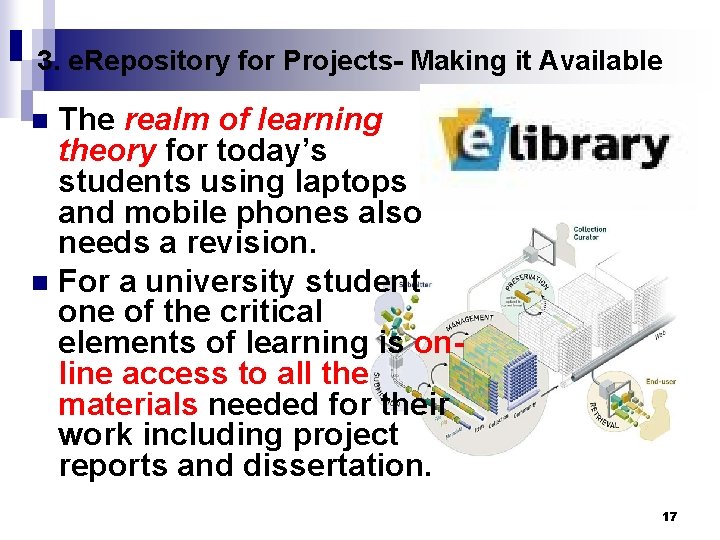
3. e. Repository for Projects- Making it Available The realm of learning theory for today’s students using laptops and mobile phones also needs a revision. n For a university student one of the critical elements of learning is online access to all the materials needed for their work including project reports and dissertation. n 17
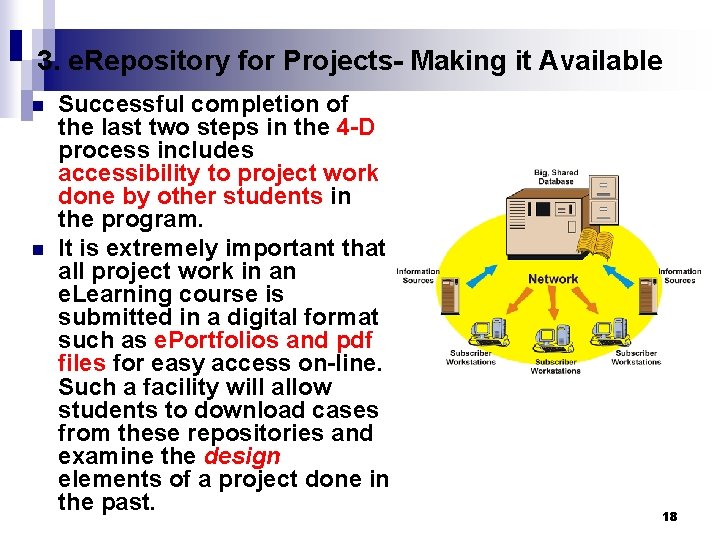
3. e. Repository for Projects- Making it Available n n Successful completion of the last two steps in the 4 -D process includes accessibility to project work done by other students in the program. It is extremely important that all project work in an e. Learning course is submitted in a digital format such as e. Portfolios and pdf files for easy access on-line. Such a facility will allow students to download cases from these repositories and examine the design elements of a project done in the past. 18
3. e. Repository for Projects- Making it Available n The e. Learning program should also provide a standardized project format in the on-line repository for organizing the students’ ongoing project documentation. n This will help students to compare their current project process with design cases of others from this web repository. 19
4. Conclusion n. The proposed 4 -D model requires harnessing the tools provided in a learning management system (LMS). n. Thoughtful and realistic project based activities can be planned using tools available in a LMS. New features in various LMSs provide sufficient facility for refining 4 -D framework for content creation, delivery, and assessment, but also include constructivist and collaborative learning and teaching methods as well. This new framework is expected to increase student motivation for learning and lead to better results. n. A general recommendation would be to introduce PBP in e. Learning, starting with projects of low complexity. Also, the model described here should be modified for courses where the student/instructor ratio is far greater. 20
4. Conclusion n. Another research direction should lead to better support for the monitoring of student progress. Currently, e. Learning course monitoring is based on tabular reports and graphs. Introduction of intelligent mechanisms that improves the monitoring process in a LMS will enhance the quality of PBPs in an e. Learning course. n. Regarding future plans for improving user interface for PBPs, a learning management subsystem solely for project work in the form of a PBP Dataabase, Wiki and e. Portfolios should be explored and implemented. 21

Questions & Answers 22

Thank You College of Internet Distance Education (CIDE) Assumption University Thailand, Bangkok www. e. Learning. au. edu knagi@au. edu 23
- Slides: 23