
PROBLEM BASED LEARNING THE TEACHERSTUDENT INTERFACE Presented at
PROBLEM BASED LEARNING: THE TEACHER-STUDENT INTERFACE Presented at the 2015 Executive Advance BY DR. DAVID OMOLE
OUTLINE • Introduction • The Generational Shift • Active Learning methods • Case Study Presentation by Dr. D. O. Omole 11/9/2020 2
1. INTRODUCTION Quote • “There will be no more important issue in the world – not energy, not oil, not water – than that of talent. The [nations] that develop talent, motivate talent and use talent will be the [nations] that move forward in the world. ” - Philip Clay, former chancellor of MIT • It would be a mistake to train only for today’s jobs. Future will require resilience and adaptability. - S. B. Mukasa (University of New Hampshire) Presentation by Dr. D. O. Omole 11/9/2020 3
2. GENERATIONAL SHIFT 20 th century students • Baby boomers (1946 -1964) • Generation X (1965 -1979) 21 st century students • Generation Y (millennials) (1980 -2000) – are the one in tertiary institutions today • Generation Z (2001 – present) – will attend higher institutions from 2017 and in the next two decades Presentation by Dr. D. O. Omole 11/9/2020 4
Millennials and Generation Z • They are smarter, raised in computer age • Regimented lifestyles (school to lesson to private study) • They multi-task • They hate writing on paper (they type on whatsapp, facebook, tablets etc) • Have problem with time management • Have short attention span • They hate textbooks and embrace google • They love activity-based learning and learn better from each other • They seek instant gratification • They enjoy technology • To reach this group of student, teachers need to leave their world to meet the students in their own world Presentation by Dr. D. O. Omole 11/9/2020 5
Reyes-Guerra(1989) categorized students into three, namely: • Verbalizers • Visualizers • Doers • The verbalizers are those who learn easily if information is in written or spoken form. They benefit from lectures, tutorials and hand-outs. • Visualizers learn easily when information is in pictorial or diagrammatic form while • The Doers learn more easily when information is presented in form of practical activities. Presentation by Dr. D. O. Omole 11/9/2020 6

• The need to use appropriate teaching method cannot be overemphasized. The need is succinctly captured in the study by Singhal et al. (1997). Presentation by Dr. D. O. Omole 11/9/2020 7

3. ACTIVE LEARNING METHODS • Team-based learning • Problem-Based Learning • Project-Based Learning • Co-operative Learning • Flipped Classroom • Technology Enhanced Learning Presentation by Dr. D. O. Omole 11/9/2020 8

A. TEAM-BASED LEARNING • Team-based learning (TBL) is a pedagogical method that uses groups of students in the learning and teaching process in a collaborative manner. • It is the use of learning groups to enhance student engagement and the quality of student or training (Michaelsen and Michael, 2012). • This method allows the involvement of an individual to contribute to the works of others Presentation by Dr. D. O. Omole 11/9/2020 9
• The contribution of the members of the team is assessed through peer evaluation and the overall team contribution are factored or weighted into the overall grading of each student. • In the assessment method, a lot of trust is placed on students. Presentation by Dr. D. O. Omole 11/9/2020 10
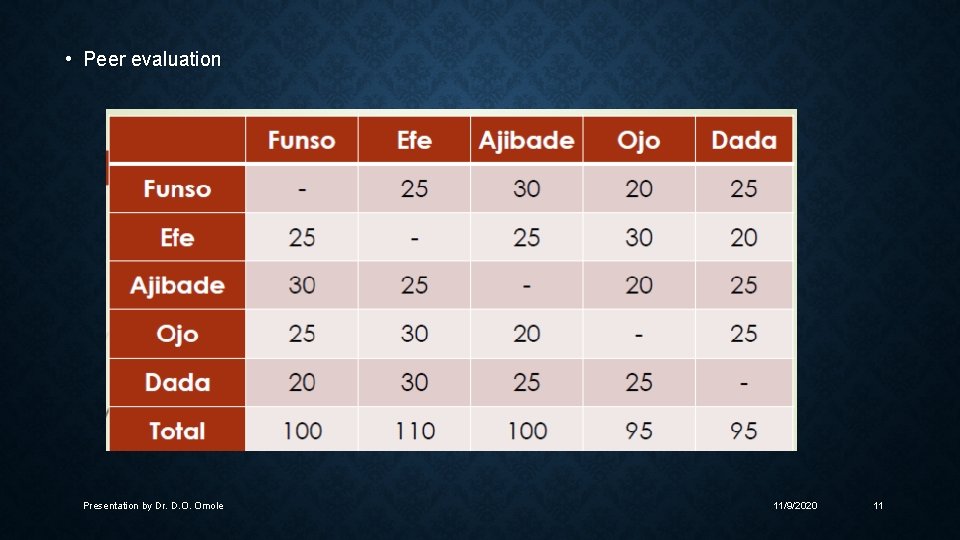
• Peer evaluation Presentation by Dr. D. O. Omole 11/9/2020 11

B. PROBLEM-BASED LEARNING • Students are placed in the active role of problem-solvers confronted with situations like the kind of problems they are likely to encounter in the future. • Develops in learners, thinking strategies, effective problem solving skills, self-directed learning, effective collaboration skills and intrinsic motivation. • In a large class, it is difficult to adopt problem-based learning alone; it should be used in conjunction with team-based learning. • This approach entails that within a group different variables are given to each team member. • This enables each member to work independently but later, they get together to collate their results to observe the results. Presentation by Dr. D. O. Omole 11/9/2020 12
C. PROJECT–BASED LEARNING • The characteristics of Project–Based Learning are similar to those of Problem–based learning. • Both methods are based on self-direction, collaboration and multidisciplinary orientation. • requires longer period of time than Problem-based learning; • it is more directed to the application of knowledge while Problem Based Learning is directed to the acquisition of knowledge; • This method is also used with team-based learning because of large student population in a class. Presentation by Dr. D. O. Omole 11/9/2020 13
D. CO-OPERATIVE LEARNING • Cooperative Learning (CL) is a teaching approach whereby students work in teams on assignment or project under conditions which include the team members being held individually responsible for the complete content of the assignment or project. • This method can help weak students. Usually after a test has been given and graded, the performance of the students is used to sort them into groups, weak students are put in the group of bright students. • Some students, especially the bright ones, do not admire this method because they see it as weighing them down. Presentation by Dr. D. O. Omole 11/9/2020 14
E. FLIPPED CLASSROOM • Teachers can make lectures available to students whenever and wherever it is convenient to them, at home, in class e. t. c. • Teachers can deliver their lectures and/or instructions by recording and screen casts of work they do on their computers, creating videos of themselves teaching. • Instead of talking about phenomena, videos and computer simulation can be used to provide detailed visual representation. • Students can access these videos as often as they want. • Rather than delivering lectures in the classroom, teacher then use the classroom period to actively engage students in learning process and attend to each student’s need since adequate time is available for discussion. • Using video can be better than real life because it enables the instructor to play it over and show it in slow motion if necessary. Presentation by Dr. D. O. Omole 11/9/2020 15

F. TECHNOLOGY ENHANCE LEARNING • Technology are deployed in education to enhance the transfer of knowledge and skills. • E–Learning includes multimedia learning, computer -based training (CBT) internet-based training (IBT), webbased training (WBT), online education, virtual learning environment (VLE) etc. • Well-designed multimedia application offer potential for reduction of time formal instruction. • E-learning can occur in or out of the classroom. With technological advancement, students can use computer or mobile device to access learning materials anywhere • in the world. Presentation by Dr. D. O. Omole 11/9/2020 16
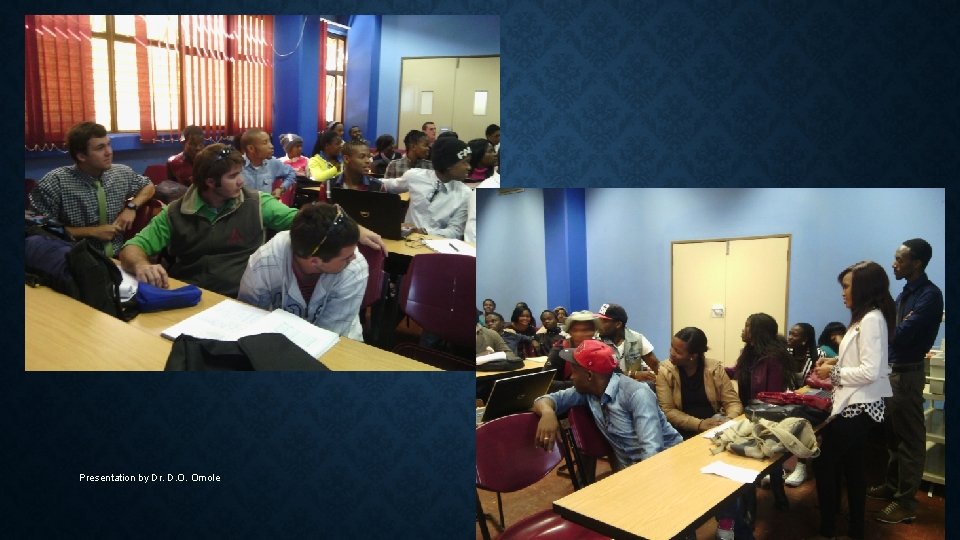
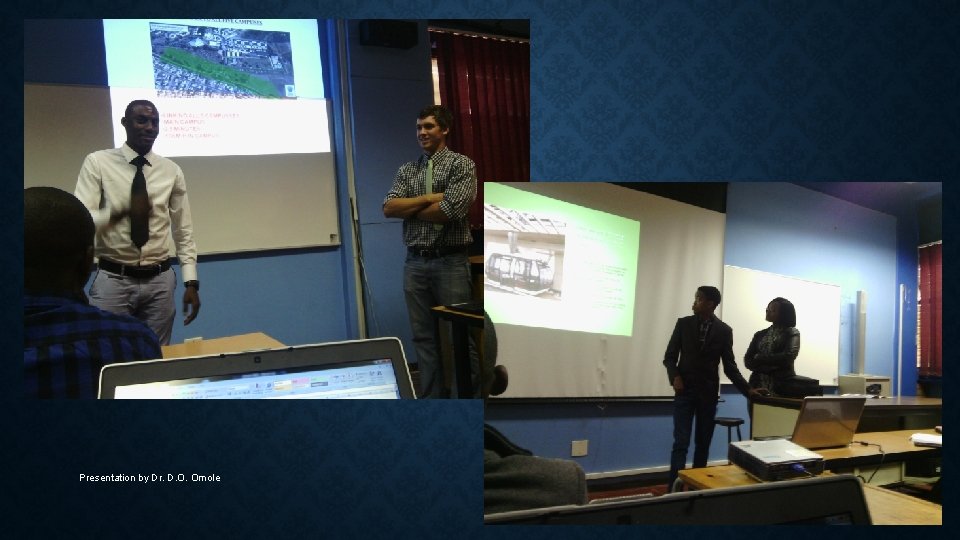
4. CASE STUDY My teaching experience in South Africa • Teaching is active-based • They use study guide system (synonymous with our course compact) • They have five assessments (2 class tests; 1 assignment; 1 veto; 1 project) • They have anonymous lecturer evaluation (but the lecturer is allowed to view it. It is also used directly to appraise the teacher) Presentation by Dr. D. O. Omole 11/9/2020 17
Presentation by Dr. D. O. Omole 11/9/2020 18
Presentation by Dr. D. O. Omole 11/9/2020 19
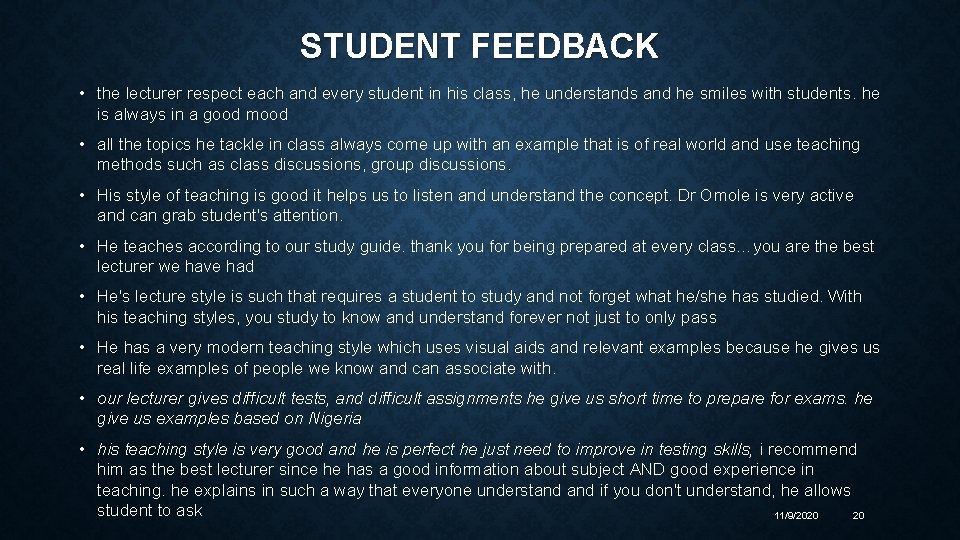
STUDENT FEEDBACK • the lecturer respect each and every student in his class, he understands and he smiles with students. he is always in a good mood • all the topics he tackle in class always come up with an example that is of real world and use teaching methods such as class discussions, group discussions. • His style of teaching is good it helps us to listen and understand the concept. Dr Omole is very active and can grab student's attention. • He teaches according to our study guide. thank you for being prepared at every class…you are the best lecturer we have had • He's lecture style is such that requires a student to study and not forget what he/she has studied. With his teaching styles, you study to know and understand forever not just to only pass • He has a very modern teaching style which uses visual aids and relevant examples because he gives us real life examples of people we know and can associate with. • our lecturer gives difficult tests, and difficult assignments he give us short time to prepare for exams. he give us examples based on Nigeria • his teaching style is very good and he is perfect he just need to improve in testing skills, i recommend him as the best lecturer since he has a good information about subject AND good experience in teaching. he explains in such a way that everyone understand if you don't understand, he allows student to ask 11/9/2020 20
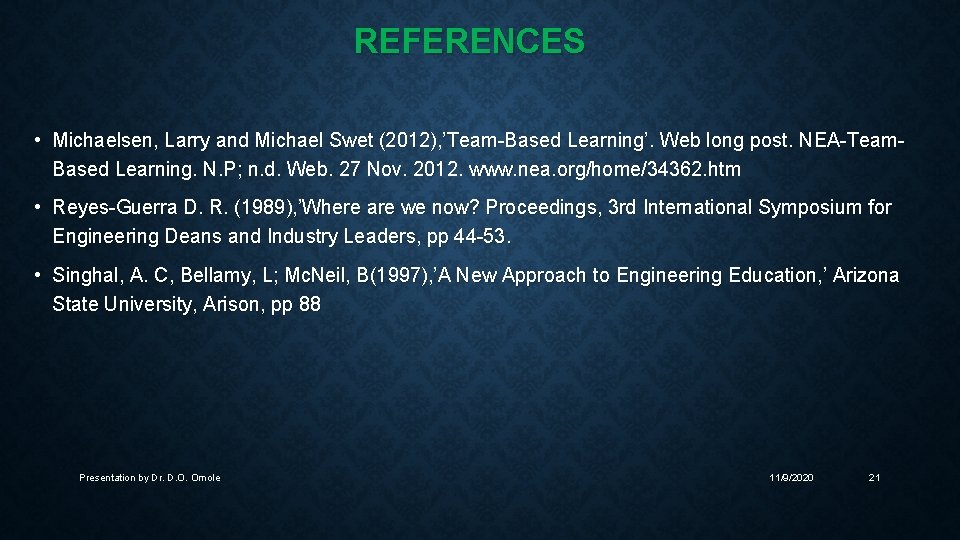
REFERENCES • Michaelsen, Larry and Michael Swet (2012), ’Team-Based Learning’. Web long post. NEA-Team. Based Learning. N. P; n. d. Web. 27 Nov. 2012. www. nea. org/home/34362. htm • Reyes-Guerra D. R. (1989), ’Where are we now? Proceedings, 3 rd International Symposium for Engineering Deans and Industry Leaders, pp 44 -53. • Singhal, A. C, Bellamy, L; Mc. Neil, B(1997), ’A New Approach to Engineering Education, ’ Arizona State University, Arison, pp 88 Presentation by Dr. D. O. Omole 11/9/2020 21
- Slides: 21