
Problem Based Learning PBL Implementation Strategies for STEM
Problem Based Learning (PBL) Implementation Strategies for STEM Courses NAWI Annual Conference Indianapolis, Indiana May 22, 2013 Fenna Hanes New England Board of Higher Education Nicholas Massa Springfield Technical Community College
Who is NEBHE? • The New England Board of Higher Education (NEBHE) represents 260 colleges in New England • Mission – to promote greater educational opportunities and services for residents of New England • Goals are to promote o Education policies of regional significance o Efficient use and sharing of educational resources o Collaboration between higher education and the economic well-being of New England
What are the PBL Projects? MISSION: To increase the number of job-ready STEM workers by engaging high school and college students with challenging authentic problems, learning materials and innovative teaching methods. Funded by the Advanced Technological Education (ATE) program of the National Science Foundation (NSF). PHOTON PBL STEM PBL Advanced Manufacturing PBL 2006 -2009 – 2012 - 2015

What are the PBL Projects? The PBL projects: • Developed problem-based learning (PBL) instructional resources ØPHOTON PBL – 8 Challenges based on authentic interdisciplinary problems in optics/photonics ØSTEM PBL – 6 Challenges based on authentic interdisciplinary problems in sustainable technologies • Provided professional development activities for high school and college STEM educators • Developed two new college-level courses in PBL methods at CCSU

What is Problem-Based Learning (PBL)? • Originally developed for medical school education in the 1970 s. • PBL teaches students content, problem solving skills, and teamwork through collaborative engagement with authentic real-world problems. Problem Analysis Solution Testing Independent Research Brainstorming

Characteristics of PBL In PBL… • Problems are presented before any formal preparation has occurred - the problem itself drives the learning • Students work collaboratively in teams to frame the problem and identify learning objectives • New information is acquired through self-directed learning • Instructor is a facilitator who provides focused instruction and guidance on an “as needed” basis

Engaging Students in the Classroom Research shows that PBL… • Improves students’ understanding and retention of content • Promotes a “deep approach” to learning • Improves critical thinking and problem solving skills • Improves student motivation and self-efficacy for learning • Improves students’ ability to transfer problem solving skills to different disciplines • Improves students’ ability to work in teams
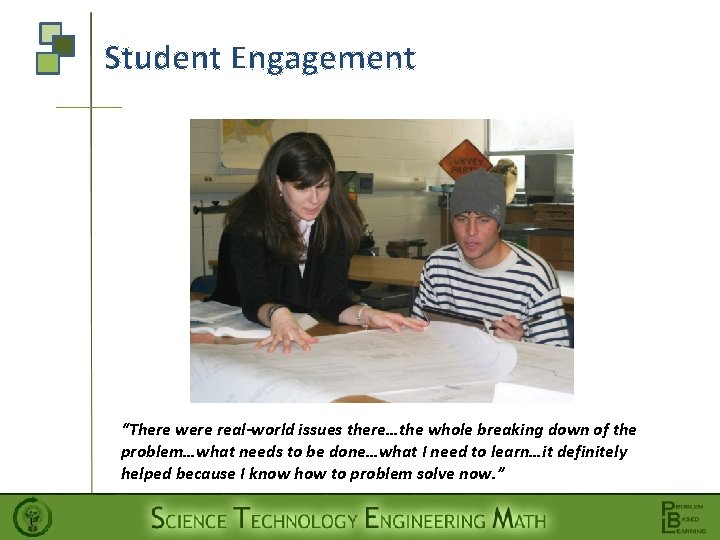
Student Engagement “There were real-world issues there…the whole breaking down of the problem…what needs to be done…what I need to learn…it definitely helped because I know how to problem solve now. ”
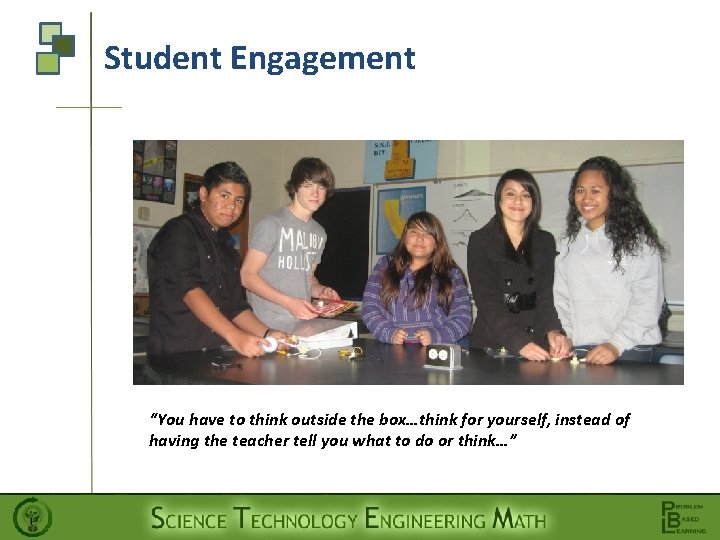
Student Engagement “You have to think outside the box…think for yourself, instead of having the teacher tell you what to do or think…”

Key Features of our PBL Challenges • Flexible scaffolded design • 3 levels of structure to “ease” students into the instructional method o Structured – instructor led o Guided – instructor as facilitator o Open – instructor as consultant • Password protected to control flow of information
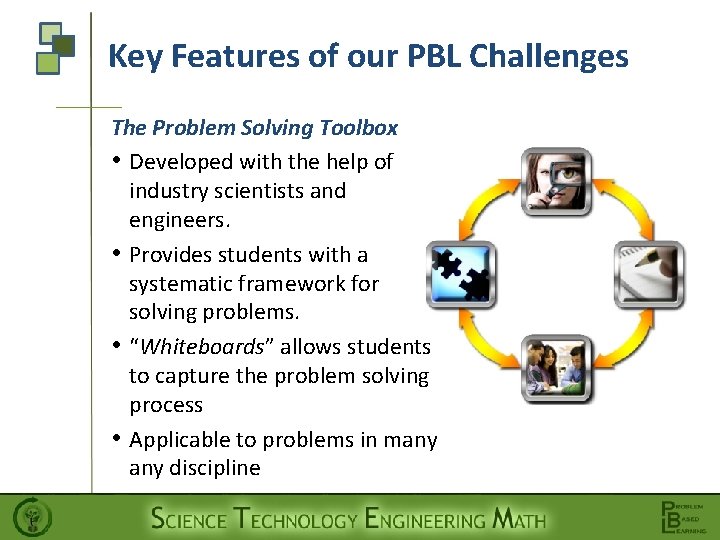
Key Features of our PBL Challenges The Problem Solving Toolbox • Developed with the help of industry scientists and engineers. • Provides students with a systematic framework for solving problems. • “Whiteboards” allows students to capture the problem solving process • Applicable to problems in many discipline
New Advanced Manufacturing PBL Project Goal Support economic growth and competitiveness of the Advanced Manufacturing industry in New England by increasing the pipeline of skilled workers • Develop 6 authentic industry-based PBL Challenges in advanced manufacturing technology • Provide professional development for in-service high school and college STEM instructors • Develop STEM PBL curricula for pre-service and in-service teacher education • Conduct research on the efficacy of PBL in advanced manufacturing education
Thank you! Contact information: • PI Fenna Hanes – fhanes@nebhe. org • Co-PI Judith Donnelly jdonnelly@lasertechonline. org • Co-PI Nicholas Massa – massa@stcc. edu • Co-PI Michele Dischino – dischinomic@ccsu. edu • Co-PI James De. Laura – delaura@ccsu. edu • Project Coord. Nicole Schepker – nschepker@nebhe. org
STEM Problem Based Learning (PBL) PBL Website www. pblprojects. org
- Slides: 14