
Problem Add the first 100 counting numbers together
Problem: Add the first 100 counting numbers together. 1 + 2 + …+ 99 + 100 We shall see if we can find a fast way of doing this problem.
A pattern of numbers in a particular order is called a number sequence, and the individual numbers in the sequence are called terms.
Each number or term in the sequence is associated with a position, which is also a number.
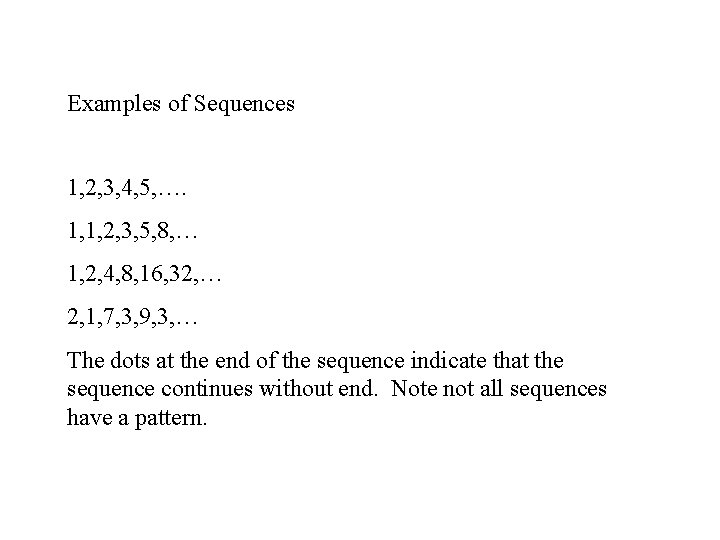
Examples of Sequences 1, 2, 3, 4, 5, …. 1, 1, 2, 3, 5, 8, … 1, 2, 4, 8, 16, 32, … 2, 1, 7, 3, 9, 3, … The dots at the end of the sequence indicate that the sequence continues without end. Note not all sequences have a pattern.
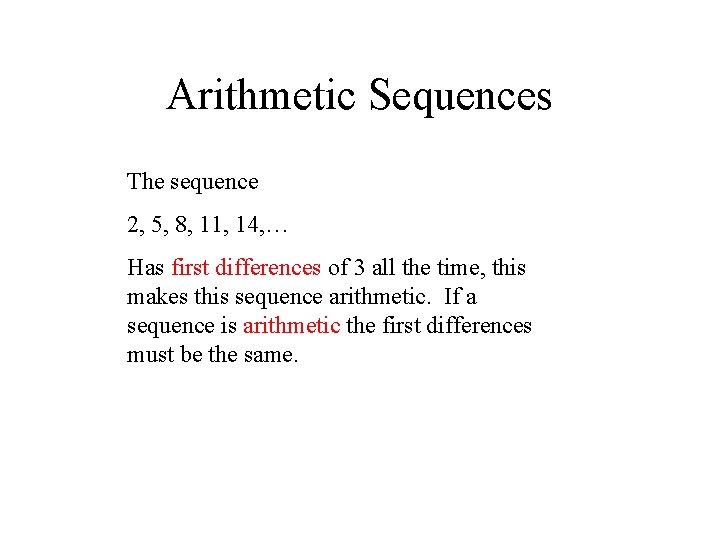
Arithmetic Sequences The sequence 2, 5, 8, 11, 14, … Has first differences of 3 all the time, this makes this sequence arithmetic. If a sequence is arithmetic the first differences must be the same.
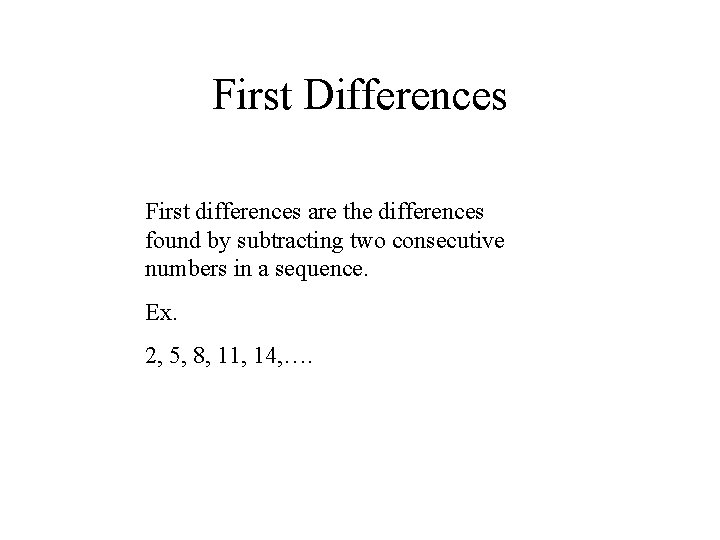
First Differences First differences are the differences found by subtracting two consecutive numbers in a sequence. Ex. 2, 5, 8, 11, 14, ….
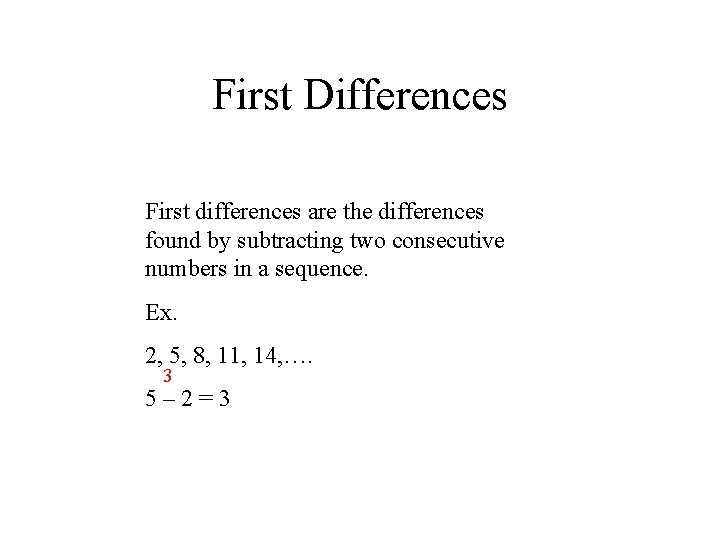
First Differences First differences are the differences found by subtracting two consecutive numbers in a sequence. Ex. 2, 5, 8, 11, 14, …. 3 5– 2=3
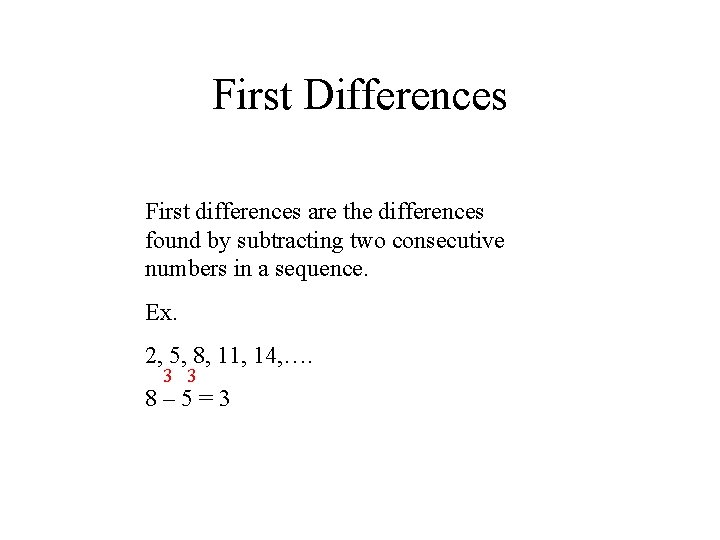
First Differences First differences are the differences found by subtracting two consecutive numbers in a sequence. Ex. 2, 5, 8, 11, 14, …. 3 3 8– 5=3
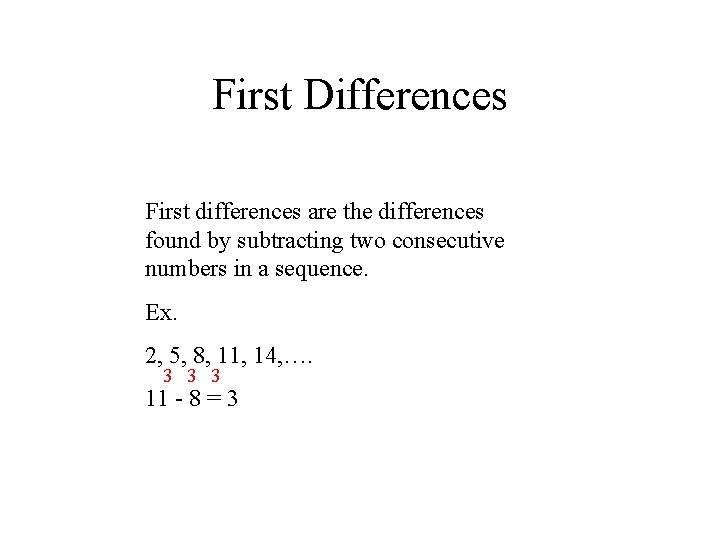
First Differences First differences are the differences found by subtracting two consecutive numbers in a sequence. Ex. 2, 5, 8, 11, 14, …. 3 3 3 11 - 8 = 3
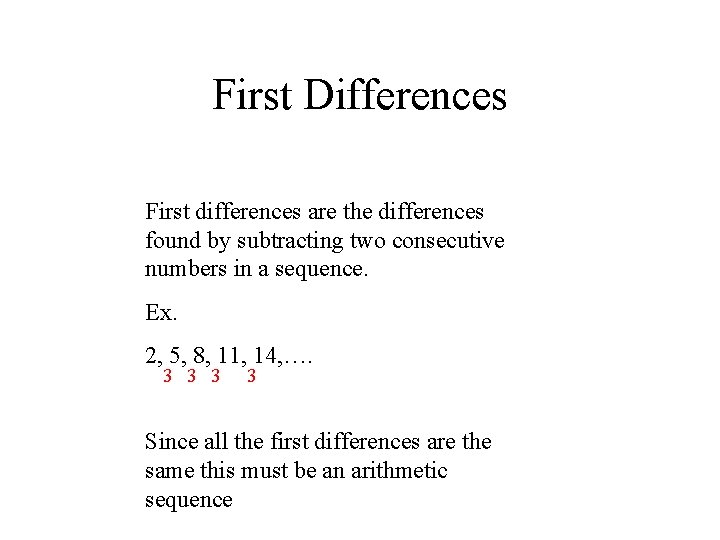
First Differences First differences are the differences found by subtracting two consecutive numbers in a sequence. Ex. 2, 5, 8, 11, 14, …. 3 3 Since all the first differences are the same this must be an arithmetic sequence
Position Numbers Each term in the sequence is paired with a position number 2, 5, 8, 11, 14, …
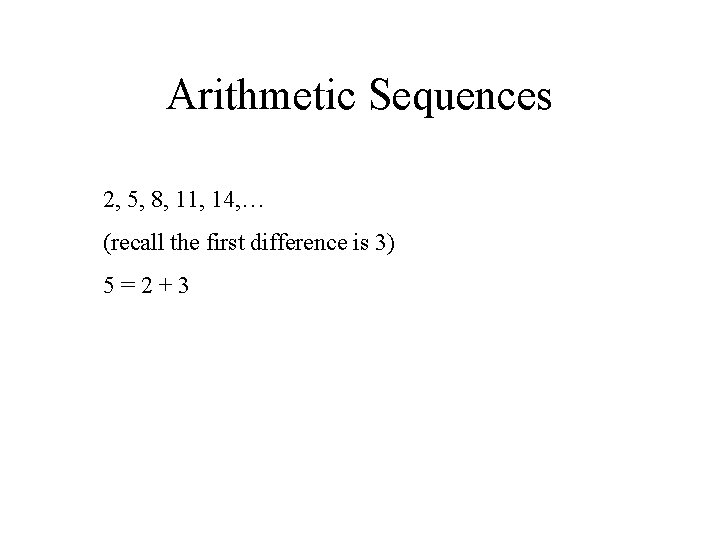
Arithmetic Sequences 2, 5, 8, 11, 14, … (recall the first difference is 3) 5=2+3
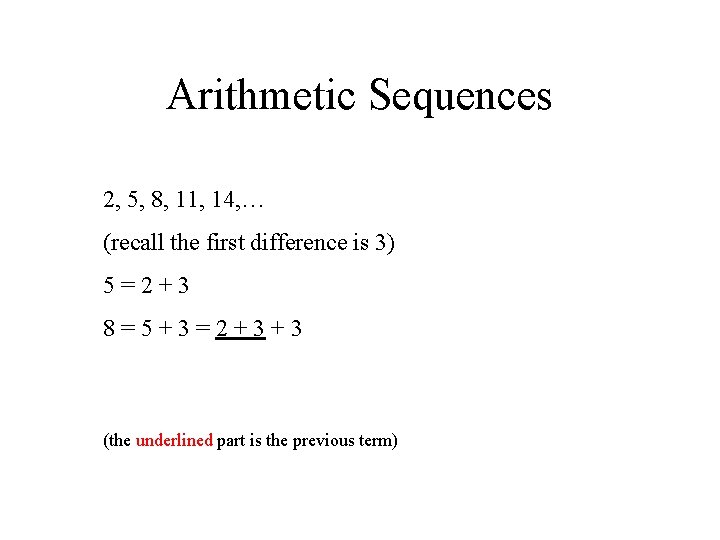
Arithmetic Sequences 2, 5, 8, 11, 14, … (recall the first difference is 3) 5=2+3 8=5+3=2+3+3 (the underlined part is the previous term)
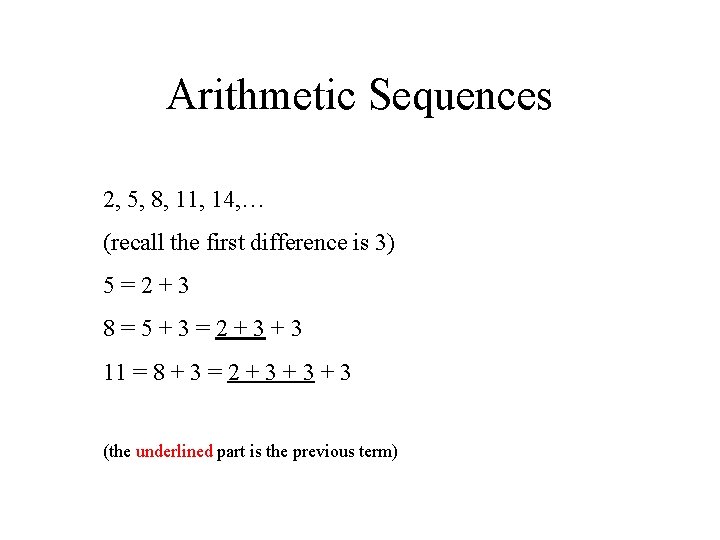
Arithmetic Sequences 2, 5, 8, 11, 14, … (recall the first difference is 3) 5=2+3 8=5+3=2+3+3 11 = 8 + 3 = 2 + 3 + 3 (the underlined part is the previous term)
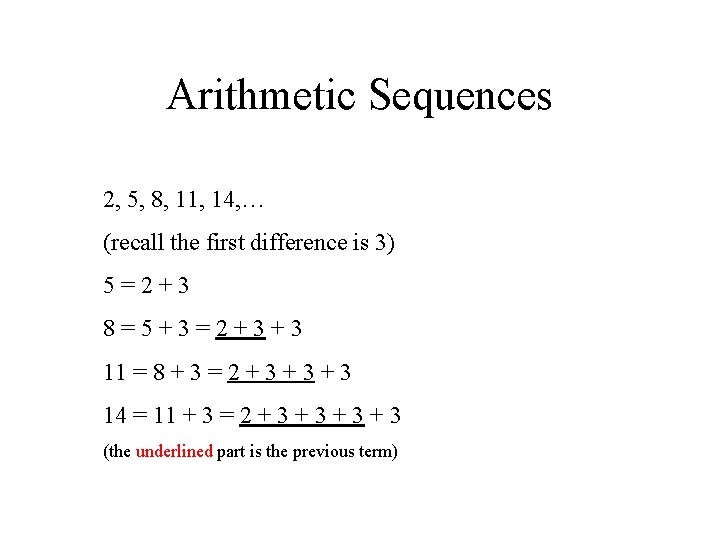
Arithmetic Sequences 2, 5, 8, 11, 14, … (recall the first difference is 3) 5=2+3 8=5+3=2+3+3 11 = 8 + 3 = 2 + 3 + 3 14 = 11 + 3 = 2 + 3 + 3 (the underlined part is the previous term)
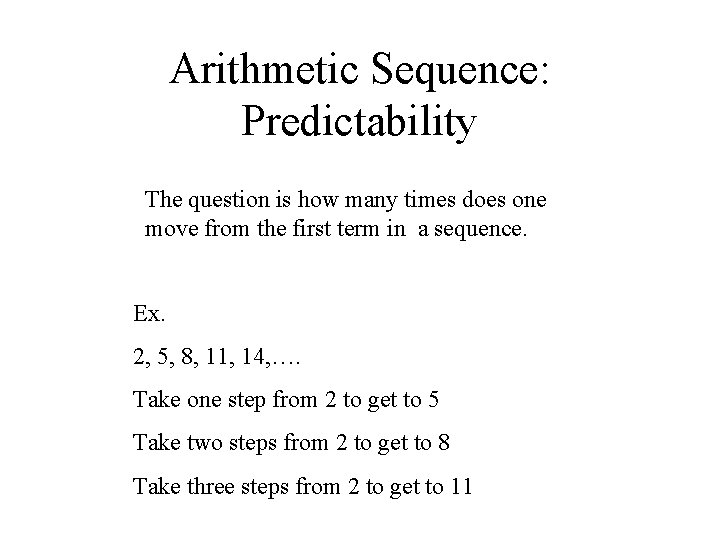
Arithmetic Sequence: Predictability The question is how many times does one move from the first term in a sequence. Ex. 2, 5, 8, 11, 14, …. Take one step from 2 to get to 5 Take two steps from 2 to get to 8 Take three steps from 2 to get to 11
Arithmetic Sequences • Have a constant first difference • Are predictable
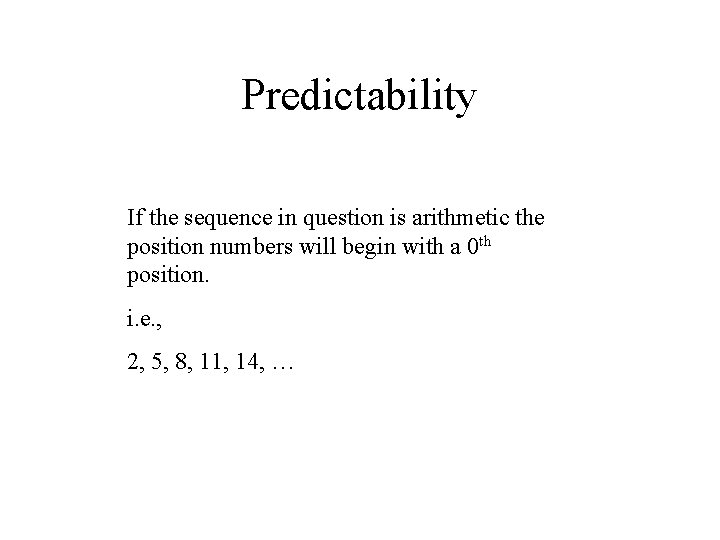
Predictability If the sequence in question is arithmetic the position numbers will begin with a 0 th position. i. e. , 2, 5, 8, 11, 14, …
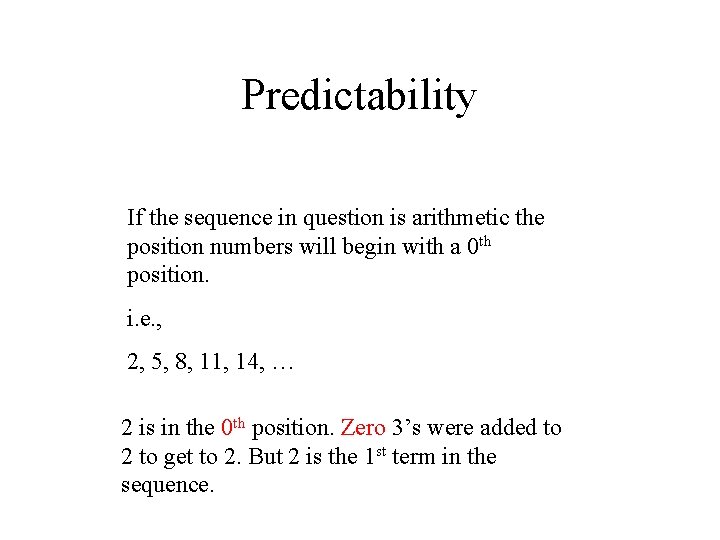
Predictability If the sequence in question is arithmetic the position numbers will begin with a 0 th position. i. e. , 2, 5, 8, 11, 14, … 2 is in the 0 th position. Zero 3’s were added to 2 to get to 2. But 2 is the 1 st term in the sequence.
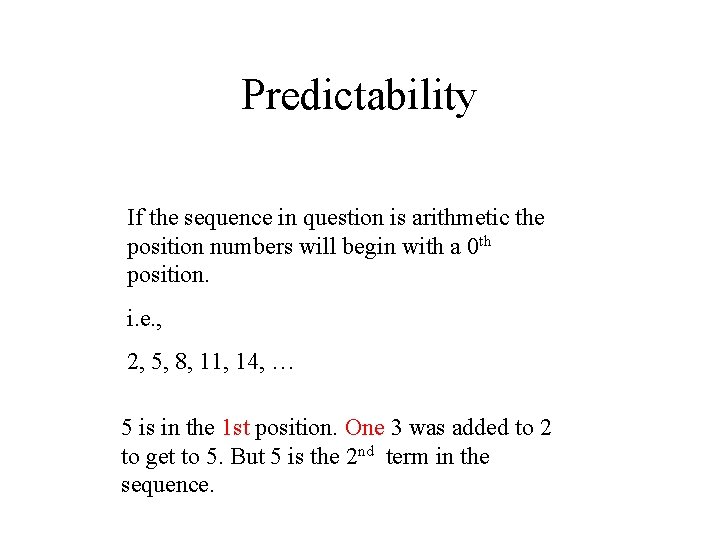
Predictability If the sequence in question is arithmetic the position numbers will begin with a 0 th position. i. e. , 2, 5, 8, 11, 14, … 5 is in the 1 st position. One 3 was added to 2 to get to 5. But 5 is the 2 nd term in the sequence.
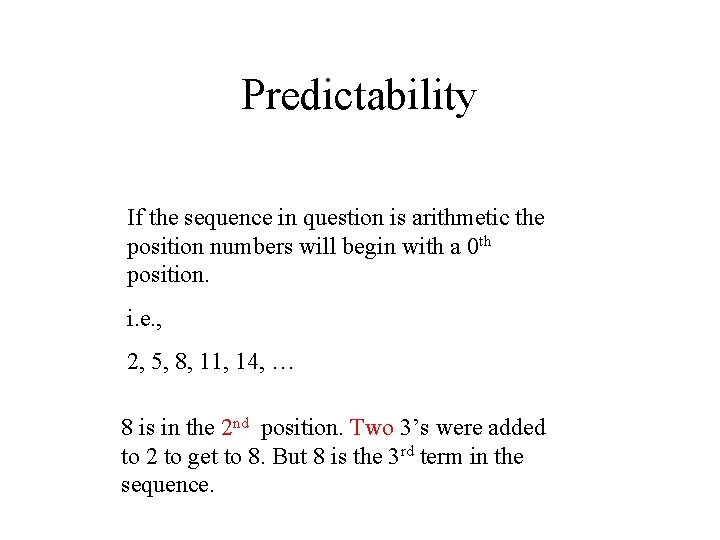
Predictability If the sequence in question is arithmetic the position numbers will begin with a 0 th position. i. e. , 2, 5, 8, 11, 14, … 8 is in the 2 nd position. Two 3’s were added to 2 to get to 8. But 8 is the 3 rd term in the sequence.
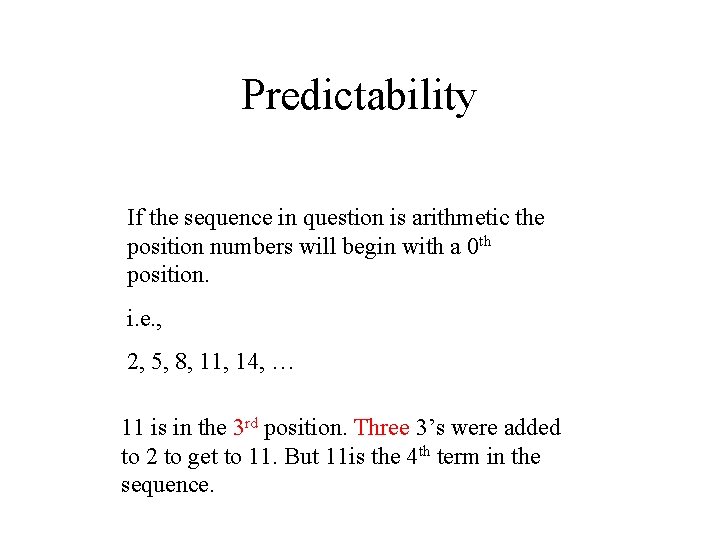
Predictability If the sequence in question is arithmetic the position numbers will begin with a 0 th position. i. e. , 2, 5, 8, 11, 14, … 11 is in the 3 rd position. Three 3’s were added to 2 to get to 11. But 11 is the 4 th term in the sequence.
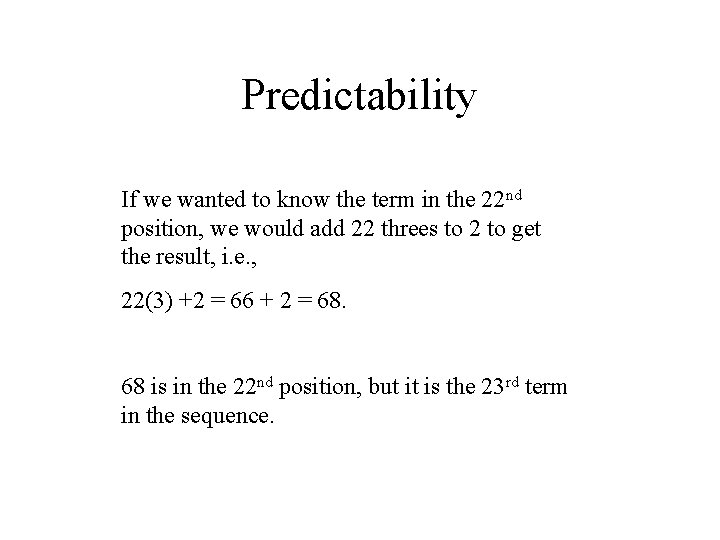
Predictability If we wanted to know the term in the 22 nd position, we would add 22 threes to 2 to get the result, i. e. , 22(3) +2 = 66 + 2 = 68. 68 is in the 22 nd position, but it is the 23 rd term in the sequence.
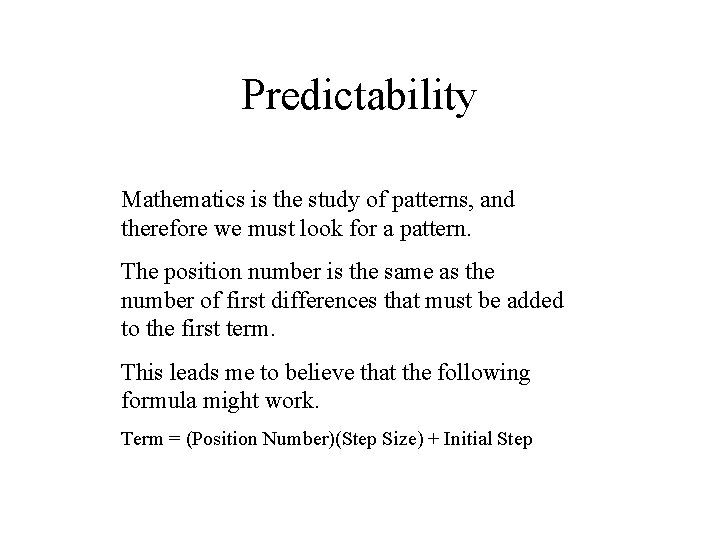
Predictability Mathematics is the study of patterns, and therefore we must look for a pattern. The position number is the same as the number of first differences that must be added to the first term. This leads me to believe that the following formula might work. Term = (Position Number)(Step Size) + Initial Step
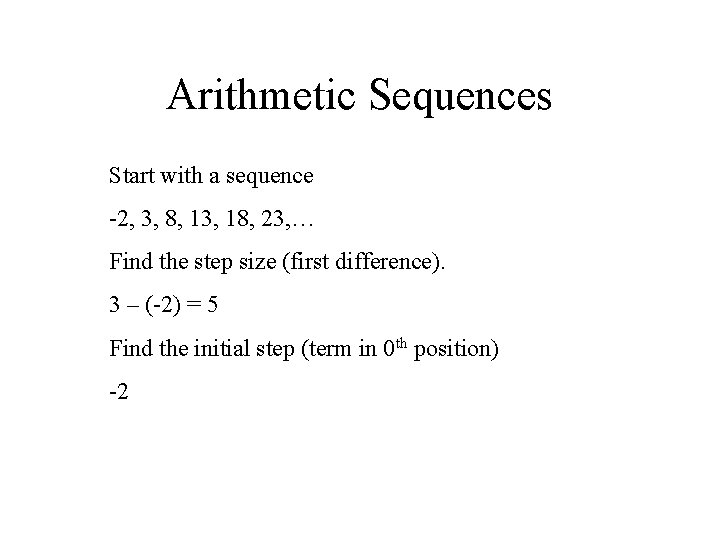
Arithmetic Sequences Start with a sequence -2, 3, 8, 13, 18, 23, … Find the step size (first difference). 3 – (-2) = 5 Find the initial step (term in 0 th position) -2
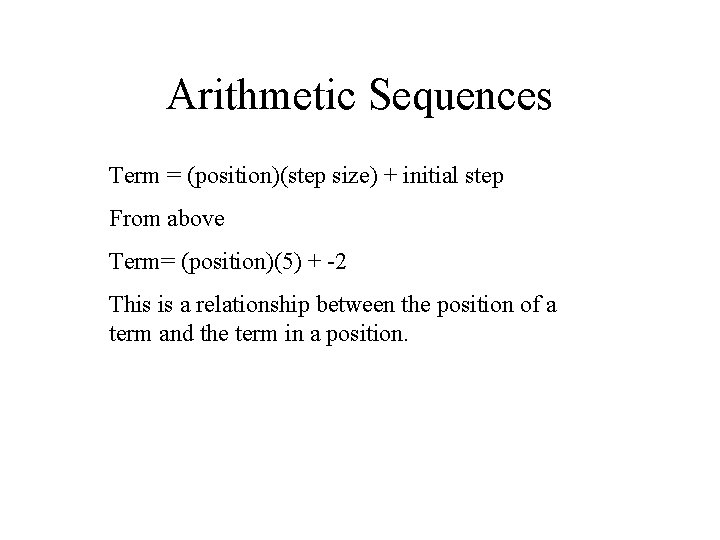
Arithmetic Sequences Term = (position)(step size) + initial step From above Term= (position)(5) + -2 This is a relationship between the position of a term and the term in a position.
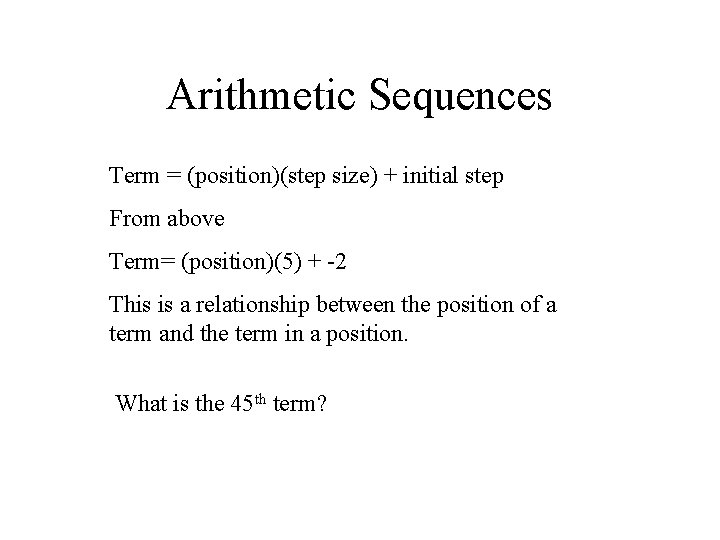
Arithmetic Sequences Term = (position)(step size) + initial step From above Term= (position)(5) + -2 This is a relationship between the position of a term and the term in a position. What is the 45 th term?
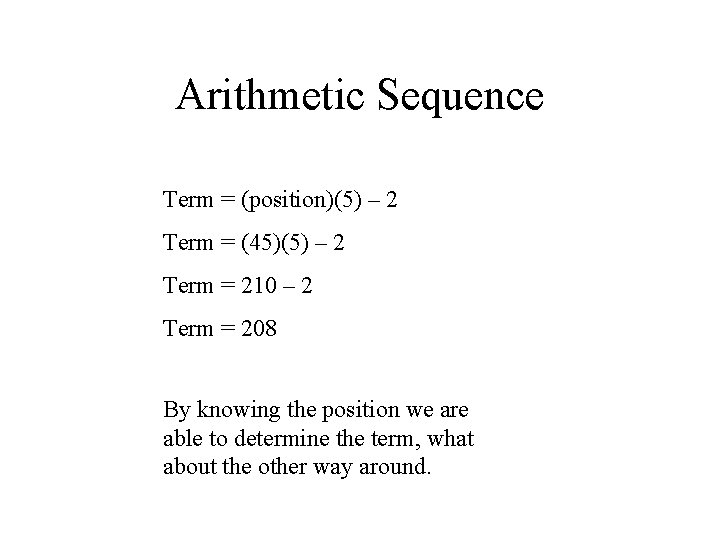
Arithmetic Sequence Term = (position)(5) – 2 Term = (45)(5) – 2 Term = 210 – 2 Term = 208 By knowing the position we are able to determine the term, what about the other way around.
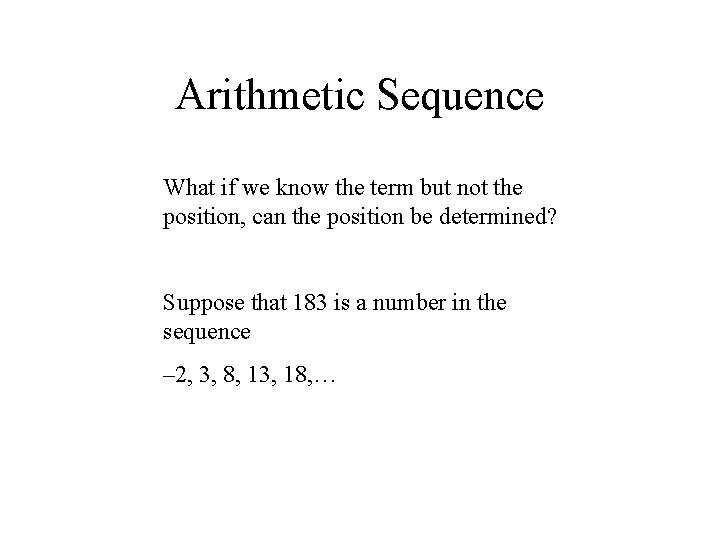
Arithmetic Sequence What if we know the term but not the position, can the position be determined? Suppose that 183 is a number in the sequence – 2, 3, 8, 13, 18, …
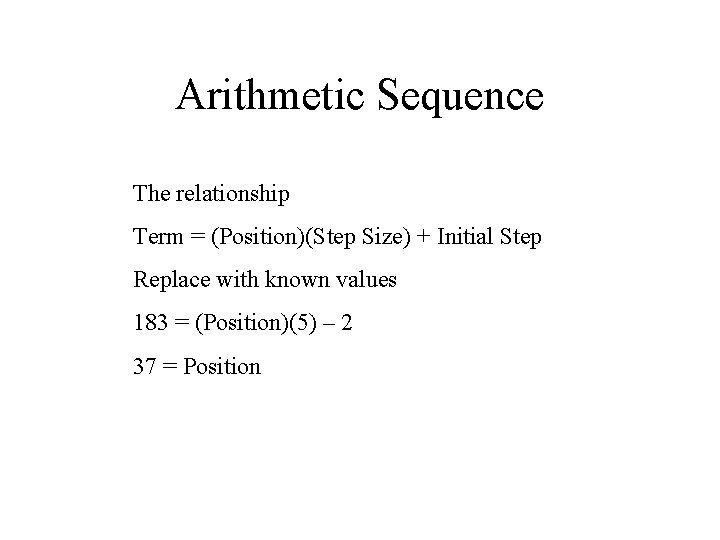
Arithmetic Sequence The relationship Term = (Position)(Step Size) + Initial Step Replace with known values 183 = (Position)(5) – 2 37 = Position
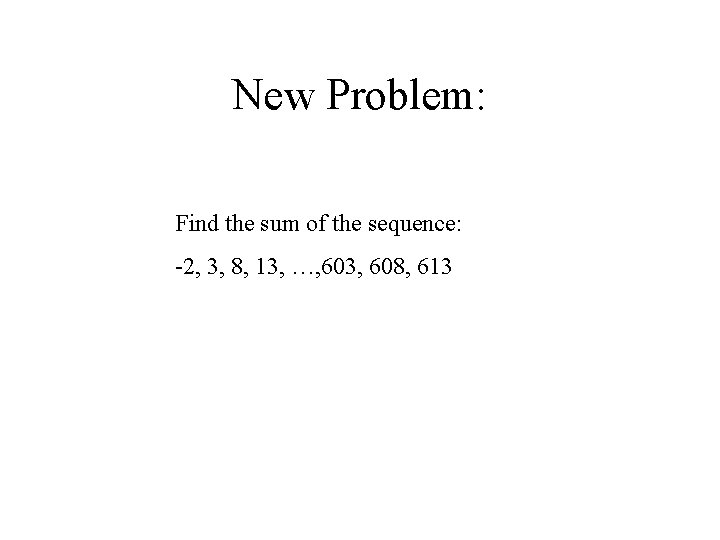
New Problem: Find the sum of the sequence: -2, 3, 8, 13, …, 603, 608, 613
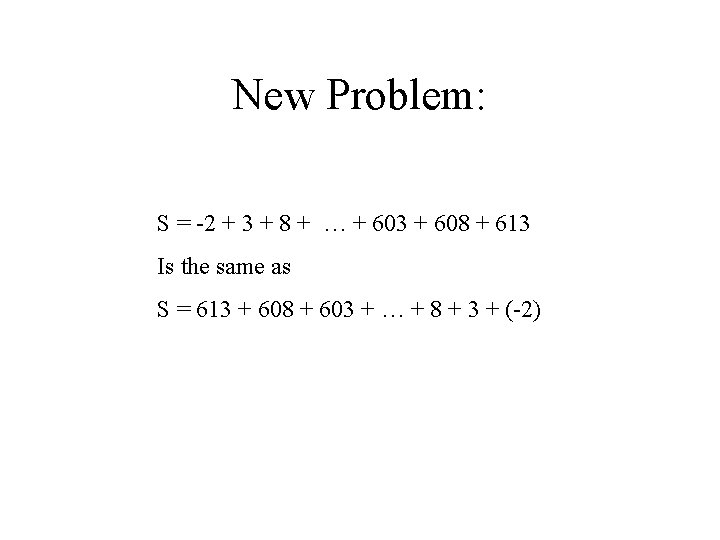
New Problem: S = -2 + 3 + 8 + … + 603 + 608 + 613 Is the same as S = 613 + 608 + 603 + … + 8 + 3 + (-2)
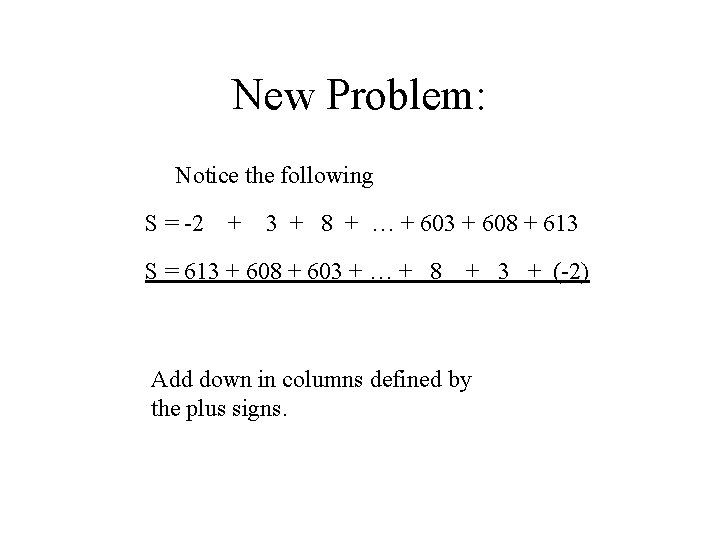
New Problem: Notice the following S = -2 + 3 + 8 + … + 603 + 608 + 613 S = 613 + 608 + 603 + … + 8 + 3 + (-2) Add down in columns defined by the plus signs.
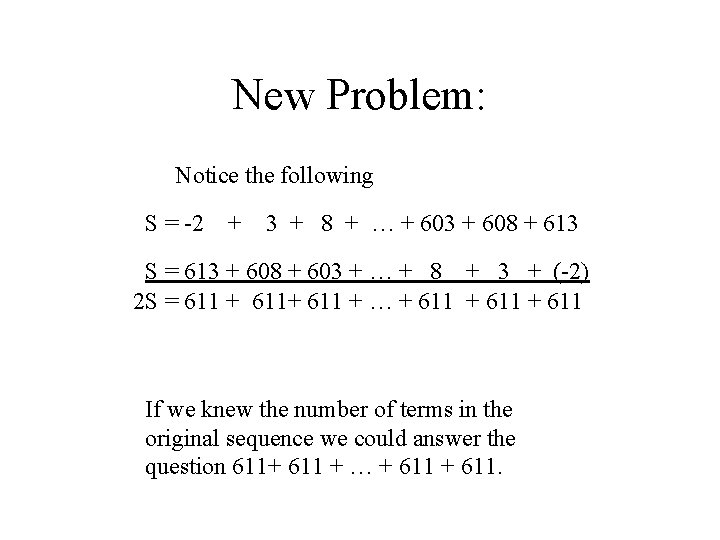
New Problem: Notice the following S = -2 + 3 + 8 + … + 603 + 608 + 613 S = 613 + 608 + 603 + … + 8 + 3 + (-2) 2 S = 611 + … + 611 If we knew the number of terms in the original sequence we could answer the question 611+ 611 + … + 611.
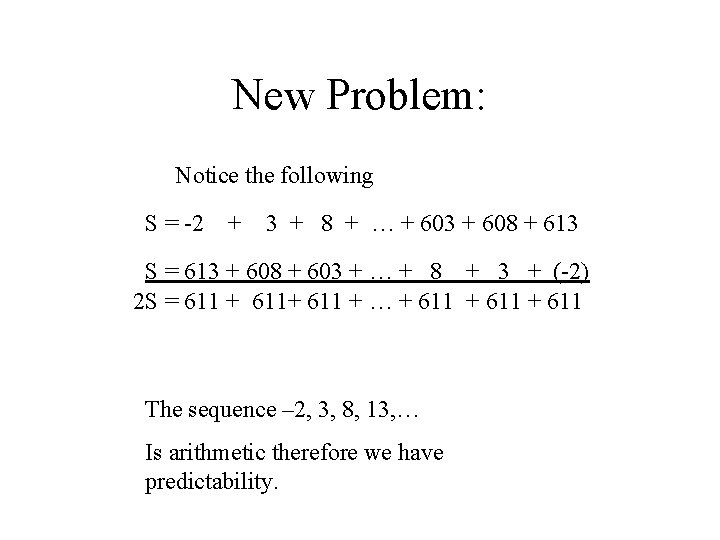
New Problem: Notice the following S = -2 + 3 + 8 + … + 603 + 608 + 613 S = 613 + 608 + 603 + … + 8 + 3 + (-2) 2 S = 611 + … + 611 The sequence – 2, 3, 8, 13, … Is arithmetic therefore we have predictability.
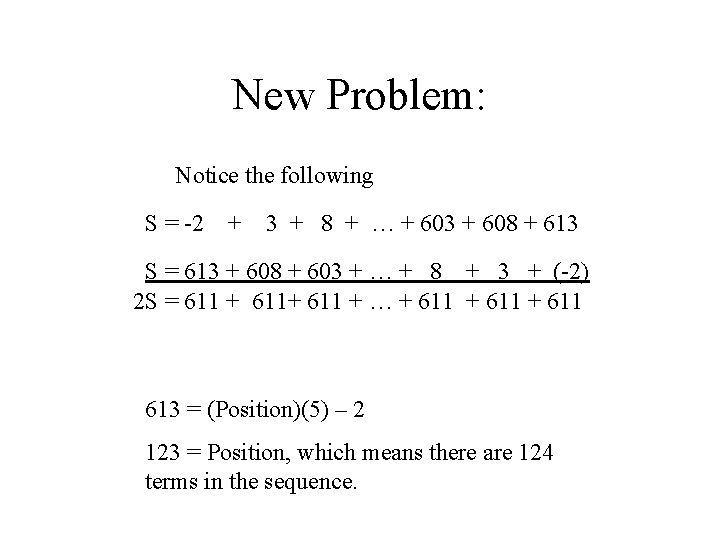
New Problem: Notice the following S = -2 + 3 + 8 + … + 603 + 608 + 613 S = 613 + 608 + 603 + … + 8 + 3 + (-2) 2 S = 611 + … + 611 613 = (Position)(5) – 2 123 = Position, which means there are 124 terms in the sequence.
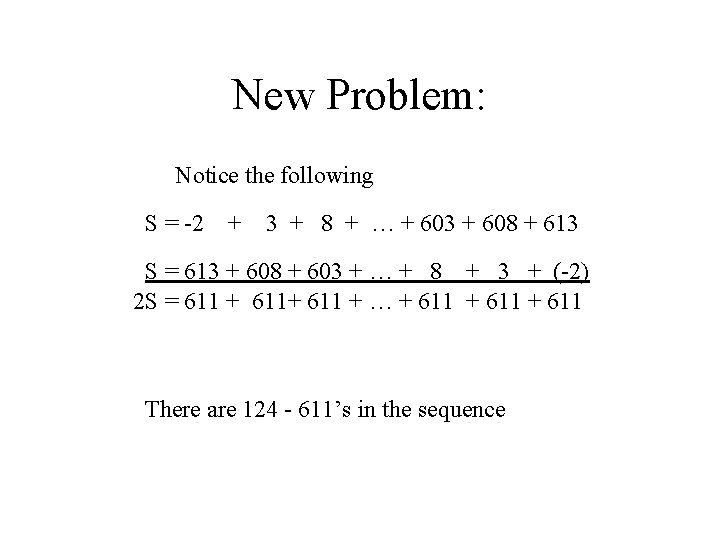
New Problem: Notice the following S = -2 + 3 + 8 + … + 603 + 608 + 613 S = 613 + 608 + 603 + … + 8 + 3 + (-2) 2 S = 611 + … + 611 There are 124 - 611’s in the sequence
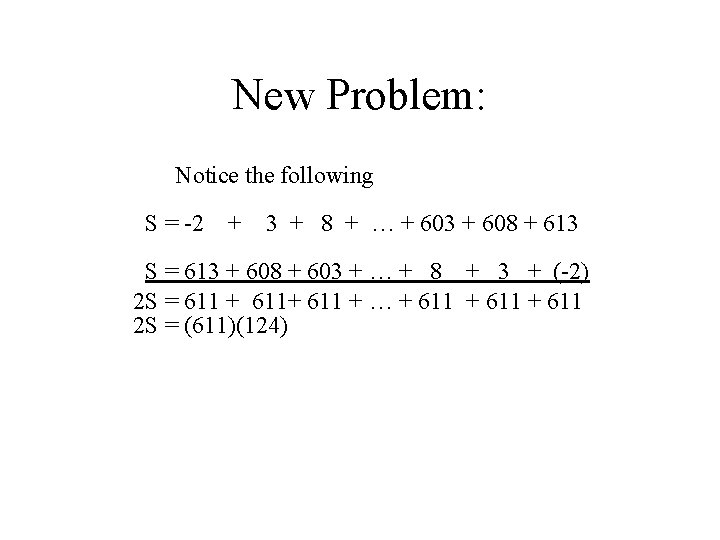
New Problem: Notice the following S = -2 + 3 + 8 + … + 603 + 608 + 613 S = 613 + 608 + 603 + … + 8 + 3 + (-2) 2 S = 611 + … + 611 2 S = (611)(124)
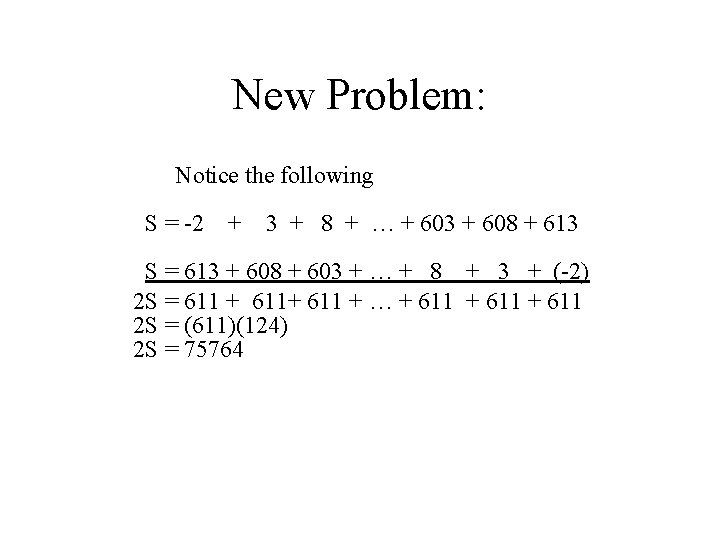
New Problem: Notice the following S = -2 + 3 + 8 + … + 603 + 608 + 613 S = 613 + 608 + 603 + … + 8 + 3 + (-2) 2 S = 611 + … + 611 2 S = (611)(124) 2 S = 75764
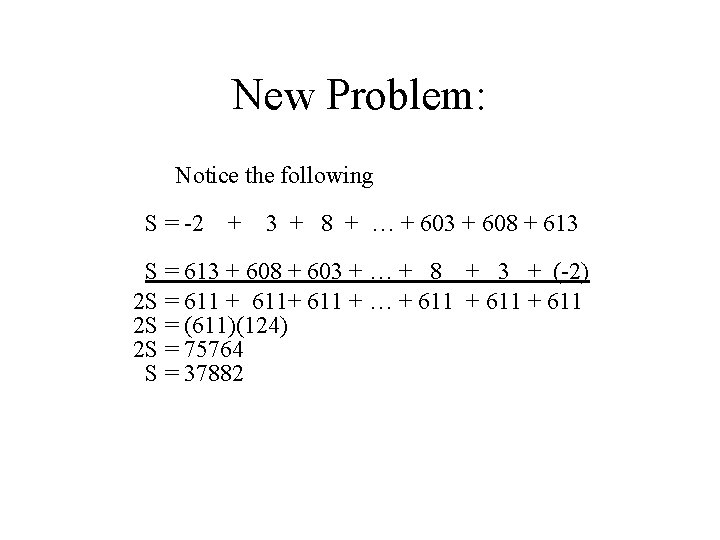
New Problem: Notice the following S = -2 + 3 + 8 + … + 603 + 608 + 613 S = 613 + 608 + 603 + … + 8 + 3 + (-2) 2 S = 611 + … + 611 2 S = (611)(124) 2 S = 75764 S = 37882
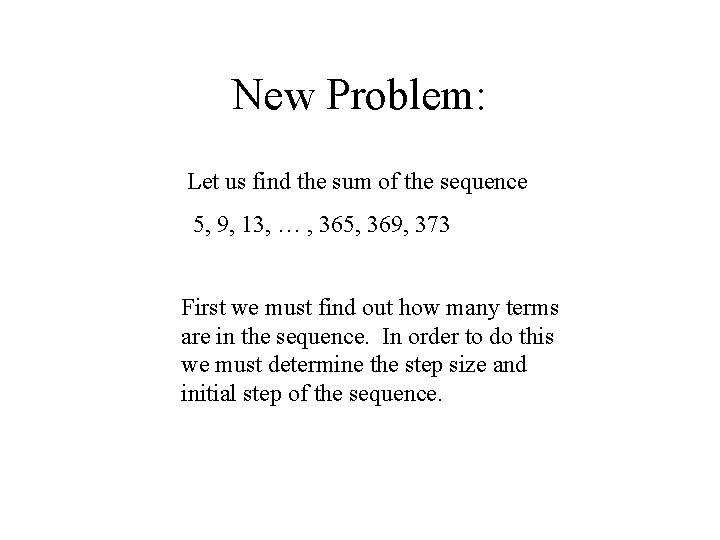
New Problem: Let us find the sum of the sequence 5, 9, 13, … , 365, 369, 373 First we must find out how many terms are in the sequence. In order to do this we must determine the step size and initial step of the sequence.
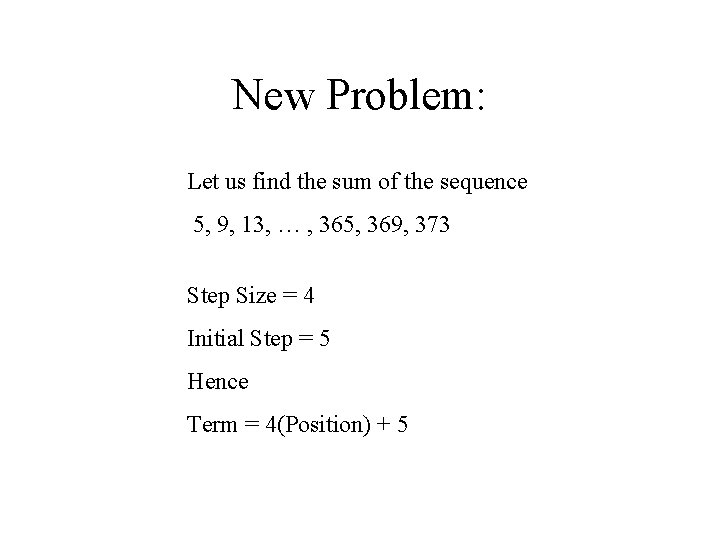
New Problem: Let us find the sum of the sequence 5, 9, 13, … , 365, 369, 373 Step Size = 4 Initial Step = 5 Hence Term = 4(Position) + 5
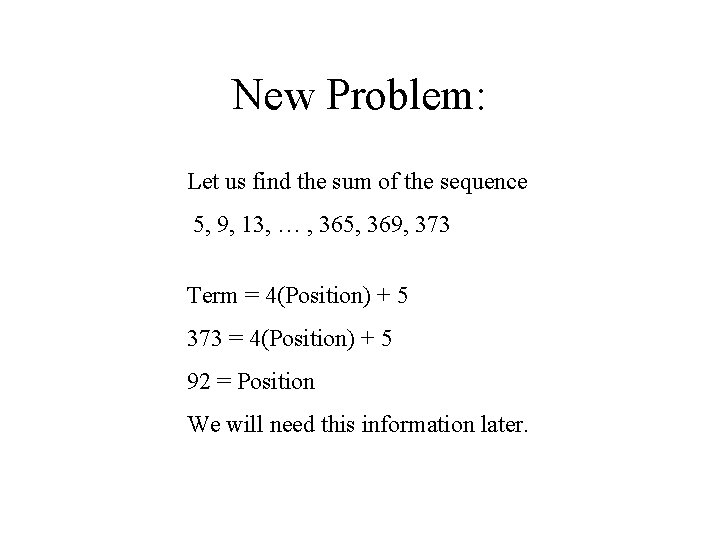
New Problem: Let us find the sum of the sequence 5, 9, 13, … , 365, 369, 373 Term = 4(Position) + 5 373 = 4(Position) + 5 92 = Position We will need this information later.
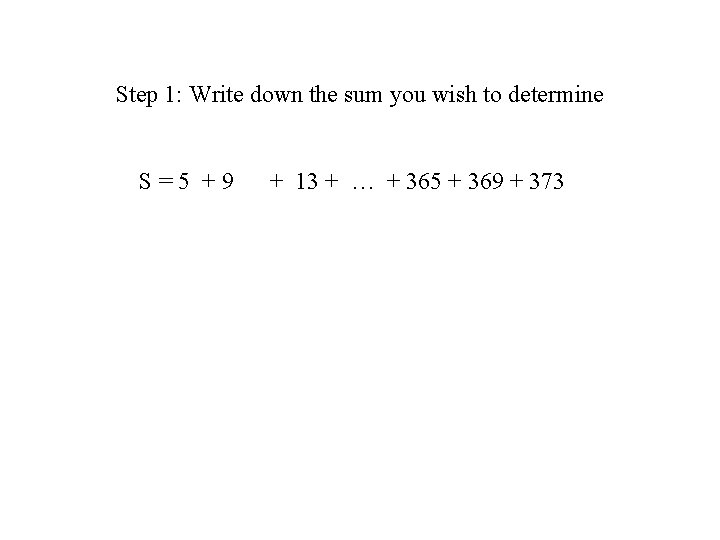
Step 1: Write down the sum you wish to determine S=5 +9 + 13 + … + 365 + 369 + 373
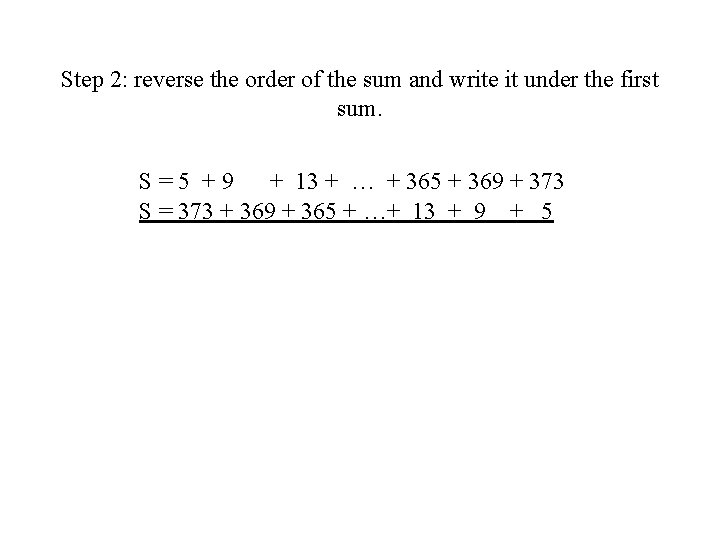
Step 2: reverse the order of the sum and write it under the first sum. S=5 +9 + 13 + … + 365 + 369 + 373 S = 373 + 369 + 365 + …+ 13 + 9 + 5
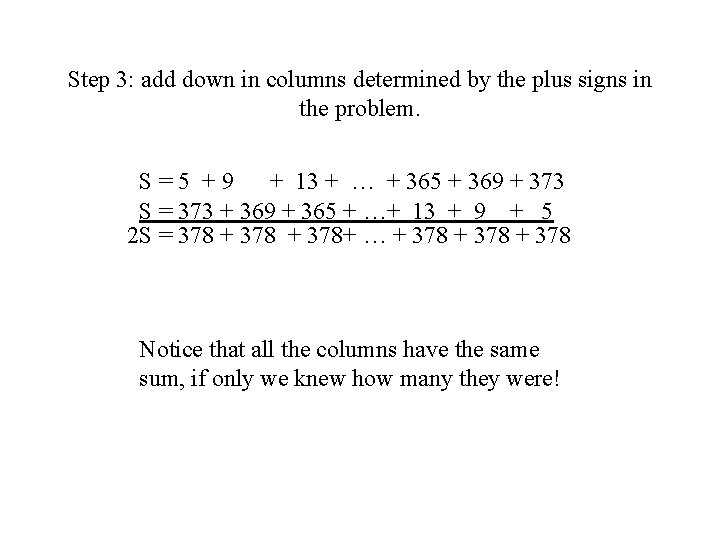
Step 3: add down in columns determined by the plus signs in the problem. S=5 +9 + 13 + … + 365 + 369 + 373 S = 373 + 369 + 365 + …+ 13 + 9 + 5 2 S = 378 + 378+ … + 378 Notice that all the columns have the same sum, if only we knew how many they were!
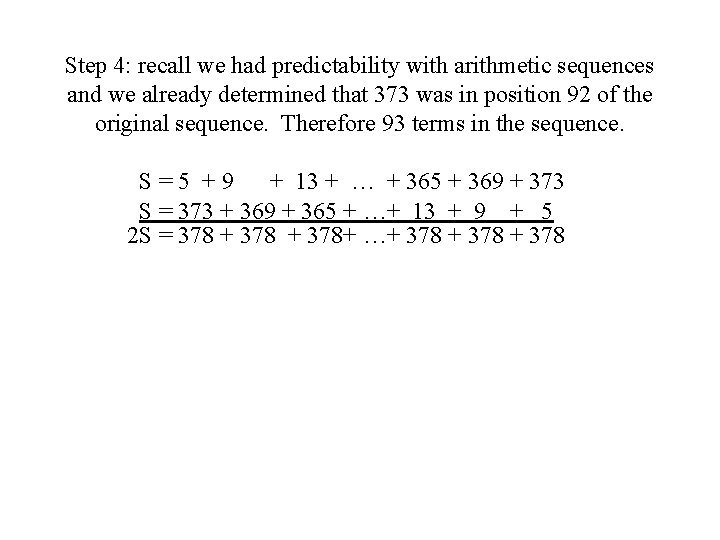
Step 4: recall we had predictability with arithmetic sequences and we already determined that 373 was in position 92 of the original sequence. Therefore 93 terms in the sequence. S=5 +9 + 13 + … + 365 + 369 + 373 S = 373 + 369 + 365 + …+ 13 + 9 + 5 2 S = 378 + 378+ …+ 378
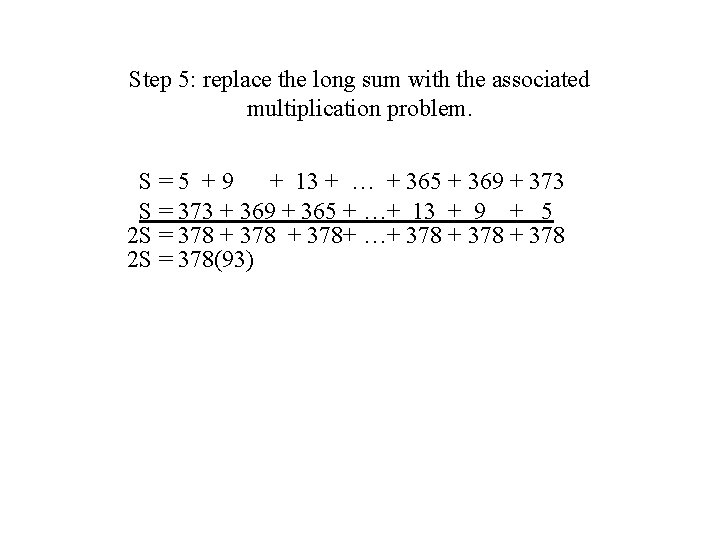
Step 5: replace the long sum with the associated multiplication problem. S=5 +9 + 13 + … + 365 + 369 + 373 S = 373 + 369 + 365 + …+ 13 + 9 + 5 2 S = 378 + 378+ …+ 378 2 S = 378(93)
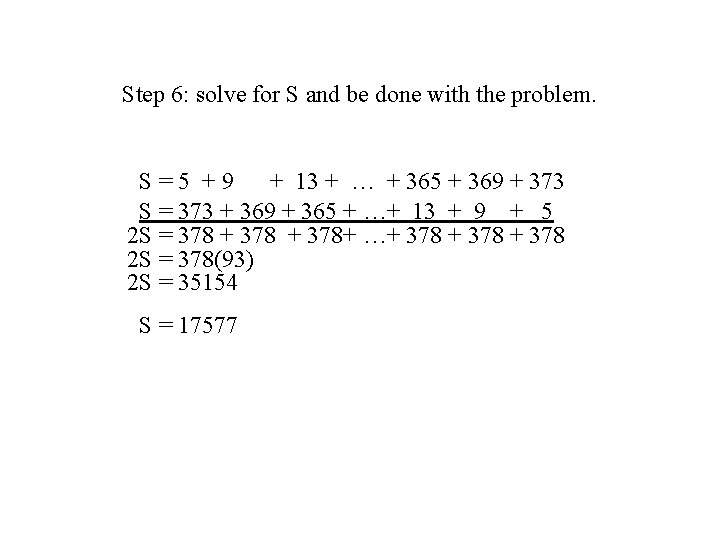
Step 6: solve for S and be done with the problem. S=5 +9 + 13 + … + 365 + 369 + 373 S = 373 + 369 + 365 + …+ 13 + 9 + 5 2 S = 378 + 378+ …+ 378 2 S = 378(93) 2 S = 35154 S = 17577
- Slides: 49