
Problem 5 SEASHELL When you put a seashell
Problem #5: SEA-SHELL “When you put a sea-shell to your ear you can hear ‘the sea’. Study the nature and the characteristics of the sound” Diogo Bercito 17 th IYPT - AUSTRALIA - Brisbane - 24 th June to 1 st July
1. 0 – OF THE HYPOTHESIS - Explanations: 1 – The sound is the amplified blood sound 2 – The sound is the external sound amplified by the shell - Our hypothesis 1 - Wind sound
1. 1 – OF THE NECESSARY KNOWLEDGE a) Sound b) - Mechanical perturbation c) - Air propagation b) Reverberation - Standing waves - Reverberation time - Tune quality t=d/v t<0, 1 2 d/v<0, 1 d<0, 1. 340/2 d<17 m c) Ressonance - Natural frequencies of vibration - Amplification of the sound - Improvement of some frequencies (usually behind 200 Hz)
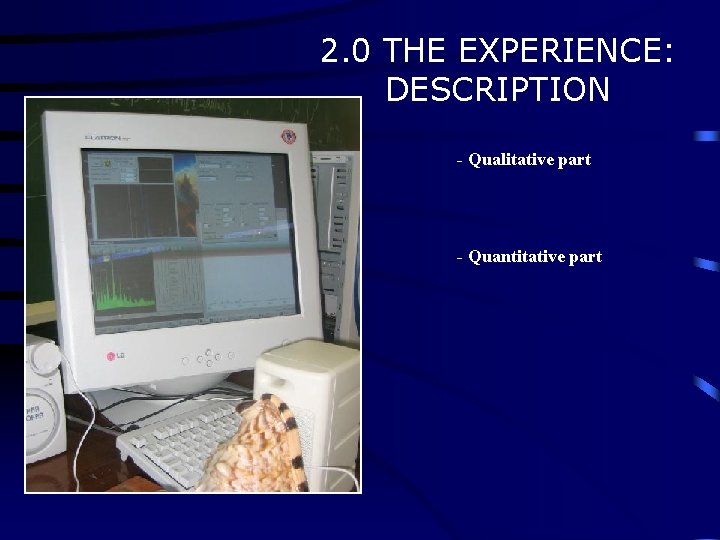
2. 0 THE EXPERIENCE: DESCRIPTION - Qualitative part - Quantitative part

a) Material - Different shaped sea-shells - PVC Tube - Complication level - The sea-shells will now be called as 1, 2 and 3, for an easy comprehension. Pecten maximus (1) Cittarium pica (2) Turbo chrysostomus (3)
b) Procedure 1) Qualitative part - Hear each sea-shell and the PVC Tube - After an exercise - Near the ventilator - In isolation 2) Quantitative part - Computerized analysis - Produce a white noise (sound with almost all frequencies) inside the shell - Measure the sound with the microphone - Analyse the result with a proper software
2. 1 THE EXPERIENCE: DATA 1) Qualitative part (1) Pecten maximus: Showed a low sound, almost inaudible, that seemed to be the sound of the wind. (2) Cittarium pica : Showed a low sound with a low pitch that could hardly remember the sea-sound. The sound was clear. (3) Turbo chrysostomus: The sound was not very high, but it was audible and remembered the sea-sound. PVC: The sound was the highest and the most high-pitched, but it was not as complex as the (3) Turbo chrystosomus.
2. 2 THE EXPERIENCE: DATA (cont. ) Exercise: - No diference between the sound listened before and after the exercise, eliminating this hypothesis. Ventilator: - No diference between the sound listened before and after the experience near the ventilator, eliminating this hypothesis. Isolation: - Sound less intense than the sound listened before the isolation, proving this hypothesis.
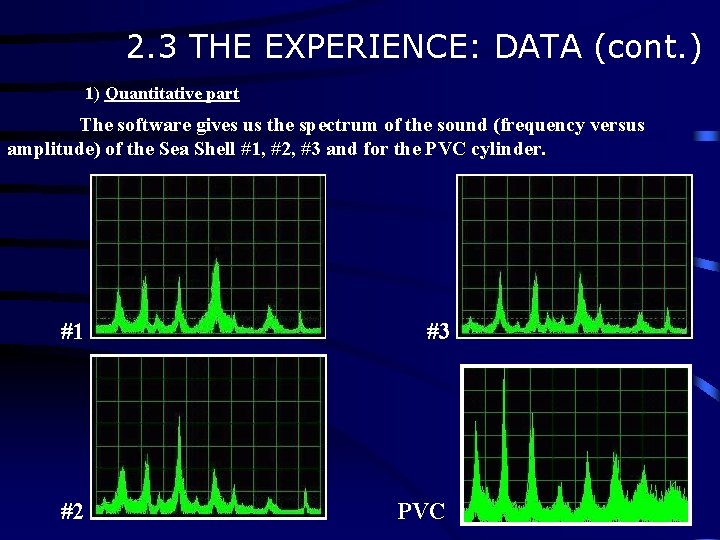
2. 3 THE EXPERIENCE: DATA (cont. ) 1) Quantitative part The software gives us the spectrum of the sound (frequency versus amplitude) of the Sea Shell #1, #2, #3 and for the PVC cylinder. #1 #3 #2 PVC
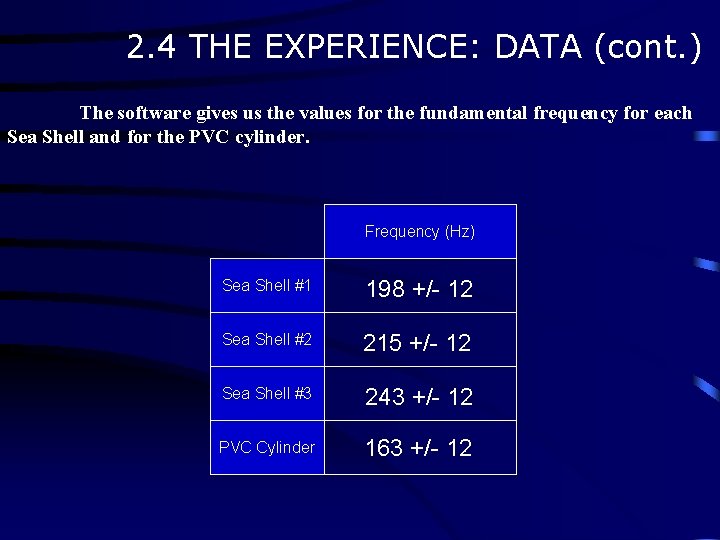
2. 4 THE EXPERIENCE: DATA (cont. ) The software gives us the values for the fundamental frequency for each Sea Shell and for the PVC cylinder. Frequency (Hz) Sea Shell #1 198 +/- 12 Sea Shell #2 215 +/- 12 Sea Shell #3 243 +/- 12 PVC Cylinder 163 +/- 12
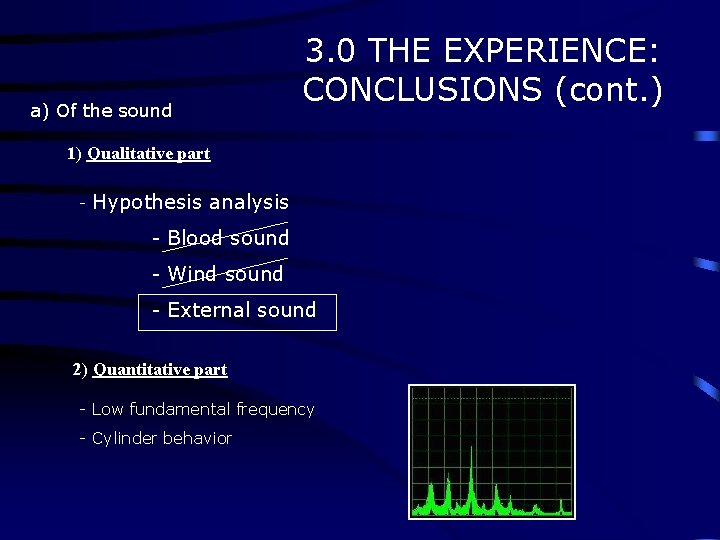
a) Of the sound 3. 0 THE EXPERIENCE: CONCLUSIONS (cont. ) 1) Qualitative part - Hypothesis analysis - Blood sound - Wind sound - External sound 2) Quantitative part - Low fundamental frequency - Cylinder behavior
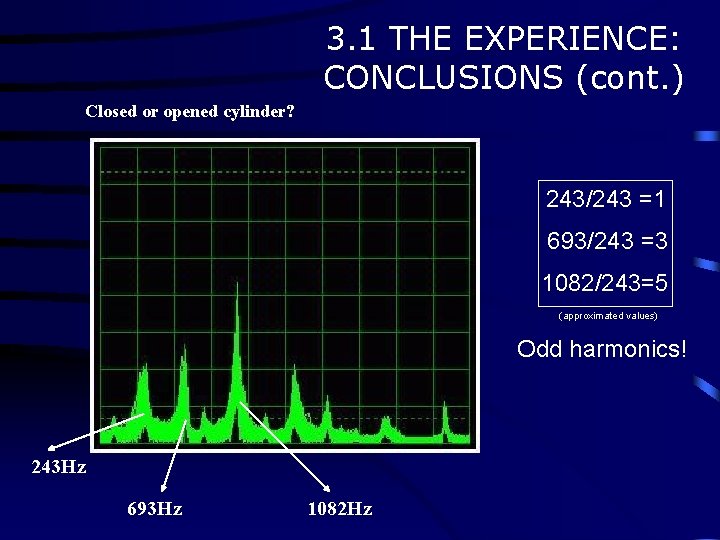
3. 1 THE EXPERIENCE: CONCLUSIONS (cont. ) Closed or opened cylinder? 243/243 =1 693/243 =3 1082/243=5 (approximated values) Odd harmonics! 243 Hz 693 Hz 1082 Hz
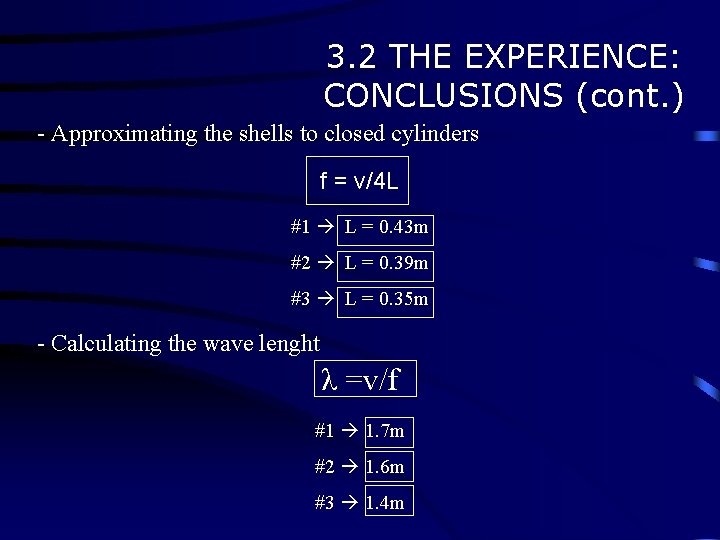
3. 2 THE EXPERIENCE: CONCLUSIONS (cont. ) - Approximating the shells to closed cylinders f = v/4 L #1 L = 0. 43 m #2 L = 0. 39 m #3 L = 0. 35 m - Calculating the wave lenght λ =v/f #1 1. 7 m #2 1. 6 m #3 1. 4 m
3. 3 THE EXPERIENCE: CONCLUSIONS (cont. ) - Sea-Shell sound X Sea Sound - Formation of the sound - The influence of the shape
4. 0 RESUME - External sound amplified by the Sea Shell - Low frequencies - Complex sound - Closed cylinders - Accoustic chambers
- Slides: 15