
Problem 31 Find the moments of inertia about
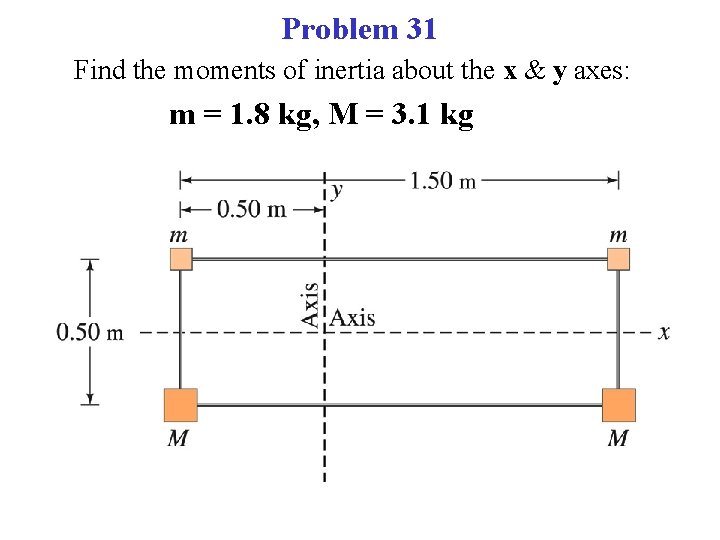
Problem 31 Find the moments of inertia about the x & y axes: m = 1. 8 kg, M = 3. 1 kg
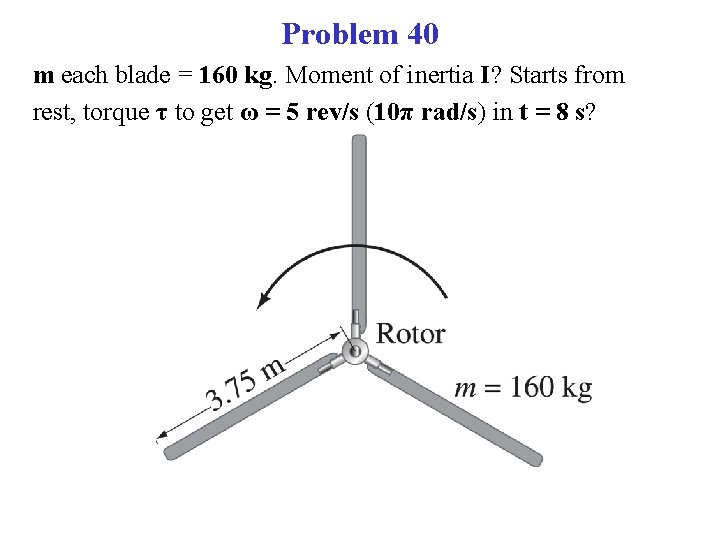
Problem 40 m each blade = 160 kg. Moment of inertia I? Starts from rest, torque τ to get ω = 5 rev/s (10π rad/s) in t = 8 s?
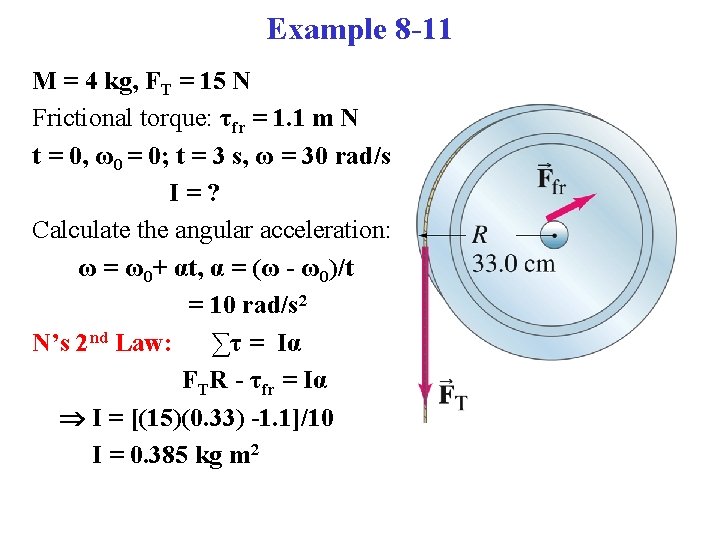
Example 8 -11 M = 4 kg, FT = 15 N Frictional torque: τfr = 1. 1 m N t = 0, ω0 = 0; t = 3 s, ω = 30 rad/s I=? Calculate the angular acceleration: ω = ω0+ αt, α = (ω - ω0)/t = 10 rad/s 2 N’s 2 nd Law: ∑τ = Iα FTR - τfr = Iα I = [(15)(0. 33) -1. 1]/10 I = 0. 385 kg m 2
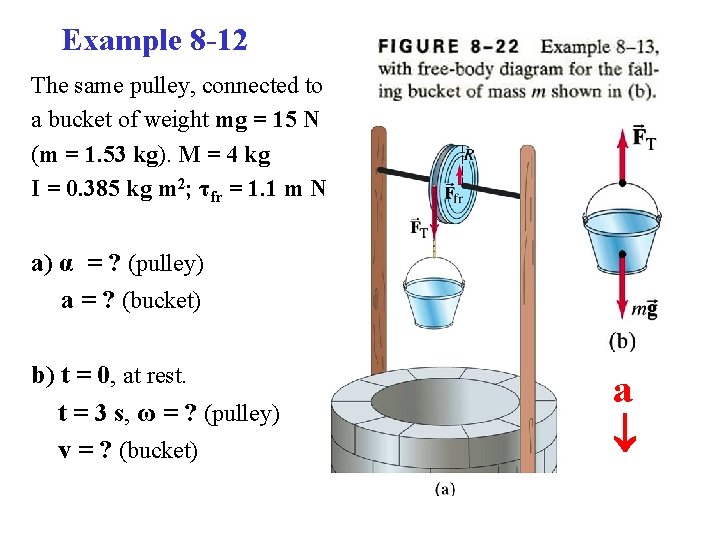
Example 8 -12 The same pulley, connected to a bucket of weight mg = 15 N (m = 1. 53 kg). M = 4 kg I = 0. 385 kg m 2; τfr = 1. 1 m N a) α = ? (pulley) a = ? (bucket) b) t = 0, at rest. t = 3 s, ω = ? (pulley) v = ? (bucket) a
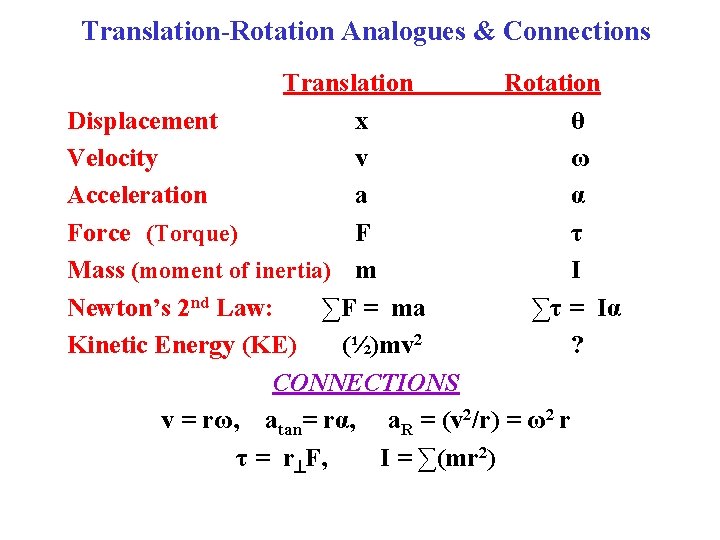
Translation-Rotation Analogues & Connections Translation Rotation Displacement x θ Velocity v ω Acceleration a α Force (Torque) F τ Mass (moment of inertia) m I Newton’s 2 nd Law: ∑F = ma ∑τ = Iα Kinetic Energy (KE) (½)mv 2 ? CONNECTIONS v = rω, atan= rα, a. R = (v 2/r) = ω2 r τ = r F, I = ∑(mr 2)
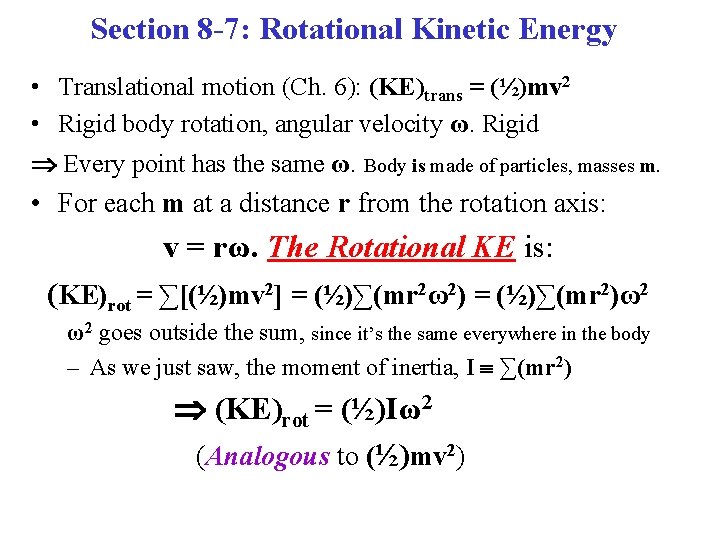
Section 8 -7: Rotational Kinetic Energy • Translational motion (Ch. 6): (KE)trans = (½)mv 2 • Rigid body rotation, angular velocity ω. Rigid Every point has the same ω. Body is made of particles, masses m. • For each m at a distance r from the rotation axis: v = rω. The Rotational KE is: (KE)rot = ∑[(½)mv 2] = (½)∑(mr 2ω2) = (½)∑(mr 2)ω2 ω2 goes outside the sum, since it’s the same everywhere in the body – As we just saw, the moment of inertia, I ∑(mr 2) (KE)rot = (½)Iω2 (Analogous to (½)mv 2)
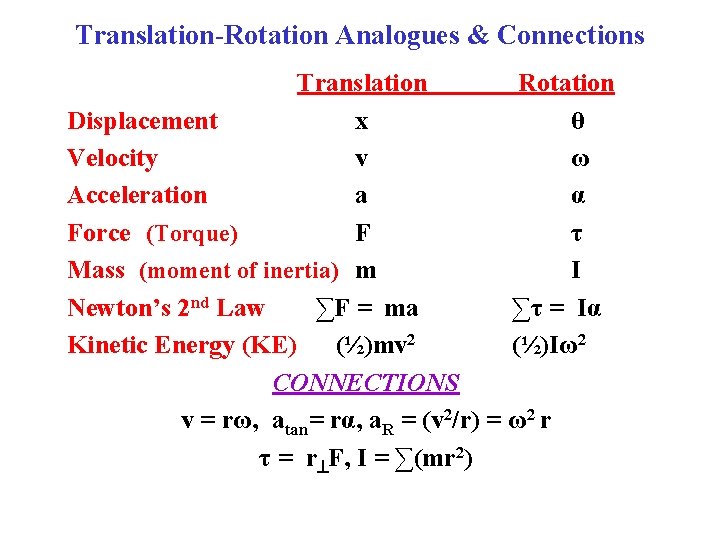
Translation-Rotation Analogues & Connections Translation Rotation Displacement x θ Velocity v ω Acceleration a α Force (Torque) F τ Mass (moment of inertia) m I Newton’s 2 nd Law ∑F = ma ∑τ = Iα Kinetic Energy (KE) (½)mv 2 (½)Iω2 CONNECTIONS v = rω, atan= rα, a. R = (v 2/r) = ω2 r τ = r F, I = ∑(mr 2)
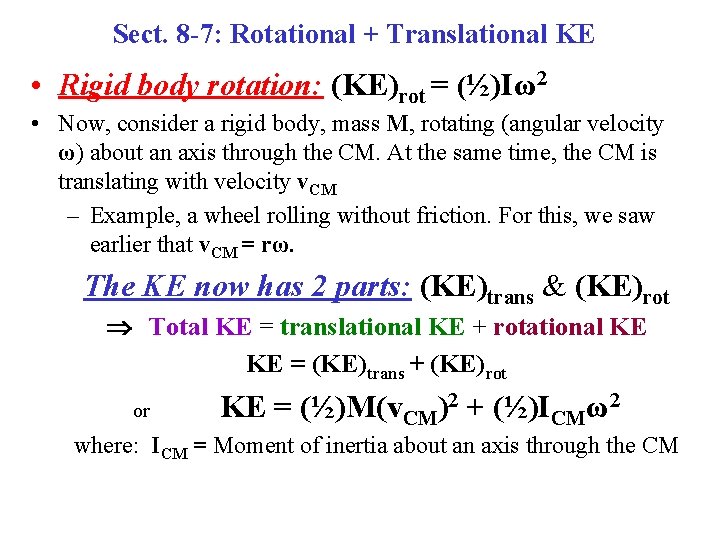
Sect. 8 -7: Rotational + Translational KE • Rigid body rotation: (KE)rot = (½)Iω2 • Now, consider a rigid body, mass M, rotating (angular velocity ω) about an axis through the CM. At the same time, the CM is translating with velocity v. CM – Example, a wheel rolling without friction. For this, we saw earlier that v. CM = rω. The KE now has 2 parts: (KE)trans & (KE)rot Total KE = translational KE + rotational KE KE = (KE)trans + (KE)rot or KE = (½)M(v. CM)2 + (½)ICMω2 where: ICM = Moment of inertia about an axis through the CM
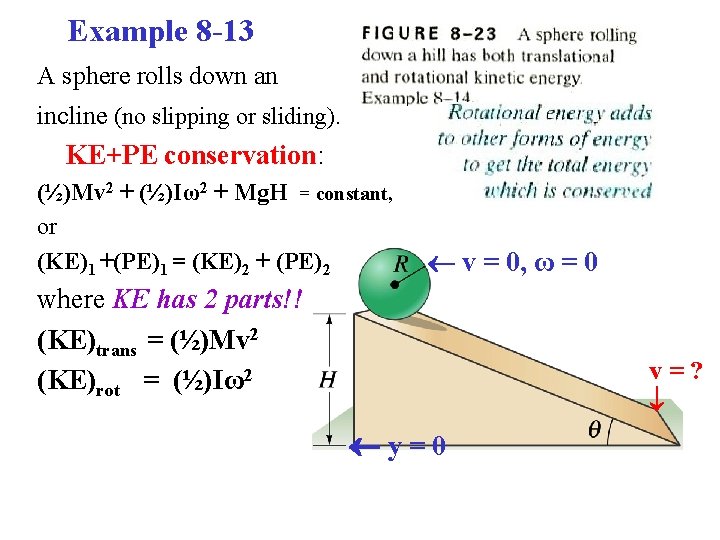
Example 8 -13 A sphere rolls down an incline (no slipping or sliding). KE+PE conservation: (½)Mv 2 + (½)Iω2 + Mg. H = constant, or (KE)1 +(PE)1 = (KE)2 + (PE)2 v = 0, ω = 0 where KE has 2 parts!! (KE)trans = (½)Mv 2 (KE)rot = (½)Iω2 v=? y=0
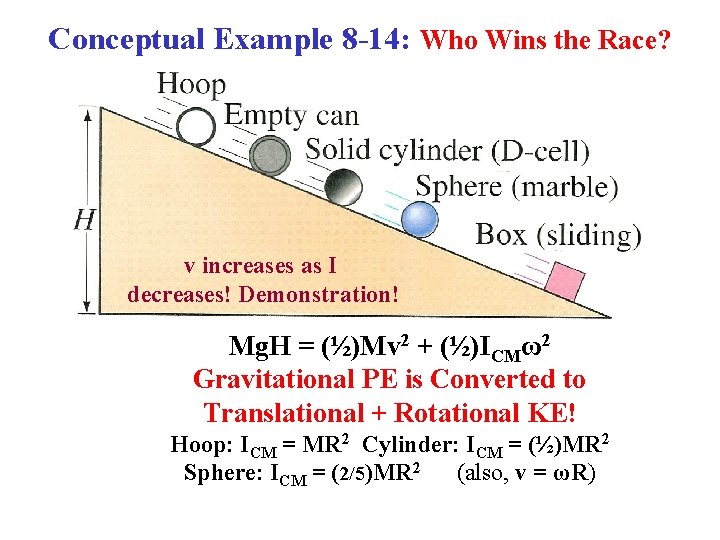
Conceptual Example 8 -14: Who Wins the Race? v increases as I decreases! Demonstration! Mg. H = (½)Mv 2 + (½)ICMω2 Gravitational PE is Converted to Translational + Rotational KE! Hoop: ICM = MR 2 Cylinder: ICM = (½)MR 2 Sphere: ICM = (2/5)MR 2 (also, v = ωR)
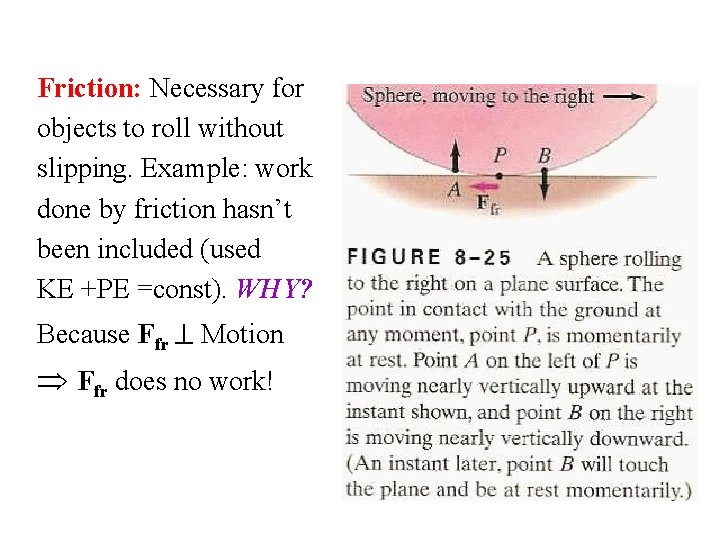
Friction: Necessary for objects to roll without slipping. Example: work done by friction hasn’t been included (used KE +PE =const). WHY? Because Ffr Motion Ffr does no work!
- Slides: 12