
Problem 1 A car stops 4 seconds after

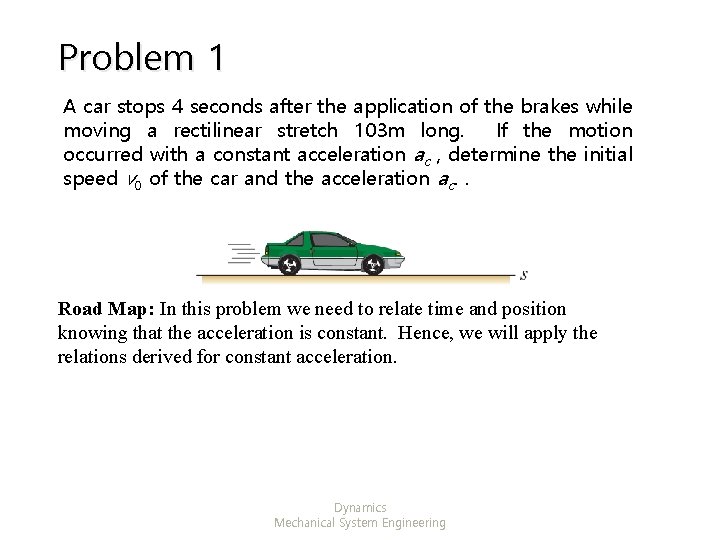
Problem 1 A car stops 4 seconds after the application of the brakes while moving a rectilinear stretch 103 m long. If the motion occurred with a constant acceleration ac , determine the initial speed v 0 of the car and the acceleration ac. . Road Map: In this problem we need to relate time and position knowing that the acceleration is constant. Hence, we will apply the relations derived for constant acceleration. Dynamics Mechanical System Engineering
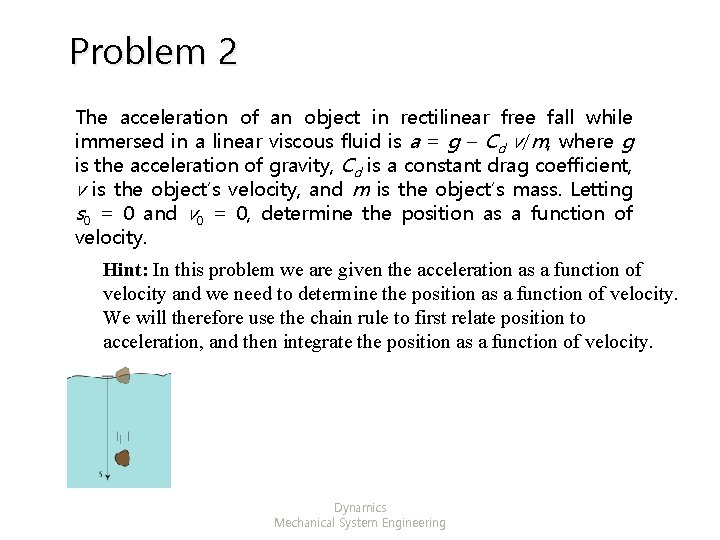
Problem 2 The acceleration of an object in rectilinear free fall while immersed in a linear viscous fluid is a = g – Cd v/m, where g is the acceleration of gravity, Cd is a constant drag coefficient, v is the object’s velocity, and m is the object’s mass. Letting s 0 = 0 and v 0 = 0, determine the position as a function of velocity. Hint: In this problem we are given the acceleration as a function of velocity and we need to determine the position as a function of velocity. We will therefore use the chain rule to first relate position to acceleration, and then integrate the position as a function of velocity. Dynamics Mechanical System Engineering
Problem 3 text 2. 5 Problem 4 text 2. 35 Problem 5 text 2. 105 Dynamics Mechanical System Engineering
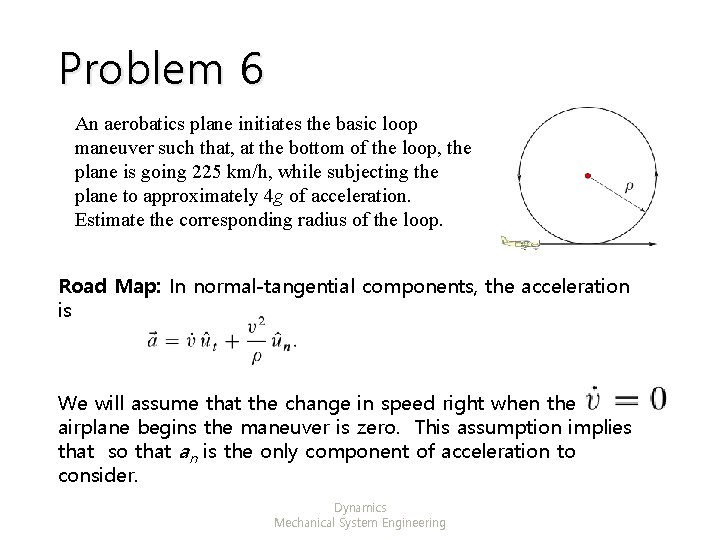
Problem 6 An aerobatics plane initiates the basic loop maneuver such that, at the bottom of the loop, the plane is going 225 km/h, while subjecting the plane to approximately 4 g of acceleration. Estimate the corresponding radius of the loop. Road Map: In normal-tangential components, the acceleration is We will assume that the change in speed right when the airplane begins the maneuver is zero. This assumption implies that so that an is the only component of acceleration to consider. Dynamics Mechanical System Engineering
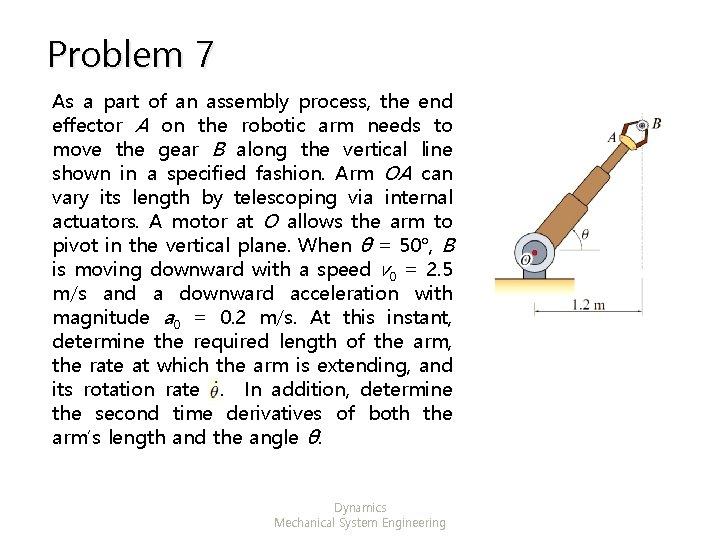
Problem 7 As a part of an assembly process, the end effector A on the robotic arm needs to move the gear B along the vertical line shown in a specified fashion. Arm OA can vary its length by telescoping via internal actuators. A motor at O allows the arm to pivot in the vertical plane. When θ = 50°, B is moving downward with a speed v 0 = 2. 5 m/s and a downward acceleration with magnitude a 0 = 0. 2 m/s. At this instant, determine the required length of the arm, the rate at which the arm is extending, and its rotation rate. In addition, determine the second time derivatives of both the arm’s length and the angle θ. Dynamics Mechanical System Engineering
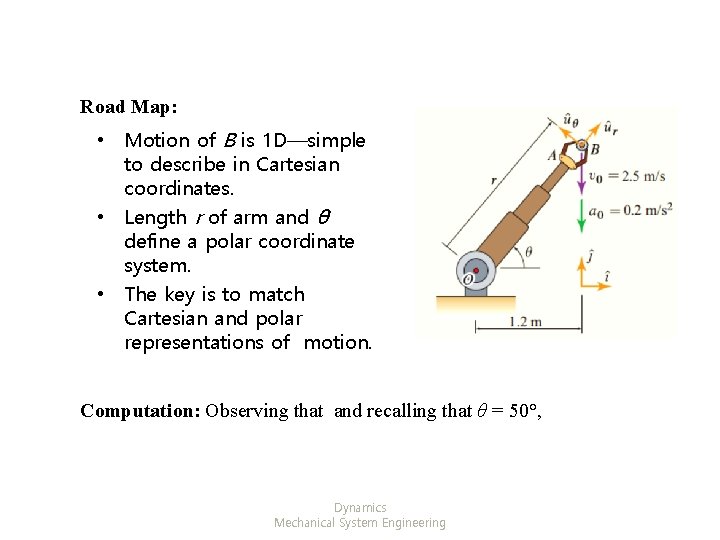
Road Map: • Motion of B is 1 D—simple to describe in Cartesian coordinates. • Length r of arm and θ define a polar coordinate system. • The key is to match Cartesian and polar representations of motion. Computation: Observing that and recalling that θ = 50°, Dynamics Mechanical System Engineering
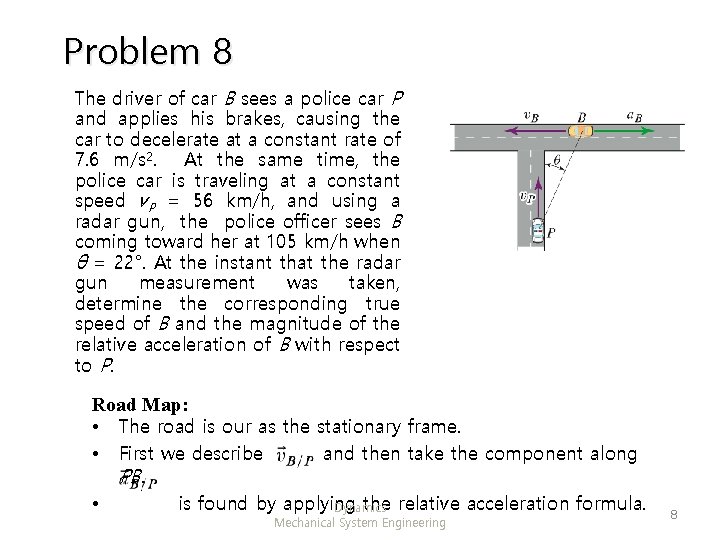
Problem 8 The driver of car B sees a police car P and applies his brakes, causing the car to decelerate at a constant rate of 7. 6 m/s 2. At the same time, the police car is traveling at a constant speed v. P = 56 km/h, and using a radar gun, the police officer sees B coming toward her at 105 km/h when θ = 22°. At the instant that the radar gun measurement was taken, determine the corresponding true speed of B and the magnitude of the relative acceleration of B with respect to P. Road Map: • The road is our as the stationary frame. • First we describe and then take the component along PB. • is found by applying the relative acceleration formula. Dynamics Mechanical System Engineering 8
Problem 9 text 2. 143 Problem 10 text 2. 215 Dynamics Mechanical System Engineering
- Slides: 9