
Probing the QGP Phase Diagram and Topological Charge
Probing the QGP Phase Diagram and Topological Charge Transitions at RHIC Paul Sorensen July 20 th, 2016 ULI Fest; CERN
Probing the QGP Phase Diagram and Topological Charge Transitions at RHIC Paul Sorensen July 20 th, 2016 ULI Fest; CERN
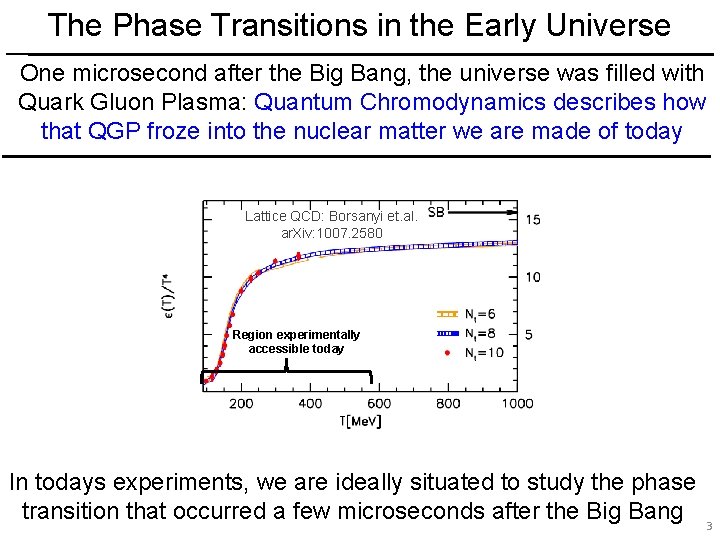
The Phase Transitions in the Early Universe One microsecond after the Big Bang, the universe was filled with Quark Gluon Plasma: Quantum Chromodynamics describes how that QGP froze into the nuclear matter we are made of today Lattice QCD: Borsanyi et. al. ar. Xiv: 1007. 2580 Region experimentally accessible today In todays experiments, we are ideally situated to study the phase transition that occurred a few microseconds after the Big Bang 3
What We Learn with ULtra-relat. Ivistic -HEavy Io. NZ Breaking of chiral symmetry in QCD generates 99% of the visible mass of the universe. Is chiral symmetry restored in heavy ion collisions? Can massless fermions in the chirally restored QGP be used to image the chiral anomaly of QCD? At low density, the phase transition between QGP and hadrons is smooth. Is there a 1 st order transition and a critical point at higher density? But first, where does the QGP exist and can we turn it off? 4
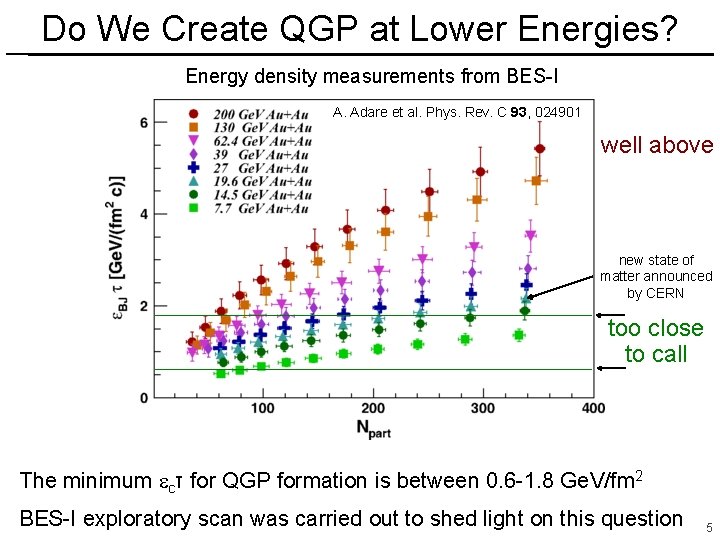
Do We Create QGP at Lower Energies? Energy density measurements from BES-I A. Adare et al. Phys. Rev. C 93, 024901 well above new state of matter announced by CERN too close to call The minimum cτ for QGP formation is between 0. 6 -1. 8 Ge. V/fm 2 BES-I exploratory scan was carried out to shed light on this question 5
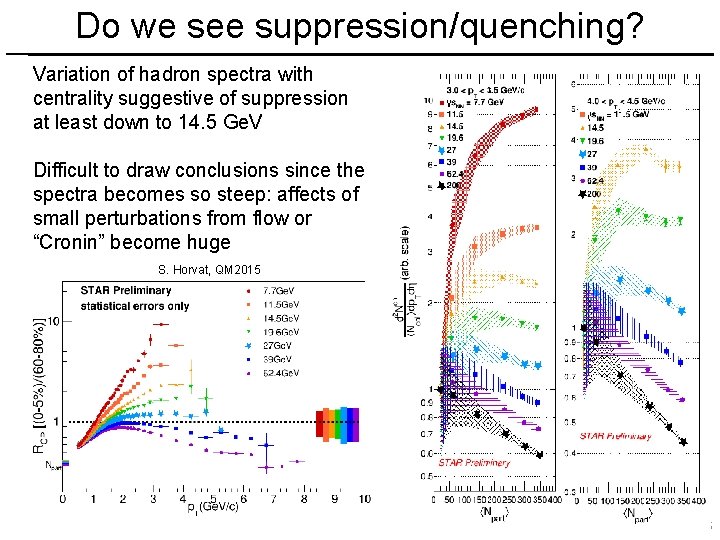
Do we see suppression/quenching? Variation of hadron spectra with centrality suggestive of suppression at least down to 14. 5 Ge. V Difficult to draw conclusions since the spectra becomes so steep: affects of small perturbations from flow or “Cronin” become huge S. Horvat, QM 2015 6
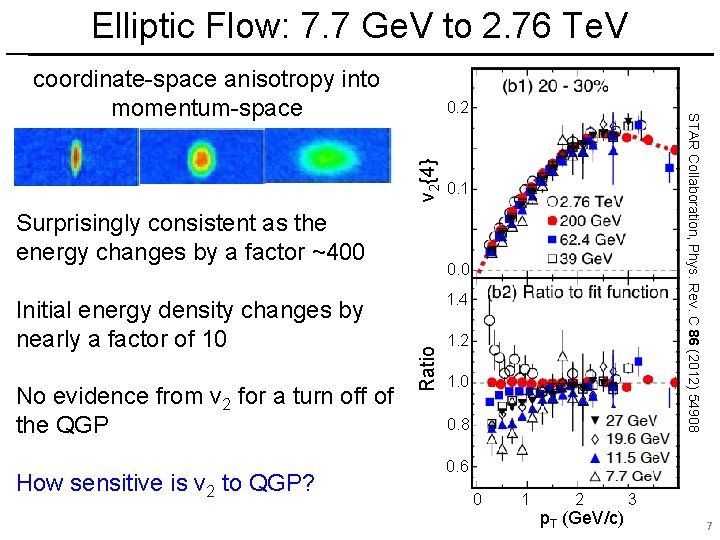
Elliptic Flow: 7. 7 Ge. V to 2. 76 Te. V coordinate-space anisotropy into momentum-space v 2{4} Surprisingly consistent as the energy changes by a factor ~400 No evidence from v 2 for a turn off of the QGP How sensitive is v 2 to QGP? 0. 1 0. 0 1. 4 Ratio Initial energy density changes by nearly a factor of 10 STAR Collaboration, Phys. Rev. C 86 (2012) 54908 0. 2 1. 0 0. 8 0. 6 0 1 2 p. T (Ge. V/c) 3 7
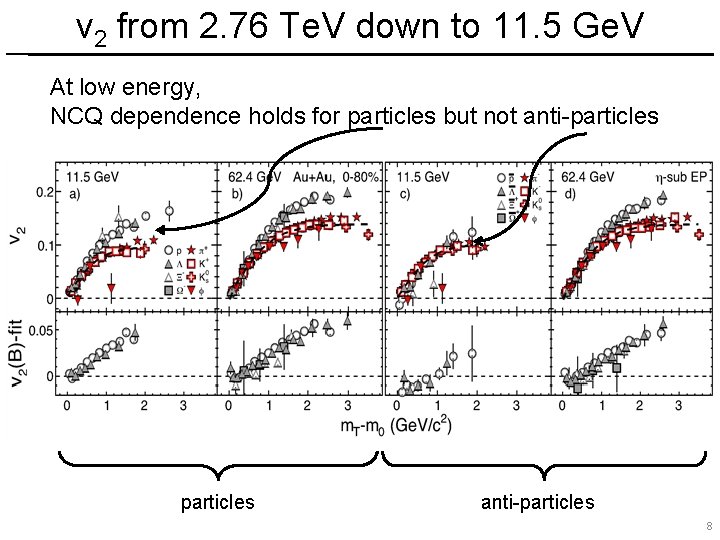
v 2 from 2. 76 Te. V down to 11. 5 Ge. V At low energy, NCQ dependence holds for particles but not anti-particles 8
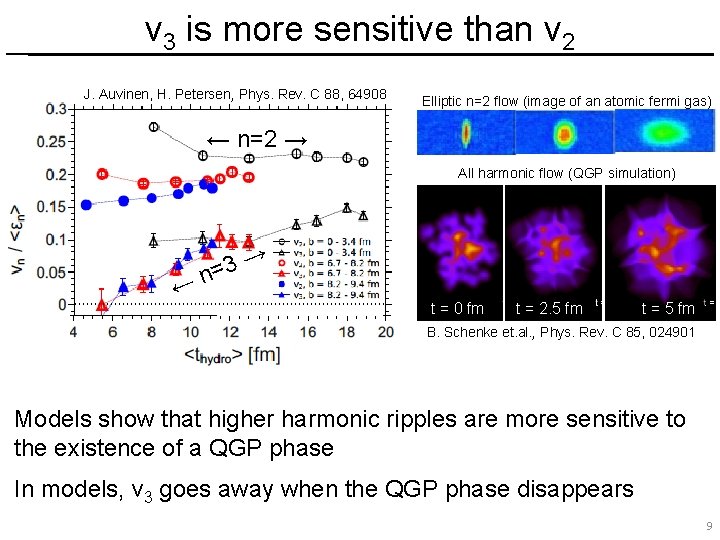
v 3 is more sensitive than v 2 J. Auvinen, H. Petersen, Phys. Rev. C 88, 64908 Elliptic n=2 flow (image of an atomic fermi gas) ← n=2 → All harmonic flow (QGP simulation) =3 n ← → t = 0 fm t = 2. 5 fm t = 5 fm B. Schenke et. al. , Phys. Rev. C 85, 024901 Models show that higher harmonic ripples are more sensitive to the existence of a QGP phase In models, v 3 goes away when the QGP phase disappears 9 9
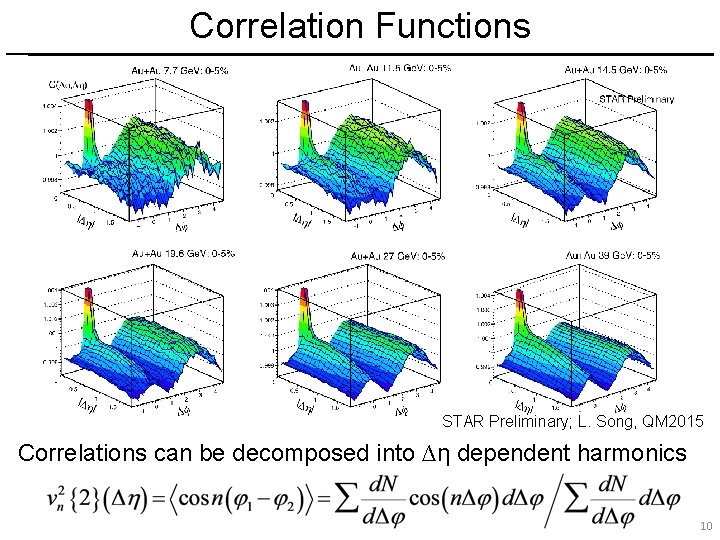
Correlation Functions STAR Preliminary; L. Song, QM 2015 Correlations can be decomposed into ∆η dependent harmonics 10
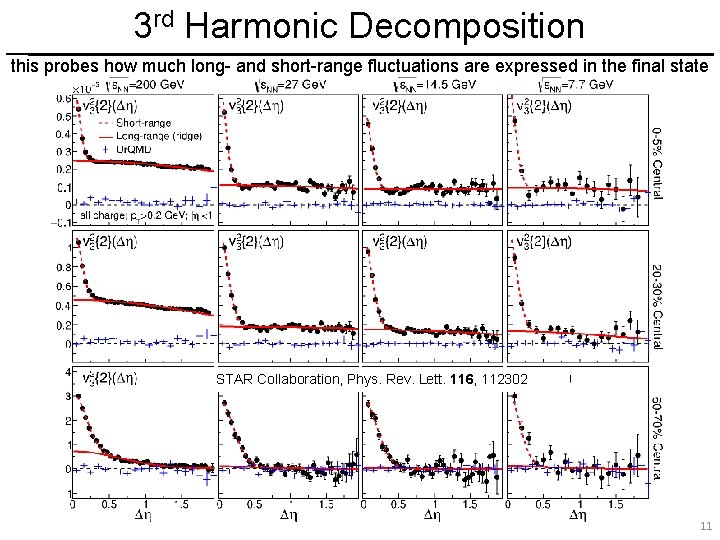
3 rd Harmonic Decomposition this probes how much long- and short-range fluctuations are expressed in the final state STAR Collaboration, Phys. Rev. Lett. 116, 112302 11 11
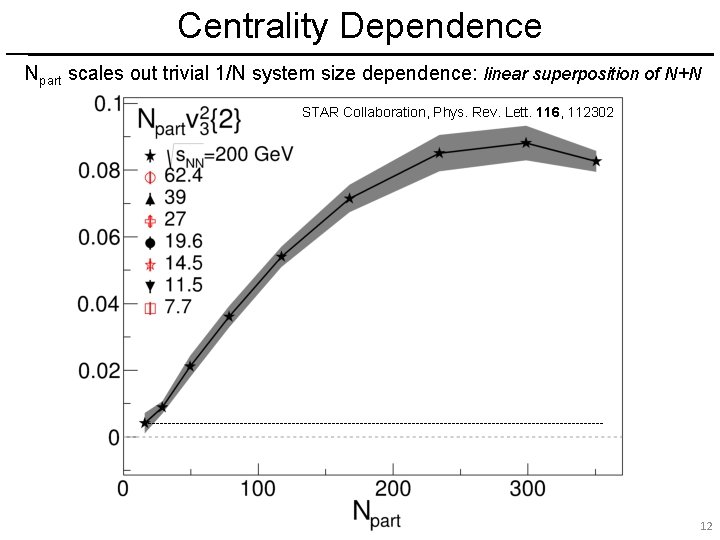
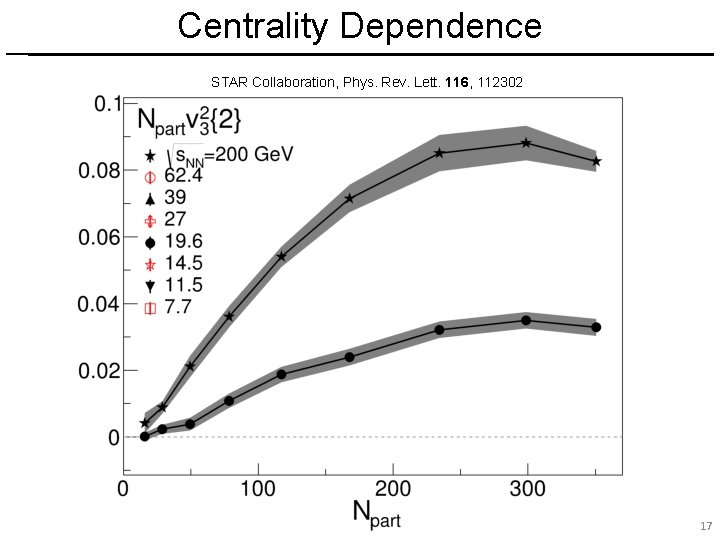
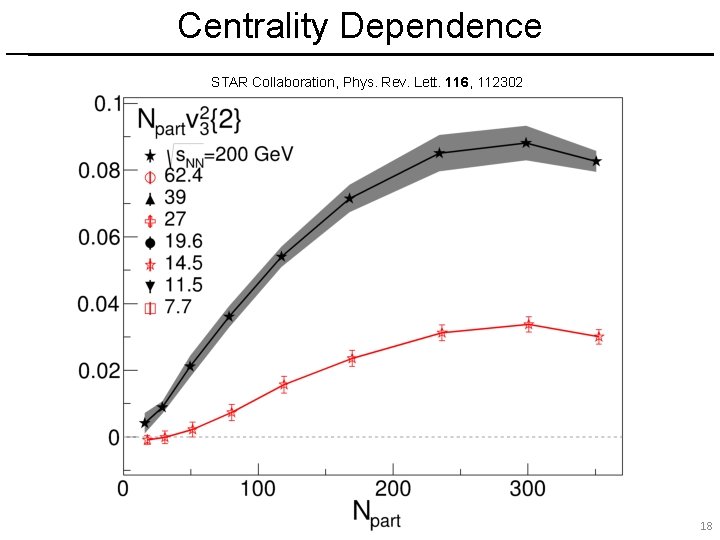
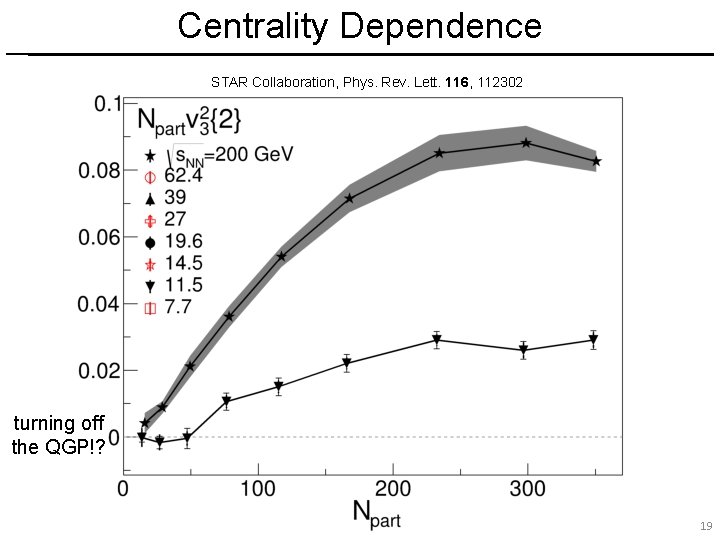
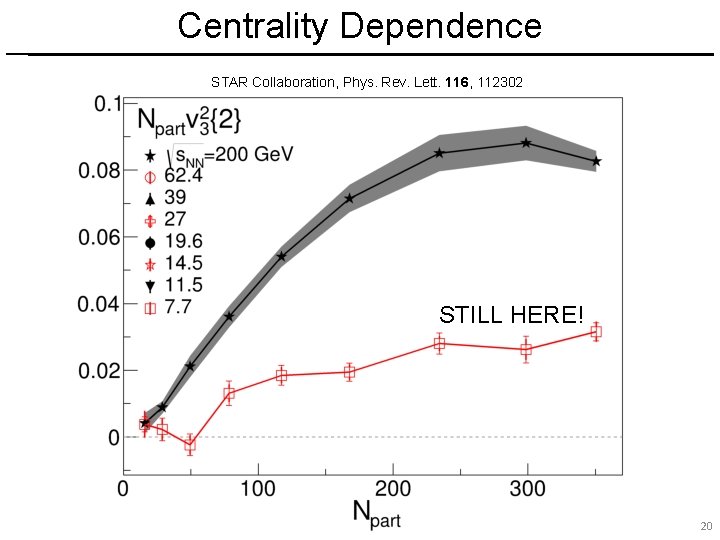
Centrality Dependence Npart scales out trivial 1/N system size dependence: linear superposition of N+N STAR Collaboration, Phys. Rev. Lett. 116, 112302 12 12
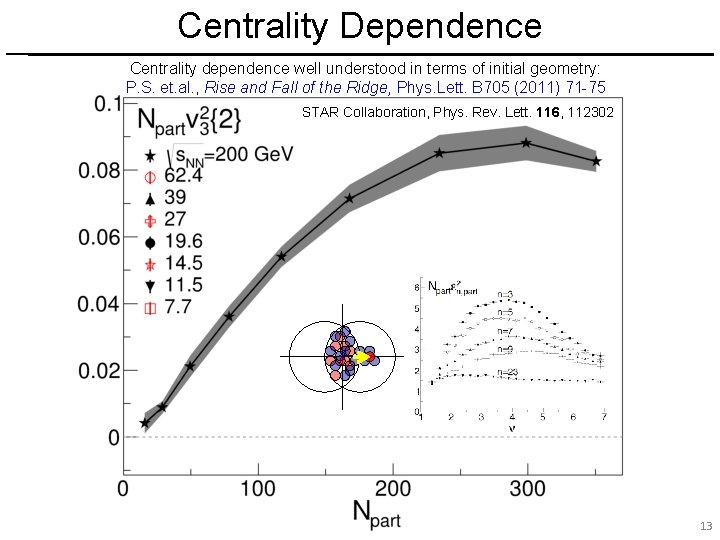
Centrality Dependence Centrality dependence well understood in terms of initial geometry: P. S. et. al. , Rise and Fall of the Ridge, Phys. Lett. B 705 (2011) 71 -75 STAR Collaboration, Phys. Rev. Lett. 116, 112302 13 13
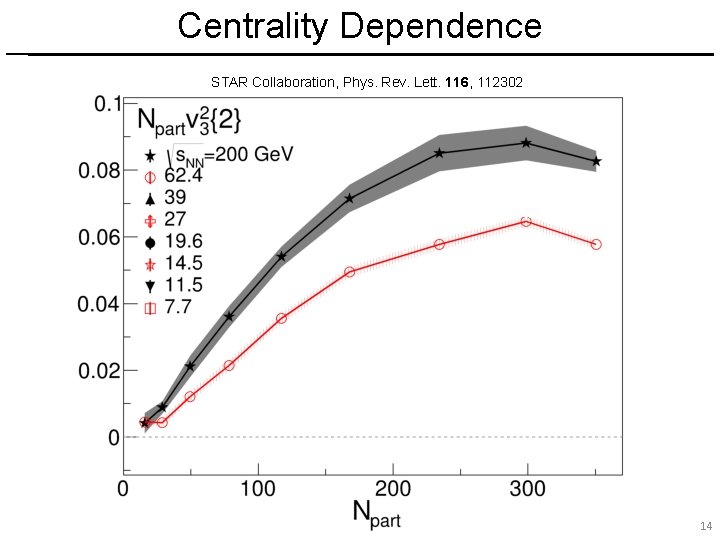
Centrality Dependence STAR Collaboration, Phys. Rev. Lett. 116, 112302 14 14
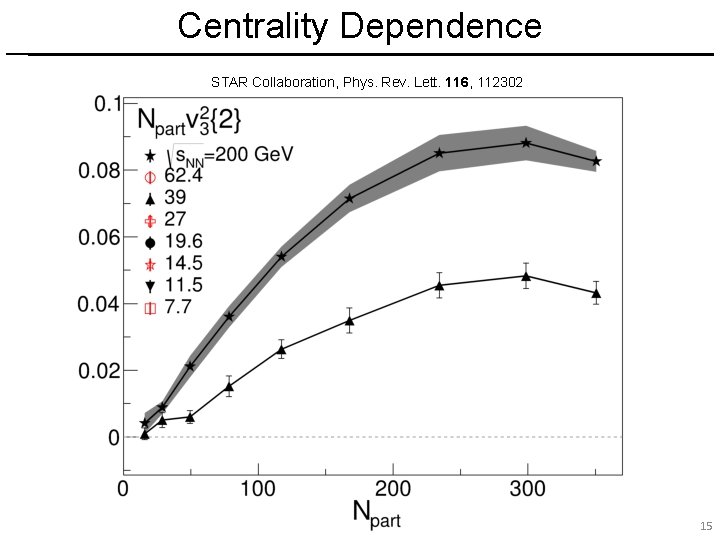
Centrality Dependence STAR Collaboration, Phys. Rev. Lett. 116, 112302 15 15
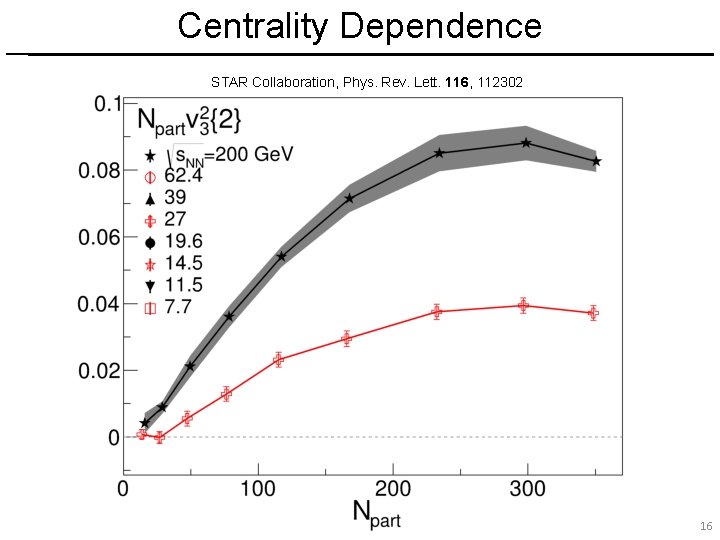
Centrality Dependence STAR Collaboration, Phys. Rev. Lett. 116, 112302 16 16
Centrality Dependence STAR Collaboration, Phys. Rev. Lett. 116, 112302 17 17
Centrality Dependence STAR Collaboration, Phys. Rev. Lett. 116, 112302 18 18
Centrality Dependence STAR Collaboration, Phys. Rev. Lett. 116, 112302 turning off the QGP!? 19 19
Centrality Dependence STAR Collaboration, Phys. Rev. Lett. 116, 112302 STILL HERE! 20 20
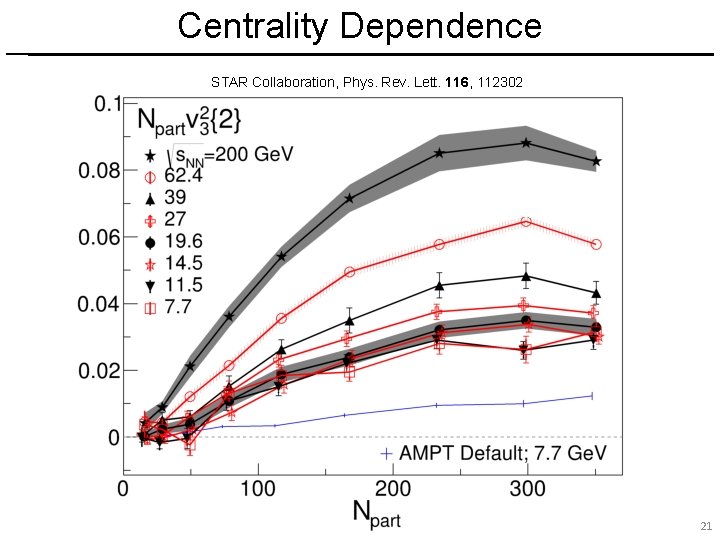
Centrality Dependence STAR Collaboration, Phys. Rev. Lett. 116, 112302 21 21
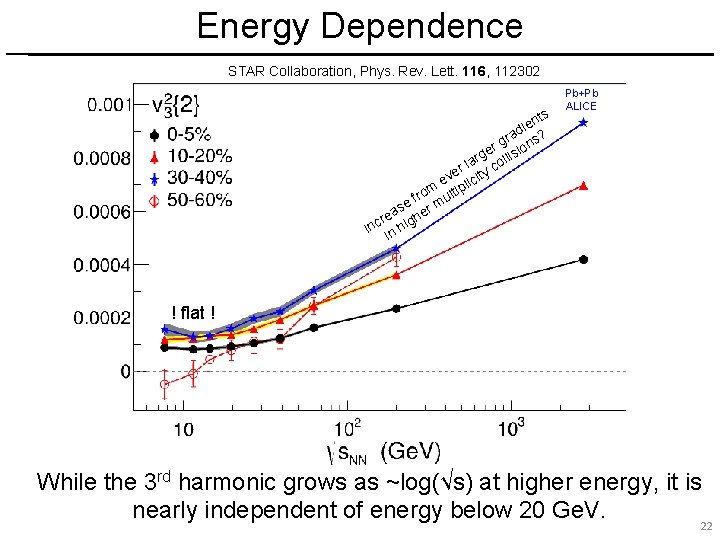
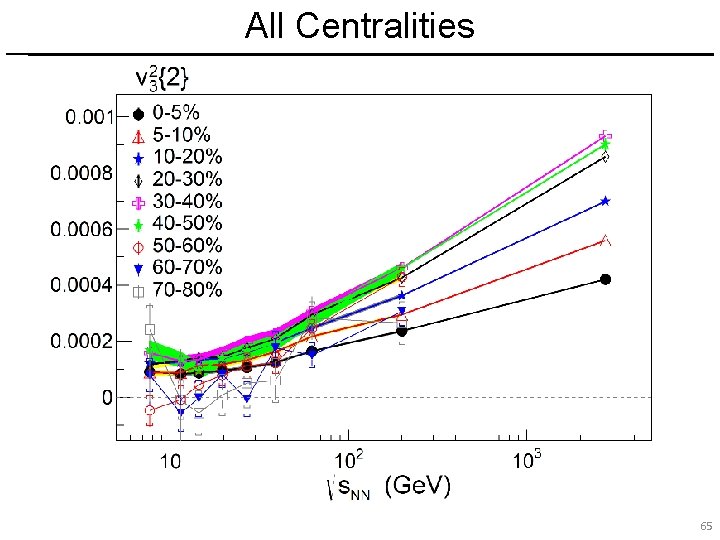
Energy Dependence STAR Collaboration, Phys. Rev. Lett. 116, 112302 nts e i rad ns? g er lisio g r la ty co e ev lici p m ro ulti f se er m a e r gh inc in hi Pb+Pb ALICE ! flat ! While the 3 rd harmonic grows as ~log(√s) at higher energy, it is nearly independent of energy below 20 Ge. V. 22 22
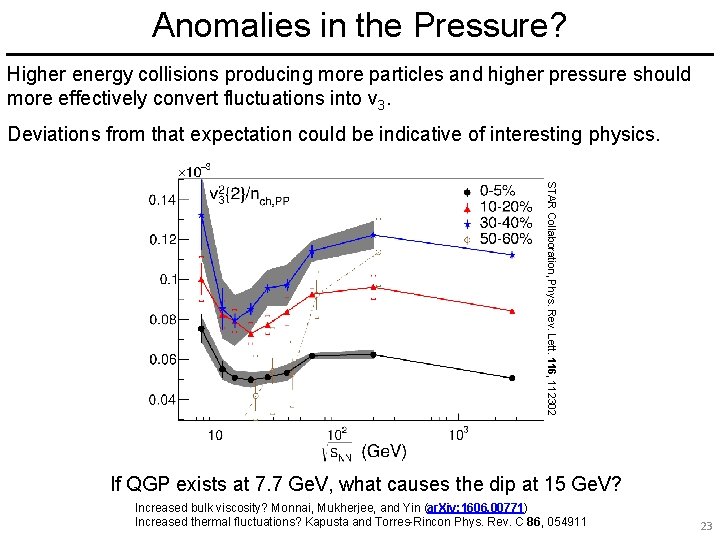
Anomalies in the Pressure? Higher energy collisions producing more particles and higher pressure should more effectively convert fluctuations into v 3. Deviations from that expectation could be indicative of interesting physics. STAR Collaboration, Phys. Rev. Lett. 116, 112302 If QGP exists at 7. 7 Ge. V, what causes the dip at 15 Ge. V? Increased bulk viscosity? Monnai, Mukherjee, and Yin (ar. Xiv: 1606. 00771) Increased thermal fluctuations? Kapusta and Torres-Rincon Phys. Rev. C 86, 054911 23
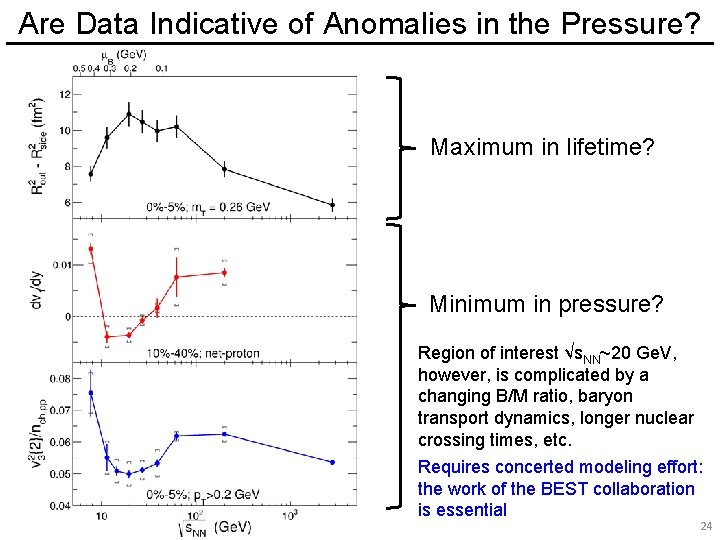
Are Data Indicative of Anomalies in the Pressure? Maximum in lifetime? Minimum in pressure? Region of interest √s. NN~20 Ge. V, however, is complicated by a changing B/M ratio, baryon transport dynamics, longer nuclear crossing times, etc. Requires concerted modeling effort: the work of the BEST collaboration is essential 24
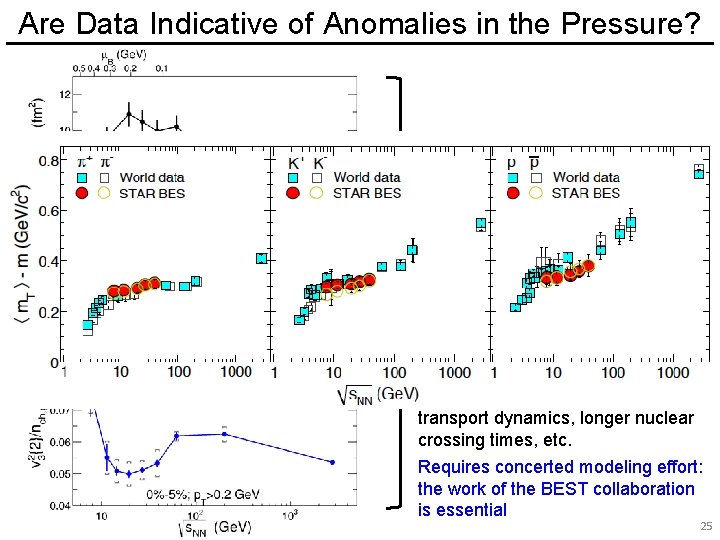
Are Data Indicative of Anomalies in the Pressure? Maximum in lifetime? Minimum in pressure? Region of interest √s. NN~20 Ge. V, however, is complicated by a changing B/M ratio, baryon transport dynamics, longer nuclear crossing times, etc. Requires concerted modeling effort: the work of the BEST collaboration is essential 25
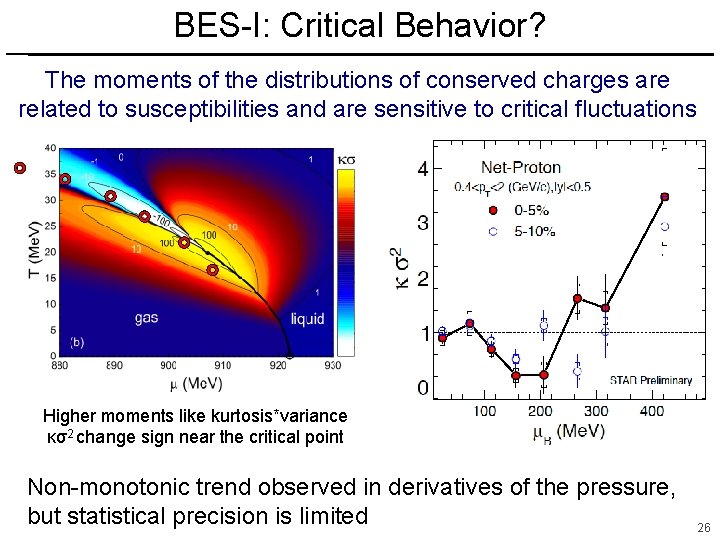
BES-I: Critical Behavior? The moments of the distributions of conserved charges are related to susceptibilities and are sensitive to critical fluctuations Higher moments like kurtosis*variance κσ2 change sign near the critical point Non-monotonic trend observed in derivatives of the pressure, but statistical precision is limited 26
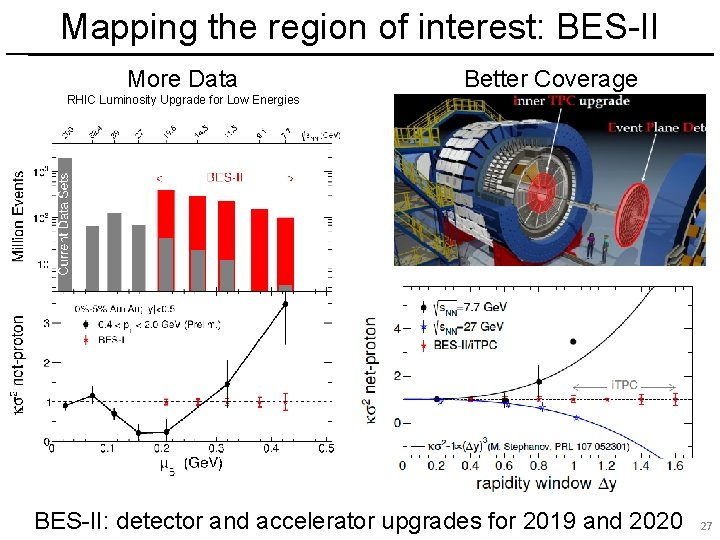
Mapping the region of interest: BES-II More Data Better Coverage RHIC Luminosity Upgrade for Low Energies BES-II: detector and accelerator upgrades for 2019 and 2020 27
What about the chiral anomaly? For more central collisions, v 3 persists down to 7. 7 Ge. V suggesting QGP may be present. For peripheral collisions however, v 3 disappears in lower energy collisions: Turn off of the QGP many measurements suggest an anomalously low pressure in heavy ion collisions with √s. NN near 15 -20 Ge. V Is chiral symmetry restored in these collisions? Have we observed evidence of the chiral anomaly of QCD? What can we do to make progress on this problem? 28
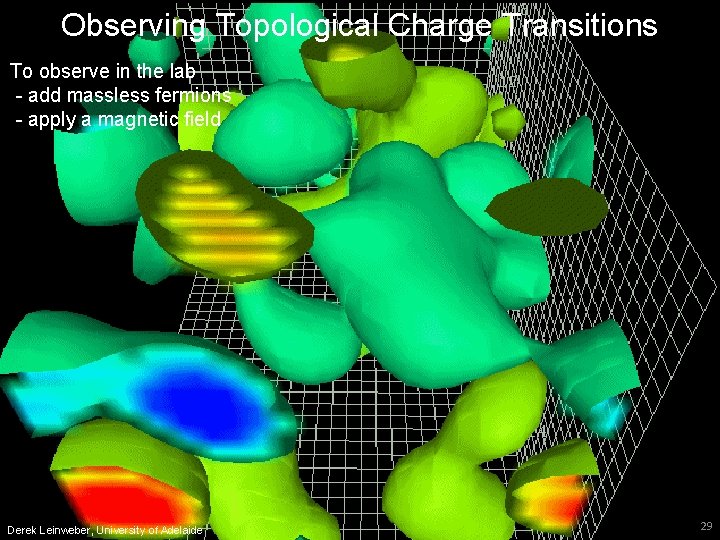
Observing Topological Charge Transitions To observe in the lab - add massless fermions - apply a magnetic field Derek Leinweber, University of Adelaide 29
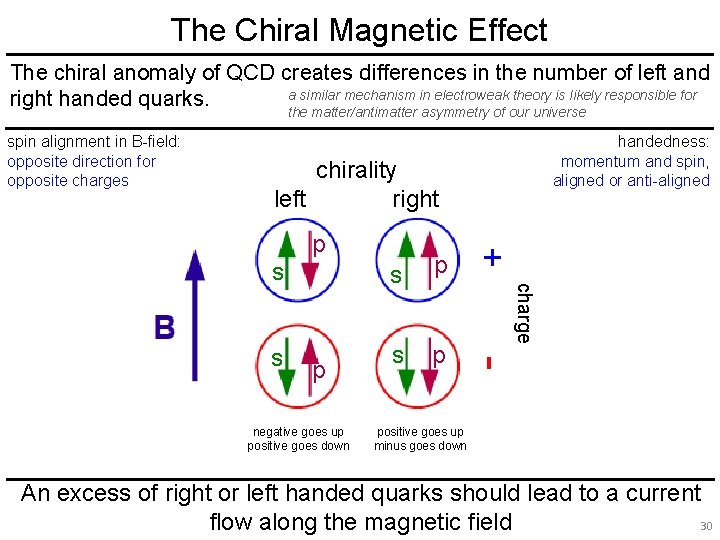
The Chiral Magnetic Effect The chiral anomaly of QCD creates differences in the number of left and a similar mechanism in electroweak theory is likely responsible for right handed quarks. the matter/antimatter asymmetry of our universe spin alignment in B-field: opposite direction for opposite charges handedness: momentum and spin, aligned or anti-aligned chirality left right s p + s s p p negative goes up positive goes down charge s - p positive goes up minus goes down An excess of right or left handed quarks should lead to a current 30 flow along the magnetic field
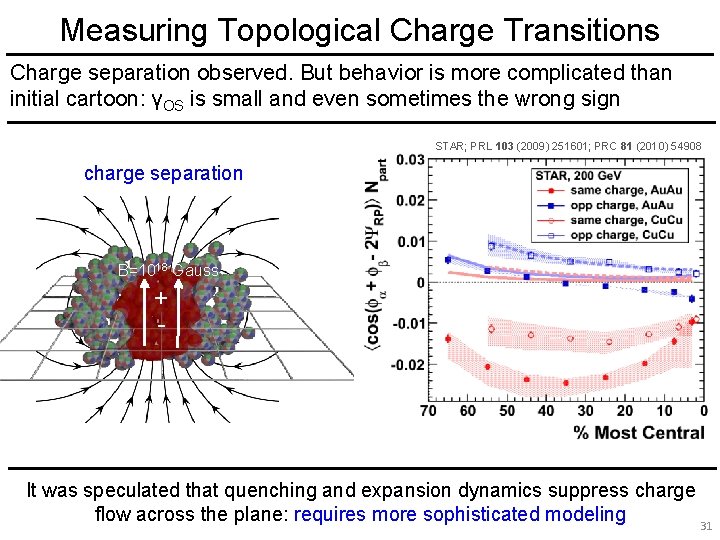
Measuring Topological Charge Transitions Charge separation observed. But behavior is more complicated than initial cartoon: γOS is small and even sometimes the wrong sign STAR; PRL 103 (2009) 251601; PRC 81 (2010) 54908 charge separation B=1018 Gauss + - It was speculated that quenching and expansion dynamics suppress charge flow across the plane: requires more sophisticated modeling 31
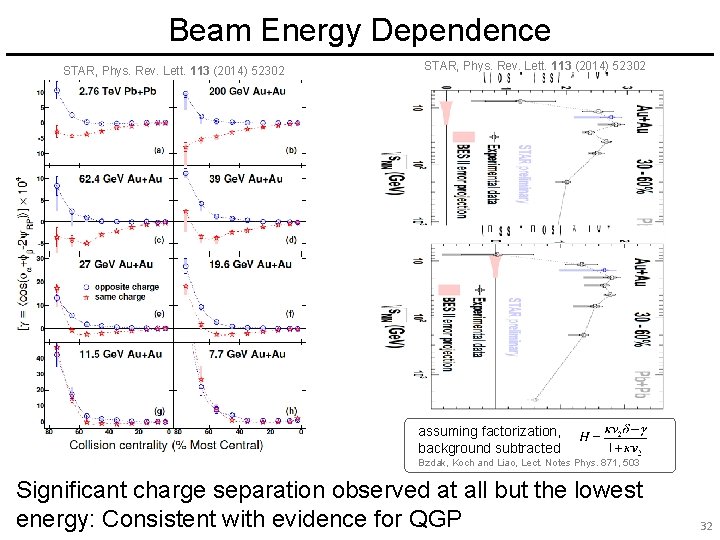
Beam Energy Dependence STAR, Phys. Rev. Lett. 113 (2014) 52302 assuming factorization, background subtracted Bzdak, Koch and Liao, Lect. Notes Phys. 871, 503 Significant charge separation observed at all but the lowest energy: Consistent with evidence for QGP 32
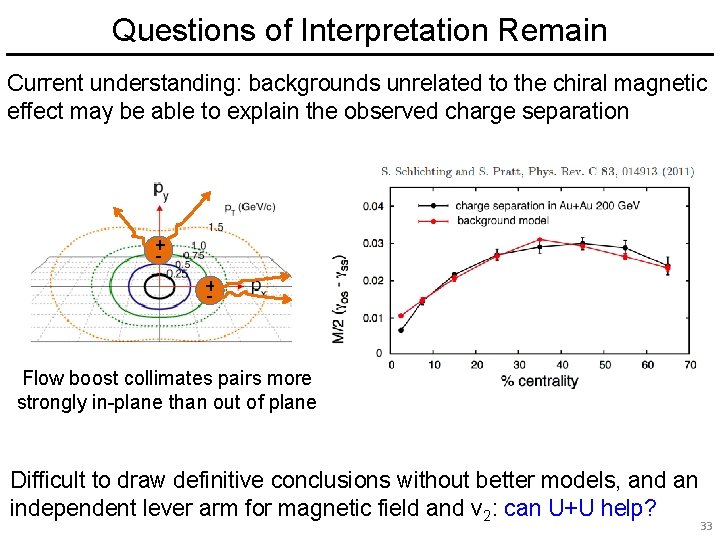
Questions of Interpretation Remain Current understanding: backgrounds unrelated to the chiral magnetic effect may be able to explain the observed charge separation + + - Flow boost collimates pairs more strongly in-plane than out of plane Difficult to draw definitive conclusions without better models, and an independent lever arm for magnetic field and v 2: can U+U help? 33
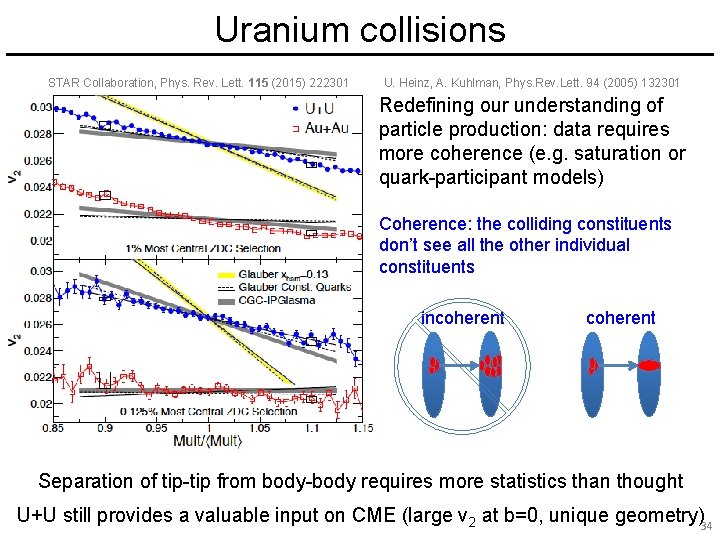
Uranium collisions STAR Collaboration, Phys. Rev. Lett. 115 (2015) 222301 U. Heinz, A. Kuhlman, Phys. Rev. Lett. 94 (2005) 132301 Redefining our understanding of particle production: data requires more coherence (e. g. saturation or quark-participant models) Coherence: the colliding constituents don’t see all the other individual constituents incoherent Separation of tip-tip from body-body requires more statistics than thought U+U still provides a valuable input on CME (large v 2 at b=0, unique geometry)34
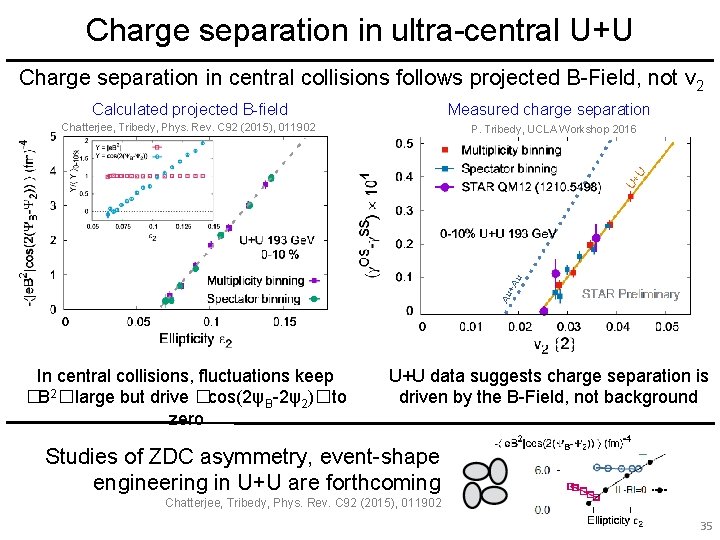
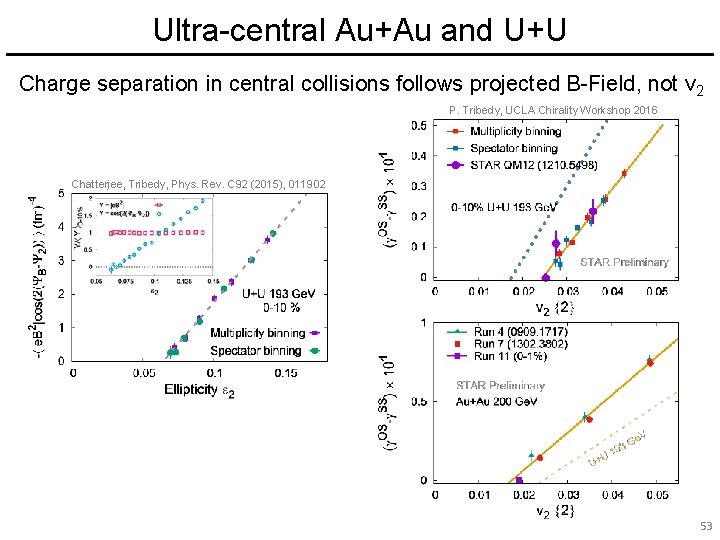
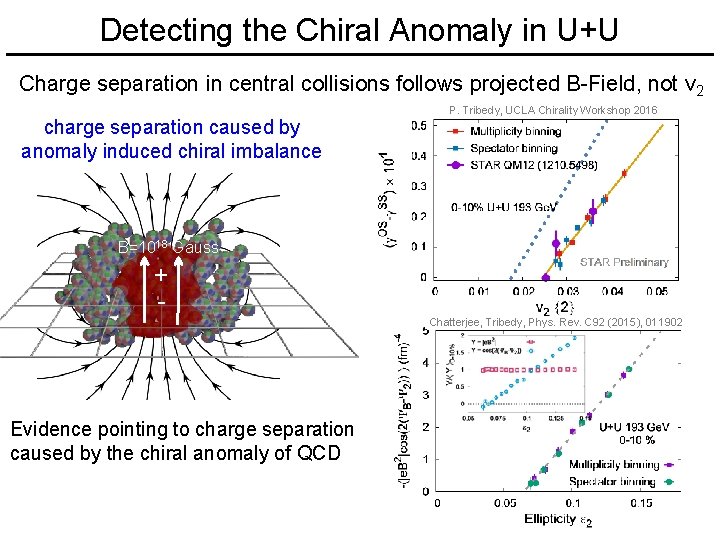
Charge separation in ultra-central U+U Charge separation in central collisions follows projected B-Field, not v 2 Calculated projected B-field Measured charge separation Chatterjee, Tribedy, Phys. Rev. C 92 (2015), 011902 Au +A u U+ U P. Tribedy, UCLA Workshop 2016 In central collisions, fluctuations keep �B 2�large but drive �cos(2ψB-2ψ2)�to zero U+U data suggests charge separation is driven by the B-Field, not background Studies of ZDC asymmetry, event-shape engineering in U+U are forthcoming Chatterjee, Tribedy, Phys. Rev. C 92 (2015), 011902 35
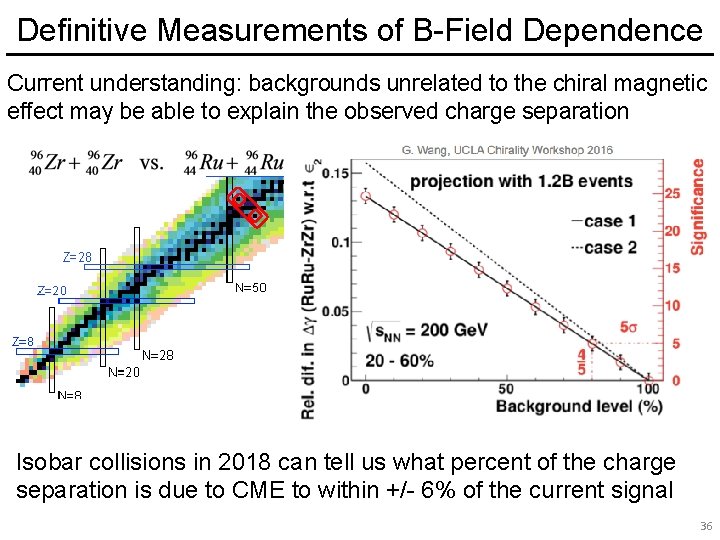
Definitive Measurements of B-Field Dependence Current understanding: backgrounds unrelated to the chiral magnetic effect may be able to explain the observed charge separation G. Wang, UCLA Chirality Workshop 2016 Isobar collisions in 2018 can tell us what percent of the charge separation is due to CME to within +/- 6% of the current signal 36
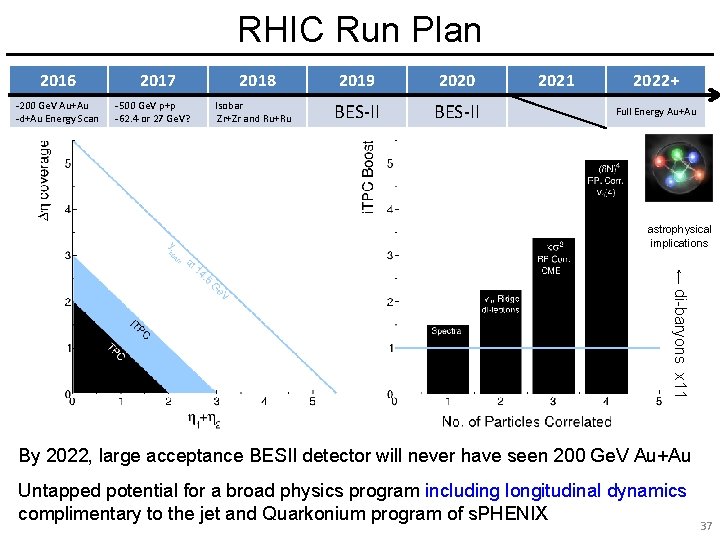
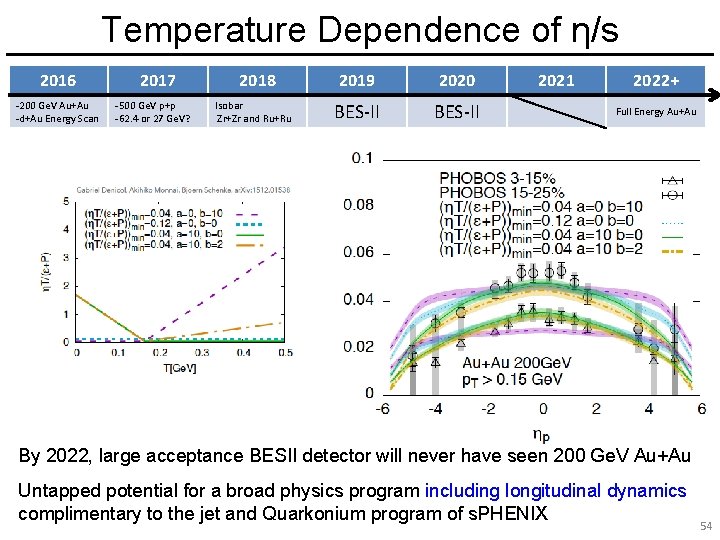
RHIC Run Plan 2016 -200 Ge. V Au+Au -d+Au Energy Scan 2017 -500 Ge. V p+p -62. 4 or 27 Ge. V? 2018 Isobar Zr+Zr and Ru+Ru 2019 2020 BES-II 2021 2022+ Full Energy Au+Au astrophysical implications ← di-baryons x 11 By 2022, large acceptance BESII detector will never have seen 200 Ge. V Au+Au Untapped potential for a broad physics program including longitudinal dynamics complimentary to the jet and Quarkonium program of s. PHENIX 37
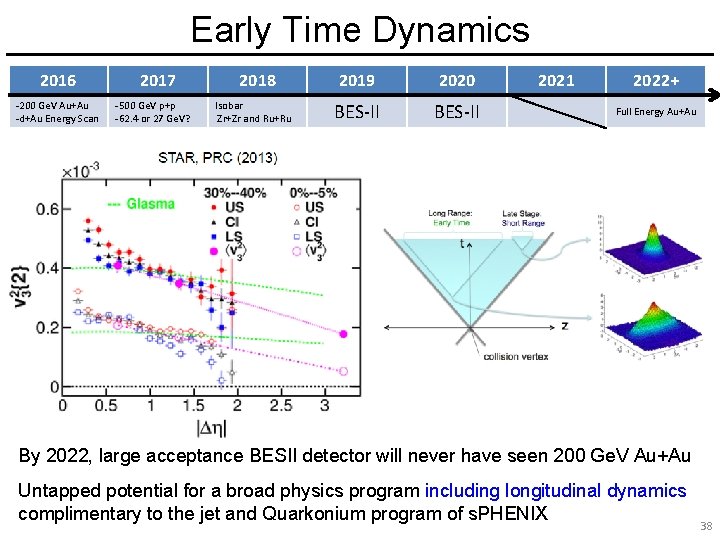
Early Time Dynamics 2016 -200 Ge. V Au+Au -d+Au Energy Scan 2017 -500 Ge. V p+p -62. 4 or 27 Ge. V? 2018 Isobar Zr+Zr and Ru+Ru 2019 2020 BES-II 2021 2022+ Full Energy Au+Au By 2022, large acceptance BESII detector will never have seen 200 Ge. V Au+Au Untapped potential for a broad physics program including longitudinal dynamics complimentary to the jet and Quarkonium program of s. PHENIX 38
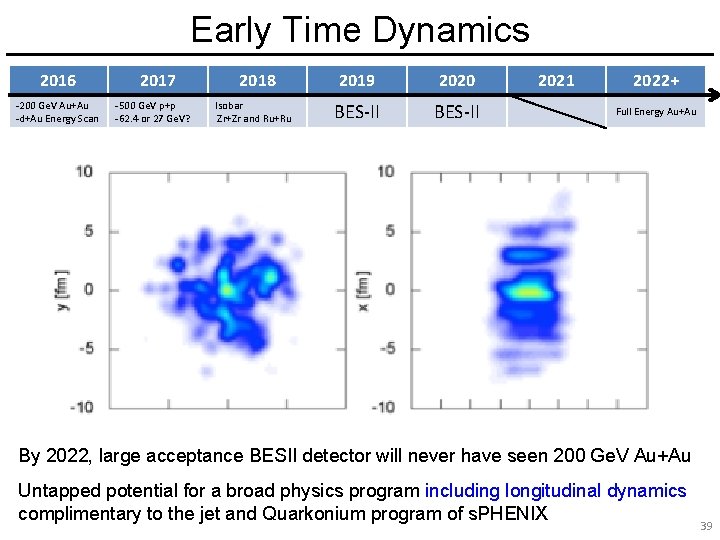
Early Time Dynamics 2016 -200 Ge. V Au+Au -d+Au Energy Scan 2017 -500 Ge. V p+p -62. 4 or 27 Ge. V? 2018 Isobar Zr+Zr and Ru+Ru 2019 2020 BES-II 2021 2022+ Full Energy Au+Au By 2022, large acceptance BESII detector will never have seen 200 Ge. V Au+Au Untapped potential for a broad physics program including longitudinal dynamics complimentary to the jet and Quarkonium program of s. PHENIX 39
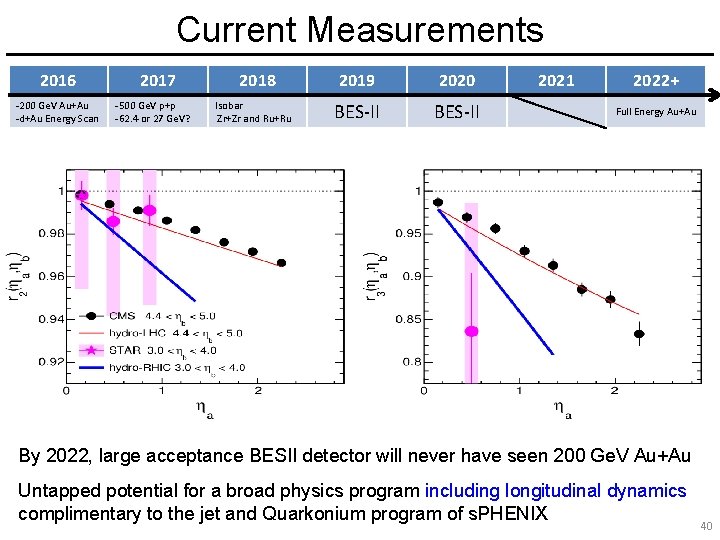
Current Measurements 2016 -200 Ge. V Au+Au -d+Au Energy Scan 2017 -500 Ge. V p+p -62. 4 or 27 Ge. V? 2018 Isobar Zr+Zr and Ru+Ru 2019 2020 BES-II 2021 2022+ Full Energy Au+Au By 2022, large acceptance BESII detector will never have seen 200 Ge. V Au+Au Untapped potential for a broad physics program including longitudinal dynamics complimentary to the jet and Quarkonium program of s. PHENIX 40
Exploring the Properties of the Phases of QCD Great progress on emergent phenomena of QCD: • • Hottest man-made temperature: 300 k times hotter than the center of the sun Data shown to prefer an Equation-of-State consistent with lattice QCD The QGP created at RHIC is the most perfect liquid ever known Exploratory scan finds QGP and intriguing behavior below 20 Ge. V Following this progress we want to make measurements needed • • • to define the phase structure in the QCD phase-diagram (critical point? ) study the chiral properties of the QGP map the T dependence of η/s and other transport properties In 2018: Isobar collisions will provide definitive evidence on the chiral magnetic effect in 2019 -2020: Detector and accelerator upgrades will provide key abilities in the search for a critical point Extended coverage intended for BESII opens up many opportunities for a diverse program in 2022+ 41

42

43

44

45
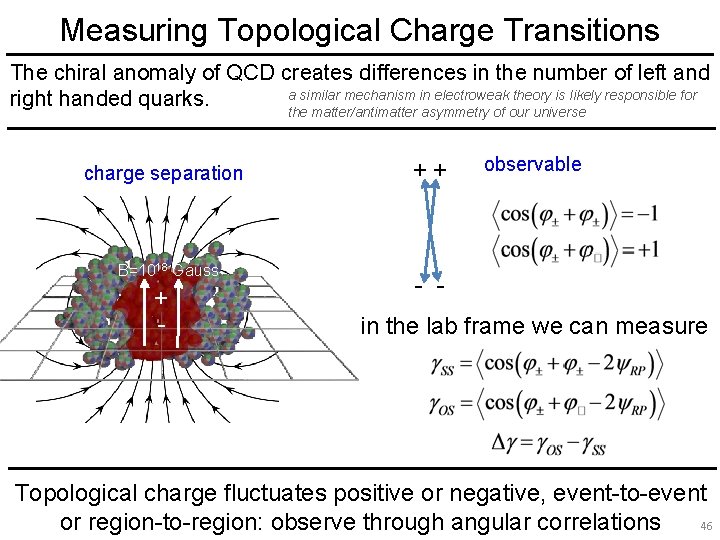
Measuring Topological Charge Transitions The chiral anomaly of QCD creates differences in the number of left and a similar mechanism in electroweak theory is likely responsible for right handed quarks. the matter/antimatter asymmetry of our universe charge separation B=1018 Gauss + - ++ observable - in the lab frame we can measure Topological charge fluctuates positive or negative, event-to-event 46 or region-to-region: observe through angular correlations
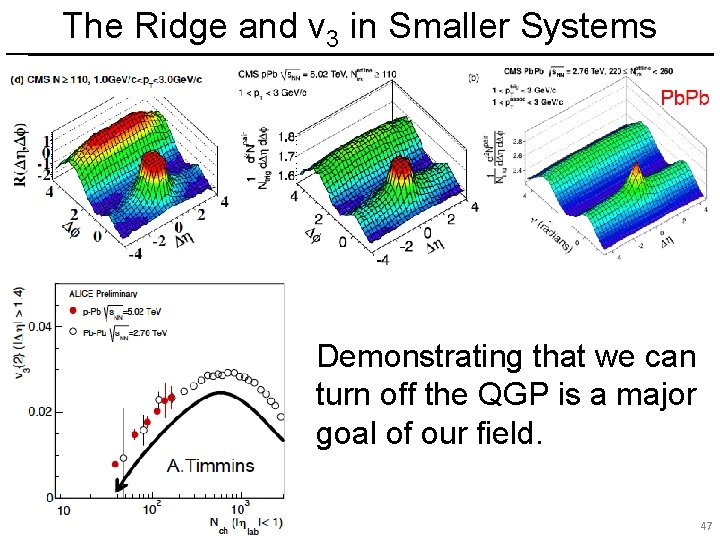
The Ridge and v 3 in Smaller Systems Demonstrating that we can turn off the QGP is a major goal of our field. 47 47
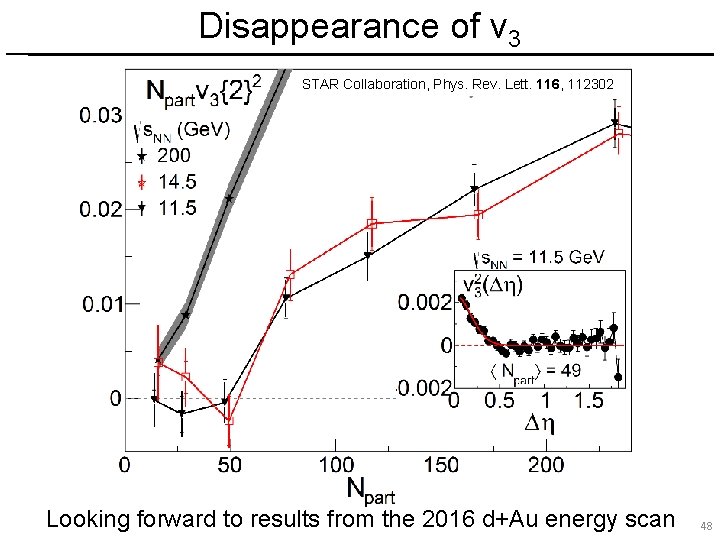
Disappearance of v 3 STAR Collaboration, Phys. Rev. Lett. 116, 112302 Looking forward to results from the 2016 d+Au energy scan 48 48
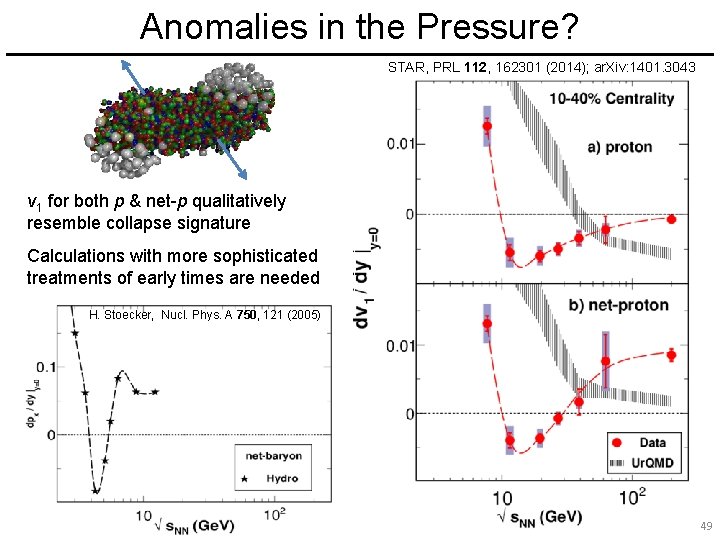
Anomalies in the Pressure? STAR, PRL 112, 162301 (2014); ar. Xiv: 1401. 3043 v 1 for both p & net-p qualitatively resemble collapse signature Calculations with more sophisticated treatments of early times are needed H. Stoecker, Nucl. Phys. A 750, 121 (2005) 49
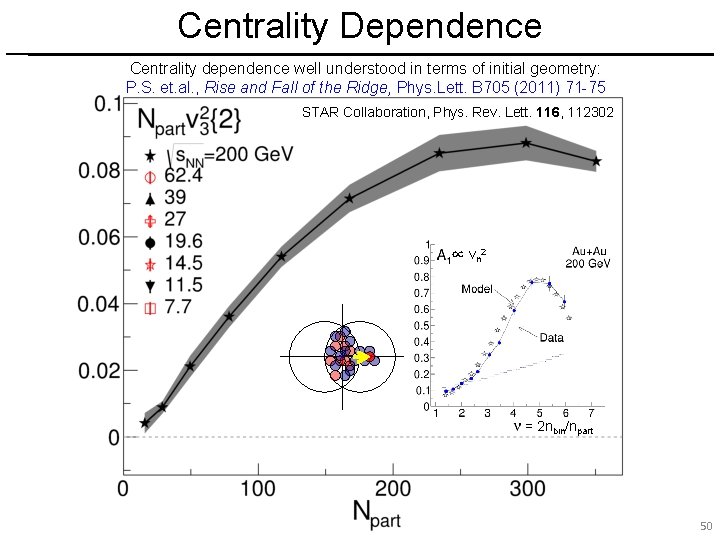
Centrality Dependence Centrality dependence well understood in terms of initial geometry: P. S. et. al. , Rise and Fall of the Ridge, Phys. Lett. B 705 (2011) 71 -75 STAR Collaboration, Phys. Rev. Lett. 116, 112302 ∝ vn 2 = 2 nbin/npart 50 50
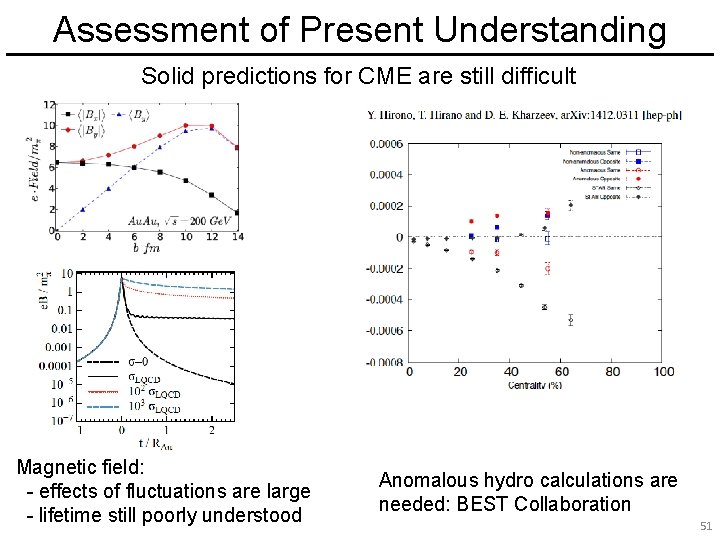
Assessment of Present Understanding Solid predictions for CME are still difficult Magnetic field: - effects of fluctuations are large - lifetime still poorly understood Anomalous hydro calculations are needed: BEST Collaboration 51
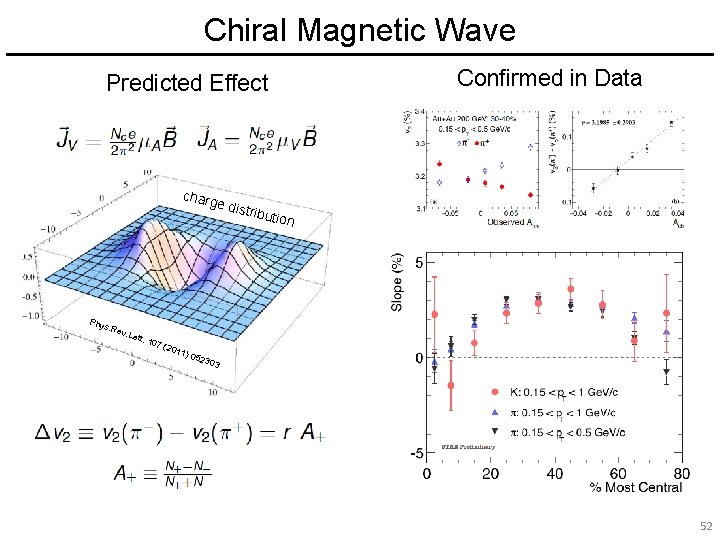
Chiral Magnetic Wave Confirmed in Data Predicted Effect charg e Phy s. Re v. Le tt. 1 07 ( distri butio n 201 1) 0 523 0 3 52
Ultra-central Au+Au and U+U Charge separation in central collisions follows projected B-Field, not v 2 P. Tribedy, UCLA Chirality Workshop 2016 Chatterjee, Tribedy, Phys. Rev. C 92 (2015), 011902 53
Temperature Dependence of η/s 2016 -200 Ge. V Au+Au -d+Au Energy Scan 2017 -500 Ge. V p+p -62. 4 or 27 Ge. V? 2018 Isobar Zr+Zr and Ru+Ru 2019 2020 BES-II 2021 2022+ Full Energy Au+Au By 2022, large acceptance BESII detector will never have seen 200 Ge. V Au+Au Untapped potential for a broad physics program including longitudinal dynamics complimentary to the jet and Quarkonium program of s. PHENIX 54
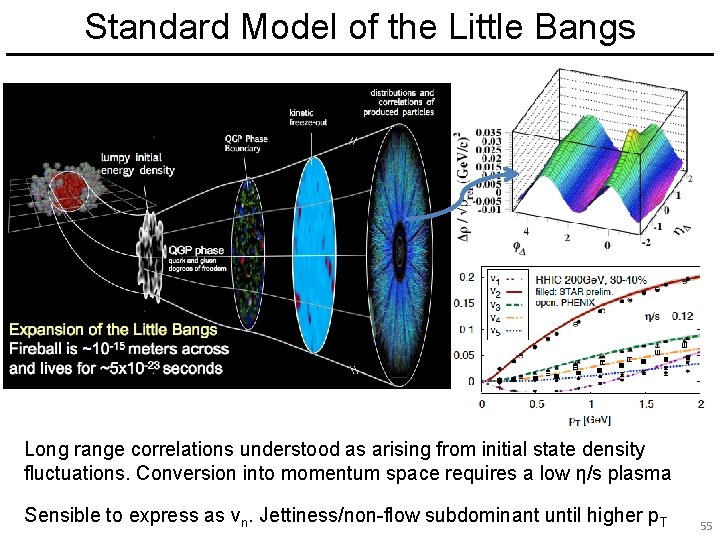
Standard Model of the Little Bangs Long range correlations understood as arising from initial state density fluctuations. Conversion into momentum space requires a low η/s plasma Sensible to express as vn. Jettiness/non-flow subdominant until higher p. T 55
Detecting the Chiral Anomaly in U+U Charge separation in central collisions follows projected B-Field, not v 2 charge separation caused by anomaly induced chiral imbalance P. Tribedy, UCLA Chirality Workshop 2016 B=1018 Gauss + Chatterjee, Tribedy, Phys. Rev. C 92 (2015), 011902 Evidence pointing to charge separation caused by the chiral anomaly of QCD
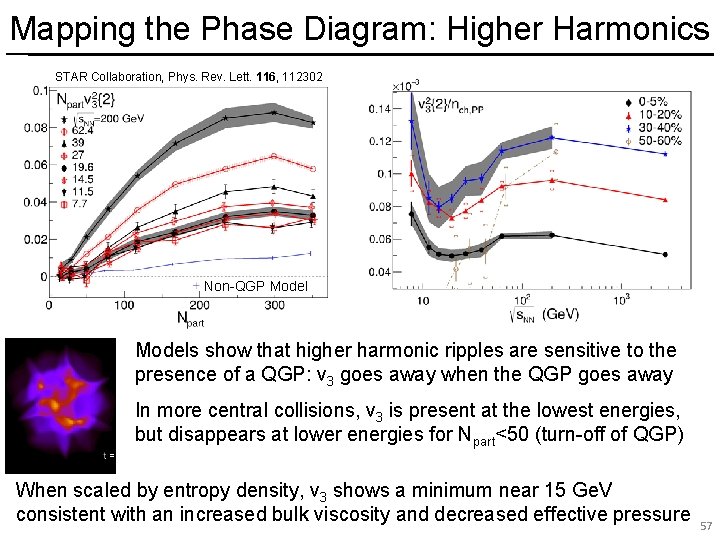
Mapping the Phase Diagram: Higher Harmonics STAR Collaboration, Phys. Rev. Lett. 116, 112302 Non-QGP Models show that higher harmonic ripples are sensitive to the presence of a QGP: v 3 goes away when the QGP goes away In more central collisions, v 3 is present at the lowest energies, but disappears at lower energies for Npart<50 (turn-off of QGP) When scaled by entropy density, v 3 shows a minimum near 15 Ge. V 57 consistent with an increased bulk viscosity and decreased effective pressure 57
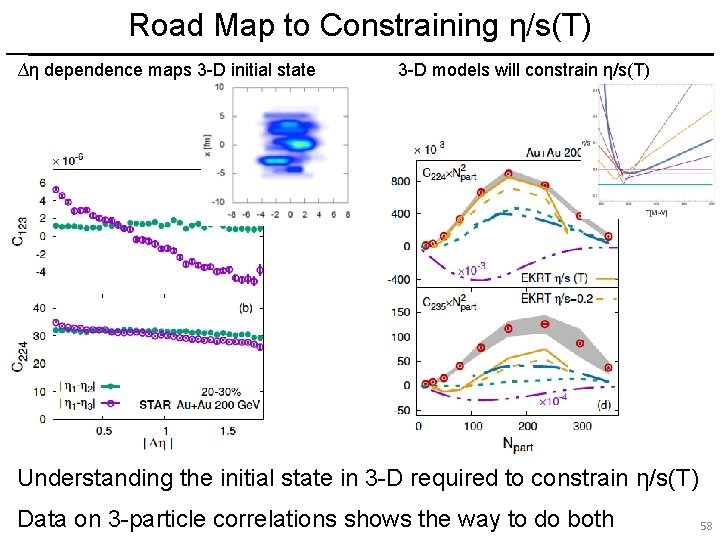
Road Map to Constraining η/s(T) ∆η dependence maps 3 -D initial state 3 -D models will constrain η/s(T) Understanding the initial state in 3 -D required to constrain η/s(T) Data on 3 -particle correlations shows the way to do both 58
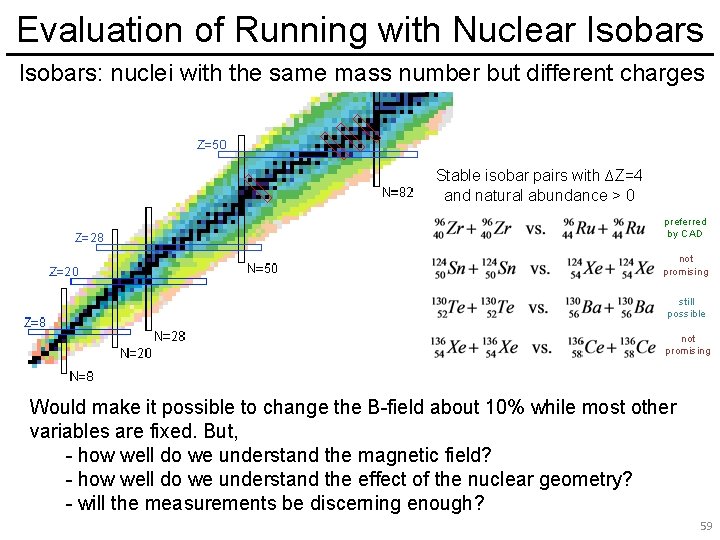
Evaluation of Running with Nuclear Isobars: nuclei with the same mass number but different charges Stable isobar pairs with ∆Z=4 and natural abundance > 0 preferred by CAD not promising still possible not promising Would make it possible to change the B-field about 10% while most other variables are fixed. But, - how well do we understand the magnetic field? - how well do we understand the effect of the nuclear geometry? - will the measurements be discerning enough? 59
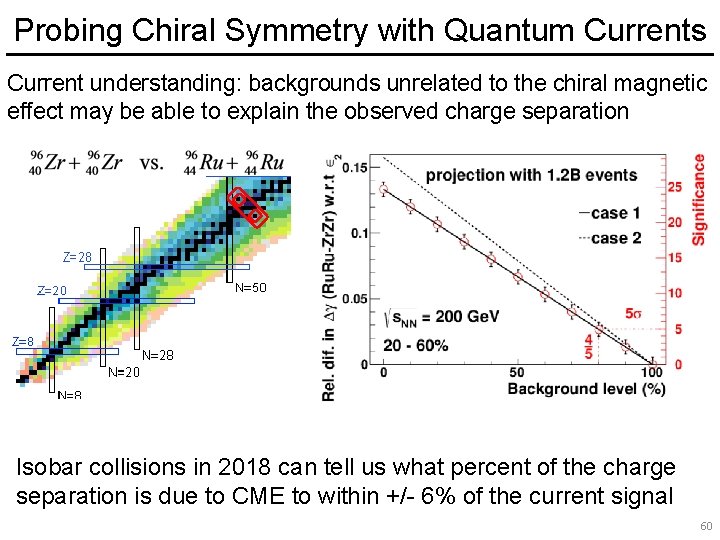
Probing Chiral Symmetry with Quantum Currents Current understanding: backgrounds unrelated to the chiral magnetic effect may be able to explain the observed charge separation Isobar collisions in 2018 can tell us what percent of the charge separation is due to CME to within +/- 6% of the current signal 60
Conclusions Large uncertainties in interpretation exist: Current CME measurements could be entirely from background There remain analyses to be done that are likely to provide some help in clarifying the relevance of CME but, none so far have proven to be decisive Reliable handles on the effect of the B-field may prove crucial Along with the sphaleron transition rate, uncertainty in the duration of the B-field will probably remain one of the key challenges to reliable predictions for the CME effect So far, the isobar program looks promising: as long as the isotopes can be acquired there seem to be no show-stoppers: note proposed statistics are sufficient for CME but not CMW studies 61
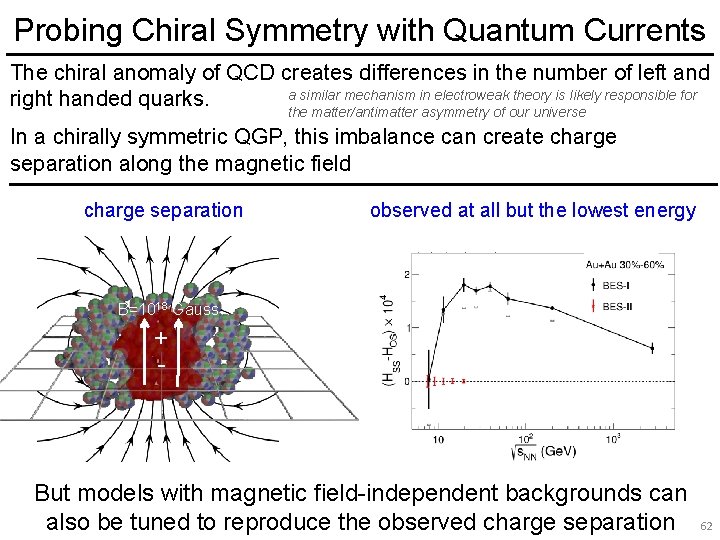
Probing Chiral Symmetry with Quantum Currents The chiral anomaly of QCD creates differences in the number of left and a similar mechanism in electroweak theory is likely responsible for right handed quarks. the matter/antimatter asymmetry of our universe In a chirally symmetric QGP, this imbalance can create charge separation along the magnetic field charge separation observed at all but the lowest energy B=1018 Gauss + - But models with magnetic field-independent backgrounds can also be tuned to reproduce the observed charge separation 62
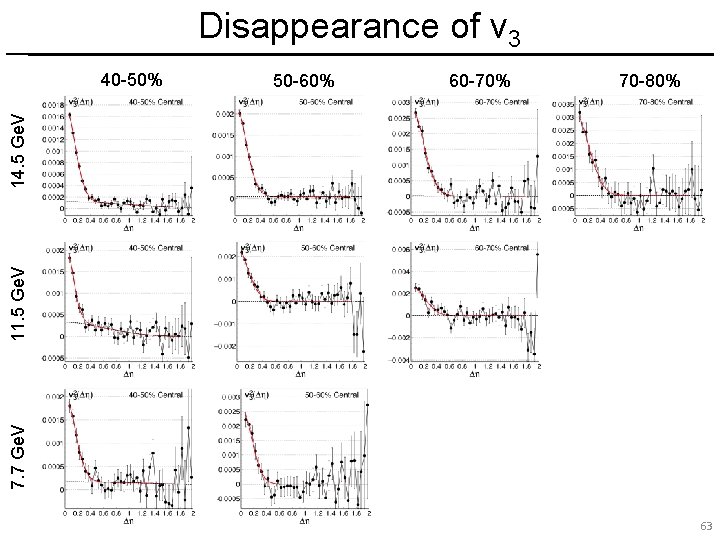
Disappearance of v 3 50 -60% 60 -70% 70 -80% 7. 7 Ge. V 11. 5 Ge. V 14. 5 Ge. V 40 -50% 63
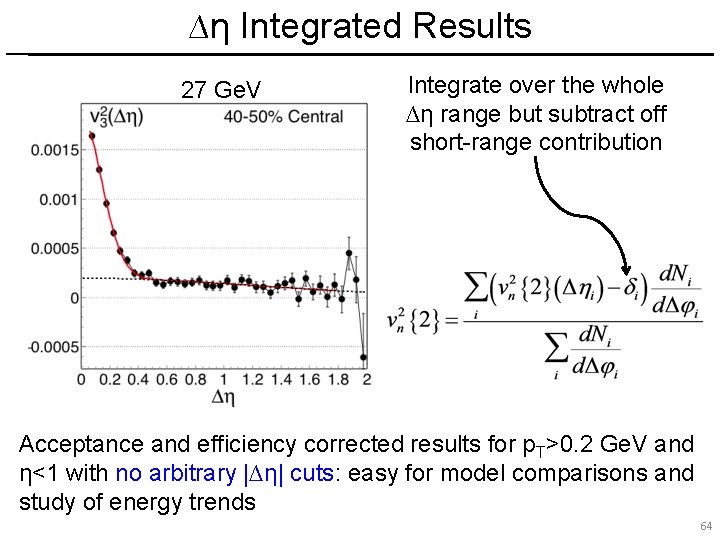
∆η Integrated Results 27 Ge. V Integrate over the whole ∆η range but subtract off short-range contribution Acceptance and efficiency corrected results for p. T>0. 2 Ge. V and η<1 with no arbitrary |∆η| cuts: easy for model comparisons and study of energy trends 64 64
All Centralities 65 65
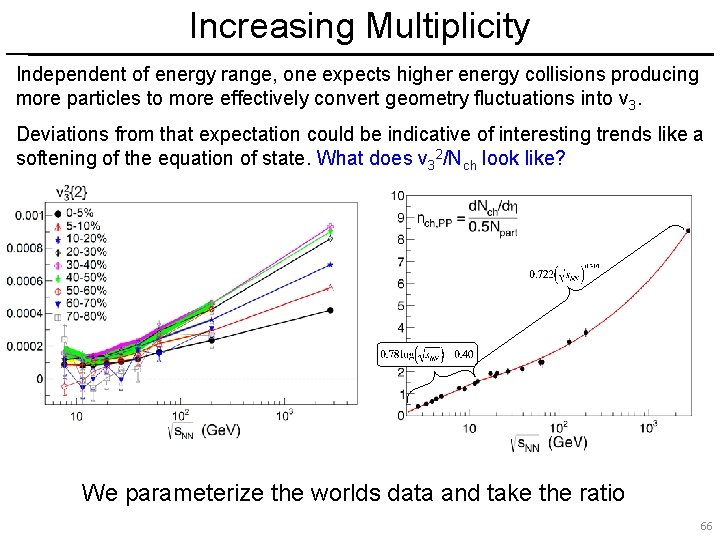
Increasing Multiplicity Independent of energy range, one expects higher energy collisions producing more particles to more effectively convert geometry fluctuations into v 3. Deviations from that expectation could be indicative of interesting trends like a softening of the equation of state. What does v 32/Nch look like? We parameterize the worlds data and take the ratio 66 66
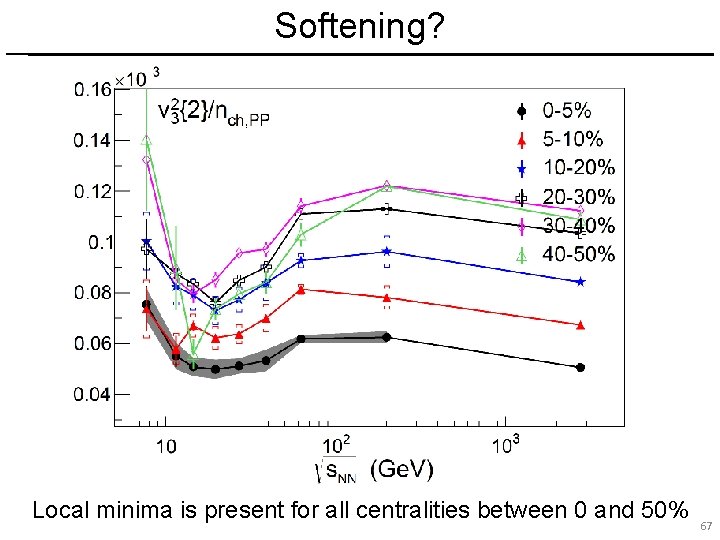
Softening? Local minima is present for all centralities between 0 and 50% 67 67
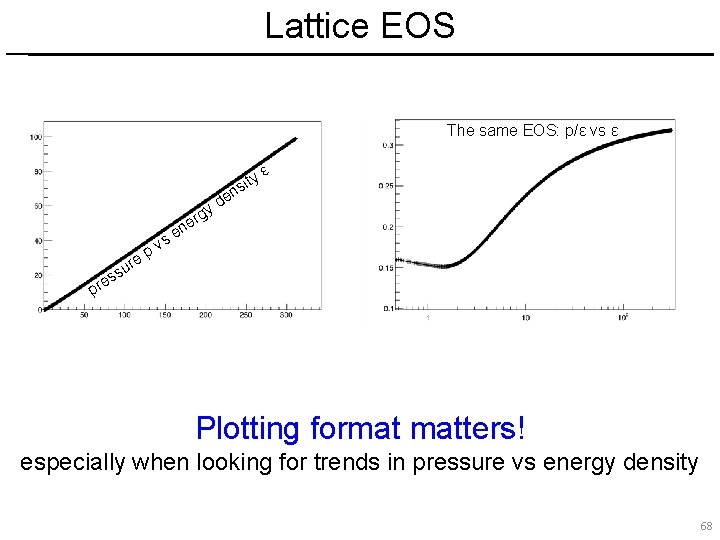
Lattice EOS The same EOS: p/ε vs ε s s es pr v p e e en e yd y sit ε n rg ur Plotting format matters! especially when looking for trends in pressure vs energy density 68 68
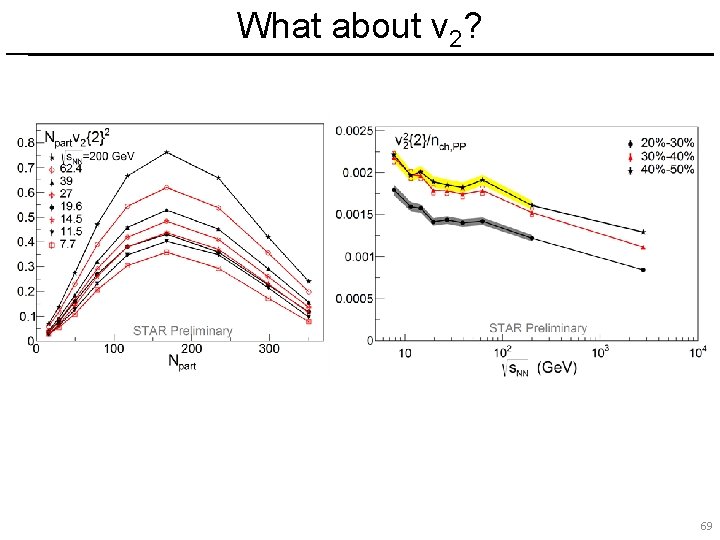
What about v 2? 69 69
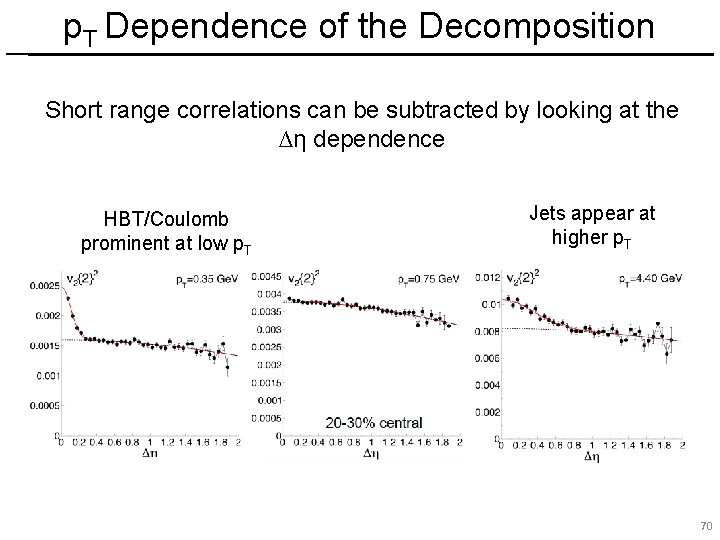
p. T Dependence of the Decomposition Short range correlations can be subtracted by looking at the ∆η dependence HBT/Coulomb prominent at low p. T 70 Jets appear at higher p. T 70
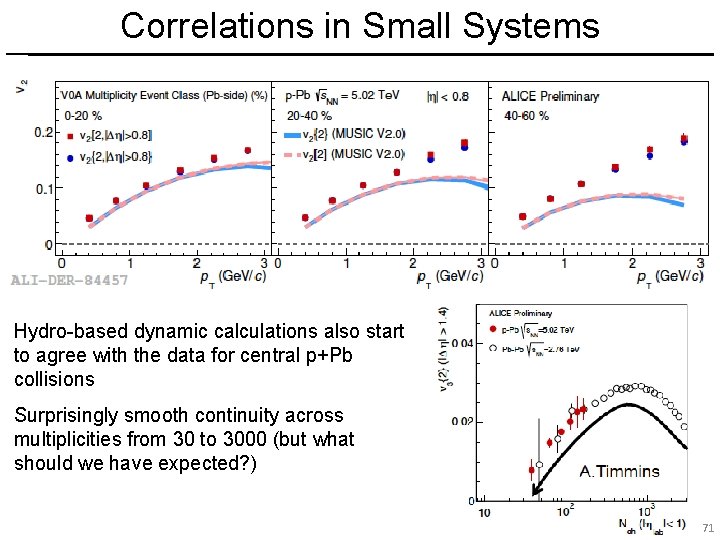
Correlations in Small Systems Hydro-based dynamic calculations also start to agree with the data for central p+Pb collisions Surprisingly smooth continuity across multiplicities from 30 to 3000 (but what should we have expected? ) 71 71
- Slides: 71