
Probing the QGP at RHIC Lessons and Challenges
Probing the QGP at RHIC: Lessons and Challenges Steffen A. Bass Duke University • Jet-Medium Interactions • Hydro and beyond • Recombination Topics not covered due to lack of time: • Photons • Dileptons • Charm(onium) Steffen A. Bass 1
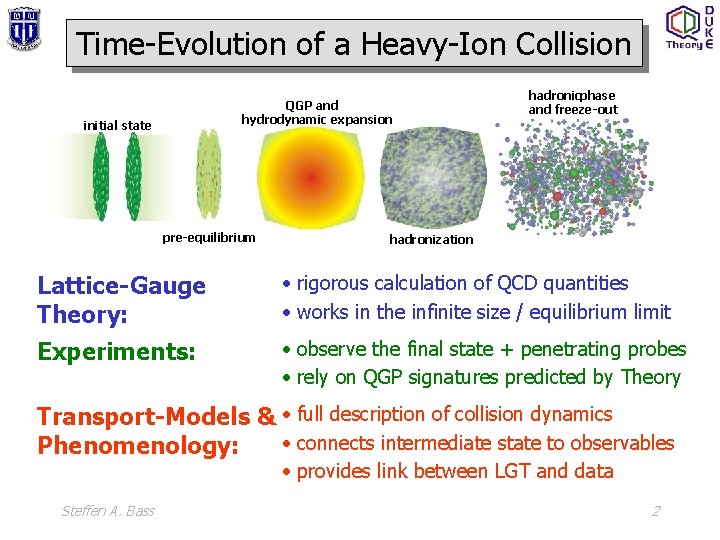
Time-Evolution of a Heavy-Ion Collision QGP and hydrodynamic expansion initial state pre-equilibrium hadronicphase and freeze-out hadronization Lattice-Gauge Theory: • rigorous calculation of QCD quantities • works in the infinite size / equilibrium limit Experiments: • observe the final state + penetrating probes • rely on QGP signatures predicted by Theory Transport-Models & • full description of collision dynamics • connects intermediate state to observables Phenomenology: • provides link between LGT and data Steffen A. Bass 2
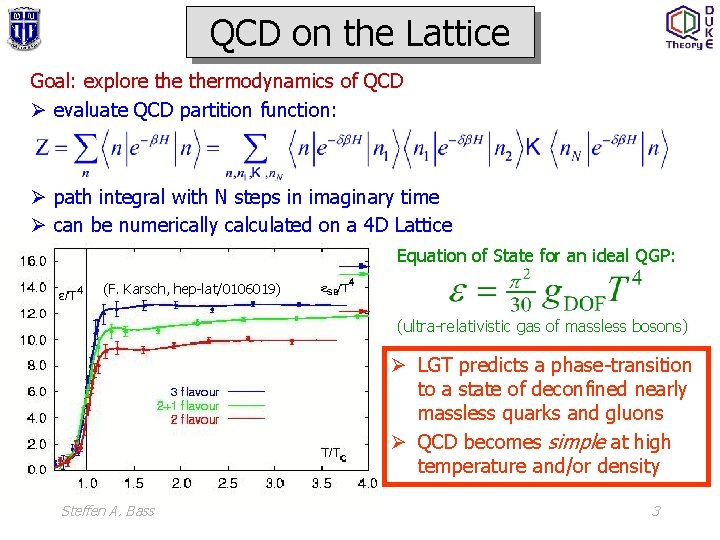
QCD on the Lattice Goal: explore thermodynamics of QCD Ø evaluate QCD partition function: Ø path integral with N steps in imaginary time Ø can be numerically calculated on a 4 D Lattice Equation of State for an ideal QGP: (F. Karsch, hep-lat/0106019) (ultra-relativistic gas of massless bosons) Ø LGT predicts a phase-transition to a state of deconfined nearly massless quarks and gluons Ø QCD becomes simple at high temperature and/or density Steffen A. Bass 3
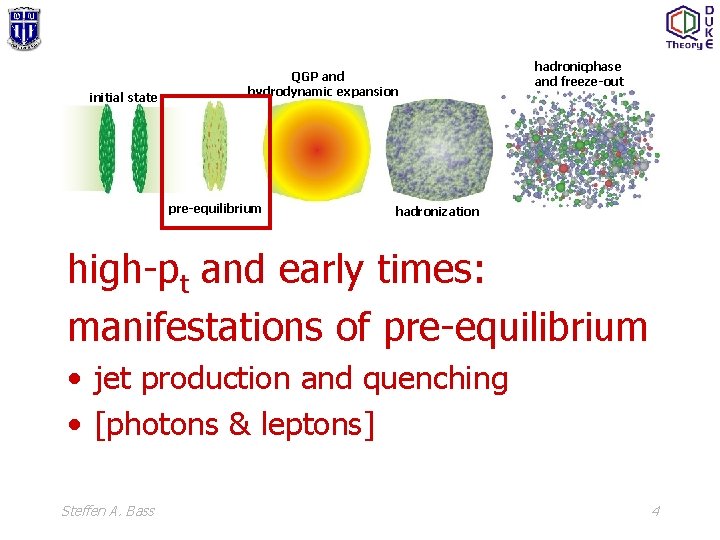
initial state QGP and hydrodynamic expansion pre-equilibrium hadronicphase and freeze-out hadronization high-pt and early times: manifestations of pre-equilibrium • jet production and quenching • [photons & leptons] Steffen A. Bass 4
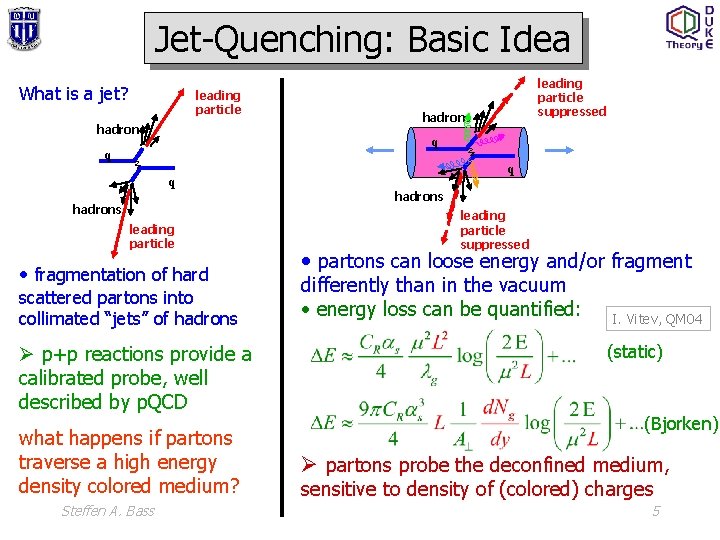
Jet-Quenching: Basic Idea What is a jet? leading particle hadrons q q q hadrons leading particle • fragmentation of hard scattered partons into collimated “jets” of hadrons Ø p+p reactions provide a calibrated probe, well described by p. QCD what happens if partons traverse a high energy density colored medium? Steffen A. Bass leading particle suppressed q hadrons leading particle suppressed • partons can loose energy and/or fragment differently than in the vacuum • energy loss can be quantified: I. Vitev, QM 04 (static) (Bjorken) Ø partons probe the deconfined medium, sensitive to density of (colored) charges 5
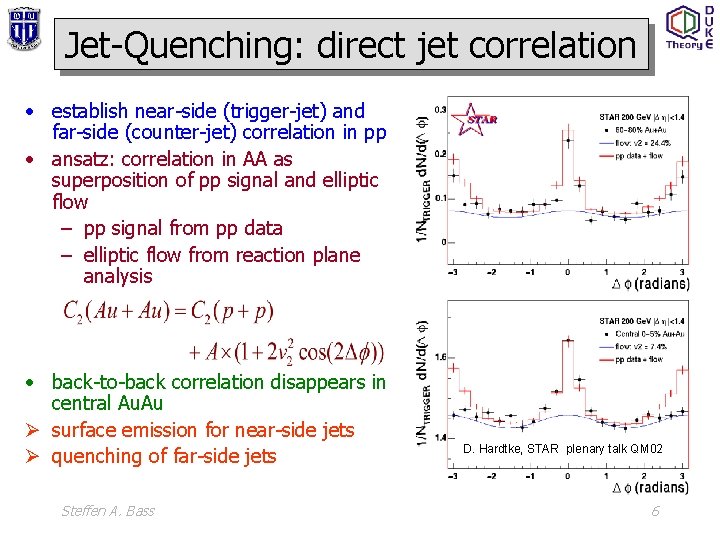
Jet-Quenching: direct jet correlation • establish near-side (trigger-jet) and far-side (counter-jet) correlation in pp • ansatz: correlation in AA as superposition of pp signal and elliptic flow – pp signal from pp data – elliptic flow from reaction plane analysis • back-to-back correlation disappears in central Au. Au Ø surface emission for near-side jets Ø quenching of far-side jets Steffen A. Bass D. Hardtke, STAR plenary talk QM 02 6
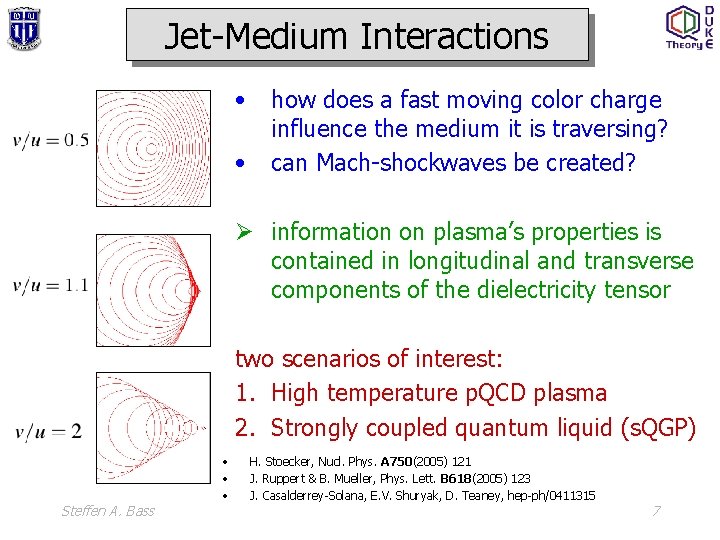
Jet-Medium Interactions • • how does a fast moving color charge influence the medium it is traversing? can Mach-shockwaves be created? Ø information on plasma’s properties is contained in longitudinal and transverse components of the dielectricity tensor two scenarios of interest: 1. High temperature p. QCD plasma 2. Strongly coupled quantum liquid (s. QGP) Steffen A. Bass • • • H. Stoecker, Nucl. Phys. A 750(2005) 121 J. Ruppert & B. Mueller, Phys. Lett. B 618(2005) 123 J. Casalderrey-Solana, E. V. Shuryak, D. Teaney, hep-ph/0411315 7
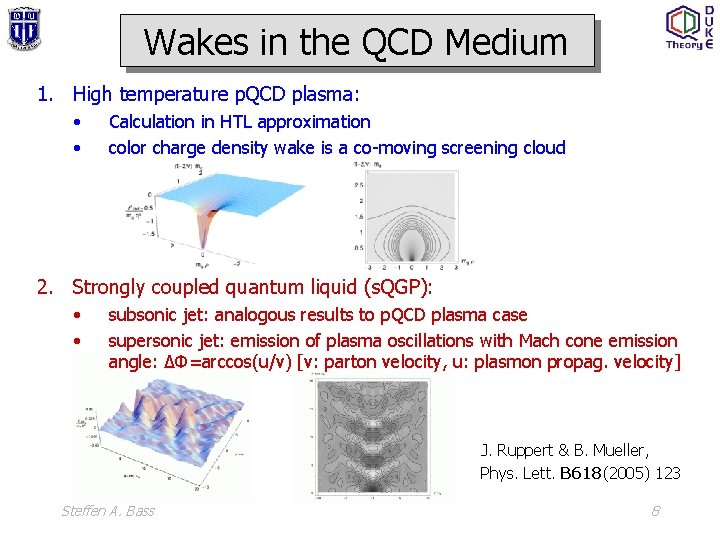
Wakes in the QCD Medium 1. High temperature p. QCD plasma: • • Calculation in HTL approximation color charge density wake is a co-moving screening cloud 2. Strongly coupled quantum liquid (s. QGP): • • subsonic jet: analogous results to p. QCD plasma case supersonic jet: emission of plasma oscillations with Mach cone emission angle: ΔΦ=arccos(u/v) [v: parton velocity, u: plasmon propag. velocity] J. Ruppert & B. Mueller, Phys. Lett. B 618(2005) 123 Steffen A. Bass 8
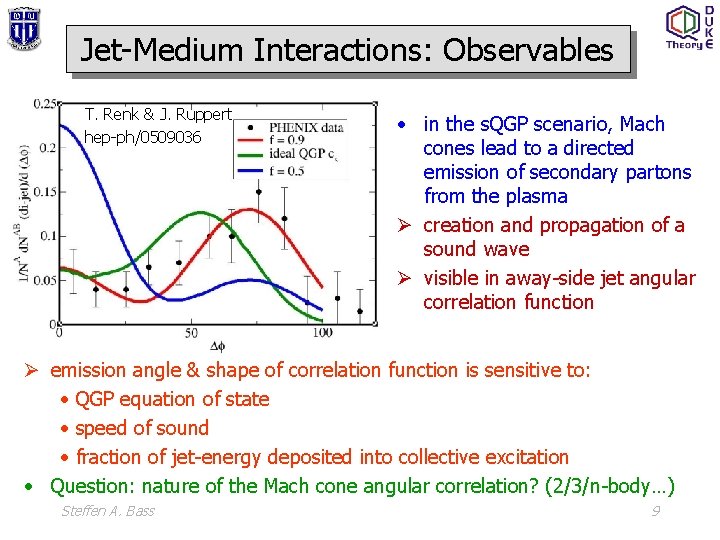
Jet-Medium Interactions: Observables T. Renk & J. Ruppert hep-ph/0509036 • in the s. QGP scenario, Mach cones lead to a directed emission of secondary partons from the plasma Ø creation and propagation of a sound wave Ø visible in away-side jet angular correlation function Ø emission angle & shape of correlation function is sensitive to: • QGP equation of state • speed of sound • fraction of jet-energy deposited into collective excitation • Question: nature of the Mach cone angular correlation? (2/3/n-body…) Steffen A. Bass 9
Lessons: • Jet-quenching well established as final state effect Ø probes gluon density of medium Ø color-wake phenomena (if confirmed!) provide novel & more detailed insights into medium properties Challenges: • verification/falsification of color-wake phenomena • quantitative characterization of medium properties Steffen A. Bass 10
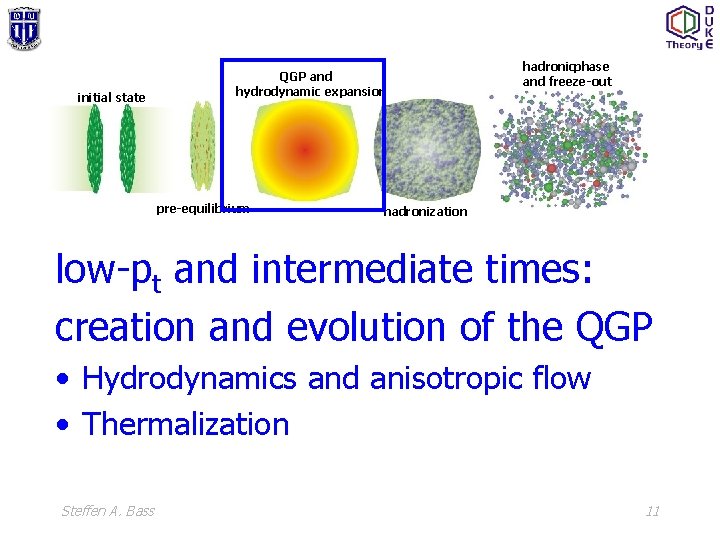
initial state QGP and hydrodynamic expansion pre-equilibrium hadronicphase and freeze-out hadronization low-pt and intermediate times: creation and evolution of the QGP • Hydrodynamics and anisotropic flow • Thermalization Steffen A. Bass 11
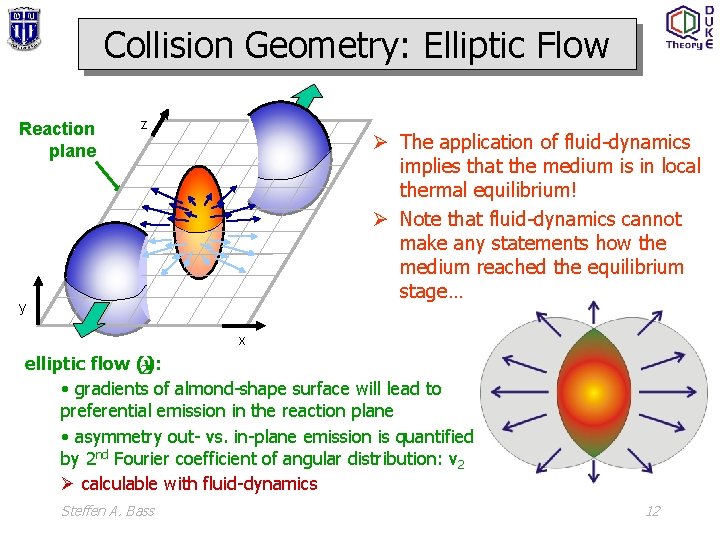
Collision Geometry: Elliptic Flow Reaction plane z Ø The application of fluid-dynamics implies that the medium is in local thermal equilibrium! Ø Note that fluid-dynamics cannot make any statements how the medium reached the equilibrium stage… y x elliptic flow (v 2): • gradients of almond-shape surface will lead to preferential emission in the reaction plane • asymmetry out- vs. in-plane emission is quantified by 2 nd Fourier coefficient of angular distribution: v 2 Ø calculable with fluid-dynamics Steffen A. Bass 12
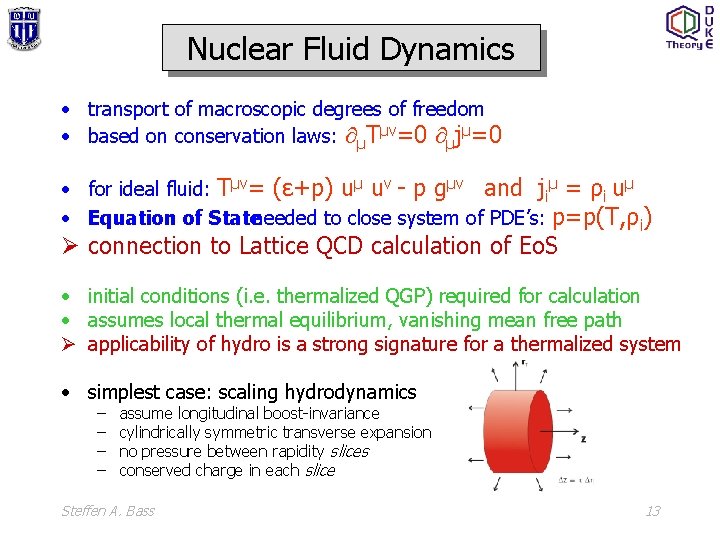
Nuclear Fluid Dynamics • transport of macroscopic degrees of freedom • based on conservation laws: μTμν=0 μjμ=0 • for ideal fluid: Tμν= (ε+p) uμ uν - p gμν and jiμ = ρi uμ • Equation of Stateneeded to close system of PDE’s: p=p(T, ρi) Ø connection to Lattice QCD calculation of Eo. S • initial conditions (i. e. thermalized QGP) required for calculation • assumes local thermal equilibrium, vanishing mean free path Ø applicability of hydro is a strong signature for a thermalized system • simplest case: scaling hydrodynamics – – assume longitudinal boost-invariance cylindrically symmetric transverse expansion no pressure between rapidity slices conserved charge in each slice Steffen A. Bass 13
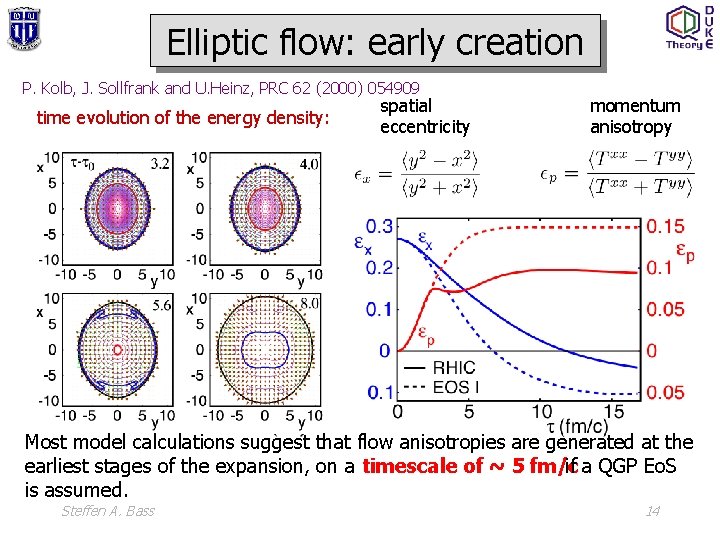
Elliptic flow: early creation P. Kolb, J. Sollfrank and U. Heinz, PRC 62 (2000) 054909 time evolution of the energy density: initial energy density distribution: spatial eccentricity momentum anisotropy Most model calculations suggest that flow anisotropies are generated at the earliest stages of the expansion, on a timescale of ~ 5 fm/c if a QGP Eo. S is assumed. Steffen A. Bass 14
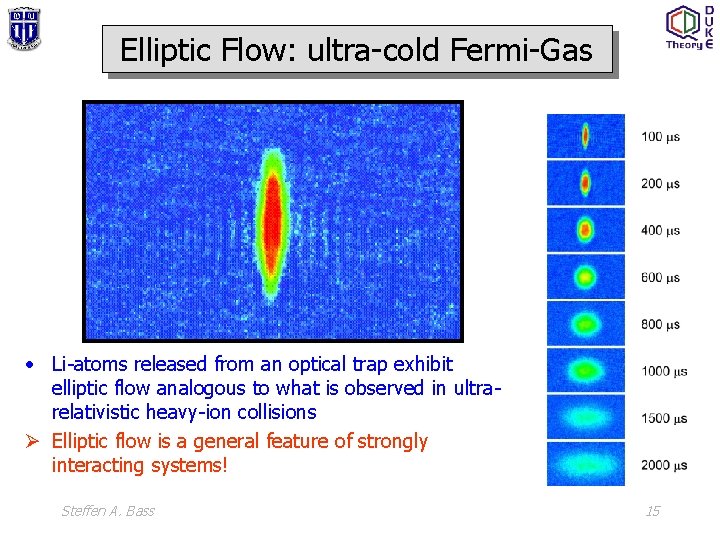
Elliptic Flow: ultra-cold Fermi-Gas • Li-atoms released from an optical trap exhibit elliptic flow analogous to what is observed in ultrarelativistic heavy-ion collisions Ø Elliptic flow is a general feature of strongly interacting systems! Steffen A. Bass 15
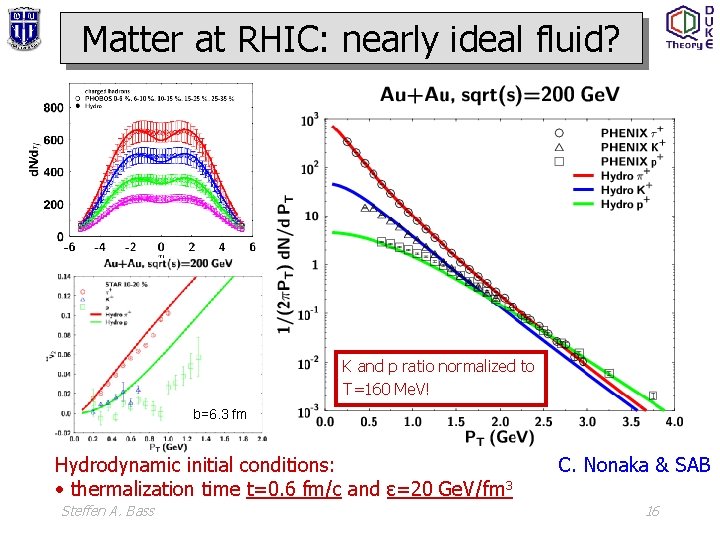
Matter at RHIC: nearly ideal fluid? K and p ratio normalized to T=160 Me. V! b=4. 5 fm b=6. 3 Hydrodynamic initial conditions: • thermalization time t=0. 6 fm/c and ε=20 Ge. V/fm 3 Steffen A. Bass C. Nonaka & SAB 16
The not-so-perfect Fluid Ideal Hydrodynamics: (Heinz, Kolb & Sollfrank; Hirano, Huovinen, …) • assumes vanishing mean free path λ, even in the dilute, break-up phase Ø fails to describe protons & pions simultaneously w/o rescaling, due to chemical and kinetic freeze-out being identical Ø no species-dependent cross sections (problem w/ Ξ’s and Ω’s) Ideal Hydrodynamics with Partial Chemical Equilibrium: (Hirano & Tsuda, Kolb & Rapp, Teaney) • separates chemical from kinetic freeze-out Ø successful for simultaneously describing proton, kaon & pion spectra Ø assumptions of vanishing λ & species-independent cross section still hold Hybrid Hydro+Micro Approach: (SAB & Dumitru; Teaney, Lauret & Shuryak; Hirano & Nara, Nonaka & SAB) • self-consistent calculation of freeze-out with finite mean free path and species-dependent cross section • full treatment of viscous effects in hadronic phase Steffen A. Bass 17
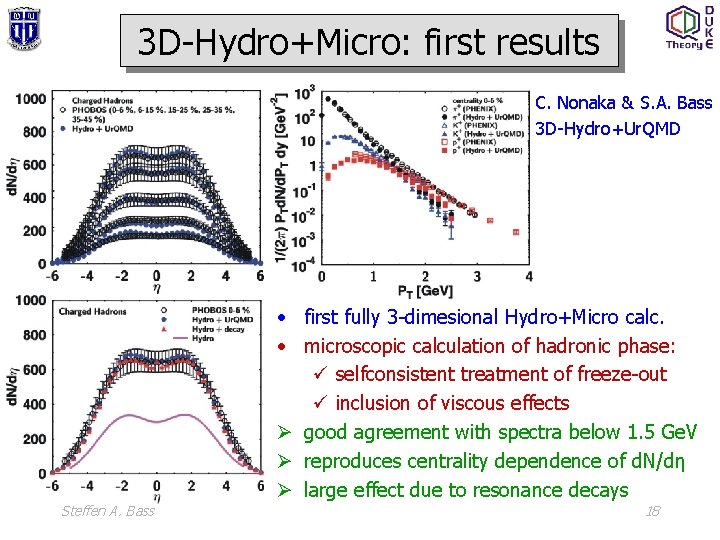
3 D-Hydro+Micro: first results C. Nonaka & S. A. Bass 3 D-Hydro+Ur. QMD Steffen A. Bass • first fully 3 -dimesional Hydro+Micro calc. • microscopic calculation of hadronic phase: ü selfconsistent treatment of freeze-out ü inclusion of viscous effects Ø good agreement with spectra below 1. 5 Ge. V Ø reproduces centrality dependence of d. N/dη Ø large effect due to resonance decays 18
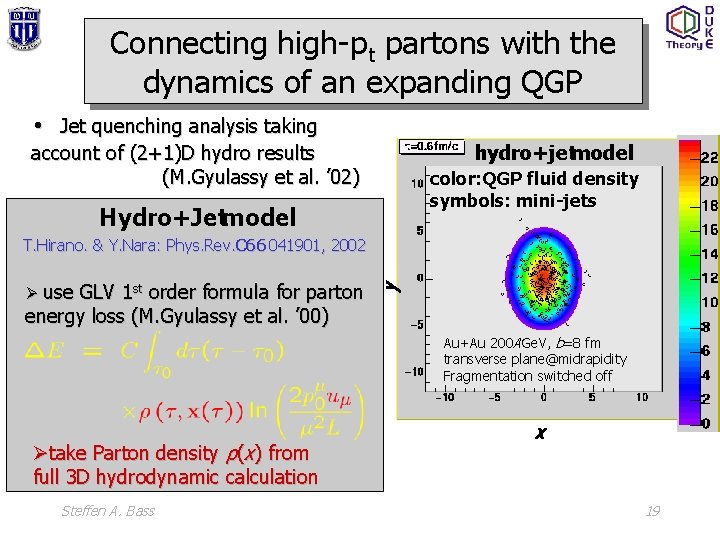
Connecting high-pt partons with the dynamics of an expanding QGP • Jet quenching analysis taking hydro+jetmodel account of (2+1)D hydro results (M. Gyulassy et al. ’ 02) color: QGP fluid density symbols: mini-jets Hydro+Jetmodel Ø use GLV 1 st order formula for parton energy loss (M. Gyulassy et al. ’ 00) y T. Hirano. & Y. Nara: Phys. Rev. C 66 041901, 2002 Au+Au 200 AGe. V, b=8 fm transverse plane@midrapidity Fragmentation switched off Øtake Parton density ρ(x) from full 3 D hydrodynamic calculation Steffen A. Bass x 19
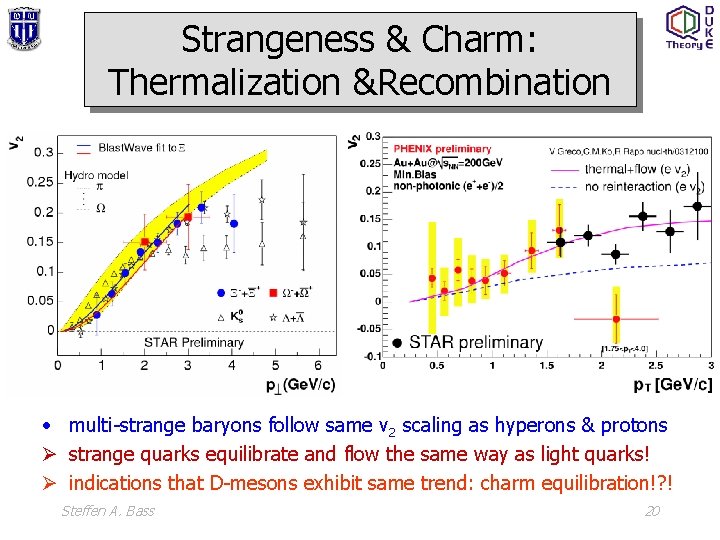
Strangeness & Charm: Thermalization &Recombination • multi-strange baryons follow same v 2 scaling as hyperons & protons Ø strange quarks equilibrate and flow the same way as light quarks! Ø indications that D-mesons exhibit same trend: charm equilibration!? ! Steffen A. Bass 20
Lessons: • system acts in 1 st approx like a near ideal fluid • heavy quarks might thermalize as well • initial conditions well in the realm of deconfinement as predicted by l. QCD • Hydro+Micro can alleviate many Hydro shortcomings Challenges: • transport coefficients (e. g. viscosity) • HOW DID THE SYSTEM THERMALIZE? ? (need experimentally verifiable/falsifiable concepts) Steffen A. Bass 21
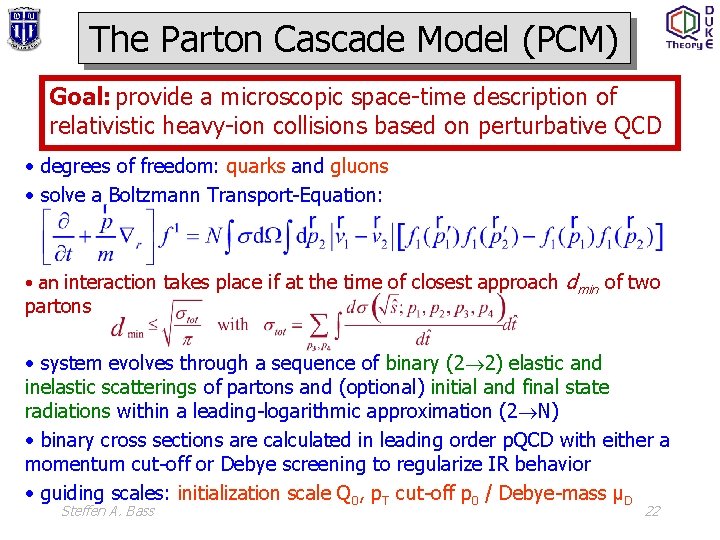
The Parton Cascade Model (PCM) Goal: provide a microscopic space-time description of relativistic heavy-ion collisions based on perturbative QCD • degrees of freedom: quarks and gluons • solve a Boltzmann Transport-Equation: • an interaction takes place if at the time of closest approach dmin of two partons • system evolves through a sequence of binary (2 2) elastic and inelastic scatterings of partons and (optional) initial and final state radiations within a leading-logarithmic approximation (2 N) • binary cross sections are calculated in leading order p. QCD with either a momentum cut-off or Debye screening to regularize IR behavior • guiding scales: initialization scale Q 0, p. T cut-off p 0 / Debye-mass μD Steffen A. Bass 22
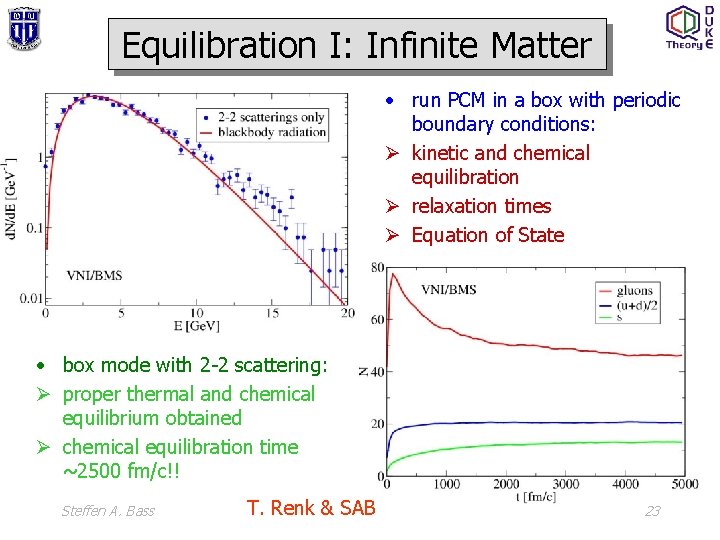
Equilibration I: Infinite Matter • run PCM in a box with periodic boundary conditions: Ø kinetic and chemical equilibration Ø relaxation times Ø Equation of State • box mode with 2 -2 scattering: Ø proper thermal and chemical equilibrium obtained Ø chemical equilibration time ~2500 fm/c!! Steffen A. Bass T. Renk & SAB 23
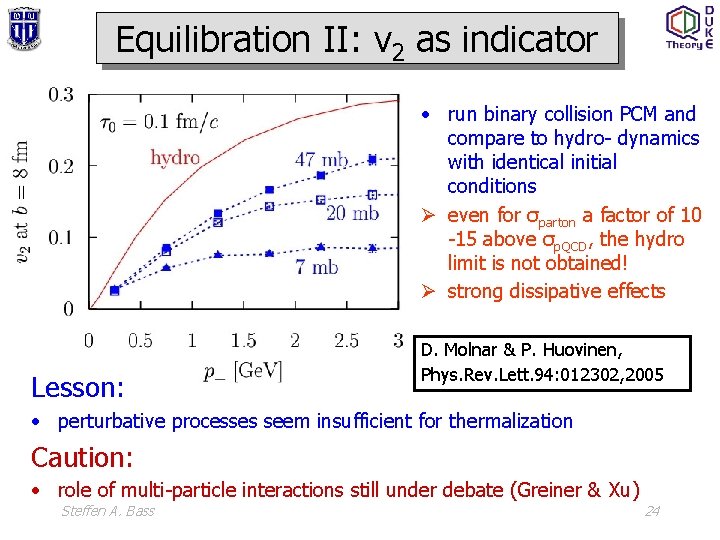
Equilibration II: v 2 as indicator • run binary collision PCM and compare to hydro- dynamics with identical initial conditions Ø even for σparton a factor of 10 -15 above σp. QCD, the hydro limit is not obtained! Ø strong dissipative effects Lesson: D. Molnar & P. Huovinen, Phys. Rev. Lett. 94: 012302, 2005 • perturbative processes seem insufficient for thermalization Caution: • role of multi-particle interactions still under debate (Greiner & Xu) Steffen A. Bass 24
Non-Perturbative Models for Thermalization Ø requires microscopic transport & progress on transport coefficients A selection of current ideas: • Plasma Instabilities (Mrowczynski, Lenaghan & Arnold; Strickland; Dumitru & Nara) • • Heavy-quark EFT (van Hees & Rapp) Classical fields + particle degrees of freedom (Molnar) Brueckner-type many-body calculations (Mannarelli & Rapp) Critical opacity at the phase transition (Aichelin & Gastineau) Steffen A. Bass 25
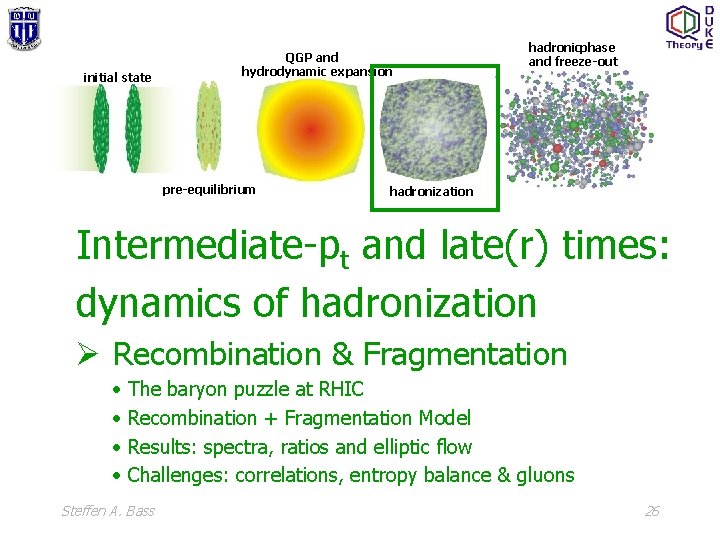
initial state QGP and hydrodynamic expansion pre-equilibrium hadronicphase and freeze-out hadronization Intermediate-pt and late(r) times: dynamics of hadronization Ø Recombination & Fragmentation • • The baryon puzzle at RHIC Recombination + Fragmentation Model Results: spectra, ratios and elliptic flow Challenges: correlations, entropy balance & gluons Steffen A. Bass 26
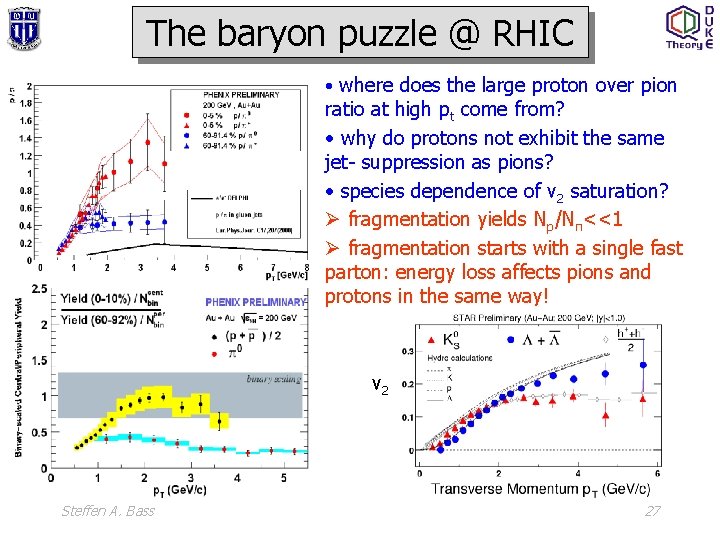
The baryon puzzle @ RHIC • where does the large proton over pion ratio at high pt come from? • why do protons not exhibit the same jet- suppression as pions? • species dependence of v 2 saturation? Ø fragmentation yields Np/Nπ<<1 Ø fragmentation starts with a single fast parton: energy loss affects pions and protons in the same way! v 2 Steffen A. Bass 27
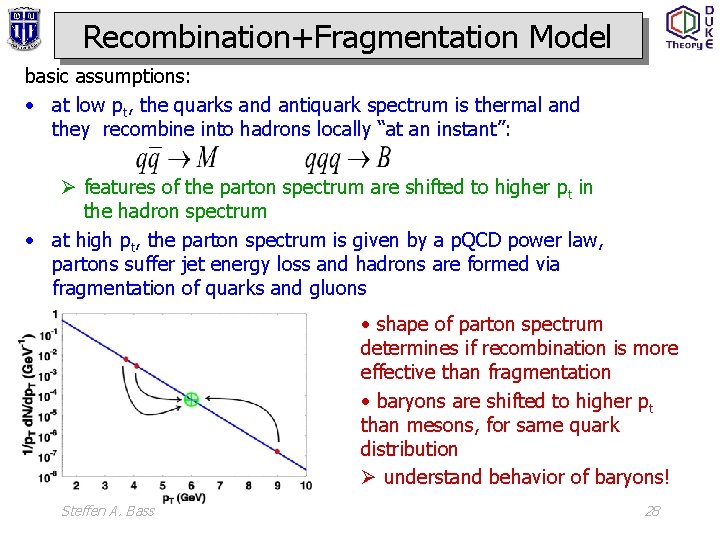
Recombination+Fragmentation Model basic assumptions: • at low pt, the quarks and antiquark spectrum is thermal and they recombine into hadrons locally “at an instant”: Ø features of the parton spectrum are shifted to higher pt in the hadron spectrum • at high pt, the parton spectrum is given by a p. QCD power law, partons suffer jet energy loss and hadrons are formed via fragmentation of quarks and gluons • shape of parton spectrum determines if recombination is more effective than fragmentation • baryons are shifted to higher pt than mesons, for same quark distribution Ø understand behavior of baryons! Steffen A. Bass 28
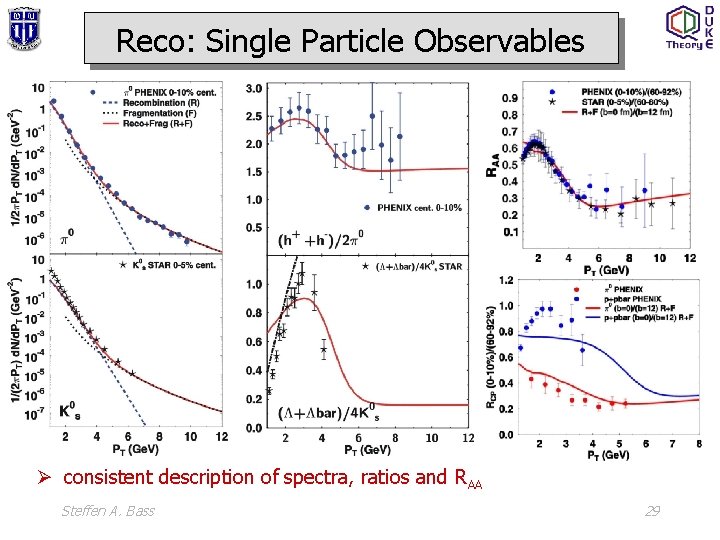
Reco: Single Particle Observables Ø consistent description of spectra, ratios and RAA Steffen A. Bass 29
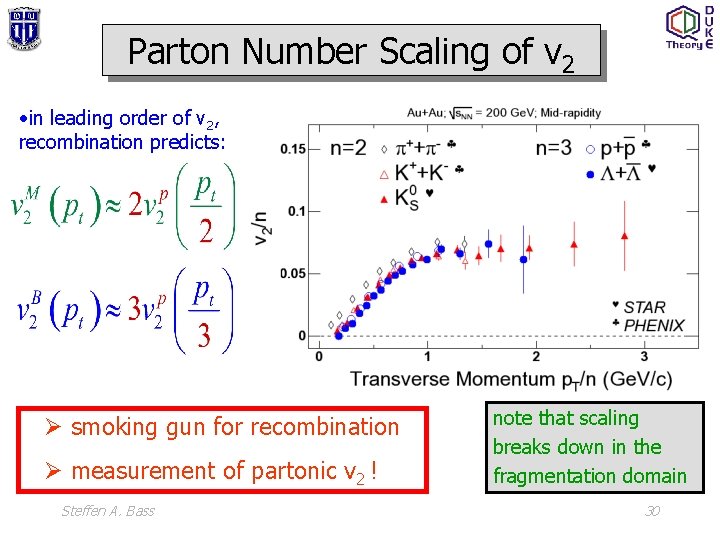
Parton Number Scaling of v 2 • in leading order of v 2, recombination predicts: Ø smoking gun for recombination Ø measurement of partonic v 2 ! Steffen A. Bass note that scaling breaks down in the fragmentation domain 30
Lessons: • reco success for single-particle distributions & v 2 indicates formation of hadrons from a system of deconfined quarks at TC (s. QGP? ) Challenges: • dynamical two-particle correlations • treatment of gluons & sea-quarks § R. J. Fries, S. A. Bass & B. Mueller, PRL 94 122301 (2005) § C. Nonaka, B. Mueller, S. A. Bass & M. Asakawa, PRC 71 051901 (2005) Rapid C. § B. Mueller, S. A. Bass & R. J. Fries, Phys. Lett. B in print, nucl-th/0503003 Steffen A. Bass 31
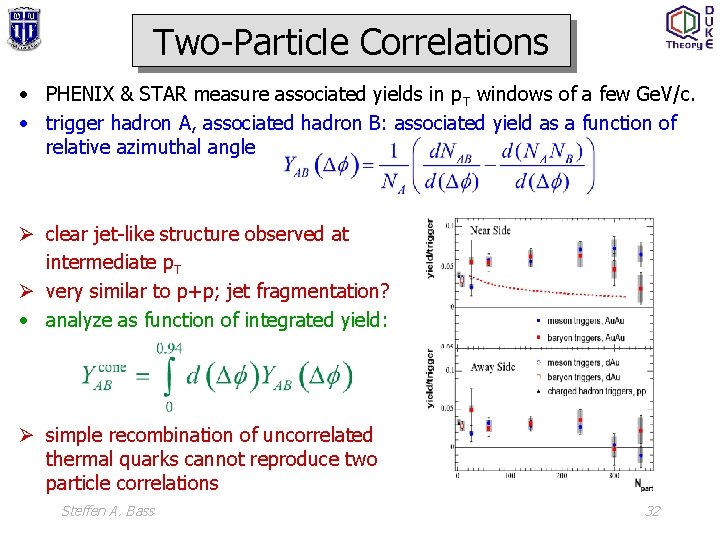
Two-Particle Correlations • PHENIX & STAR measure associated yields in p. T windows of a few Ge. V/c. • trigger hadron A, associated hadron B: associated yield as a function of relative azimuthal angle Ø clear jet-like structure observed at intermediate p. T Ø very similar to p+p; jet fragmentation? • analyze as function of integrated yield: Ø simple recombination of uncorrelated thermal quarks cannot reproduce two particle correlations Steffen A. Bass 32
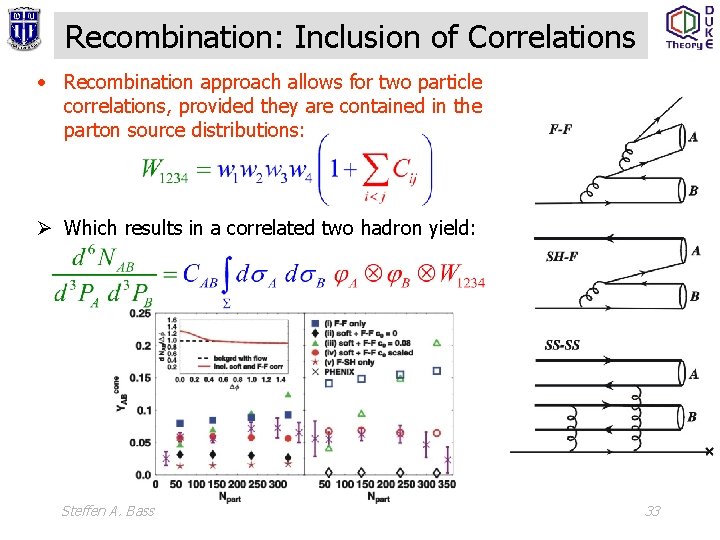
Recombination: Inclusion of Correlations • Recombination approach allows for two particle correlations, provided they are contained in the parton source distributions: Ø Which results in a correlated two hadron yield: Steffen A. Bass 33
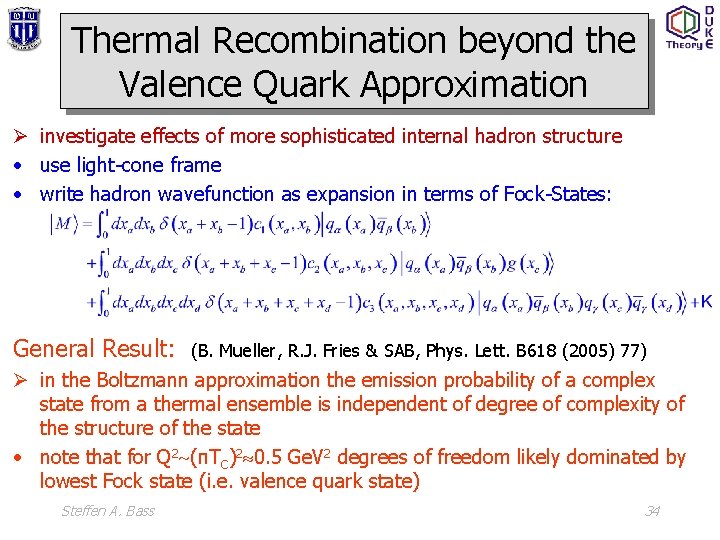
Thermal Recombination beyond the Valence Quark Approximation Ø investigate effects of more sophisticated internal hadron structure • use light-cone frame • write hadron wavefunction as expansion in terms of Fock-States: General Result: (B. Mueller, R. J. Fries & SAB, Phys. Lett. B 618 (2005) 77) Ø in the Boltzmann approximation the emission probability of a complex state from a thermal ensemble is independent of degree of complexity of the structure of the state • note that for Q 2 (πTC)2 0. 5 Ge. V 2 degrees of freedom likely dominated by lowest Fock state (i. e. valence quark state) Steffen A. Bass 34
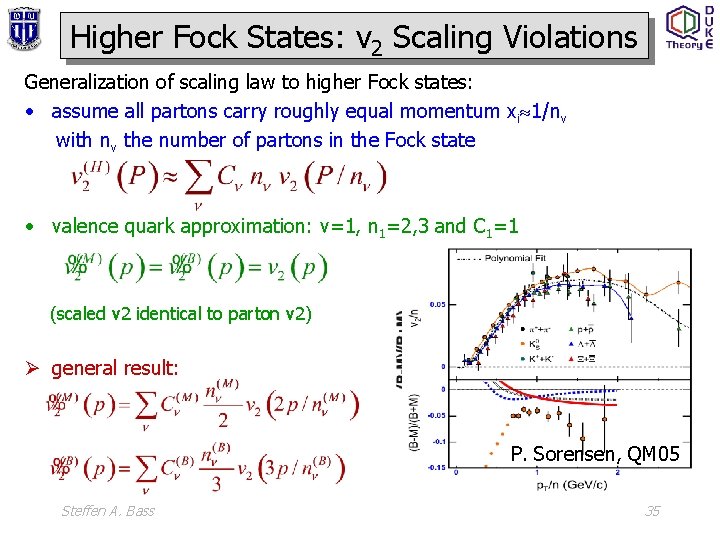
Higher Fock States: v 2 Scaling Violations Generalization of scaling law to higher Fock states: • assume all partons carry roughly equal momentum xi 1/nν with nν the number of partons in the Fock state • valence quark approximation: ν=1, n 1=2, 3 and C 1=1 (scaled v 2 identical to parton v 2) Ø general result: Ø scaling violations 5% P. Sorensen, QM 05 Steffen A. Bass 35
Lessons: • dynamical correlations compatible with reco approach • inclusion of gluons & sea-quarks: interpretation of scaled v 2 as partonic flow still valid Beware: • Recombination is not a dynamical model for the timeevolution of a heavy-ion reaction, but only a formalism on how to hadronize an ensemble of constituent quarks Ø snapshot of system at TC Steffen A. Bass 36
Last Words… • The (s)QGP has been discovered – the gunsmoke is thickening w/ every measurement! • RHIC experiments have performed way beyond expectations! • RHIC physics is transitioning from the discovery phase to the exploratory phase: Ø keep pushing the envelope w/ new measurements! Ø do not neglect the nitty-gritty details – they will become more important in quantitatively determining the s. QGP properties… - but don’t forget the big picture in the process!! Steffen A. Bass 37

The End Steffen A. Bass 38
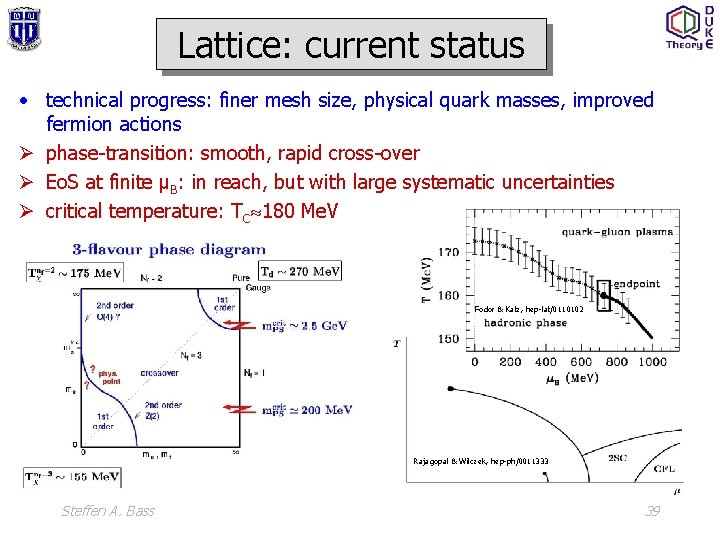
Lattice: current status • technical progress: finer mesh size, physical quark masses, improved fermion actions Ø phase-transition: smooth, rapid cross-over Ø Eo. S at finite μB: in reach, but with large systematic uncertainties Ø critical temperature: TC 180 Me. V Fodor & Katz, hep-lat/0110102 Rajagopal & Wilczek, hep-ph/0011333 Steffen A. Bass 39
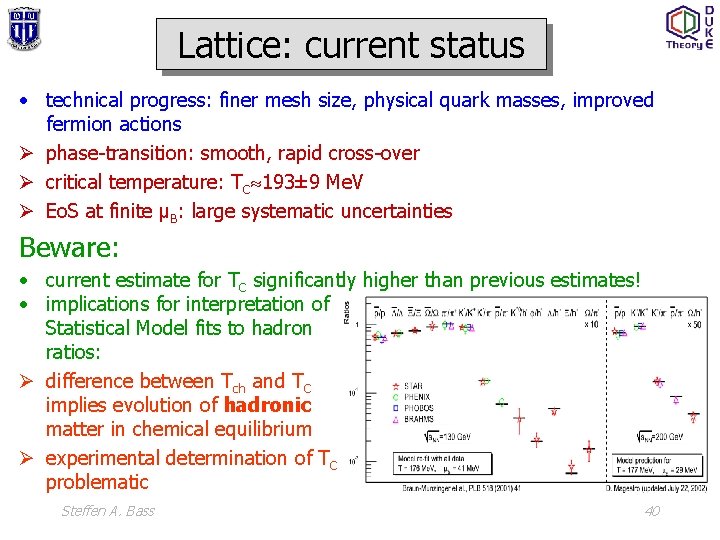
Lattice: current status • technical progress: finer mesh size, physical quark masses, improved fermion actions Ø phase-transition: smooth, rapid cross-over Ø critical temperature: TC 193± 9 Me. V Ø Eo. S at finite μB: large systematic uncertainties Beware: • current estimate for TC significantly higher than previous estimates! • implications for interpretation of Statistical Model fits to hadron ratios: Ø difference between Tch and TC implies evolution of hadronic matter in chemical equilibrium Ø experimental determination of TC problematic Steffen A. Bass 40
- Slides: 40