
Probing the QCD Phase Diagram Aneta Iordanova 9
Probing the QCD Phase Diagram Aneta Iordanova 9 th June 2008 Seminar at UC Riverside
Outline Motivation ¢ Analysis Technique ¢ Freeze-out ¢ Chemical l Kinetic l Baryon/meson and strangeness production ¢ Scaling properties ¢ 2 Aneta Iordanova University of Illinois at Chicago 9 th June 2008
Motivation ¢ Identified particle spectra in heavy-ion collisions at different center-of-mass energies and system size provide: l l ¢ a unique tool to explore the QCD phase diagram. system size dependence of the freeze-out parameters at RHIC. Bulk particle production provide: l Kinetic freeze-out properties from spectral shapes • Tkin at kinetic freeze-out, transverse radial flow (β) l Chemical freeze-out properties from particle ratios • Tch at chemical freeze-out, strangeness and baryon production 3 Aneta Iordanova University of Illinois at Chicago 9 th June 2008
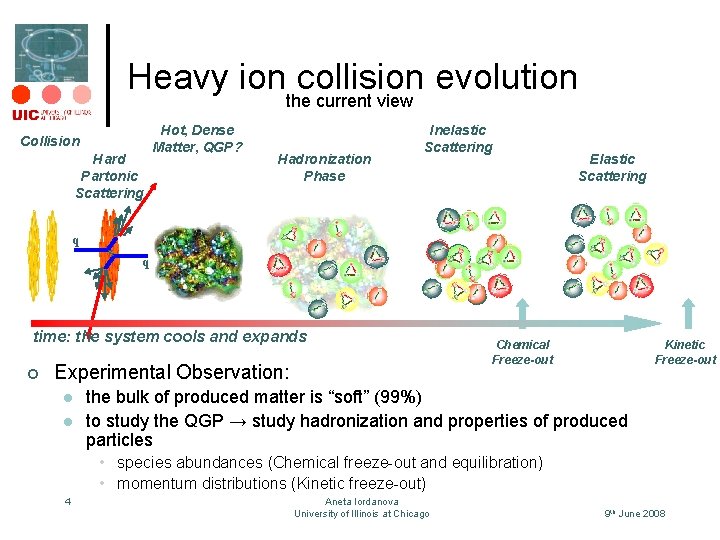
Heavy ion collision evolution the current view Collision Hard Partonic Scattering Hot, Dense Matter, QGP? Hadronization Phase Inelastic Scattering Elastic Scattering q q time: the system cools and expands ¢ Experimental Observation: l l Chemical Freeze-out Kinetic Freeze-out the bulk of produced matter is “soft” (99%) to study the QGP → study hadronization and properties of produced particles • species abundances (Chemical freeze-out and equilibration) • momentum distributions (Kinetic freeze-out) 4 Aneta Iordanova University of Illinois at Chicago 9 th June 2008
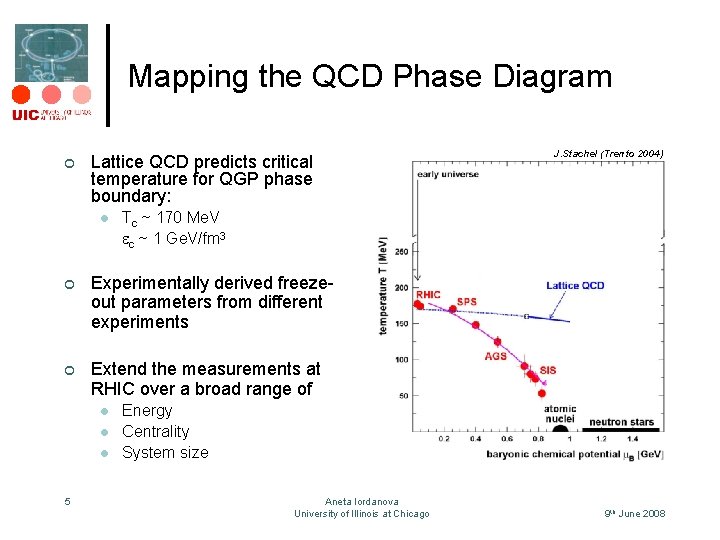
Mapping the QCD Phase Diagram ¢ Lattice QCD predicts critical temperature for QGP phase boundary: l Tc ~ 170 Me. V ec ~ 1 Ge. V/fm 3 ¢ Experimentally derived freezeout parameters from different experiments ¢ Extend the measurements at RHIC over a broad range of l l l 5 J. Stachel (Trento 2004) Energy Centrality System size Aneta Iordanova University of Illinois at Chicago 9 th June 2008
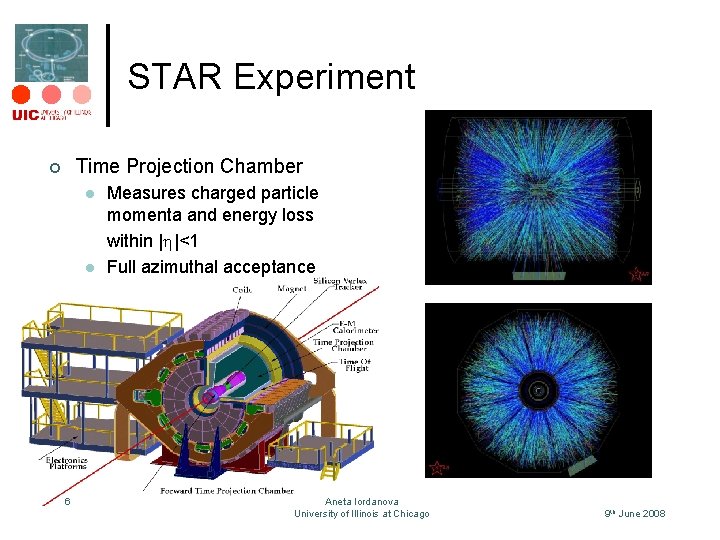
STAR Experiment Time Projection Chamber ¢ l l 6 Measures charged particle momenta and energy loss within |h|<1 Full azimuthal acceptance Aneta Iordanova University of Illinois at Chicago 9 th June 2008
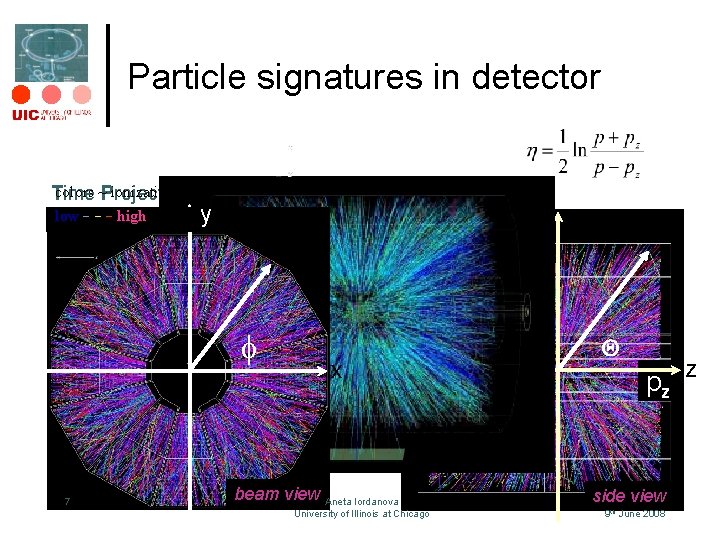
Particle signatures in detector pseudorapidity: colors ~Projection ionization: Chamber: Time low - - - high provides chargedyparticle information • trajectories • momentum f 7 x beam view Aneta Iordanova University of Illinois at Chicago p. T pz z side view 9 th June 2008
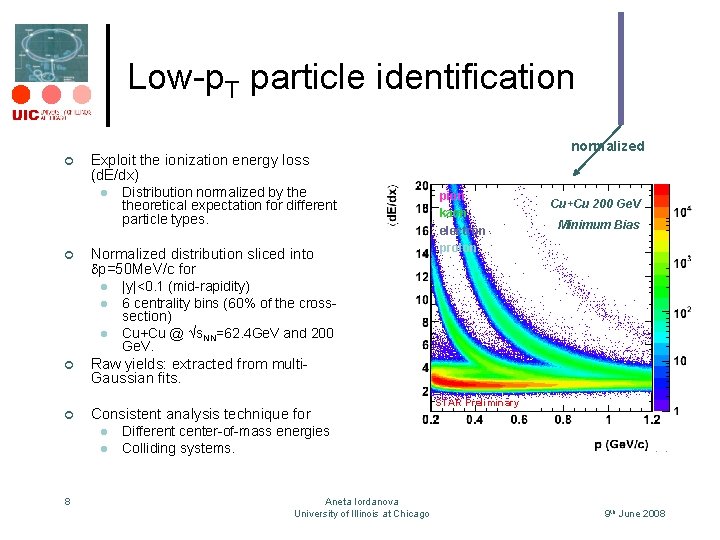
Low-p. T particle identification ¢ Exploit the ionization energy loss (d. E/dx) l ¢ Distribution normalized by theoretical expectation for different particle types. Normalized distribution sliced into dp=50 Me. V/c for l l l Raw yields: extracted from multi. Gaussian fits. ¢ Consistent analysis technique for l l pion kaon electron proton Cu+Cu 200 Ge. V 0 -10% central Minimum Bias 0. 50<p. T<0. 55 Ge. V/c |y|<0. 1 (mid-rapidity) 6 centrality bins (60% of the crosssection) Cu+Cu @ √s. NN=62. 4 Ge. V and 200 Ge. V. ¢ 8 normalized STAR Preliminary Different center-of-mass energies Colliding systems. Aneta Iordanova University of Illinois at Chicago 9 th June 2008
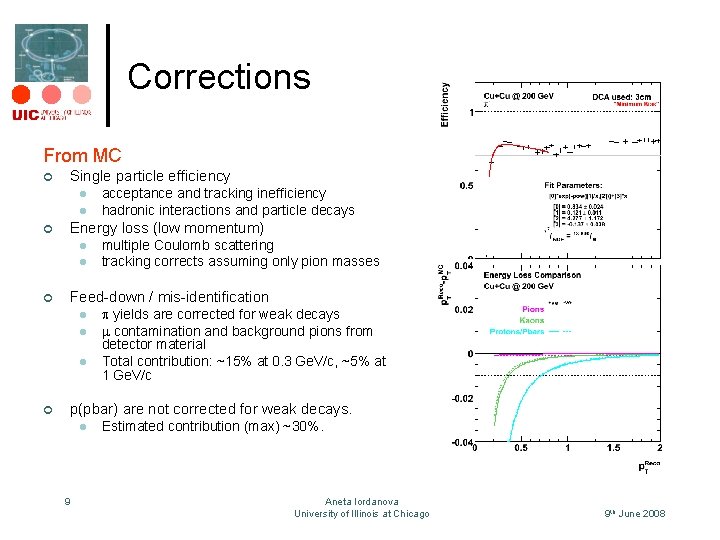
Corrections From MC ¢ Single particle efficiency l l ¢ Energy loss (low momentum) l l ¢ multiple Coulomb scattering tracking corrects assuming only pion masses Feed-down / mis-identification l l l ¢ acceptance and tracking inefficiency hadronic interactions and particle decays p yields are corrected for weak decays m contamination and background pions from detector material Total contribution: ~15% at 0. 3 Ge. V/c, ~5% at 1 Ge. V/c p(pbar) are not corrected for weak decays. l 9 Estimated contribution (max) ~30%. Aneta Iordanova University of Illinois at Chicago 9 th June 2008
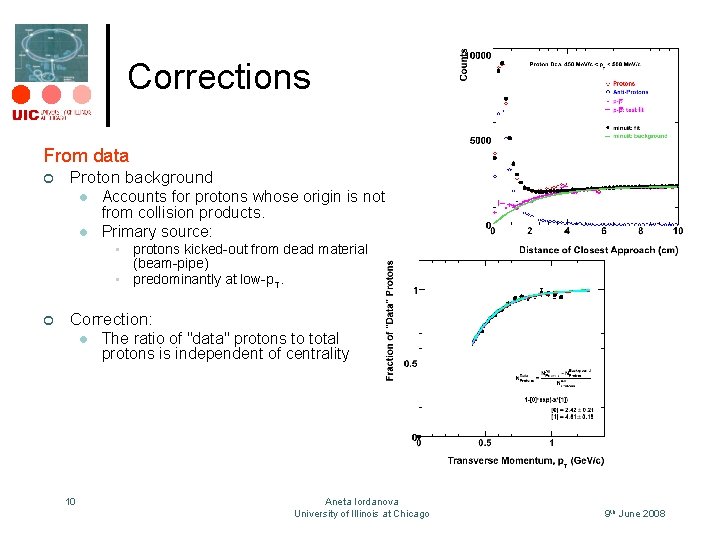
Corrections From data ¢ Proton background l l Accounts for protons whose origin is not from collision products. Primary source: • protons kicked-out from dead material (beam-pipe) • predominantly at low-p. T. ¢ Correction: l 10 The ratio of "data" protons to total protons is independent of centrality Aneta Iordanova University of Illinois at Chicago 9 th June 2008
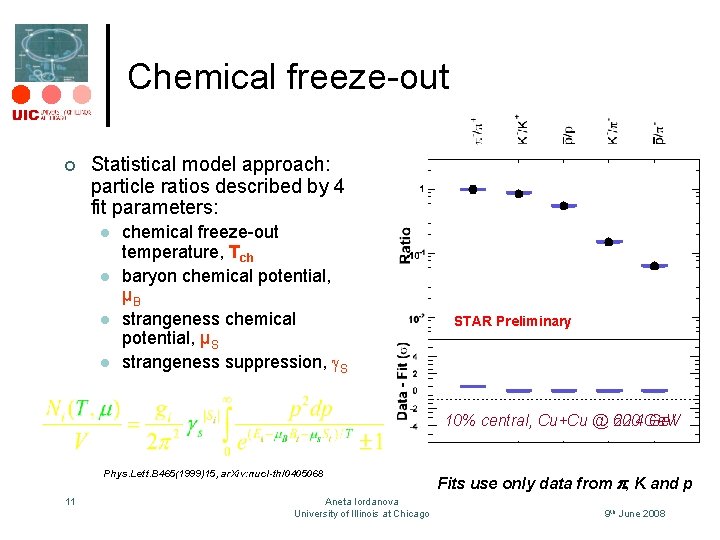
Chemical freeze-out ¢ Statistical model approach: particle ratios described by 4 fit parameters: l l chemical freeze-out temperature, Tch baryon chemical potential, μB strangeness chemical potential, μS strangeness suppression, g. S STAR Preliminary 10% central, Cu+Cu @ 200 62. 4 Ge. V Phys. Lett. B 465(1999)15, ar. Xiv: nucl-th/0405068 11 Aneta Iordanova University of Illinois at Chicago Fits use only data from p, K and p 9 th June 2008
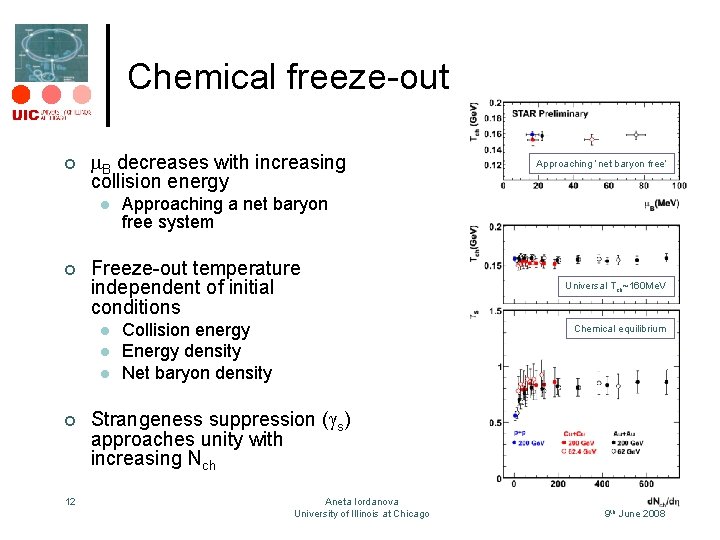
Chemical freeze-out ¢ m. B decreases with increasing collision energy l ¢ l l ¢ 12 Approaching a net baryon free system Freeze-out temperature independent of initial conditions l Approaching ‘net baryon free’ Collision energy Energy density Net baryon density Universal Tch~160 Me. V Chemical equilibrium Strangeness suppression (gs) approaches unity with increasing Nch Aneta Iordanova University of Illinois at Chicago 9 th June 2008
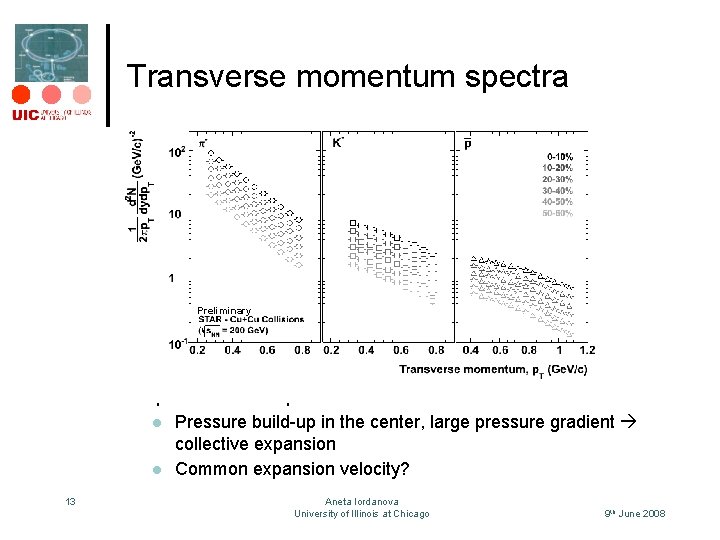
Transverse momentum spectra Preliminary Spectra Mass dependence l l 13 Pressure build-up in the center, large pressure gradient collective expansion Common expansion velocity? Aneta Iordanova University of Illinois at Chicago 9 th June 2008
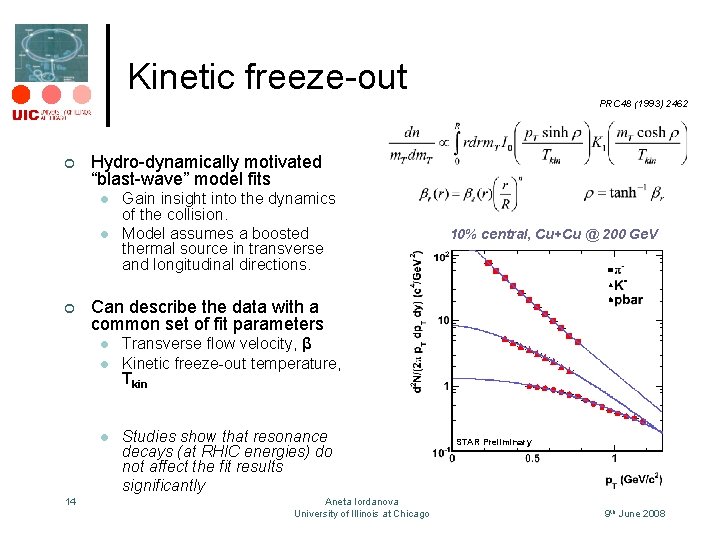
Kinetic freeze-out PRC 48 (1993) 2462 ¢ Hydro-dynamically motivated “blast-wave” model fits l l ¢ 10% central, Cu+Cu @ 200 Ge. V Can describe the data with a common set of fit parameters l l l 14 Gain insight into the dynamics of the collision. Model assumes a boosted thermal source in transverse and longitudinal directions. Transverse flow velocity, β Kinetic freeze-out temperature, Tkin Studies show that resonance decays (at RHIC energies) do not affect the fit results significantly Aneta Iordanova University of Illinois at Chicago STAR Preliminary 9 th June 2008
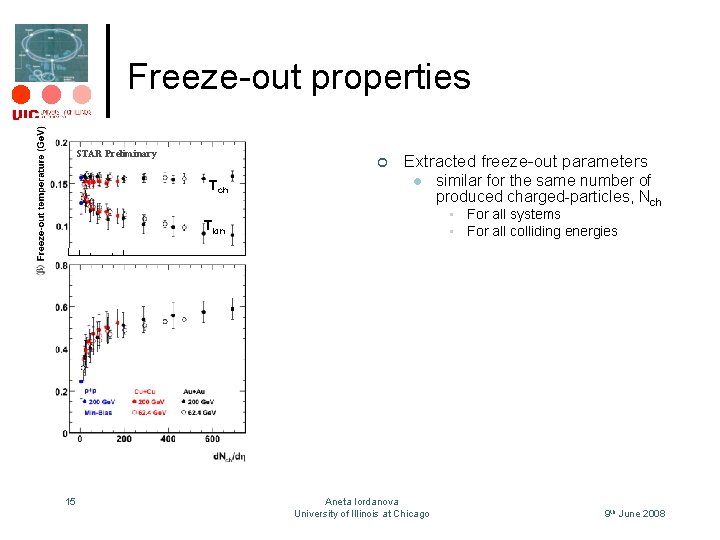
Freeze-out properties STAR Preliminary ¢ Tch Extracted freeze-out parameters l • For all systems • For all colliding energies Tkin 15 similar for the same number of produced charged-particles, Nch Aneta Iordanova University of Illinois at Chicago 9 th June 2008
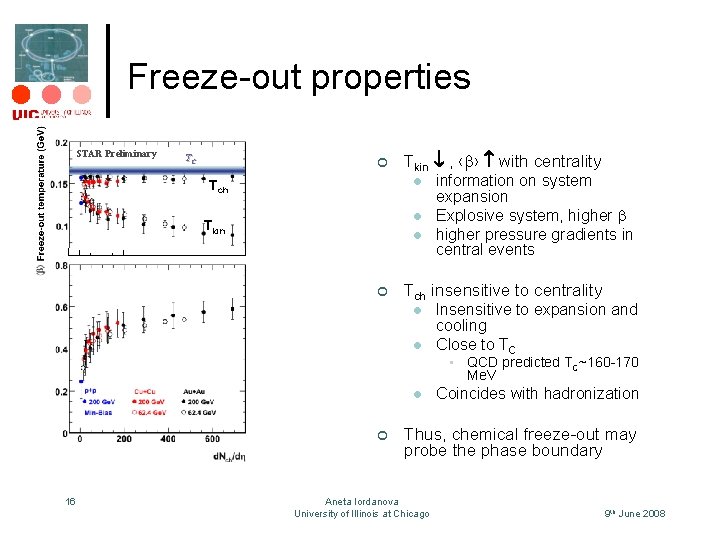
Freeze-out properties STAR Preliminary TC ¢ Tkin , ‹b› with centrality l Tch l Tkin l ¢ information on system expansion Explosive system, higher b higher pressure gradients in central events Tch insensitive to centrality l l Insensitive to expansion and cooling Close to TC • QCD predicted TC~160 -170 Me. V l ¢ 16 Coincides with hadronization Thus, chemical freeze-out may probe the phase boundary Aneta Iordanova University of Illinois at Chicago 9 th June 2008
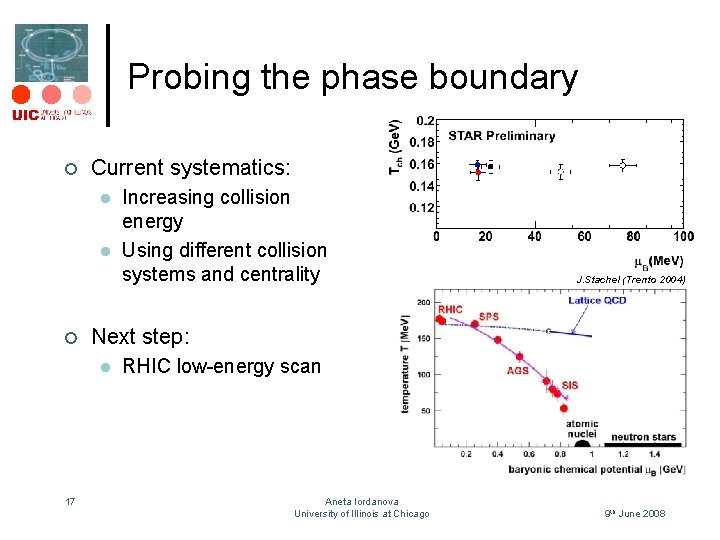
Probing the phase boundary ¢ Current systematics: l l ¢ J. Stachel (Trento 2004) Next step: l 17 Increasing collision energy Using different collision systems and centrality RHIC low-energy scan Aneta Iordanova University of Illinois at Chicago 9 th June 2008
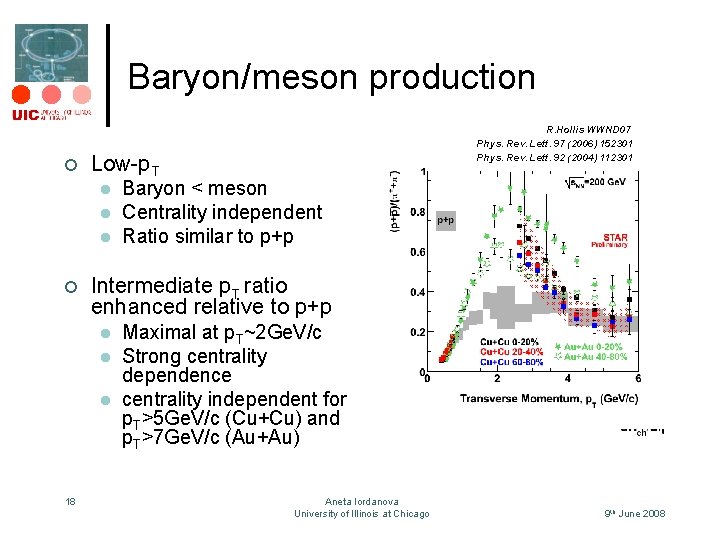
Baryon/meson production ¢ Low-p. T l l l ¢ Baryon < meson Centrality independent Ratio similar to p+p Intermediate p. T ratio enhanced relative to p+p l l l 18 R. Hollis WWND 07 Phys. Rev. Lett. 97 (2006) 152301 Phys. Rev. Lett. 92 (2004) 112301 Maximal at p. T~2 Ge. V/c Strong centrality dependence centrality independent for p. T>5 Ge. V/c (Cu+Cu) and p. T>7 Ge. V/c (Au+Au) Aneta Iordanova University of Illinois at Chicago 9 th June 2008
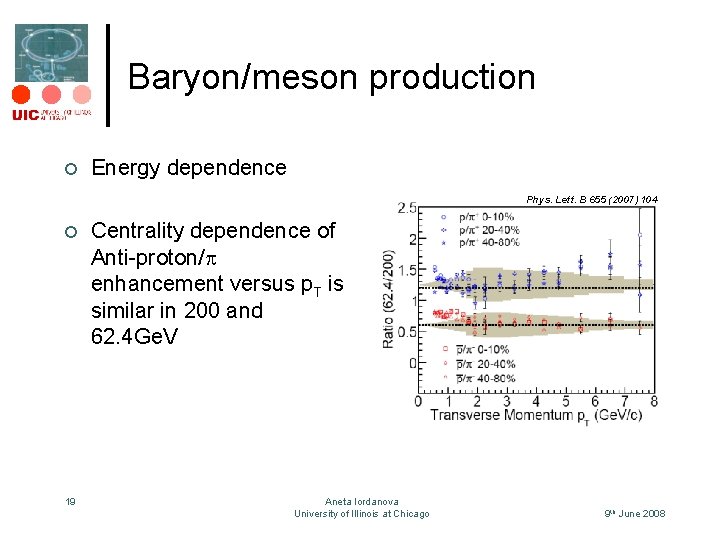
Baryon/meson production ¢ Energy dependence Phys. Lett. B 655 (2007) 104 ¢ 19 Centrality dependence of Anti-proton/p enhancement versus p. T is similar in 200 and 62. 4 Ge. V Aneta Iordanova University of Illinois at Chicago 9 th June 2008
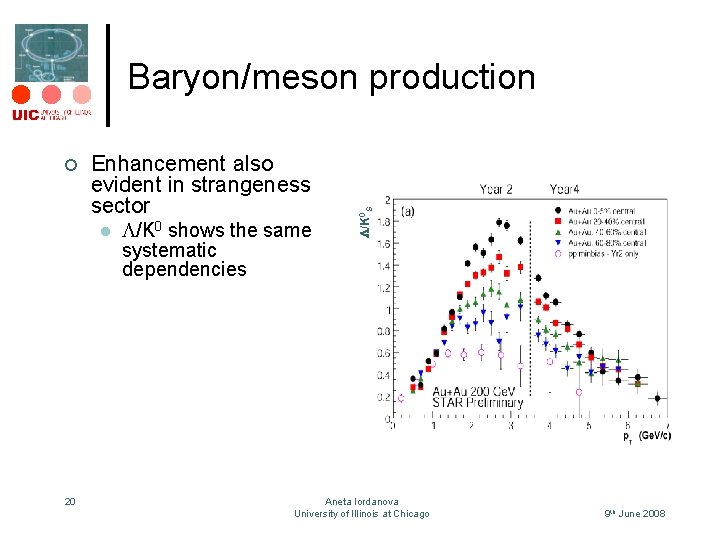
¢ Enhancement also evident in strangeness sector l 20 L/K 0 shows the same systematic dependencies L/K 0 S Baryon/meson production Aneta Iordanova University of Illinois at Chicago 9 th June 2008
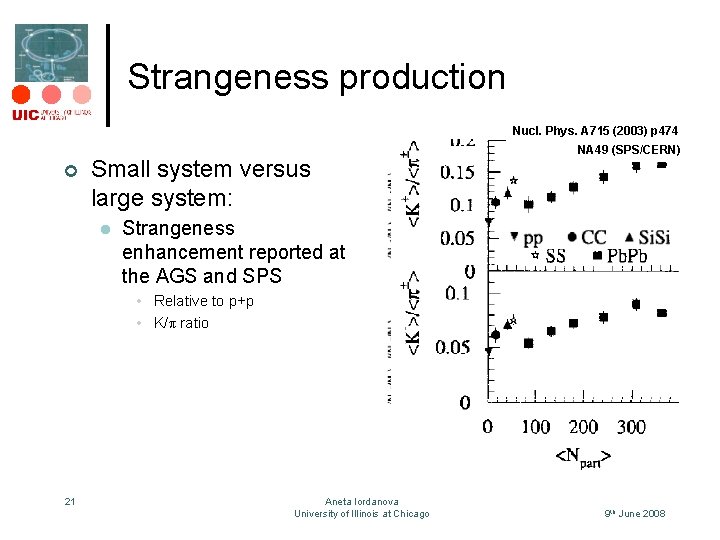
Strangeness production Nucl. Phys. A 715 (2003) p 474 ¢ Small system versus large system: l NA 49 (SPS/CERN) PR C 60 044904 (1999) E 802 (AGS/BNL) Strangeness enhancement reported at the AGS and SPS • Relative to p+p • K/p ratio 21 Aneta Iordanova University of Illinois at Chicago 9 th June 2008
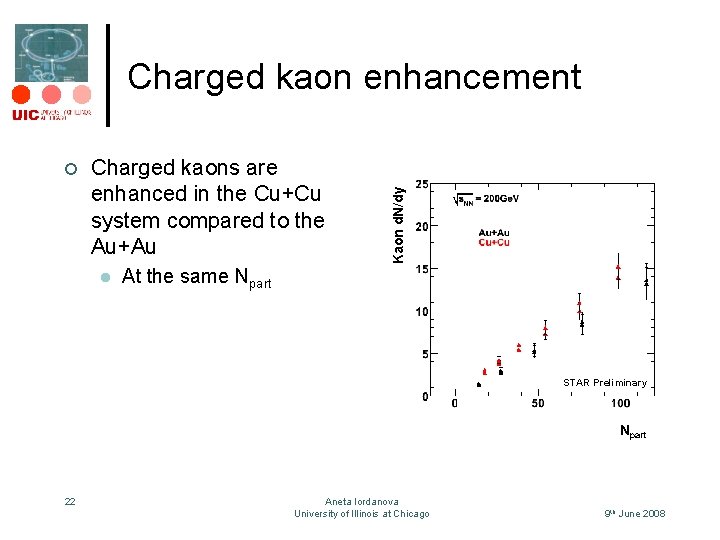
¢ Charged kaons are enhanced in the Cu+Cu system compared to the Au+Au l Kaon d. N/dy Charged kaon enhancement At the same Npart STAR Preliminary Npart 22 Aneta Iordanova University of Illinois at Chicago 9 th June 2008
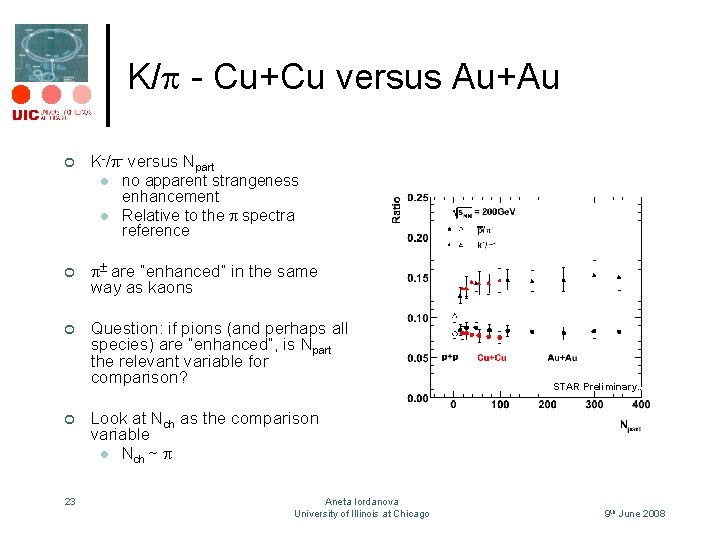
K/p - Cu+Cu versus Au+Au ¢ K-/p- versus Npart l l no apparent strangeness enhancement Relative to the p spectra reference ¢ p are “enhanced” in the same way as kaons ¢ Question: if pions (and perhaps all species) are “enhanced”, is Npart the relevant variable for comparison? ¢ Look at Nch as the comparison variable l 23 STARPreliminary Nch ~ p Aneta Iordanova University of Illinois at Chicago 9 th June 2008
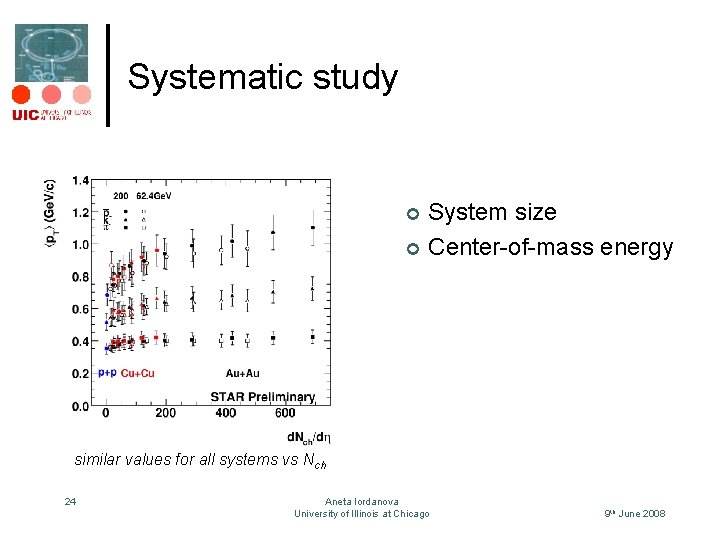
Systematic study System size ¢ Center-of-mass energy ¢ similar values for all systems vs Nch 24 Aneta Iordanova University of Illinois at Chicago 9 th June 2008
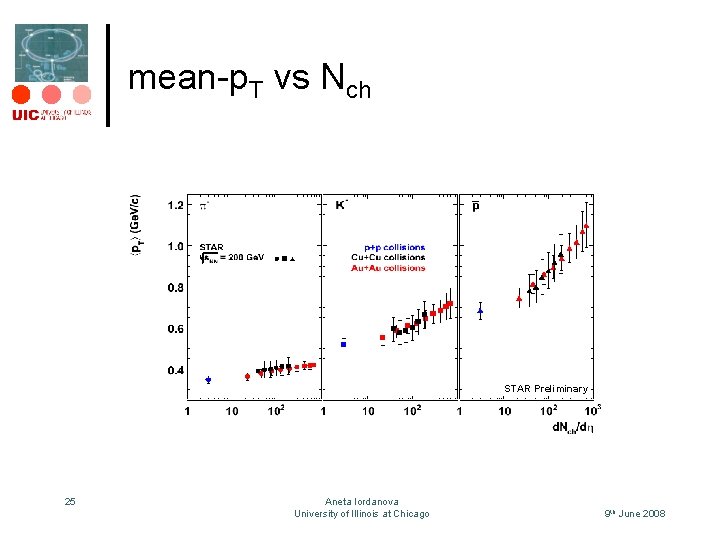
mean-p. T vs Nch STAR Preliminary 25 Aneta Iordanova University of Illinois at Chicago 9 th June 2008
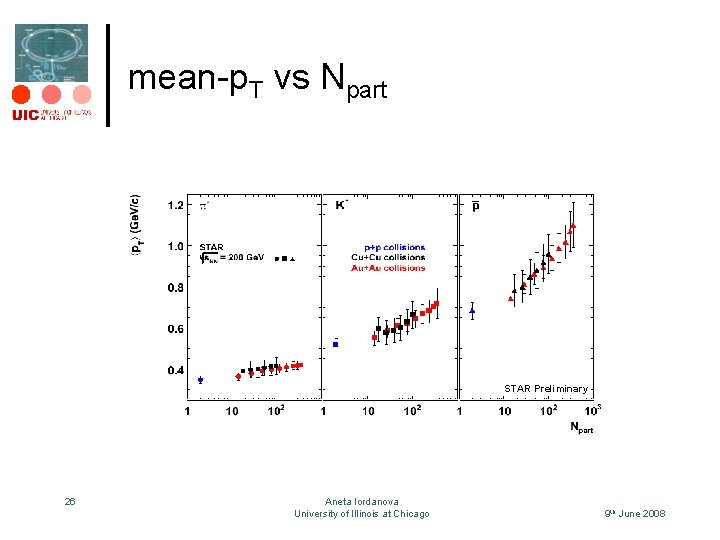
mean-p. T vs Npart STAR Preliminary 26 Aneta Iordanova University of Illinois at Chicago 9 th June 2008
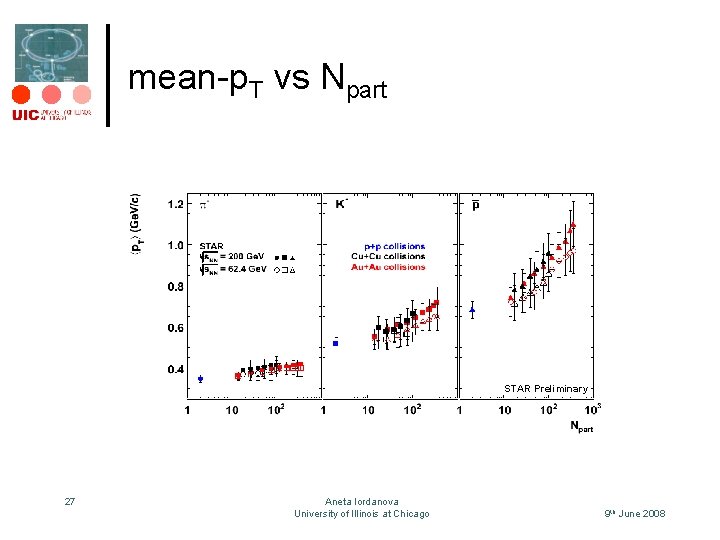
mean-p. T vs Npart STAR Preliminary 27 Aneta Iordanova University of Illinois at Chicago 9 th June 2008
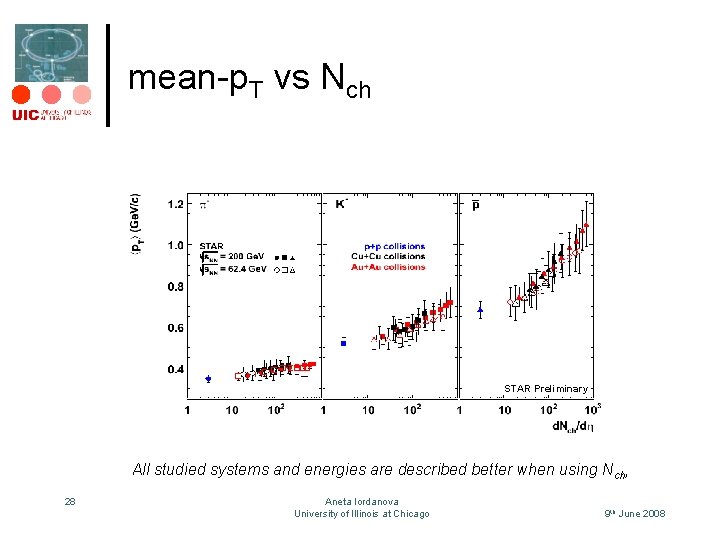
mean-p. T vs Nch STAR Preliminary All studied systems and energies are described better when using Nch, 28 Aneta Iordanova University of Illinois at Chicago 9 th June 2008
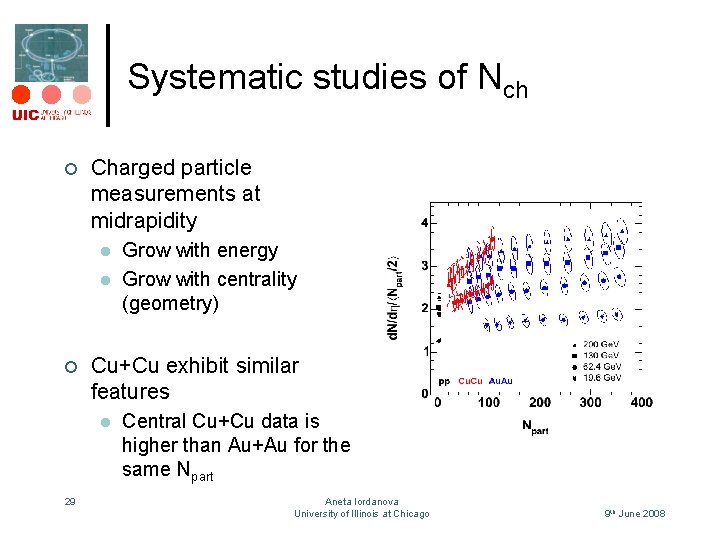
Systematic studies of Nch ¢ Charged particle measurements at midrapidity l l ¢ Cu+Cu exhibit similar features l 29 Grow with energy Grow with centrality (geometry) Central Cu+Cu data is higher than Au+Au for the same Npart Aneta Iordanova University of Illinois at Chicago 9 th June 2008
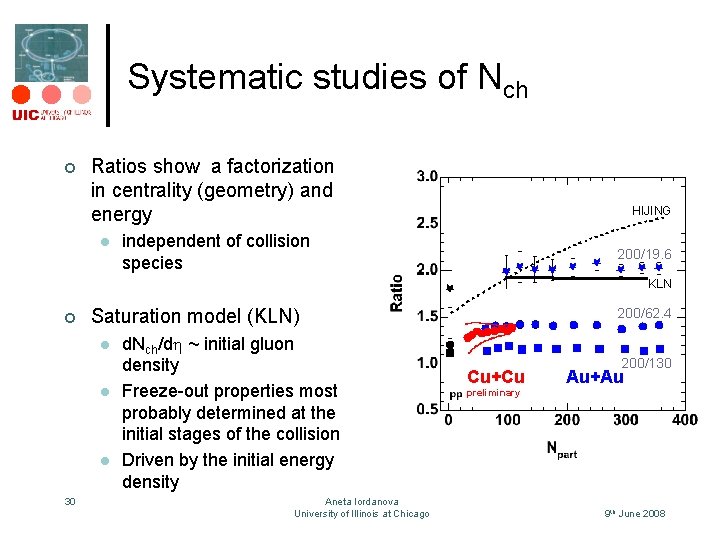
Systematic studies of Nch ¢ Ratios show a factorization in centrality (geometry) and energy l HIJING independent of collision species 200/19. 6 Saturation KLN ¢ Saturation model (KLN) l l l 30 d. Nch/dh ~ initial gluon density Freeze-out properties most probably determined at the initial stages of the collision Driven by the initial energy density Aneta Iordanova University of Illinois at Chicago 200/62. 4 Cu+Cu 200/130 Au+Au preliminary 9 th June 2008
Summary ¢ STAR has enlarged the variety of hadron spectra measurements at RHIC by providing new results for Cu+Cu at two different center-ofmass energies, √s=200 and 62. 4 Ge. V. ¢ The freeze-out properties (Tch, Tkin, g. S, b) at RHIC energies seem to scale by the number of produced charged hadrons at mid-rapidity l l ¢ 31 determined at the initial stages of the collision and driven by the initial energy density, Tch coincides with the LGT predicted Tc which is around 160 Me. V. In both Cu+Cu and Au+Au collisions, mid-rapidity baryon production at intermediate p. T is enhanced compared to that of mesons indicating the coalescence process for hadronization. Aneta Iordanova University of Illinois at Chicago 9 th June 2008
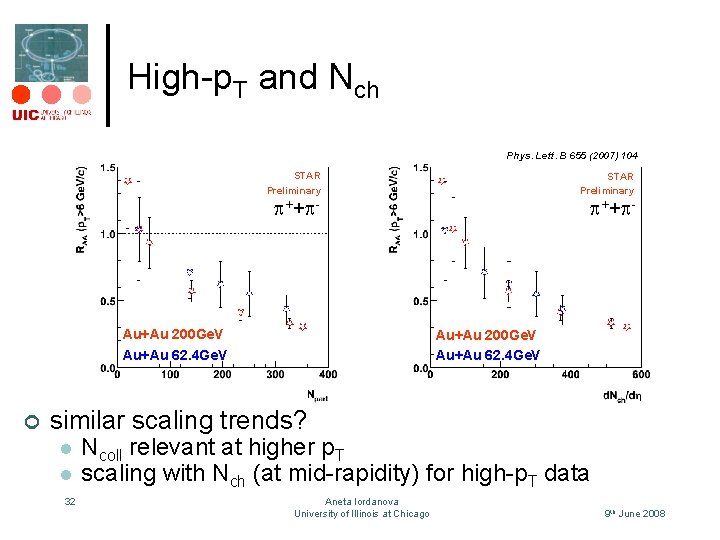
High-p. T and Nch Phys. Lett. B 655 (2007) 104 STAR Preliminary p++p- Au+Au 200 Ge. V Au+Au 62. 4 Ge. V ¢ p++p- Au+Au 200 Ge. V Au+Au 62. 4 Ge. V similar scaling trends? l l 32 Ncoll relevant at higher p. T scaling with Nch (at mid-rapidity) for high-p. T data Aneta Iordanova University of Illinois at Chicago 9 th June 2008
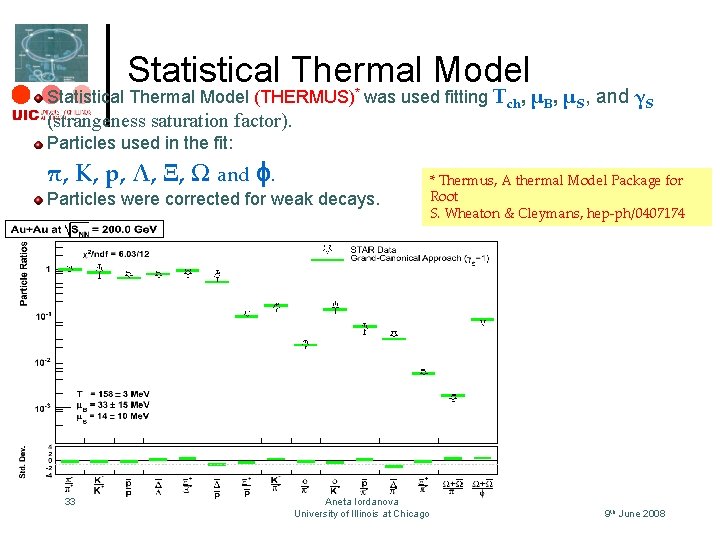
Statistical Thermal Model (THERMUS)* was used fitting Tch, μB, μS, and γS (strangeness saturation factor). Particles used in the fit: π, K, p, Λ, Ξ, Ω and f. Particles were corrected for weak decays. 33 * Thermus, A thermal Model Package for Root S. Wheaton & Cleymans, hep-ph/0407174 Aneta Iordanova University of Illinois at Chicago 9 th June 2008
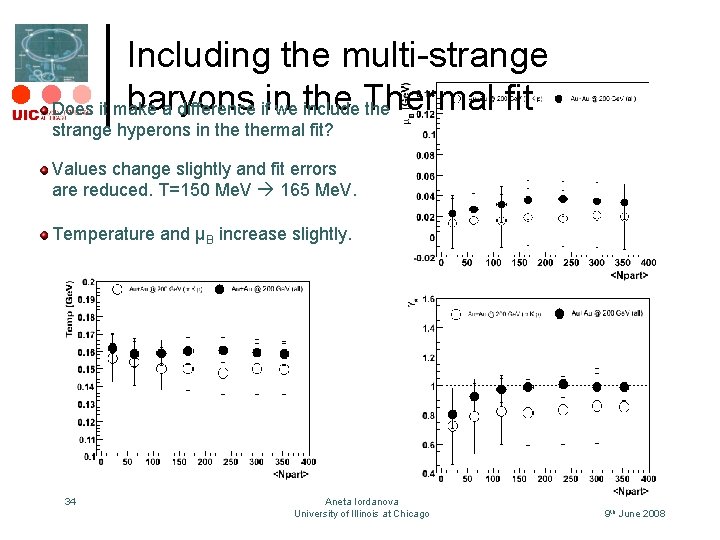
Including the multi-strange baryons fit Does it make a difference ifin we the include Thermal the strange hyperons in thermal fit? Values change slightly and fit errors are reduced. T=150 Me. V 165 Me. V. Temperature and μB increase slightly. 34 Aneta Iordanova University of Illinois at Chicago 9 th June 2008
- Slides: 34