
Probing the Potential of the SecularReligious Interface Thomas
Probing the Potential of the Secular-Religious Interface Thomas Heilke Professor, Political Science UBC Okanagan “Christianity breaks up because of the necessary character of its morality. —Science has awakened doubt in the truthfulness of the Christian God: and by this doubt, Christianity dies (Pascal’s deus absconditus). F. Nietzsche (unpublished note, 1886) “. . . the story of how we got here is inextricably bound up with our account of where we are. . . ” Charles Taylor, A Secular Age, 2007)
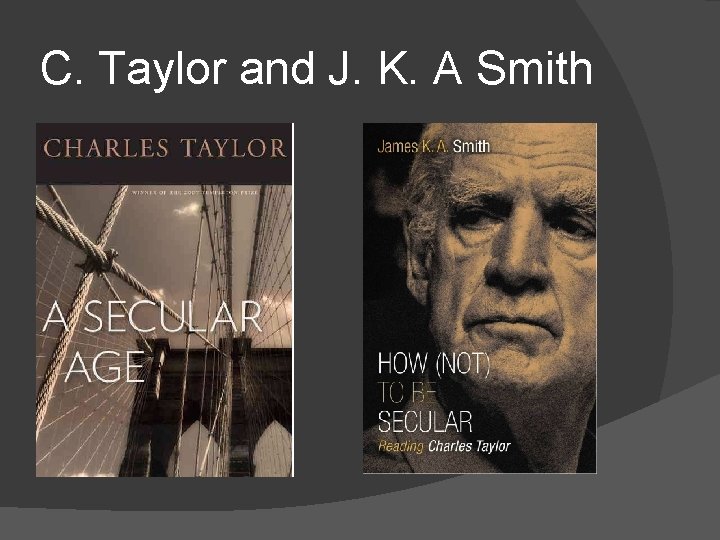
C. Taylor and J. K. A Smith
Outline of Presentation 1. What is “Here”? : Secularization versions 1, 2. a and 2. b. 1 & 2. b. 2 2. What is “Here”? : Secularization version 3 3. What is “Here”? : Existential representation in our political institutions (a point of emphasis, not disagreement) 4. What might/should Christians do about it?
What is secularization? 3 + 1 types/meanings/versions Version 1: saeculum A “time, ” not a realm of existence The “interval between fall and eschaton where coercive justice, private property and impaired natural reason” were understood as means of coping with “the unredeemed effects of sinful humanity” (John Milbank, Theology and Social Theory, 1990)

Secularization v. 2. a 1) differentiation 1) privatization 2) desacralization 3) liberalization
Secularization v. 2. a “Neutral”? � � � A theory of secularization that claims to be politically more or less neutral No implication that there will be less religious influence or significance in politics However: it develops into a theory of modernization that claims that religion will be less relevant and influential connects macro-level trends with micro-level trends Has what this theory of secularized modernity expected actually happened?
The Persistence of Religious Belief (excursus) � In the United States �Some secularization, but religions remains an important socio-political force �US as first modernized country �therefore a puzzle � Global Religion � Note on Europe � BUT: Secularized Institutions
The Persistence of Religious Belief (excursus) � Question: Does this persistence matter to Taylor’s argument? � Answer: No, but it matters to what we (Christians) do with that argument
The Two forms of secularism theory/doctrine (v 2 b)
1. Laicism A strategy � an agenda for action � expel religion from politics altogether � advocates for the complete privatization of religion � advocates the eventual decline or elimination of religious belief and practice � the objective of laicism �
Laicism (cont. ) laicism has heavily influenced modern social science �(see the writings of pundits and public intellectuals) �
Laicism (cont) � origin of term: laïcité: “a doctrine of complete freedom from, and noninterference by, religion. . . the belief that functions previously performed by a priesthood should be transferred to the laity, especially in the judicial and educational spheres. ” (Azzam Tamimi, “The Origins of Arab Secularism” ) � Note: “laity” =“non-clergy”
Secularism V. 2 b 2. Judeo-Christian secularism 1. 2. 3. 4. 5. 6. 7. not so much a theory as a prescription the role of Christianity no attempt to expel Judeo-Christian religion from public life religious-secular divide Euro-American secular public life and Judeo. Christian civilization basic argument: Judeo-Christian dispositions and cultural instincts function of separation of church and state
Secularism v 2. b. 1 & 2. b. 2 What (A) laicist secularism and (B) "Judeo-Christian" secularism have in common � separation of church and state � religious language in the public (political) sphere is a bad idea � democracy requires a religiously neutral public sphere
Political and scholarly outcomes � Political: “discursive frames, habits of speech and thought, and collective dispositions” � Scholarly: ““secularist habits, dispositions, and interpretive traditions” � What are we not seeing that we don’t know we’re not seeing because of patterned incompetencies in our visual apparatus?
Secularism V. 3 � Charles � “A Taylor/James K. A. Smith: new option —the possibility of exclusive humanism as a viable social imaginary—a way of constructing meaning and significance without any reference to the divine or transcendence”
Secularism V. 3 Charles Taylor/James K. A. Smith: � Not believing in the gods is not the whole story: “we also had to be able to imagine significance within an immanent frame, to imagine modes of meaning that did not depend on transcendence. ” � So, “subtraction stories” (as in Secularism v. 1, v. 2 or v. 3) “will always fall short” � Taylor want to recognize Secularism v. 3 as an achievement, as a mode of existence that (apparently) can be humanly satisfactory, and that contains predicaments of ethics and human fulfillment similar to those that Christian believers confront �
Secularism v. 3 and Political Representation � Arguments concerning the decline of religiosity, etc. � Suppose the evidence of the disappearance of religion is slight or nil? � My response: institutionally, it has receded, regardless of historically comparative numbers and data of adherents, believers, etc. � So what?
Secularism v. 3 and Political Representation �therefore: the meaning of our societies has changed ○ so, natural scientists, for example, may still believe in God at reasonably stable rates for past 80 years (results of a survey), but “we” as a society articulating its meaning, do not ○ We no longer formally recognize or institutionally represent Christian cosmological, imperial, or ___ beliefs in our institutions (legal, governmental, social, etc. )
The Socio-Political Articulation of Meaning “Human society is not merely a fact, or an event, in the external world, to be studied by an observer like a natural phenomenon. Though it has externality as one of its important components, it is, as a whole, a little world, a cosmion, illuminated with meaning from within by the human beings who continuously create and bear it as the mode and condition of their selfrealization. It is illuminated through an elaborate symbolism. . ” Eric Voegelin, The New Science of Politics, 27.
Representation and Truth The two components of the “cosmion” � Elemental representation � Existential representation � Symbols and concepts
The Anglican Church in Wellington County: Representing (British) Empire � Lists of the war dead (“Great War” and WWII) � Flags from all branches of the British and Canadian armed services and Federal and Provincial � Photos of King, Queen, and Prince � Gabriel blowing his trumpet
The Canadian Charter Myth 1. 2. 3. 4. 5. 6. 7. No longer the myth of [Christian] Empire A new “Charter Myth” to unify Canadian society the progressive historical unfolding of human potentiality, freedom, and equality “democratic faith” of pluralism, tolerance, cosmopolitanism, autonomy, and equality [hypergoods] “democratic faith” characterized as: . . Canadian version is at home in Supreme Court “conscience of the nation”
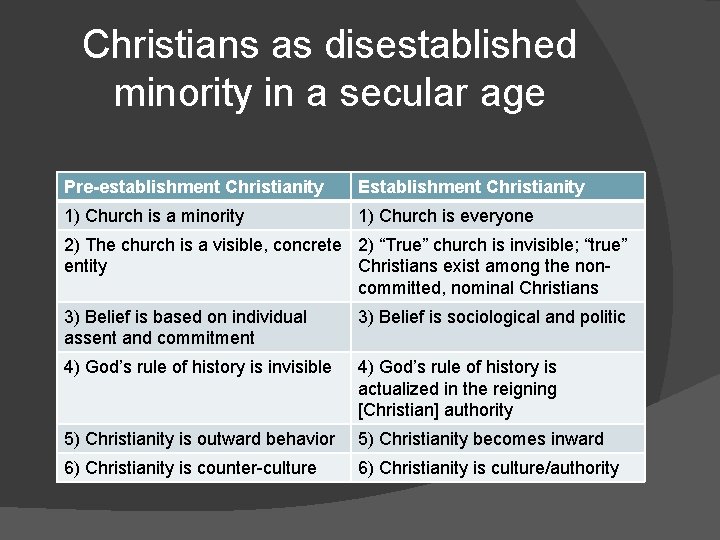
Christians as disestablished minority in a secular age Pre-establishment Christianity Establishment Christianity 1) Church is a minority 1) Church is everyone 2) The church is a visible, concrete 2) “True” church is invisible; “true” entity Christians exist among the noncommitted, nominal Christians 3) Belief is based on individual assent and commitment 3) Belief is sociological and politic 4) God’s rule of history is invisible 4) God’s rule of history is actualized in the reigning [Christian] authority 5) Christianity is outward behavior 5) Christianity becomes inward 6) Christianity is counter-culture 6) Christianity is culture/authority
How (not) to be secular, yet Christian? Distinguish between your culture and your theology, between your establishment stance and your disestablished status � Stop assuming power and pre-eminence (be a “resident alien”) � Think through (and learn to practice) what it means to speak and live the gospel in a (radically) pluralist society (in which you don’t rule) � No society-wide re-enchantment possible � Individualistic Christians in modernity �
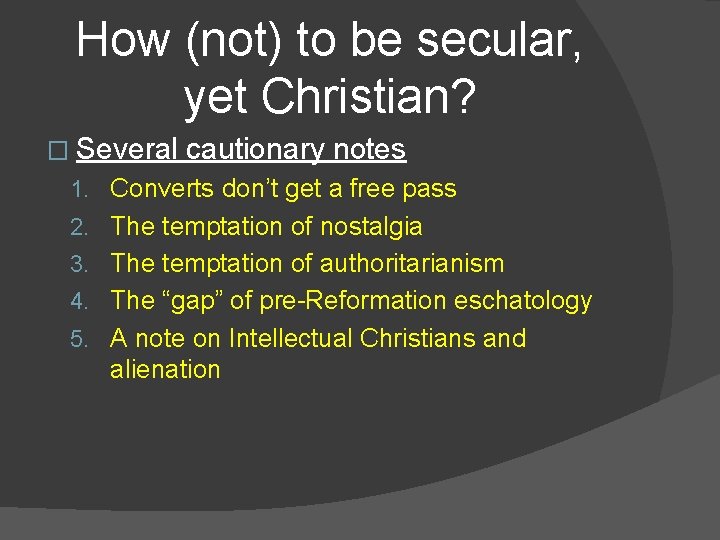
How (not) to be secular, yet Christian? � Several cautionary notes 1. Converts don’t get a free pass 2. The temptation of nostalgia 3. The temptation of authoritarianism 4. The “gap” of pre-Reformation eschatology 5. A note on Intellectual Christians and alienation
- Slides: 26