
Probing the cosmic dark ages using the 21
Probing the cosmic dark ages using the 21 cm line Jonathan Pritchard (Caltech) Collaborators: Steve Furlanetto (Yale) Marc Kamionkowski (Caltech) Particle Physics and Cosmology: The Fabric of Spacetime Les Houches Summer School 2006
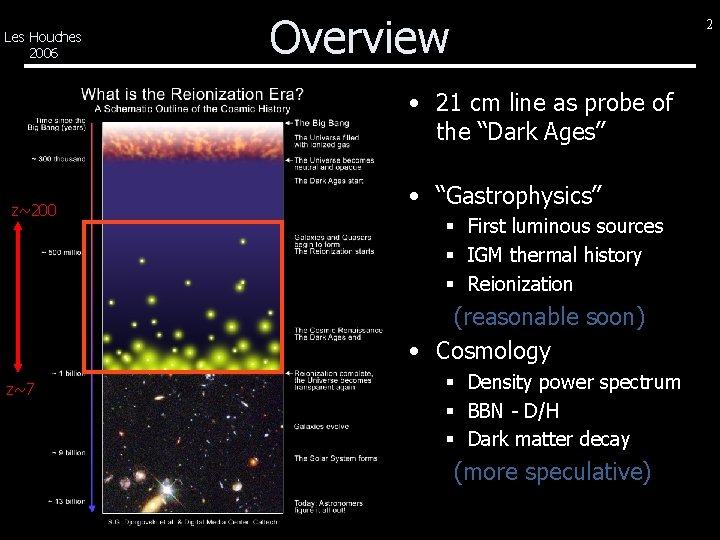
Les Houches 2006 Overview 2 • 21 cm line as probe of the “Dark Ages” z~200 • “Gastrophysics” § First luminous sources § IGM thermal history § Reionization (reasonable soon) • Cosmology z~7 § Density power spectrum § BBN - D/H § Dark matter decay (more speculative)
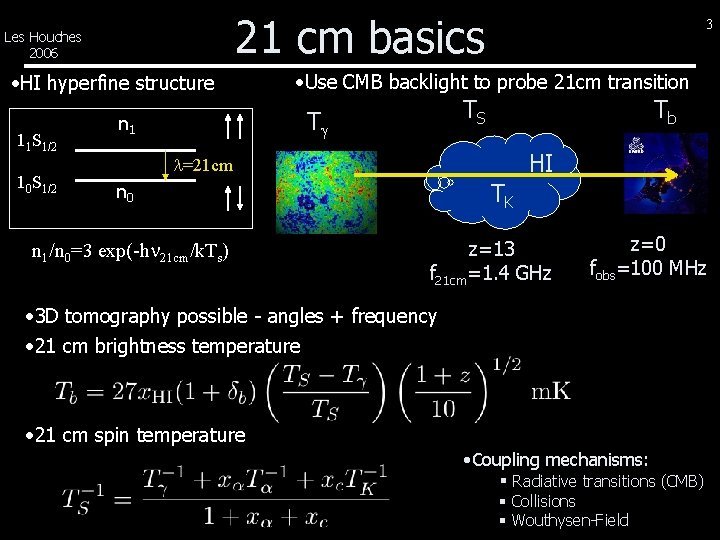
21 cm basics Les Houches 2006 • HI hyperfine structure 11 S 1/2 10 S 1/2 • Use CMB backlight to probe 21 cm transition TS T n 1 3 Tb HI l=21 cm TK n 0 n 1/n 0=3 exp(-hn 21 cm/k. Ts) z=13 f 21 cm=1. 4 GHz z=0 fobs=100 MHz • 3 D tomography possible - angles + frequency • 21 cm brightness temperature • 21 cm spin temperature • Coupling mechanisms: § Radiative transitions (CMB) § Collisions § Wouthysen-Field
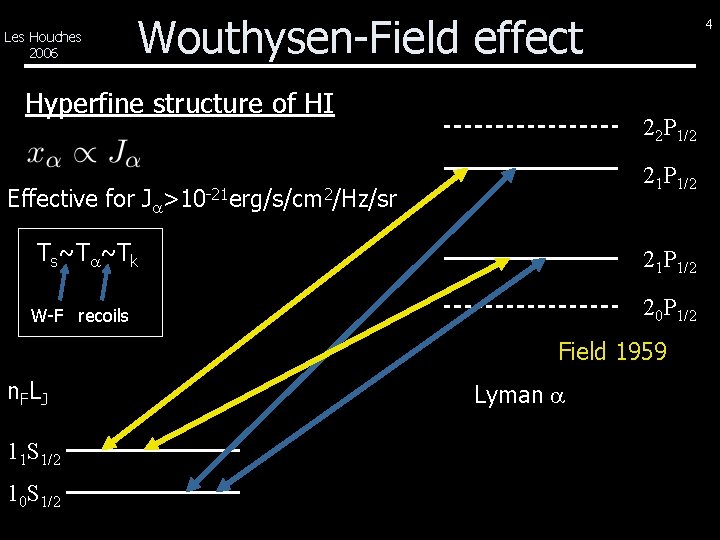
Les Houches 2006 Wouthysen-Field effect Hyperfine structure of HI 4 22 P 1/2 21 P 1/2 Effective for J >10 -21 erg/s/cm 2/Hz/sr Ts~T ~Tk 21 P 1/2 20 P 1/2 W-F recoils Field 1959 n FL J 11 S 1/2 10 S 1/2 Lyman
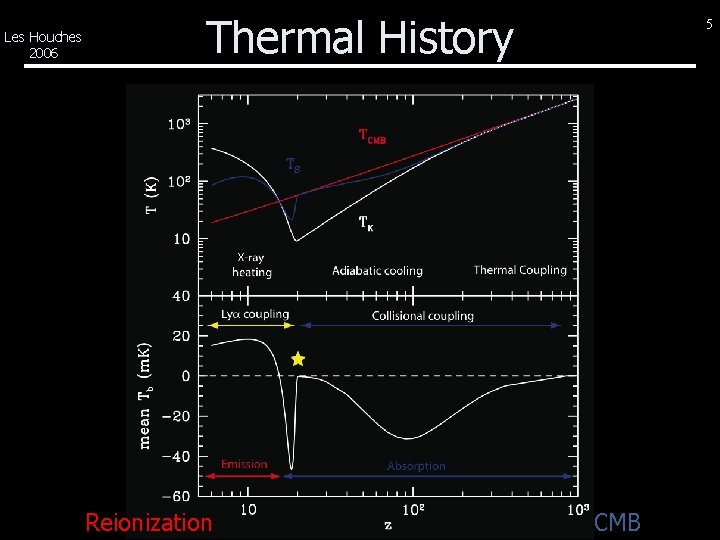
Les Houches 2006 Thermal History Reionization 5 CMB
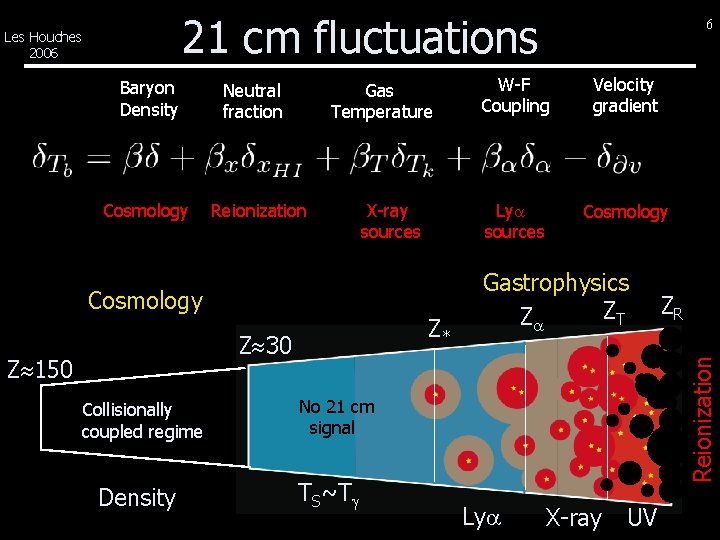
21 cm fluctuations Baryon Density Cosmology Neutral fraction Gas Temperature Reionization X-ray sources Cosmology Z* Z 30 Z 150 Collisionally coupled regime Density 6 W-F Coupling Velocity gradient Ly sources Cosmology Gastrophysics ZT Z No 21 cm signal TS~T ZR Reionization Les Houches 2006 Ly X-ray UV
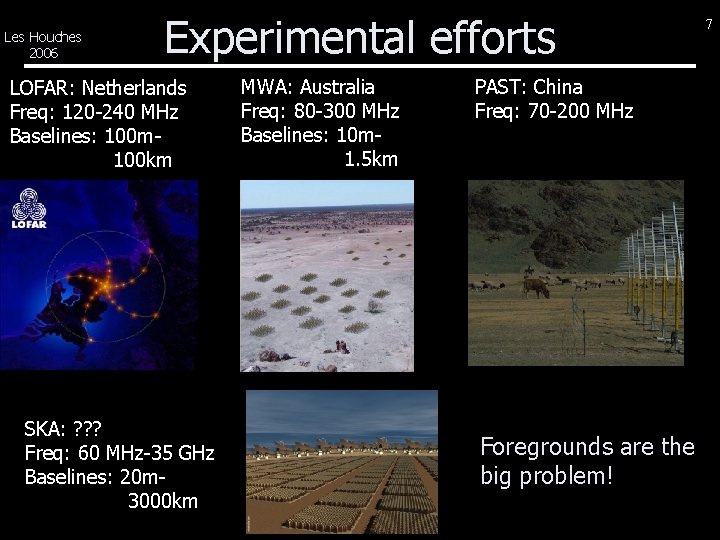
Les Houches 2006 Experimental efforts LOFAR: Netherlands Freq: 120 -240 MHz Baselines: 100 m 100 km SKA: ? ? ? Freq: 60 MHz-35 GHz Baselines: 20 m 3000 km MWA: Australia Freq: 80 -300 MHz Baselines: 10 m 1. 5 km PAST: China Freq: 70 -200 MHz Foregrounds are the big problem! 7
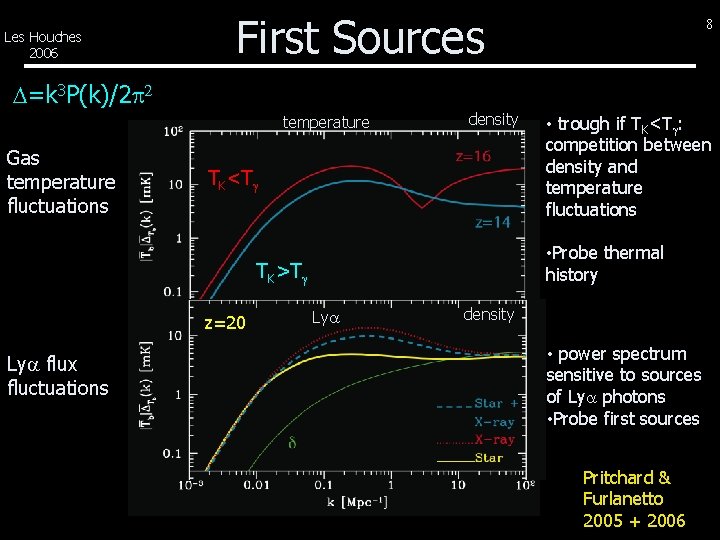
Les Houches 2006 First Sources 8 =k 3 P(k)/2 temperature Gas temperature fluctuations density TK<T • Probe thermal history TK>T z=20 Ly flux fluctuations • trough if TK<T : competition between density and temperature fluctuations Ly density • power spectrum sensitive to sources of Ly photons • Probe first sources Pritchard & Furlanetto 2005 + 2006
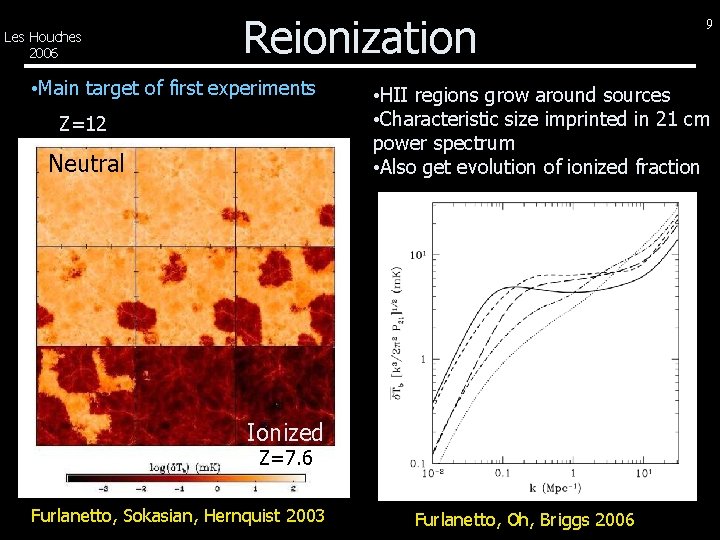
Les Houches 2006 Reionization • Main target of first experiments Z=12 Neutral • HII regions grow around sources • Characteristic size imprinted in 21 cm power spectrum • Also get evolution of ionized fraction Ionized Z=7. 6 Furlanetto, Sokasian, Hernquist 2003 9 Furlanetto, Oh, Briggs 2006
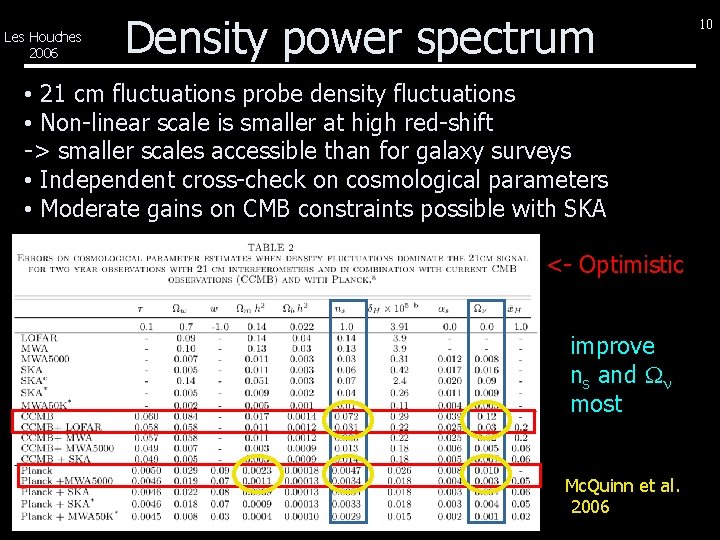
Les Houches 2006 Density power spectrum • 21 cm fluctuations probe density fluctuations • Non-linear scale is smaller at high red-shift -> smaller scales accessible than for galaxy surveys • Independent cross-check on cosmological parameters • Moderate gains on CMB constraints possible with SKA <- Optimistic improve ns and Wn most Mc. Quinn et al. 2006 10
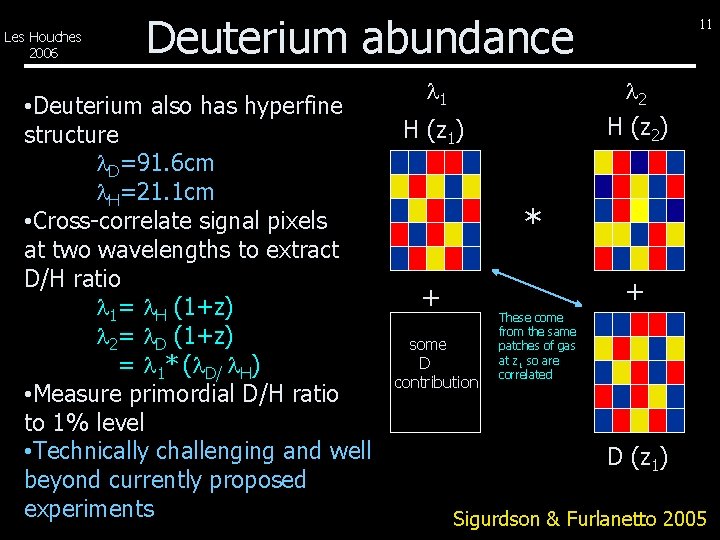
Les Houches 2006 Deuterium abundance • Deuterium also has hyperfine structure l. D=91. 6 cm l. H=21. 1 cm • Cross-correlate signal pixels at two wavelengths to extract D/H ratio l 1= l. H (1+z) l 2= l. D (1+z) = l 1* (l. D/ l. H) • Measure primordial D/H ratio to 1% level • Technically challenging and well beyond currently proposed experiments 11 l 2 H (z 1) H (z 2) * + + some D contribution These come from the same patches of gas at z 1 so are correlated D (z 1) Sigurdson & Furlanetto 2005
Les Houches 2006 Dark matter decays • Some dark matter candidates can decay during dark ages DM lifetime ~ 1017 -1020 years i. e. <<H 0 e. g. sterile neutrinos with m~2 -4 ke. V axinos with m~1 -100 Ge. V • Energetic photons produced heat and ionize the IGM • Detect resulting 21 cm fluctuations • Constrain DM parameter space Furlanetto, Oh, Pierpaoli 2006 • Also technically demanding and far in the future 12
Les Houches 2006 Conclusions • 21 cm signal contains an enormous wealth of information… … the trick is separating it all out • Best region for doing cosmology is z>30, but also hardest to observe • At z<30, “gastrophysics” tends to obscure cosmology but is interesting in its own right • 21 cm should provide moderate gains in cosmological parameters in the next decade or so • Very early days yet and still unclear what will and will not be possible • Foregrounds are still a largely unresolved issue Recent review: Furlanetto, Oh, Briggs (2006) astro-ph/0608032 13
- Slides: 13