
PROBING THE BOGOLIUBOV EXCITATION SPECTRUM OF A POLARITON
PROBING THE BOGOLIUBOV EXCITATION SPECTRUM OF A POLARITON SUPERFLUID BY HETERODYNE FOUR-WAVE-MIXING SPECTROSCOPY Verena Kohnle, Yoan Leger, Maxime Richard, Michiel Wouters, Marcia Portella-Oberli, Benoit Deveaud-Pledran
Outline o Introduction o strong coupling: polaritons o sample o Motivation: excitation spectrum of a polariton superfluid o Heterodyne Four Wave Mixing (FWM) experiment o Experimental Results o Conclusion
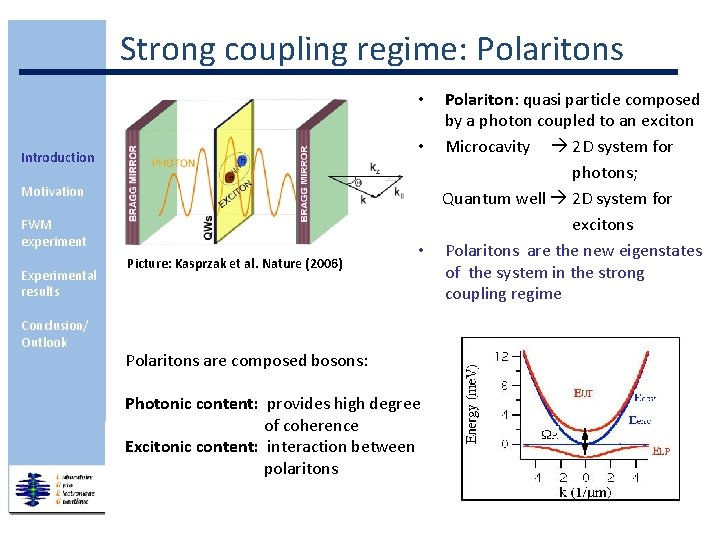
Strong coupling regime: Polaritons Polariton: quasi particle composed by a photon coupled to an exciton • Microcavity 2 D system for photons; Quantum well 2 D system for excitons • Polaritons are the new eigenstates of the system in the strong coupling regime • Introduction Motivation FWM experiment Experimental results Conclusion/ Outlook Picture: Kasprzak et al. Nature (2006) Polaritons are composed bosons: Photonic content: provides high degree of coherence Excitonic content: interaction between polaritons
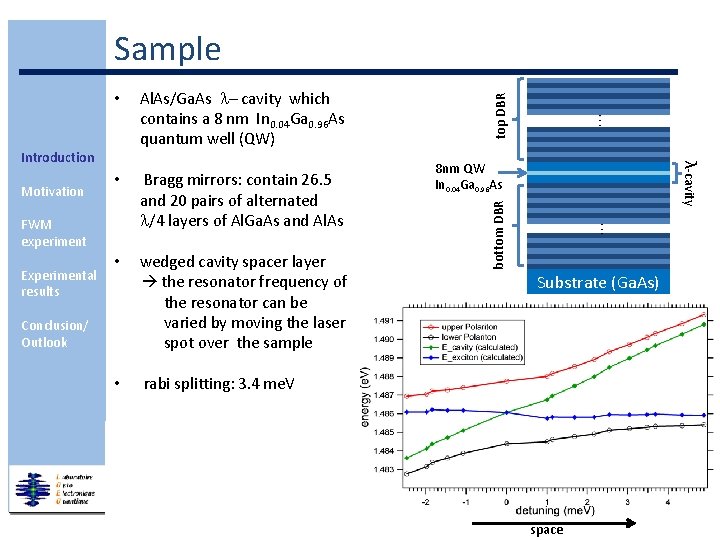
Motivation • FWM experiment Experimental results Bragg mirrors: contain 26. 5 and 20 pairs of alternated /4 layers of Al. Ga. As and Al. As • wedged cavity spacer layer the resonator frequency of the resonator can be varied by moving the laser spot over the sample • rabi splitting: 3. 4 me. V Conclusion/ Outlook • • • 8 nm QW In 0. 04 Ga 0. 96 As λ-cavity Introduction Al. As/Ga. As – cavity which contains a 8 nm In 0. 04 Ga 0. 96 As quantum well (QW) bottom DBR • top DBR Sample • • • Substrate (Ga. As) space
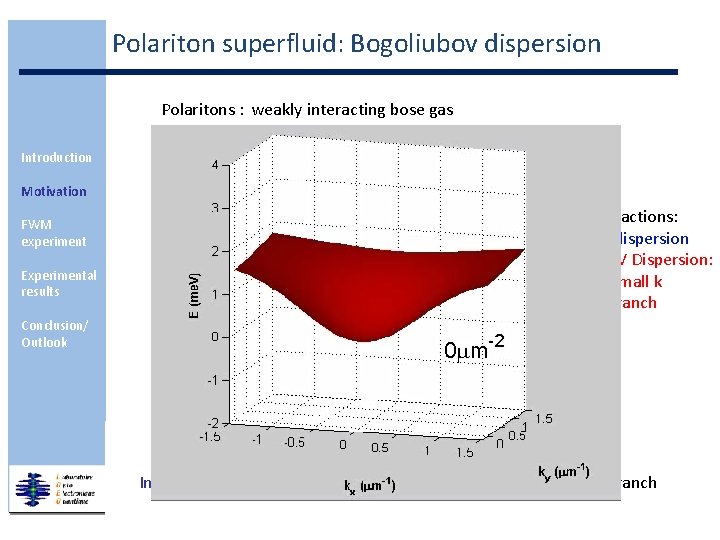
Polariton superfluid: Bogoliubov dispersion Polaritons : weakly interacting bose gas Introduction Motivation FWM experiment Experimental results feature of interactions: blueshift of dispersion BOGOLIUBOV Dispersion: • linear at small k • „ghost“ branch Conclusion/ Outlook In experiment: up to now nobody was able to show the „ghost“ branch
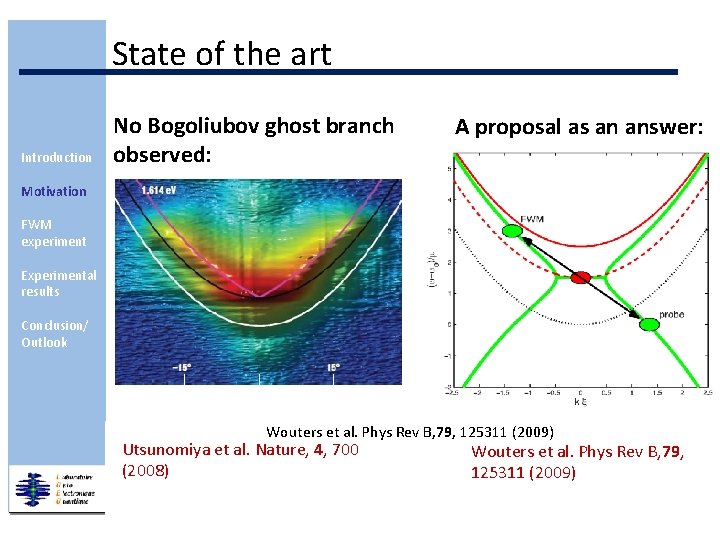
State of the art Introduction No Bogoliubov ghost branch observed: A proposal as an answer: Motivation FWM experiment Experimental results Conclusion/ Outlook Wouters et al. Phys Rev B, 79, 125311 (2009) Utsunomiya et al. Nature, 4, 700 (2008) Wouters et al. Phys Rev B, 79, 125311 (2009)
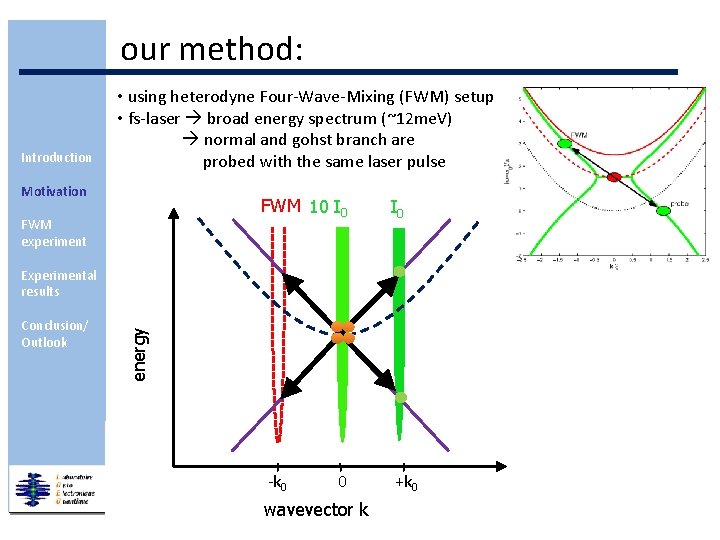
our method: Introduction • using heterodyne Four-Wave-Mixing (FWM) setup • fs-laser broad energy spectrum (~12 me. V) normal and gohst branch are probed with the same laser pulse Motivation FWM 10 I 0 FWM experiment I 0 Conclusion/ Outlook energy Experimental results -k 0 0 wavevector k +k 0
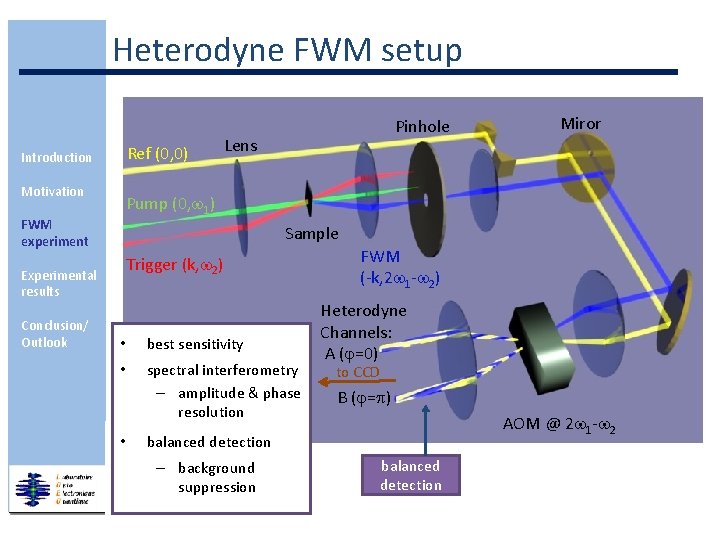
Heterodyne FWM setup Ref (0, 0) Introduction Motivation Lens Miror Pump (0, w 1) FWM experiment Sample Trigger (k, w 2) Experimental results Conclusion/ Outlook Pinhole • best sensitivity • spectral interferometry – amplitude & phase resolution • FWM (-k, 2 w 1 -w 2) Heterodyne Channels: A (j=0) to CCD B (j=p) AOM @ 2 w 1 -w 2 balanced detection – background suppression balanced detection
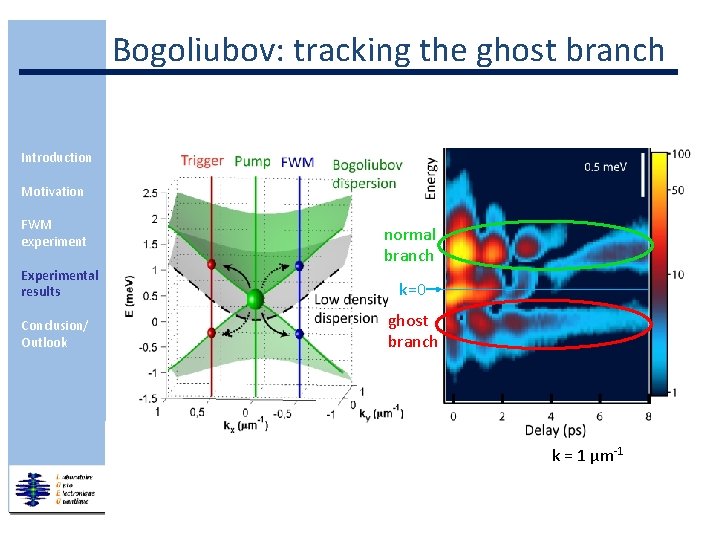
Bogoliubov: tracking the ghost branch Introduction Motivation FWM experiment Experimental results Conclusion/ Outlook normal branch k=0 ghost branch k = 1 µm-1
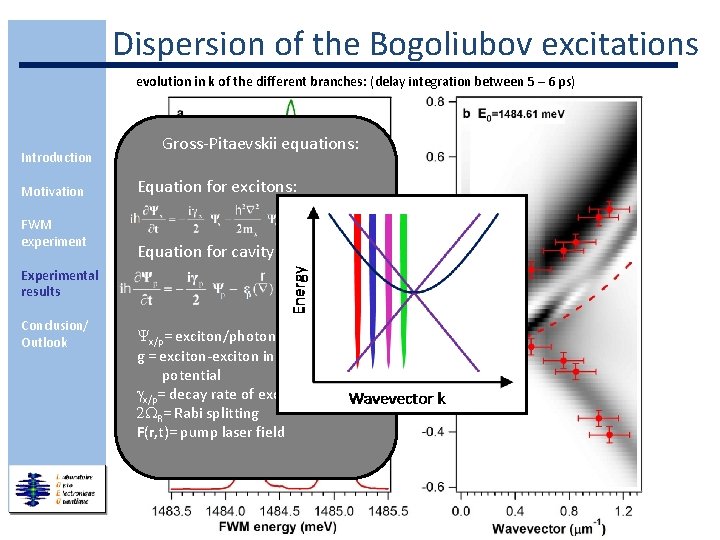
Dispersion of the Bogoliubov excitations evolution in k of the different branches: (delay integration between 5 – 6 ps) Introduction Motivation FWM experiment Gross-Pitaevskii equations: Equation for excitons: Equation for cavity photons: Experimental results Conclusion/ Outlook Yx/p= exciton/photon wavefunction g = exciton-exciton interaction potential gx/p= decay rate of excitons/photons 2 WR= Rabi splitting F(r, t)= pump laser field
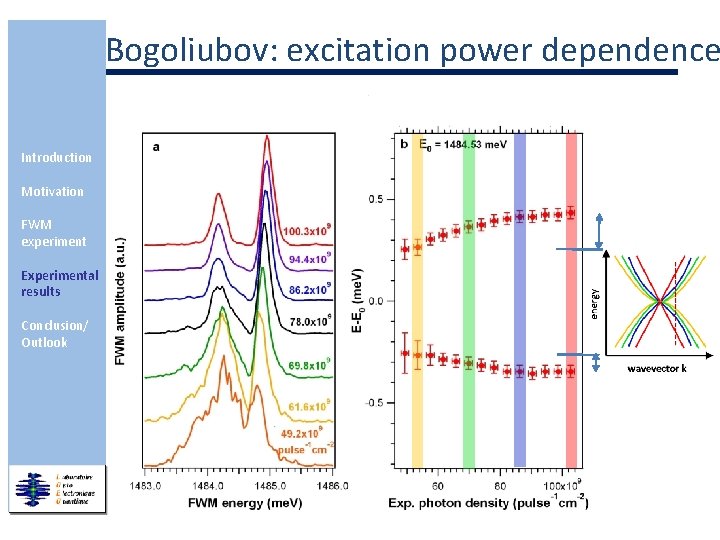
Bogoliubov: excitation power dependence evolution in excitation power: (@ delay time t=5. 7 ps) Introduction Motivation FWM experiment Experimental results k = 1 µm-1 Conclusion/ Outlook Arb. Int. = 16
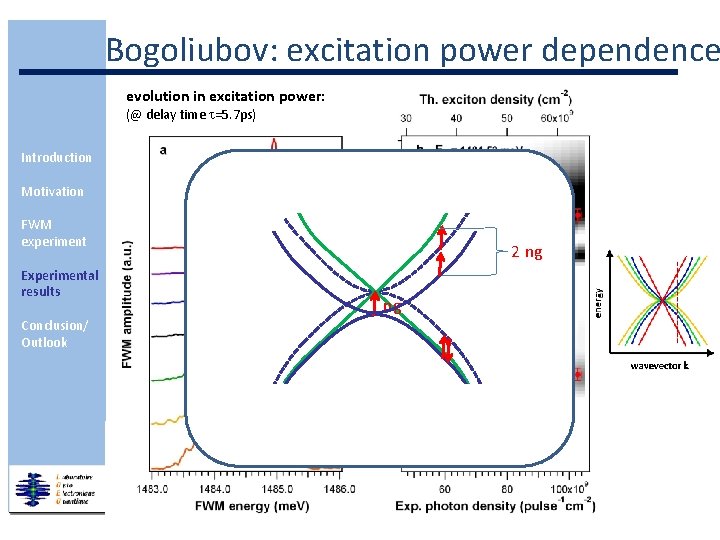
Bogoliubov: excitation power dependence evolution in excitation power: (@ delay time t=5. 7 ps) Introduction Motivation FWM experiment Experimental results Conclusion/ Outlook 2 ng ng k = 1 µm-1 Arb. Int. = 16
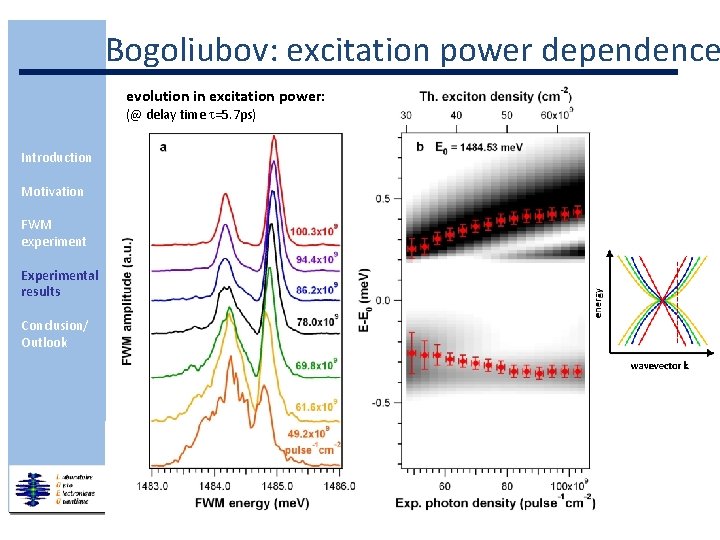
Bogoliubov: excitation power dependence evolution in excitation power: (@ delay time t=5. 7 ps) Introduction Motivation FWM experiment Experimental results k = 1 µm-1 Conclusion/ Outlook Arb. Int. = 16
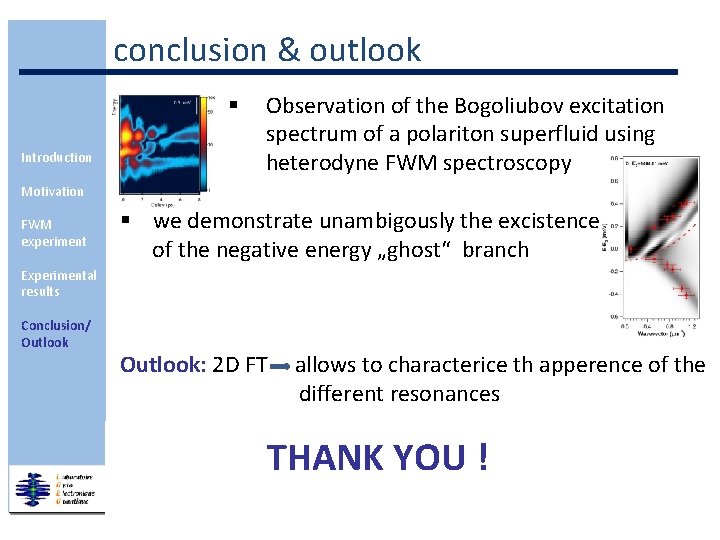
conclusion & outlook § Introduction Observation of the Bogoliubov excitation spectrum of a polariton superfluid using heterodyne FWM spectroscopy Motivation FWM experiment § we demonstrate unambigously the excistence of the negative energy „ghost“ branch Experimental results Conclusion/ Outlook: 2 D FT allows to characterice th apperence of the different resonances THANK YOU !
- Slides: 14