
Probing singleparticle structure along N126 Direct reactions with
Probing single-particle structure along N=126 Direct reactions with the ISOLDE Solenoidal Spectrometer D. K. Sharp The University of Manchester, UK Physics between lead and uranium: in preparation of new experimental campaigns at ISOLDE 16 th-18 th April 2019
Overview Evolution of single-particle structure Single-particle structure outside N=126 via transfer reactions ISOLDE Solenoidal Spectrometer Overview so far Future developments Challenges involved in this mass region
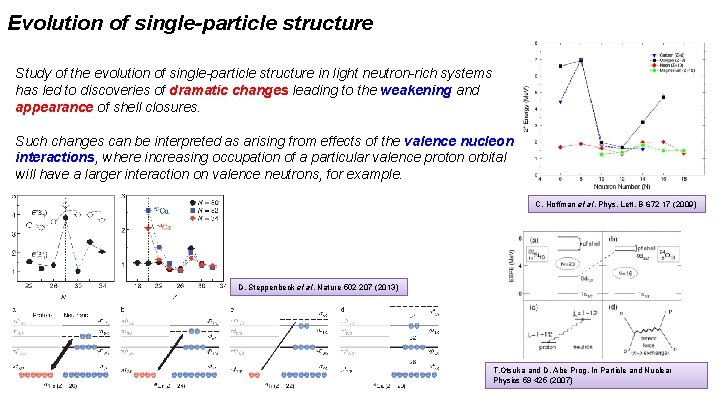
Evolution of single-particle structure Study of the evolution of single-particle structure in light neutron-rich systems has led to discoveries of dramatic changes leading to the weakening and appearance of shell closures. Such changes can be interpreted as arising from effects of the valence nucleon interactions, where increasing occupation of a particular valence proton orbital will have a larger interaction on valence neutrons, for example. C. Hoffman et al, Phys. Lett. B 672 17 (2009) D. Steppenbeck et al, Nature 502 207 (2013) T. Otsuka and D. Abe Prog. In Particle and Nuclear Physics 59 425 (2007)
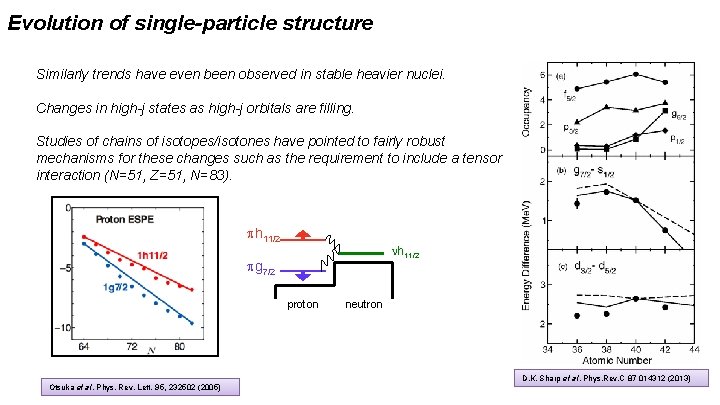
Evolution of single-particle structure Similarly trends have even been observed in stable heavier nuclei. Changes in high-j states as high-j orbitals are filling. Studies of chains of isotopes/isotones have pointed to fairly robust mechanisms for these changes such as the requirement to include a tensor interaction (N=51, Z=51, N=83). h 11/2 g 7/2 proton neutron D. K. Sharp et al, Phys. Rev. C 87 014312 (2013) Otsuka et al. Phys. Rev. Lett. 95, 232502 (2005)
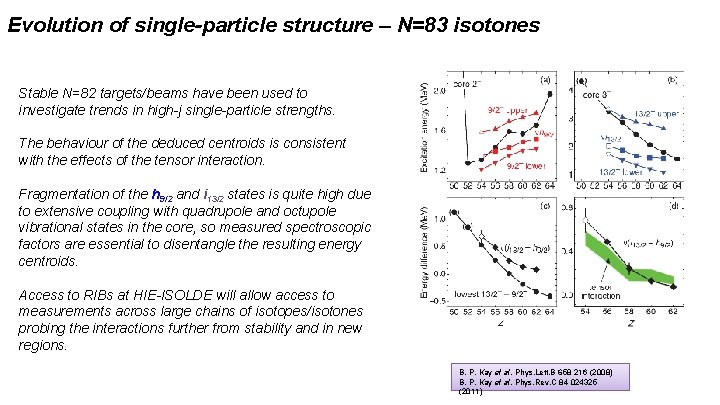
Evolution of single-particle structure – N=83 isotones Stable N=82 targets/beams have been used to investigate trends in high-j single-particle strengths. The behaviour of the deduced centroids is consistent with the effects of the tensor interaction. Fragmentation of the h 9/2 and i 13/2 states is quite high due to extensive coupling with quadrupole and octupole vibrational states in the core, so measured spectroscopic factors are essential to disentangle the resulting energy centroids. Access to RIBs at HIE-ISOLDE will allow access to measurements across large chains of isotopes/isotones probing the interactions further from stability and in new regions. B. P. Kay et al, Phys. Lett. B 658 216 (2008) B. P. Kay et al, Phys. Rev. C 84 024325 (2011)
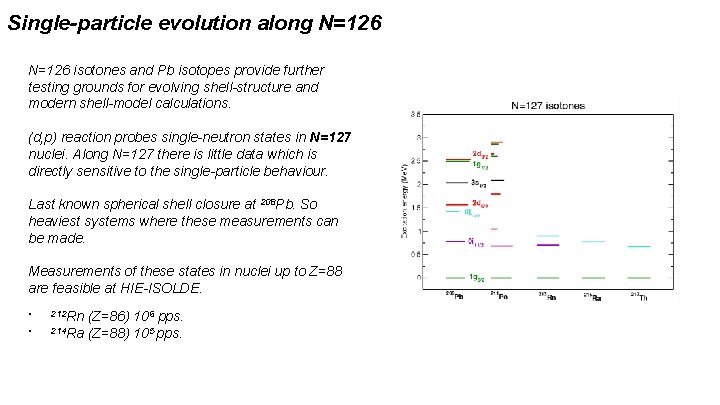
Single-particle evolution along N=126 isotones and Pb isotopes provide further testing grounds for evolving shell-structure and modern shell-model calculations. (d, p) reaction probes single-neutron states in N=127 nuclei. Along N=127 there is little data which is directly sensitive to the single-particle behaviour. Last known spherical shell closure at 208 Pb. So heaviest systems where these measurements can be made. Measurements of these states in nuclei up to Z=88 are feasible at HIE-ISOLDE. • • 212 Rn (Z=86) 106 pps. 214 Ra (Z=88) 105 pps.
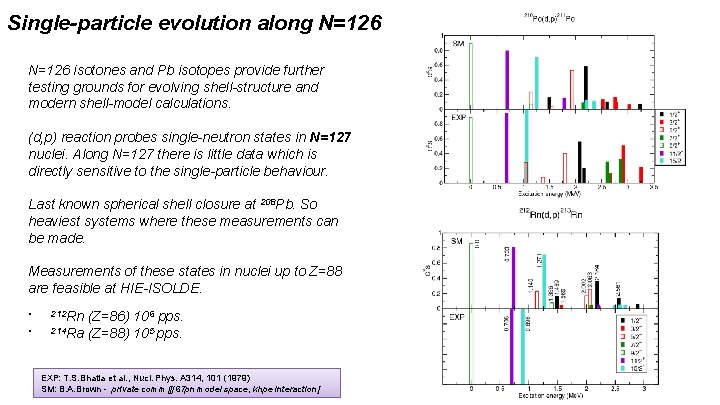
Single-particle evolution along N=126 isotones and Pb isotopes provide further testing grounds for evolving shell-structure and modern shell-model calculations. (d, p) reaction probes single-neutron states in N=127 nuclei. Along N=127 there is little data which is directly sensitive to the single-particle behaviour. Last known spherical shell closure at 208 Pb. So heaviest systems where these measurements can be made. Measurements of these states in nuclei up to Z=88 are feasible at HIE-ISOLDE. • • 212 Rn (Z=86) 106 pps. 214 Ra (Z=88) 105 pps. EXP: T. S. Bhatia et al. , Nucl. Phys. A 314, 101 (1979) SM: B. A. Brown - private comm [jj 67 pn model space, khpe interaction]
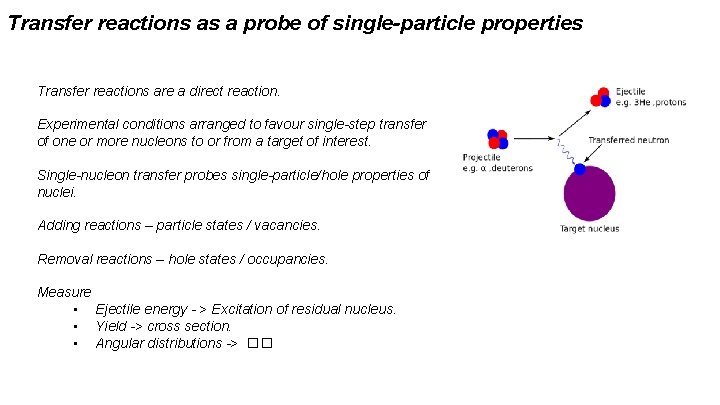
Transfer reactions as a probe of single-particle properties Transfer reactions are a direct reaction. Experimental conditions arranged to favour single-step transfer of one or more nucleons to or from a target of interest. Single-nucleon transfer probes single-particle/hole properties of nuclei. Adding reactions – particle states / vacancies. Removal reactions – hole states / occupancies. Measure • Ejectile energy - > Excitation of residual nucleus. • Yield -> cross section. • Angular distributions -> ��.
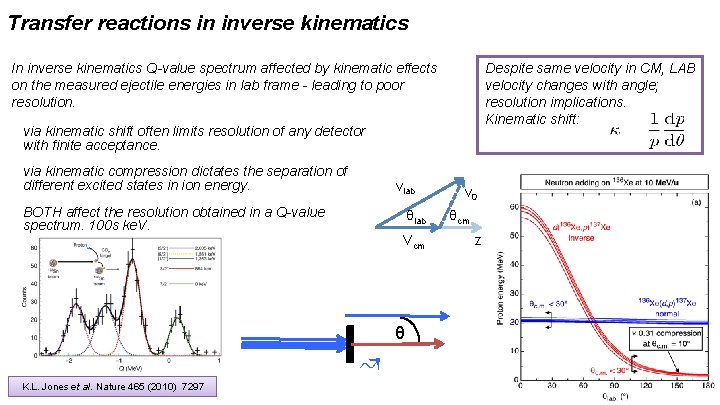
Transfer reactions in inverse kinematics Despite same velocity in CM, LAB velocity changes with angle; resolution implications. Kinematic shift: In inverse kinematics Q-value spectrum affected by kinematic effects on the measured ejectile energies in lab frame - leading to poor resolution. via kinematic shift often limits resolution of any detector with finite acceptance. via kinematic compression dictates the separation of different excited states in ion energy. vlab BOTH affect the resolution obtained in a Q-value spectrum. 100 s ke. V. K. L. Jones et al. Nature 465 (2010) 7297 θlab Vcm ↝ θ v 0 θcm z
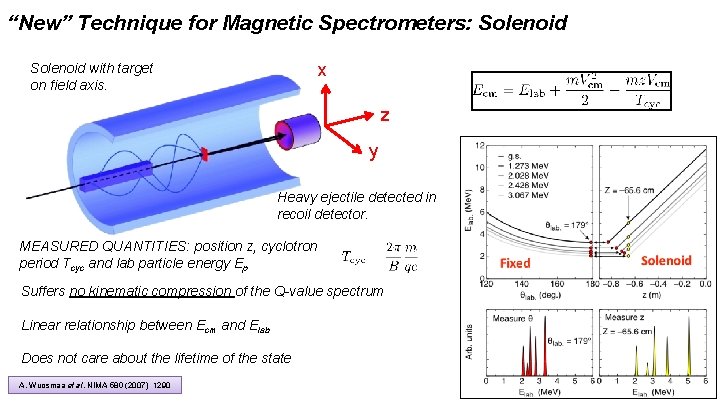
“New” Technique for Magnetic Spectrometers: Solenoid x Solenoid with target on field axis. z y Heavy ejectile detected in recoil detector. MEASURED QUANTITIES: position z, cyclotron period Tcyc and lab particle energy Ep Suffers no kinematic compression of the Q-value spectrum Linear relationship between Ecm and Elab Does not care about the lifetime of the state A. Wuosmaa et al. NIMA 580 (2007) 1290
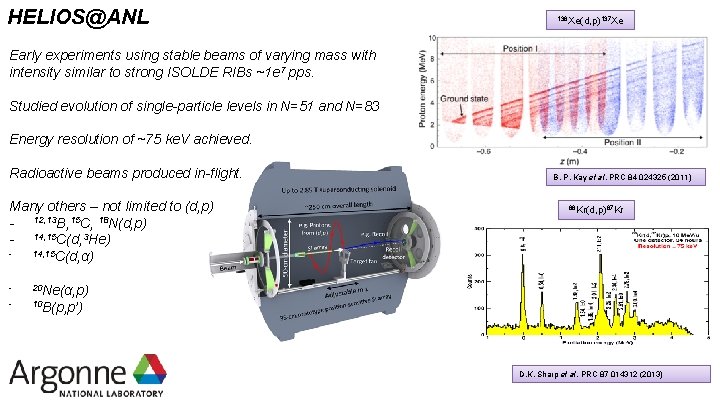
HELIOS@ANL 136 Xe(d, p)137 Xe Early experiments using stable beams of varying mass with intensity similar to strong ISOLDE RIBs ~1 e 7 pps. Studied evolution of single-particle levels in N=51 and N=83 Energy resolution of ~75 ke. V achieved. Radioactive beams produced in-flight. Many others – not limited to (d, p) - 12, 13 B, 15 C, 18 N(d, p) - 14, 15 C(d, 3 He) 14, 15 C(d, α) - 20 Ne(α, p) - 10 B(p, p’) B. P. Kay et al, PRC 84 024325 (2011) 86 Kr(d, p)87 Kr D. K. Sharp et al, PRC 87 014312 (2013)
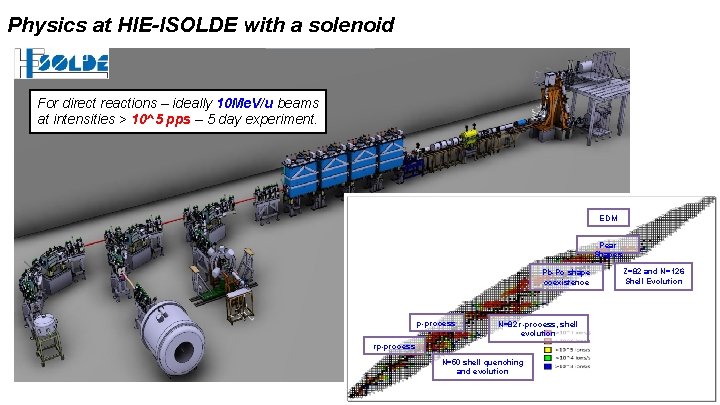
Physics at HIE-ISOLDE with a solenoid For direct reactions – ideally 10 Me. V/u beams at intensities > 10^5 pps – 5 day experiment. EDM Pear Shapes Pb-Po shape coexistence p-process N=82 r-process, shell evolution rp-process N=50 shell quenching and evolution Z=82 and N=126 Shell Evolution
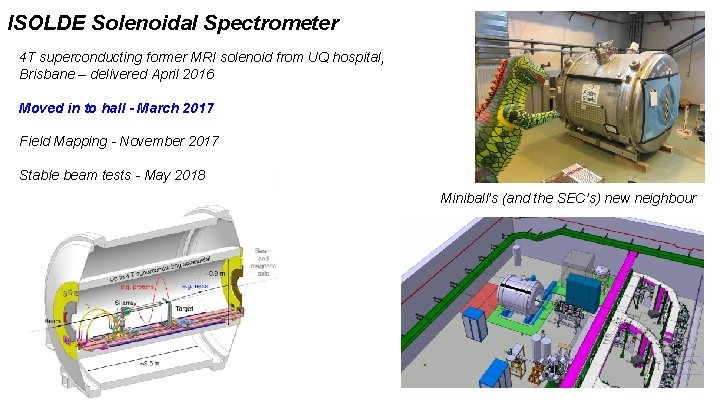
ISOLDE Solenoidal Spectrometer 4 T superconducting former MRI solenoid from UQ hospital, Brisbane – delivered April 2016 Moved in to hall - March 2017 Field Mapping - November 2017 Stable beam tests - May 2018 Miniball’s (and the SEC’s) new neighbour
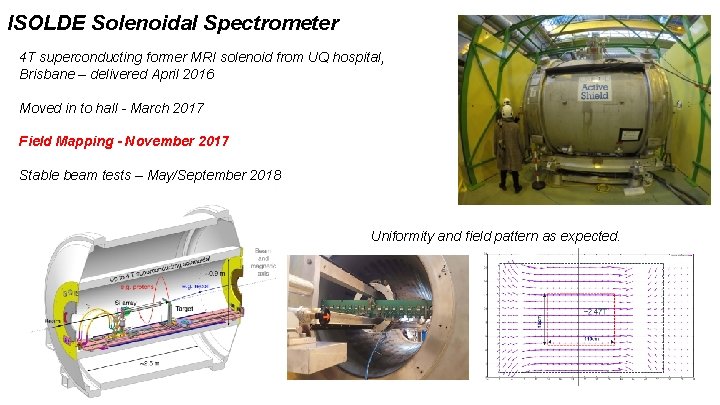
ISOLDE Solenoidal Spectrometer 4 T superconducting former MRI solenoid from UQ hospital, Brisbane – delivered April 2016 Moved in to hall - March 2017 Field Mapping - November 2017 Stable beam tests – May/September 2018 Uniformity and field pattern as expected.
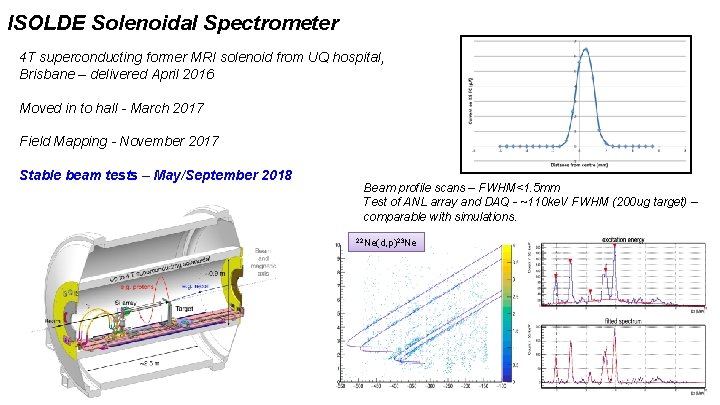
ISOLDE Solenoidal Spectrometer 4 T superconducting former MRI solenoid from UQ hospital, Brisbane – delivered April 2016 Moved in to hall - March 2017 Field Mapping - November 2017 Stable beam tests – May/September 2018 Beam profile scans – FWHM<1. 5 mm Test of ANL array and DAQ - ~110 ke. V FWHM (200 ug target) – comparable with simulations. 22 Ne(d, p)23 Ne
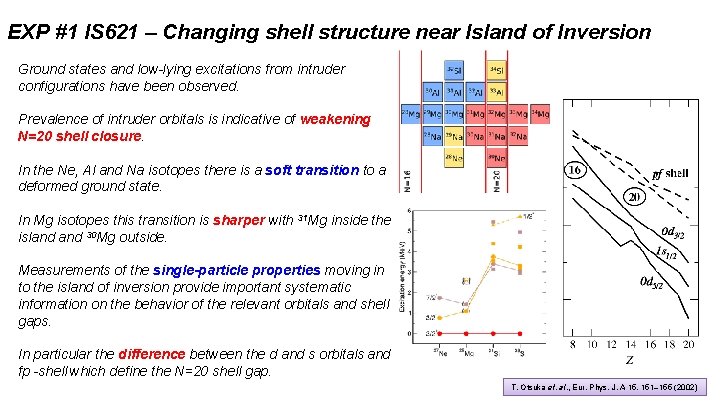
EXP #1 IS 621 – Changing shell structure near Island of Inversion Ground states and low-lying excitations from intruder configurations have been observed. Prevalence of intruder orbitals is indicative of weakening N=20 shell closure. In the Ne, Al and Na isotopes there is a soft transition to a deformed ground state. In Mg isotopes this transition is sharper with 31 Mg inside the island 30 Mg outside. Measurements of the single-particle properties moving in to the island of inversion provide important systematic information on the behavior of the relevant orbitals and shell gaps. In particular the difference between the d and s orbitals and fp -shell which define the N=20 shell gap. T. Otsuka et. al. , Eur. Phys. J. A 15, 151– 155 (2002)
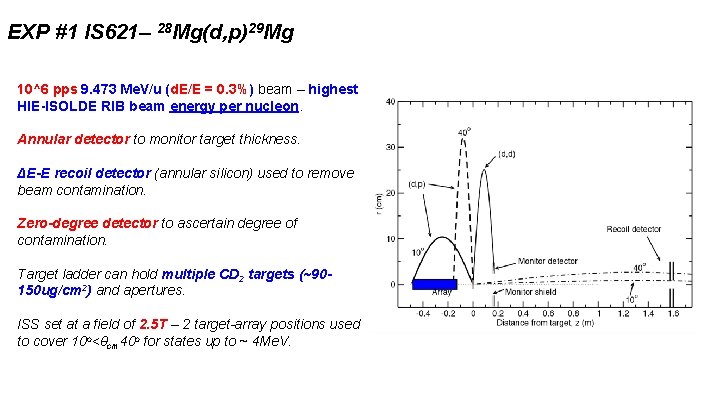
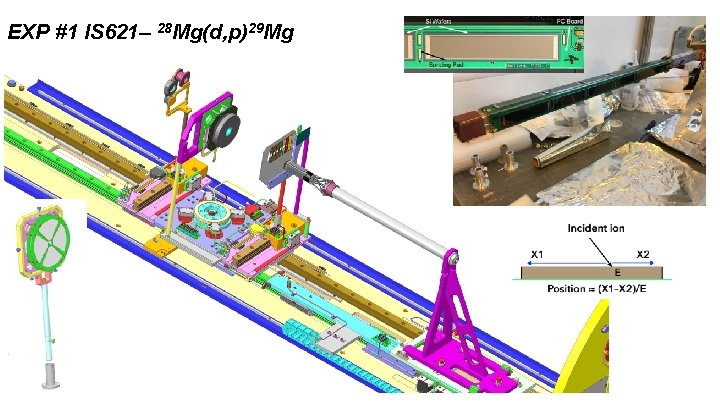
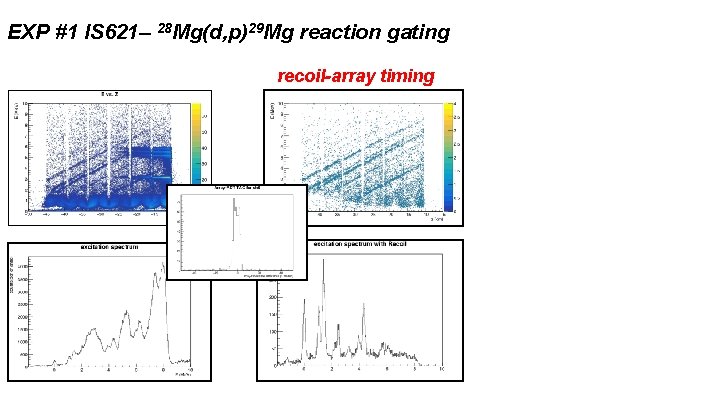
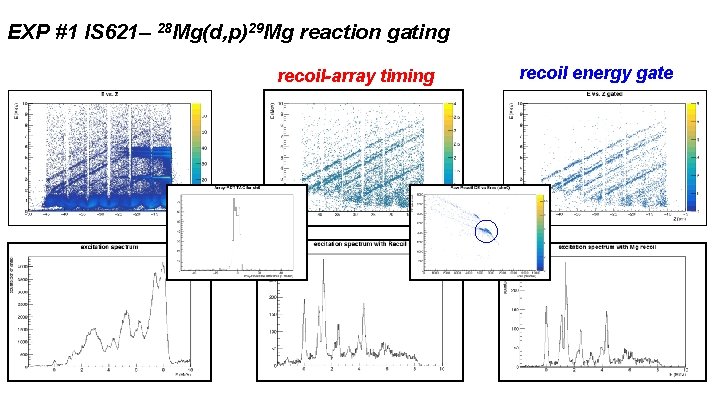
EXP #1 IS 621– 28 Mg(d, p)29 Mg 10^6 pps 9. 473 Me. V/u (d. E/E = 0. 3%) beam – highest HIE-ISOLDE RIB beam energy per nucleon. Annular detector to monitor target thickness. ΔE-E recoil detector (annular silicon) used to remove beam contamination. Zero-degree detector to ascertain degree of contamination. Target ladder can hold multiple CD 2 targets (~90150 ug/cm 2) and apertures. ISS set at a field of 2. 5 T – 2 target-array positions used to cover 10 o<θcm 40 o for states up to ~ 4 Me. V.
EXP #1 IS 621– 28 Mg(d, p)29 Mg
EXP #1 IS 621– 28 Mg(d, p)29 Mg reaction gating recoil-array timing
EXP #1 IS 621– 28 Mg(d, p)29 Mg reaction gating recoil-array timing recoil energy gate
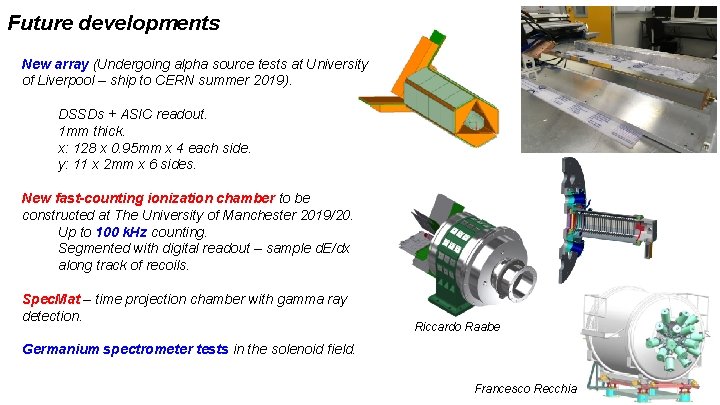
Future developments New array (Undergoing alpha source tests at University of Liverpool – ship to CERN summer 2019). DSSDs + ASIC readout. 1 mm thick. x: 128 x 0. 95 mm x 4 each side. y: 11 x 2 mm x 6 sides. New fast-counting ionization chamber to be constructed at The University of Manchester 2019/20. Up to 100 k. Hz counting. Segmented with digital readout – sample d. E/dx along track of recoils. Spec. Mat – time projection chamber with gamma ray detection. Riccardo Raabe Germanium spectrometer tests in the solenoid field. Francesco Recchia
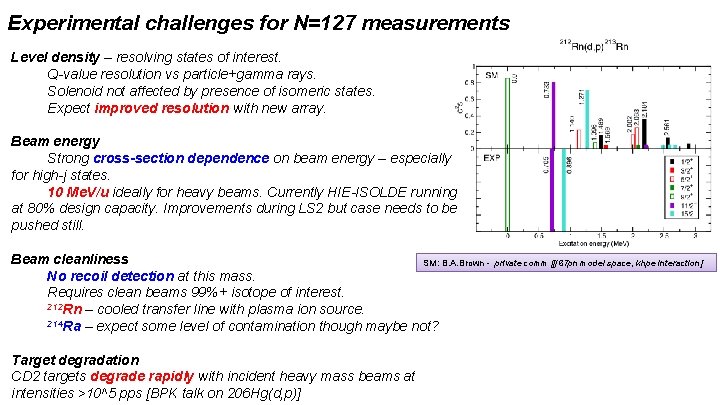
Experimental challenges for N=127 measurements Level density – resolving states of interest. Q-value resolution vs particle+gamma rays. Solenoid not affected by presence of isomeric states. Expect improved resolution with new array. Beam energy Strong cross-section dependence on beam energy – especially for high-j states. 10 Me. V/u ideally for heavy beams. Currently HIE-ISOLDE running at 80% design capacity. Improvements during LS 2 but case needs to be pushed still. Beam cleanliness SM: B. A. Brown No recoil detection at this mass. Requires clean beams 99%+ isotope of interest. 212 Rn – cooled transfer line with plasma ion source. 214 Ra – expect some level of contamination though maybe not? Target degradation CD 2 targets degrade rapidly with incident heavy mass beams at intensities >10^5 pps [BPK talk on 206 Hg(d, p)] private comm [jj 67 pn model space, khpe interaction]
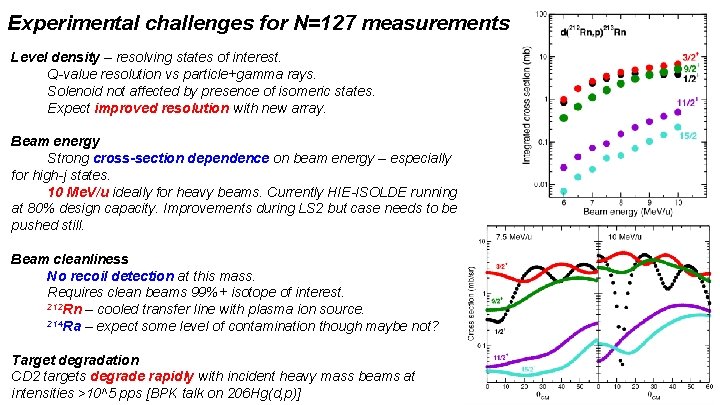
Experimental challenges for N=127 measurements Level density – resolving states of interest. Q-value resolution vs particle+gamma rays. Solenoid not affected by presence of isomeric states. Expect improved resolution with new array. Beam energy Strong cross-section dependence on beam energy – especially for high-j states. 10 Me. V/u ideally for heavy beams. Currently HIE-ISOLDE running at 80% design capacity. Improvements during LS 2 but case needs to be pushed still. Beam cleanliness No recoil detection at this mass. Requires clean beams 99%+ isotope of interest. 212 Rn – cooled transfer line with plasma ion source. 214 Ra – expect some level of contamination though maybe not? Target degradation CD 2 targets degrade rapidly with incident heavy mass beams at intensities >10^5 pps [BPK talk on 206 Hg(d, p)]
Conclusions N=126 beams available at ISOLDE will provide access to a previously unexplored region of the nuclear chart in terms of single-particle structure. (d, p) reactions probe states in N=127 nuclei. Beam intensities are sufficient. Contamination and energy provide challenges. Questions of expected level density. New array for ISS will have improved resolution. Repair of cryomodule will help with energy. First measurements with ISS have been made, with one in this mass region – see next talk by BPK. ISS developed to study direct reactions so well suited. Ideally would also like to know what protons are doing. (t, α) reactions could be used to probe the proton occupancy. (3 He, d) vacancies.
ISS collaboration
- Slides: 25