
Probing Neutron Star interiors with ET Kostas Glampedakis
Probing Neutron Star interiors with ET ? Kostas Glampedakis University of Tuebingen Joint ILIAS-ET meeting, Cascina, Italy, Nov. 2008
This talk • We review the expected GW observability of isolated and accreting neutron stars. • We address two key issues: (i) Which mechanisms hold promise for a “detectable” GW signal ? (ii) What are the main theoretical challenges ? • We provide rough estimates for the GW strain h.
Key mechanisms for GW emission • ‘Mountains’ & Precession • Pulsar glitches • Fluid instabilities • Magnetars
Neutron star mountains • Any mechanism leading to deformation is potentially relevant for GWs. — Deformation is represented by the ellipticity: = ∆I/Izz, (Iij = moment of inertia tensor) • GW strain & frequency: h = 10 -28 (f/10 Hz)2 (1 kpc/d) ( /10 -6) f. GW = f, 2 f (f is spin frequency) • Link with precession: — GW emission requires misalignment between spin axis and deformation axis: (i) precession (ii) or ‘orthogonal rotator’ , provided < 0 (Mestel-Jones mechanism).
Building neutron star mountains • Strained crust : — Maximum deformation: max ≈ 10 -6 ( br/10 -2) — uncertain breaking strain, br = 10 -2 - 10 -5 for terrestrial materials. — unclear whether max is attainable. • Magnetic deformation by interior B-field: B ≈ ± 10 -9 (H/1015 G) (B/1012 G) — Superconducting core: H = 1015 G, H = B otherwise. — B-field geometry, Eo. S: could change B by a factor ~ 10 -100. • Exotic cores: — quark matter in CFL superconducting “crystalline” phase ? — uncertain physics, max ≈ 10 -3 ( br/10 -2) (already constrained by LIGO). • Magnetically confined matter in accreting neutron stars: max ≈ 10 -7
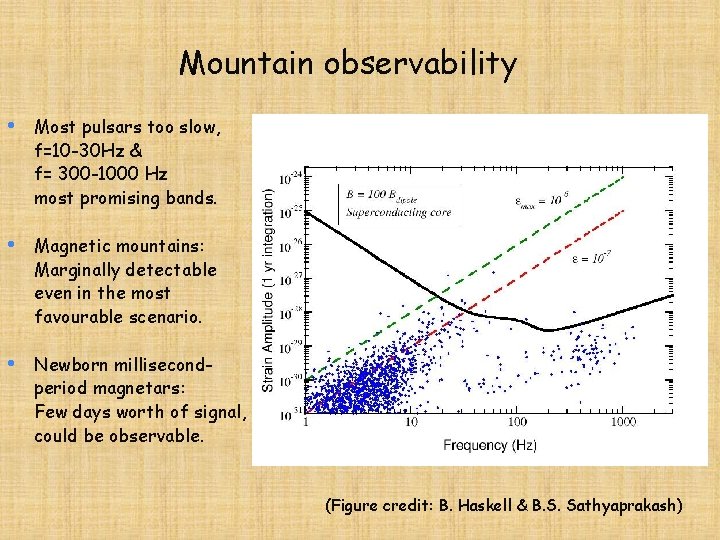
Mountain observability • Most pulsars too slow, f=10 -30 Hz & f= 300 -1000 Hz most promising bands. • Magnetic mountains: Marginally detectable even in the most favourable scenario. • Newborn millisecondperiod magnetars: Few days worth of signal, could be observable. (Figure credit: B. Haskell & B. S. Sathyaprakash)
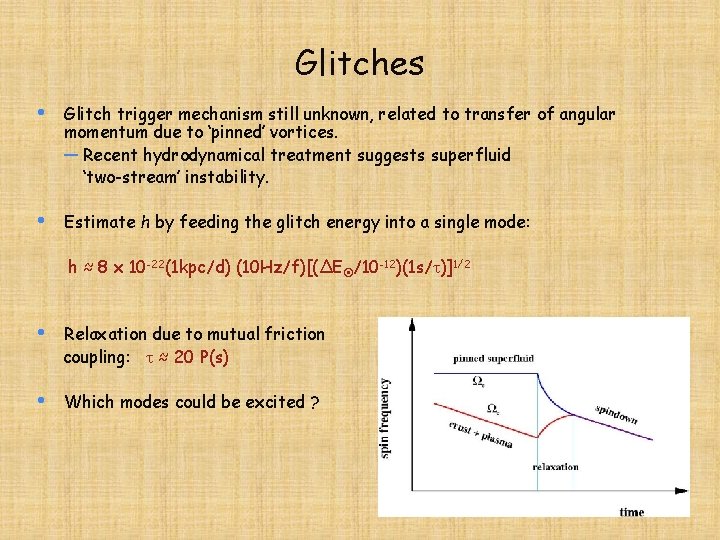
Glitches • Glitch trigger mechanism still unknown, related to transfer of angular momentum due to ‘pinned’ vortices. — Recent hydrodynamical treatment suggests superfluid ‘two-stream’ instability. • Estimate h by feeding the glitch energy into a single mode: h ≈ 8 x 10 -22(1 kpc/d) (10 Hz/f)[(∆E /10 -12)(1 s/ )]1/2 • Relaxation due to mutual friction coupling: ≈ 20 P(s) • Which modes could be excited ?
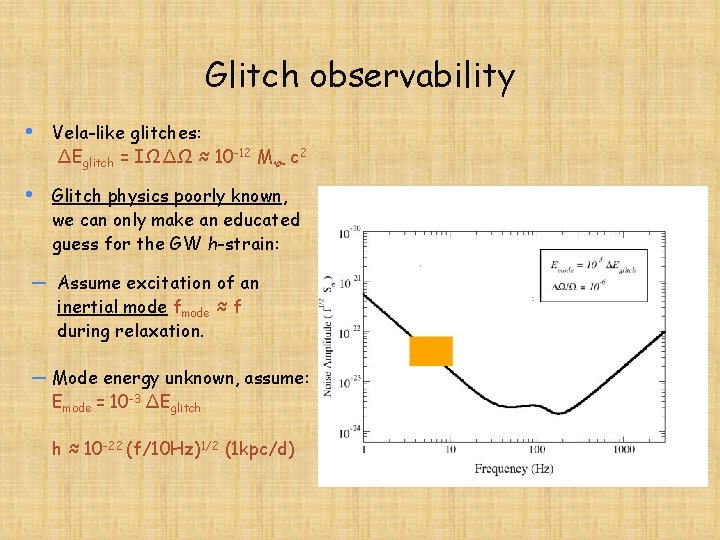
Glitch observability • Vela-like glitches: ∆Eglitch = IΩ∆Ω ≈ 10 -12 M c 2 • Glitch physics poorly known, we can only make an educated guess for the GW h-strain: — Assume excitation of an inertial mode fmode ≈ f during relaxation. — Mode energy unknown, assume: Emode = 10 -3 ∆Eglitch h ≈ 10 -22 (f/10 Hz)1/2 (1 kpc/d)
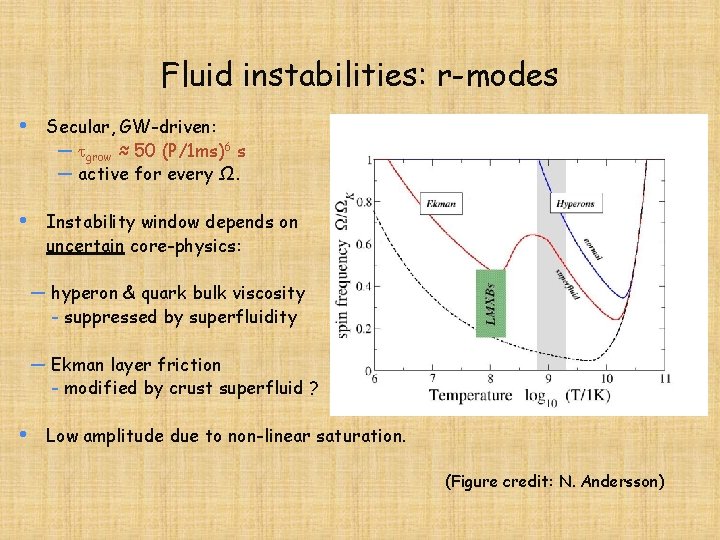
Fluid instabilities: r-modes • Secular, GW-driven: — grow ≈ 50 (P/1 ms)6 s — active for every Ω. • Instability window depends on uncertain core-physics: — hyperon & quark bulk viscosity - suppressed by superfluidity — Ekman layer friction - modified by crust superfluid ? • Low amplitude due to non-linear saturation. (Figure credit: N. Andersson)
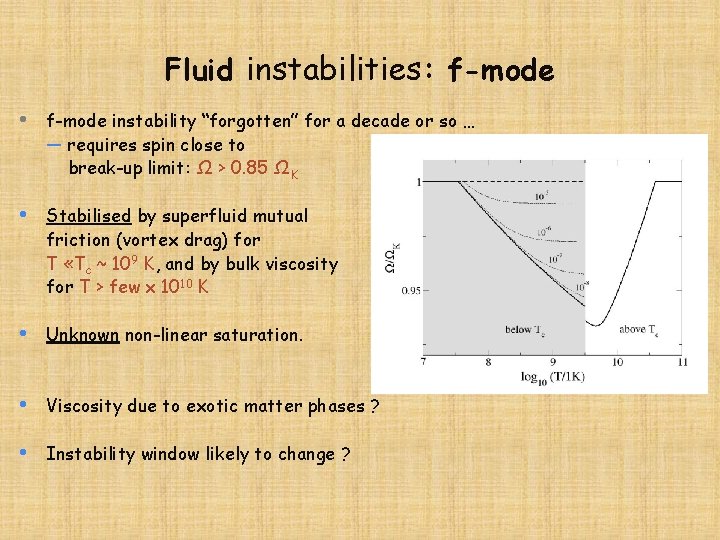
Fluid instabilities: f-mode • f-mode instability “forgotten” for a decade or so … — requires spin close to break-up limit: Ω > 0. 85 ΩK • Stabilised by superfluid mutual friction (vortex drag) for T «Tc ~ 109 K, and by bulk viscosity for T > few x 1010 K • Unknown non-linear saturation. • Viscosity due to exotic matter phases ? • Instability window likely to change ?
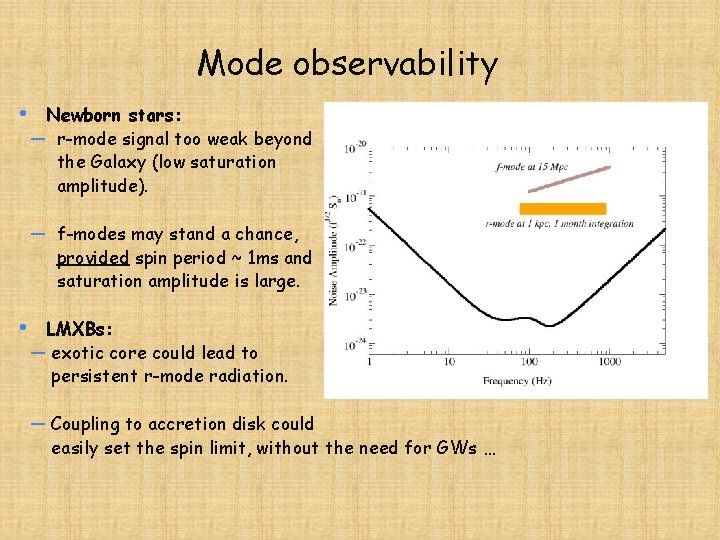
Mode observability • Newborn stars: — r-mode signal too weak beyond the Galaxy (low saturation amplitude). — f-modes may stand a chance, provided spin period ~ 1 ms and saturation amplitude is large. • LMXBs: — exotic core could lead to persistent r-mode radiation. — Coupling to accretion disk could easily set the spin limit, without the need for GWs …
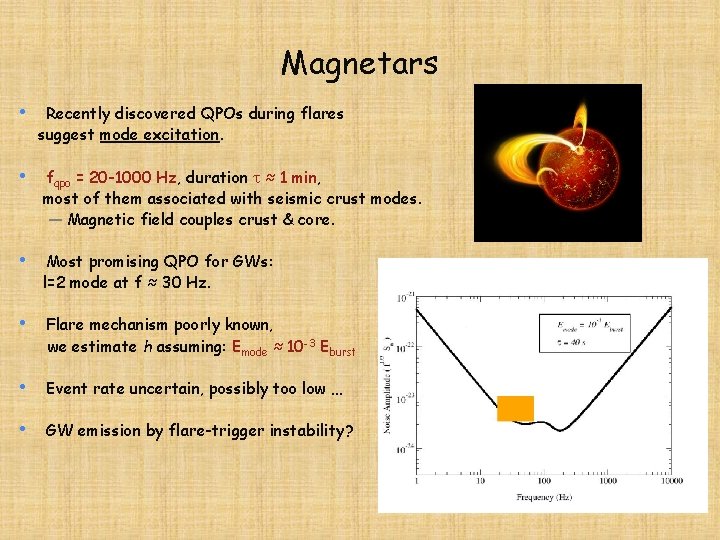
Magnetars • Recently discovered QPOs during flares suggest mode excitation. • fqpo = 20 -1000 Hz, duration ≈ 1 min, most of them associated with seismic crust modes. — Magnetic field couples crust & core. • Most promising QPO for GWs: l=2 mode at f ≈ 30 Hz. • Flare mechanism poorly known, we estimate h assuming: Emode ≈ 10 -3 Eburst • Event rate uncertain, possibly too low … • GW emission by flare-trigger instability?
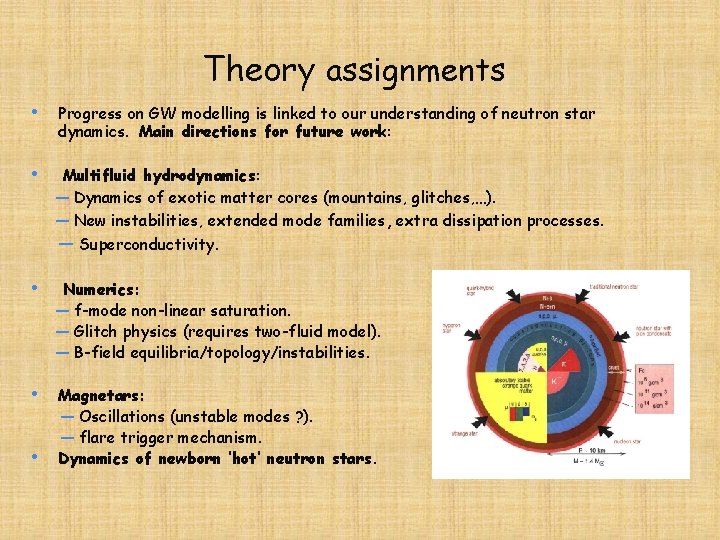
Theory assignments • Progress on GW modelling is linked to our understanding of neutron star dynamics. Main directions for future work: • Multifluid hydrodynamics: — Dynamics of exotic matter cores (mountains, glitches, …). — New instabilities, extended mode families, extra dissipation processes. — Superconductivity. • Numerics: — f-mode non-linear saturation. — Glitch physics (requires two-fluid model). — B-field equilibria/topology/instabilities. • Magnetars: — Oscillations (unstable modes ? ). — flare trigger mechanism. Dynamics of newborn ‘hot’ neutron stars. •
Executive summary • Several mechanisms for GW emission, but none really outstanding. • A secure assessment is hindered by the currently limited (or even rudimentary…) theoretical understanding. • Advances in theoretical modelling in the next 5 -10 years should help us identify the most prominent GW-related aspects of neutron star dynamics. • Opt for narrow-banding ? — 300 -1000 Hz for LMXBs, unstable modes (and supernovae!)
- Slides: 14