
Probing interacting systems of cold atoms using interference
Probing interacting systems of cold atoms using interference experiments Vladimir Gritsev, Adilet Imambekov, Anton Burkov, Robert Cherng, Anatoli Polkovnikov, Ehud Altman, Mikhail Lukin, Eugene Demler Measuring equilibrium correlation functions using interference experiments Studying non-equilibrium dynamics of interacting Bose systems in interference experiments
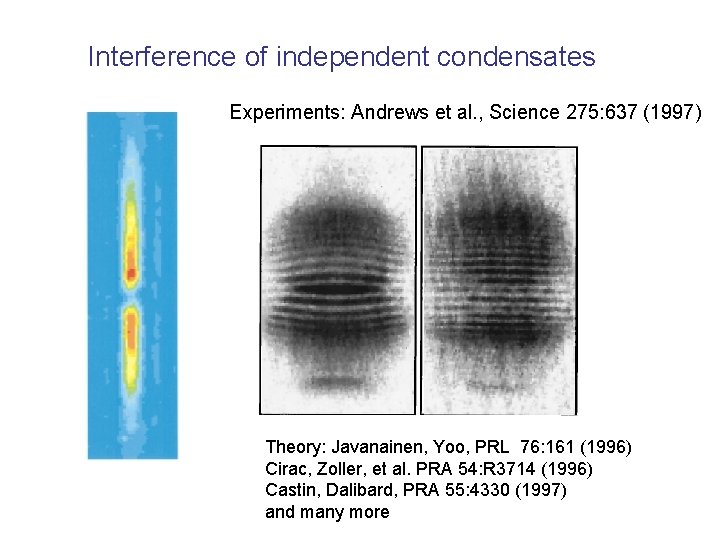
Interference of independent condensates Experiments: Andrews et al. , Science 275: 637 (1997) Theory: Javanainen, Yoo, PRL 76: 161 (1996) Cirac, Zoller, et al. PRA 54: R 3714 (1996) Castin, Dalibard, PRA 55: 4330 (1997) and many more
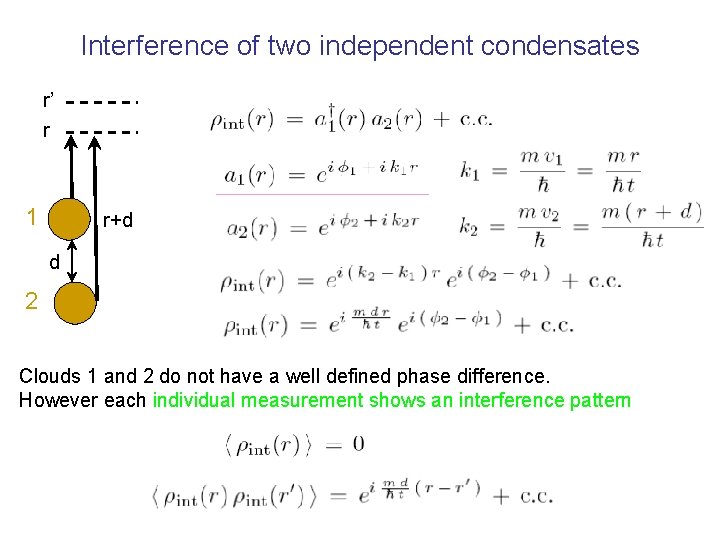
Interference of two independent condensates r’ r 1 r+d d 2 Clouds 1 and 2 do not have a well defined phase difference. However each individual measurement shows an interference pattern
Nature 4877: 255 (1963)
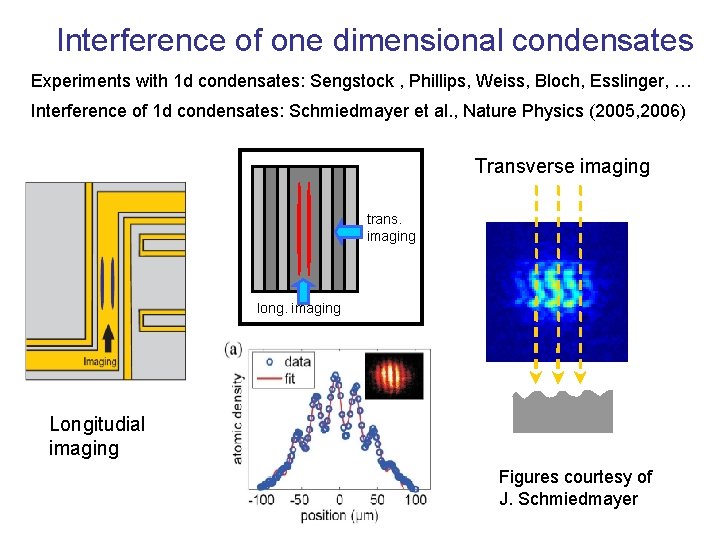
Interference of one dimensional condensates Experiments with 1 d condensates: Sengstock , Phillips, Weiss, Bloch, Esslinger, … Interference of 1 d condensates: Schmiedmayer et al. , Nature Physics (2005, 2006) Transverse imaging trans. imaging long. imaging Longitudial imaging Figures courtesy of J. Schmiedmayer
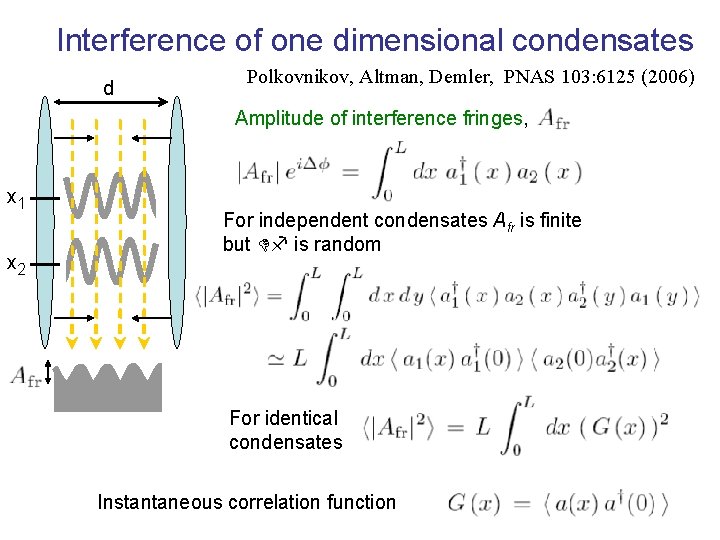
Interference of one dimensional condensates d Polkovnikov, Altman, Demler, PNAS 103: 6125 (2006) Amplitude of interference fringes, x 1 x 2 For independent condensates Afr is finite but Df is random For identical condensates Instantaneous correlation function
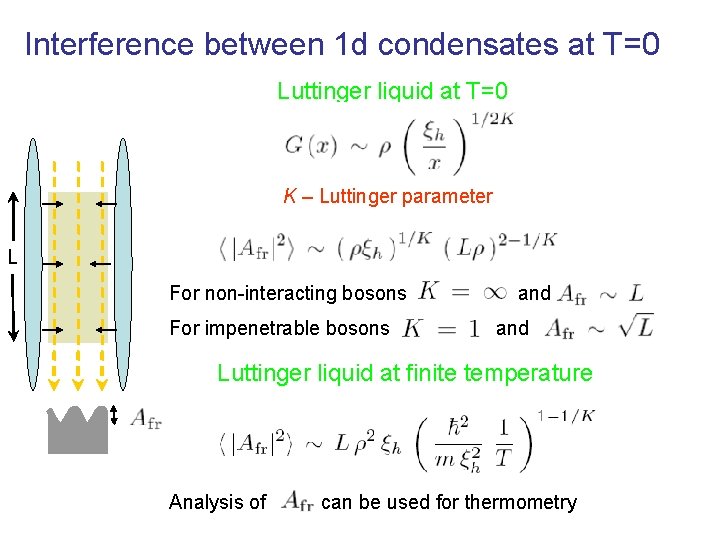
Interference between 1 d condensates at T=0 Luttinger liquid at T=0 K – Luttinger parameter L For non-interacting bosons For impenetrable bosons and Luttinger liquid at finite temperature Analysis of can be used for thermometry
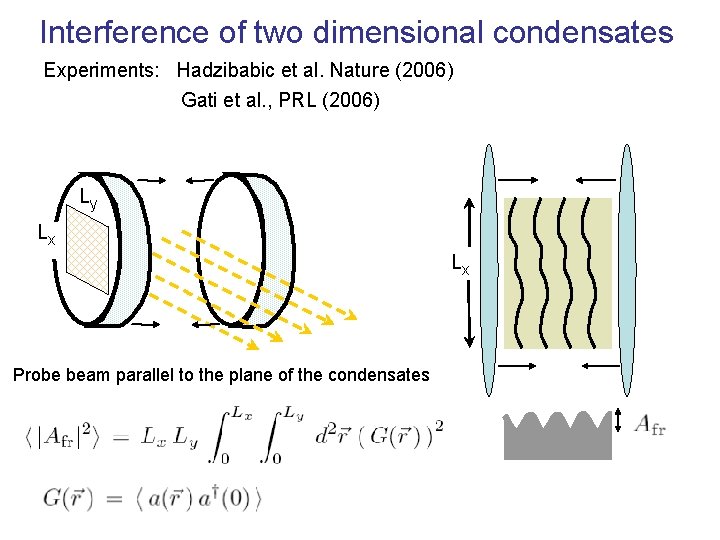
Interference of two dimensional condensates Experiments: Hadzibabic et al. Nature (2006) Gati et al. , PRL (2006) Ly Lx Lx Probe beam parallel to the plane of the condensates
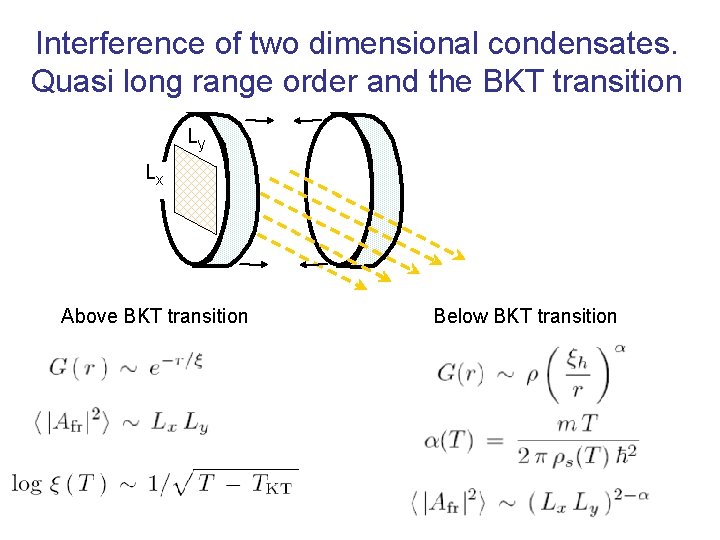
Interference of two dimensional condensates. Quasi long range order and the BKT transition Ly Lx Above BKT transition Below BKT transition
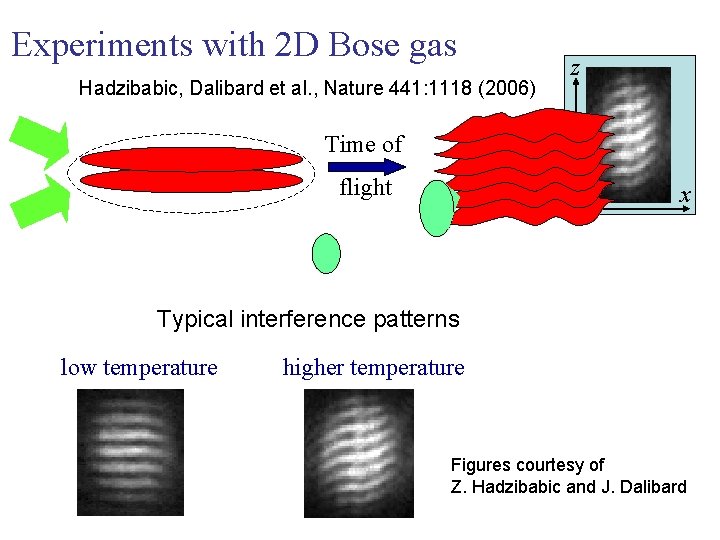
Experiments with 2 D Bose gas Hadzibabic, Dalibard et al. , Nature 441: 1118 (2006) z Time of flight x Typical interference patterns low temperature higher temperature Figures courtesy of Z. Hadzibabic and J. Dalibard
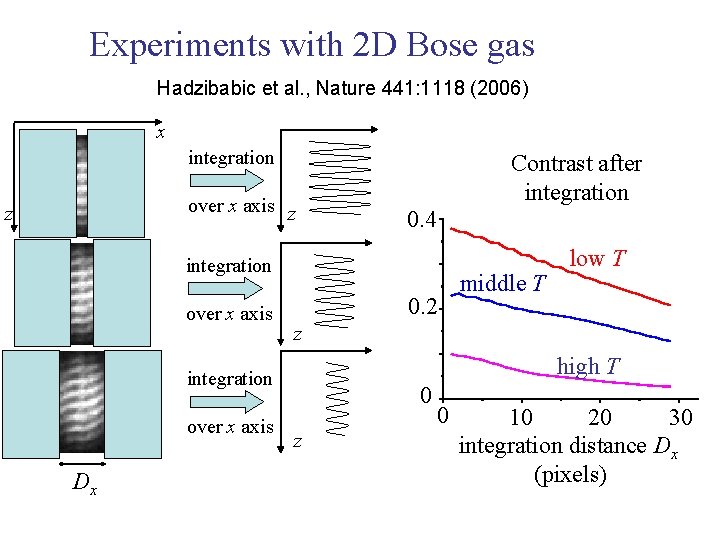
Experiments with 2 D Bose gas Hadzibabic et al. , Nature 441: 1118 (2006) x integration over x axis z z Contrast after integration 0. 4 integration over x axis 0. 2 z high T integration over x axis Dx middle T low T 0 z 0 10 20 30 integration distance Dx (pixels)
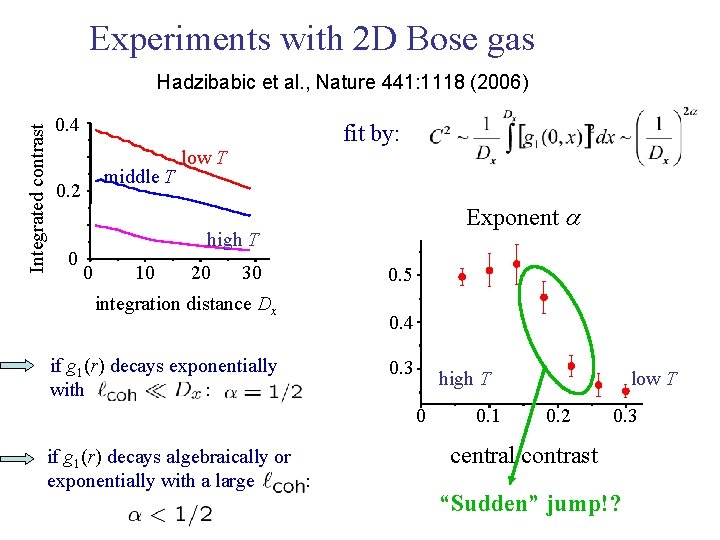
Experiments with 2 D Bose gas Integrated contrast Hadzibabic et al. , Nature 441: 1118 (2006) 0. 4 fit by: middle T 0. 2 0 low T Exponent a high T 0 10 20 30 integration distance Dx if g 1(r) decays exponentially with : 0. 5 0. 4 0. 3 high T 0 if g 1(r) decays algebraically or exponentially with a large : 0. 1 low T 0. 2 0. 3 central contrast “Sudden” jump!?
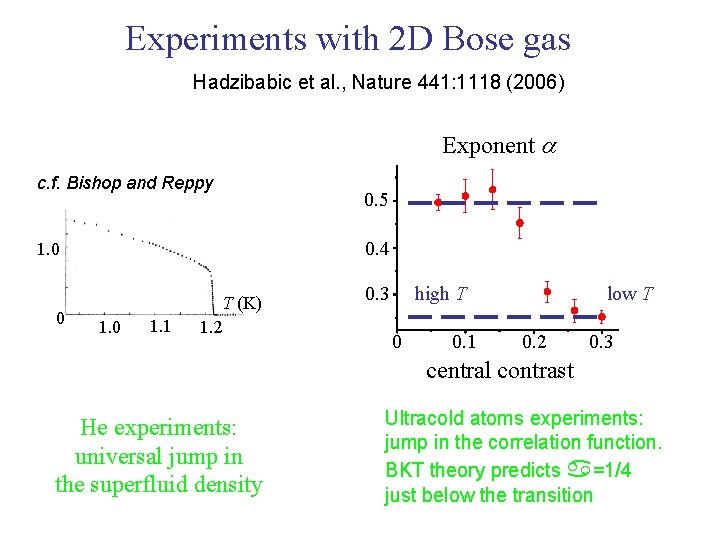
Experiments with 2 D Bose gas Hadzibabic et al. , Nature 441: 1118 (2006) Exponent a c. f. Bishop and Reppy 0. 4 1. 0 0 0. 5 1. 0 1. 1 T (K) 1. 2 0. 3 high T 0 0. 1 low T 0. 2 0. 3 central contrast He experiments: universal jump in the superfluid density Ultracold atoms experiments: jump in the correlation function. BKT theory predicts a=1/4 just below the transition
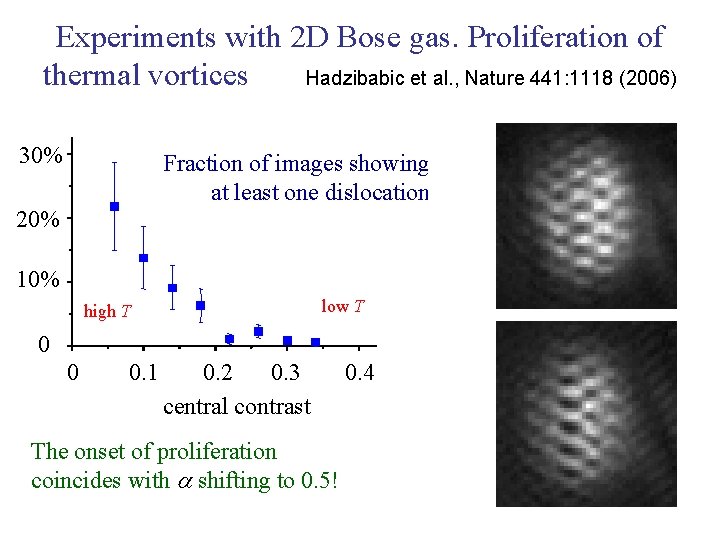
Experiments with 2 D Bose gas. Proliferation of thermal vortices Hadzibabic et al. , Nature 441: 1118 (2006) 30% Fraction of images showing at least one dislocation Exponent a 20% 0. 5 10% 0. 4 low T high T 0 0 0. 1 0. 2 0. 3 central contrast The onset of proliferation coincides with a shifting to 0. 5! 0. 4 0. 3 0 0. 1 0. 2 central contrast 0. 3
Fundamental noise in interference experiments Amplitude of interference fringes is a quantum operator. The measured value of the amplitude will fluctuate from shot to shot. We want to characterize not only the average but the fluctuations as well.
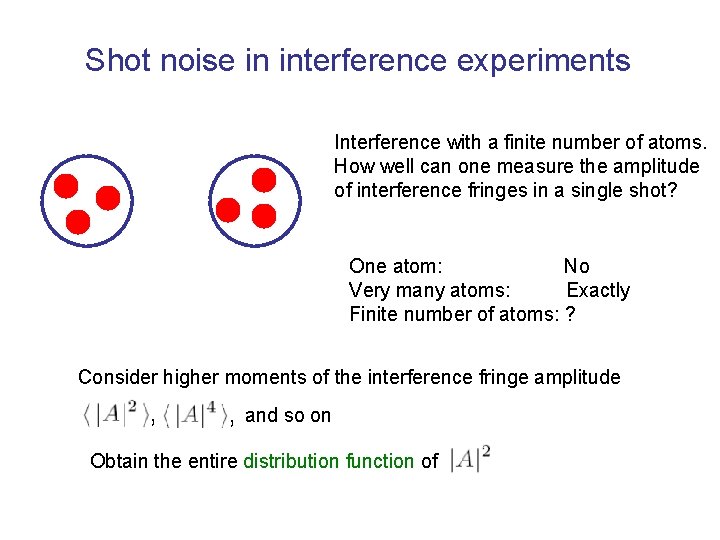
Shot noise in interference experiments Interference with a finite number of atoms. How well can one measure the amplitude of interference fringes in a single shot? One atom: No Very many atoms: Exactly Finite number of atoms: ? Consider higher moments of the interference fringe amplitude , , and so on Obtain the entire distribution function of
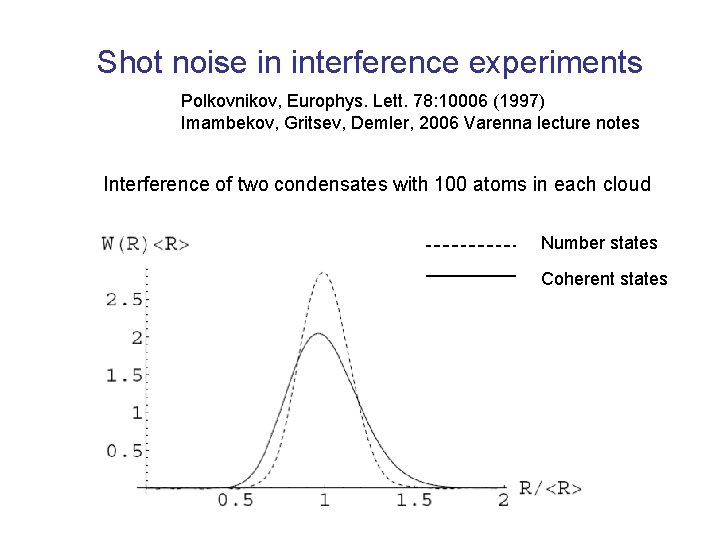
Shot noise in interference experiments Polkovnikov, Europhys. Lett. 78: 10006 (1997) Imambekov, Gritsev, Demler, 2006 Varenna lecture notes Interference of two condensates with 100 atoms in each cloud Number states Coherent states
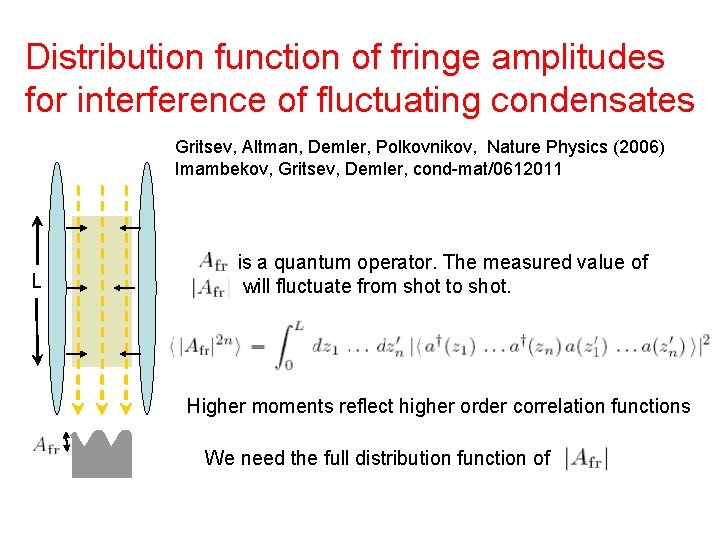
Distribution function of fringe amplitudes for interference of fluctuating condensates Gritsev, Altman, Demler, Polkovnikov, Nature Physics (2006) Imambekov, Gritsev, Demler, cond-mat/0612011 L is a quantum operator. The measured value of will fluctuate from shot to shot. Higher moments reflect higher order correlation functions We need the full distribution function of
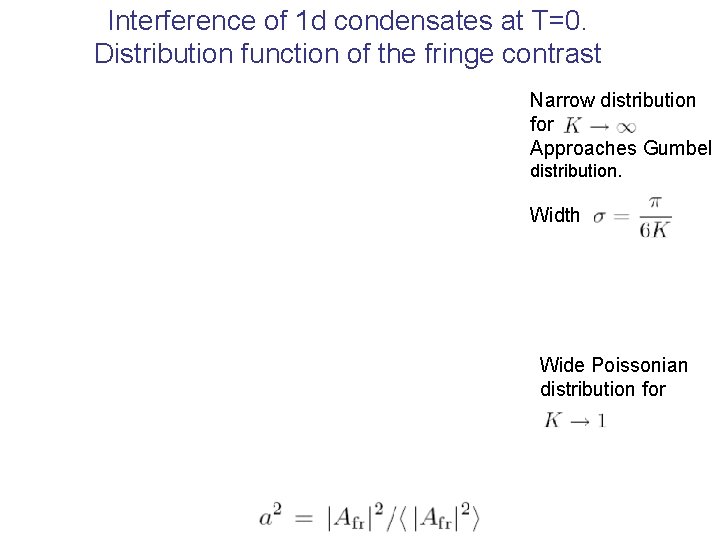
Interference of 1 d condensates at T=0. Distribution function of the fringe contrast Narrow distribution for. Approaches Gumbel distribution. Width Wide Poissonian distribution for
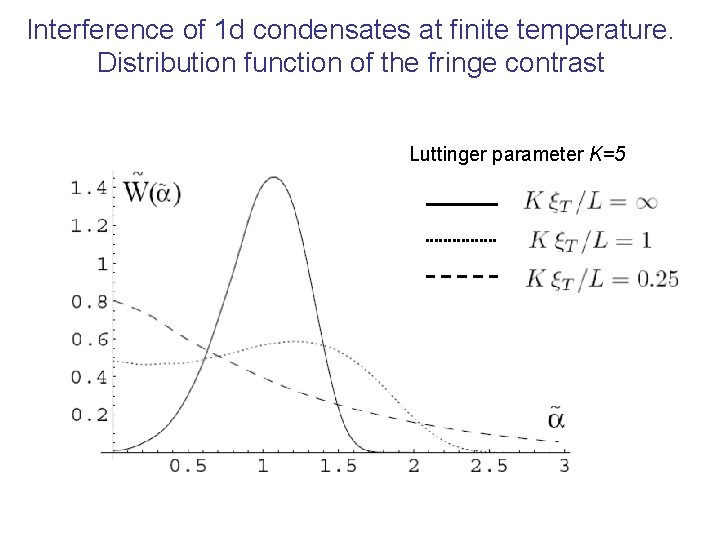
Interference of 1 d condensates at finite temperature. Distribution function of the fringe contrast Luttinger parameter K=5
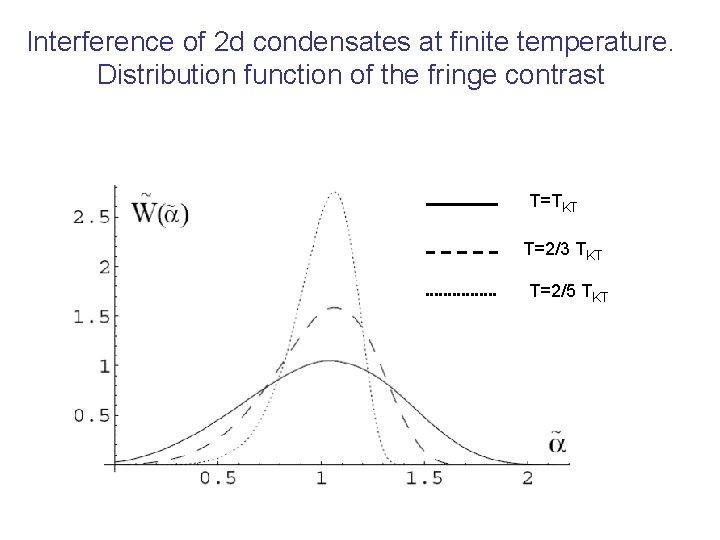
Interference of 2 d condensates at finite temperature. Distribution function of the fringe contrast T=TKT T=2/3 TKT T=2/5 TKT
From visibility of interference fringes to other problems in physics
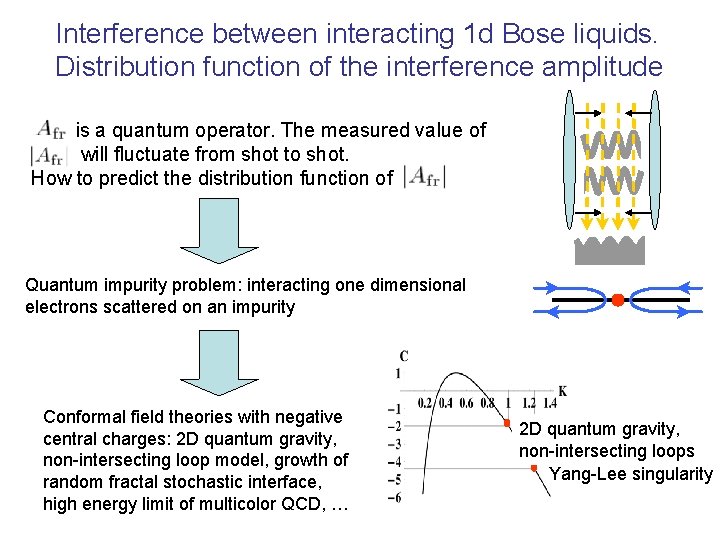
Interference between interacting 1 d Bose liquids. Distribution function of the interference amplitude is a quantum operator. The measured value of will fluctuate from shot to shot. How to predict the distribution function of Quantum impurity problem: interacting one dimensional electrons scattered on an impurity Conformal field theories with negative central charges: 2 D quantum gravity, non-intersecting loop model, growth of random fractal stochastic interface, high energy limit of multicolor QCD, … 2 D quantum gravity, non-intersecting loops Yang-Lee singularity
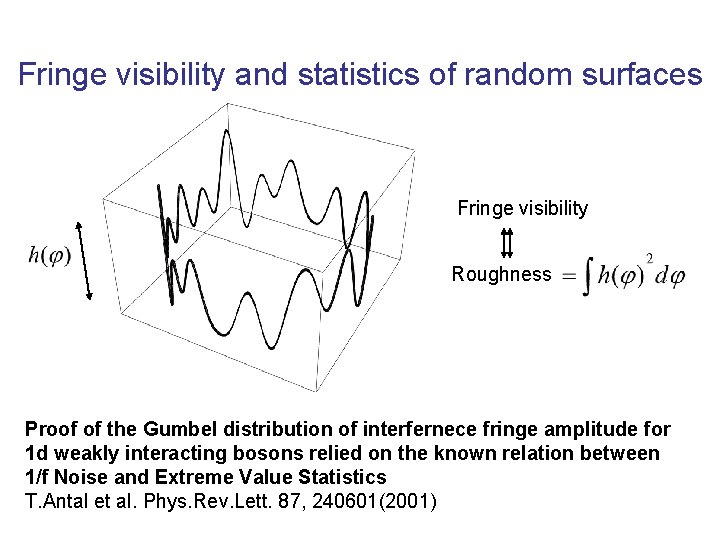
Fringe visibility and statistics of random surfaces Fringe visibility Roughness Proof of the Gumbel distribution of interfernece fringe amplitude for 1 d weakly interacting bosons relied on the known relation between 1/f Noise and Extreme Value Statistics T. Antal et al. Phys. Rev. Lett. 87, 240601(2001)
Non-equilibrium coherent dynamics of low dimensional Bose gases probed in interference experiments
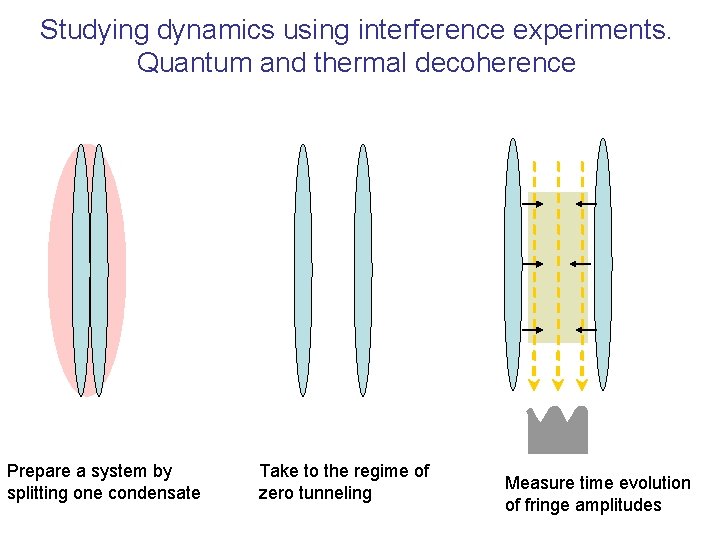
Studying dynamics using interference experiments. Quantum and thermal decoherence Prepare a system by splitting one condensate Take to the regime of zero tunneling Measure time evolution of fringe amplitudes
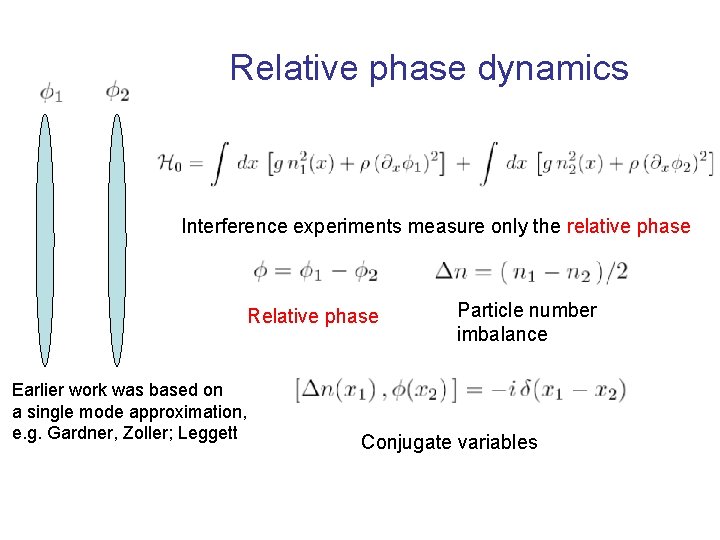
Relative phase dynamics Interference experiments measure only the relative phase Relative phase Earlier work was based on a single mode approximation, e. g. Gardner, Zoller; Leggett Particle number imbalance Conjugate variables
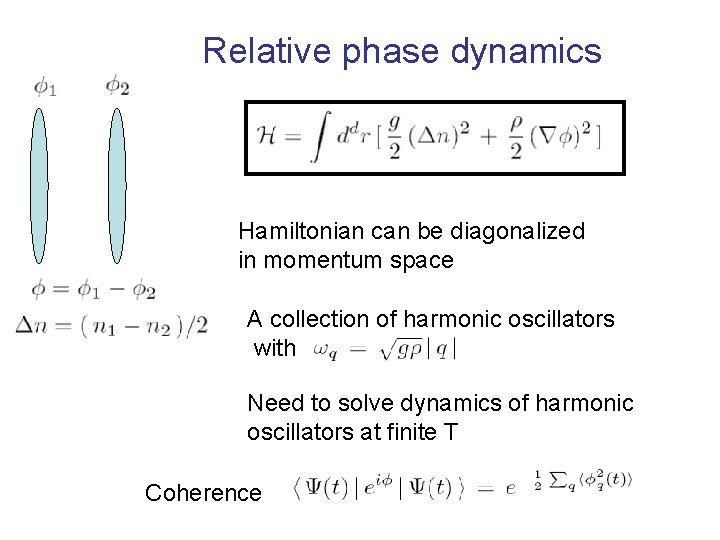
Relative phase dynamics Hamiltonian can be diagonalized in momentum space A collection of harmonic oscillators with Need to solve dynamics of harmonic oscillators at finite T Coherence
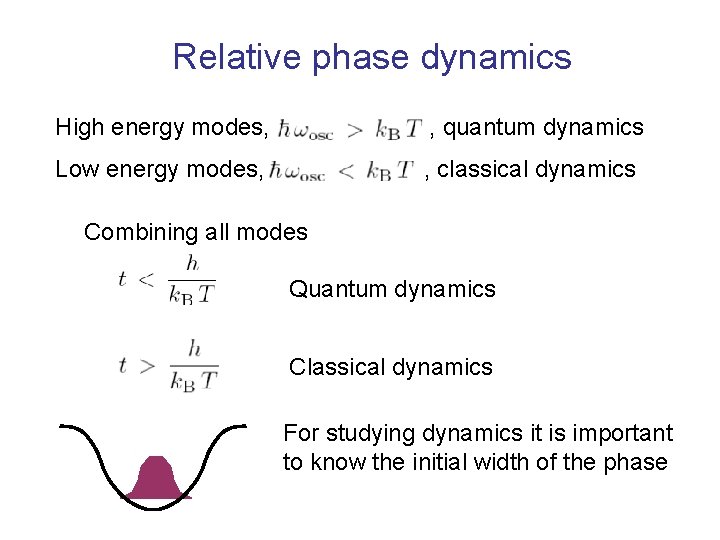
Relative phase dynamics High energy modes, , quantum dynamics Low energy modes, , classical dynamics Combining all modes Quantum dynamics Classical dynamics For studying dynamics it is important to know the initial width of the phase
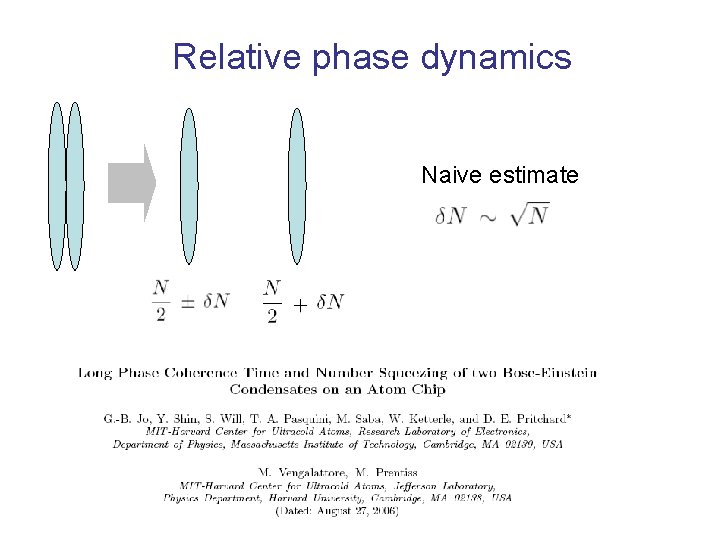
Relative phase dynamics Naive estimate
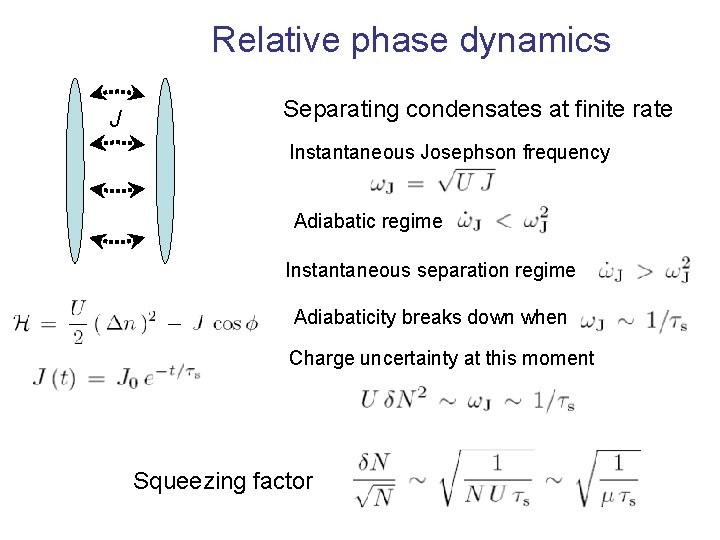
Relative phase dynamics J Separating condensates at finite rate Instantaneous Josephson frequency Adiabatic regime Instantaneous separation regime Adiabaticity breaks down when Charge uncertainty at this moment Squeezing factor
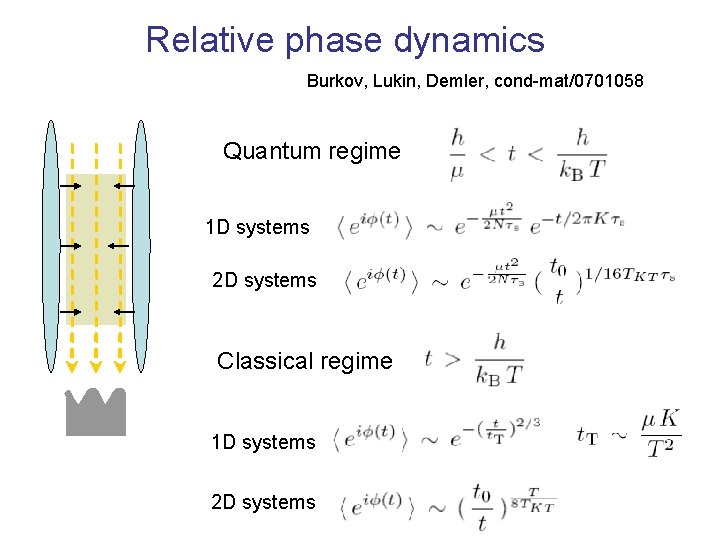
Relative phase dynamics Burkov, Lukin, Demler, cond-mat/0701058 Quantum regime 1 D systems 2 D systems Classical regime 1 D systems 2 D systems
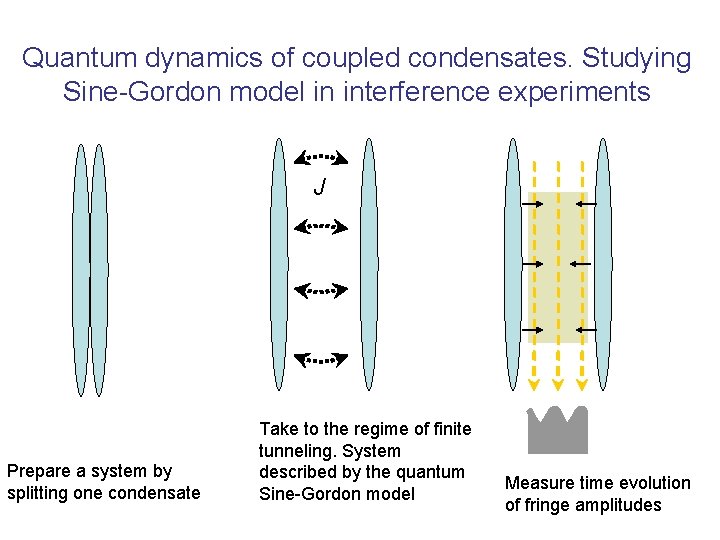
Quantum dynamics of coupled condensates. Studying Sine-Gordon model in interference experiments J Prepare a system by splitting one condensate Take to the regime of finite tunneling. System described by the quantum Sine-Gordon model Measure time evolution of fringe amplitudes
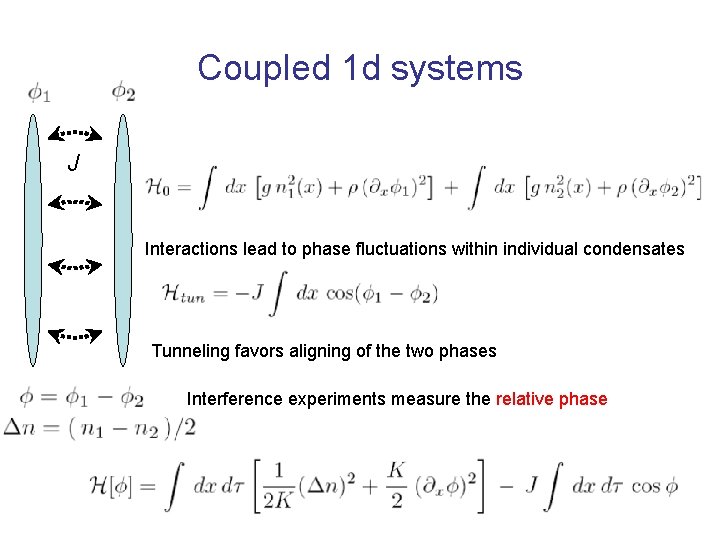
Coupled 1 d systems J Interactions lead to phase fluctuations within individual condensates Tunneling favors aligning of the two phases Interference experiments measure the relative phase
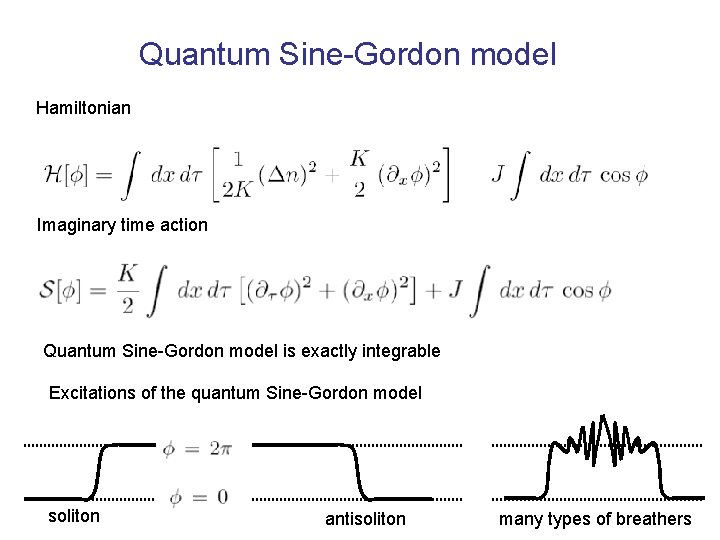
Quantum Sine-Gordon model Hamiltonian Imaginary time action Quantum Sine-Gordon model is exactly integrable Excitations of the quantum Sine-Gordon model soliton antisoliton many types of breathers
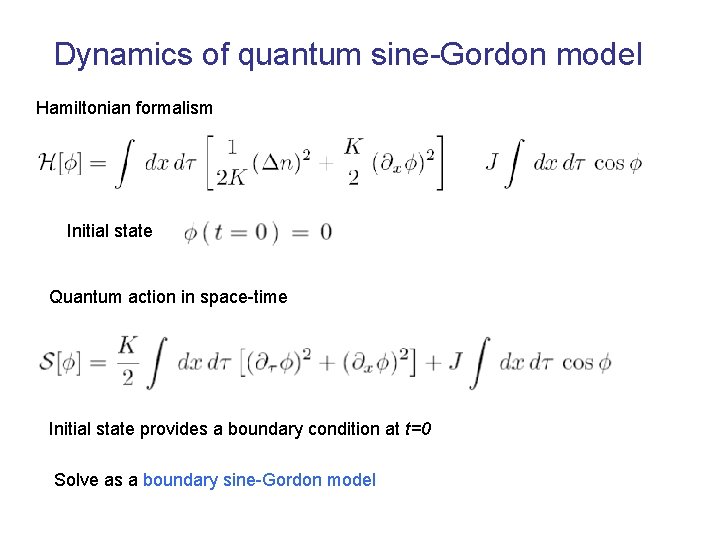
Dynamics of quantum sine-Gordon model Hamiltonian formalism Initial state Quantum action in space-time Initial state provides a boundary condition at t=0 Solve as a boundary sine-Gordon model
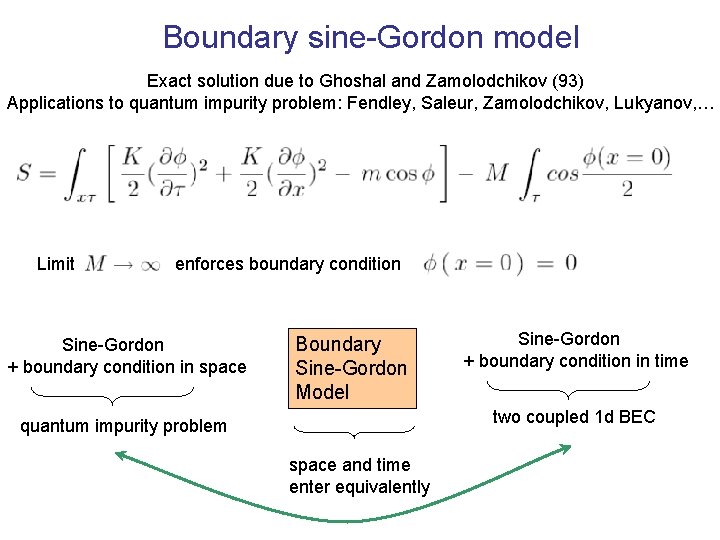
Boundary sine-Gordon model Exact solution due to Ghoshal and Zamolodchikov (93) Applications to quantum impurity problem: Fendley, Saleur, Zamolodchikov, Lukyanov, … Limit enforces boundary condition Sine-Gordon + boundary condition in space Boundary Sine-Gordon Model Sine-Gordon + boundary condition in time two coupled 1 d BEC quantum impurity problem space and time enter equivalently
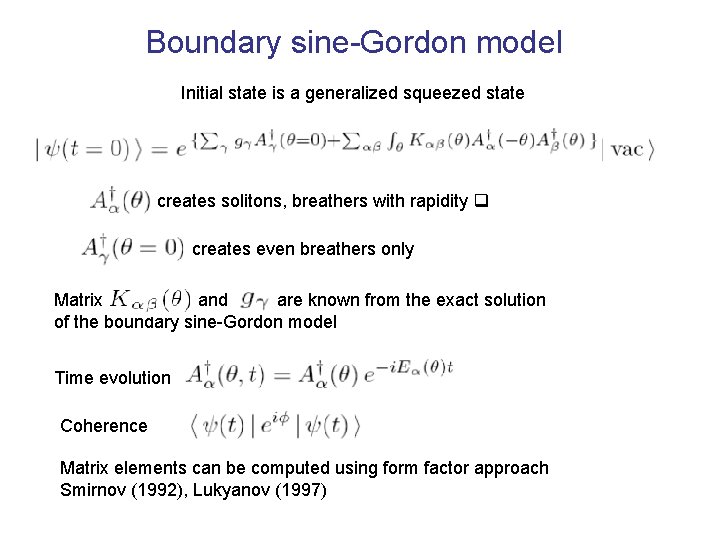
Boundary sine-Gordon model Initial state is a generalized squeezed state creates solitons, breathers with rapidity q creates even breathers only Matrix and are known from the exact solution of the boundary sine-Gordon model Time evolution Coherence Matrix elements can be computed using form factor approach Smirnov (1992), Lukyanov (1997)
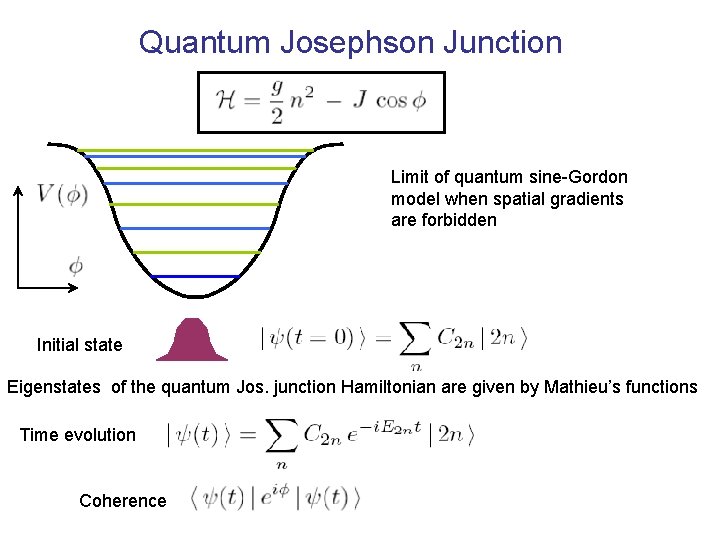
Quantum Josephson Junction Limit of quantum sine-Gordon model when spatial gradients are forbidden Initial state Eigenstates of the quantum Jos. junction Hamiltonian are given by Mathieu’s functions Time evolution Coherence
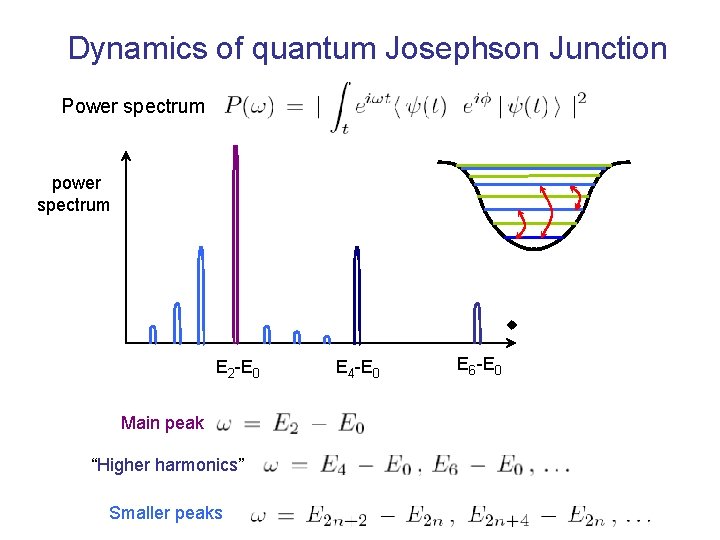
Dynamics of quantum Josephson Junction Power spectrum power spectrum w E 2 -E 0 Main peak “Higher harmonics” Smaller peaks E 4 -E 0 E 6 -E 0
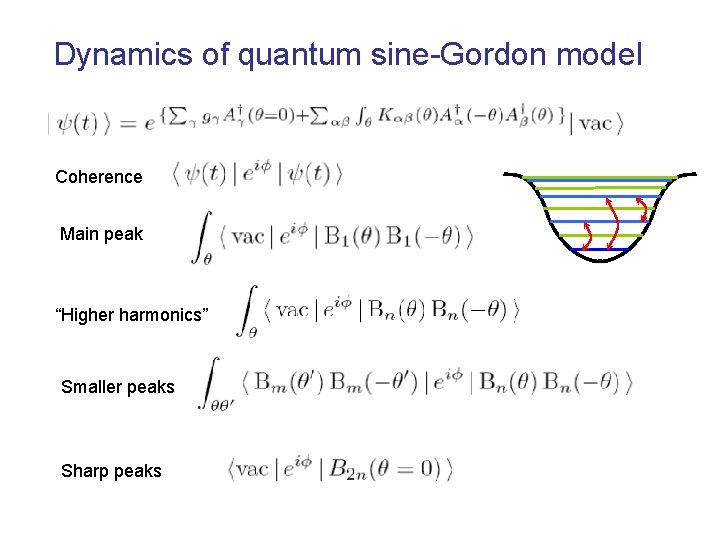
Dynamics of quantum sine-Gordon model Coherence Main peak “Higher harmonics” Smaller peaks Sharp peaks
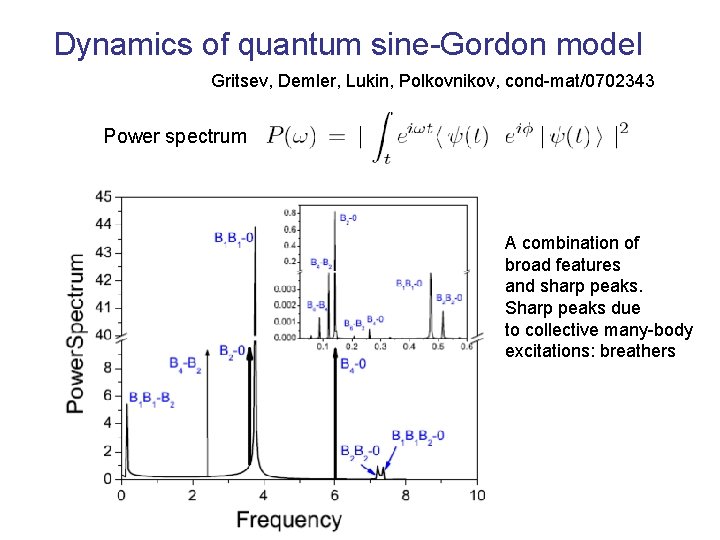
Dynamics of quantum sine-Gordon model Gritsev, Demler, Lukin, Polkovnikov, cond-mat/0702343 Power spectrum A combination of broad features and sharp peaks. Sharp peaks due to collective many-body excitations: breathers

Conclusions Interference of extended condensates can be used to probe equilibrium correlation functions in one and two dimensional systems Interference experiments can be used to study non-equilibrium dynamics of low dimensional superfluids and perform spectroscopy of the quantum sine-Gordon model
- Slides: 43