
Probing Inflation with CMB Polarization Measurements QUIET POLARBEAR
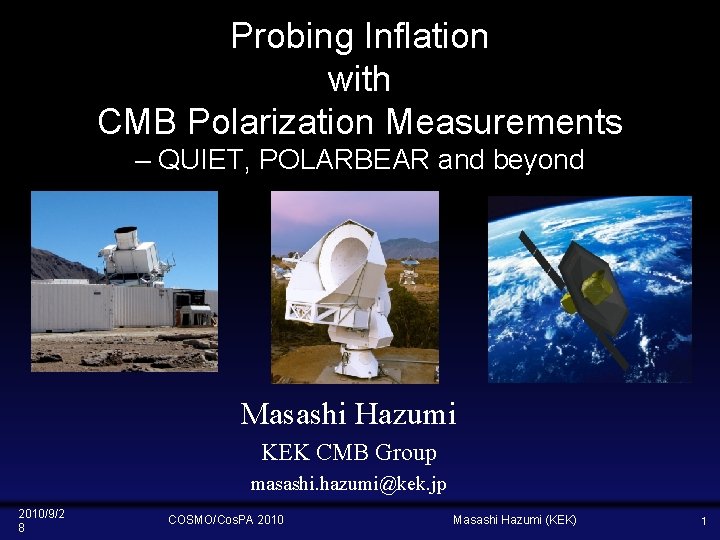
Probing Inflation with CMB Polarization Measurements – QUIET, POLARBEAR and beyond Masashi Hazumi KEK CMB Group masashi. hazumi@kek. jp 2010/9/2 8 COSMO/Cos. PA 2010 Masashi Hazumi (KEK) 1
Outline 1. Science of CMB polarization 2. Summary of projects 3. QUIET and POLARBEAR 4. Future small satellite Lite. BIRD Disclaimer: Not a comprehensive review of ongoing/future projects. Focus is on the projects Japanese CMB groups are involved in. 2010/9/2 8 COSMO/Cos. PA 2010 Masashi Hazumi (KEK) 2

1. Science of CMB Polarization • The best way to discover primordial gravitational wave (PGW) predicted in cosmic inflation CMB polarization map Inflatio n 2010/9/2 8 Recombinatio n COSMO/Cos. PA 2010 “a fingerprint” of inflation time Masashi Hazumi (KEK) 3
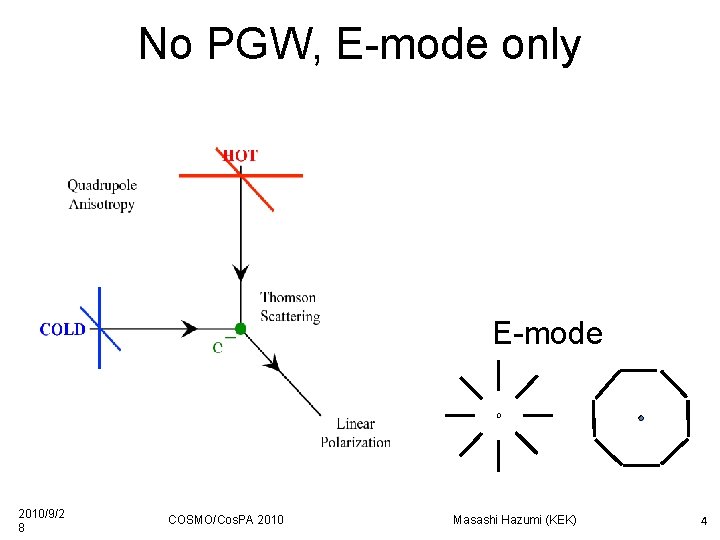
No PGW, E-mode only E-mode 2010/9/2 8 COSMO/Cos. PA 2010 Masashi Hazumi (KEK) 4
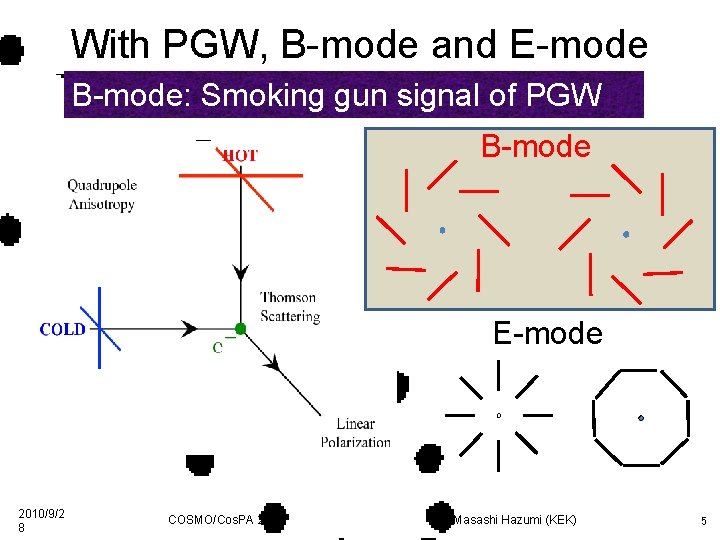
With PGW, B-mode and E-mode B-mode: Smoking gun signal of PGW B-mode E-mode 2010/9/2 8 COSMO/Cos. PA 2010 Masashi Hazumi (KEK) 5
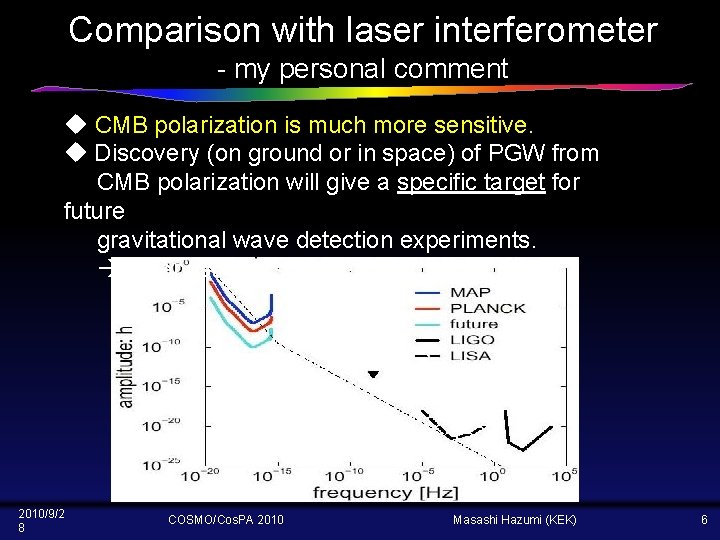
Comparison with laser interferometer - my personal comment u CMB polarization is much more sensitive. u Discovery (on ground or in space) of PGW from CMB polarization will give a specific target for future gravitational wave detection experiments. a very strong science case can be made. 2010/9/2 8 COSMO/Cos. PA 2010 Masashi Hazumi (KEK) 6
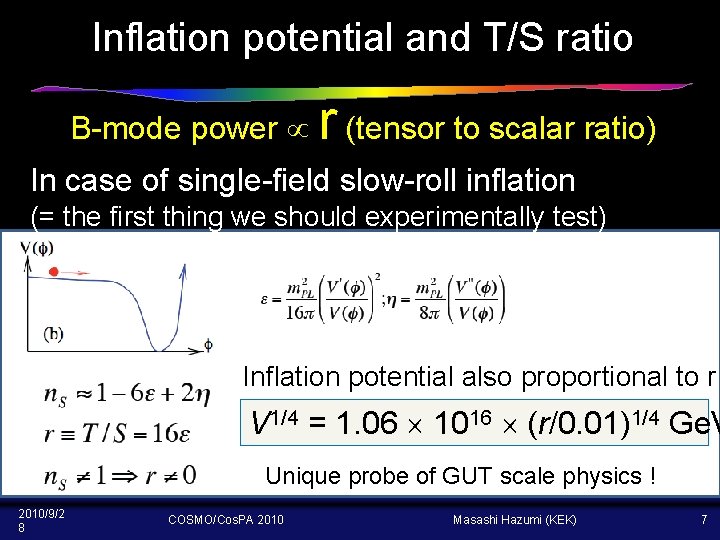
Inflation potential and T/S ratio B-mode power r (tensor to scalar ratio) In case of single-field slow-roll inflation (= the first thing we should experimentally test) Inflation potential also proportional to r V 1/4 = 1. 06 1016 (r/0. 01)1/4 Ge. V Unique probe of GUT scale physics ! 2010/9/2 8 COSMO/Cos. PA 2010 Masashi Hazumi (KEK) 7
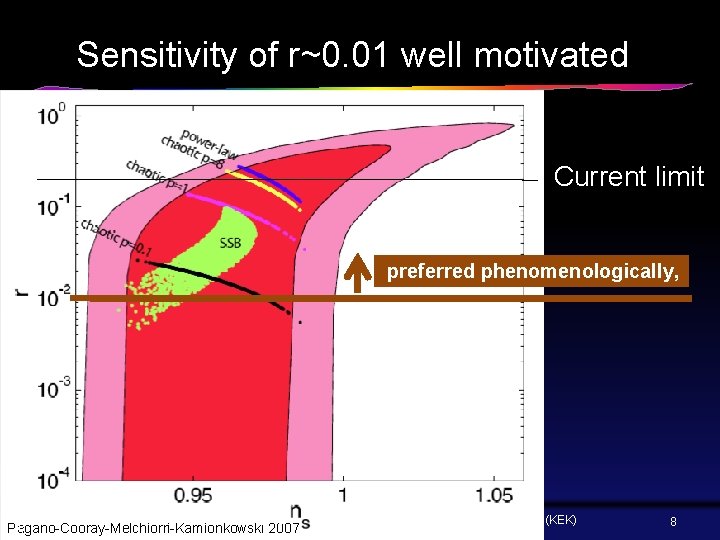
Sensitivity of r~0. 01 well motivated Current limit preferred phenomenologically, 2010/9/2 COSMO/Cos. PA 2010 8 Pagano-Cooray-Melchiorri-Kamionkowski 2007 Masashi Hazumi (KEK) 8

CMB Power spectra Ground-based TT W. Hu et al. astro-ph/0210096 Space/Balloon ~2 deg. Reionization bump O(1)n. K precision required for r=0. 01 2010/9/2 8 COSMO/Cos. PA 2010 Masashi Hazumi (KEK) 9
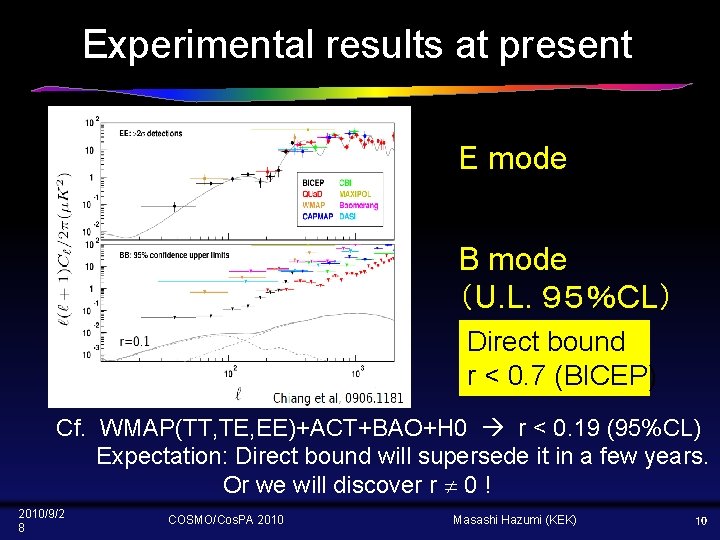
Experimental results at present E mode B mode (U. L. 95%CL) Direct bound r < 0. 7 (BICEP) Cf. WMAP(TT, TE, EE)+ACT+BAO+H 0 r < 0. 19 (95%CL) Expectation: Direct bound will supersede it in a few years. Or we will discover r 0 ! 2010/9/2 8 COSMO/Cos. PA 2010 Masashi Hazumi (KEK) 10
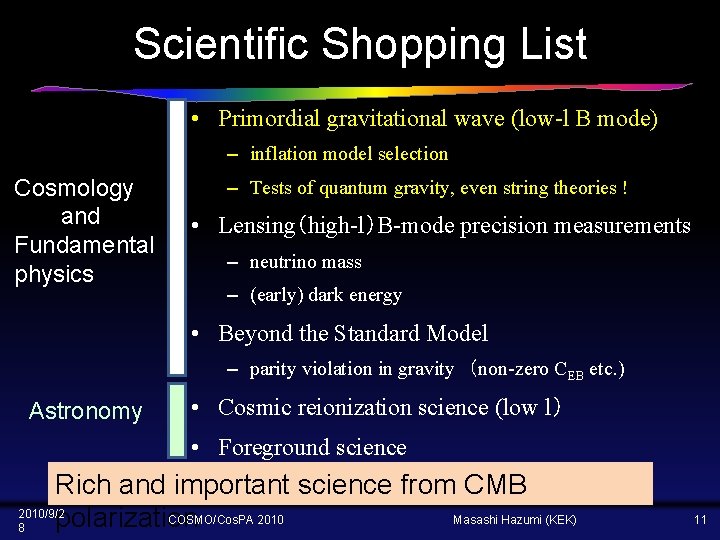
Scientific Shopping List • Primordial gravitational wave (low-l B mode) – inflation model selection Cosmology and Fundamental physics – Tests of quantum gravity, even string theories ! • Lensing(high-l)B-mode precision measurements – neutrino mass – (early) dark energy • Beyond the Standard Model – parity violation in gravity (non-zero CEB etc. ) Astronomy • Cosmic reionization science (low l) • Foreground science Rich and important science from CMB 2010/9/2 COSMO/Cos. PA 2010 Masashi Hazumi (KEK) polarization 8 11
2. Summary of projects 2010/9/2 8 COSMO/Cos. PA 2010 Masashi Hazumi (KEK) 12
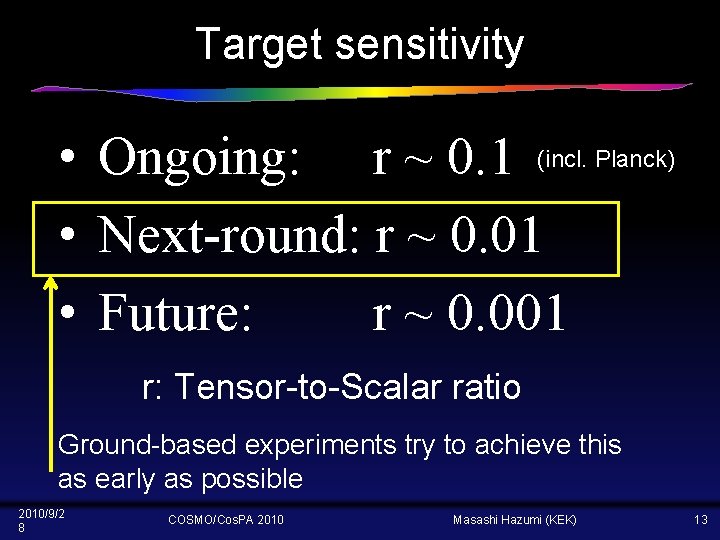
Target sensitivity • Ongoing: r ~ 0. 1 (incl. Planck) • Next-round: r ~ 0. 01 • Future: r ~ 0. 001 r: Tensor-to-Scalar ratio Ground-based experiments try to achieve this as early as possible 2010/9/2 8 COSMO/Cos. PA 2010 Masashi Hazumi (KEK) 13
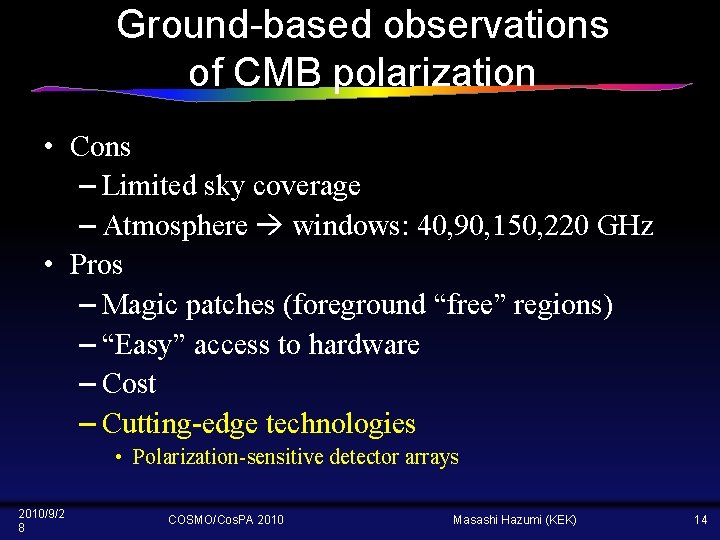
Ground-based observations of CMB polarization • Cons – Limited sky coverage – Atmosphere windows: 40, 90, 150, 220 GHz • Pros – Magic patches (foreground “free” regions) – “Easy” access to hardware – Cost – Cutting-edge technologies • Polarization-sensitive detector arrays 2010/9/2 8 COSMO/Cos. PA 2010 Masashi Hazumi (KEK) 14
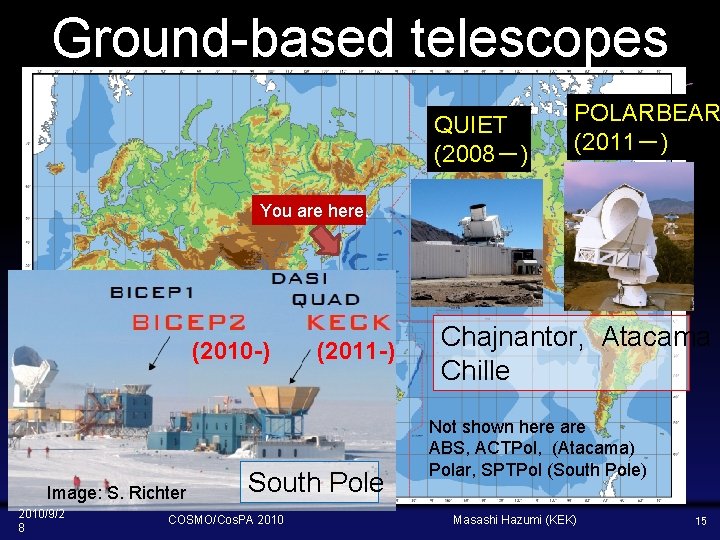
Ground-based telescopes QUIET (2008-) POLARBEAR (2011-) You are here. (2010 -) Image: S. Richter 2010/9/2 8 (2011 -) チリ South Pole COSMO/Cos. PA 2010 Chajnantor, Atacama Chille Not shown here are ABS, ACTPol, (Atacama) Polar, SPTPol (South Pole) Masashi Hazumi (KEK) 15
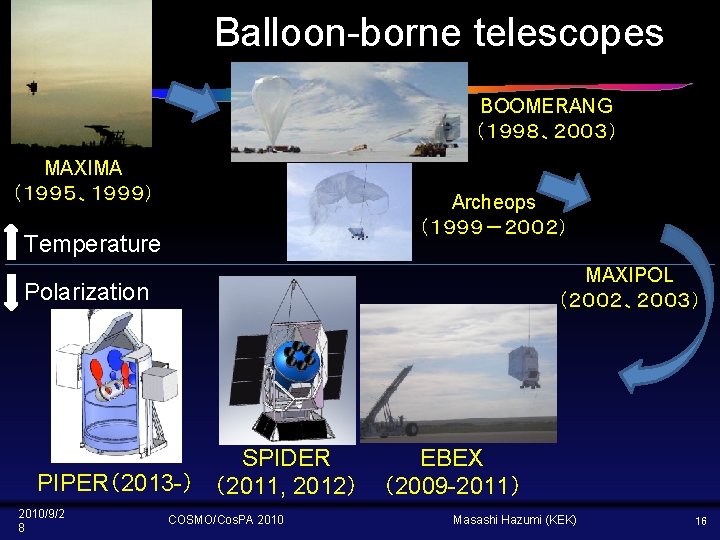
Balloon-borne telescopes BOOMERANG (1998、2003) MAXIMA (1995、1999) Archeops (1999-2002) Temperature MAXIPOL (2002、2003) Polarization SPIDER PIPER(2013 -) (2011, 2012) 2010/9/2 8 COSMO/Cos. PA 2010 EBEX (2009 -2011) Masashi Hazumi (KEK) 16
Comparison. . . • Enough to say for now that all the projects targeting r ~ 0. 01 in 2~5 years – Recent technological development on polarizationsensitive detector arrays quite impressive, good reason for optimism • We will see 2010/9/2 8 COSMO/Cos. PA 2010 Masashi Hazumi (KEK) 17
3. QUIET and POLARBEAR 2010/9/2 8 COSMO/Cos. PA 2010 Masashi Hazumi (KEK) 18
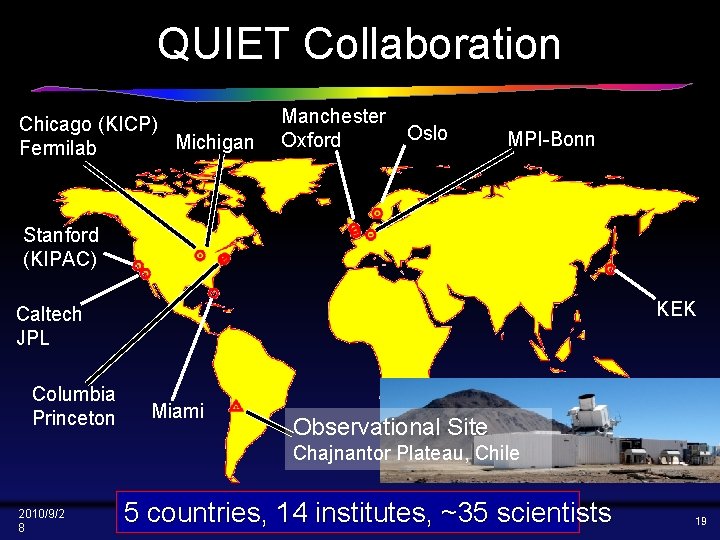
QUIET Collaboration Chicago (KICP) Michigan Fermilab Manchester Oxford Oslo MPI-Bonn Stanford (KIPAC) KEK Caltech JPL Columbia Princeton Miami Observational Site Chajnantor Plateau, Chile 2010/9/2 8 5 countries, 14 institutes, ~Masashi 35 scientists COSMO/Cos. PA 2010 Hazumi (KEK) 19
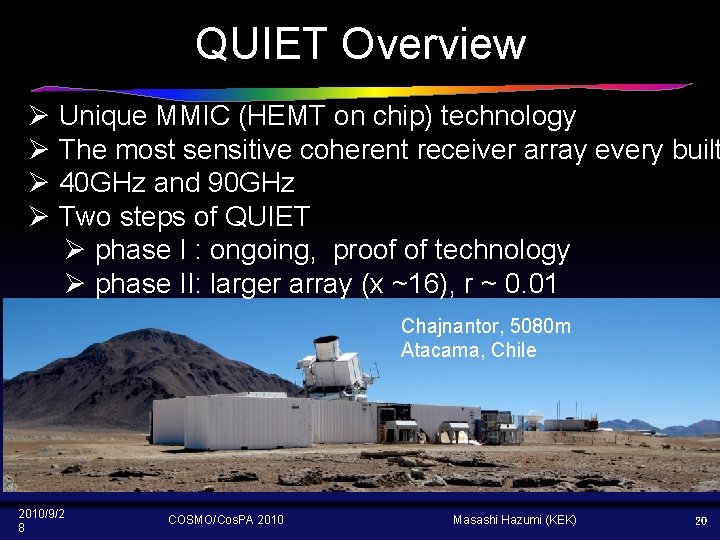
QUIET Overview Ø Unique MMIC (HEMT on chip) technology Ø The most sensitive coherent receiver array every built Ø 40 GHz and 90 GHz Ø Two steps of QUIET Ø phase I : ongoing, proof of technology Ø phase II: larger array (x ~16), r ~ 0. 01 Chajnantor, 5080 m Atacama, Chile 2010/9/2 8 COSMO/Cos. PA 2010 Masashi Hazumi (KEK) 20
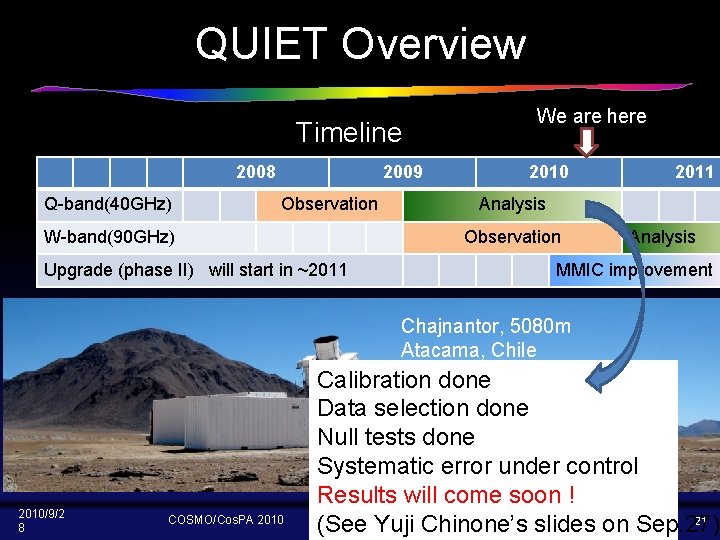
QUIET Overview Timeline 2008 Q-band(40 GHz) 2009 Observation W-band(90 GHz) We are here 2010 Analysis Observation Upgrade (phase II) will start in ~2011 Analysis MMIC improvement Chajnantor, 5080 m Atacama, Chile 2010/9/2 8 COSMO/Cos. PA 2010 Calibration done Data selection done Null tests done Systematic error under control Results will come soon ! Masashi Hazumi (KEK) 21 (See Yuji Chinone’s slides on Sep. 27)
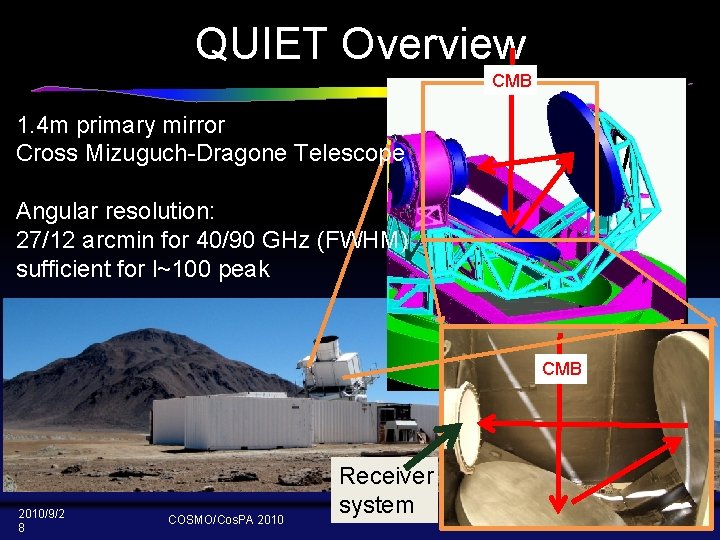
QUIET Overview CMB 1. 4 m primary mirror Cross Mizuguch-Dragone Telescope Angular resolution: 27/12 arcmin for 40/90 GHz (FWHM) sufficient for l~100 peak Chajnantor, 5080 m Atacama, Chile CMB 2010/9/2 8 COSMO/Cos. PA 2010 Receiver system Masashi Hazumi (KEK) 22
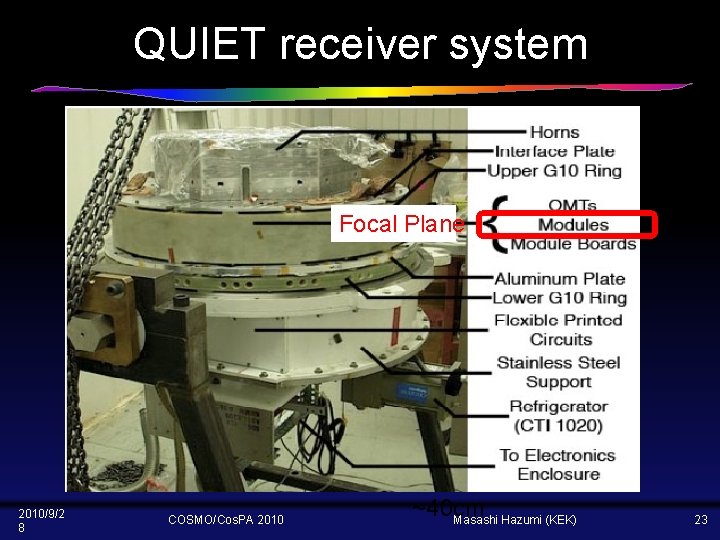
QUIET receiver system Focal Plane 2010/9/2 8 COSMO/Cos. PA 2010 ~40 cm Masashi Hazumi (KEK) 23
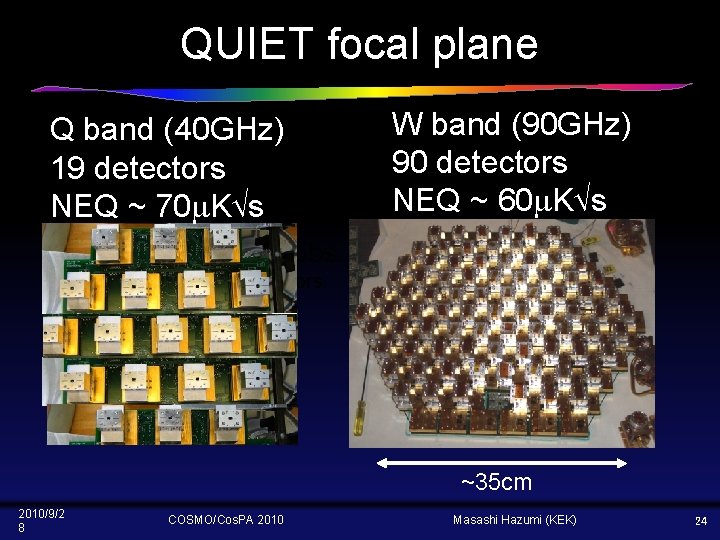
QUIET focal plane Q band (40 GHz) 19 detectors NEQ ~ 70 m. K s W band (90 GHz) 90 detectors NEQ ~ 60 m. K s Q-band obs. 19 detectors ~35 cm 2010/9/2 8 COSMO/Cos. PA 2010 Masashi Hazumi (KEK) 24
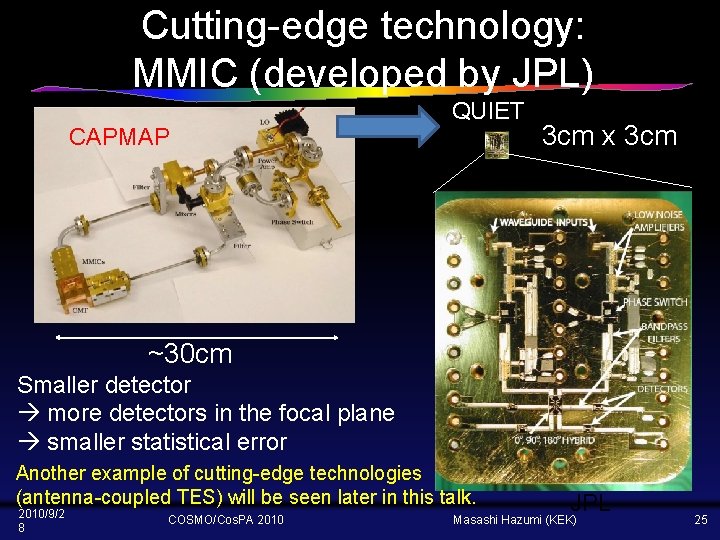
Cutting-edge technology: MMIC (developed by JPL) CAPMAP QUIET 3 cm x 3 cm ~30 cm Smaller detector more detectors in the focal plane smaller statistical error Another example of cutting-edge technologies (antenna-coupled TES) will be seen later in this talk. 2010/9/2 8 COSMO/Cos. PA 2010 JPL Masashi Hazumi (KEK) 25
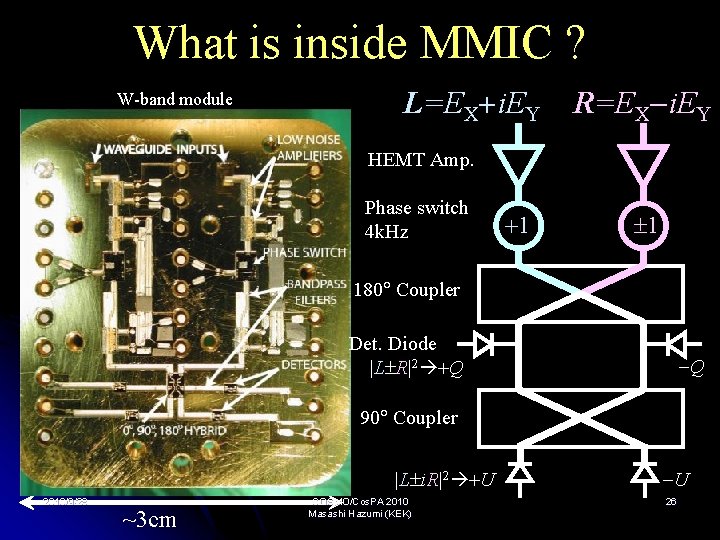
What is inside MMIC ? W-band module L=EX+i. EY R=EX i. EY HEMT Amp. Phase switch 4 k. Hz +1 1 180 Coupler Det. Diode |L R|2 +Q Q 90 Coupler |L i. R|2 +U 2010/9/28 ~3 cm COSMO/Cos. PA 2010 Masashi Hazumi (KEK) U 26
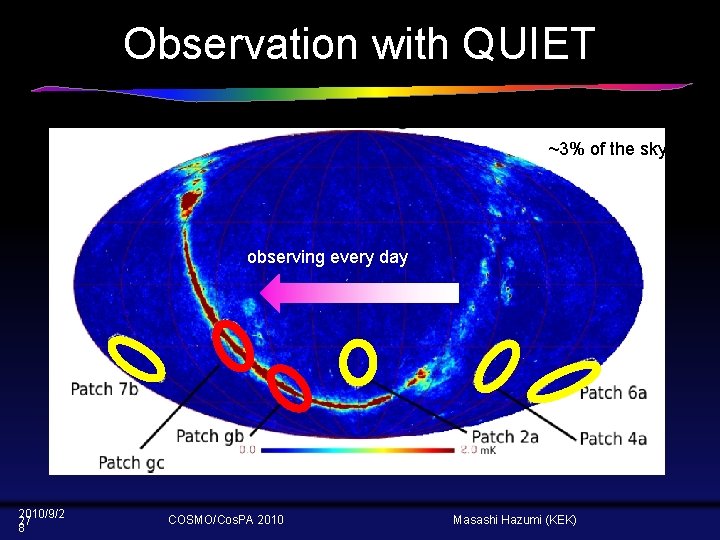
Observation with QUIET ~3% of the sky observing every day 2010/9/2 27 8 COSMO/Cos. PA 2010 Masashi Hazumi (KEK)
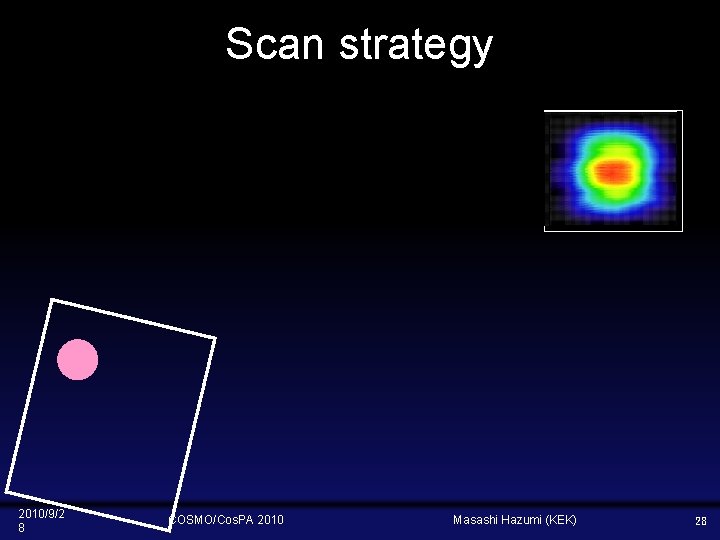
Scan strategy 2010/9/2 8 COSMO/Cos. PA 2010 Masashi Hazumi (KEK) 28
2010/9/2 8 COSMO/Cos. PA 2010 Masashi Hazumi (KEK) 29
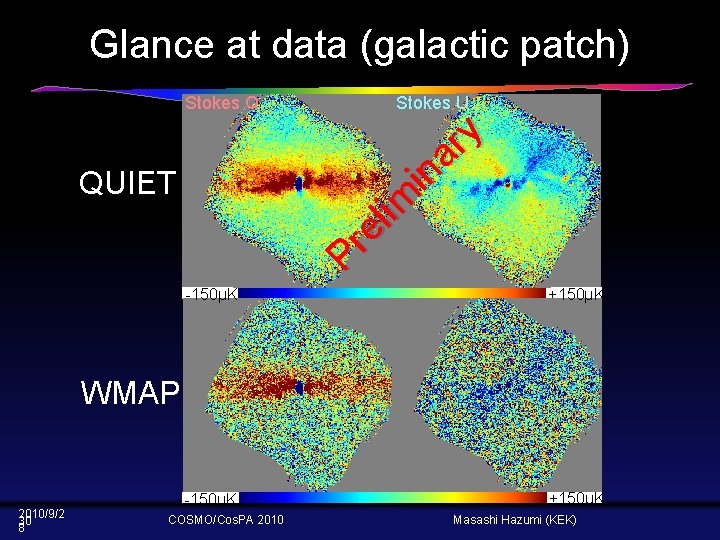
Glance at data (galactic patch) Stokes U Pr el im in ar y Stokes Q QUIET -150μK +150μK WMAP 2010/9/2 30 8 COSMO/Cos. PA 2010 Masashi Hazumi (KEK)
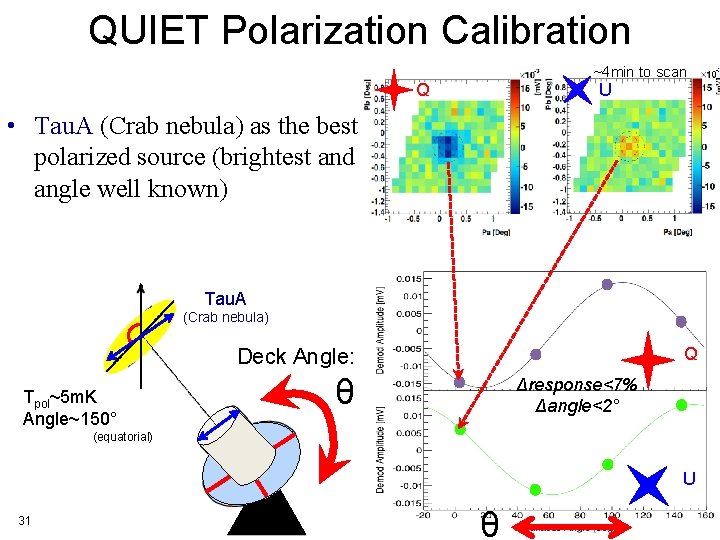
QUIET Polarization Calibration ~4 min to scan U Q • Tau. A (Crab nebula) as the best polarized source (brightest and angle well known) Tau. A (Crab nebula) Q Deck Angle: Tpol~5 m. K Angle~150° θ Δresponse<7% Δangle<2° (equatorial) U 31 θ
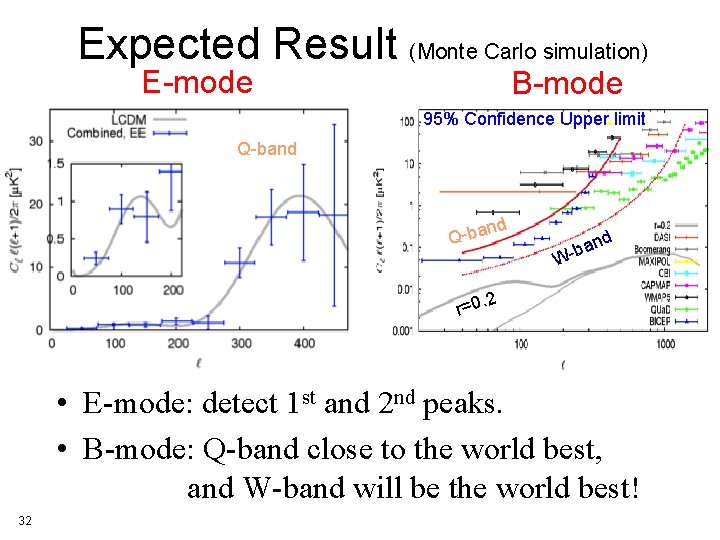
Expected Result (Monte Carlo simulation) E-mode B-mode 95% Confidence Upper limit Q-band d n Q-ba nd ba W- 2 r=0. • E-mode: detect 1 st and 2 nd peaks. • B-mode: Q-band close to the world best, and W-band will be the world best! 32
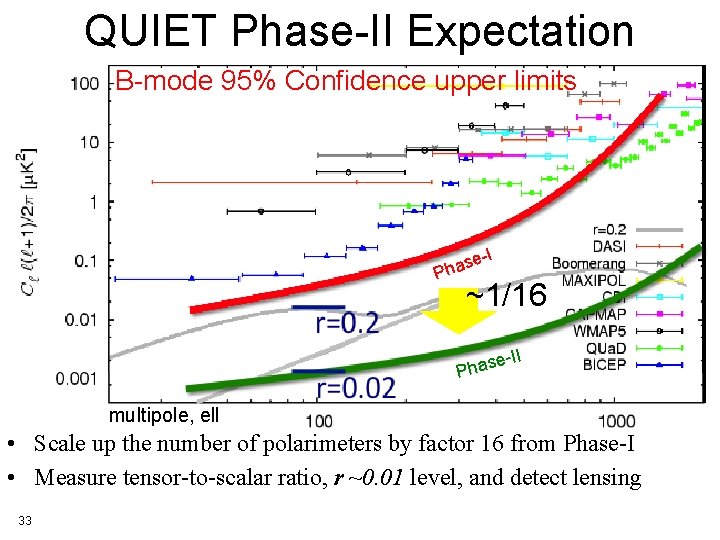
QUIET Phase-II Expectation B-mode 95% Confidence upper limits -I se a h P ~1/16 -II e Phas multipole, ell • Scale up the number of polarimeters by factor 16 from Phase-I • Measure tensor-to-scalar ratio, r ~0. 01 level, and detect lensing 33
POLARBEAR collaboration University of California at Berkeley Kam Arnold Daniel Flannigan Wlliam Holzapfel Jacob Howard Zigmund Kermish Adrian Lee, P. I. Marius Lungu Xiaofan Meng Mike Myers Roger O'Brient Erin Quealy Christian Reichardt Paul Richards Chase Shimmin Bryan Steinbach Aritoki Suzuki Oliver 2010/9/2 Zahn 8 Lawrence Berkeley National Lab Julian Borrill Christopher Cantalupo Theodore Kisner Eric Linder Helmuth Spieler University of Colorado at Boulder Aubra Anthony Nils Halverson Laboratoire Astroparticule & Cosmologie Josquin Errard Radek Stompor COSMO/Cos. PA 2010 KEK University of California at San Diego David Boettger Brian Keating George Fuller Nathan Miller Hans Paar Ian Schanning Meir Shimon Masashi Hazumi Tomo Matsumura Haruki Nishino Akie Shimizu Takayuki Tomaru Mc. Gill University Peter Hyland Matt Dobbs Imperial College Cardiff University Andrew Jaffe Daniel O’Dea Peter Ade Carole Tucker Masashi Hazumi (KEK) 34
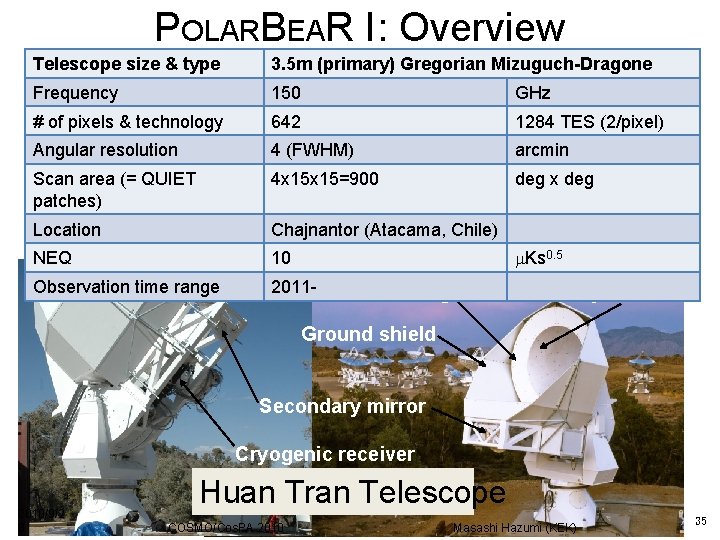
POLARBEAR I: Overview Telescope size & type 3. 5 m (primary) Gregorian Mizuguch-Dragone Frequency 150 GHz # of pixels & technology 642 1284 TES (2/pixel) Angular resolution 4 (FWHM) arcmin Scan area (= QUIET patches) 4 x 15=900 deg x deg Location Chajnantor (Atacama, Chile) NEQ 10 Observation time range 2011 - m. Ks 0. 5 Primary mirror Guard ring Ground shield Secondary mirror Cryogenic receiver 2010/9/2 8 Huan Tran Telescope COSMO/Cos. PA 2010 Masashi Hazumi (KEK) 35
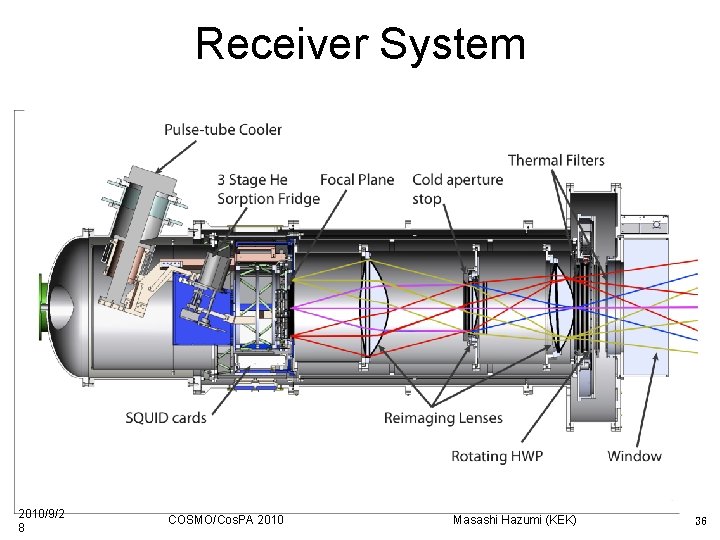
Receiver System 2010/9/2 8 COSMO/Cos. PA 2010 Masashi Hazumi (KEK) 36
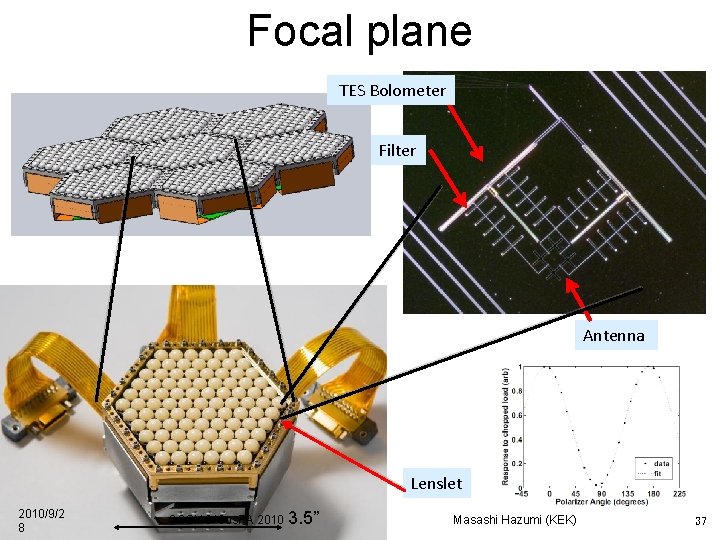
Focal plane TES Bolometer Filter 8 cm Antenna Lenslet 2010/9/2 8 COSMO/Cos. PA 2010 3. 5” Masashi Hazumi (KEK) 37
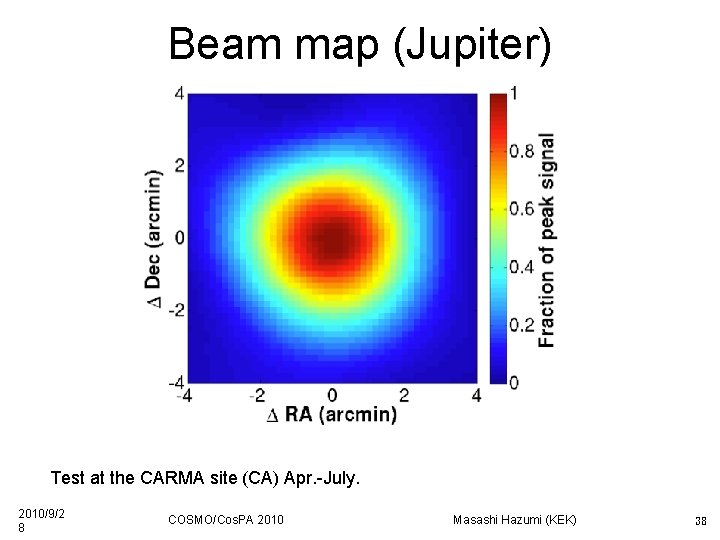
Beam map (Jupiter) Test at the CARMA site (CA) Apr. -July. 2010/9/2 8 COSMO/Cos. PA 2010 Masashi Hazumi (KEK) 38
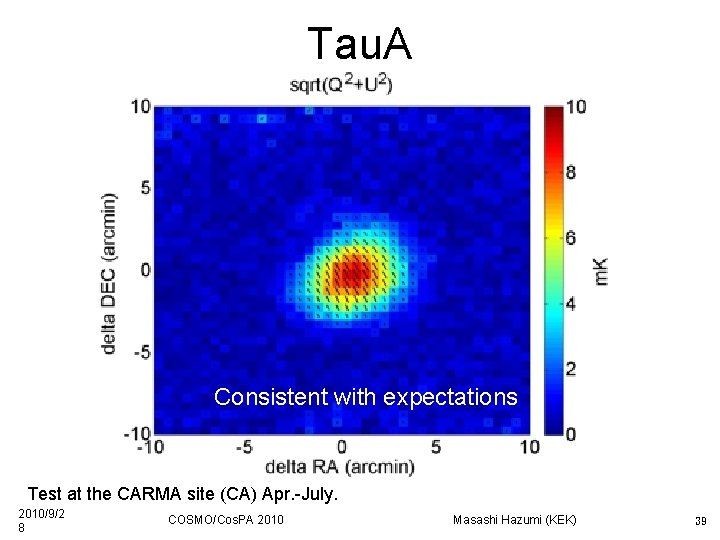
Tau. A Consistent with expectations Test at the CARMA site (CA) Apr. -July. 2010/9/2 8 COSMO/Cos. PA 2010 Masashi Hazumi (KEK) 39
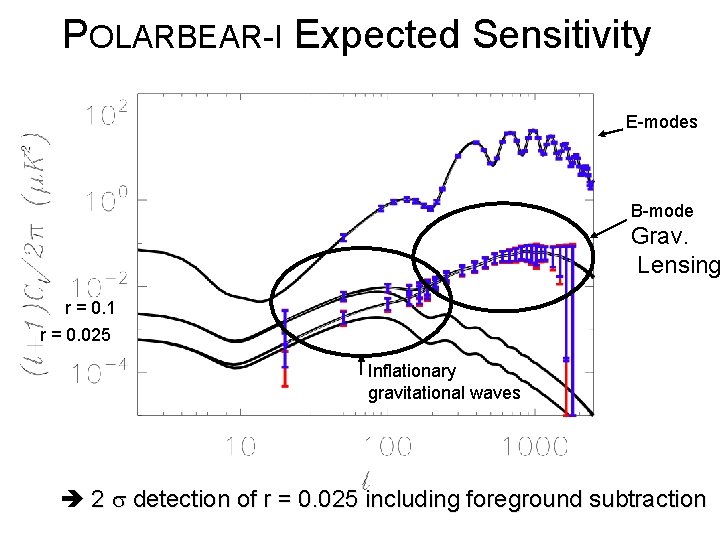
POLARBEAR-I Expected Sensitivity E-modes B-mode Grav. Lensing r = 0. 1 r = 0. 025 Inflationary gravitational waves 2 s detection of r = 0. 025 including foreground subtraction
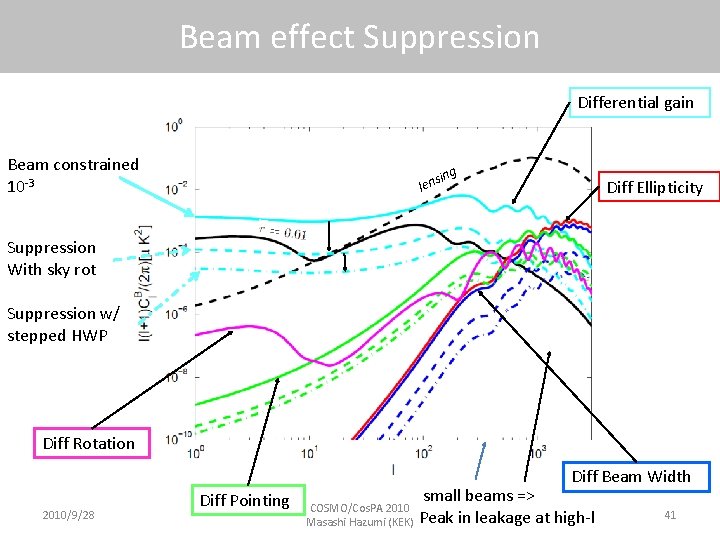
Beam effect Suppression Differential gain Beam constrained 10 -3 g sin len Diff Ellipticity Suppression With sky rot Suppression w/ stepped HWP Diff Rotation Diff Beam Width 2010/9/28 Diff Pointing COSMO/Cos. PA 2010 Masashi Hazumi (KEK) small beams => Peak in leakage at high-l 41
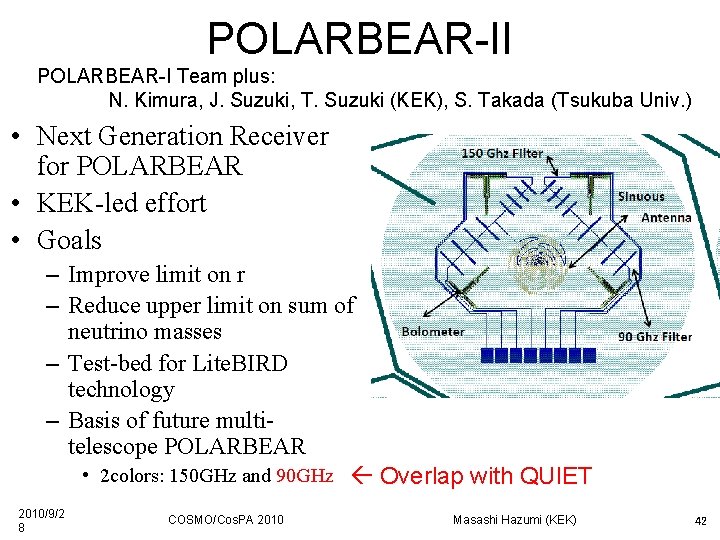
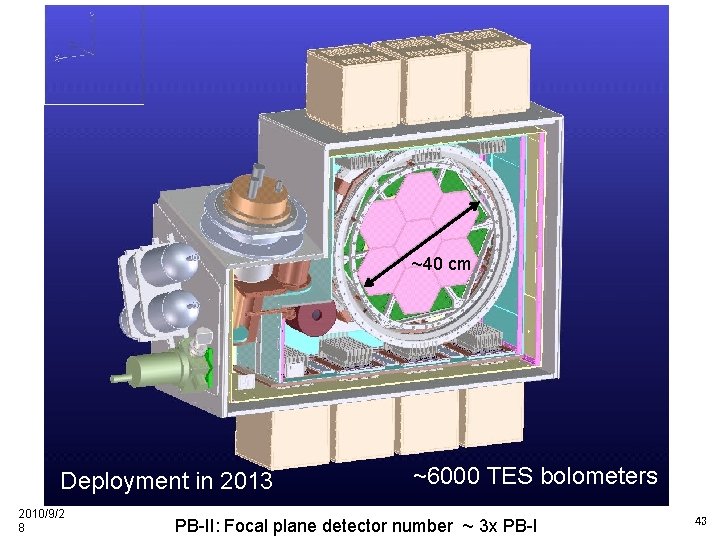
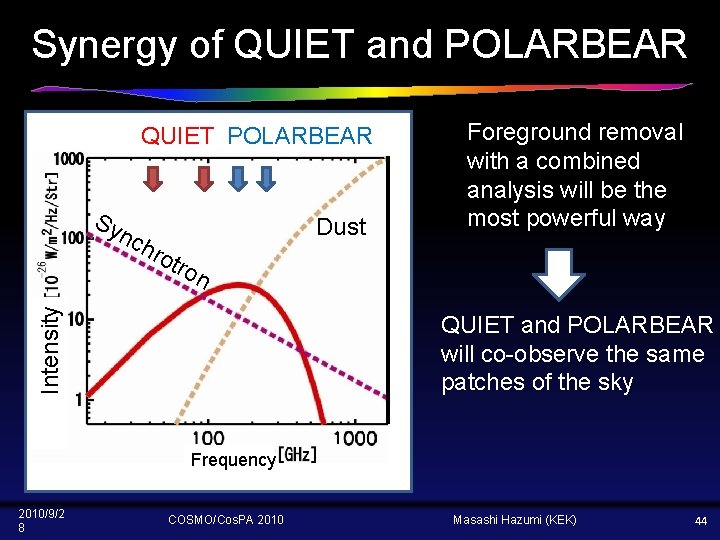
POLARBEAR-II POLARBEAR-I Team plus: N. Kimura, J. Suzuki, T. Suzuki (KEK), S. Takada (Tsukuba Univ. ) • Next Generation Receiver for POLARBEAR • KEK-led effort • Goals – Improve limit on r – Reduce upper limit on sum of neutrino masses – Test-bed for Lite. BIRD technology – Basis of future multitelescope POLARBEAR • 2 colors: 150 GHz and 90 GHz Overlap with QUIET 2010/9/2 8 COSMO/Cos. PA 2010 Masashi Hazumi (KEK) 42
~40 cm Deployment in 2013 2010/9/2 8 ~6000 TES bolometers PB-II: Focal plane detector number ~ 3 x PB-I 43
Synergy of QUIET and POLARBEAR QUIET POLARBEAR Sy nc Dust hro Foreground removal with a combined analysis will be the most powerful way Intensity tro n QUIET and POLARBEAR will co-observe the same patches of the sky Frequency 2010/9/2 8 COSMO/Cos. PA 2010 Masashi Hazumi (KEK) 44
4. Future small satellite Lite. BIRD 2010/9/2 8 COSMO/Cos. PA 2010 Masashi Hazumi (KEK) 45
CMB satellite COBE (1989 -1993) WMAP (2001-) Temperature is the main target Planck (2009-) Polarization is the main target (~2020-) 2010/9/2 8 COSMO/Cos. PA 2010 EPIC(US):Medium B-Pol(Europe):Small Lite. BIRD (Japan/US):Small Masashi Hazumi (KEK) 46
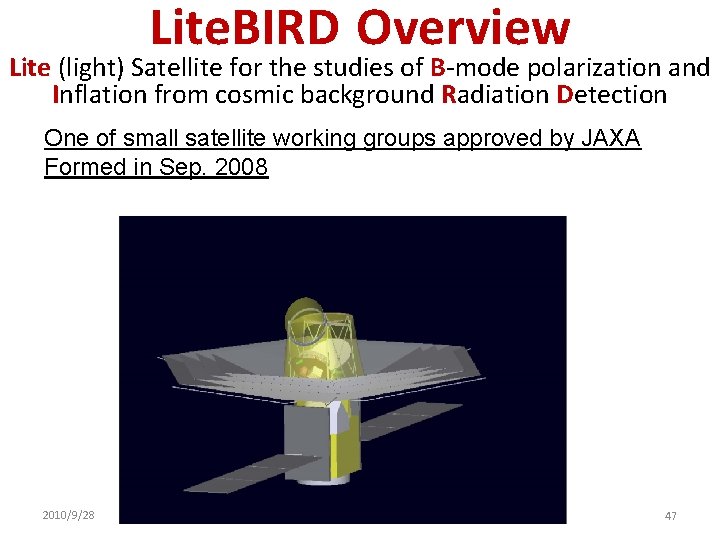
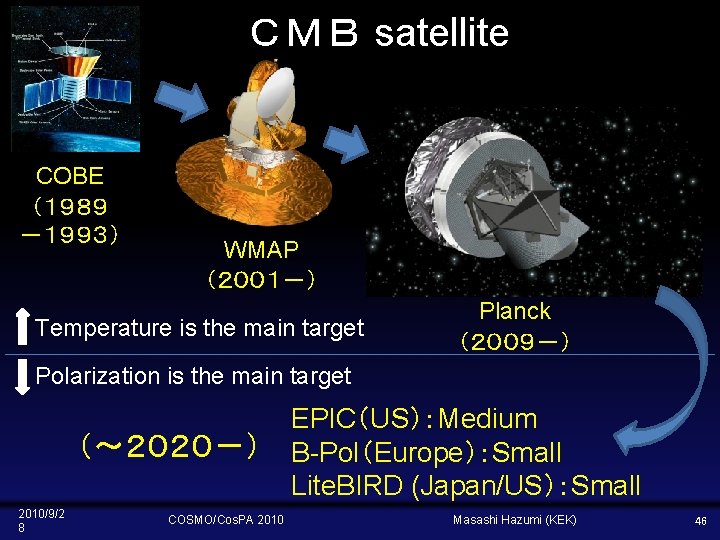
Lite. BIRD Overview Lite (light) Satellite for the studies of B-mode polarization and Inflation from cosmic background Radiation Detection One of small satellite working groups approved by JAXA Formed in Sep. 2008 2010/9/28 COSMO/Cos. PA 2010 Masashi Hazumi (KEK) 47
Lite. BIRD Working Group Y. Sato, K. Shinozaki, H. Sugita (ARD/JAXA) • • H. Fuke, H. Matsuhara, K. Mitsuda, T. Yoshida (ISAS/JAXA) • K. Ishidoshiro, N. Katayama, M. Kimura, M. Nagai, R. Nagata, N. Sato, K. Sumisawa, T. Suzuki, O. Tajima, T. Tomaru, M. Hazumi [PI], M. Hasegawa. T. Higuchi, T. Matsumura, H. Nishino, M. Yoshida (KEK) • I. Ohta (Kinki U. ) • Y. Uzawa, Y. Sekimoto, T. Noguchi (NAOJ) Some are • J. Borrill (LBNL) • H. Ishino, A. Kibayashi, K. Hattori, S. Mima, T. Misawa (Okayama U. ) members of: ALMA • T. Ohtani (Riken) APEX • E. Yaginuma (SOKENDAI) BICEP • Y. Chinone, M. Hattori (Tohoku U. ) EBEX • T. Takada (U. Tsukuba) Planck • A. Ghribi, W. L. Holzapfel, B. R. Johnson, A. T. Lee, POLARBEAR P. L. Richards, H. T. Tran, A. Suzuki (UC Berkeley) QUIET • E. Komatsu (UT Austin) SPT Consultants WMAP • H. Kodama (KEK), T. Nakagawa (JAXA), Y. Kawabe (NAOJ) Cryogenic expertise from X-ray group (DIOS) and IR group (SPICA) “Technology alliance” COSMO/Cos. PA 2010/9/28 48 Masashi Hazumi (KEK) CMBワークショップ 国立天文台 2010年6月7、8、9日
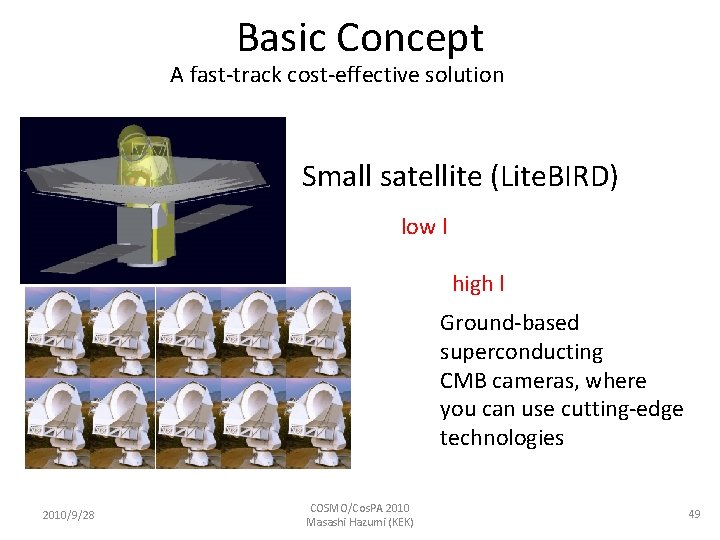
Basic Concept A fast-track cost-effective solution Small satellite (Lite. BIRD) low l high l Ground-based superconducting CMB cameras, where you can use cutting-edge technologies 2010/9/28 COSMO/Cos. PA 2010 Masashi Hazumi (KEK) 49
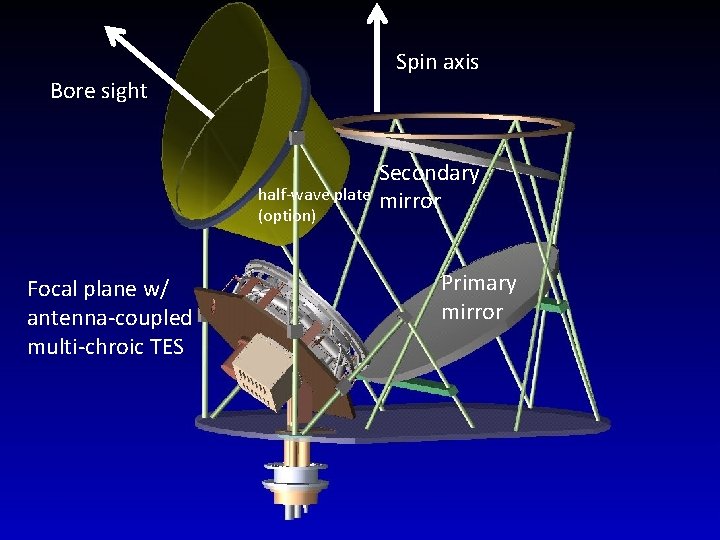
Spin axis Bore sight half-wave plate (option) Secondary mirror Primary mirror Focal plane w/ antenna-coupled multi-chroic TES 2010/9/28 COSMO/Cos. PA 2010 Masashi Hazumi (KEK) 50
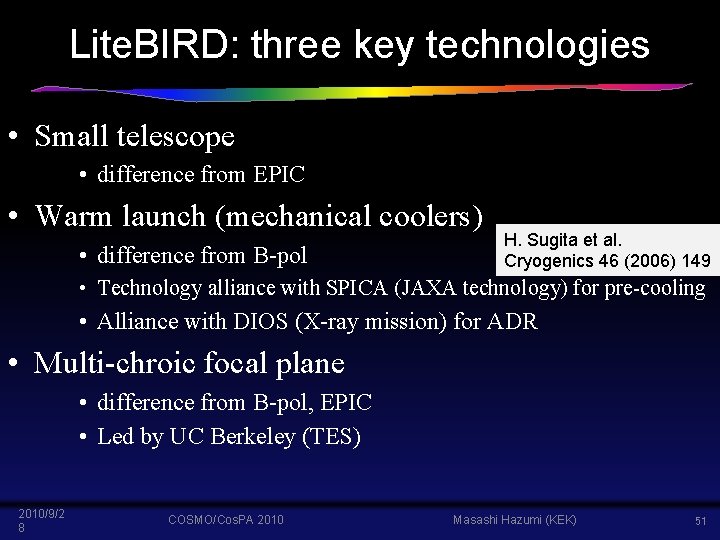
Lite. BIRD: three key technologies • Small telescope • difference from EPIC • Warm launch (mechanical coolers) • difference from B-pol H. Sugita et al. Cryogenics 46 (2006) 149 • Technology alliance with SPICA (JAXA technology) for pre-cooling • Alliance with DIOS (X-ray mission) for ADR • Multi-chroic focal plane • difference from B-pol, EPIC • Led by UC Berkeley (TES) 2010/9/2 8 COSMO/Cos. PA 2010 Masashi Hazumi (KEK) 51
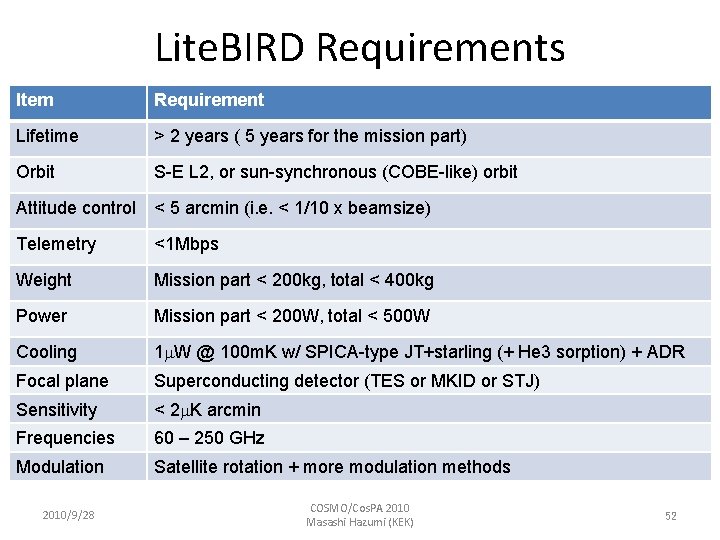
Lite. BIRD Requirements Item Requirement Lifetime > 2 years ( 5 years for the mission part) Orbit S-E L 2, or sun-synchronous (COBE-like) orbit Attitude control < 5 arcmin (i. e. < 1/10 x beamsize) Telemetry <1 Mbps Weight Mission part < 200 kg, total < 400 kg Power Mission part < 200 W, total < 500 W Cooling 1 m. W @ 100 m. K w/ SPICA-type JT+starling (+ He 3 sorption) + ADR Focal plane Superconducting detector (TES or MKID or STJ) Sensitivity < 2 m. K arcmin Frequencies 60 – 250 GHz Modulation Satellite rotation + more modulation methods 2010/9/28 COSMO/Cos. PA 2010 52 Masashi Hazumi (KEK) 日本物理学会 2010年3月20日、岡山大学
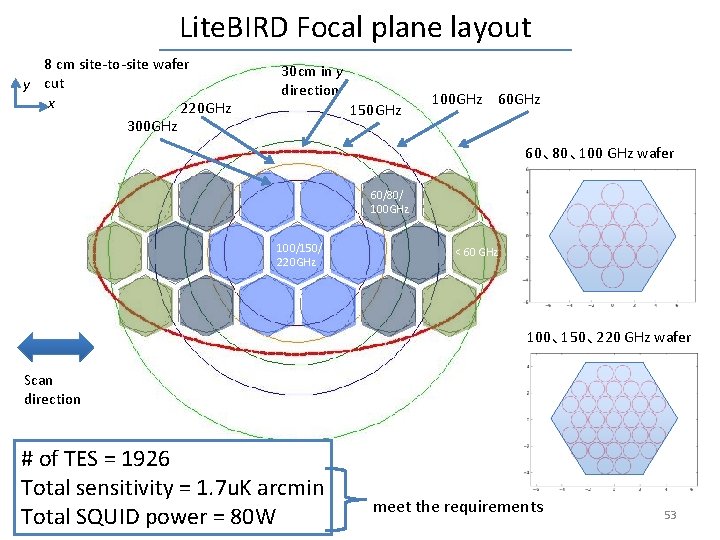
Lite. BIRD Focal plane layout 8 cm site-to-site wafer y cut x 220 GHz 30 cm in y direction 150 GHz 100 GHz 60、80、100 GHz wafer 60/80/ 100 GHz 100/150/ 220 GHz < 60 GHz 100、150、220 GHz wafer Scan direction # of TES = 1926 Total sensitivity = 1. 7 u. K arcmin Total SQUID power = 80 W meet the requirements 53
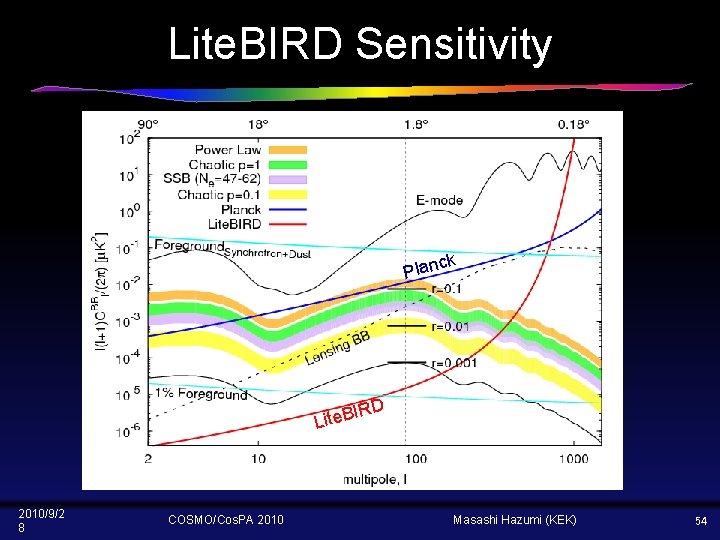
Lite. BIRD Sensitivity ck Plan RD I Lite. B 2010/9/2 8 COSMO/Cos. PA 2010 Masashi Hazumi (KEK) 54
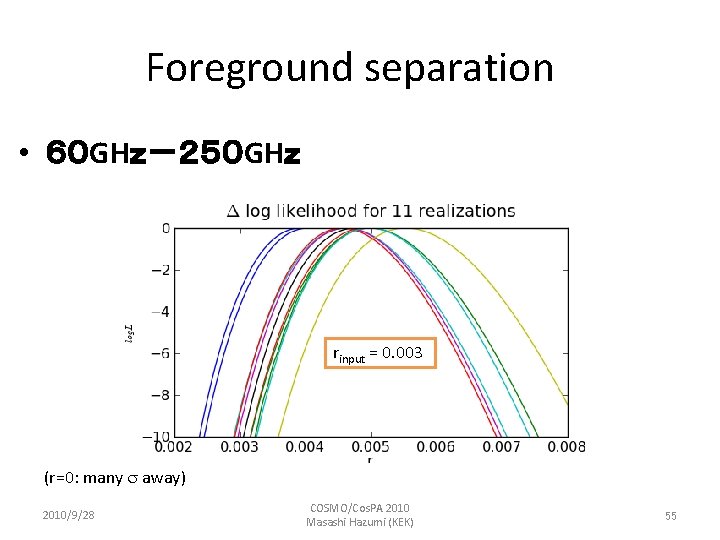
Foreground separation • 60 GHz-250 GHz rinput = 0. 003 (r=0: many s away) 2010/9/28 COSMO/Cos. PA 2010 Masashi Hazumi (KEK) 55
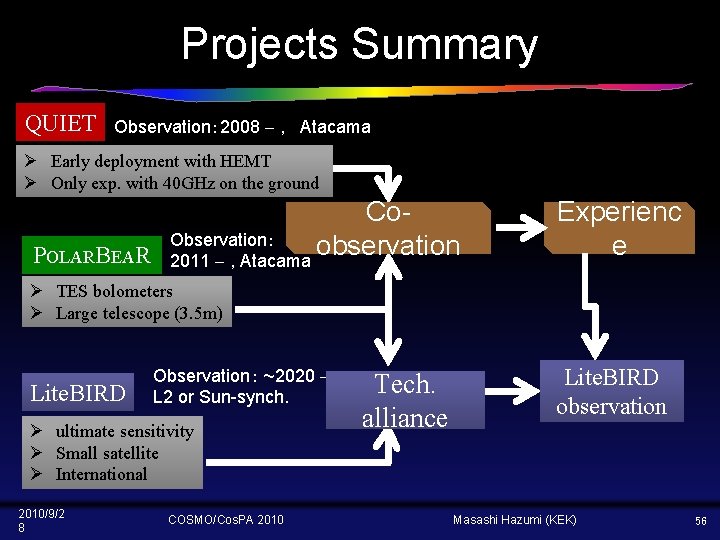
Projects Summary QUIET Observation: 2008 , Atacama Ø Early deployment with HEMT Ø Only exp. with 40 GHz on the ground Co. Observation: POLARBEAR 2011 , Atacama observation Experienc e Ø TES bolometers Ø Large telescope (3. 5 m) Lite. BIRD Observation: ~2020 L 2 or Sun-synch. Ø ultimate sensitivity Ø Small satellite Ø International 2010/9/2 8 COSMO/Cos. PA 2010 Tech. alliance Lite. BIRD observation Masashi Hazumi (KEK) 56
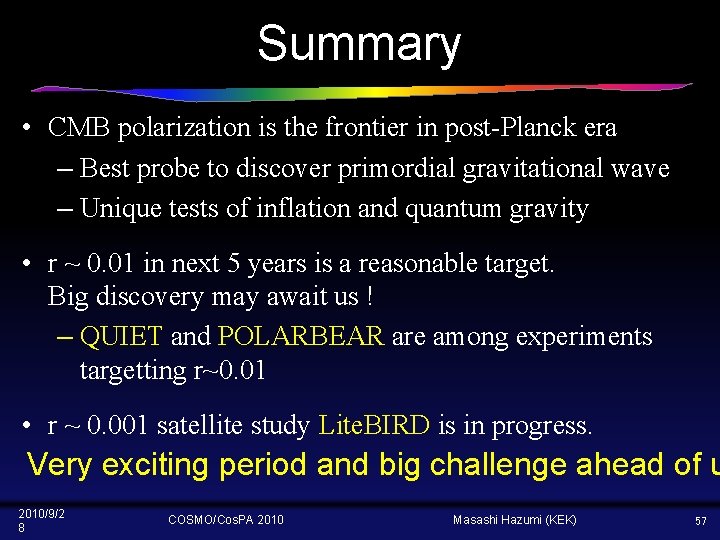
Summary • CMB polarization is the frontier in post-Planck era – Best probe to discover primordial gravitational wave – Unique tests of inflation and quantum gravity • r ~ 0. 01 in next 5 years is a reasonable target. Big discovery may await us ! – QUIET and POLARBEAR are among experiments targetting r~0. 01 • r ~ 0. 001 satellite study Lite. BIRD is in progress. Very exciting period and big challenge ahead of u 2010/9/2 8 COSMO/Cos. PA 2010 Masashi Hazumi (KEK) 57
- Slides: 57