
Probing Dark Energy Josh Frieman SUSY 2005 Durham
Probing Dark Energy Josh Frieman SUSY 2005, Durham, UK July 19, 2005 SUSY 05
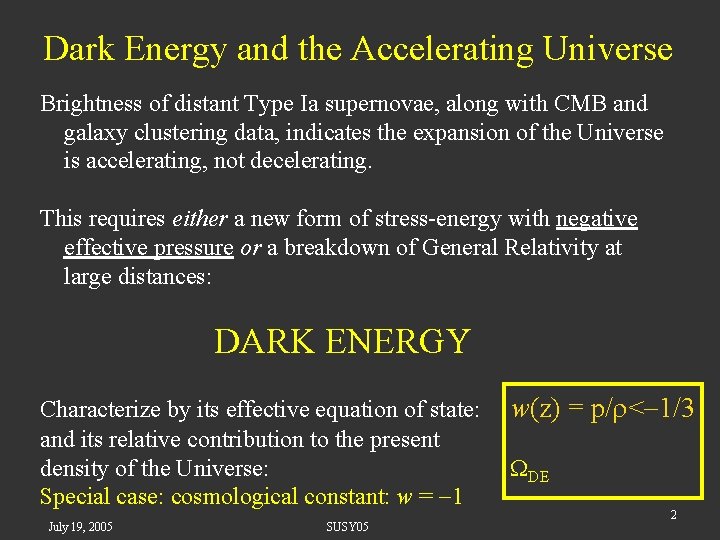
Dark Energy and the Accelerating Universe Brightness of distant Type Ia supernovae, along with CMB and galaxy clustering data, indicates the expansion of the Universe is accelerating, not decelerating. This requires either a new form of stress-energy with negative effective pressure or a breakdown of General Relativity at large distances: DARK ENERGY Characterize by its effective equation of state: and its relative contribution to the present density of the Universe: Special case: cosmological constant: w = 1 July 19, 2005 SUSY 05 w(z) = p/ < 1/3 DE 2
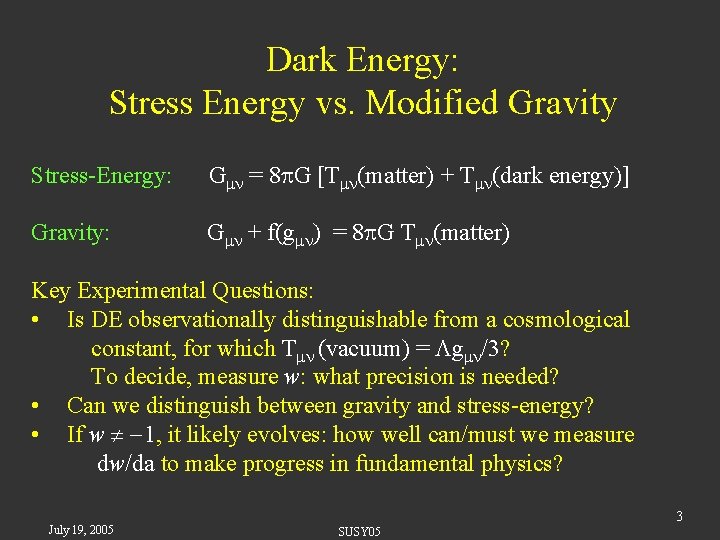
Dark Energy: Stress Energy vs. Modified Gravity Stress-Energy: G = 8 G [T (matter) + T (dark energy)] Gravity: G + f(g ) = 8 G T (matter) Key Experimental Questions: • Is DE observationally distinguishable from a cosmological constant, for which T (vacuum) = g /3? To decide, measure w: what precision is needed? • Can we distinguish between gravity and stress-energy? • If w 1, it likely evolves: how well can/must we measure dw/da to make progress in fundamental physics? July 19, 2005 3 SUSY 05
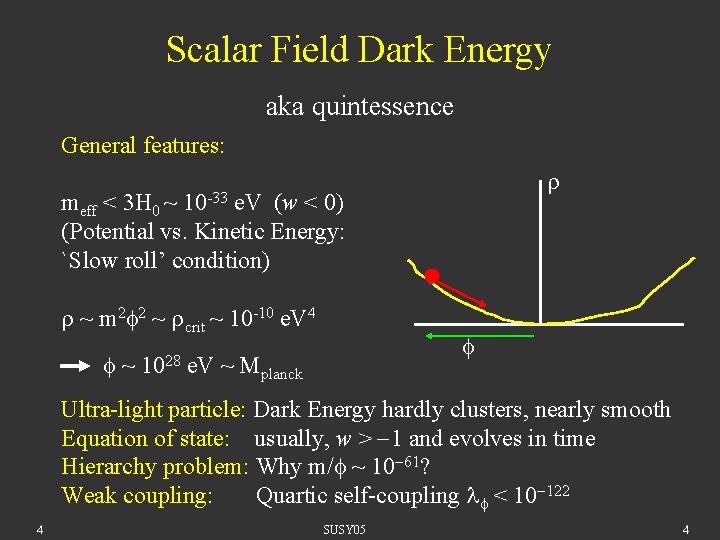
Scalar Field Dark Energy aka quintessence General features: 10 -33 meff < 3 H 0 ~ e. V (w < 0) (Potential vs. Kinetic Energy: `Slow roll’ condition) ~ m 2 2 ~ crit ~ 10 -10 e. V 4 ~ 1028 e. V ~ Mplanck Ultra-light particle: Dark Energy hardly clusters, nearly smooth Equation of state: usually, w > 1 and evolves in time Hierarchy problem: Why m/ ~ 10 61? Weak coupling: Quartic self-coupling < 10 122 4 SUSY 05 4
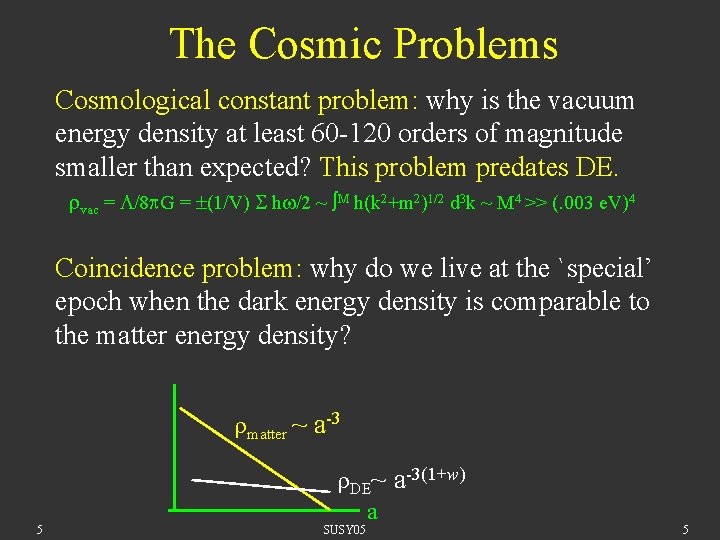
The Cosmic Problems Cosmological constant problem: why is the vacuum energy density at least 60 -120 orders of magnitude smaller than expected? This problem predates DE. vac = /8 G = (1/V) h /2 ~ M h(k 2+m 2)1/2 d 3 k ~ M 4 >> (. 003 e. V)4 Coincidence problem: why do we live at the `special’ epoch when the dark energy density is comparable to the matter energy density? matter ~ a-3 5 DE~ a-3(1+w) a SUSY 05 5
Dark Energy & Inflation Imagine you were living ~ 1 Hubble time after the onset of primordial inflation, at t ~ 10 -35 sec (How) would you worry about the coincidence problem? Inflation suggests existence of a new mass scale MGUT ~ 1015 Ge. V where we expected new physics of Unification, addresses early U. coincidence problem. Does Dark Energy indicate a new mass scale in physics? MVAC ~ 10 -3 e. V Alternative: it’s dynamics, not mass scale. 6 SUSY 05 6
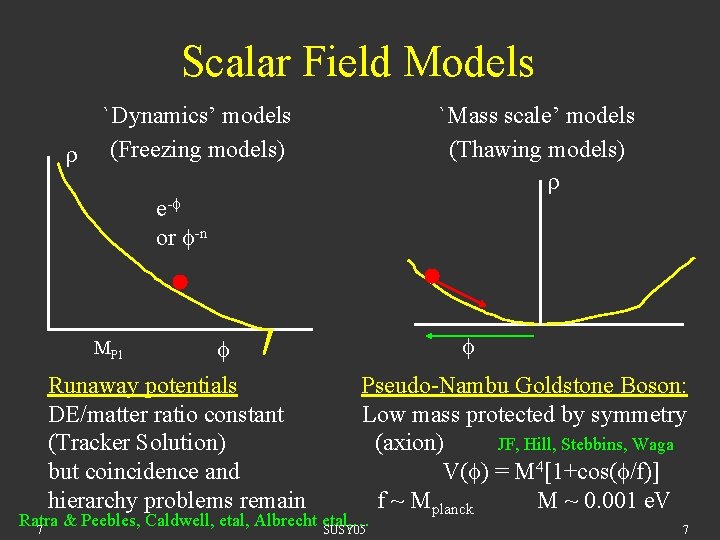
Scalar Field Models `Dynamics’ models (Freezing models) `Mass scale’ models (Thawing models) e- or -n Runaway potentials DE/matter ratio constant (Tracker Solution) but coincidence and hierarchy problems remain MPl Pseudo-Nambu Goldstone Boson: Low mass protected by symmetry (axion) JF, Hill, Stebbins, Waga V( ) = M 4[1+cos( /f)] f ~ Mplanck M ~ 0. 001 e. V Ratra & Peebles, Caldwell, etal, Albrecht etal, … 7 SUSY 05 7
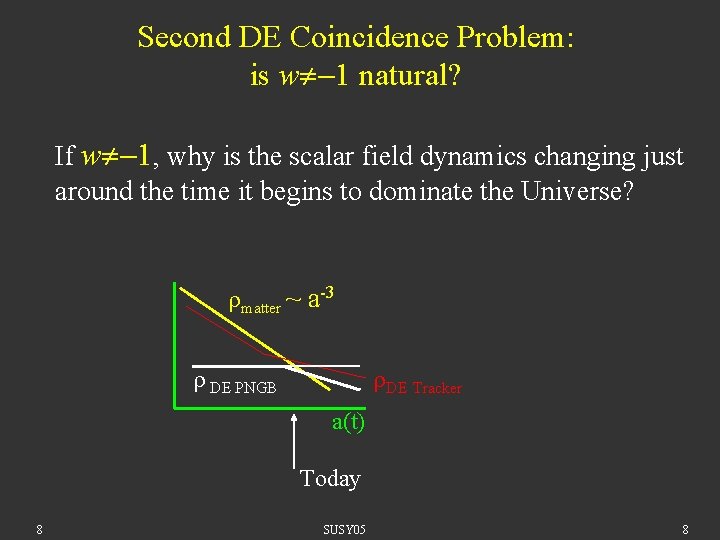
Second DE Coincidence Problem: is w 1 natural? If w 1, why is the scalar field dynamics changing just around the time it begins to dominate the Universe? matter ~ a-3 DE Tracker DE PNGB a(t) Today 8 SUSY 05 8
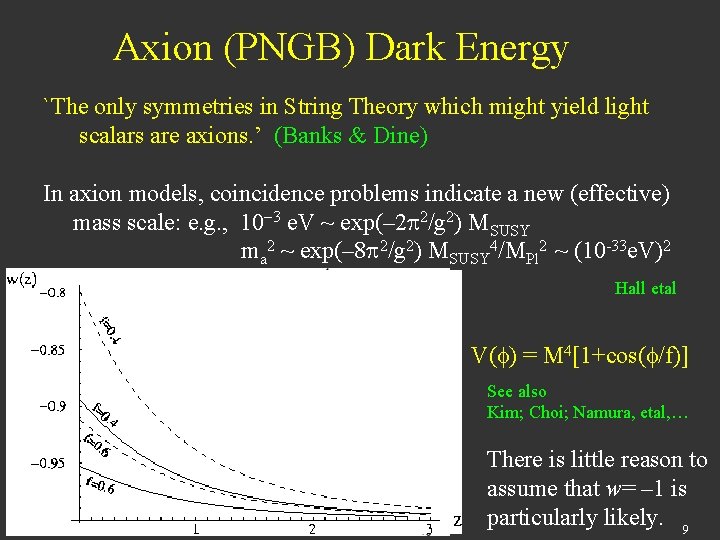
Axion (PNGB) Dark Energy `The only symmetries in String Theory which might yield light scalars are axions. ’ (Banks & Dine) In axion models, coincidence problems indicate a new (effective) mass scale: e. g. , 10 3 e. V ~ exp(– 2 2/g 2) MSUSY ma 2 ~ exp(– 8 2/g 2) MSUSY 4/MPl 2 ~ (10 -33 e. V)2 Hall etal V( ) = M 4[1+cos( /f)] See also Kim; Choi; Namura, etal, … 9 SUSY 05 There is little reason to assume that w= – 1 is particularly likely. 9
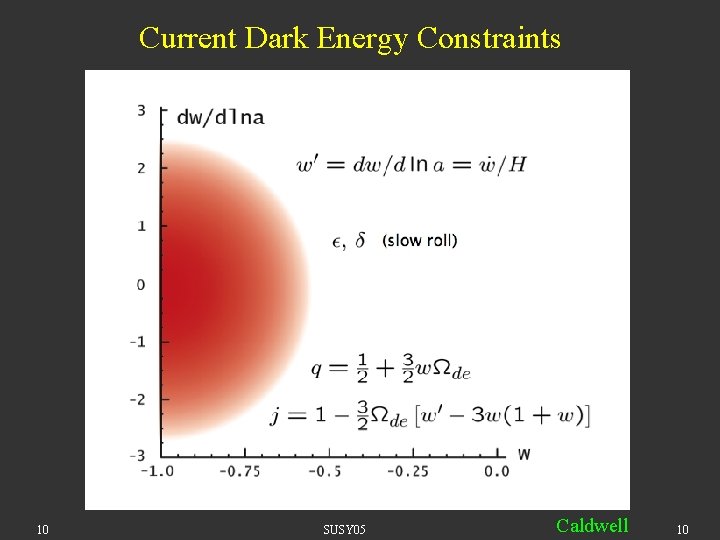
Current Dark Energy Constraints 10 SUSY 05 Caldwell 10
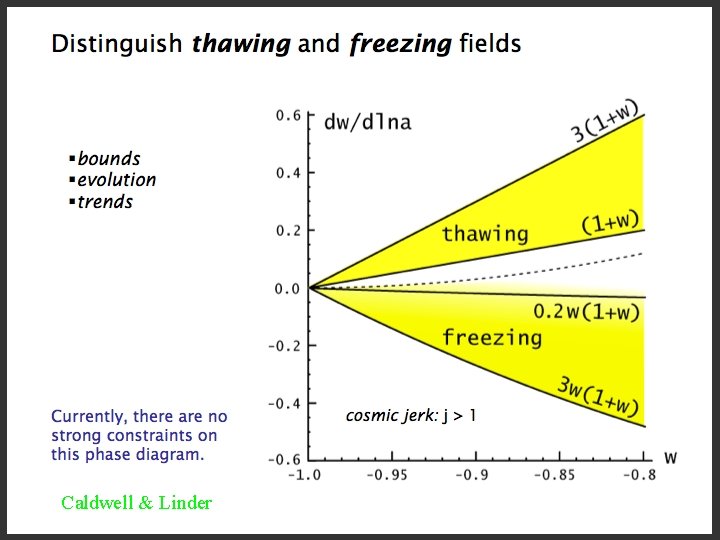
Caldwell & Linder 11 SUSY 05 11
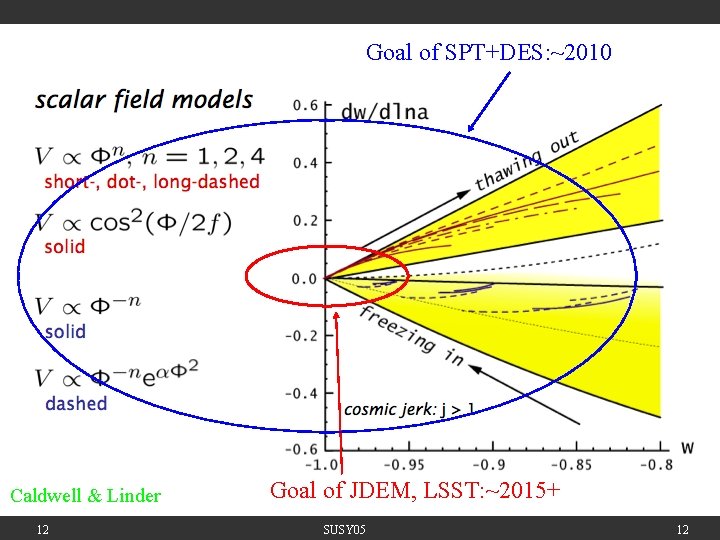
Goal of SPT+DES: ~2010 Caldwell & Linder 12 Goal of JDEM, LSST: ~2015+ SUSY 05 12
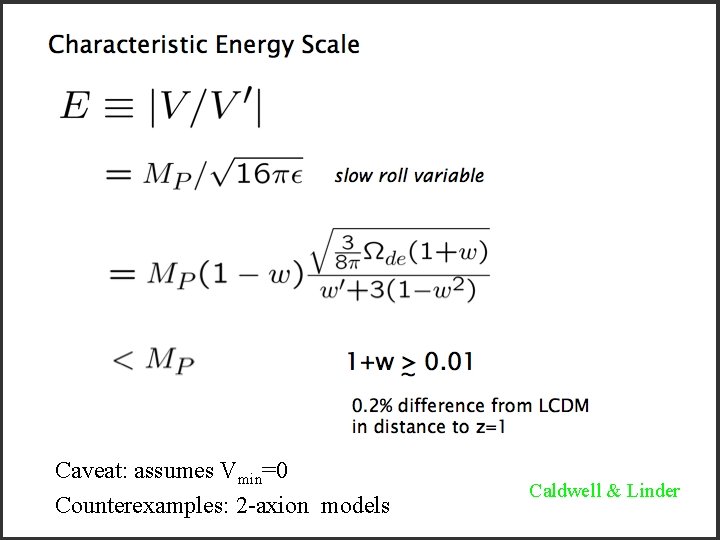
Caveat: assumes Vmin=0 Counterexamples: 2 -axion models 13 SUSY 05 Caldwell & Linder 13
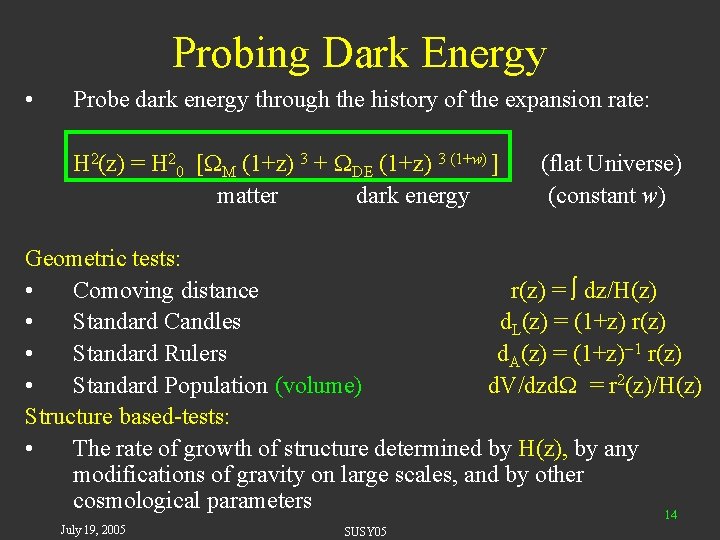
Probing Dark Energy • Probe dark energy through the history of the expansion rate: H 2(z) = H 20 [ M (1+z) 3 + DE (1+z) 3 (1+w) ] matter dark energy (flat Universe) (constant w) Geometric tests: • Comoving distance r(z) = dz/H(z) • Standard Candles d. L(z) = (1+z) r(z) • Standard Rulers d. A(z) = (1+z) 1 r(z) • Standard Population (volume) d. V/dzd = r 2(z)/H(z) Structure based-tests: • The rate of growth of structure determined by H(z), by any modifications of gravity on large scales, and by other cosmological parameters 14 July 19, 2005 SUSY 05
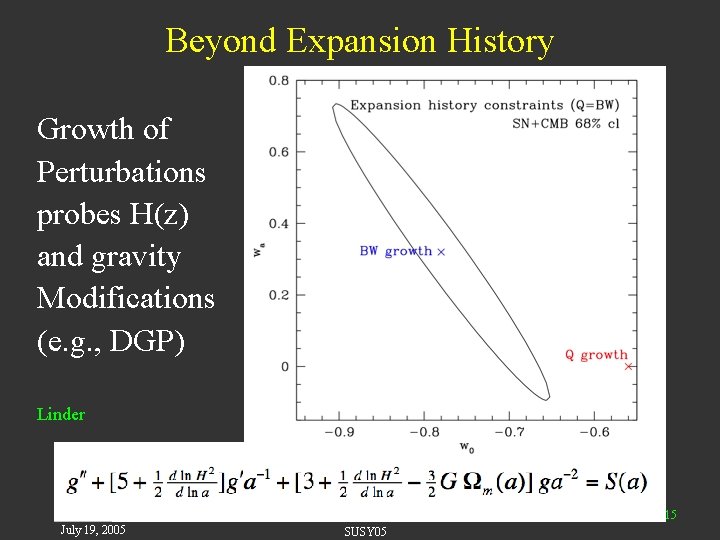
Beyond Expansion History Growth of Perturbations probes H(z) and gravity Modifications (e. g. , DGP) Linder 15 July 19, 2005 SUSY 05
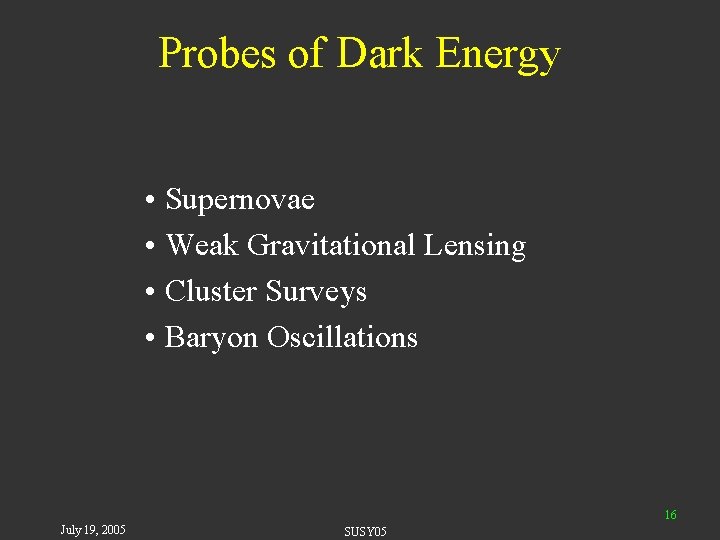
Probes of Dark Energy • Supernovae • Weak Gravitational Lensing • Cluster Surveys • Baryon Oscillations 16 July 19, 2005 SUSY 05
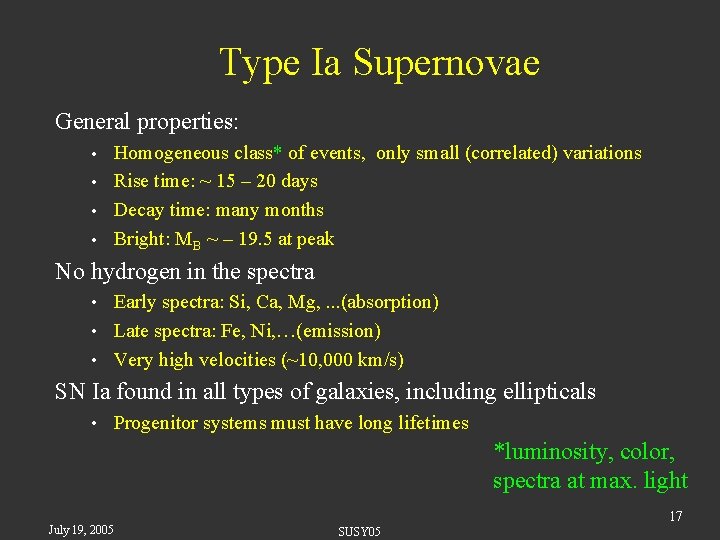
Type Ia Supernovae General properties: Homogeneous class* of events, only small (correlated) variations • Rise time: ~ 15 – 20 days • Decay time: many months • Bright: MB ~ – 19. 5 at peak • No hydrogen in the spectra • Early spectra: Si, Ca, Mg, . . . (absorption) • Late spectra: Fe, Ni, …(emission) • Very high velocities (~10, 000 km/s) SN Ia found in all types of galaxies, including ellipticals • Progenitor systems must have long lifetimes *luminosity, color, spectra at max. light July 19, 2005 17 SUSY 05
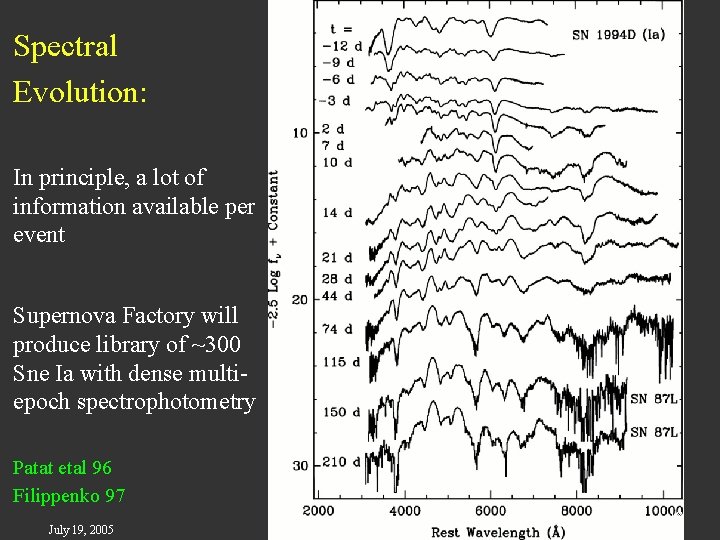
Spectral Evolution: In principle, a lot of information available per event Supernova Factory will produce library of ~300 Sne Ia with dense multiepoch spectrophotometry Patat etal 96 Filippenko 97 July 19, 2005 18 SUSY 05
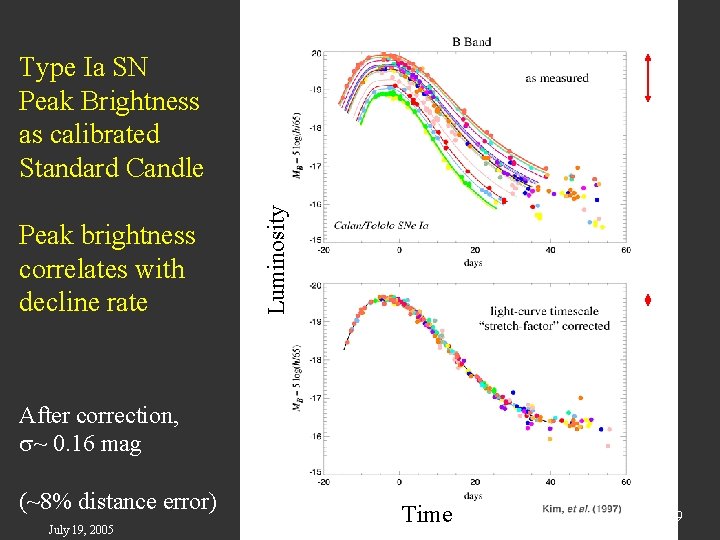
Peak brightness correlates with decline rate Luminosity Type Ia SN Peak Brightness as calibrated Standard Candle After correction, ~ 0. 16 mag (~8% distance error) July 19, 2005 SUSY 05 Time 19
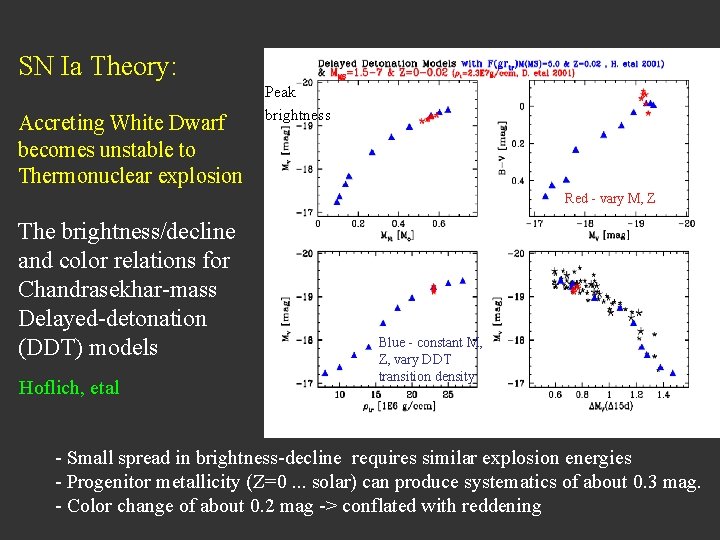
SN Ia Theory: Accreting White Dwarf becomes unstable to Thermonuclear explosion Peak brightness Red - vary M, Z The brightness/decline and color relations for Chandrasekhar-mass Delayed-detonation (DDT) models Hoflich, etal Blue - constant M, Z, vary DDT transition density - Small spread in brightness-decline requires similar explosion energies - Progenitor metallicity (Z=0. . . solar) can produce systematics of about 0. 3 mag. - Color change of about 0. 2 mag -> conflated with reddening
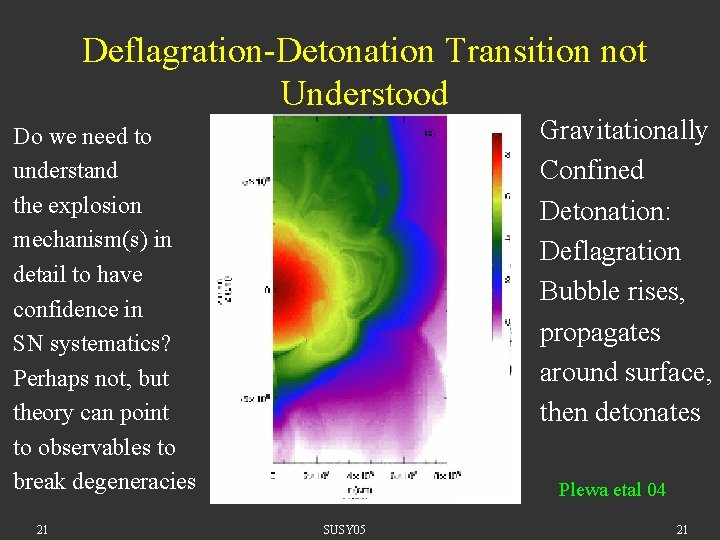
Deflagration-Detonation Transition not Understood Gravitationally Confined Detonation: Deflagration Bubble rises, propagates around surface, then detonates Do we need to understand the explosion mechanism(s) in detail to have confidence in SN systematics? Perhaps not, but theory can point to observables to break degeneracies 21 Plewa etal 04 SUSY 05 21
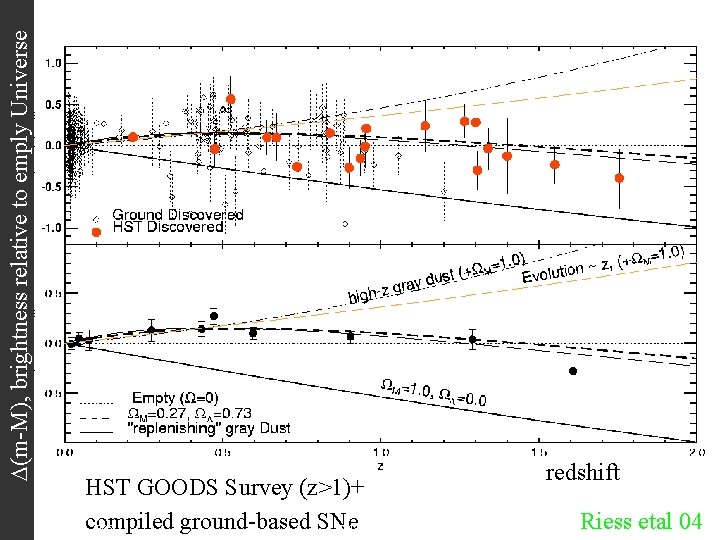
(m-M), brightness relative to emply Universe HST GOODS Survey (z>1)+ ground-based SNe July 19, compiled 2005 SUSY 05 redshift Riess etal 04
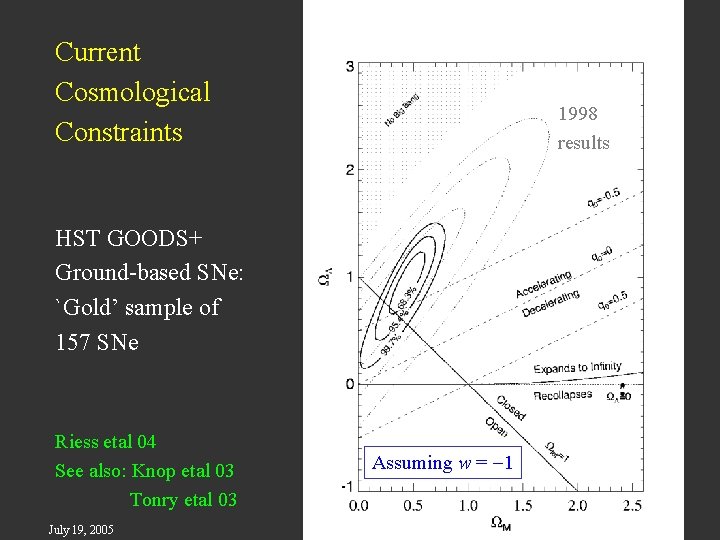
Current Cosmological Constraints 1998 results HST GOODS+ Ground-based SNe: `Gold’ sample of 157 SNe Riess etal 04 See also: Knop etal 03 Tonry etal 03 July 19, 2005 Assuming w = 1 SUSY 05
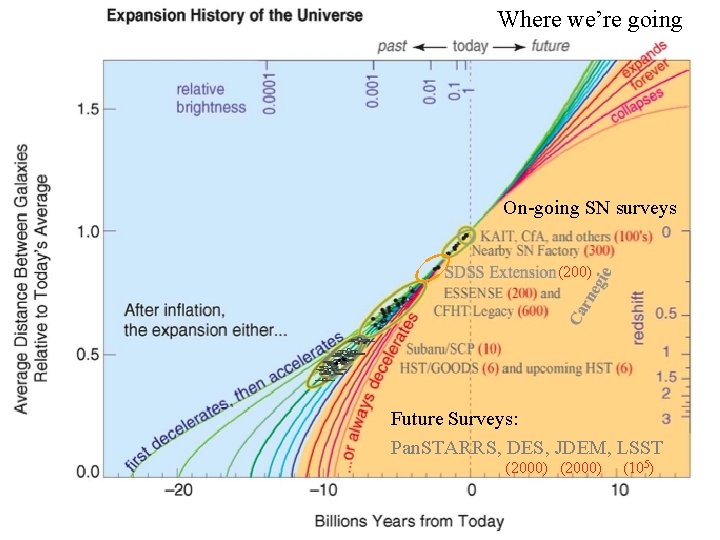
Where we’re going On-going SN surveys (200) Future Surveys: Pan. STARRS, DES, JDEM, LSST (2000) July 19, 2005 (105) 24 SUSY 05
SDSS 2. 5 meter Telescope 25 SUSY 05 25
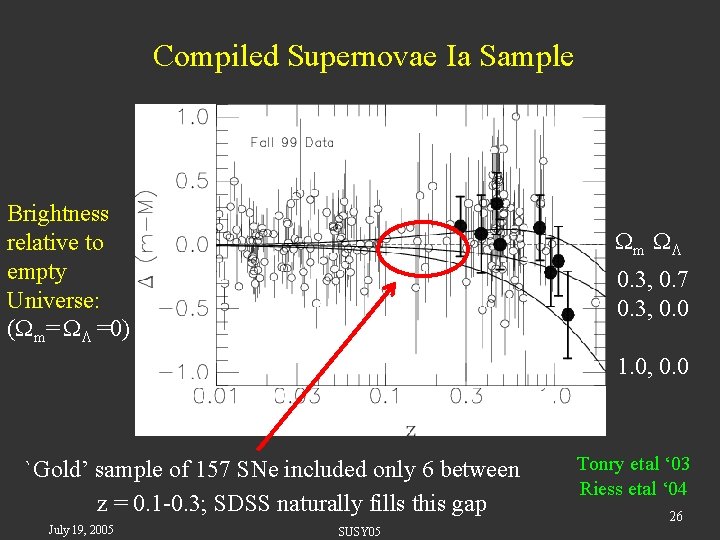
Compiled Supernovae Ia Sample Brightness relative to empty Universe: ( m= =0) m 0. 3, 0. 7 0. 3, 0. 0 1. 0, 0. 0 `Gold’ sample of 157 SNe included only 6 between z = 0. 1 -0. 3; SDSS naturally fills this gap July 19, 2005 SUSY 05 Tonry etal ‘ 03 Riess etal ‘ 04 26
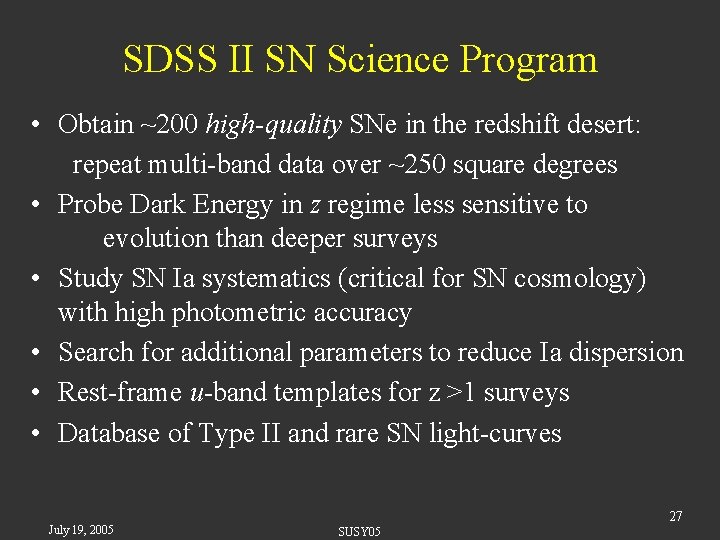
SDSS II SN Science Program • Obtain ~200 high-quality SNe in the redshift desert: repeat multi-band data over ~250 square degrees • Probe Dark Energy in z regime less sensitive to evolution than deeper surveys • Study SN Ia systematics (critical for SN cosmology) with high photometric accuracy • Search for additional parameters to reduce Ia dispersion • Rest-frame u-band templates for z >1 surveys • Database of Type II and rare SN light-curves July 19, 2005 27 SUSY 05

Need Broad Redshift Coverage to Break Degeneracies Loci of constant Luminosity Distance DL at fixed z Flat Universe z= July 19, 2005 SUSY 05
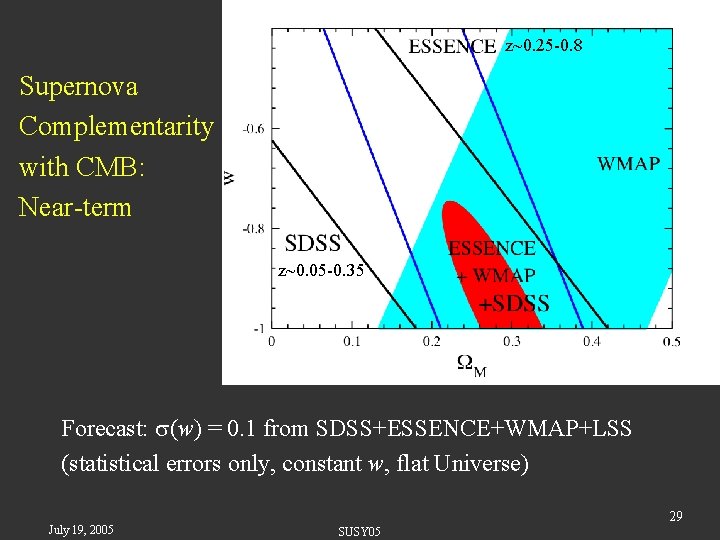
z~0. 25 -0. 8 Supernova Complementarity with CMB: Near-term z~0. 05 -0. 35 Forecast: (w) = 0. 1 from SDSS+ESSENCE+WMAP+LSS (statistical errors only, constant w, flat Universe) July 19, 2005 29 SUSY 05
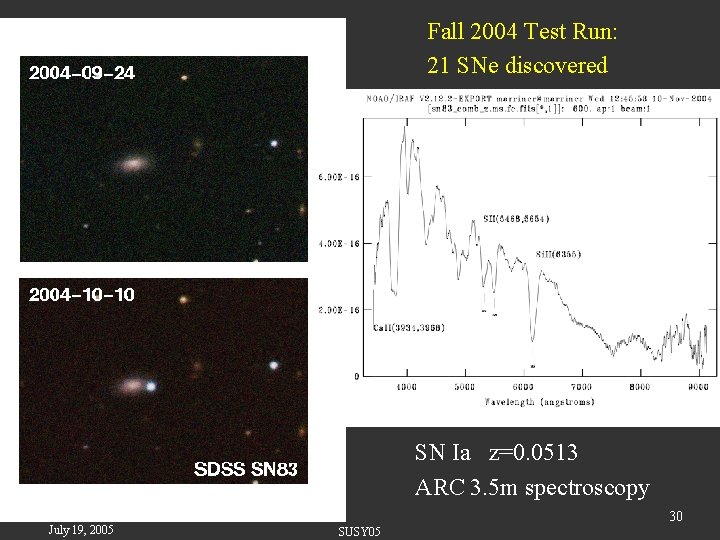
Fall 2004 Test Run: 21 SNe discovered SN Ia z=0. 0513 ARC 3. 5 m spectroscopy July 19, 2005 30 SUSY 05
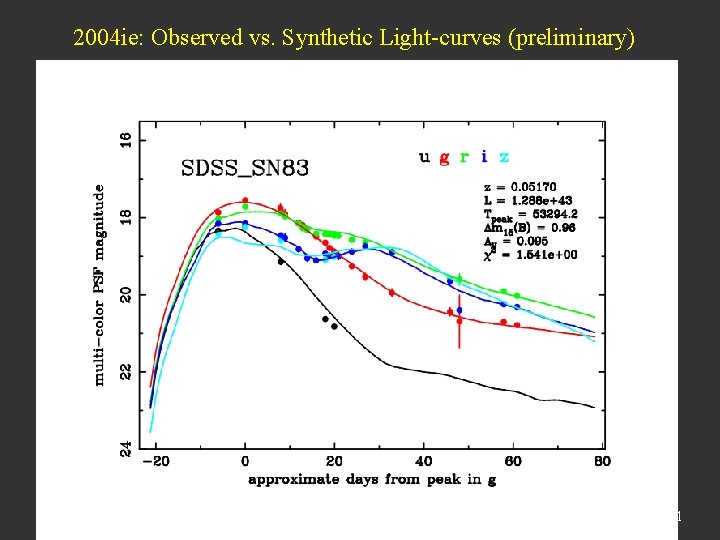
2004 ie: Observed vs. Synthetic Light-curves (preliminary) bright time July 19, 2005 31 SUSY 05
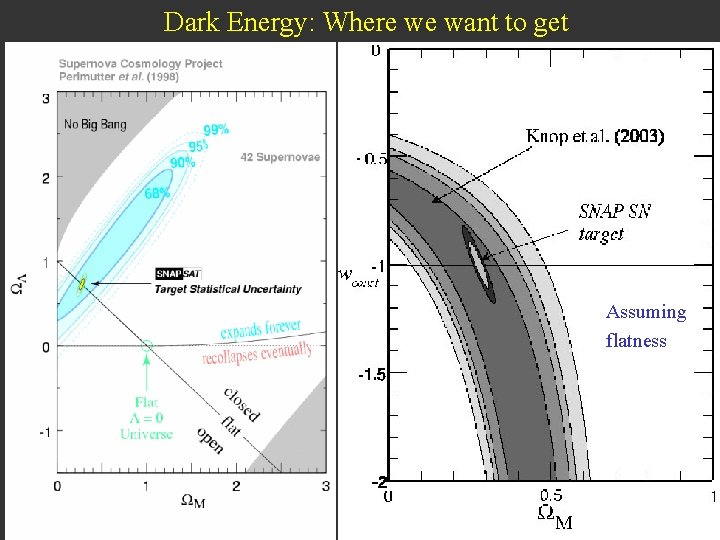
Dark Energy: Where we want to get Assuming flatness July 19, 2005 32 SUSY 05

How do we get there? • Goal: Determine w 0 to ~5% and dw/dz to ~10 -20% with SNe. • Statistical Requirement: ~1% relative distance measurements (2% flux) in z~0. 1 redshift bins. • Assume systematic error can be reduced to this level (to be demonstrated). • This requires ~3000 SNe spread over z ~ 0. 3 -1. 7 and a well-observed sample at low z to anchor the Hubble diagram. July 19, 2005 SUSY 05 33
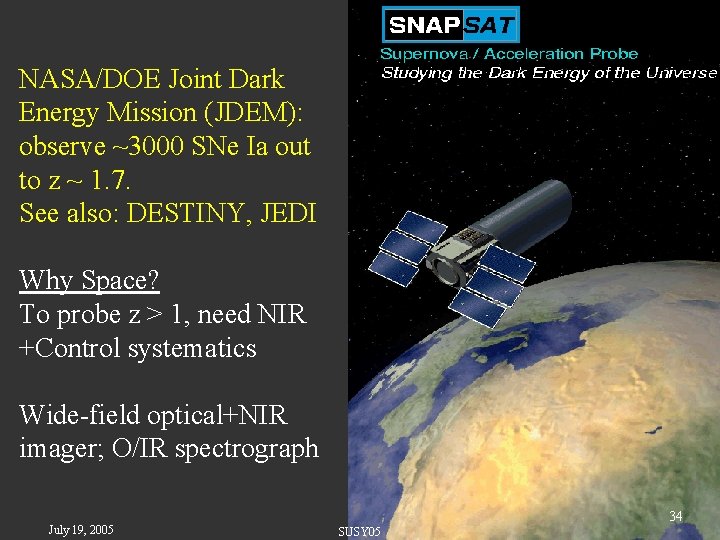
NASA/DOE Joint Dark Energy Mission (JDEM): observe ~3000 SNe Ia out to z ~ 1. 7. See also: DESTINY, JEDI Why Space? To probe z > 1, need NIR +Control systematics Wide-field optical+NIR imager; O/IR spectrograph July 19, 2005 34 SUSY 05
Can we get there? Systematics Concerns Luminosity Evolution: We believe SNe Ia at z~0. 5 are not intrinsically ~25% fainter than nearby SNe (the basis for Dark Energy). Could SNe at z~1. 5 be 2% fainter/brighter than those nearby, in a way that leaves all other observables fixed? Expectation: drift in progenitor population mix (progenitor mass, age, metallicity, C/O, accretion rates, etc). Control: the variety of host environments at low redshift spans a much larger range of metallicity, etc, than the median differences between low- and high-z environments, so we can compare high-z apples with low-z apples, using host info. , LC shape, colors, spectral features & spectral evolution, and assuming these exhaust the parameters that control Lpeak. July 19, 2005 SUSY 05 35
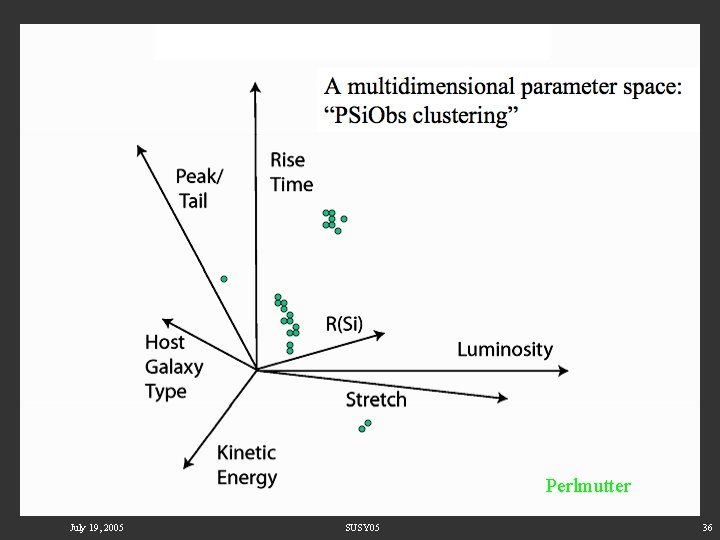
Perlmutter July 19, 2005 SUSY 05 36
SNe Ia as Dark Energy Probes • Purely geometrical: independent of structure formation paradigm (unlike clusters, weak lensing, LSS) • Nearly orthogonal parameter degeneracy to structure-based probes: complementary to WL & CMB • Best standardizable candles/relative distance indicators • Lots of information in principle available per event to provide systematics cross-checks: multi-epoch spectrophotometry from near UV to near IR. How much of this information do we need for each SN at high z? • Few % constraints on w will require exquisite control of observational systematics (from space), improved local SN templates, and improved LC analysis algorithms, and preferably better theoretical SN modeling July 19, 2005 SUSY 05 37
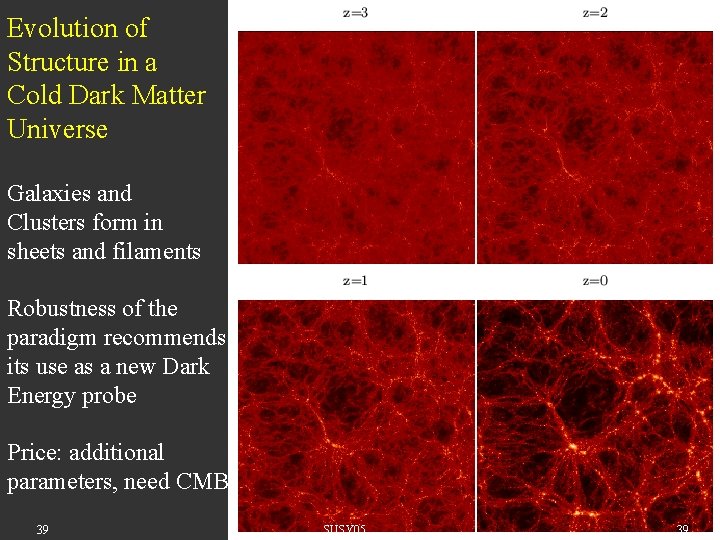
Evolution of Structure in a Cold Dark Matter Universe Galaxies and Clusters form in sheets and filaments Robustness of the paradigm recommends its use as a new Dark Energy probe Price: additional parameters, need CMB 39 SUSY 05 39
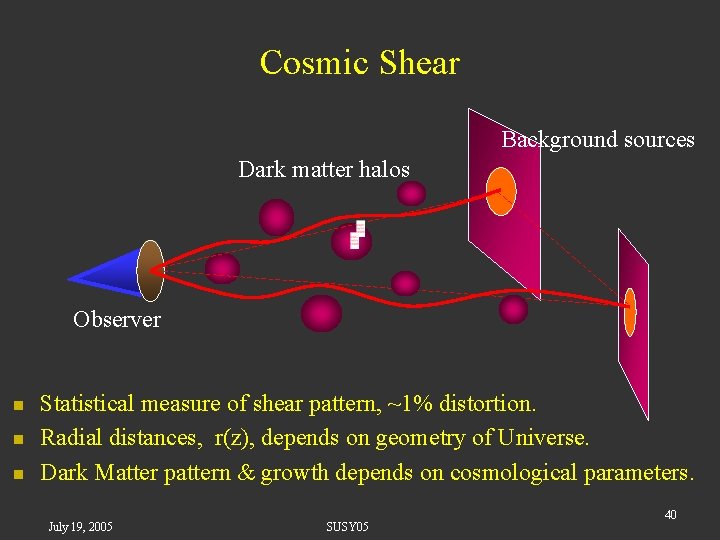
Cosmic Shear Background sources Dark matter halos Observer n n n Statistical measure of shear pattern, ~1% distortion. Radial distances, r(z), depends on geometry of Universe. Dark Matter pattern & growth depends on cosmological parameters. July 19, 2005 SUSY 05 40
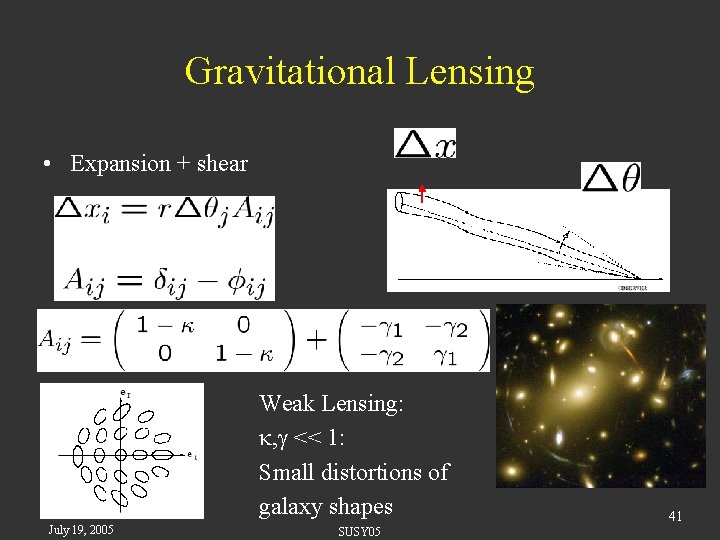
Gravitational Lensing • Expansion + shear Weak Lensing: , << 1: Small distortions of galaxy shapes July 19, 2005 SUSY 05 41

Gravitational Lensing 42 SUSY 05 42
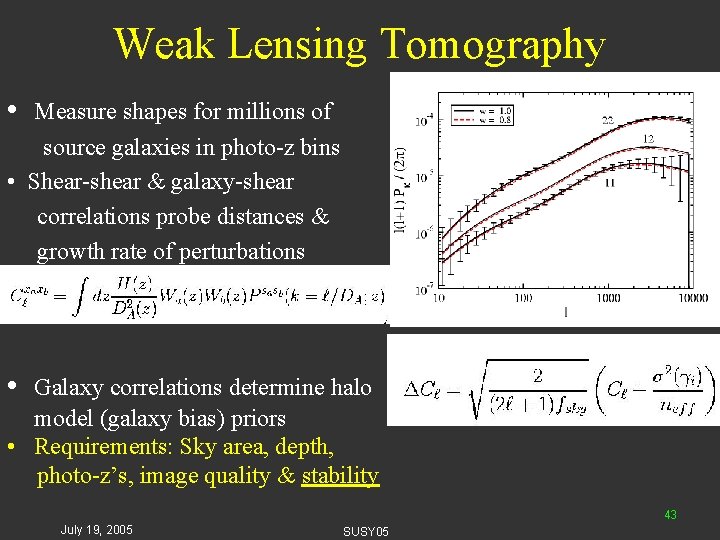
Weak Lensing Tomography • Marginalized 68% CL DES constraints Measure shapes for millions of source galaxies in photo-z bins • Shear-shear & galaxy-shear correlations probe distances & growth rate of perturbations • Galaxy correlations determine halo model (galaxy bias) priors • Requirements: Sky area, depth, photo-z’s, image quality & stability 43 July 19, 2005 SUSY 05
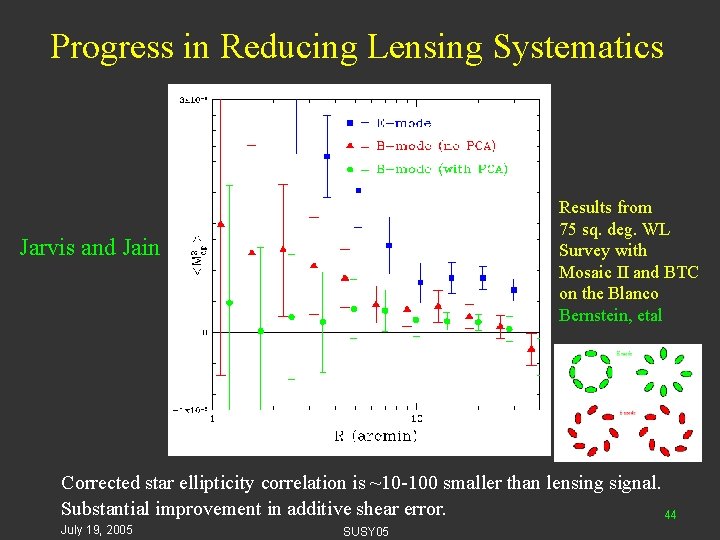
Progress in Reducing Lensing Systematics Red: expected signal Jarvis and Jain Results from 75 sq. deg. WL Survey with Mosaic II and BTC on the Blanco Bernstein, etal Corrected star ellipticity correlation is ~10 -100 smaller than lensing signal. Substantial improvement in additive shear error. 44 July 19, 2005 SUSY 05
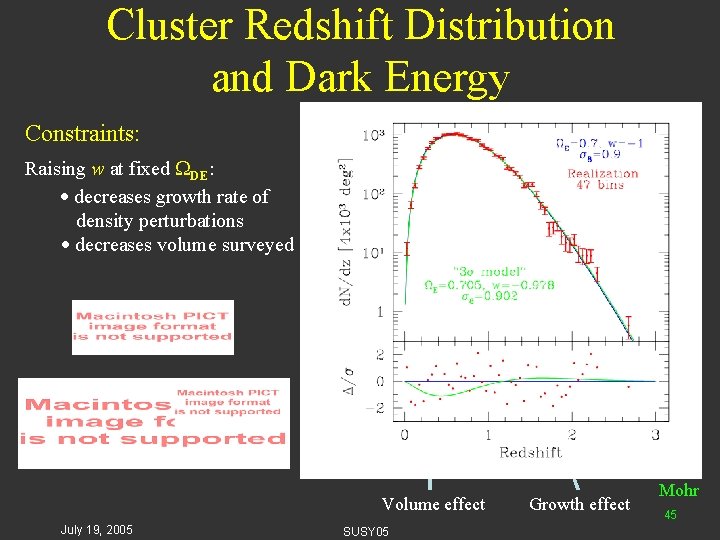
Cluster Redshift Distribution and Dark Energy Constraints: Raising w at fixed DE: decreases growth rate of density perturbations decreases volume surveyed Volume effect July 19, 2005 SUSY 05 Growth effect Mohr 45
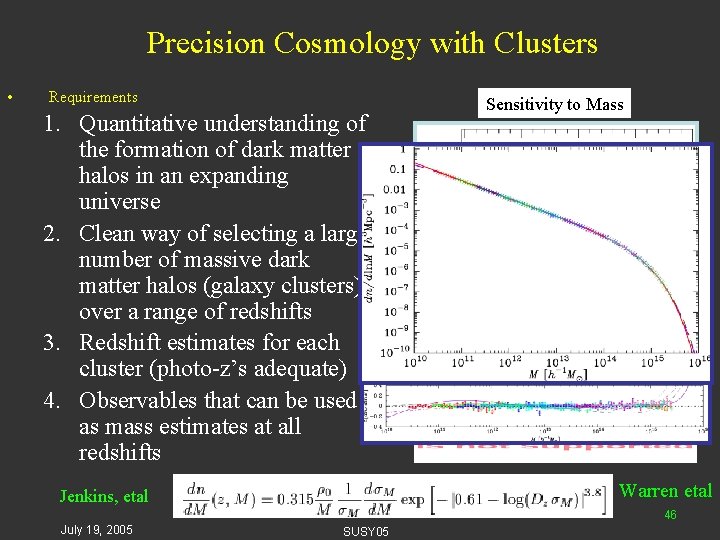
Precision Cosmology with Clusters • Requirements 1. Quantitative understanding of the formation of dark matter halos in an expanding universe 2. Clean way of selecting a large number of massive dark matter halos (galaxy clusters) over a range of redshifts 3. Redshift estimates for each cluster (photo-z’s adequate) 4. Observables that can be used as mass estimates at all redshifts Sensitivity to Mass Warren et al ‘ 05 Warren etal Jenkins, etal 46 July 19, 2005 SUSY 05
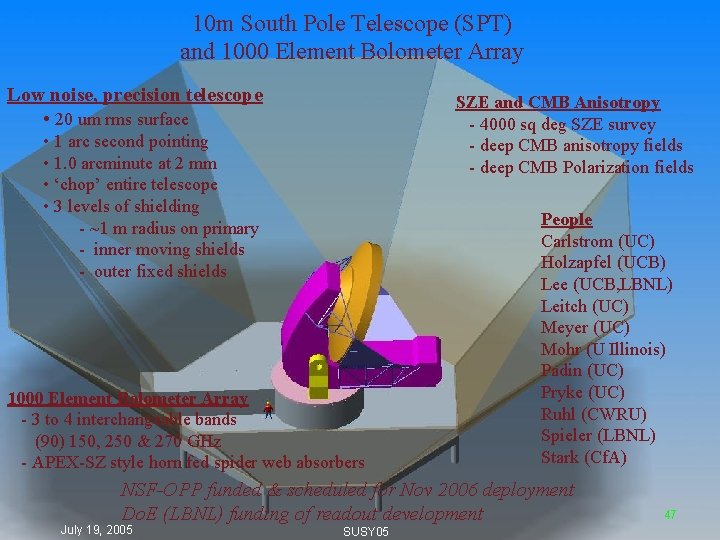
10 m South Pole Telescope (SPT) and 1000 Element Bolometer Array Low noise, precision telescope • 20 um rms surface SZE and CMB Anisotropy - 4000 sq deg SZE survey - deep CMB anisotropy fields - deep CMB Polarization fields • 1 arc second pointing • 1. 0 arcminute at 2 mm • ‘chop’ entire telescope • 3 levels of shielding - ~1 m radius on primary - inner moving shields - outer fixed shields 1000 Element Bolometer Array - 3 to 4 interchangeable bands (90) 150, 250 & 270 GHz - APEX-SZ style horn fed spider web absorbers People Carlstrom (UC) Holzapfel (UCB) Lee (UCB, LBNL) Leitch (UC) Meyer (UC) Mohr (U Illinois) Padin (UC) Pryke (UC) Ruhl (CWRU) Spieler (LBNL) Stark (Cf. A) NSF-OPP funded & scheduled for Nov 2006 deployment Do. E (LBNL) funding of readout development July 19, 2005 SUSY 05 47
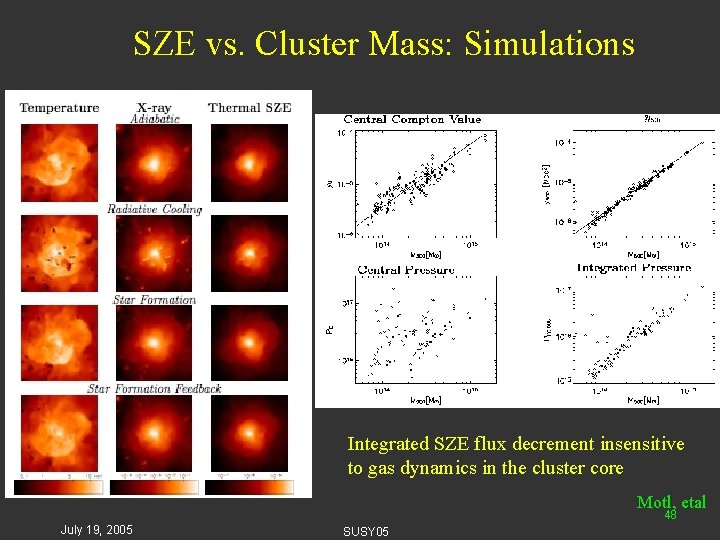
SZE vs. Cluster Mass: Simulations Integrated SZE flux decrement insensitive to gas dynamics in the cluster core Motl, etal 48 July 19, 2005 SUSY 05

The Dark Energy Survey • Study Dark Energy using 4 complementary* techniques: Blanco 4 -meter at CTIO Cluster counts & clustering Weak lensing Galaxy angular clustering SNe Ia distances • Two multiband surveys: 5000 deg 2 g, r, i, z 40 deg 2 repeat (SNe) • Build new 3 deg 2 camera Construction 2005 -2009 Survey 2009 -2014 (525 nights) Response to NOAO AO *in systematics & in cosmological parameter degeneracies *geometric+growth: test Dark Energy vs. Gravity 49 July 19, 2005 SUSY 05
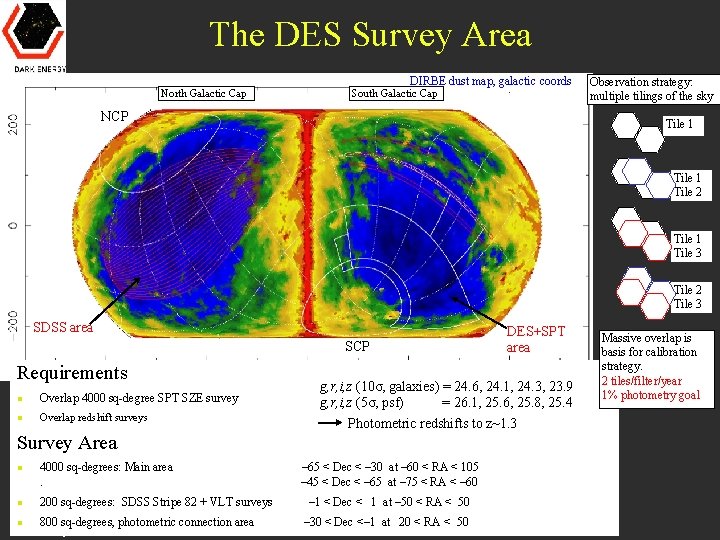
The DES Survey Area North Galactic Cap DIRBE dust map, galactic coords South Galactic Cap NCP Observation strategy: multiple tilings of the sky Tile 1 Tile 2 Tile 1 Tile 3 Tile 2 Tile 3 SDSS area SCP Requirements n Overlap 4000 sq-degree SPT SZE survey n Overlap redshift surveys Survey Area n 4000 sq-degrees: Main area. n 200 sq-degrees: SDSS Stripe 82 + VLT surveys n 800 sq-degrees, photometric connection area July 19, 2005 DES+SPT area g, r, i, z (10σ, galaxies) = 24. 6, 24. 1, 24. 3, 23. 9 g, r, i, z (5σ, psf) = 26. 1, 25. 6, 25. 8, 25. 4 Photometric redshifts to z~1. 3 – 65 < Dec < – 30 at – 60 < RA < 105 – 45 < Dec < – 65 at – 75 < RA < – 60 – 1 < Dec < 1 at – 50 < RA < 50 – 30 < Dec <– 1 at 20 < RA < 50 SUSY 05 Massive overlap is basis for calibration strategy. 2 tiles/filter/year 1% photometry goal
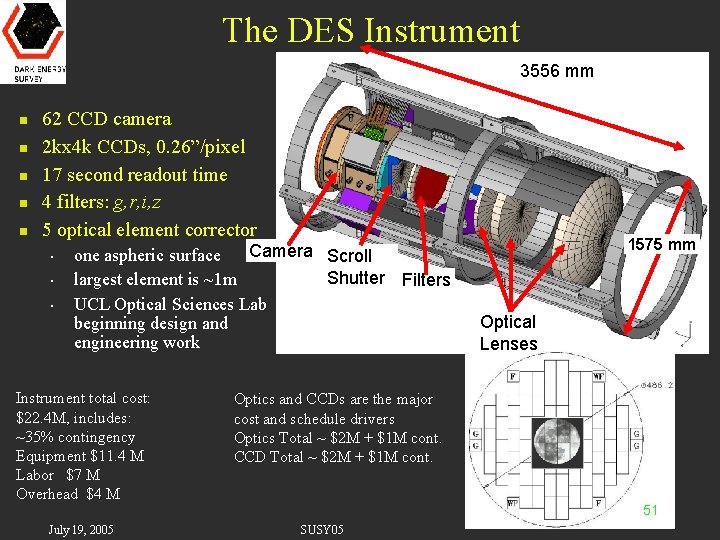
The DES Instrument 3556 mm n n n 62 CCD camera 2 kx 4 k CCDs, 0. 26”/pixel 17 second readout time 4 filters: g, r, i, z 5 optical element corrector • • • Camera Scroll one aspheric surface Shutter Filters largest element is ~1 m UCL Optical Sciences Lab beginning design and engineering work Instrument total cost: $22. 4 M, includes: ~35% contingency Equipment $11. 4 M Labor $7 M Overhead $4 M July 19, 2005 1575 mm Optical Lenses Optics and CCDs are the major cost and schedule drivers Optics Total ~ $2 M + $1 M cont. CCD Total ~ $2 M + $1 M cont. 51 SUSY 05
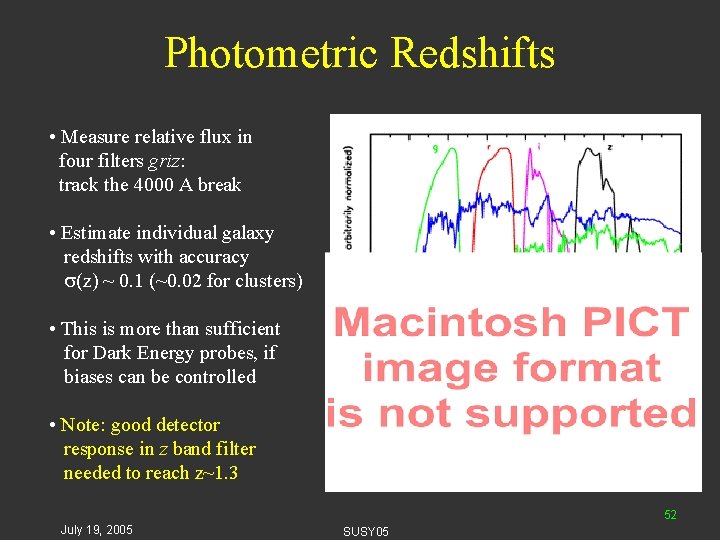
Photometric Redshifts • Measure relative flux in four filters griz: track the 4000 A break • Estimate individual galaxy redshifts with accuracy (z) ~ 0. 1 (~0. 02 for clusters) • This is more than sufficient for Dark Energy probes, if biases can be controlled • Note: good detector response in z band filter needed to reach z~1. 3 52 July 19, 2005 SUSY 05

Lensing Cluster
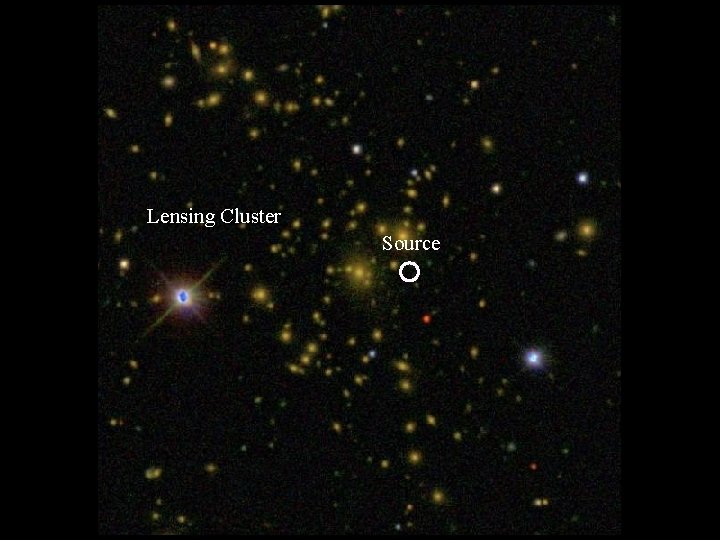
Lensing Cluster Source
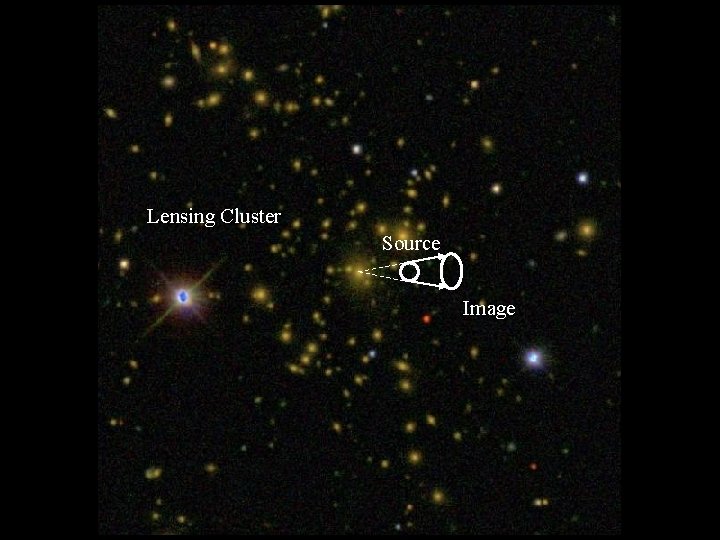
Lensing Cluster Source Image
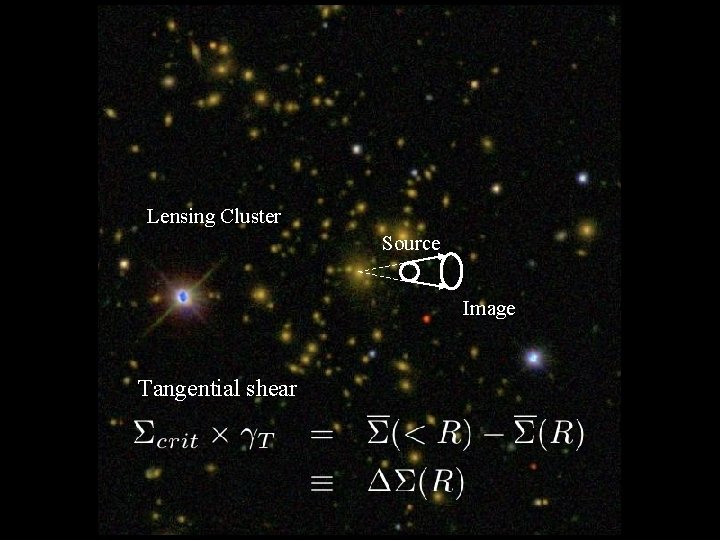
Lensing Cluster Source Image Tangential shear
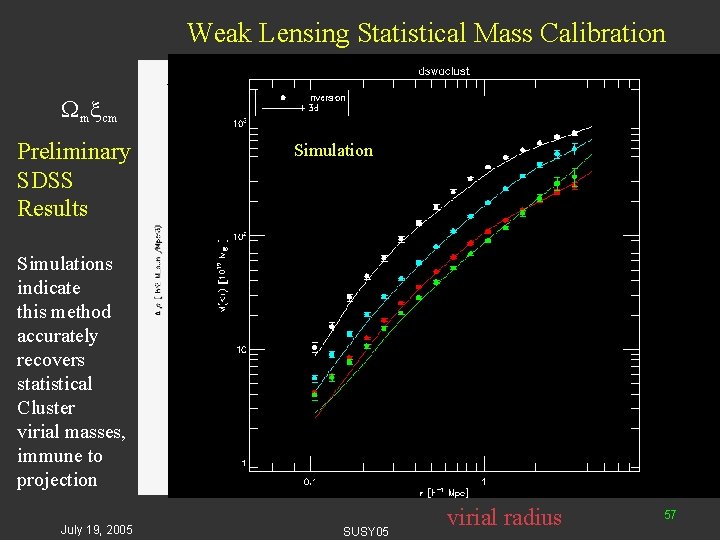
Weak Lensing Statistical Mass Calibration m cm Preliminary SDSS Results Simulations indicate this method accurately recovers statistical Cluster virial masses, immune to projection July 19, 2005 SUSY 05 virial radius 57
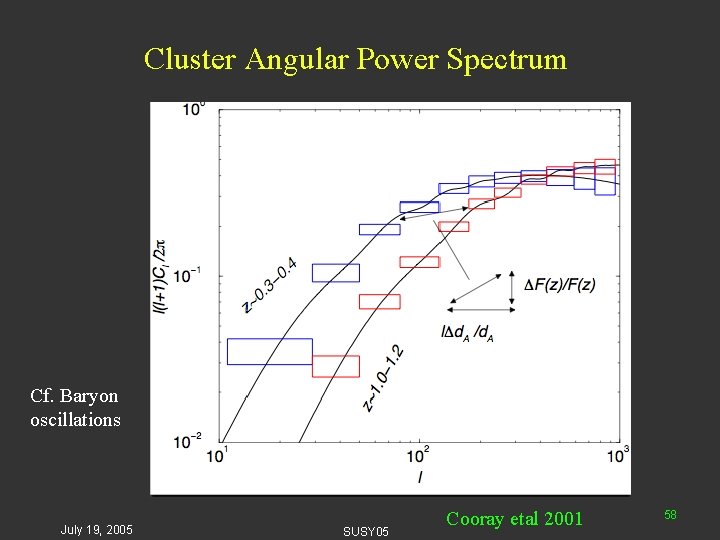
Cluster Angular Power Spectrum Cf. Baryon oscillations July 19, 2005 SUSY 05 Cooray etal 2001 58
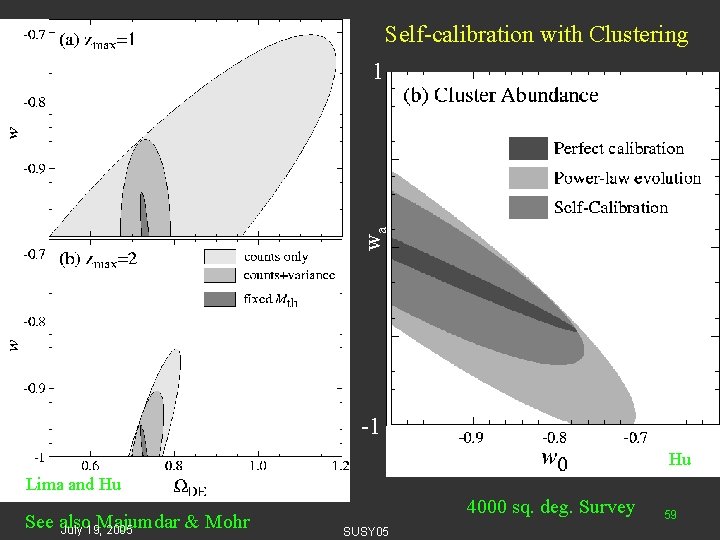
Self-calibration with Clustering wa 1 -1 Hu Lima and Hu See also Majumdar & Mohr July 19, 2005 4000 sq. deg. Survey SUSY 05 59
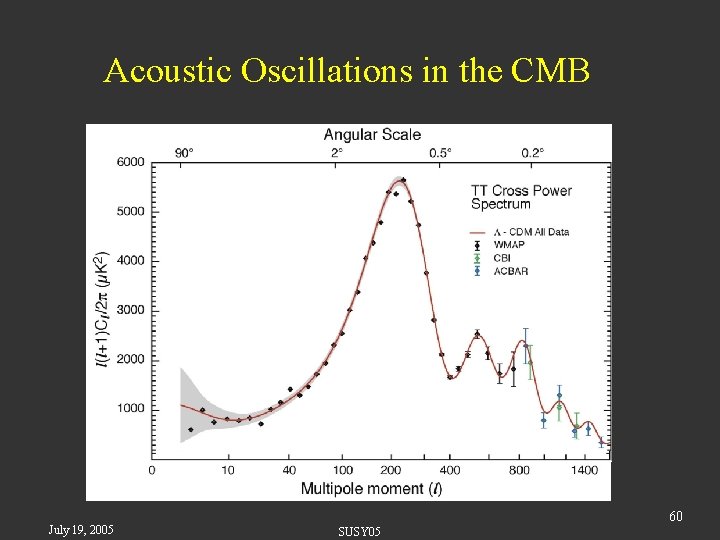
Acoustic Oscillations in the CMB July 19, 2005 60 SUSY 05

SDSS Large-scale Galaxy Correlations Redshiftspace Correlation Function Acoustic series in P(k) becomes a single peak in (r) Pure CDM model has no peak Warning: Correlated Error Bars July 19, 2005 Future: WFMOS on Subaru Eisenstein, etal 61 SUSY 05
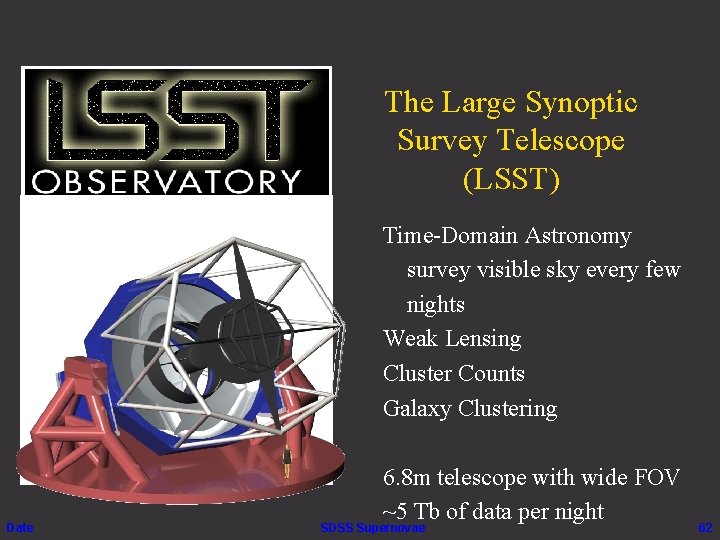
The Large Synoptic Survey Telescope (LSST) Time-Domain Astronomy survey visible sky every few nights Weak Lensing Cluster Counts Galaxy Clustering Date 6. 8 m telescope with wide FOV ~5 Tb of data per night SDSS Supernovae 62
Conclusions • Excellent prospects for increasing the precision on Dark Energy parameters from a sequence of increasingly complex, ambitious, and costly experiments over the next 5 -15 years; 2005 -2010: ~20 M$ projects; 2012 -2020: ~1 B$ • Exploiting complementarity of multiple probes (supernovae, clusters, weak lensing, baryon oscillations) will be key: we don’t know what the ultimate systematic error floors for each method will be. • What parameter precision is needed to stimulate theoretical progress? 63 July 19, 2005 SUSY 05
- Slides: 62