
PROBING BL UNIFICATION via NNbar Oscillation Proton and
PROBING B-L UNIFICATION via N-N-bar Oscillation, Proton and Rare Lepton Decays R. N. Mohapatra University of Maryland INT NEUTRON WORKSHOP, April 2007 Theme Group 2 March 2005
Plan of the Talk 1. Why B-L symmetry ? 2. Two classes of local B-L models 4. Proton Decay, Rare Lepton decays and N-N -bar Oscillations as tests of these models. Theme Group 2 March 2005
Why B-L Symmetry ? • Standard model has global B-L symmetry. • What is the nature of this symmetry ? Is it a global or local symmetry ? • Is it broken or exact ? If broken, what is the breaking scale and what new physics is associated with it ? Theme Group 2 March 2005
Any Hint of B-L symmetry beyond SM? • Neutrino Mass points towards a BL symmetry beyond the standard model. • As does SUSY dark matter. • One popular way to understand the origin of matter also involves B-L breaking. Theme Group 2 March 2005
Neutrino mass and • -standard model Starting point: add RH neutrino to SM for nu mass: Theme Group 2 March 2005
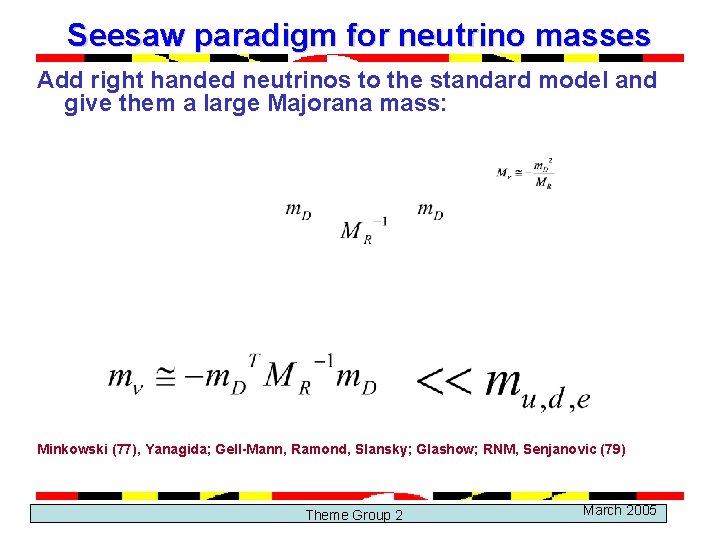
Seesaw paradigm for neutrino masses Add right handed neutrinos to the standard model and give them a large Majorana mass: Minkowski (77), Yanagida; Gell-Mann, Ramond, Slansky; Glashow; RNM, Senjanovic (79) Theme Group 2 March 2005
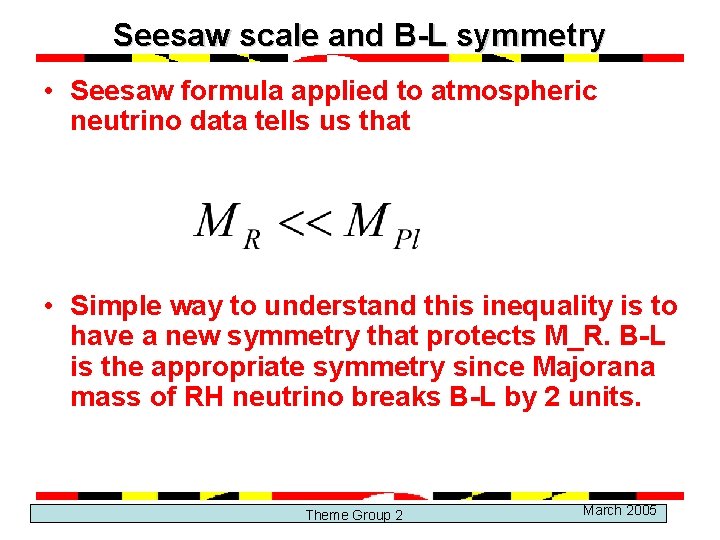
Seesaw scale and B-L symmetry • Seesaw formula applied to atmospheric neutrino data tells us that • Simple way to understand this inequality is to have a new symmetry that protects M_R. B-L is the appropriate symmetry since Majorana mass of RH neutrino breaks B-L by 2 units. Theme Group 2 March 2005
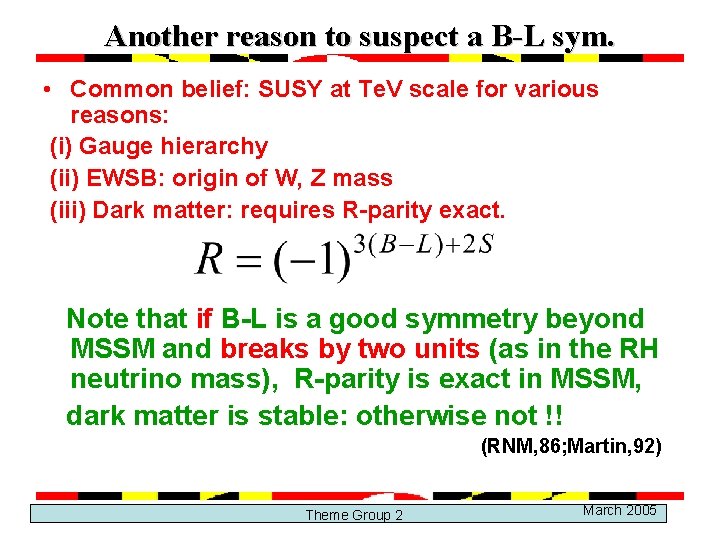
Another reason to suspect a B-L sym. • Common belief: SUSY at Te. V scale for various reasons: (i) Gauge hierarchy (ii) EWSB: origin of W, Z mass (iii) Dark matter: requires R-parity exact. Note that if B-L is a good symmetry beyond MSSM and breaks by two units (as in the RH neutrino mass), R-parity is exact in MSSM, dark matter is stable: otherwise not !! (RNM, 86; Martin, 92) Theme Group 2 March 2005
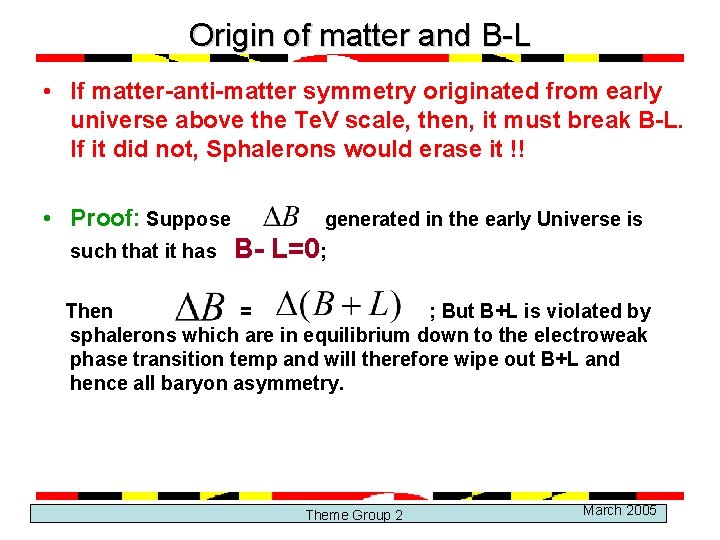
Origin of matter and B-L • If matter-anti-matter symmetry originated from early universe above the Te. V scale, then, it must break B-L. If it did not, Sphalerons would erase it !! • Proof: Suppose such that it has generated in the early Universe is B- L=0; Then = ; But B+L is violated by sphalerons which are in equilibrium down to the electroweak phase transition temp and will therefore wipe out B+L and hence all baryon asymmetry. Theme Group 2 March 2005
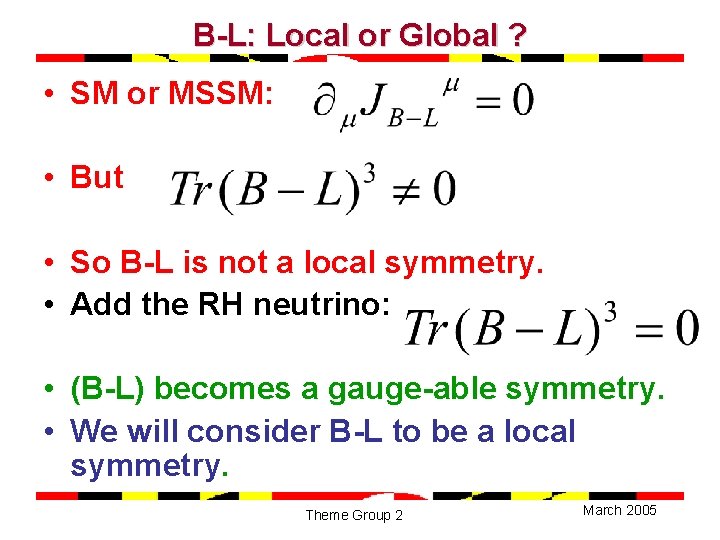
B-L: Local or Global ? • SM or MSSM: • But • So B-L is not a local symmetry. • Add the RH neutrino: • (B-L) becomes a gauge-able symmetry. • We will consider B-L to be a local symmetry. Theme Group 2 March 2005
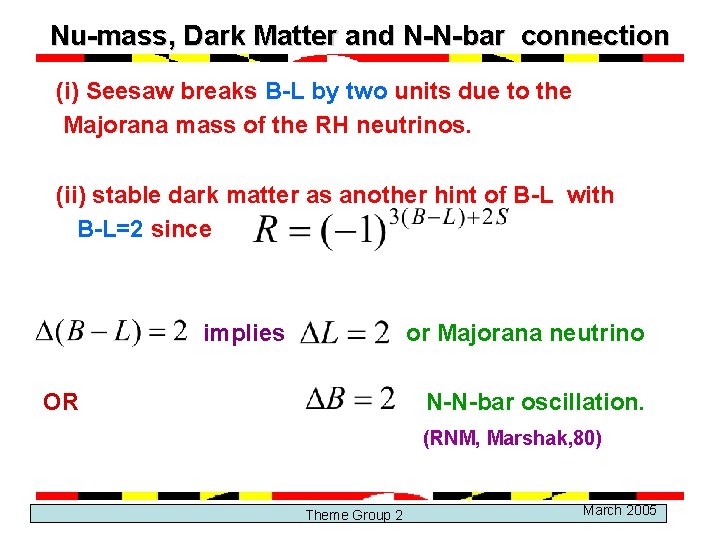
Nu-mass, Dark Matter and N-N-bar connection (i) Seesaw breaks B-L by two units due to the Majorana mass of the RH neutrinos. (ii) stable dark matter as another hint of B-L with B-L=2 since implies or Majorana neutrino OR N-N-bar oscillation. (RNM, Marshak, 80) Theme Group 2 March 2005
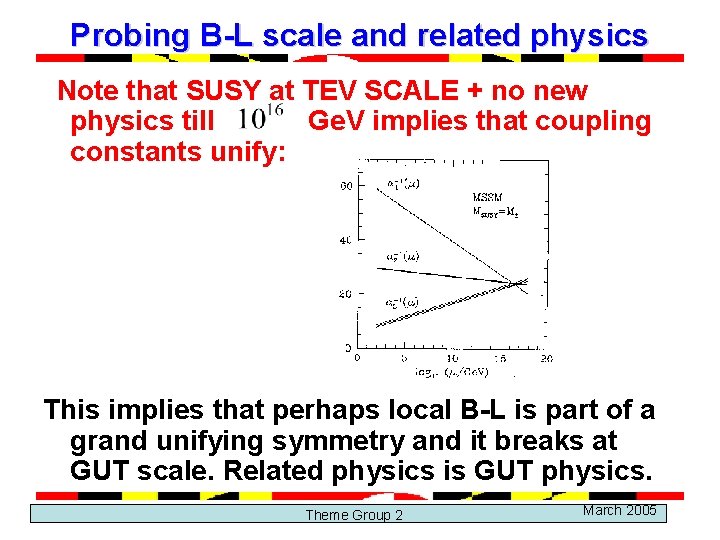
Probing B-L scale and related physics Note that SUSY at TEV SCALE + no new physics till Ge. V implies that coupling constants unify: This implies that perhaps local B-L is part of a grand unifying symmetry and it breaks at GUT scale. Related physics is GUT physics. Theme Group 2 March 2005
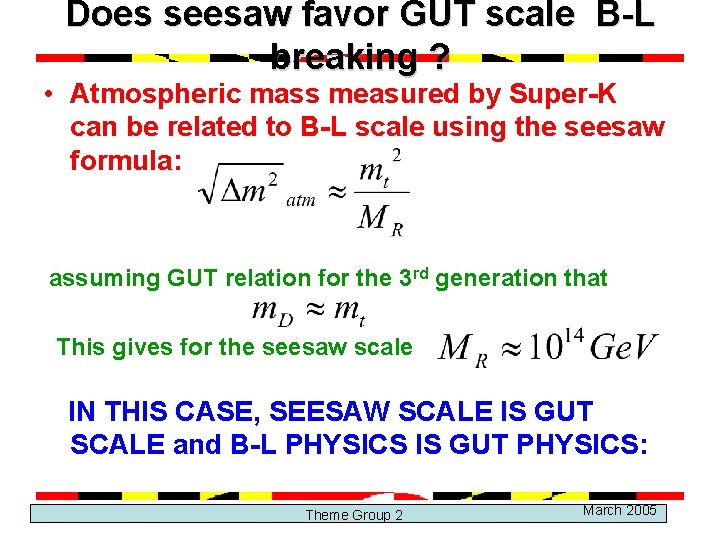
Does seesaw favor GUT scale B-L breaking ? • Atmospheric mass measured by Super-K can be related to B-L scale using the seesaw formula: assuming GUT relation for the 3 rd generation that This gives for the seesaw scale IN THIS CASE, SEESAW SCALE IS GUT SCALE and B-L PHYSICS IS GUT PHYSICS: Theme Group 2 March 2005
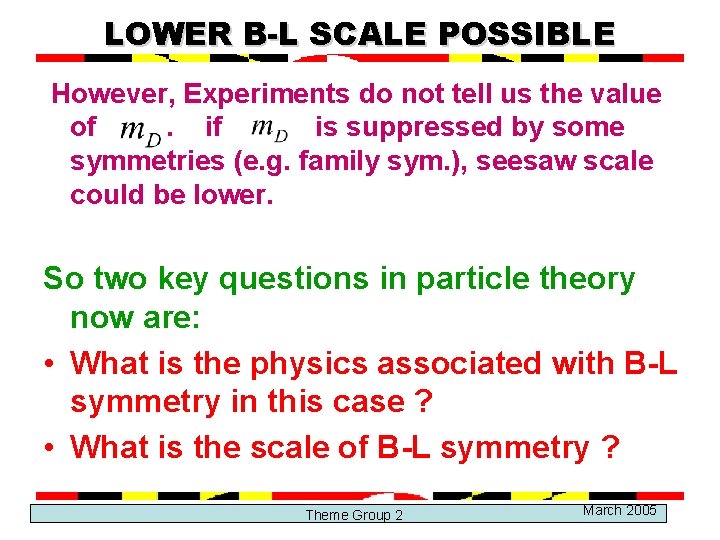
LOWER B-L SCALE POSSIBLE However, Experiments do not tell us the value of. if is suppressed by some symmetries (e. g. family sym. ), seesaw scale could be lower. So two key questions in particle theory now are: • What is the physics associated with B-L symmetry in this case ? • What is the scale of B-L symmetry ? Theme Group 2 March 2005
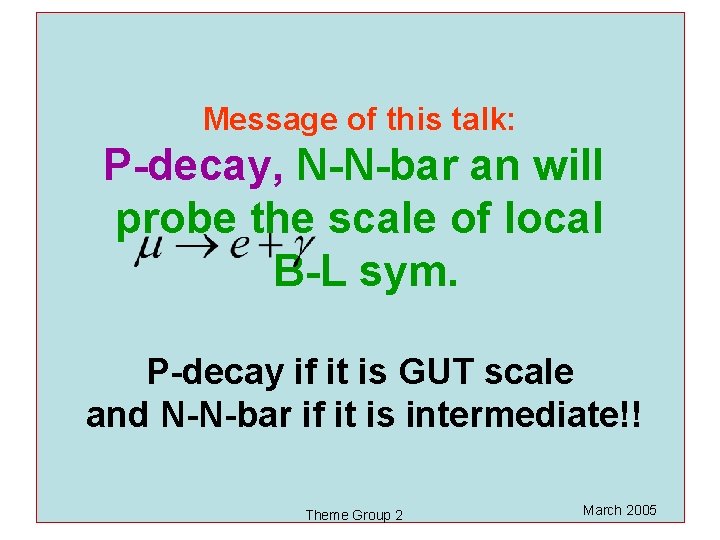
Message of this talk: P-decay, N-N-bar an will probe the scale of local B-L sym. P-decay if it is GUT scale and N-N-bar if it is intermediate!! Theme Group 2 March 2005
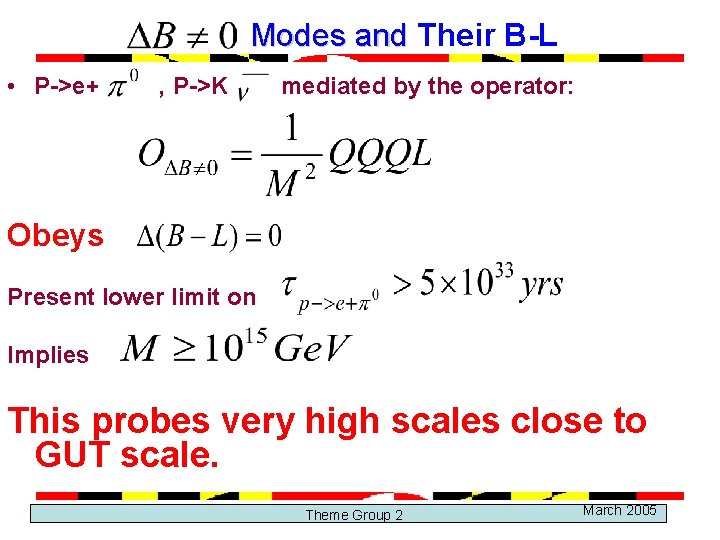
Modes and Their B-L • P->e+ , P->K mediated by the operator: Obeys Present lower limit on Implies This probes very high scales close to GUT scale. Theme Group 2 March 2005
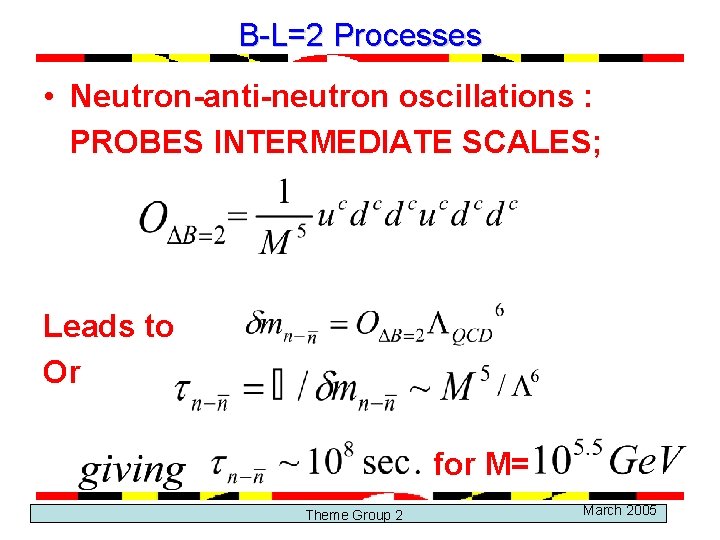
B-L=2 Processes • Neutron-anti-neutron oscillations : PROBES INTERMEDIATE SCALES; Leads to Or for M= Theme Group 2 March 2005
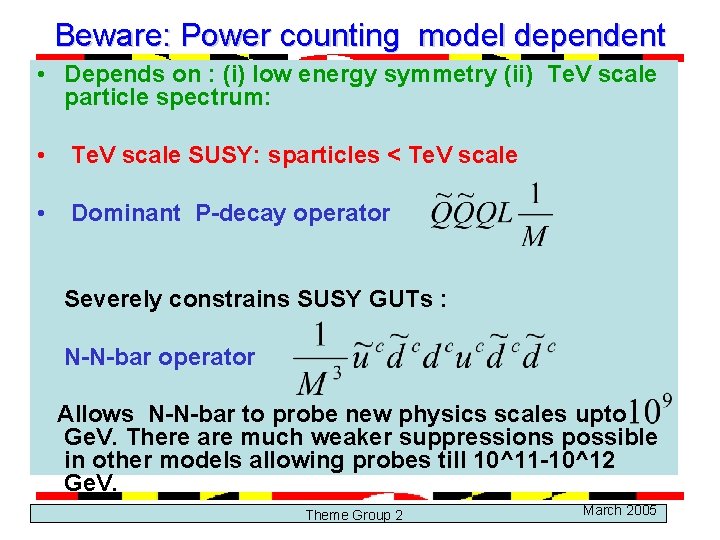
Beware: Power counting model dependent • Depends on : (i) low energy symmetry (ii) Te. V scale particle spectrum: • Te. V scale SUSY: sparticles < Te. V scale • Dominant P-decay operator Severely constrains SUSY GUTs : N-N-bar operator Allows N-N-bar to probe new physics scales upto Ge. V. There are much weaker suppressions possible in other models allowing probes till 10^11 -10^12 Ge. V. Theme Group 2 March 2005
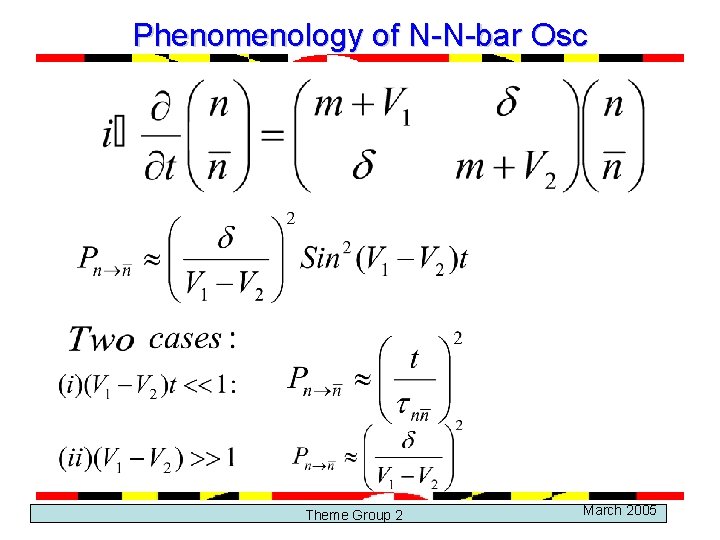
Phenomenology of N-N-bar Osc Theme Group 2 March 2005
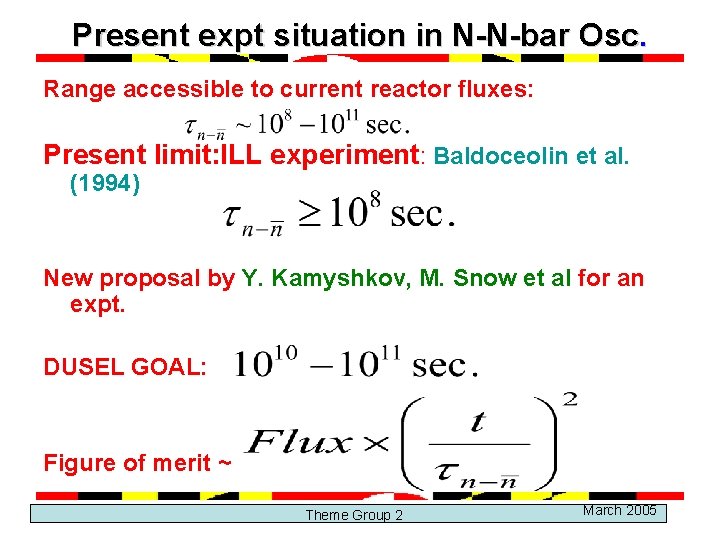
Present expt situation in N-N-bar Osc. Range accessible to current reactor fluxes: Present limit: ILL experiment: Baldoceolin et al. (1994) New proposal by Y. Kamyshkov, M. Snow et al for an expt. DUSEL GOAL: Figure of merit ~ Theme Group 2 March 2005
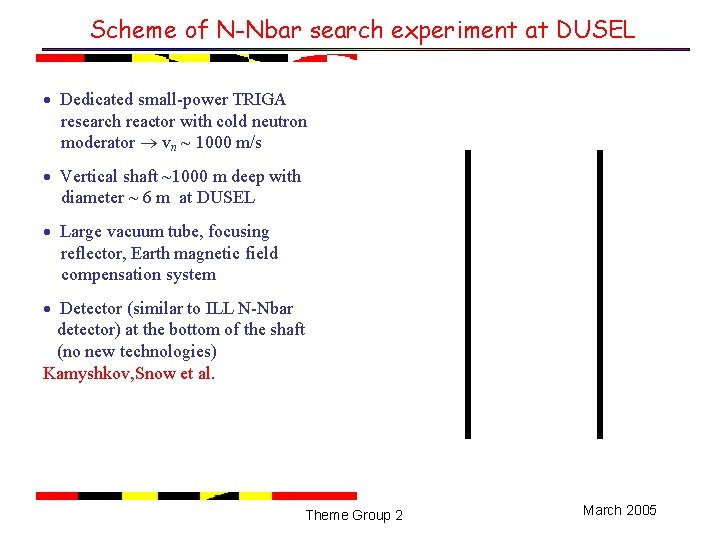
Scheme of N-Nbar search experiment at DUSEL Dedicated small-power TRIGA research reactor with cold neutron moderator vn ~ 1000 m/s Vertical shaft ~1000 m deep with diameter ~ 6 m at DUSEL Large vacuum tube, focusing reflector, Earth magnetic field compensation system Detector (similar to ILL N-Nbar detector) at the bottom of the shaft (no new technologies) Kamyshkov, Snow et al. Theme Group 2 March 2005
Two Examples of B-L Models • (A): SO(10) : the minimal GUT theory with B-L • Georgi; Fritzsch and Minkowski (75) • All fermions unified to one {16} dim rep. • Breaks to MSSM below 10^16 Ge. V; B-L scale is GUT scale. Theme Group 2 March 2005
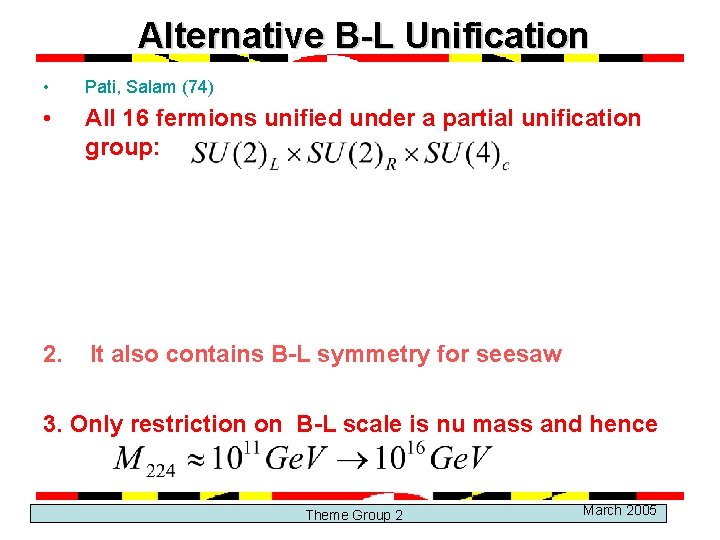
Alternative B-L Unification • Pati, Salam (74) • All 16 fermions unified under a partial unification group: 2. It also contains B-L symmetry for seesaw 3. Only restriction on B-L scale is nu mass and hence Theme Group 2 March 2005
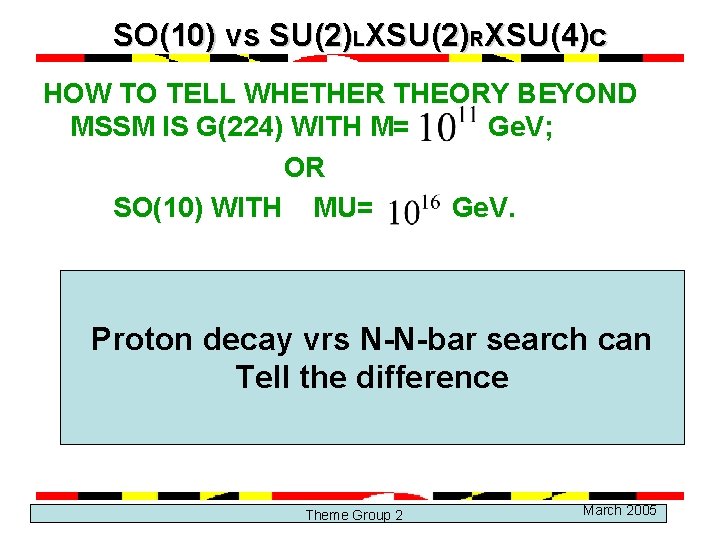
SO(10) vs SU(2)LXSU(2)RXSU(4)c HOW TO TELL WHETHER THEORY BEYOND MSSM IS G(224) WITH M= Ge. V; OR SO(10) WITH MU= Ge. V. Proton decay vrs N-N-bar search can Tell the difference Theme Group 2 March 2005
Digression on GUTs and Proton decay SU(5) as a Warm-up example: Theme Group 2 March 2005
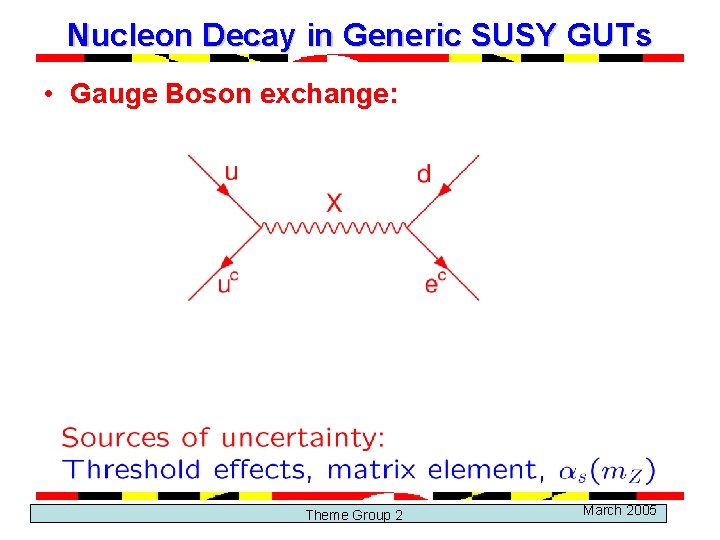
Nucleon Decay in Generic SUSY GUTs • Gauge Boson exchange: Theme Group 2 March 2005
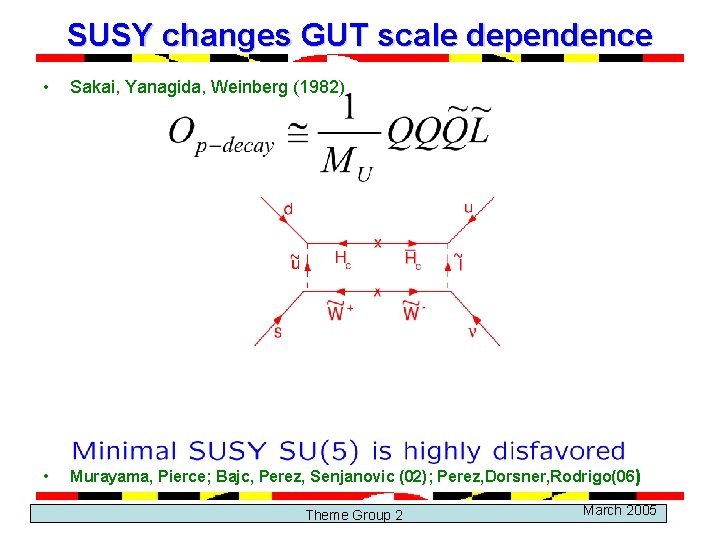
SUSY changes GUT scale dependence • Sakai, Yanagida, Weinberg (1982) • Murayama, Pierce; Bajc, Perez, Senjanovic (02); Perez, Dorsner, Rodrigo(06) Theme Group 2 March 2005
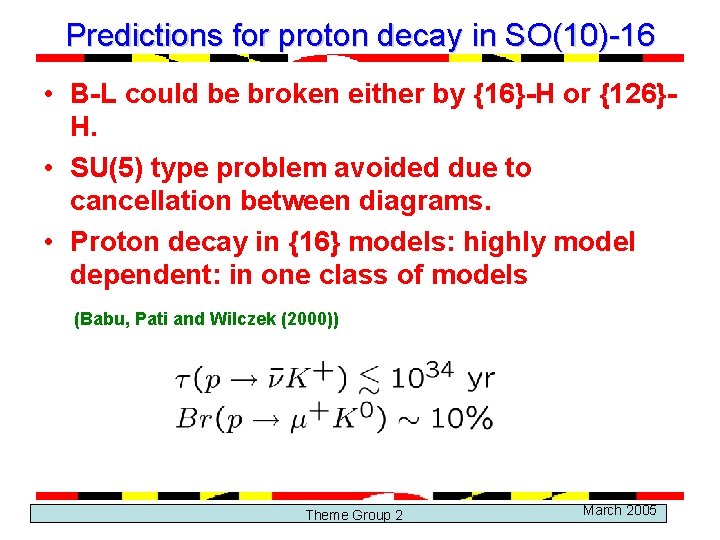
Predictions for proton decay in SO(10)-16 • B-L could be broken either by {16}-H or {126}H. • SU(5) type problem avoided due to cancellation between diagrams. • Proton decay in {16} models: highly model dependent: in one class of models (Babu, Pati and Wilczek (2000)) Theme Group 2 March 2005
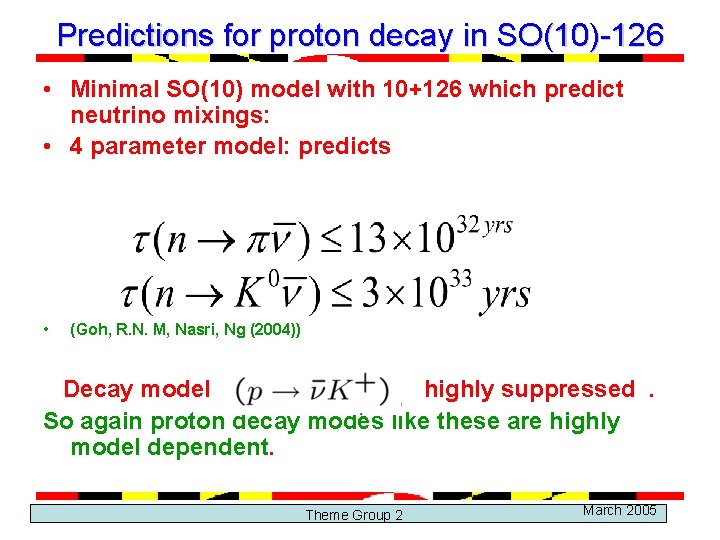
Predictions for proton decay in SO(10)-126 • Minimal SO(10) model with 10+126 which predict neutrino mixings: • 4 parameter model: predicts • (Goh, R. N. M, Nasri, Ng (2004)) Decay model highly suppressed. So again proton decay modes like these are highly model dependent. Theme Group 2 March 2005
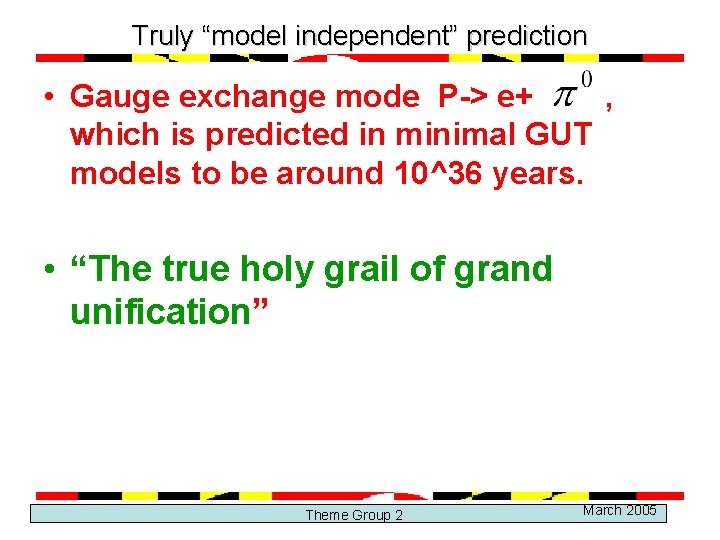
Truly “model independent” prediction • Gauge exchange mode P-> e+ , which is predicted in minimal GUT models to be around 10^36 years. • “The true holy grail of grand unification” Theme Group 2 March 2005
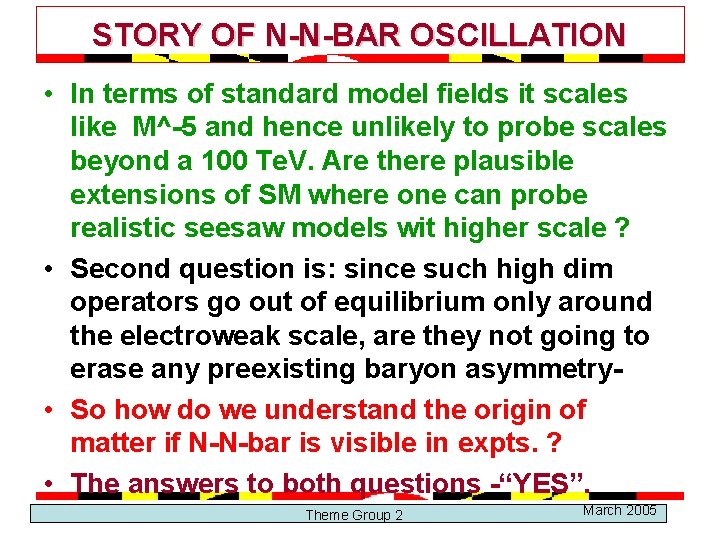
STORY OF N-N-BAR OSCILLATION • In terms of standard model fields it scales like M^-5 and hence unlikely to probe scales beyond a 100 Te. V. Are there plausible extensions of SM where one can probe realistic seesaw models wit higher scale ? • Second question is: since such high dim operators go out of equilibrium only around the electroweak scale, are they not going to erase any preexisting baryon asymmetry • So how do we understand the origin of matter if N-N-bar is visible in expts. ? • The answers to both questions -“YES”. Theme Group 2 March 2005
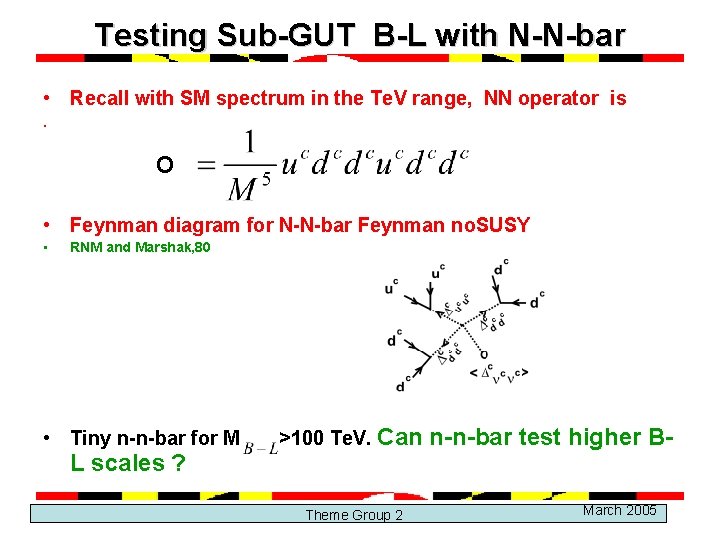
Testing Sub-GUT B-L with N-N-bar • Recall with SM spectrum in the Te. V range, NN operator is • O • Feynman diagram for N-N-bar Feynman no. SUSY • RNM and Marshak, 80 • Tiny n-n-bar for M L scales ? >100 Te. V. Can Theme Group 2 n-n-bar test higher BMarch 2005
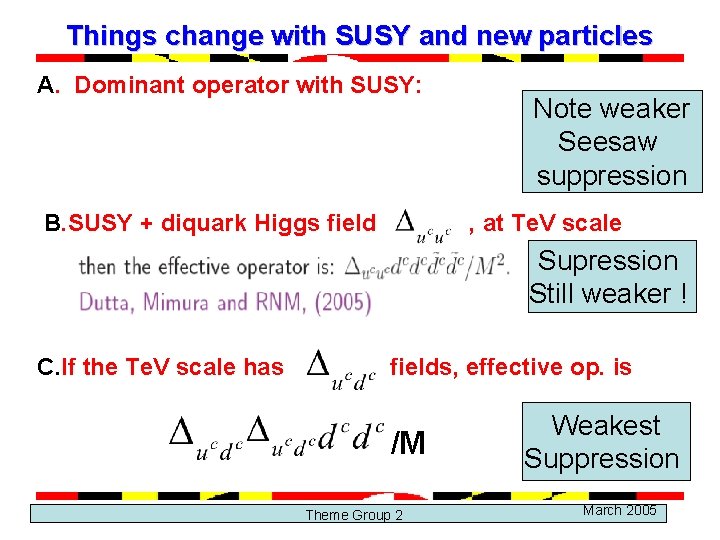
Things change with SUSY and new particles A. Dominant operator with SUSY: B. SUSY + diquark Higgs field Note weaker Seesaw suppression , at Te. V scale Supression Still weaker ! C. If the Te. V scale has fields, effective op. is /M Theme Group 2 Weakest Suppression March 2005
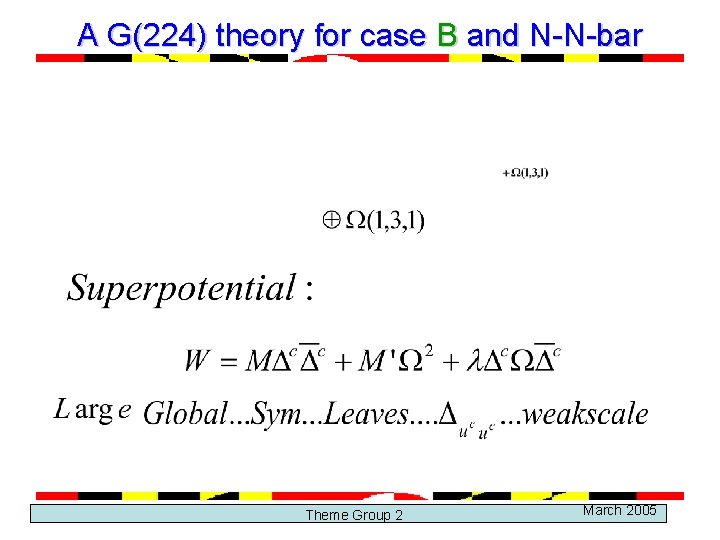
A G(224) theory for case B and N-N-bar Theme Group 2 March 2005
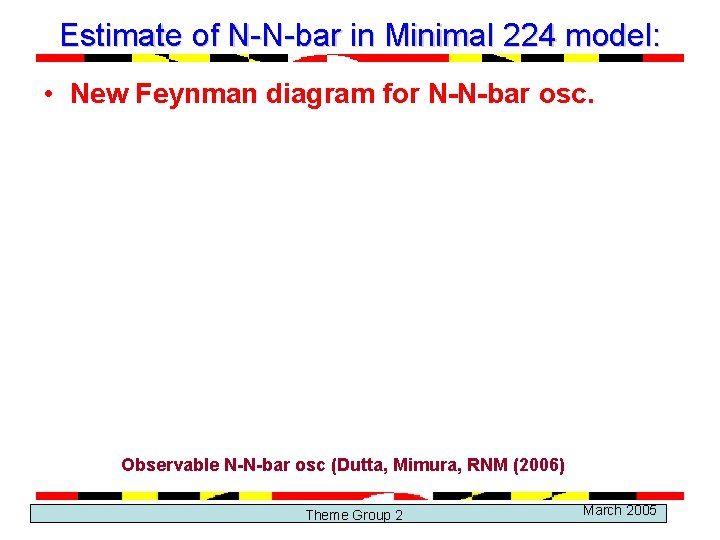
Estimate of N-N-bar in Minimal 224 model: • New Feynman diagram for N-N-bar osc. Observable N-N-bar osc (Dutta, Mimura, RNM (2006) Theme Group 2 March 2005
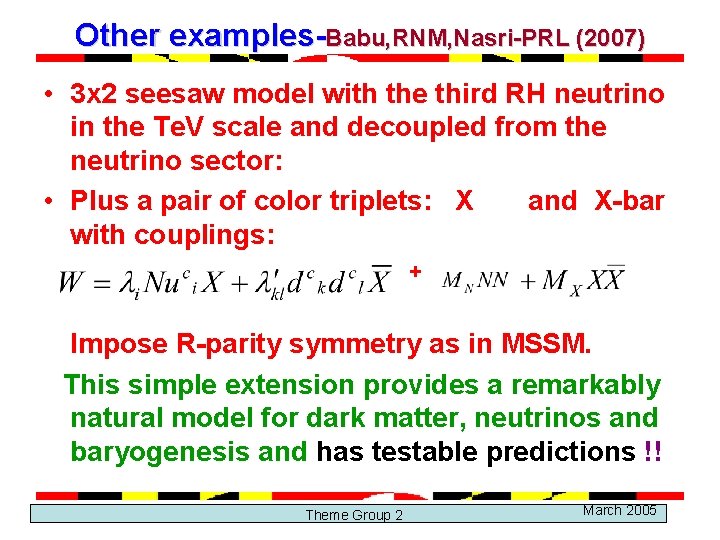
Other examples-Babu, RNM, Nasri-PRL (2007) • 3 x 2 seesaw model with the third RH neutrino in the Te. V scale and decoupled from the neutrino sector: • Plus a pair of color triplets: X and X-bar with couplings: + Impose R-parity symmetry as in MSSM. This simple extension provides a remarkably natural model for dark matter, neutrinos and baryogenesis and has testable predictions !! Theme Group 2 March 2005
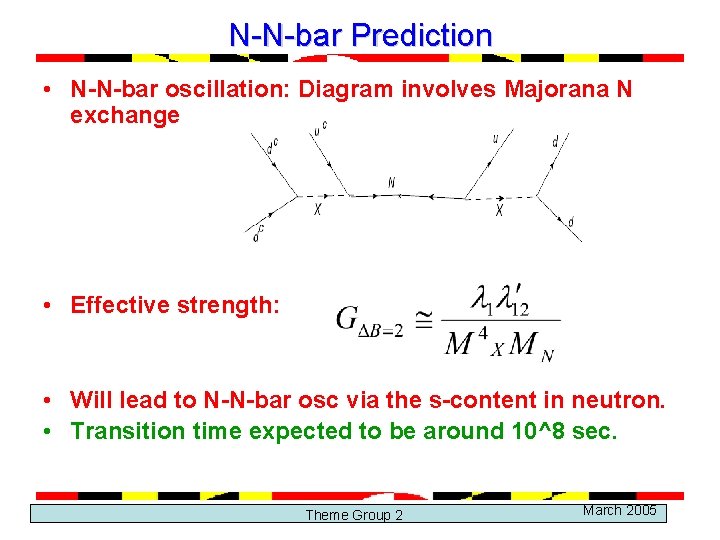
N-N-bar Prediction • N-N-bar oscillation: Diagram involves Majorana N exchange • Effective strength: • Will lead to N-N-bar osc via the s-content in neutron. • Transition time expected to be around 10^8 sec. Theme Group 2 March 2005
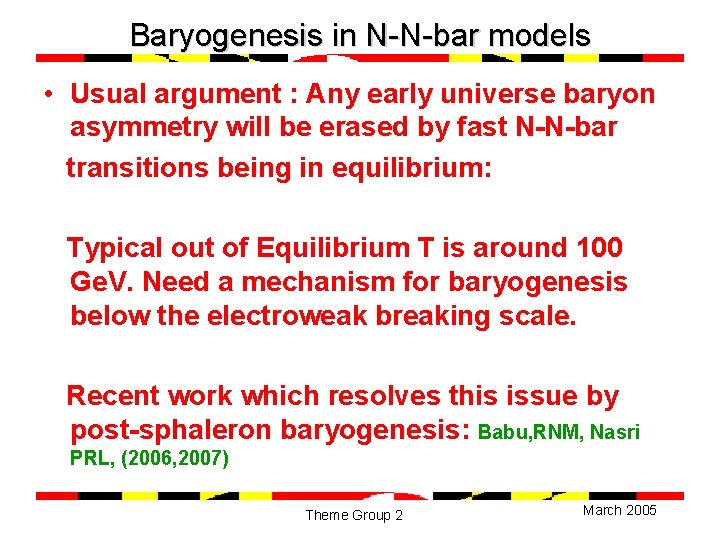
Baryogenesis in N-N-bar models • Usual argument : Any early universe baryon asymmetry will be erased by fast N-N-bar transitions being in equilibrium: Typical out of Equilibrium T is around 100 Ge. V. Need a mechanism for baryogenesis below the electroweak breaking scale. Recent work which resolves this issue by post-sphaleron baryogenesis: Babu, RNM, Nasri PRL, (2006, 2007) Theme Group 2 March 2005
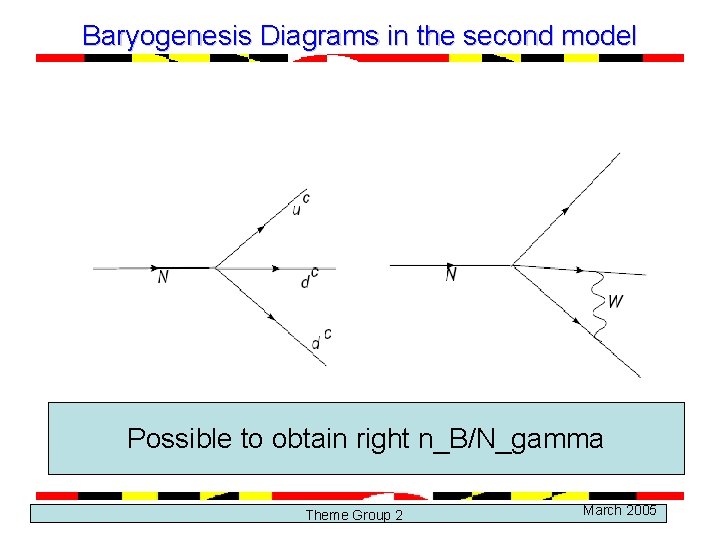
Baryogenesis Diagrams in the second model Possible to obtain right n_B/N_gamma Theme Group 2 March 2005
Other Examples: • Shrock and Nussinov (2001) • Models with extra dimensions where fermions are localized in the fifth dimension lead to observable N-N-bar oscillation. Theme Group 2 March 2005
Proton decay vs N-N-bar oscillation Theme Group 2 March 2005
Comparision P-decay vs N-N-bar Theme Group 2 March 2005
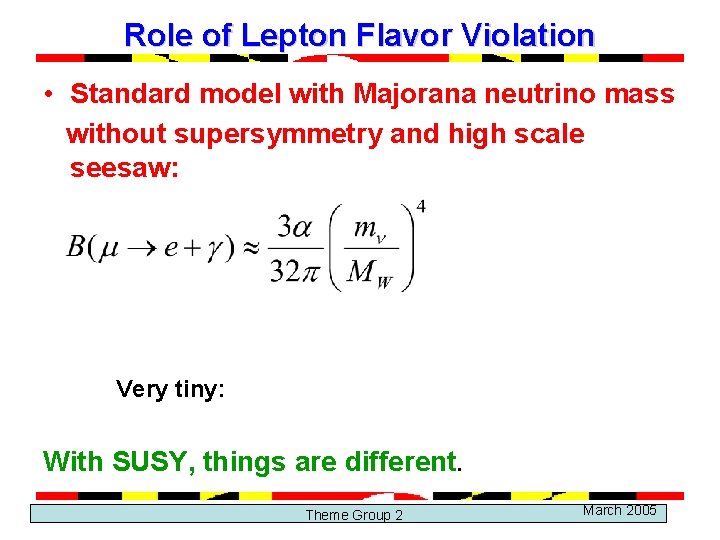
Role of Lepton Flavor Violation • Standard model with Majorana neutrino mass without supersymmetry and high scale seesaw: Very tiny: With SUSY, things are different. Theme Group 2 March 2005
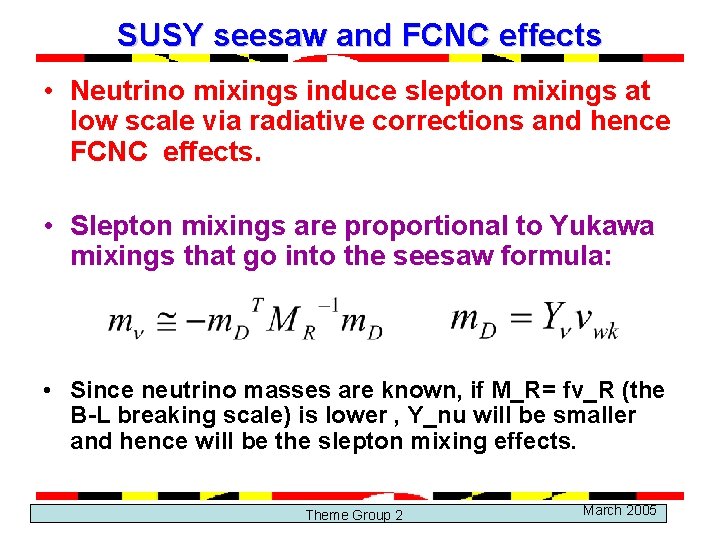
SUSY seesaw and FCNC effects • Neutrino mixings induce slepton mixings at low scale via radiative corrections and hence FCNC effects. • Slepton mixings are proportional to Yukawa mixings that go into the seesaw formula: • Since neutrino masses are known, if M_R= fv_R (the B-L breaking scale) is lower , Y_nu will be smaller and hence will be the slepton mixing effects. Theme Group 2 March 2005
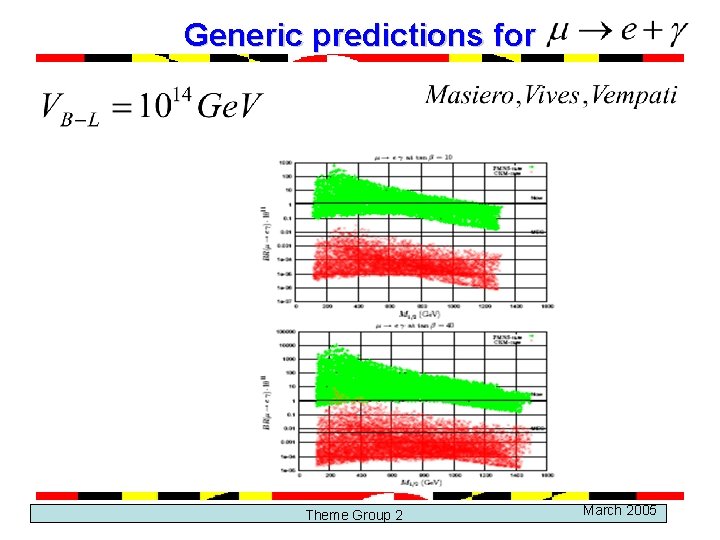
Generic predictions for Theme Group 2 March 2005
Lower V_BL • Branching ratio lower by v_BL square. So non-observation of any effect at MEG expt along with a positive signal for N-N-bar oscillation will indicate lower B-L scales. Only exception is if B-L scale is the Te. V range: In this case even without SUSY, mu-> e +gamma Br. Can be observable. Theme Group 2 March 2005
Conclusion • With the discovery of neutrino mass the case for N-N-bar oscillation is a lot stronger now than it was in the 1980 s. Urge new search at the level of 10^10 sec to test for B-L seesaw scale around 10^11 Ge. V as against GUT scale seesaw. • N-N-bar discovery will completely change thinking on grand unification. • As far as Proton decay goes, predictions below 10^36 yrs are model dependent; while they should be done, the true value of Pdecay as a test of GUT idea is the 10^36 yrs level search and should be the ultimate goal. Theme Group 2 Thank you for your attention. March 2005
- Slides: 47