
probe light pump light LED PIA Signal analysis
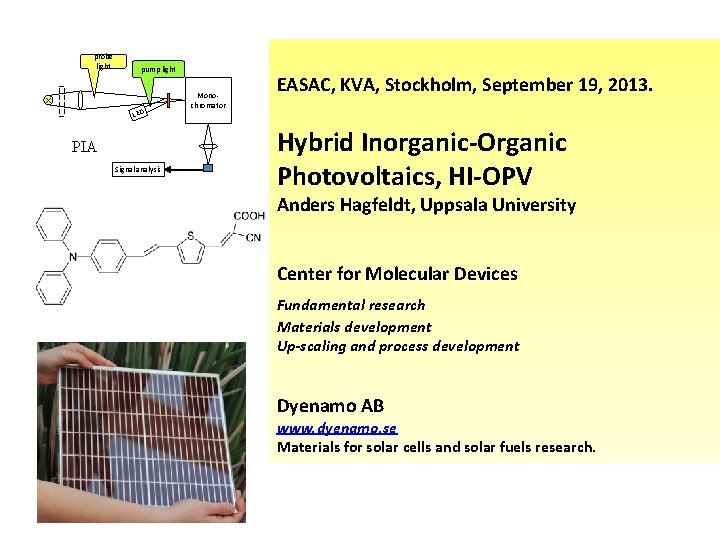
probe light pump light LED PIA Signal analysis Monochromator EASAC, KVA, Stockholm, September 19, 2013. Hybrid Inorganic-Organic Photovoltaics, HI-OPV Anders Hagfeldt, Uppsala University Center for Molecular Devices Fundamental research Materials development Up-scaling and process development Dyenamo AB www. dyenamo. se Materials for solar cells and solar fuels research.
Center for Molecular Devices (CMD) Uppsala University Physical Chemistry: Anders Hagfeldt Gerrit Boschloo Erik Johansson Leif Häggman Nick Vlachopoulos Susanna Eriksson Marina Freitag Lei Yang Yan Hao Dongqin Bi Byung-wook Park Hanna Ellis Jinbao Zhang Wenxing Yang Meysam Pazoki Kerttu Aitola Valentina Leandri 2 Physics: Håkan Rensmo Rebecka Lindblad Johan Oscarsson Azhar Zia Swerea IVF, Mölndal Henrik Pettersson Tadeusz Gruszecki Jan Preisig Elis Carlström KTH Stockholm Organic Chemistry: Licheng Sun Yunhua Xu Martin Karlsson Erik Gabrielsson Bo Xu Haining Tian Inorganic Chemistry: Lars Kloo Gunther Andersson Mikhail Gorlov James Gardner Johnny Slätt Muthuraaman Bhagavathi Achari Viswanathan Elumalai Majid Safdari Jiajia Gao
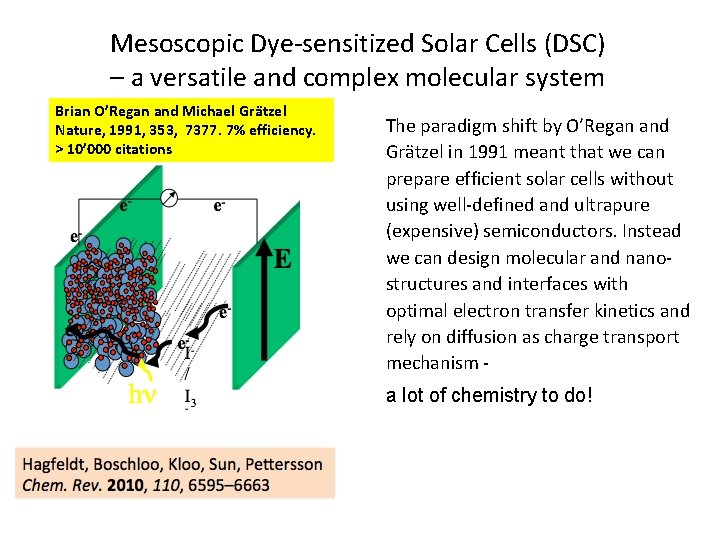
Mesoscopic Dye-sensitized Solar Cells (DSC) – a versatile and complex molecular system Brian O’Regan and Michael Grätzel Nature, 1991, 353, 7377. 7% efficiency. > 10’ 000 citations The paradigm shift by O’Regan and Grätzel in 1991 meant that we can prepare efficient solar cells without using well-defined and ultrapure (expensive) semiconductors. Instead we can design molecular and nanostructures and interfaces with optimal electron transfer kinetics and rely on diffusion as charge transport mechanism a lot of chemistry to do!
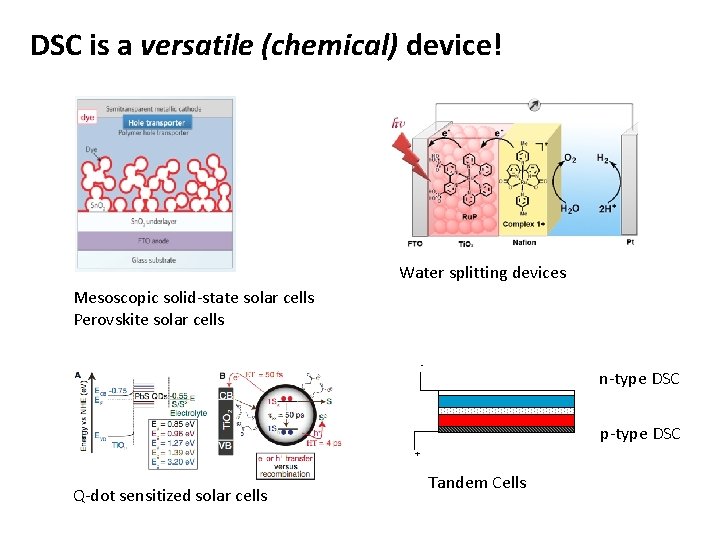
DSC is a versatile (chemical) device! Water splitting devices Mesoscopic solid-state solar cells Perovskite solar cells - n-type DSC p-type DSC + Q-dot sensitized solar cells Tandem Cells
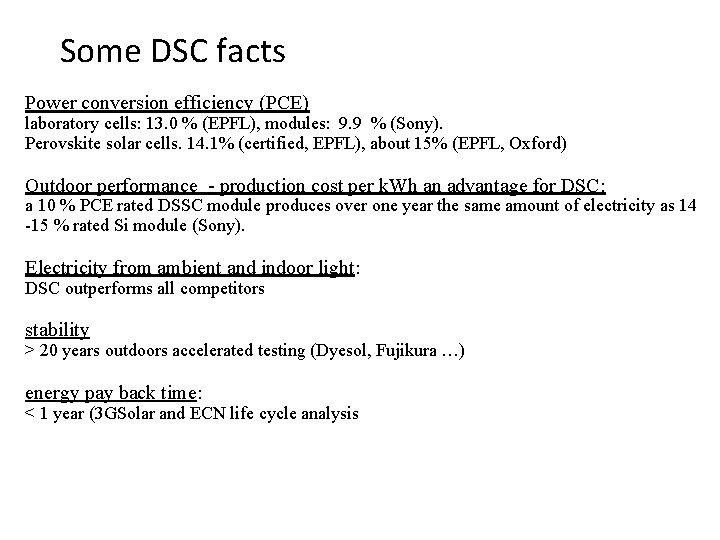
Some DSC facts Power conversion efficiency (PCE) laboratory cells: 13. 0 % (EPFL), modules: 9. 9 % (Sony). Perovskite solar cells. 14. 1% (certified, EPFL), about 15% (EPFL, Oxford) Outdoor performance - production cost per k. Wh an advantage for DSC: a 10 % PCE rated DSSC module produces over one year the same amount of electricity as 14 -15 % rated Si module (Sony). Electricity from ambient and indoor light: DSC outperforms all competitors stability > 20 years outdoors accelerated testing (Dyesol, Fujikura …) energy pay back time: < 1 year (3 GSolar and ECN life cycle analysis
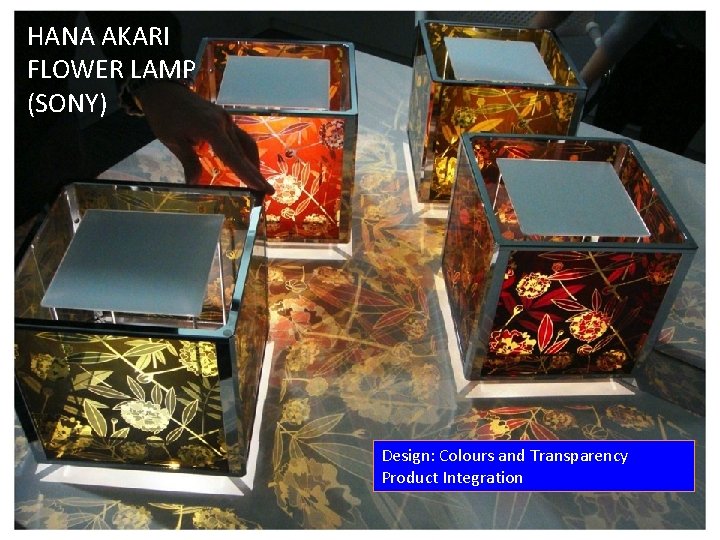
HANA AKARI FLOWER LAMP (SONY) Design: Colours and Transparency Product Integration 6
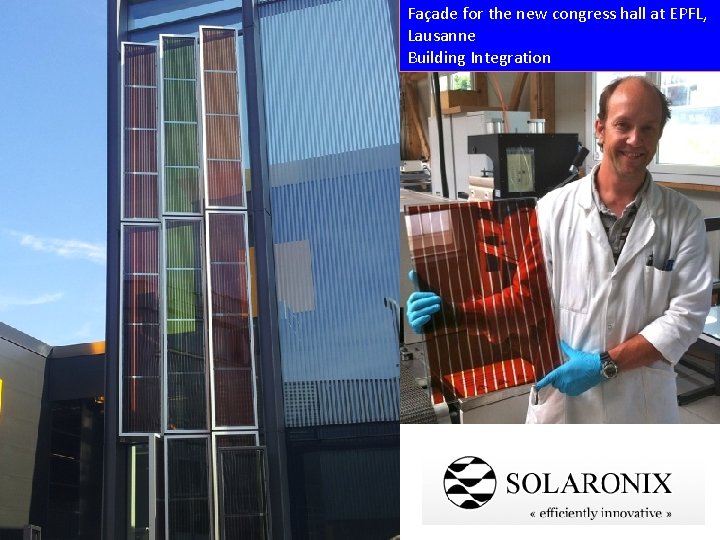
Façade for the new congress hall at EPFL, Lausanne Building Integration
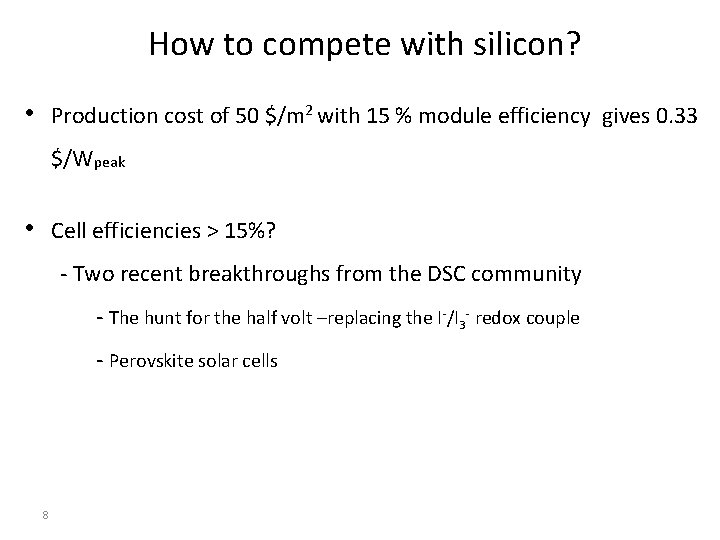
How to compete with silicon? • Production cost of 50 $/m 2 with 15 % module efficiency gives 0. 33 $/Wpeak • Cell efficiencies > 15%? - Two recent breakthroughs from the DSC community - The hunt for the half volt –replacing the I-/I 3 - redox couple - Perovskite solar cells 8
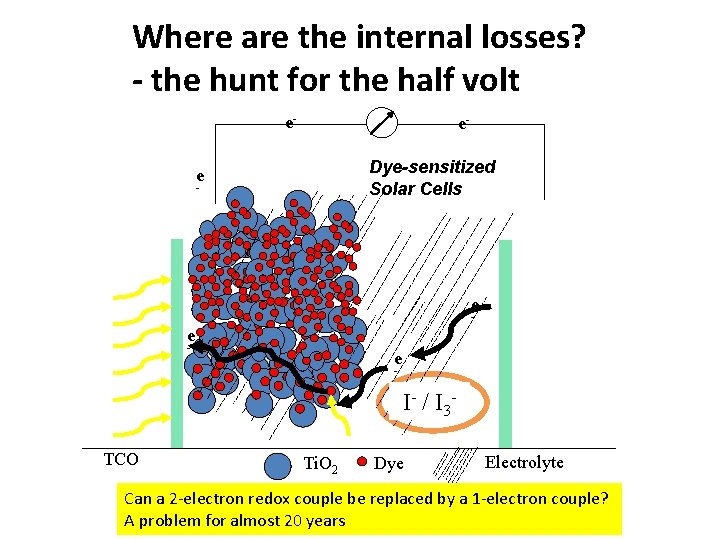
Where are the internal losses? - the hunt for the half volt e- e. Dye-sensitized Solar Cells e - e - I- / I 3 TCO Ti. O 2 Dye Electrolyte Can a 2 -electron redox couple be replaced by a 1 -electron couple? A problem for almost 20 years
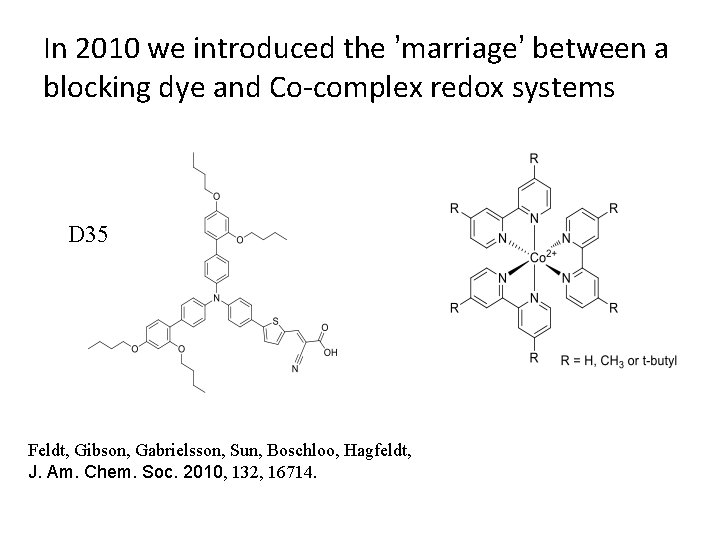
In 2010 we introduced the ’marriage’ between a blocking dye and Co-complex redox systems D 35 Feldt, Gibson, Gabrielsson, Sun, Boschloo, Hagfeldt, J. Am. Chem. Soc. 2010, 132, 16714.
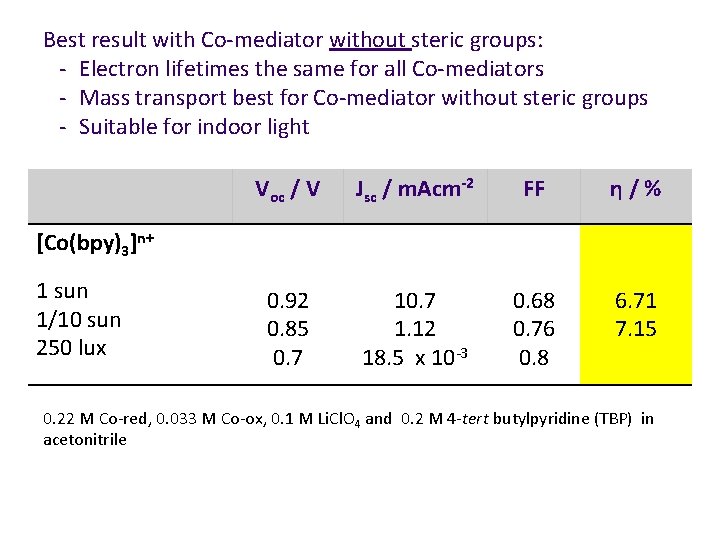
Best result with Co-mediator without steric groups: - Electron lifetimes the same for all Co-mediators - Mass transport best for Co-mediator without steric groups - Suitable for indoor light Voc / V Jsc / m. Acm-2 FF η/% 0. 92 0. 85 0. 7 1. 12 18. 5 x 10 -3 0. 68 0. 76 0. 8 6. 71 7. 15 [Co(bpy)3]n+ 1 sun 1/10 sun 250 lux 0. 22 M Co-red, 0. 033 M Co-ox, 0. 1 M Li. Cl. O 4 and 0. 2 M 4 -tert butylpyridine (TBP) in acetonitrile
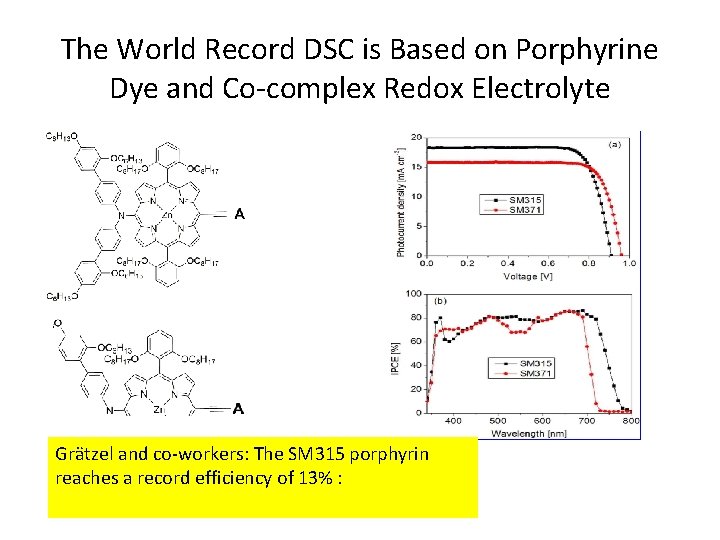
The World Record DSC is Based on Porphyrine Dye and Co-complex Redox Electrolyte Grätzel and co-workers: The SM 315 porphyrin reaches a record efficiency of 13% :
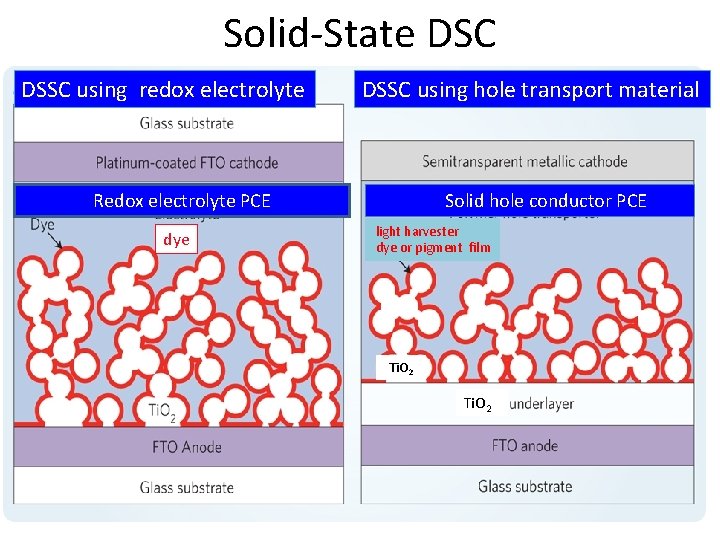
Solid-State DSC DSSC using redox electrolyte DSSC using hole transport material Redox electrolyte PCE dye Solid hole conductor PCE light harvester dye or pigment film Ti. O 2
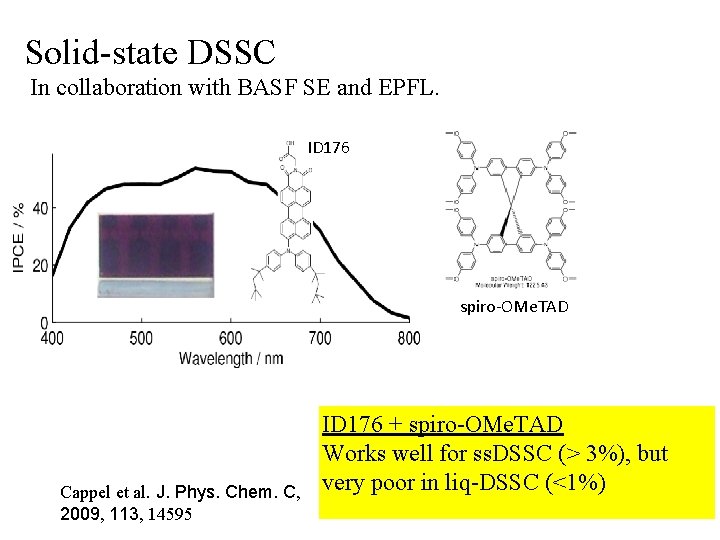
Solid-state DSSC In collaboration with BASF SE and EPFL. ID 176 spiro-OMe. TAD Cappel et al. J. Phys. Chem. C, 2009, 113, 14595 ID 176 + spiro-OMe. TAD Works well for ss. DSSC (> 3%), but very poor in liq-DSSC (<1%)
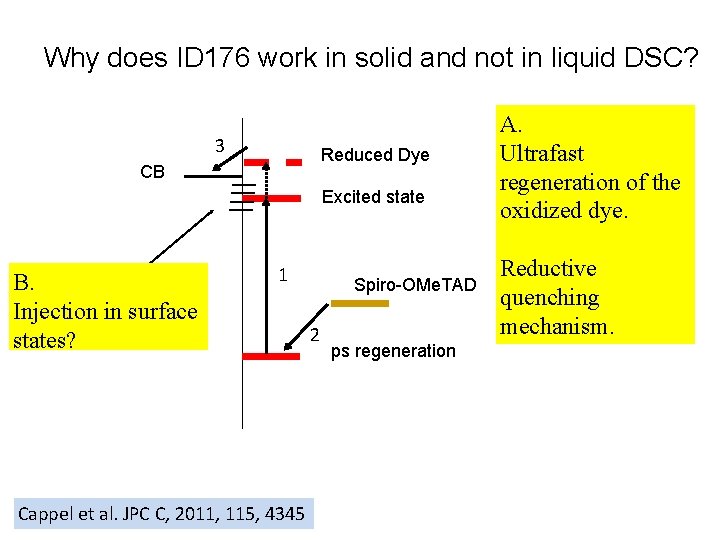
Why does ID 176 work in solid and not in liquid DSC? 3 Reduced Dye CB Excited state B. Injection in surface states? 1 Cappel et al. JPC C, 2011, 115, 4345 Spiro-OMe. TAD 2 ps regeneration A. Ultrafast regeneration of the oxidized dye. Reductive quenching mechanism.
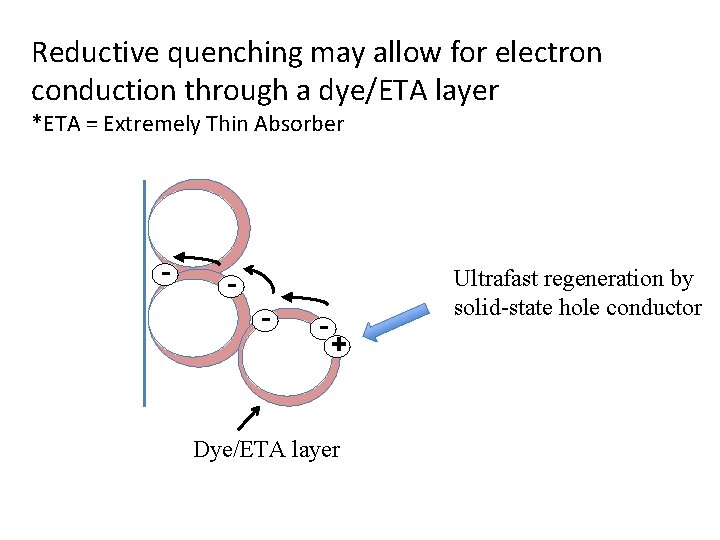
Reductive quenching may allow for electron conduction through a dye/ETA layer *ETA = Extremely Thin Absorber - - Ultrafast regeneration by solid-state hole conductor + Dye/ETA layer
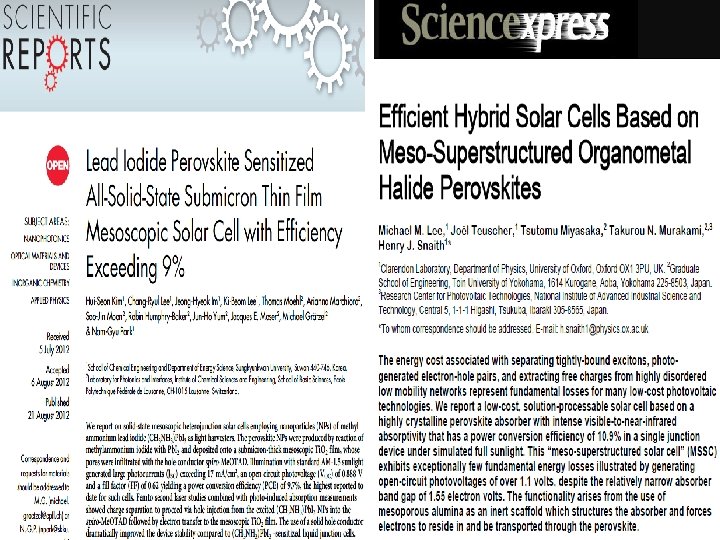
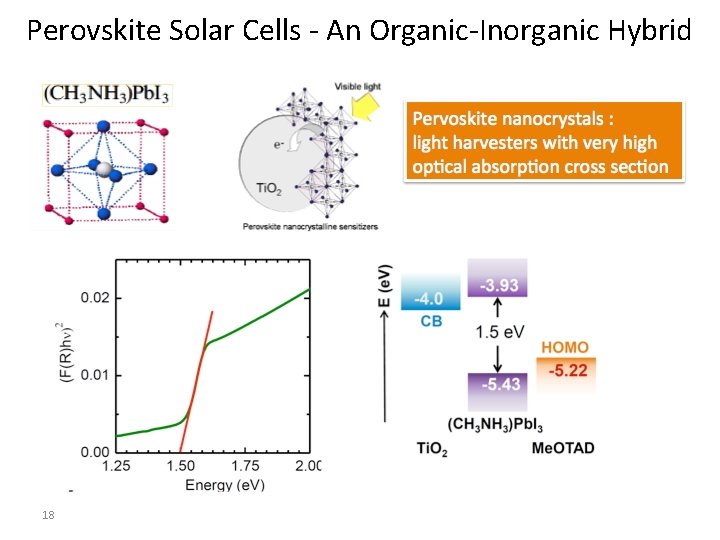
Perovskite Solar Cells - An Organic-Inorganic Hybrid 18
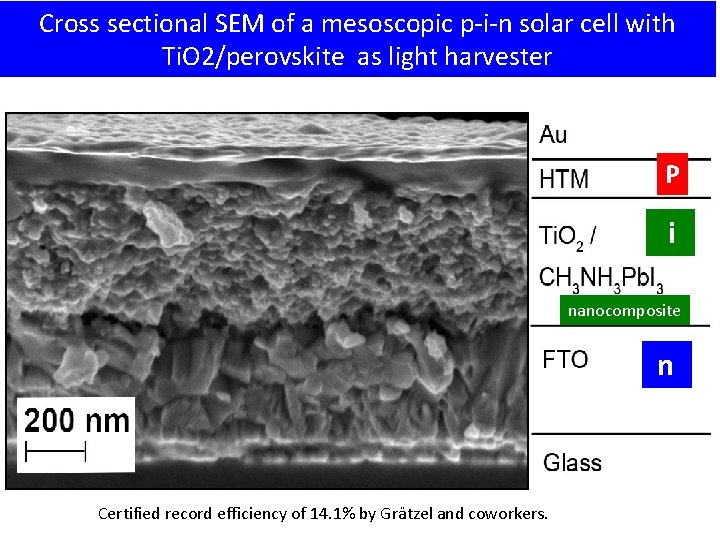
Cross sectional SEM of a mesoscopic p-i-n solar cell with Ti. O 2/perovskite as light harvester P i nanocomposite n Certified record efficiency of 14. 1% by Grätzel and coworkers.
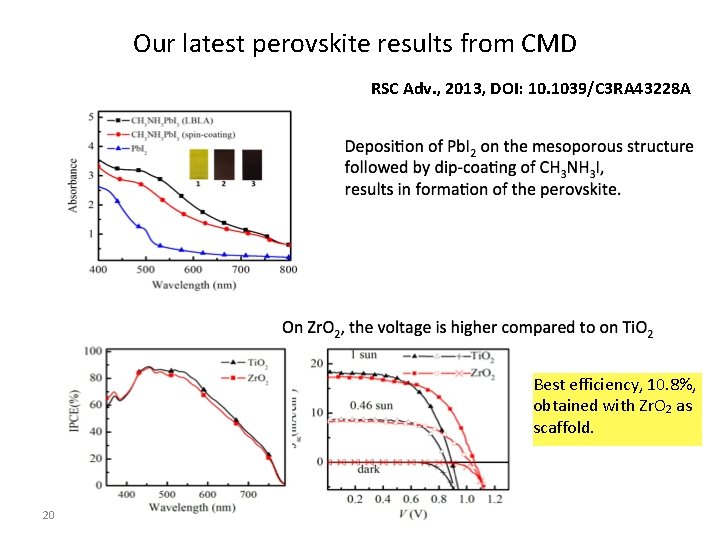
Our latest perovskite results from CMD RSC Adv. , 2013, DOI: 10. 1039/C 3 RA 43228 A Best efficiency, 10. 8%, obtained with Zr. O 2 as scaffold. 20
Several open fundamental questions • Perovskites work on insulating substrates like Zr. O 2 and Al 2 O 3. Is electron injection necessary? • Works without the p-type hole conductor (direct contact between Au and perovskite). • Low exciton binding energy (30 – 50 m. V). Selective contact device? • Reproducibility (morphology of perovskite vs preparation conditions) • Stability: for a single crystal perovskite there is e. g. A phase transtion at 55 0 C (from tetragonal to cubic) • Possibilities to replace Pb? • Opens up 3 rd Generation concepts?
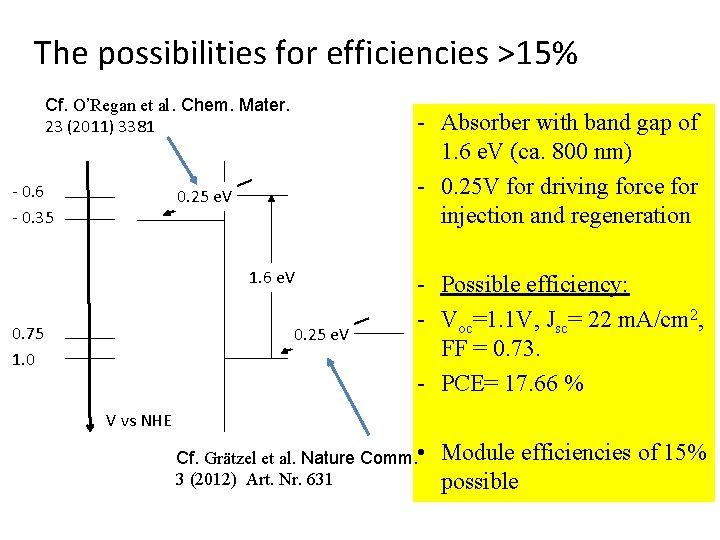
The possibilities for efficiencies >15% Cf. O’Regan et al. Chem. Mater. 23 (2011) 3381 - 0. 6 - 0. 35 - Absorber with band gap of 1. 6 e. V (ca. 800 nm) - 0. 25 V for driving force for injection and regeneration 0. 25 e. V 1. 6 e. V 0. 75 1. 0 0. 25 e. V - Possible efficiency: - Voc=1. 1 V, Jsc= 22 m. A/cm 2, FF = 0. 73. - PCE= 17. 66 % V vs NHE Cf. Grätzel et al. Nature Comm. • 3 (2012) Art. Nr. 631 Module efficiencies of 15% possible
Financial Support - CMD Knut & Alice Wallenberg Foundation Sony Deutschland Gmb. H Merck, Germany
- Slides: 23