
PROBATE AND ADMINISTATION OF ESTATES 2016 Administering the
PROBATE AND ADMINISTATION OF ESTATES 2016 Administering the Estate – Part One October 28, 2016 ______________________________________ Daniel P. Buckley (914) 287 -6111 Bleakley Platt & Schmidt LLP dbuckley@bpslaw. com
Estate Administration Generally • General Overview: The process of marshalling the decedent’s assets, paying the decedent’s debts, administration expenses and taxes, and distributing the decedent’s remaining assets pursuant to governing instruments (usually the decedent’s last will and testament and/or a trust). • Probate and administration proceedings are really about allowing this process to begin and setting its terms 2
Timing of Estate Administration • • • Generally begins upon appointment of fiduciary • A nominated executor may have some powers pursuant to EPTL § 11 -1. 3, but this is questionable • Gather as much information before appointment as possible Be prepared to execute critical tasks immediately upon appointment Completing the administration of an estate often takes 1 -3 years, or could be significantly longer under certain circumstances 3
Bear in Mind Throughout Administration • Always think about taxes! • Examples 1. Timing of legal fees 2. Satisfaction of pecuniary bequest • Executor’s Account • Will need to account to beneficiaries for all actions (and inactions) and transactions • Standard of conduct • Record keeping – Consider computer software 4
A. Determine the Nature and Extent of Decedent’s Assets and Liabilities • Sources of information: • Estate planning file and other advisors’ files • Executor’s knowledge • Decedent’s files (who to review? ) • Email? • Income tax returns (past 3 years) • Financial account statements (past 3 years) • Estate planning documents: 5
B. Study the Will and All Non-Testamentary Instruments • Didn’t I already do this for the probate proceeding? • Make outline of all governing instruments • But watch out! • Be prepared to explain all relevant provisions to Executor and beneficiaries in non-technical terms 6
B. Study the Will and All Non-Testamentary Instruments • Dispositive scheme: • Specific bequests • General bequests • Demonstrative bequests • Residuary bequests • Identity of beneficiaries: • Competent adults • Minors • Trusts • Executor 7
B. Study the Will and All Non-Testamentary Instruments • Tax apportionment (very important!) • Default rule : EPTL § 2 -1. 8 • Generally, tax apportioned among bequests based on how much tax each bequest generates • Usually modified by governing instruments • Consider corrective measures for “bad” tax clauses • Beware: an error can easily lead to surcharge! 8
B. Study the Will and All Non-Testamentary Instruments • Fiduciary powers • Default powers granted by statute : EPTL § 11 -1. 1 • Does instrument expand or restrict powers? • Are such modifications valid? – Consistent with prudent investor rule? (EPTL § 11 -2. 3) – Barred by anti-exoneration statute? (EPTL § 11 -1. 7) » Does not apply to inter vivos instruments? • Important Powers • Sell property • Continue business 9
B. Study the Will and All Non-Testamentary Instruments • Fiduciary powers (cont. ) • Mandatory instructions to Executor • Sell certain properties • Offers right of first refusal • Care for certain pieces of tangible personal property • Non-probate assets • Executor does not have direct power to administer • But has power to receive information about them • Often called upon to assist with administering • Tax apportionment (Executor primarily liable for tax) 10
C. Inter-vivos Trusts • • Make sure in existence prior to execution of pour-over will! Determine if funded during grantor’s life Check coordination between will and trust • Tax clauses For Revocable Trusts designed to avoid probate: • Were they fully funded (assignment of tangibles? )? • How will trustee’s commissions be calculated? • What notice and information to provide beneficiaries? • Are other rules the same? (E. g. , CPLR 4503(b)) 11
D. Collect and Value Assets • Determine what tasks should be done immediately: • Disposition of Decedent’s remains • Safeguarding assets and arranging for insurance • Obtain EIN, do tax forms (Forms SS-4, 2848 (ET-14), 56) • Retitle securities accounts and delegate investment responsibilities • Determine if RMDs have been taken from retirement accounts • Satisfy any RMD remaining for year of death • Payable to beneficiary, not Estate 12
D. Collect and Value Assets • Continue Decedent’s business • Need to hire someone? • Obligations under partnership or buy/sell agreement? • Analyze cash needs • Taxes, expenses, cash bequests, etc. • Pay debts immediately due • Not always as urgent as it seems • Notify social security • Collect death benefit • Refund excess payments (may be done automatically) 13
D. Collect and Value Assets • Other assets to be administered: • Open safe deposit box • Collect refunds from insurance, services and clubs • Stock certificates • Savings bonds • Otherwise non-probate assets payable to Estate • Currency and cash accounts • Debts owned to decedent • Real property • Obtain releases of lien for sale 14
D. Collect and Value Assets • • • Tangible personal property • What if beneficiaries are already in possession? Refunds • Services or memberships • Income tax Firearms Powers of appointment Review past three years of decedent’s income taxes and bank statements for additional assets 15
D. Collect and Value Assets Digital Assets Facebook, Gmail, You. Tube, Linked. In, Instagram Federal privacy laws (CFAA and SCA) generally make it illegal for an executor to access the accounts Terms of Service Agreements generally do not allow transference to anyone else and prevent sharing of login information (even to executor) State anti-hacking laws broadly criminalize unauthorized accessing of a computer 16
D. Collect and Value Assets Digital Assets (cont. ) RUFADAA • Check the governing instrument • Possible federal preemption • Still have choice of law and forum provisions in terms of service which can make getting orders difficult Look for list of digital assets Look for physical backup Traditional assets with online access probably unaffected 17
D. Collect and Value Assets Valuation, in brief Real estate Stocks and bonds Life insurance Closely held businesses (new § 2704 Regs. ) Powers of appointment Discounts • Lack of Control • Lack of Marketability • Blockage • Built in tax liability for capital gains? 18
E. Plan the Administration • For all estates, consider: • Cash needs • Recordkeeping (Duplicate statements) • Division of labor between executor and attorney • Tax return preparation • Income tax planning • § 645 election • § 754 election • Insurance coverage 19
E. Plan the Administration • • Meet with Executor as soon as possible to discuss: • Terms of governing instruments • Urgent tasks • Division of labor between Executor and law firm • Cash needs • Problem assets • Issues regarding beneficiaries Follow up with “roadmap” letter 20
E. Plan the Administration Remember your and your client’s duties Attorney • Fees • Who is your client? Executor: • Duty to keep assets separate • Undivided loyalty • Duty to account 21
E. Plan the Administration Avoiding liability, for both Executor and attorney Try to predict where things can go wrong Try to predict how you would challenge administration Common mistakes: • Failure to review statements • Poor or no income tax planning • Violation of fiduciary duties (self dealing, impartiality) • Loses occasioned or exacerbated by delay • Failure to utilize post mortem estate planning • Missing or unnecessarily making QTIP election • Missing GST tax issues 22
F. Dealing with Creditors • • A claim is a debt, other than taxes (SCPA § 1803) In the normal course: • Executor receives invoice • Executor attempts to negotiate a discount • Executor pays claim after (minimal? ) investigation Exceptions • Executor to challenge claim • Estate is insolvent Not an option • Ignoring a claim • Paying an unjustified claim 23
F. Dealing with Creditors Overview of claims procedure (SCPA Art. 18) Claim must be presented in writing (§ 1803) Executor can request supporting affidavit (§ 1803) Executor allows or rejects claim • Claim is deemed rejected if not allowed w/in 90 days After 7 months from appointment, Executor is no longer personally liable for unpresented claims • Can be a good explanation for delay of distributions Creditors can litigate rejected claim in Surrogate’s Court or other court (if action brought within 60 days) 24
F. Dealing with Creditors Claims owed to fiduciary Examples • Fiduciary is owed professional fees • Fiduciary made loan to decedent during lifetime Generally, cannot pay claim until final settlement of estate • Informal settlement acceptable Must seek court approval to be paid prior 25
G. Insolvent Estates An insolvent estate cannot make all payments necessary prior to distribution to beneficiaries If there is even a question of insolvency, do not pay anything until all necessary information is gathered to be able to comply with SCPA § 1811! Failure to do so exposes him to surcharge May want to seek court approval of payments in any event 26
G. Insolvent Estates 1. 2. 3. 4. 5. • • General Overview of § 1811 Warning – details dramatically change the result! Exempt property Administration expenses Funeral expenses Taxes Other unsecured debts Exception – secured debts, to extent of collateral Creditors also may have rights against non-probate assets 27
H. Spouse’s Right of Election A “forced share” of a decedent’s property to be paid to surviving spouse Governed by EPTL 5 -1. 1 -A Greater of $50, 000 or 1/3 of the “net estate” Complicated calculation Pecuniary amount Interest? See new statute. Does not share in income of estate Does not share in increases or decreases of value of assets 28 of the estate
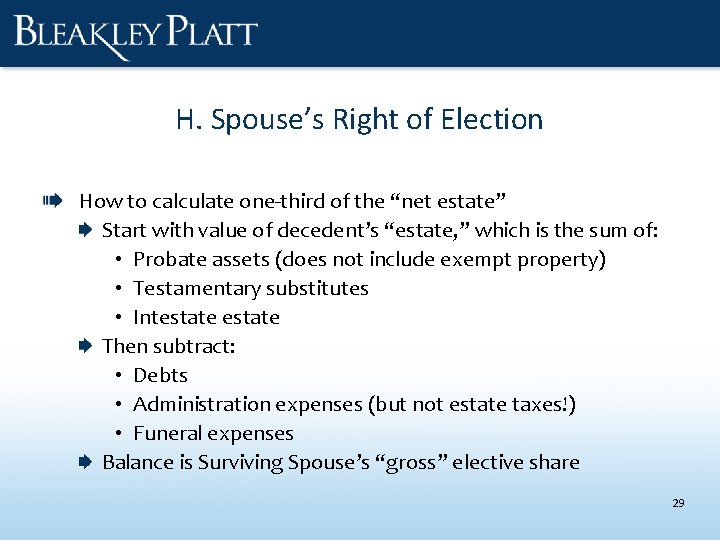
H. Spouse’s Right of Election How to calculate one-third of the “net estate” Start with value of decedent’s “estate, ” which is the sum of: • Probate assets (does not include exempt property) • Testamentary substitutes • Intestate Then subtract: • Debts • Administration expenses (but not estate taxes!) • Funeral expenses Balance is Surviving Spouse’s “gross” elective share 29
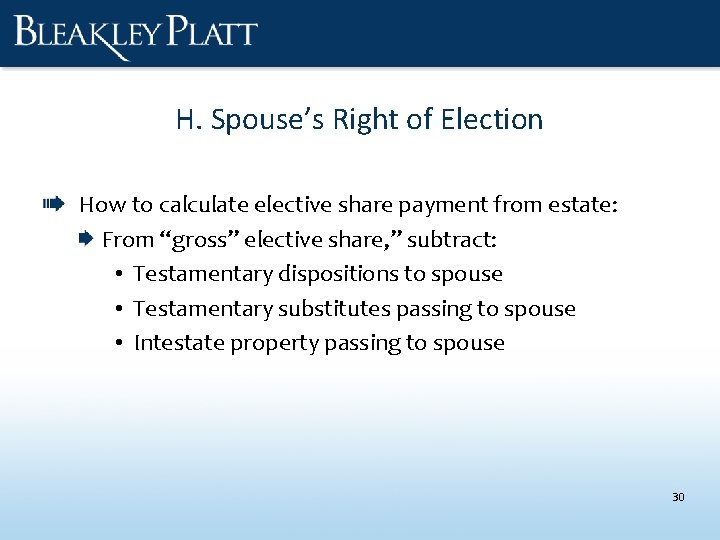
H. Spouse’s Right of Election How to calculate elective share payment from estate: From “gross” elective share, ” subtract: • Testamentary dispositions to spouse • Testamentary substitutes passing to spouse • Intestate property passing to spouse 30
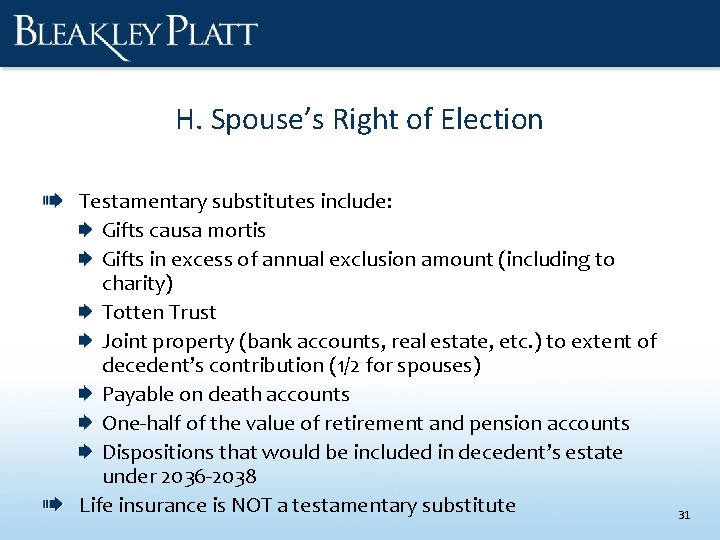
H. Spouse’s Right of Election Testamentary substitutes include: Gifts causa mortis Gifts in excess of annual exclusion amount (including to charity) Totten Trust Joint property (bank accounts, real estate, etc. ) to extent of decedent’s contribution (1/2 for spouses) Payable on death accounts One-half of the value of retirement and pension accounts Dispositions that would be included in decedent’s estate under 2036 -2038 Life insurance is NOT a testamentary substitute 31
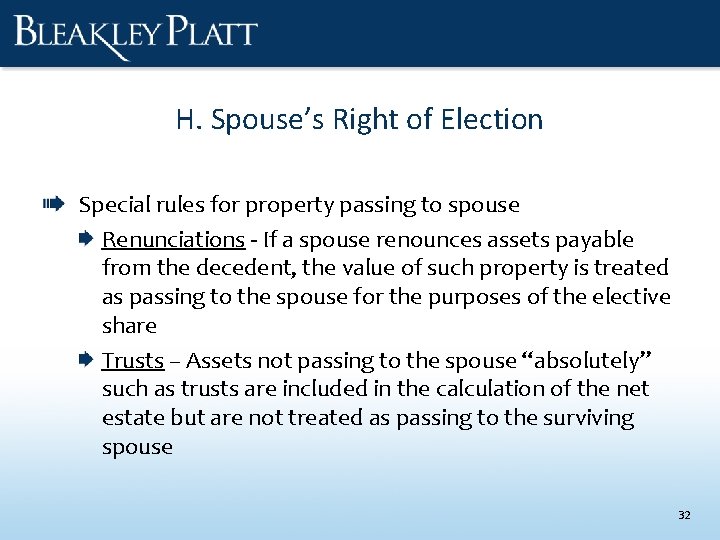
H. Spouse’s Right of Election Special rules for property passing to spouse Renunciations - If a spouse renounces assets payable from the decedent, the value of such property is treated as passing to the spouse for the purposes of the elective share Trusts – Assets not passing to the spouse “absolutely” such as trusts are included in the calculation of the net estate but are not treated as passing to the surviving spouse 32
H. Spouse’s Right of Election Any elective share payment is made pro rata from all persons benefiting from property over which elective share was calculated This can be varied by governing instruments, but usually is drafted around altogether A right of election can be waived so check pre/post nuptial agreements Right of election is a personal right and cannot be exercised by spouse’s personal representative or creditors 33
H. Spouse’s Right of Election Procedure Election must be made within six months of the issuance of letters, but no later than two years after decedent’s death • Extension can be granted by court for good cause Election must be in writing and served on decedent’s representative and filed in court 34
I. Disqualification of Surviving Spouse EPTL § 5 -1. 2 provides that person can be disqualified as a surviving spouse for the purposes of: Intestacy Elective share Exempt property Wrongful death 35
I. Disqualification of Surviving Spouse Person can be disqualified as surviving spouse on the following grounds: 1. Divorce or annulment in effect at time of death 2. Bigamy or other prohibited marriage 3. Separation decree in effect at time of death 4. Abandonment 5. Failure to provide for surviving spouse 36
J. Exempt Property Some states have “widow’s allowance” statues New York does not have one Instead, New York has an “exempt property” statute which provides that certain property passes automatically from a decedent to his or her surviving spouse, or if none, to his or her children under the age of 21 Exempt property can be enforced by beneficiary pursuant to SCPA § 2102(2) 37
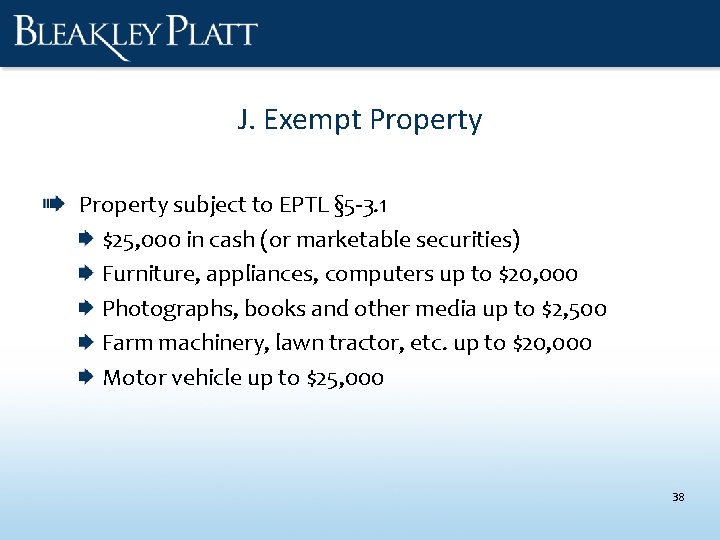
J. Exempt Property subject to EPTL § 5 -3. 1 $25, 000 in cash (or marketable securities) Furniture, appliances, computers up to $20, 000 Photographs, books and other media up to $2, 500 Farm machinery, lawn tractor, etc. up to $20, 000 Motor vehicle up to $25, 000 38
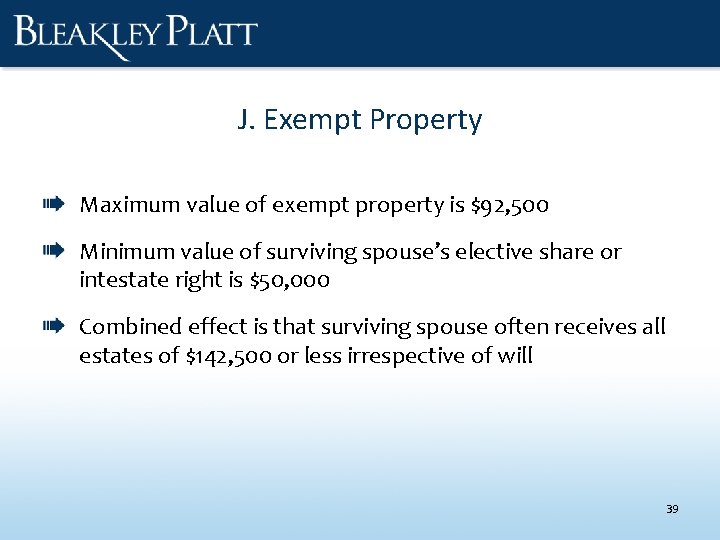
J. Exempt Property Maximum value of exempt property is $92, 500 Minimum value of surviving spouse’s elective share or intestate right is $50, 000 Combined effect is that surviving spouse often receives all estates of $142, 500 or less irrespective of will 39
K. Renunciation and Disclaimer • • • Disclaimer – IRC § 2518 Renunciation – EPTL § 2 -1. 11 Essentially a refusal to accept property Effect of a disclaimer is to treat the person making the disclaimer as predeceasing transferor Allows for a number of post mortem planning opportunities 40
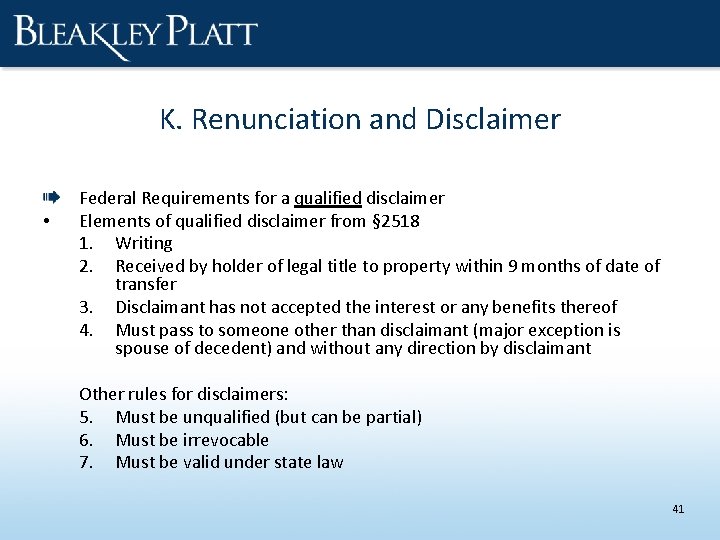
K. Renunciation and Disclaimer • Federal Requirements for a qualified disclaimer Elements of qualified disclaimer from § 2518 1. Writing 2. Received by holder of legal title to property within 9 months of date of transfer 3. Disclaimant has not accepted the interest or any benefits thereof 4. Must pass to someone other than disclaimant (major exception is spouse of decedent) and without any direction by disclaimant Other rules for disclaimers: 5. Must be unqualified (but can be partial) 6. Must be irrevocable 7. Must be valid under state law 41
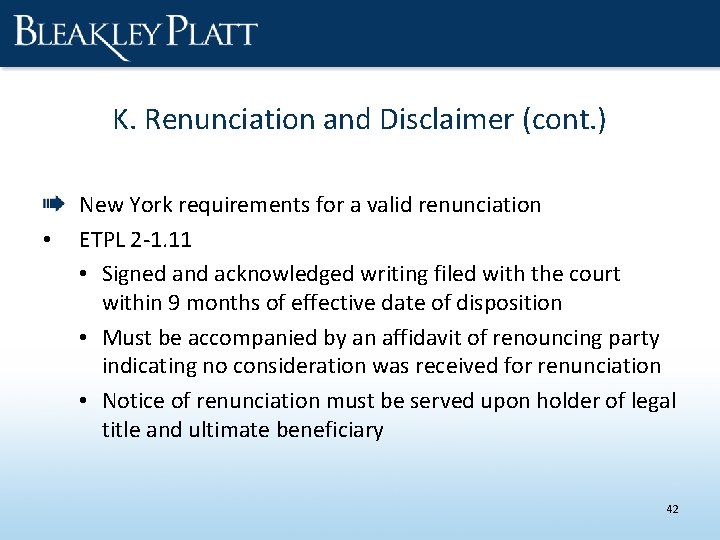
K. Renunciation and Disclaimer (cont. ) • New York requirements for a valid renunciation ETPL 2 -1. 11 • Signed and acknowledged writing filed with the court within 9 months of effective date of disposition • Must be accompanied by an affidavit of renouncing party indicating no consideration was received for renunciation • Notice of renunciation must be served upon holder of legal title and ultimate beneficiary 42
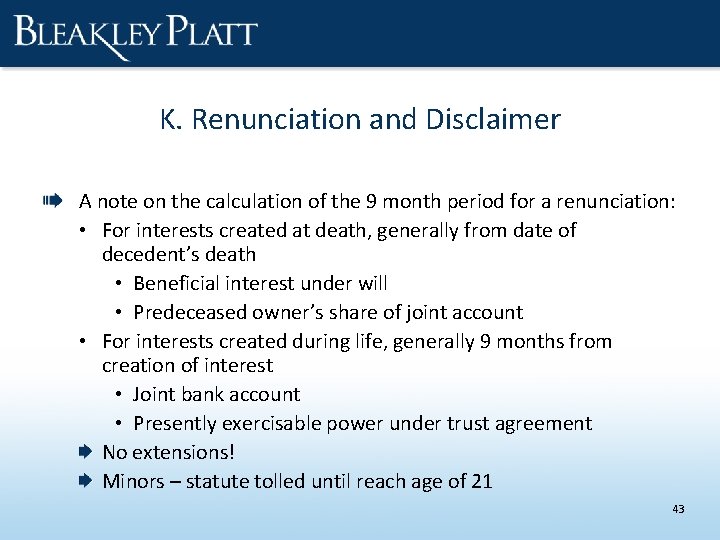
K. Renunciation and Disclaimer A note on the calculation of the 9 month period for a renunciation: • For interests created at death, generally from date of decedent’s death • Beneficial interest under will • Predeceased owner’s share of joint account • For interests created during life, generally 9 months from creation of interest • Joint bank account • Presently exercisable power under trust agreement No extensions! Minors – statute tolled until reach age of 21 43
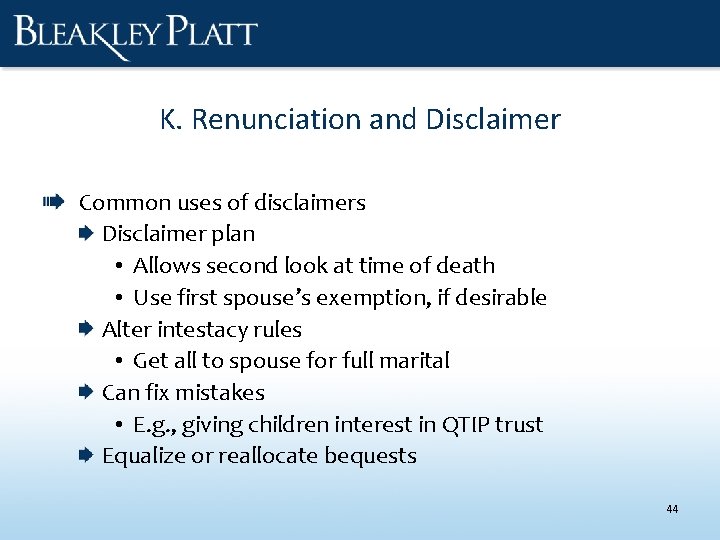
K. Renunciation and Disclaimer Common uses of disclaimers Disclaimer plan • Allows second look at time of death • Use first spouse’s exemption, if desirable Alter intestacy rules • Get all to spouse for full marital Can fix mistakes • E. g. , giving children interest in QTIP trust Equalize or reallocate bequests 44
L. Payment and Satisfaction of Test. Disp. General timing of distributions EPTL § 11 -1. 5 allows wait seven months to make distributions Testamentary dispositions must be analyzed individually Often paid as soon as possible once Executor determines distribution is proper
L. Payment and Satisfaction of Test. Disp. Specific bequests Title vests at moment of death, subject to Executor’s right to use for debts, expenses, etc. Once Executor assents to specific legatee taking property he must take it where it is and pay all shipping and storing costs Will usually varies this rule 46
L. Payment and Satisfaction of Test. Disp. General legacies Be sure there are sufficient assets before paying bequest First obtain receipt, release and refunding agreement from beneficiary (applies to specific bequests also) If you have a marital deduction formula, check if it creates a pecuniary or fractional disposition Interest is payable after seven months • Rate is greater of federal funds rate minus 1% or 0. 5% Satisfaction in kind can have income tax consequences 47
L. Payment and Satisfaction of Test. Disp. Residuary Bequests Providing for debts, expenses, taxes critical Shares in income and increase/decrease of assets Consider holding reserve, if necessary Prepare Receipt, Release, Refunding and Indemnification Agreement File with Charities Bureau, if necessary 48
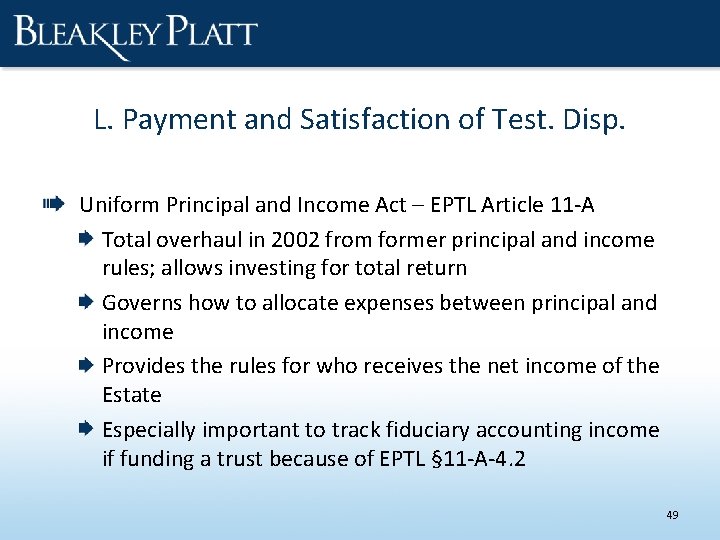
L. Payment and Satisfaction of Test. Disp. Uniform Principal and Income Act – EPTL Article 11 -A Total overhaul in 2002 from former principal and income rules; allows investing for total return Governs how to allocate expenses between principal and income Provides the rules for who receives the net income of the Estate Especially important to track fiduciary accounting income if funding a trust because of EPTL § 11 -A-4. 2 49
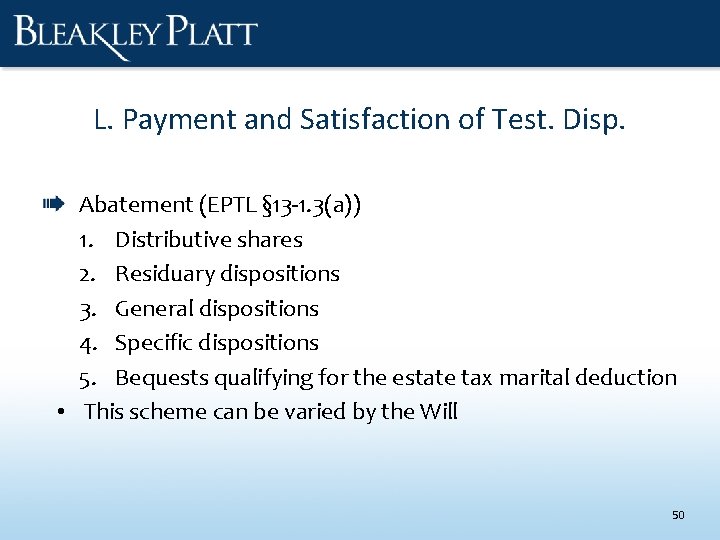
L. Payment and Satisfaction of Test. Disp. Abatement (EPTL § 13 -1. 3(a)) 1. Distributive shares 2. Residuary dispositions 3. General dispositions 4. Specific dispositions 5. Bequests qualifying for the estate tax marital deduction • This scheme can be varied by the Will 50
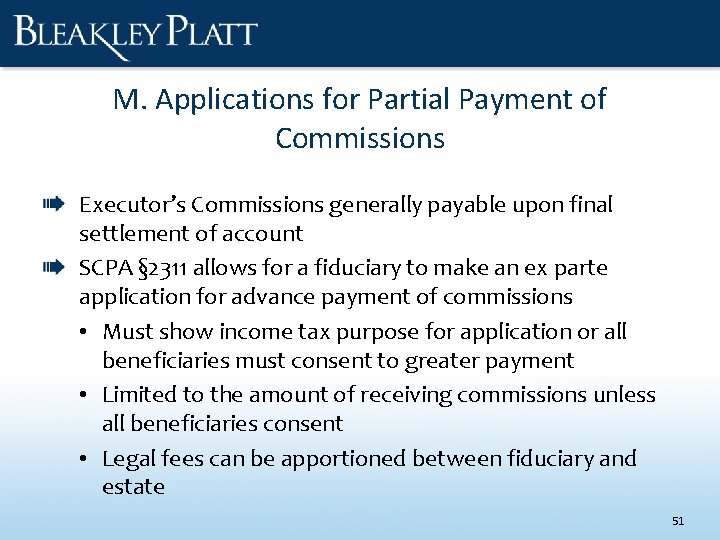
M. Applications for Partial Payment of Commissions Executor’s Commissions generally payable upon final settlement of account SCPA § 2311 allows for a fiduciary to make an ex parte application for advance payment of commissions • Must show income tax purpose for application or all beneficiaries must consent to greater payment • Limited to the amount of receiving commissions unless all beneficiaries consent • Legal fees can be apportioned between fiduciary and estate 51
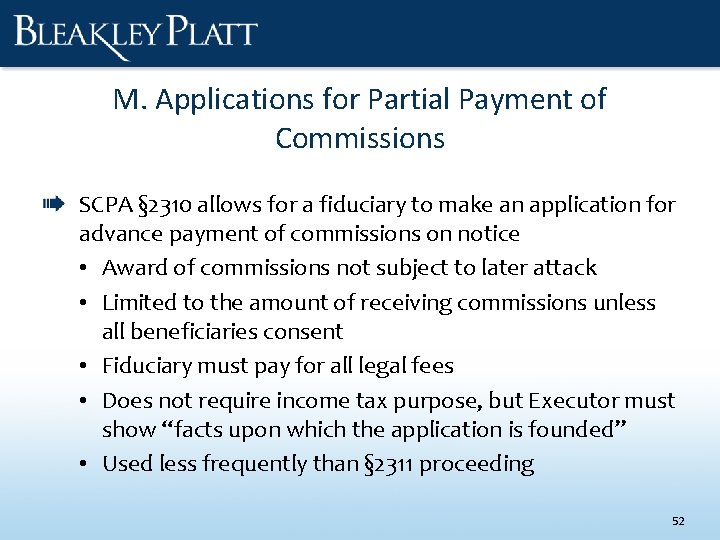
M. Applications for Partial Payment of Commissions SCPA § 2310 allows for a fiduciary to make an application for advance payment of commissions on notice • Award of commissions not subject to later attack • Limited to the amount of receiving commissions unless all beneficiaries consent • Fiduciary must pay for all legal fees • Does not require income tax purpose, but Executor must show “facts upon which the application is founded” • Used less frequently than § 2311 proceeding 52
N. Application for Advice and Direction SCPA § 2107 allows for a fiduciary to request court approval of a proposed course of action Can be used by Executors to: • Approve terms of a sale of an asset • Resolve deadlock among Executors • Approve of a course of action opposed by beneficiaries • Fiduciary wishes to purchase estate property Often unused because: Expense of proceeding Surrogates can (and often do) decline to entertain proceeding Fiduciaries do not like to give up control 53
O. Inventory of Assets Uniform Rule of Surrogate’s Court § 207. 20 requires the filing of an Inventory of Assets Uniform Rule recently amended and form of Inventory of Assets revised Revised form of Inventory now less specific Major use of Inventory is Court’s ability to confirm correct filing fee paid 54
O. Inventory of Assets Uniform Rule of the Surrogate’s Court § 207. 64 was also recently amended to provide that: Executors must redact “confidential personal information” from all filings with the court, which includes SSNs and EINs and account numbers (except last four digits) The following documents are no longer available for public inspection: • Article 17 or 17 -A matters • Death Certificates • Tax returns • Firearms Inventories • Medical records protected by HIPAA or other law 55
P. Foreign Property in the US outside of New York • Intangible personal property • Tangible personal property • Real property • Needs ancillary probate proceeding – Unless held in rev trust or LLC Property outside of the US 56
Summary 57
Must-Haves for Your Library New York Estate Administration By Dean Turano & Surrogate Radigan Warren’s Heaton on Surrogate’s Court Practice By various distinguished authors Harris – New York Estates: Probate Administration and Litigation By various distinguished authors BNA Portfolios An estate planning treatise 58
Questions? 59
- Slides: 59