
ProbabilityStatistics Review A random experiment Outcome varies in
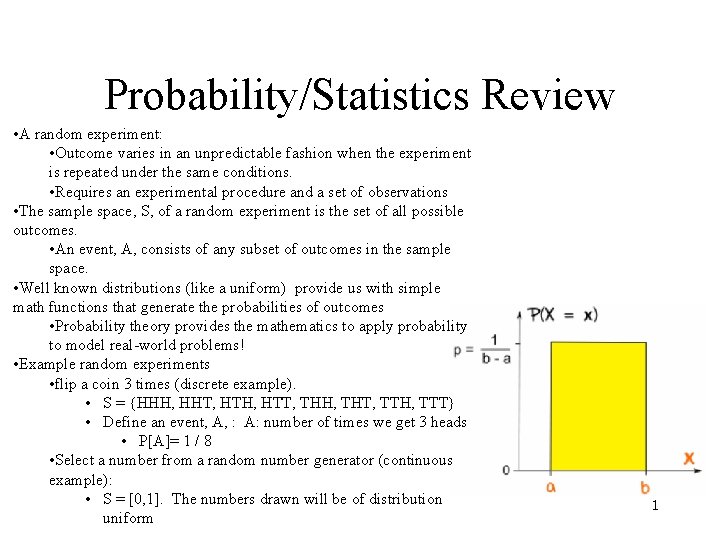
Probability/Statistics Review • A random experiment: • Outcome varies in an unpredictable fashion when the experiment is repeated under the same conditions. • Requires an experimental procedure and a set of observations • The sample space, S, of a random experiment is the set of all possible outcomes. • An event, A, consists of any subset of outcomes in the sample space. • Well known distributions (like a uniform) provide us with simple math functions that generate the probabilities of outcomes • Probability theory provides the mathematics to apply probability to model real-world problems! • Example random experiments • flip a coin 3 times (discrete example). • S = {HHH, HHT, HTH, HTT, THH, THT, TTH, TTT} • Define an event, A, : A: number of times we get 3 heads • P[A]= 1 / 8 • Select a number from a random number generator (continuous example): • S = [0, 1]. The numbers drawn will be of distribution uniform 1
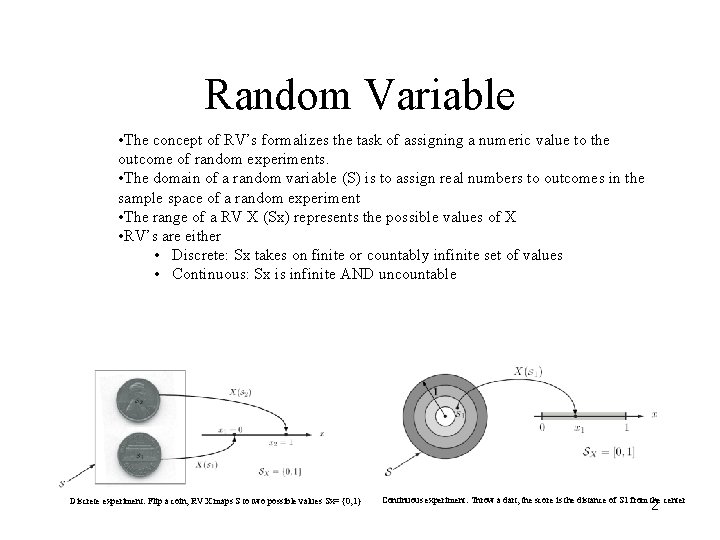
Random Variable • The concept of RV’s formalizes the task of assigning a numeric value to the outcome of random experiments. • The domain of a random variable (S) is to assign real numbers to outcomes in the sample space of a random experiment • The range of a RV X (Sx) represents the possible values of X • RV’s are either • Discrete: Sx takes on finite or countably infinite set of values • Continuous: Sx is infinite AND uncountable Discrete experiment: Flip a coin, RV X maps S to two possible values Sx= {0, 1} Continuous experiment: Throw a dart, the score is the distance of S 1 from the center 2
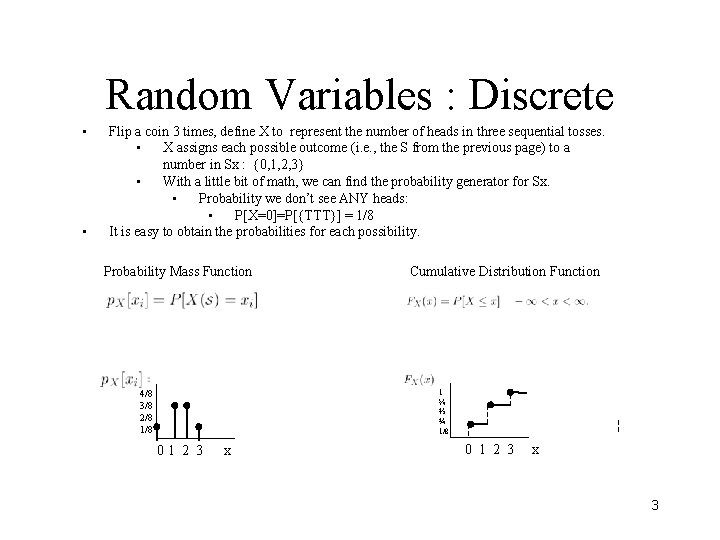
Random Variables : Discrete • • Flip a coin 3 times, define X to represent the number of heads in three sequential tosses. • X assigns each possible outcome (i. e. , the S from the previous page) to a number in Sx : {0, 1, 2, 3} • With a little bit of math, we can find the probability generator for Sx. • Probability we don’t see ANY heads: • P[X=0]=P[{TTT}] = 1/8 It is easy to obtain the probabilities for each possibility. Probability Mass Function 4/8 3/8 2/8 1/8 Cumulative Distribution Function 1 ¾ ½ ¼ 1/8 01 2 3 x 0 1 2 3 x 3
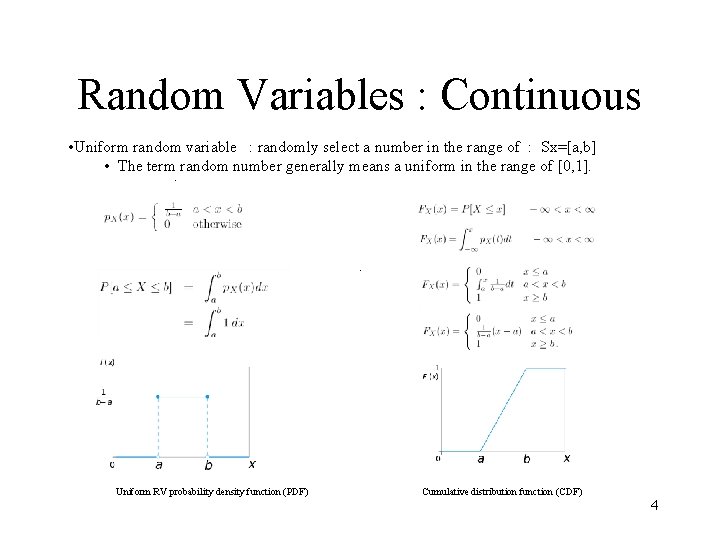
Random Variables : Continuous • Uniform random variable : randomly select a number in the range of : Sx=[a, b] • The term random number generally means a uniform in the range of [0, 1]. Uniform RV probability density function (PDF) Cumulative distribution function (CDF) 4
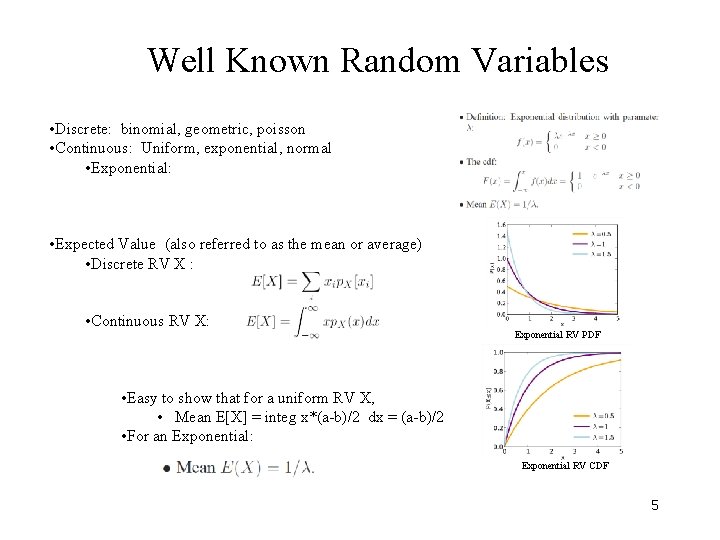
Well Known Random Variables • Discrete: binomial, geometric, poisson • Continuous: Uniform, exponential, normal • Exponential: • Expected Value (also referred to as the mean or average) • Discrete RV X : • Continuous RV X: Exponential RV PDF • Easy to show that for a uniform RV X, • Mean E[X] = integ x*(a-b)/2 dx = (a-b)/2 • For an Exponential: Exponential RV CDF 5
Random Number Generators • Rather than generating random variables, we generate random variates. • Random variates generated from the uniform distribution U[0, 1] are called random numbers. • Random variates from other distributions (e. g. , exponential) and realizations from various random processes (e. g. , Poisson process) can be obtained by transforming IID RN’s in particular ways. 6
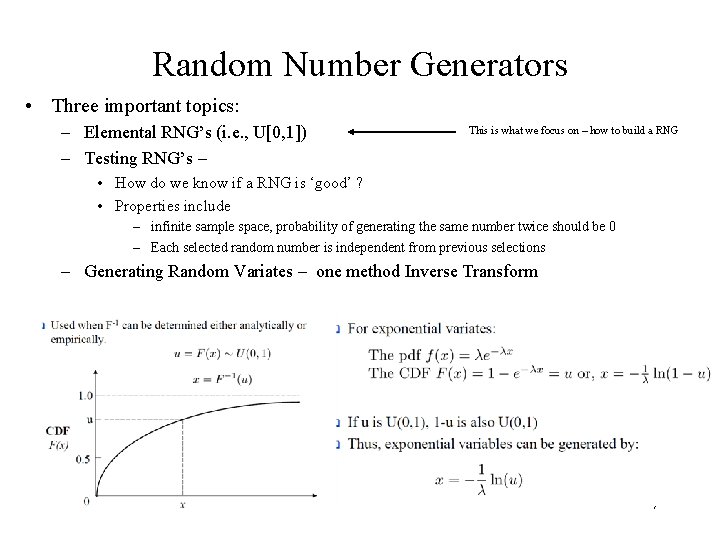
Random Number Generators • Three important topics: – Elemental RNG’s (i. e. , U[0, 1]) – Testing RNG’s – This is what we focus on – how to build a RNG • How do we know if a RNG is ‘good’ ? • Properties include – infinite sample space, probability of generating the same number twice should be 0 – Each selected random number is independent from previous selections – Generating Random Variates – one method Inverse Transform 7
Random Number Generators • At least three methods for obtaining RNs: – Read from a table of RN’s. – Use a physical device – Employ a recursive equation which generates the (i+1)st RN from previous RNs. • Deterministic therefore ‘pseudorandom number’ • The seed represents the location within the repeatable set of numbers 8
Random Number Generators • Properties of a U(0, 1) RN Generator: – Uniformly distributed in the interval (0, 1) – The RNs should be independent…. we will look at the mathematical definition of ‘correlation’ later – Many RNs should be generated before the cycle repeats (ideally it exhibits full period) – Reproducible and allow multiple streams – Consumes minimal cpu and memory resources 9
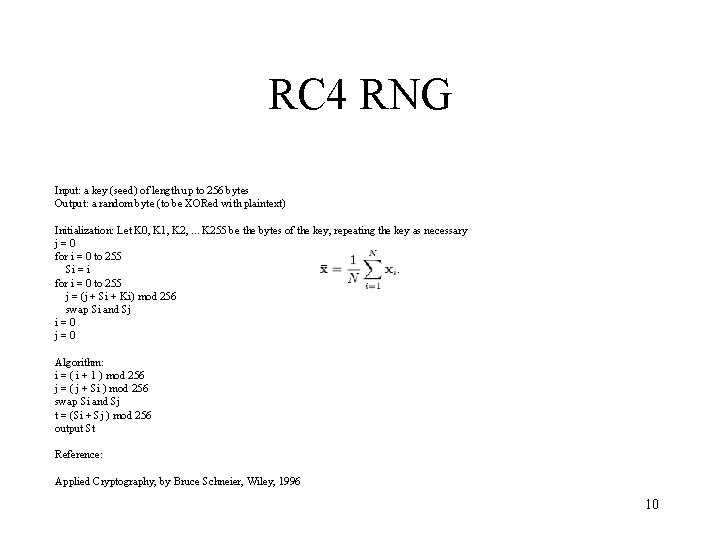
RC 4 RNG Input: a key (seed) of length up to 256 bytes Output: a random byte (to be XORed with plaintext) Initialization: Let K 0, K 1, K 2, . . . K 255 be the bytes of the key, repeating the key as necessary j=0 for i = 0 to 255 Si = i for i = 0 to 255 j = (j + Si + Ki) mod 256 swap Si and Sj i=0 j=0 Algorithm: i = ( i + 1 ) mod 256 j = ( j + Si ) mod 256 swap Si and Sj t = (Si + Sj ) mod 256 output St Reference: Applied Cryptography, by Bruce Schneier, Wiley, 1996 10
- Slides: 10