
Probability Theory Section 7 2 part 2 Bernoulli

Probability Theory Section 7. 2 (part 2)
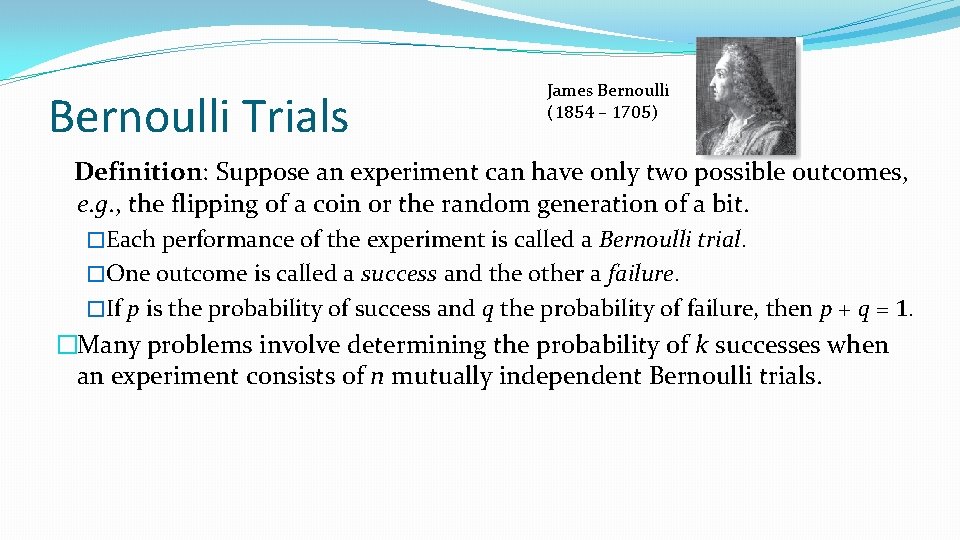
Bernoulli Trials James Bernoulli (1854 – 1705) Definition: Suppose an experiment can have only two possible outcomes, e. g. , the flipping of a coin or the random generation of a bit. �Each performance of the experiment is called a Bernoulli trial. �One outcome is called a success and the other a failure. �If p is the probability of success and q the probability of failure, then p + q = 1. �Many problems involve determining the probability of k successes when an experiment consists of n mutually independent Bernoulli trials.
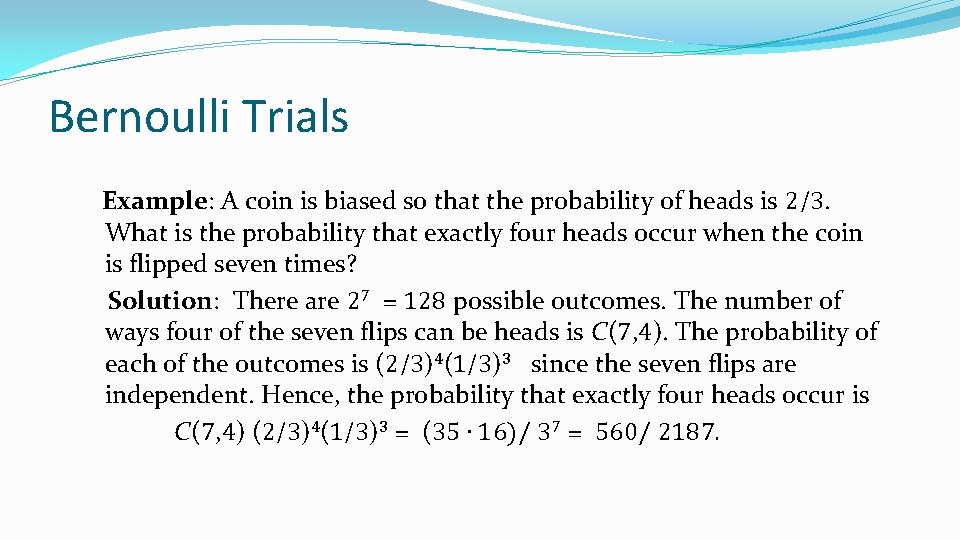
Bernoulli Trials Example: A coin is biased so that the probability of heads is 2/3. What is the probability that exactly four heads occur when the coin is flipped seven times? Solution: There are 27 = 128 possible outcomes. The number of ways four of the seven flips can be heads is C(7, 4). The probability of each of the outcomes is (2/3)4(1/3)3 since the seven flips are independent. Hence, the probability that exactly four heads occur is C(7, 4) (2/3)4(1/3)3 = (35 ∙ 16)/ 37 = 560/ 2187.

Probability of k Successes in n Independent Bernoulli Trials. Theorem 2: The probability of exactly k successes in n independent Bernoulli trials, with probability of success p and probability of failure q = 1 − p, is b(k: n, p) = C(n, k)pkqn−k. Proof: The outcome of n Bernoulli trials is an n-tuple (t 1, t 2, …, tn), where each ti is either S (success) or F (failure). The probability of each outcome of n trials consisting of k successes and k − 1 failures (in any order) is pkqn−k. Because there are C(n, k) n-tuples of Ss and Fs that contain exactly k Ss, the probability of k successes is C(n, k)pkqn−k. �This is the binomial distribution.
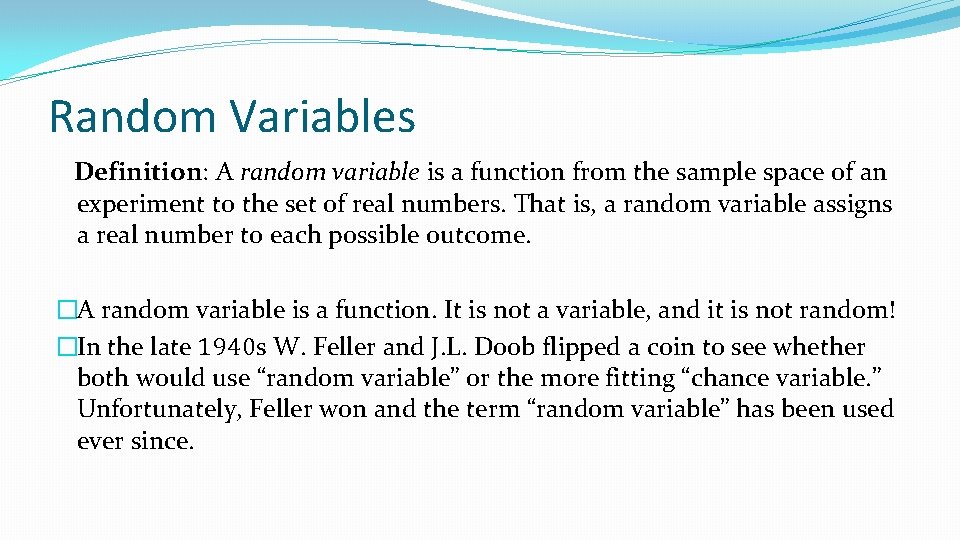
Random Variables Definition: A random variable is a function from the sample space of an experiment to the set of real numbers. That is, a random variable assigns a real number to each possible outcome. �A random variable is a function. It is not a variable, and it is not random! �In the late 1940 s W. Feller and J. L. Doob flipped a coin to see whether both would use “random variable” or the more fitting “chance variable. ” Unfortunately, Feller won and the term “random variable” has been used ever since.
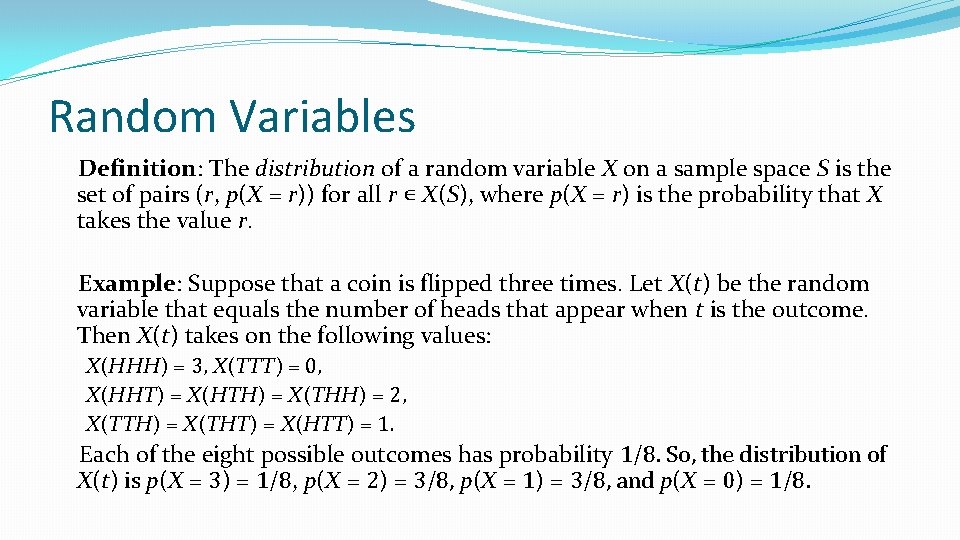
Random Variables Definition: The distribution of a random variable X on a sample space S is the set of pairs (r, p(X = r)) for all r ∊ X(S), where p(X = r) is the probability that X takes the value r. Example: Suppose that a coin is flipped three times. Let X(t) be the random variable that equals the number of heads that appear when t is the outcome. Then X(t) takes on the following values: X(HHH) = 3, X(TTT) = 0, X(HHT) = X(HTH) = X(THH) = 2, X(TTH) = X(THT) = X(HTT) = 1. Each of the eight possible outcomes has probability 1/8. So, the distribution of X(t) is p(X = 3) = 1/8, p(X = 2) = 3/8, p(X = 1) = 3/8, and p(X = 0) = 1/8.
The Famous Birthday Problem The puzzle of finding the number of people needed in a room to ensure that the probability of at least two of them having the same birthday is more than ½ has a surprising answer, which we now find. Solution: We assume that all birthdays are equally likely and that there are 366 days in the year. First, we find the probability pn that at least two of n people have different birthdays. Now, imagine the people entering the room one by one. The probability that at least two have the same birthday is 1− pn. � The probability that the birthday of the second person is different from that of the first is 365/366. � The probability that the birthday of the third person is different from the other two, when these have two different birthdays, is 364/366. � In general, the probability that the jth person has a birthday different from the birthdays of those already in the room, assuming that these people all have different birthdays, is (366 − (j − 1))/366 = (367 − j)/366. � Hence, pn = (365/366)(364/366)∙∙∙ (367 − n)/366. � Therefore , 1− pn = 1−(365/366)(364/366)∙∙∙ (367 − n)/366. Checking various values for n with computation help tells us that for n = 22, 1− pn ≈ 0. 457, and for n = 23, 1− pn ≈ 0. 506. Consequently, a minimum number of 23 people are needed so that the probability that at least two of them have the same birthday is greater than 1/2.
Monte Carlo Algorithms �Algorithms that make random choices at one or more steps are called probabilistic algorithms. �Monte Carlo algorithms are probabilistic algorithms that always produce an answer, but the answer is only probably correct, or sometimes approximately correct. �Monte Carlo algorithms are often used to answer decision problems, which are problems that either have “true” or “false” as their answer. � The algorithm consists of a sequence of tests, responding to each with “true” or ‘unknown. ’ � If the response is “true, ” the algorithm terminates with the answer is “true. ” � After running a specified sequence of tests where every step yields “unknown”, the algorithm outputs “false. ” � The idea is that the probability of the algorithm incorrectly outputting “false” should be very small as long as a sufficient number of tests are performed.
Probabilistic Primality Testing �Probabilistic primality testing (see Example 16 in text) is an example of a Monte Carlo algorithm, which is used to find large primes to generate the encryption keys for RSA cryptography (as discussed in Chapter 4). � An integer n greater than 1 can be shown to be composite (i. e. , not prime) if it fails a particular test (Miller’s test), using a random integer b with 1 < b < n as the base. But if n passes Miller’s test for a particular base b, it may either be prime or composite. The probability that a composite integer passes n Miller’s test is for a random b, is less that ¼. � So failing the test, is the “true” response in a Monte Carlo algorithm, and passing the test is “unknown. ” � If the test is performed k times (choosing a random integer b each time) and the number n passes Miller’s test at every iteration, then the probability that it is composite is less than (1/4)k. So for a sufficiently, large k, the probability that n is composite even though it has passed all k iterations of Miller’s test is small. For example, with 10 iterations, the probability that n is composite is less than 1 in 1, 000.
- Slides: 9