
Probability The probability scale The chance of an
Probability
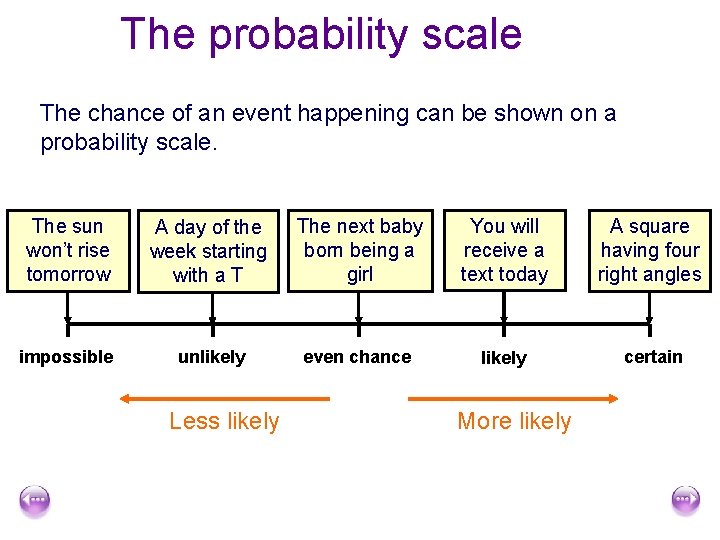
The probability scale The chance of an event happening can be shown on a probability scale. The sun won’t rise tomorrow A day of the week starting with a T The next baby born being a girl You will receive a text today A square having four right angles impossible unlikely even chance likely certain Less likely More likely
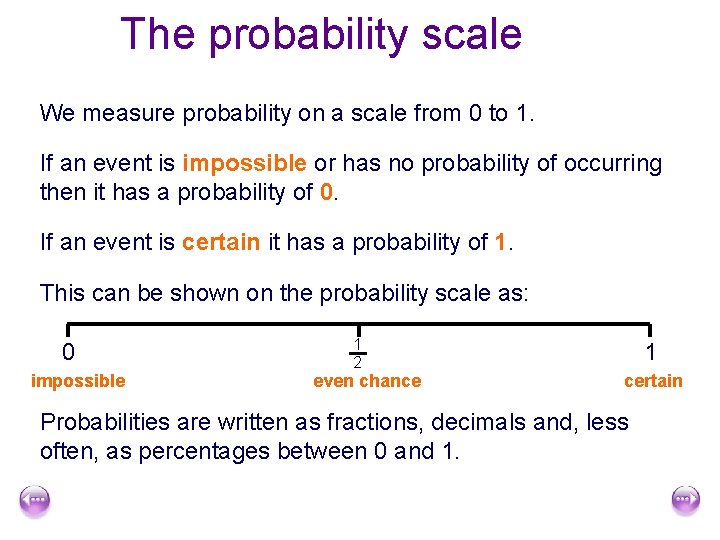
The probability scale We measure probability on a scale from 0 to 1. If an event is impossible or has no probability of occurring then it has a probability of 0. If an event is certain it has a probability of 1. This can be shown on the probability scale as: 0 impossible 1 2 even chance 1 certain Probabilities are written as fractions, decimals and, less often, as percentages between 0 and 1.
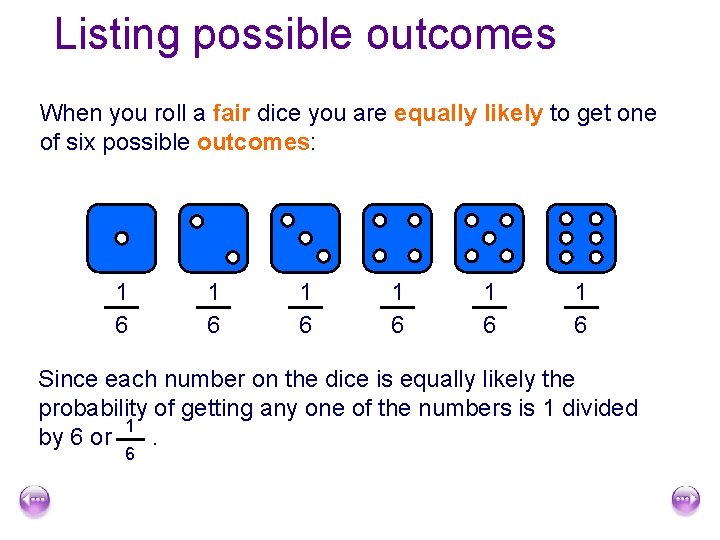
Listing possible outcomes When you roll a fair dice you are equally likely to get one of six possible outcomes: 1 6 1 6 1 6 Since each number on the dice is equally likely the probability of getting any one of the numbers is 1 divided 1 by 6 or. 6
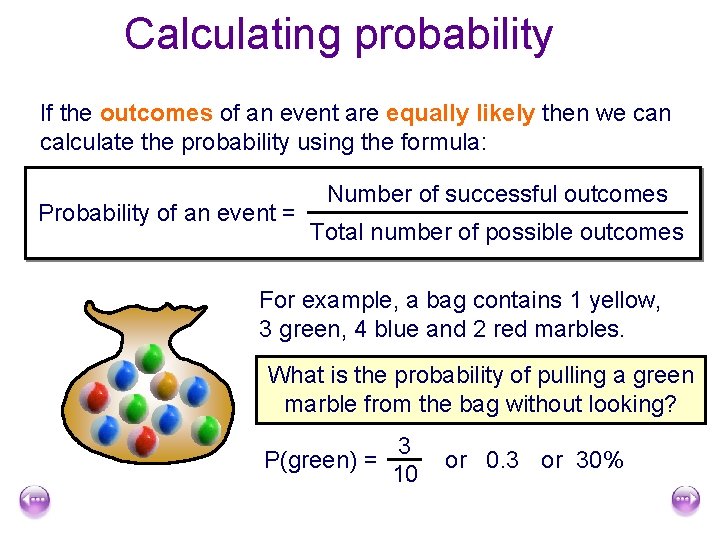
Calculating probability If the outcomes of an event are equally likely then we can calculate the probability using the formula: Probability of an event = Number of successful outcomes Total number of possible outcomes For example, a bag contains 1 yellow, 3 green, 4 blue and 2 red marbles. What is the probability of pulling a green marble from the bag without looking? P(green) = 3 10 or 0. 3 or 30%
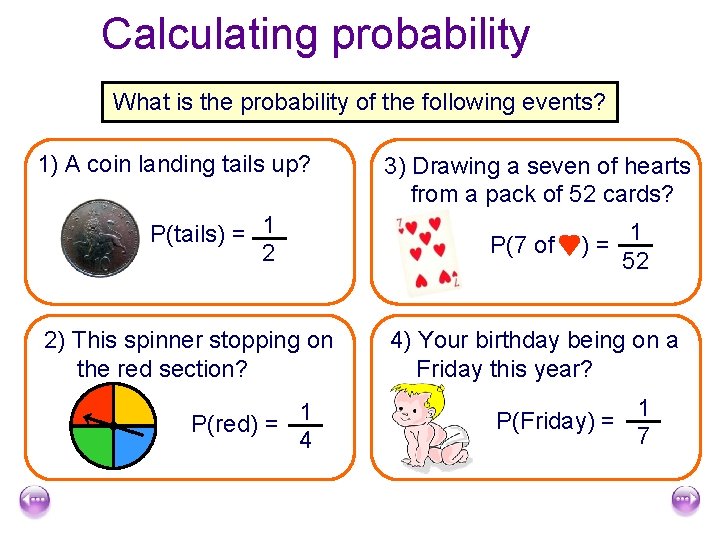
Calculating probability What is the probability of the following events? 1) A coin landing tails up? P(tails) = 1 2 2) This spinner stopping on the red section? 1 P(red) = 4 3) Drawing a seven of hearts from a pack of 52 cards? P(7 of )= 1 52 4) Your birthday being on a Friday this year? P(Friday) = 1 7
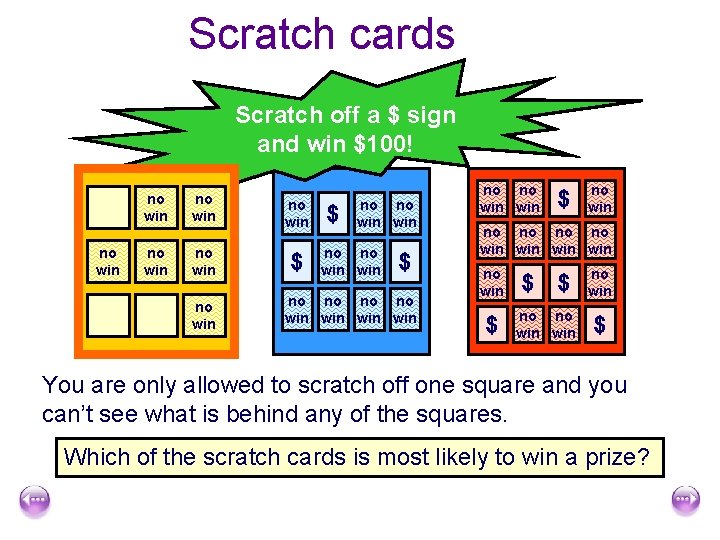
Scratch cards Scratch off a $ sign and win $100! £ no win no win £ no win $ $ no no win win no no win $ no win no no win win no win $ $ no win $ no no win $ You are only allowed to scratch off one square and you can’t see what is behind any of the squares. Which of the scratch cards is most likely to win a prize?
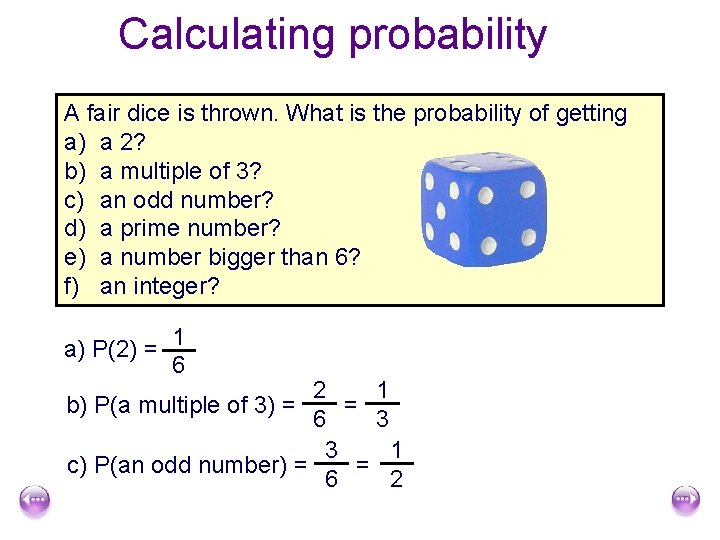
Calculating probability A fair dice is thrown. What is the probability of getting a) a 2? b) a multiple of 3? c) an odd number? d) a prime number? e) a number bigger than 6? f) an integer? a) P(2) = 1 6 2 1 = b) P(a multiple of 3) = 6 3 3 1 c) P(an odd number) = = 6 2
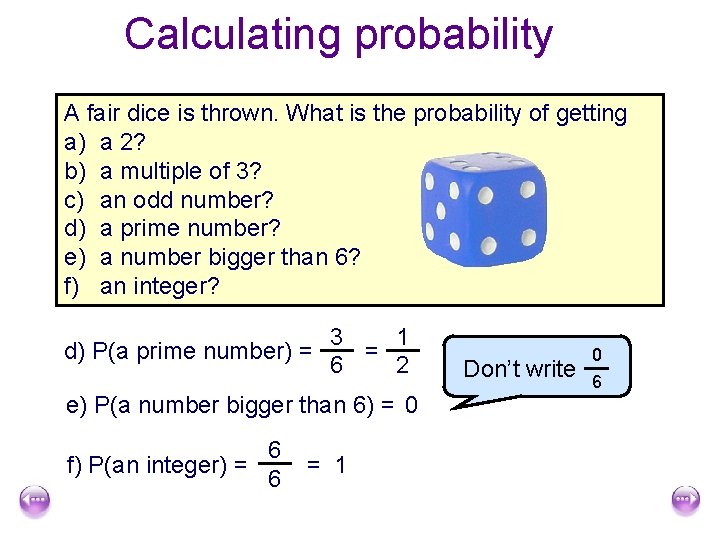
Calculating probability A fair dice is thrown. What is the probability of getting a) a 2? b) a multiple of 3? c) an odd number? d) a prime number? e) a number bigger than 6? f) an integer? d) P(a prime number) = 3 1 = 6 2 e) P(a number bigger than 6) = 0 6 f) P(an integer) = 6 = 1 Don’t write 0 6
Probability Exercise 8. 1 – Page 246
- Slides: 10